

FinOps case study
How Cloudaware helped a Fortune-scale insurer identify $7M+ in annual savings and cut reporting time from 5 days to real time.
1. About The Company
The Company is one of the largest life insurance companies in the United States, serving millions of customers across the country. As a long-standing and highly regulated institution, the company manages a massive and complex AWS infrastructure that supports critical financial operations. With a rapidly growing cloud footprint, the Company faced the challenge of maintaining granular visibility into cloud spend and ensuring strict financial accountability.
To satisfy both internal stakeholders and external auditors, the Company decided to mature its FinOps practice, focusing on precise cost allocation, budget predictability, and asset-linked billing visibility. The goal was to implement a robust FinOps framework that aligns cloud consumption with business value, all while operating within the rigorous compliance standards of the insurance industry.
2. Challenges
At the beginning of this journey, the Company found itself in the "Crawl" phase of the FinOps lifecycle. While cloud adoption was high, the maturity of financial management processes had not kept pace with technical scaling. The following key challenges were identified:
- Lack of Accountability and Ownership
- FinOps Principle: Everyone takes ownership for their technology usage
There was no clear decentralized ownership of cloud spend. Engineering teams viewed cloud costs as a "central IT problem" rather than an outcome of their architectural decisions, leading to a disconnect between resource provisioning and budgetary responsibility.
- Poor Cost Allocation and Tagging Hygiene
- FinOps Capability: Allocation
A significant portion of the AWS spend was "unallocated." Without standardized tagging enforcement or a way to map shared resources to specific insurance products, the Company could not achieve an accurate Chargeback/Showback model.
- Insufficient Reporting and Analytics
- FinOps Capability: Reporting & Analytics
The absence of a "single pane of glass" meant that financial stakeholders relied on fragmented, lagging reports. This lack of real-time visibility prevented the business from making data-driven decisions regarding cloud investments.
- Lack of Defined Unit Economics
- FinOps Capability: Unit Economics
The Company struggled to measure the business value of its cloud spend. There were no clear unit metrics (e.g., cost per insurance policy or cost per claim) to determine whether an increase in spend was driven by business growth or inefficiency.
- Absence of Internal Governance
- FinOps Capability: Governance, Policy & Risk
The lack of automated guardrails and financial governance meant that there was no consistent process for rightsizing resources or decommissioning idle assets, leading to continuous cloud waste.
- Underdeveloped FinOps Culture
- Capability: FinOps Education & Enablement
There was a total absence of a cross-functional FinOps culture. Finance, Procurement, and Engineering operated in silos, with no common language or shared goals regarding cloud value management.
3. Solutions
Establishing Ownership through Automated Inventory
To solve the lack of accountability, CloudAware integrated with the Company’s identity providers and AWS organizations to create a clear mapping of resources not only to specific owners but also to the applications they support. By automatically discovering every asset and associating it with the relevant teams and application stacks, the platform shifted the responsibility from a "central IT problem" to the engineers and application owners who provisioned the resources, ensuring full visibility into the cost of each business service.
Solving Allocation with CMDB-Driven Tagging and Real-Time Visibility
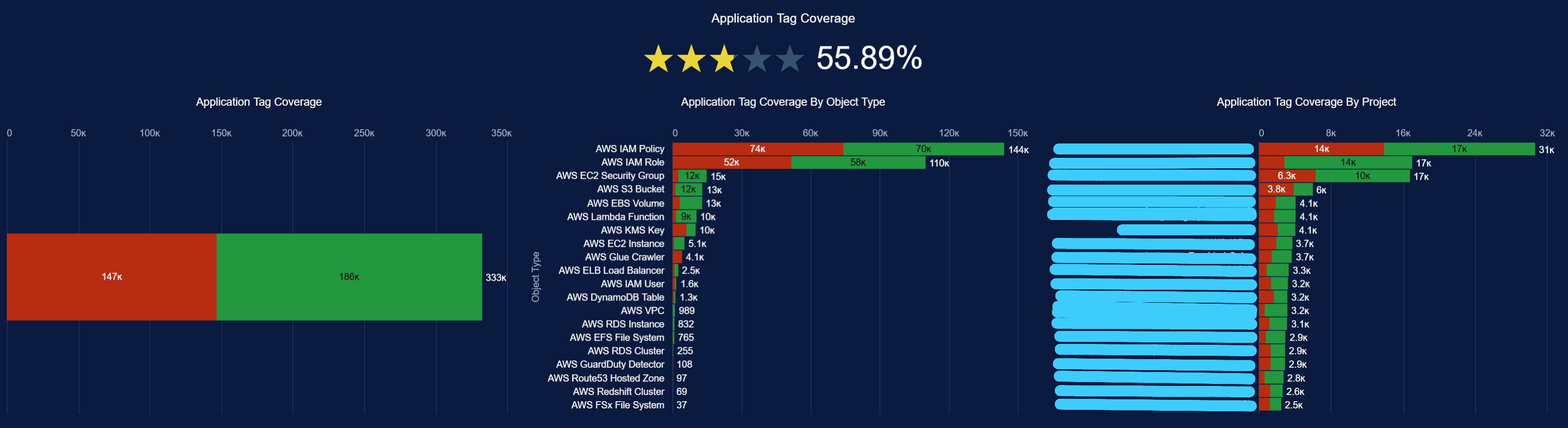
CloudAware addressed Poor Tagging Coverage by first performing a comprehensive analysis of the Company's entire existing inventory and its current tagging state. Leveraging these insights, the platform established a Tagging Coverage Dashboard, which provided real-time visibility into how coverage evolved over time. By combining this with the previously established ownership data, CloudAware granted application owners direct visibility into the specific tagging health of their own environments. This data-driven approach, coupled with an executive directive to improve compliance, empowered teams to systematically close the gaps. For resources that still lacked native AWS tags, the platform used its CMDB relationship mapping to programmatically allocate costs, ultimately achieving 98% accuracy for the Company's chargeback model.
Centralizing Visibility with Reporting and Analytics
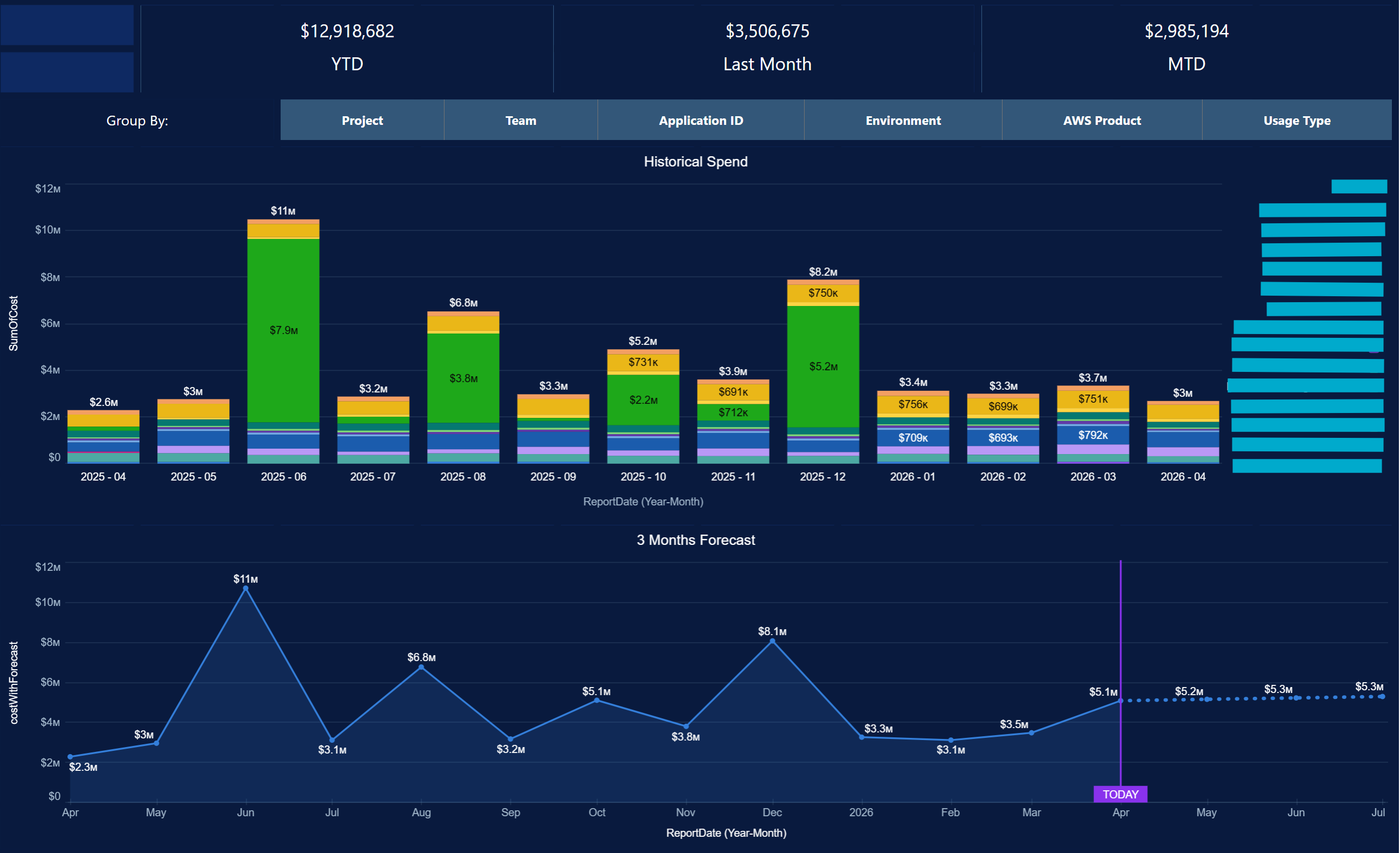
CloudAware addressed the lack of a "single pane of glass" by leveraging its advanced reporting capabilities to ingest and process the complete AWS billing info. By correlating this data with the previously mapped Applications and Owners, the platform delivered a granular breakdown based on existing. To ensure maximum depth of visibility, the data was provided in both monthly compressed and daily compressed formats, allowing stakeholders to toggle between high-level executive summaries and granular daily trend analysis. With data kept constantly up-to-date and minimal ingestion lag, the Company transitioned from relying on fragmented, historical reports to making proactive, data-driven decisions based on near real-time cloud investment insights.
Establishing Internal Governance and Human-Centric Remediation
To resolve the absence of internalgovernance, the Company leveraged CloudAware to architect a comprehensive Tagging Policy, establishing clear standards for mandatory tags and validated values. This framework was reinforced by automated control mechanisms, such as AWS Lambda functions, to monitor and enforce tagging integrity across the infrastructure in real-time.
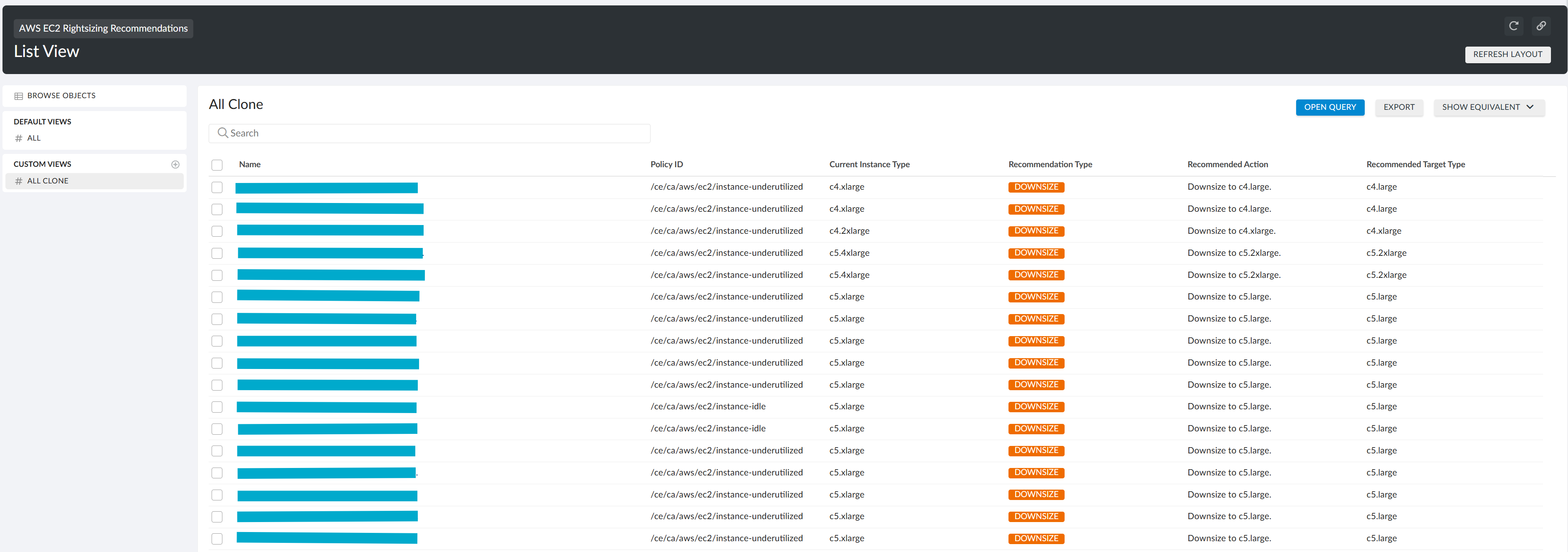
Additionally, the Company significantly improved its resource efficiency by leveraging the CloudAware Rightsizing Recommendations Engine to identify optimization opportunities. Since these optimizations impacted critical production environments, a specialized "human-in-the-loop" workflow was developed. Instead of using risky auto-remediation, CloudAware automatically generates detailed Jira tickets assigned to the respective Application Owners. This allows for a manual review of each recommendation, ensuring that cost-saving opportunities are aggressively identified without risking the operational stability of the Company’s core services.
Operationalizing Data-Driven Unit Economics
To address the lack of defined unit economics, CloudAware conducted collaborative brainstorming sessions with the Company’s teams to move beyond broad spending figures and identify metrics that reflect technical efficiency.
A primary outcome was the establishment of more granular, data-centric measures such as Cost per GB of customer data storage and Cost per TB of archived claims data. These specific metrics allowed the Company to clearly see how engineering decisions, such as choosing between different S3 storage classes or implementing data compression, directly influenced the cost of managing their massive data lake.
With CloudAware’s ability to store and visualize historical data, the Company can now track these efficiency measures over time, ensuring that as the volume of customer data grows, the unit cost remains optimized and predictable.
Fostering a Cross-Functional FinOps Culture through Education
To address the Underdeveloped FinOps Culture, CloudAware acted as both a FinOps analyst and evangelist, facilitating dedicated training sessions to bridge the gap between Finance, Procurement, and Engineering. These sessions were specifically tailored to each stakeholder group: providing engineers with direct visibility into how their architectural choices drive cloud spend, while equipping finance teams with the technical context needed to interpret complex AWS billing. By fostering a "common language" and demonstrating best practices for cost-conscious decision-making, CloudAware helped the Company transition from operational silos to a collaborative environment where every department shares accountability for cloud value.
4. Implementation
The implementation of CloudAware followed a structured 16-week roadmap, designed to transition the Company from a reactive "Crawl" state to a governed, proactive FinOps maturity level.
Phase 1: Discovery & Billing Data Ingestion (Weeks 1–4)
The initial month focused on establishing a foundation of absolute visibility across the Company’s massive cloud footprint.
- Assessment & Ingestion: CloudAware deployed API-based collectors to ingest historical and real-time billing data, including the AWS Cost and Usage Report (CUR).
- CMDB Enrichment: CloudAware enriched the underlying infrastructure data with customer-specific business attributes, specifically mapping every resource to its respective Application and Application Owner. By integrating this organizational metadata directly into the CMDB, the platform gained the ability to associate billing records with specific business services. This ensured that all cloud consumption—including ephemeral resources—was linked to a clear owner and application stack, providing the granular context required for precise financial traceability.
Phase 2: Financial Governance & Tagging Integrity (Weeks 5–8)
With visibility established, the focus shifted to cost allocation and ensuring every dollar spent had a clear "owner."
- Policy Alignment: CloudAware worked with the Finance and Engineering leadership to architect a Global Tagging Policy. This policy mandated specific keys such as
App ID,Cost Center, andBusiness Unit. - Automated Policy Enforcement: A custom FinOps compliance policy engine was configured to monitor the environment for tagging compliance. If a resource was launched without mandatory tags, CloudAware immediately flagged the violation for remediation.
Example: Automated Tagging Policy Logic
JavaScript
// Lifecycle configuration
CeTagUtils.taggigPolicyLifecycle(lifecycleBuilder)
    .updateField(CA10__CaPolicyViolation__c.CA10__awsInstanceId__c, 'instanceId');
// SOQL Query
SELECT Id, Name,CA10__instanceId__c, CA10__tagsJson__c, CA10__account__c, CA10__region__c, CA10__account__r.CA10__accountId__c
FROM CA10__CaAwsInstance__c
WHERE CA10__disappearanceTime__c = null
// Process
CeTagUtils.checkSObjectTags(obj.CA10__tagsJson__c, output, CeTagUtils.REQUIRED_TAGS_ECS);
       output.put('instanceId', obj.CA10__instanceId__c);
       output.put('awsAccount', obj.CA10__account__c);
       output.put('awsAccountId', obj.CA10__account__r.CA10__accountId__c );
       output.put('region', obj.CA10__region__c);
// Test Code
CA10__CaAwsAccount__c acc = new CA10__CaAwsAccount__c();
acc.Name = 'not-test';
acc.CA10__caUuid__c = '1';
insert acc;
CA10__CaAwsInstance__c i1 = newObject();
i1.CA10__account__c = acc.Id;
insert i1;
Phase 3: Operationalizing Optimization & Jira Integration (Weeks 9–12)
The third phase focused on Usage Optimization by turning analytical insights into tangible savings.
- Jira Workflow Integration: To bridge the gap between Finance and Engineering, CloudAware was integrated with the Company’s Jira instance to facilitate a "human-in-the-loop" remediation process.
- Smart Rightsizing: CloudAware’s rightsizing recommendation engine automatically generated Jira tickets for Application Owners whenever idle resources or over-provisioned instances were detected.
- Closed-Loop Tracking: Once an engineer resized a resource, the CMDB detected the change, updated the compliance status, and automatically resolved the associated Jira ticket with a timestamped cost-savings report.
Phase 4: Unit Economics & Cultural Enablement (Weeks 13–16)
The final phase focused on long-term sustainability and aligning cloud spend with business growth.
- Unit Economics Implementation: The team configured custom dashboards to track business-aligned metrics, specifically "Cost per GB of customer data storage." This allowed the Company to measure technical efficiency as their data lake continued to expand.
- FinOps Evangelism: CloudAware led a series of cross-functional "FinOps Training Session" workshops. These sessions trained engineers to use CloudAware for self-service cost monitoring and provided finance teams with the tools to build accurate Forecasting models.
- Operational Handoff: The system was successfully handed over to the internal Cloud Center of Excellence (CCoE), equipped with automated reporting cadences for executive leadership.
5. Results
To conclude the case study, we need to showcase the tangible business impact. This section highlights how the Company moved from a "Crawl" to a "Walk/Run" phase of FinOps maturity.
After implementation, Company saw measurable improvements in cloud visibility, compliance posture, and operational efficiency:
- Significant Growth in Cost Attribution: The Company successfully transitioned from a baseline of just 7% allocated spend to over 55% during the implementation period. By leveraging CMDB enrichment, the team is now able to map a majority of resources to specific Application IDs and Owners. Recognizing that achieving total attribution is an ongoing task, the Company continues to use CloudAware to refine its tagging hygiene, steadily moving toward a more mature and transparent Chargeback model.
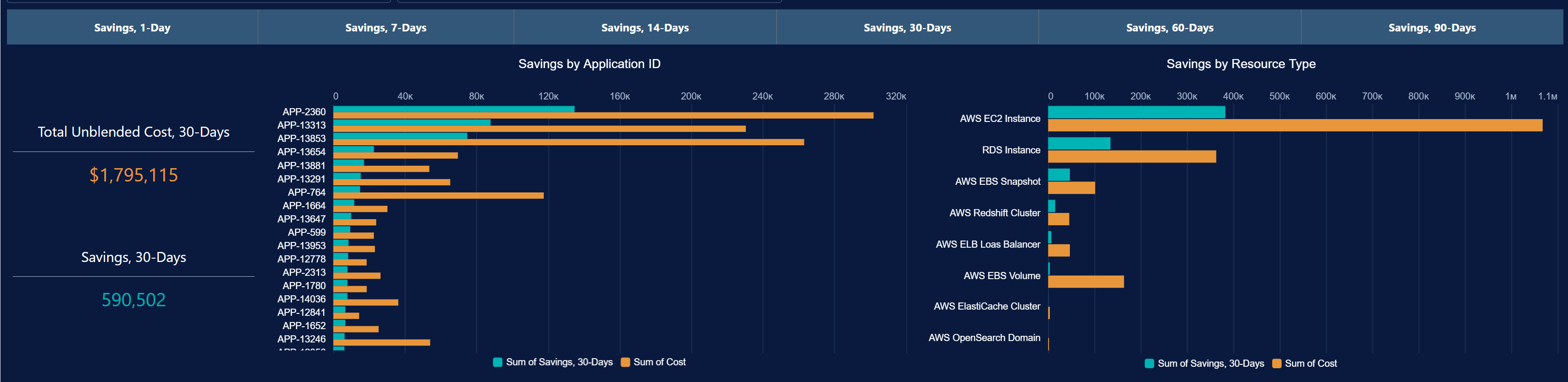
- Significant Reduction in Cloud Waste: Within the first three months, the Rightsizing Recommendations Engine identified over $7M in annualized savings opportunities. By operationalizing the Jira-based remediation workflow, the Company successfully reclaimed 15% of its monthly compute spend by decommissioning idle assets and downsizing over-provisioned instances.
- From "Lagging" to "Real-Time" Reporting: The time required to generate comprehensive financial reports for leadership was reduced from 5 business days to near real-time. Stakeholders now access a "Single Pane of Glass" with daily compressed data, eliminating the need for manual spreadsheet consolidation.
- Predictable Unit Economics: The Company successfully shifted from tracking "Total Spend" to tracking business value. The ability to monitor Cost per GB of customer data storage allowed the IT department to demonstrate that while total storage costs grew, the efficiency of the data lake improved by 12% year-over-year.
- Audit-Ready Infrastructure: With full historical traceability of resource ownership and configuration changes, the Company reduced the manual effort required for internal and external audits by 70%. Auditors now have access to timestamped logs of ownership and compliance status for every cloud asset.
- Cultural Transformation: The project successfully dismantled operational silos. Today, the Company operates with a unified FinOps culture where engineering teams proactively monitor their own "Application Dashboards," treating cloud cost as a key performance metric alongside uptime and security.
6. Conclusion: The Path Forward
The successful implementation of CloudAware marks a pivotal turning point for the Company’s cloud financial management. While the journey from the "Crawl" to the "Run" phase of FinOps is a long-term evolution that involves the continuous alignment of Finance, Engineering, and Procurement, these first steps have firmly established a foundation of transparency and accountability.
The Company has effectively moved beyond manual data gathering into a structured environment where cost is no longer an afterthought but a key architectural consideration. Having completed comprehensive training on the platform's core functionalities, the internal teams are now empowered to operate independently and continually, refining their tagging hygiene, optimizing workloads, and fostering a self-sustaining FinOps culture.
As the Company moves into the next phase of maturity, CloudAware will transition into a strategic advisory role. While the client manages day-to-day operations and ongoing culture improvements, CloudAware will remain a key partner, providing expert consultancy on advanced capabilities and helping the Company navigate the ever-evolving complexities of cloud unit economics and governance. This partnership ensures that while the first successful steps have been taken, the momentum for continuous cloud value optimization remains unstoppable.
Ready to control your multi-cloud budget with the same level of clarity? Schedule a demo to identify savings opportunities across AWS, Azure, and GCP.
Any questions? Contact sales