


Cloud costs don’t behave like traditional IT budgets. They move with usage, change with architecture, and keep growing through normal engineering work.
Since most teams can already see their numbers, visibility is not the problem. Their problem is that they still can’t explain what changed, who owns it, or whether the increase was expected. A team scales up a service to handle traffic, leaves the larger footprint in place, and Finance sees the effect when the month is almost closed.
Cloud spend slips when small technical decisions create costs faster than teams can review and correct them. This article shows how to turn that into an operating model that teams can actually run.
TL;DR
- Cloud is a live consumption environment, so finance in the cloud doesn't work like static infrastructure budgeting.
- Visibility alone doesn't solve much. Teams also need ownership, actionability, and governance.
- Budgets and anomaly detection solve different problems, so they shouldn’t be treated as the same control.
- Optimization is continuous operational work, not a one-time cleanup exercise.
- Engineering teams belong in the conversation because architecture, scaling, and provisioning decisions drive cloud costs.
- Cloud financial management sits inside a broader FinOps model, though it still needs its own explanation as an operating discipline.
What is cloud financial management?
Cloud financial management (CFM) is the discipline of understanding how cloud usage turns into spend, assigning ownership for that spend, and making better decisions before waste becomes normal. It goes beyond tracking invoices or watching monthly bills and includes visibility, accountability, budgeting, forecasting, governance, and continuous efficiency work.
In practice, cloud financial management connects usage, cost, and ownership in a way that teams can use. It helps organizations understand what they are running, who owns it, how much it costs, and whether that cost makes sense for the workload.
In a healthy program, CFM shows up in weekly review loops, owner-based budgets, anomaly triage, and recurring cleanup of waste that comes back through normal usage.
Why cloud financial management exists
Cloud changed the shape of spend. Costs stopped coming from a few planned purchases and started showing up through everyday engineering decisions: a larger instance, more storage, extra traffic, another containerized service, another shared platform bill.
Most teams tried to solve that with dashboards, tagging, and month-end reviews. That helped, but only up to a point. The dashboard showed the bill, not what changed. Tags were incomplete. Reviews happened after the money was already spent. Shared costs still turned into debates.
That is why cloud financial management matters. It gives teams a way to work on cloud spend continuously instead of explaining it after the month-end.
Cloud financial management vs cloud cost management vs cloud spend management vs FinOps
If you sit in any FinOps review long enough, these terms start getting used interchangeably. Someone says “we need better cost management,” another means optimization, and a third is actually talking about governance and ownership.
Here is how these concepts actually differ in practice:
Cloud cost management usually covers the basics: cost visibility, budgets, alerts, and reporting. It helps teams see what they spent and when they crossed a threshold, but it doesn't always explain why it happened or what to do next.
Cloud cost optimization is the action layer. Rightsizing compute, adjusting commitments, cleaning up idle resources, moving storage to cheaper tiers, or fixing inefficient traffic patterns.
Cloud financial management is the umbrella model. It brings planning, allocation, governance, optimization, and accountability into one system, so teams can manage spend deliberately instead of reacting to it.
Cloud spend management is the more day-to-day version of that idea. Teams use it when they start treating spend as something to control continuously, not just report on. In reality, it often overlaps with cost management, but with a more operational focus.
FinOps is the framework that helps teams run this across engineering, finance, and business.
| Term | What it usually means | Main focus |
|---|---|---|
| Cloud cost management | Reporting, budgets, alerts, and visibility | Seeing and tracking cost |
| Cloud cost optimization | Rightsizing, commitments, storage, and waste reduction | Improving efficiency |
| Cloud financial management | Planning, governance, allocation, optimization, and accountability | Running spend as an operating model |
| Cloud spend management | Day-to-day operational control of spend | Managing spending behavior |
| FinOps | Cross-functional practice for making cloud cost decisions at scale | Aligning finance, engineering, and business |
Four key areas of cloud financial management
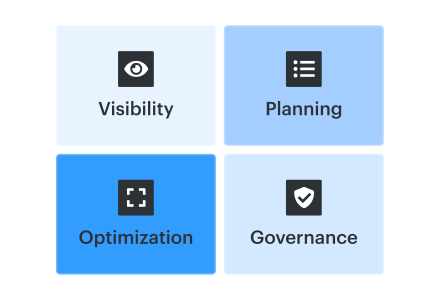
Cloud financial management works best when 4 things stay connected: visibility, planning, optimization, and governance.
When one gets weak, the others start covering for it. Teams lean on budgets when allocation is weak, push optimization harder when ownership is unclear, or add governance when visibility arrives too late. That is usually when cost control starts getting noisy and brittle.
Cost visibility and allocation
Before teams can improve spend, they need to know where it goes and who owns it. That sounds obvious, but this is where a lot of programs break first.
A central platform team may run Kubernetes, observability, and shared networking for 12 product teams. The bill is visible, but until those costs are allocated by namespace, cluster usage, or agreed business logic, nobody can tell which team is actually expensive.
Cost visibility stops helping much once allocation is missing, because teams still need a way to review, explain, and improve the bill.
Budgeting and forecasting
Teams should not wait for “maturity” before setting budgets. They are one of the first controls that change behavior. A budget gives a team a boundary. While forecasting shows whether the current run rate, planned changes, or shared-cost shifts are about to push them through it.
Optimization and efficiency
Optimization is where teams turn cost review into action. Sometimes that means easy cleanup: idle resources, oversized instances, stale storage. Sometimes it means harder fixes, like over-requested Kubernetes resources or commitments that no longer match usage.
Teams try to keep cost aligned with real workload behavior instead of carrying oversized or misconfigured resources for months.
Governance and accountability
Without governance, cost management becomes passive observation. Teams can see the problem, talk about the problem, and still do nothing about it.
CFM needs rules, ownership, thresholds, and response paths to hold up. Good governance makes follow-up, escalation, and action part of normal operations.
Cloud financial management framework
Once those 4 areas are clear, the next question is how to make them repeatable.
That is what a cloud financial management framework is for. Without one, each function handles its piece in isolation. Finance builds reports. Engineering reacts when a bill looks wrong. Platform teams write standards and hope someone follows them.
A working framework turns that into one operating model, so the pillars stop drifting into separate projects. Without that structure, teams usually handle each one separately: Finance builds reports, engineering reacts to bills, and platform teams try to enforce standards after the fact.
A working framework connects those efforts into one operating model for cloud financial management and gives CFM a rhythm teams can keep.
Core principles behind a cloud financial management framework
The principles are not complicated, but they change day-to-day work in useful ways.
- Visibility needs context. Otherwise, Finance sees totals, but not drivers, and engineering gets asked to explain a number with no path back to workload, owner, or change.
- Ownership needs to follow spend. Otherwise, shared costs turn into debates instead of decisions.
- Actionability matters more than noise. Otherwise, alerts pile up in Slack or email, and nobody knows which ones require a response.
- Optimization has to be continuous. Otherwise, teams clean up once, declare victory, and recreate the same waste a month later.
- Accountability has to be shared. Otherwise, Finance ends up reporting, engineering keeps creating cost, and platform teams sit in the middle trying to translate.
How teams operationalize CFM across engineering and finance
Cloud financial management only works when the people creating spend and the people reviewing it work from the same model. That usually looks like this:
| Function | What they own in CFM |
|---|---|
| Finance | Budgeting, forecasting, variance analysis, and cost reporting. Focuses on predictability and financial control. |
| Engineering | Architecture decisions, resource usage, scaling behavior, and workload design. Directly influences how costs are created. |
| Platform/Cloud teams | Guardrails such as tagging standards, allocation logic, policies, and automation. Keeps the system consistent and enforceable. |
Cloud spend visibility and cost intelligence
Cost visibility and allocation answer one question: who owns the spend?
Cost intelligence answers the next one: what changed, why, and does it matter.
Seeing the bill helps, but knowing what moved and whether it was expected is what makes cloud financial management operational. Totals can show that cloud spend increased, but they can't tell you if it came from a planned release, a scaling decision, shared infrastructure growth, or silent inefficiency.
Why cloud spend is hard to track accurately
Cloud spending is messy by design. Resources appear and disappear quickly, shared services blur ownership, storage and data transfer grow quietly, and usage shifts across environments and workloads.
Teams can stay within budget and still run unhealthy patterns underneath. In practice, cost rarely spikes because of one obvious mistake. It grows through small, normal changes that nobody revisits: a slightly oversized instance, a feature rollout with conservative scaling, or storage that never gets cleaned up.
What cost intelligence adds beyond raw billing data
Cost intelligence connects spend to behavior. It shows which team, service, environment, or change created a pattern, and whether that pattern is expected.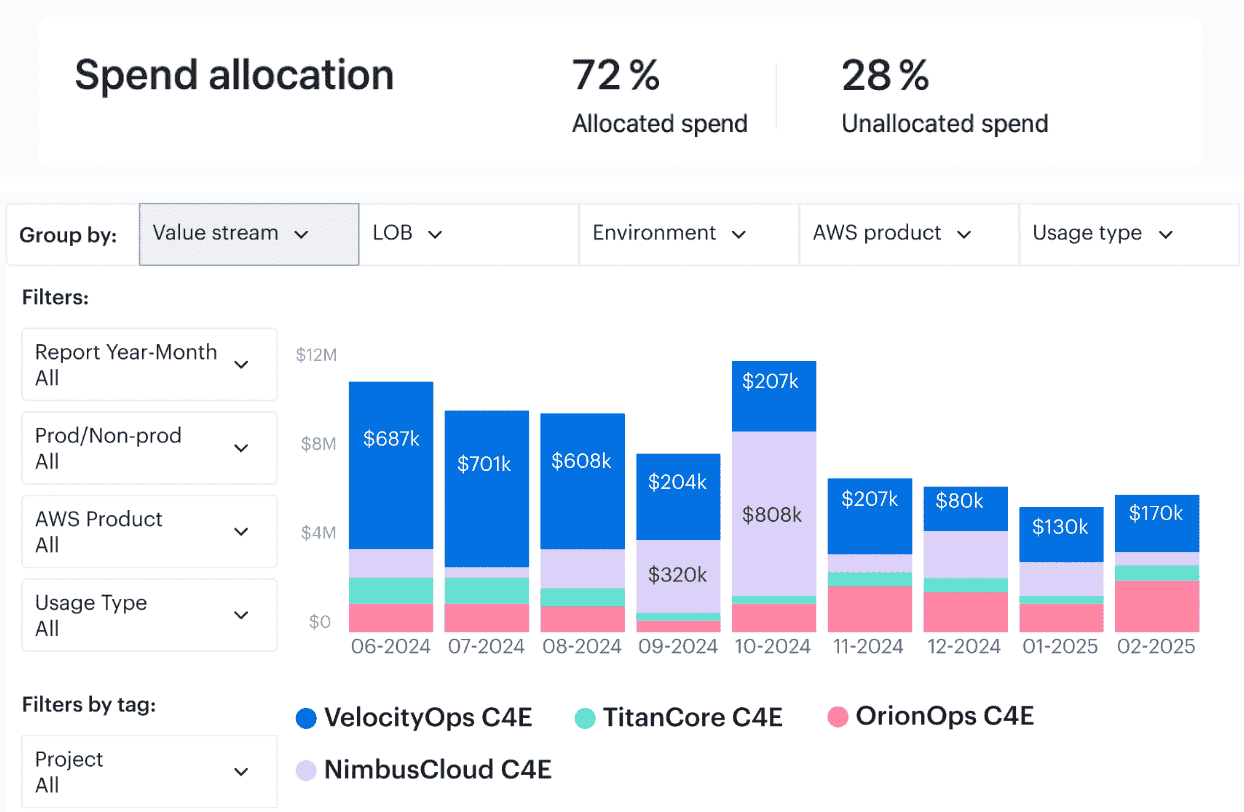 The most useful distinction here is between threshold monitoring and anomaly detection, because they answer different questions.
For example, a planned region launch that increases transfer and storage is a healthy anomaly. No release, but a sudden x2 increase in compute for one service is not. One is expected growth. The other needs investigation.
Read also: 7 Cloud Cost Allocation Strategies from FinOps Experts
Budgeting and forecasting in cloud financial management
A reliable cloud budget is tied to a scope someone actually owns: an app, team, environment, account, or Kubernetes namespace. That is what turns budgeting from reporting into control.
A payments-prod budget, for example, can alert at 80% actuals, but it can also flag a likely breach if the current run rate says the team will cross the line before the month closes.
Building a reliable cloud budget
A useful budget needs more than a number. It should map to real usage patterns, service categories, and accountable teams, so when spend moves, somebody knows whether it is expected and who should respond. Otherwise, the budget becomes a reporting artifact instead of a control.
That is also why budgets work well as an early discipline. They create boundaries before teams build mature forecasting or optimization habits, and they force a simple question early: who owns this number?
Forecasting challenges in dynamic environments
Forecasting gets harder because cloud cost models change underneath you. Some changes are gradual, like seasonality or traffic growth. Others are event-driven: a product launch, a migration, a commitment purchase, a one-time cleanup, or even a team reorg that changes how shared costs are allocated.
That is why good forecasts usually combine 2 inputs:
1️⃣ Baseline forecast uses historical trends to show what is already in motion
2️⃣ Driver-based forecast layers in known events that will change the curve
Both matter because cloud forecasts don't break only when usage changes. They also break when ownership, architecture, or allocation logic changes with it.
Read also: Cloud Cost Forecasting. How to Build a Reliable Cloud Budget?
Optimization as a continuous process
Cloud efficiency is not something teams achieve once and then keep forever. It slips because the environment keeps changing underneath it.
Why optimization is not a one-time activity
Waste comes back through normal usage. A team rightsizes compute in March, then launches a feature in April and scales it conservatively. A project ends, but its storage stays behind. Non-production environments meant for office hours run all week. Nobody plans that waste. It accumulates.
It helps to separate quick wins from deeper efficiency problems:
| Type | What it looks like | Why it matters |
|---|---|---|
| Easy waste | Unattached volumes, idle load balancers, stopped projects that still generate storage cost, dev environments left running | Visible, fast to fix, and usually the first layer teams clean up |
| Structural inefficiency | Over-requested Kubernetes CPU and memory, low RI/SP coverage, the wrong storage tier, or architecture choices that trade convenience for recurring cost | Harder to spot, slower to fix, and much more expensive over time |
That is also the real shift: from one-time cleanup to optimization embedded into delivery. Mature FinOps teams don't just remove waste when it becomes obvious. They keep reviewing the same efficiency patterns because usage, architecture, and demand keep drifting..
Trade-offs between performance, reliability, and cost
Good optimization is not about cutting everything to the cheapest state. A smaller instance may save money but hurt latency. More redundancy may increase cost but protect critical services. Commitments improve efficiency, but only when usage is stable enough to support them.
Read also: Cloud Cost Optimization. The Complete 2026 FinOps Guide
Governance and accountability in cloud financial management
Cloud cost control breaks down fast when nobody owns the number, and nobody has to act on it.
Defining ownership for cloud cost
Ownership has to map to something real: a team, application, environment, platform, or business service. Otherwise, cost stays visible but ungoverned. A shared Kubernetes cluster, for example, may be technically one platform, but financially it still needs to be split by workload, namespace, or product line if teams are expected to manage their part of the spend.
That is why accountability starts with allocation. If a cost can't be attributed, it can't be reviewed, challenged, or improved. Good cloud spend management starts when a team can look at a cost line and say, “Yes, this is ours, and we know why it moved.”
Policies, guardrails, and financial controls
Ownership only works when teams also have boundaries and response rules. Otherwise, governance turns into a slide deck.
In practice, the control loop should be simple. A budget breach notifies the owner. A material anomaly gets triaged within a defined window, often the same day or within 24 hours. Repeated idle resources move toward automated cleanup or an approval workflow. Commitment reviews happen on a monthly or quarterly cadence because they affect longer-term cost posture rather than daily noise.
AWS cloud financial management vs Azure cloud financial management
For a FinOps team, the real difference between AWS and Azure is not the billing engine. It is where financial control starts getting blurry. In both clouds, the confusion usually comes from the same place: technical structure and financial ownership stop lining up cleanly.
AWS cloud financial management approach
In AWS, financial management usually gets messy when architecture scales faster than allocation discipline. More accounts, shared services, EKS, serverless workloads, and rising transfer costs make ownership harder to keep clean, even when billing visibility is already there.
What cloud financial management AWS teams need at that stage is a tighter operating model for attribution, budgets, and response. Once shared platforms start growing faster than the ownership model around them, visibility alone stops helping much.
The same pressure shows up across the AWS cloud financial management key areas. Visibility, planning, optimization, and governance still matter most, but they become harder to run when ownership is weak.
CFM works better when teams establish allocation and ownership early, because that is what keeps the four key areas of cloud financial management, AWS environments, usable at scale.
Read also: 6 Ways to (not) Fail AWS Cloud Cost Optimization in 2026
Azure cloud financial management considerations
In Azure, the failure mode often shows up earlier in the hierarchy. Management groups, subscriptions, and resource groups help with governance, though they don’t automatically give teams a cost model that maps cleanly to product or business ownership.
Azure teams often need centralized financial views sooner than they expect, especially when billing scopes and operating structure don’t line up neatly.
Read also: Azure Cloud Cost Optimization from FinOps Pros
| What changes in practice | AWS | Azure |
|---|---|---|
| Visibility problem | Multi-account sprawl, dynamic services, shared infrastructure | Cross-subscription and cross-tenant fragmentation |
| Allocation challenge | Tags break in shared, containerized, or serverless environments | Hierarchy supports governance but not always cost attribution |
| Early control layer | Budgets, anomaly detection, ownership routing | Centralized views, budgets, policy-backed controls |
| Common FinOps failure | Optimizing without ownership | Reporting is split across billing and organizational layers |
Common challenges in cloud financial management
Usage changes, ownership gets blurred, and financial review usually happens more slowly than an engineering change. Add multiple accounts, subscriptions, environments, and services, and even a disciplined FinOps team can end up with spend that is visible but still hard to govern.
That is why the most common problems tend to repeat across organizations:
- Weak allocation. Costs sit in shared buckets, tags are inconsistent, and nobody can tell which workload or team actually drove the spend.
- Unclear ownership. A number appears in the report, but nobody knows who is supposed to review it, defend it, or reduce it.
- Overprovisioning. Instances stay oversized, storage keeps growing, and non-production environments run longer than they should because nobody revisits old assumptions.
- Alert fatigue. Budgets, anomalies, and reporting all generate signals, but too many of them arrive without enough context to make a response easy.
- Fragmented reporting. Different clouds, accounts, subscriptions, and shared services produce separate views, so teams spend more time reconciling data than improving it.
- Reactive review cycles. By the time Finance asks what happened, the month is already closed, and the team is explaining spend instead of controlling it.
- False confidence from partial allocation. Teams see that 70% or 80% of spend is mapped and assume visibility is good enough, while the most volatile or politically sensitive costs are still sitting unallocated.
- Optimization without change management. Teams find waste, clean it up once, and then recreate it because nobody updates defaults, provisioning rules, or platform guardrails.
- Forecast drift after org changes. Reorgs, ownership changes, and new cost-sharing logic can make historical trends look cleaner than they really are, which weakens forecasting right when teams need it most.
What effective cloud financial management looks like
Effective cloud financial management shows up in day-to-day behavior, not in dashboards. Teams stop treating cost as a monthly report and start treating it as part of how they run infrastructure. Just as important, mature teams stop reacting to every increase. They focus on unexplained change, weak ownership, and persistent inefficiency.
Here is what that looks like in practice:
| Area | What mature teams do differently | What they avoid |
|---|---|---|
| Cost visibility | Explain variance in plain language (release impact, scaling, traffic, infra changes) | Looking only at monthly totals without understanding drivers |
| Ownership | Map spend to teams, apps, or services before month-end | Debating shared costs after the fact |
| Budgets | Use budgets as early signals with clear response thresholds | Treat budgets as reporting artifacts |
| Anomaly management | Separate anomalies from overspend and investigate unusual patterns early | Assuming “within budget” means healthy |
| Optimization | Continuously review idle, oversized, and misaligned resources as part of operations | One-time cleanup without changing behavior |
| Governance | Define clear ownership, review loops, and guardrails that enable fast action | Adding controls that slow teams down without improving response |
Read also: FinOps Maturity Model. 7 Expert Moves You Can Steal
Best practices for building a cloud financial management strategy
Control of cloud spend usually breaks when cost management doesn’t keep up with how fast the environment changes. New services get deployed, shared platforms grow, ownership shifts, and financial controls lag.
If you want cloud financial management to hold up under real load, the model has to match how teams actually operate: fast changes, shared infrastructure, and constant drift. The practices below come from that reality, not from a checklist.
Proven practices that hold up in real environments:
- Start with visibility you can trust: different billing scopes, delayed exports, or mismatched dimensions across clouds create small gaps that compound into slow decisions.
- Fix allocation before chasing savings: in shared environments like Kubernetes or platform services, even obvious waste can sit unresolved because attribution was never defined.
- Set budgets before the data is perfect: early budgets work because they force ownership and create response points, even if the underlying data still has gaps.
- Don’t rely on tags alone: teams that rely only on tags eventually rebuild allocation using usage signals or business logic on top.
- Build a weekly review loop: issues get noticed only after budgets are breached, or Finance raises a question. A weekly loop works because it catches changes early enough to still be reversible.
- Define escalation before increasing alerts: more signals do not help if nobody knows who responds, how fast, or what happens next.
Read also: 13 Cloud Cost Optimization Best Practices to Use in 2026
How Cloudaware empowers cloud financial management
If your team is already doing allocation reviews, budget checks, anomaly triage, and waste cleanup manually, the problem is no longer knowing the process. It is scaling it without burning time on reconciliation.
That is where Cloudaware becomes useful operationally. It automates the ugly parts, so cloud finance doesn't depend on perfect provider data or manual cleanup.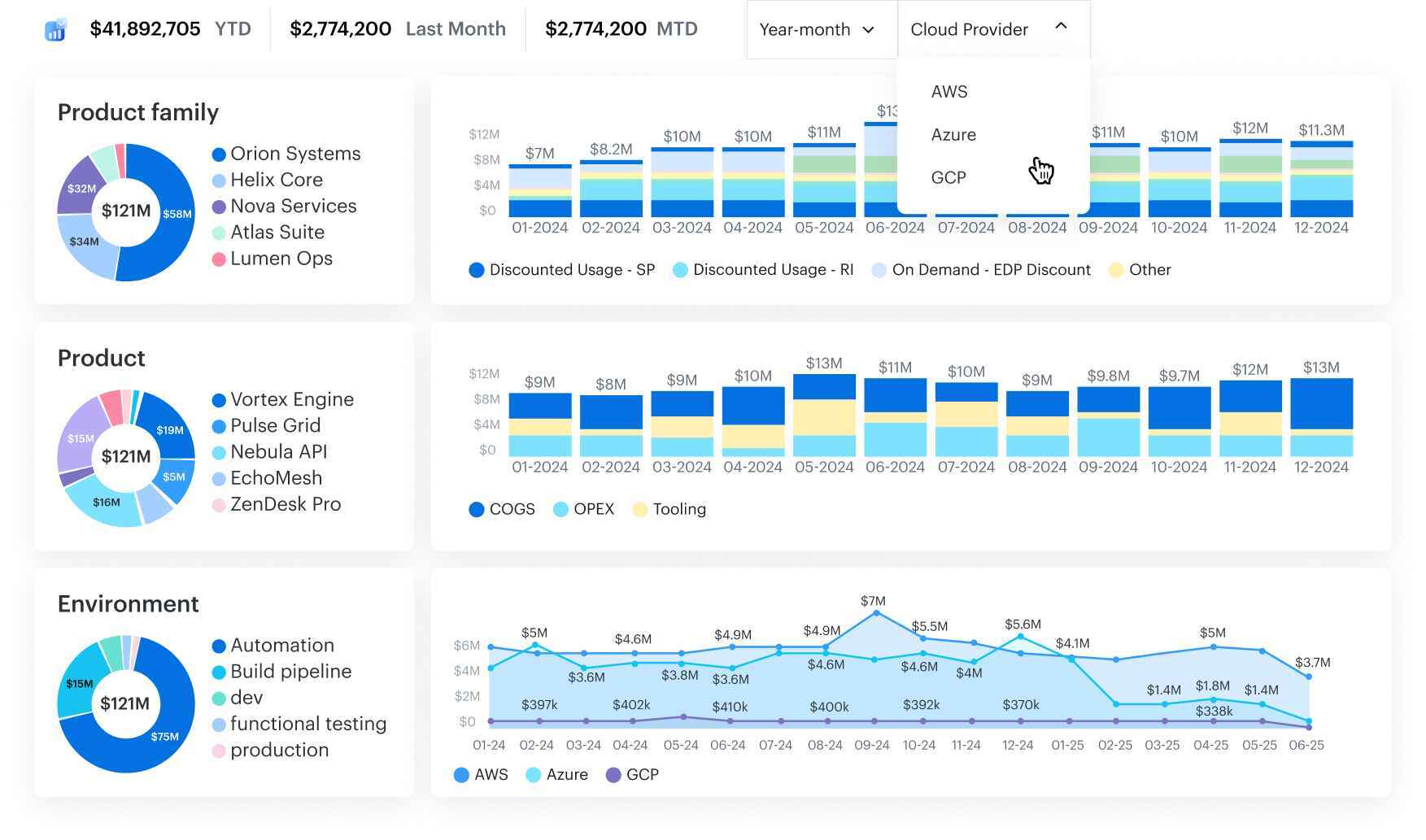 Cloudaware helps automate the parts of cloud financial management that usually turn into manual work:
- Multi-cloud billing and usage ingestion collects near-real-time cost and usage data across AWS, Azure, GCP, Oracle, and Kubernetes.
- Tag normalization and CMDB mapping turn inconsistent provider data into cleaner, report-ready cost context tied to apps, teams, and services.
- Cost allocation and shared-cost allocation distribute direct and shared spend using tags, CMDB context, and custom business logic.
- Showback-ready reporting gives app owners and stakeholders cleaner dashboards and chargeback-ready views.
- Forecasting and budget planning support spend forecasting, budget planning, and commitment analysis across major cloud providers.
- Waste detection and anomaly detection flags idle resources, billing spikes, unusual usage increases, and cost drift.