


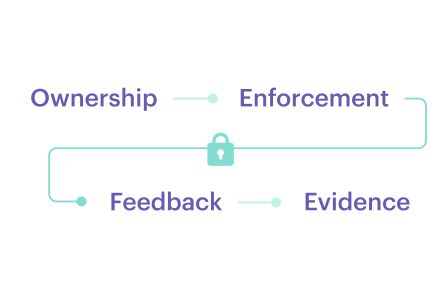
Most DevSecOps programs do not fail because a scanner missed a vulnerability. They fail twenty minutes before production, when a finding appears and nobody can answer three operational questions with confidence: Does it block the release? Who owns the risk? What evidence is needed to move forward?
The tools ran. The pipeline produced data. A decision still has to be negotiated in Slack.
That is the implementation gap.
DevSecOps implementation means turning security requirements into repeatable controls across planning, code, build, test, deployment, and runtime. Each control needs an owner, a defined outcome, an exception path, and evidence that the decision occurred.
This guide walks through that work in six steps. It includes a stage-by-stage control matrix, a 90-day rollout plan, policy examples, and the metrics that reveal when an implementation is creating security theatre instead of safer releases.
NIST’s Secure Software Development Framework offers the right foundation here. It is designed to integrate secure practices into existing SDLC models, reduce vulnerabilities in released software, and address root causes so the same weakness does not keep returning.
What DevSecOps implementation actually means
DevSecOps implementation is the process of embedding security work into the systems teams already use to plan, build, release, and operate software.
A working implementation has five visible properties:
| Property | What it looks like in practice |
|---|---|
| Known scope | Every production service maps to a repository, pipeline, runtime environment, criticality tier, and accountable owner. |
| Defined rules | Teams know which conditions block a merge or deployment and which create a remediation ticket. |
| Automated enforcement | Deterministic rules run inside the delivery path rather than arriving as a report after it. |
| Controlled exceptions | Every exception has an approver, reason, compensating control, and expiry date. |
| Runtime feedback | Production exposure, drift, incidents, and new vulnerabilities change future delivery rules. |
A collection of SAST, SCA, IaC, container, and cloud-security tools is not yet DevSecOps. Those tools become an implementation when their outputs consistently affect delivery and risk decisions.
The DoD continuous authorization guide uses similar building blocks: automated guardrails, control gates, agreed risk tolerances, production feedback, dashboards, and evidence collected during delivery.
Usually, pipelines move artifacts forward reliably while security findings arrive alongside the flow rather than inside it. This forces engineers to interpret results manually and decide what to do under time pressure, often with incomplete context and inconsistent outcomes from one release to the next.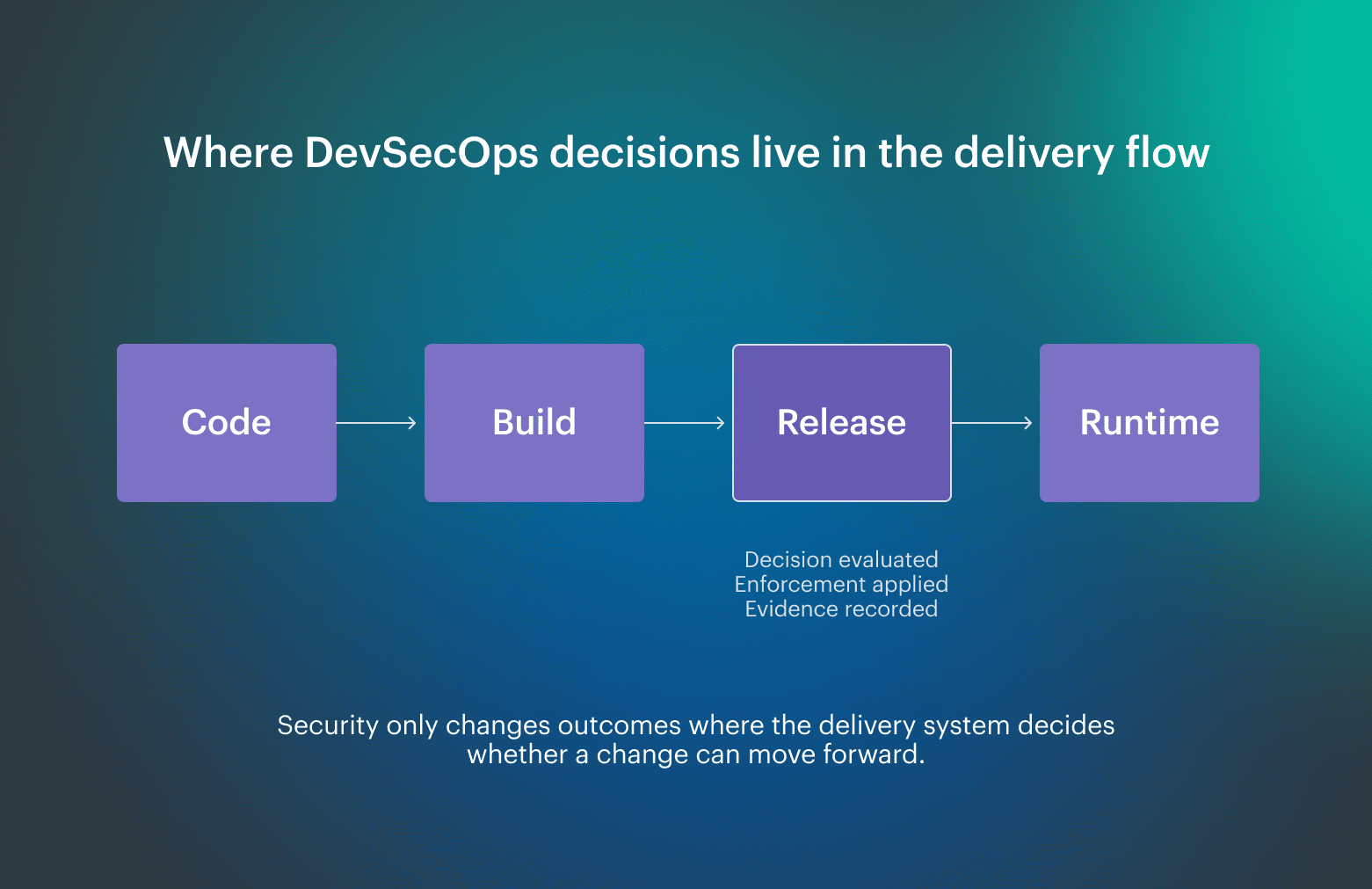 This way, security checks stop acting as suggestions and start acting as controls, which reduces last-minute debates and makes release behavior predictable instead of negotiable.
At a practical level, this means the delivery system knows where decisions are enforced, who owns remediation when something fails, and how runtime behavior feeds back into future rules.
Read also: Inside the DevSecOps Lifecycle - Decisions, Gates, and Evidence
Why DevSecOps implementation fails in practice
Failure shows up at release time, not during design. The pipeline ran, the tools reported what they saw, and the system still cannot apply a decision on its own, which pushes teams into manual judgment calls right when time pressure is highest.
A common pattern is that security controls are added faster than ownership and enforcement are defined, so findings accumulate while responsibility stays vague, and teams quietly create exceptions to keep shipping.
Another recurring issue is that runtime signals never make it back into delivery rules, so the same misconfigurations reappear across releases even after incidents or audit findings. Teams fix symptoms in production, but the pipeline never learns, so the cost shows up again at the next promotion.
When these gaps exist, the pipeline can report risk but can’t act on it, which is why delivery ends up negotiating decisions manually under pressure.
Сore principles behind a successful DevSecOps implementation
A successful DevSecOps implementation survives real delivery pressure because it treats security as part of the decision flow, not as an overlay of checks, which gives a consistent way to ship without renegotiating risk on every release.
Automated security decisions at promotion time
The first principle is automated decision-making, where risk thresholds are defined upfront and evaluated by the delivery system itself at promotion points, so releases behave consistently regardless of timing, urgency, or who is on call.
This model aligns with continuous authorization practices used in regulated environments, including guidance from the U.S. Department of Defense, where more security decisions become automatable, enforceable, and auditable over time.
Explicit ownership for risk and remediation
The second principle is explicit ownership, because controls without owners decay quickly as exceptions accumulate and accountability fades. When ownership is clearly assigned, failed checks result in updated rules or remediation paths rather than temporary workarounds that quietly become permanent.
Continuous evidence instead of after-the-fact audits
The third principle is continuous evidence, where every decision is recorded as part of normal delivery, allowing audits to validate how the system operates in real time instead of forcing teams to reconstruct intent months later.
Together, these principles make DevSecOps implementation predictable, auditable, and scalable.
DevSecOps implementation architecture (from pipeline to runtime)
DevSecOps implementation architecture becomes relevant the moment teams realize that most security failures are not caused by missing checks, but by broken connections between build, release, and runtime, where decisions are made in one place and consequences surface somewhere else.
Usually, the pipeline evaluates changes in isolation, which creates a gap where approved intent and actual behavior slowly diverge without triggering enforcement.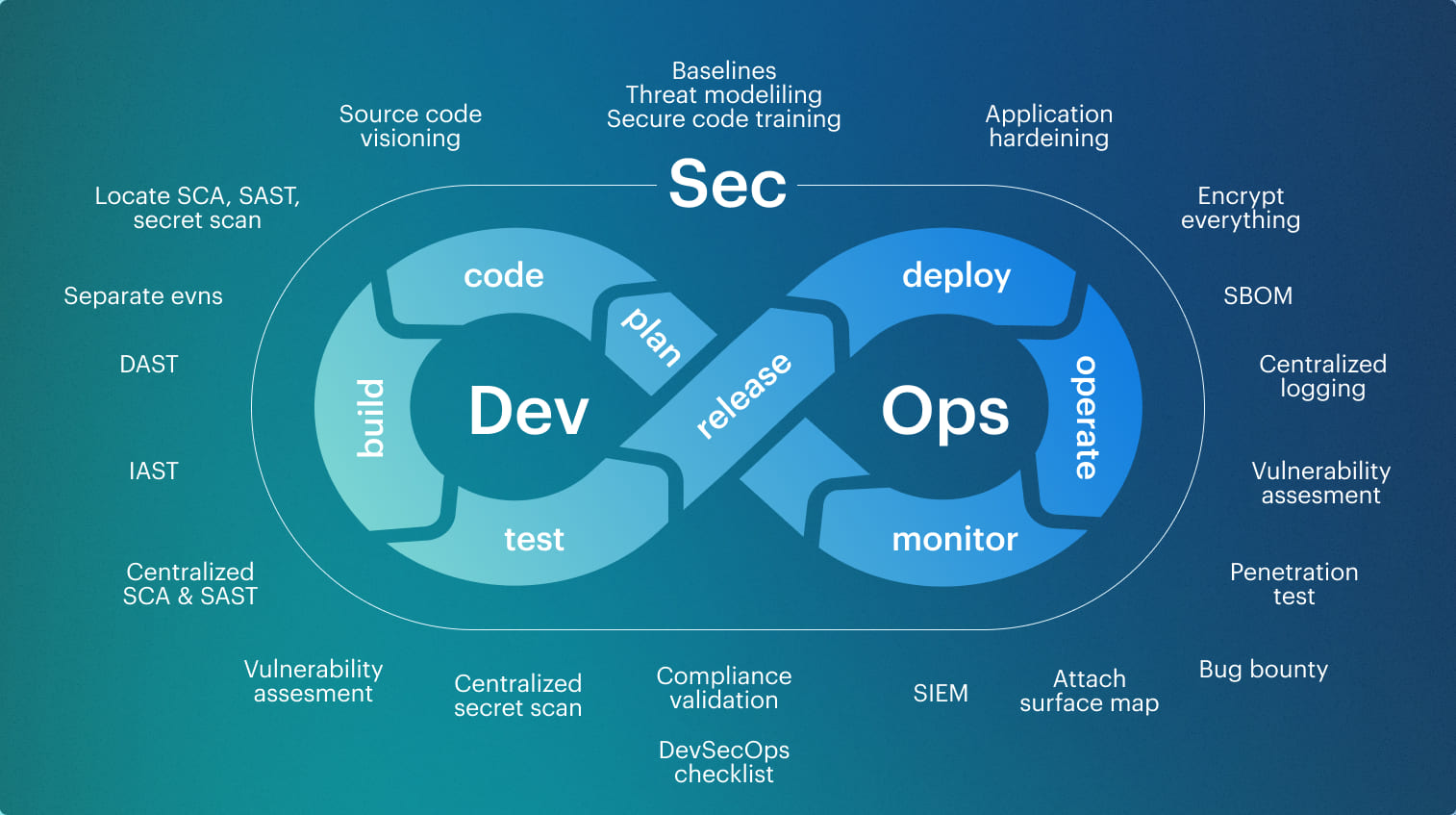 This is what DevSecOps often looks like in practice: comprehensive coverage, constant scanning, and very little clarity about which signals actually block a release.
A resilient DevSecOps implementation architecture closes that gap by treating the pipeline and runtime as a single decision system, where promotion events, environment changes, and configuration updates all pass through shared control points that apply the same risk thresholds and record outcomes as evidence.
Pipeline enforcement tied to promotion
Build and release stages enforce defined risk thresholds at promotion points, so artifacts move forward only when conditions are met, and decisions are applied automatically instead of escalated.
Runtime feedback connected to delivery rules
Runtime signals such as drift, exposure, or incident patterns feed back into pipeline rules, which allows the system to learn from production instead of repeating the same failures.
When this gap exists:
- Approved intent drifts silently
- Enforcement weakens over time
- Audits surface surprises instead of assurance
Continuous evidence across stages
Every decision is logged at the moment it happens, which means audits validate live system behavior rather than reconstructed history.
Read also: DevSecOps Architecture (A Practical Reference Model Teams Actually Use)
How to implement DevSecOps in 6 steps
Implementing DevSecOps across every repository at once usually creates a noisy program with weak enforcement. Start with one service that matters, then prove the operating model under real release pressure.
Step 1. Map one service from commit to production
Choose a production service with an active delivery team, regular releases, and enough business importance to make the pilot meaningful.
Document its path:
Repository → build pipeline → artifact registry → deployment workflow → cloud resources → runtime dependencies
Then attach the operating context:
- application and infrastructure owners;
- production risk approver;
- internet exposure;
- data sensitivity;
- compliance scope;
- business criticality;
- current security checks;
- existing exceptions.
A generic inventory is not enough. The map must let the team trace a security finding to the service, environment, pipeline, and person expected to act.
Pilot output: one service map with named owners and a documented release path.
Step 2. Define risk boundaries before adding gates
Severity labels alone make poor release policy.
A critical vulnerability in a dormant development dependency is not equivalent to a critical vulnerability on a reachable path in an internet-facing production service. The gate needs context.
Start with a short policy set:
| Condition | Pipeline action |
|---|---|
| Verified secret added in the current commit | Block merge |
| Critical reachable vulnerability in an internet-facing production workload | Block promotion |
| Unsigned or unapproved artifact | Block deployment |
| Prohibited public exposure in production IaC | Block deployment |
| High-severity vulnerability with no known exploit path | Create ticket and apply SLA |
| Medium-severity issue in a non-production environment | Record and monitor |
Keep the first blocking set narrow. Five well-tuned rules beat forty rules that developers learn to bypass.
Pilot output: risk tiers, blocking criteria, remediation SLAs, and the people authorized to approve an exception.
Step 3. Place each control where it can make a reliable decision
Do not run every tool at every stage. Put the control close to the change it can evaluate accurately.
DevSecOps control matrix
| SDLC stage | Useful controls | Example blocking rule | Evidence to retain |
|---|---|---|---|
| Plan | Threat modelling, data classification, compliance scoping | No high-risk service proceeds without an owner and threat model | Approved requirements, owner, risk tier |
| Code and pull request | Secret scanning, SAST on changed code, peer review | Verified credential or prohibited code pattern in the change | Commit, finding, review result |
| Build | SCA, SBOM generation, artifact signing, container scanning | Critical reachable dependency or unsigned artifact | SBOM, scan result, signature |
| Test | DAST, API testing, IaC validation, security regression tests | Exploitable critical finding in a production candidate | Test result, environment, build ID |
| Deploy | Policy as code, approved-artifact verification, configuration policy | Deployment differs from the approved artifact or violates production policy | Policy evaluation, deployment record |
| Operate | Exposure monitoring, configuration drift, vulnerability and incident signals | Runtime risk exceeds the agreed tolerance | Asset state, change history, alert, owner action |
Octopus’ strong SERP performance is partly explained by this stage-by-stage completeness. Its article explicitly walks from planning and coding through build, test, deployment, and runtime.
Pilot output: a control-to-stage matrix with one owner and one expected action per control.
Step 4. Build the exception path before the first gate blocks
A gate without an exception process eventually produces one of two results: hidden bypasses or emergency policy changes.
Require these fields for every exception:
- affected service and environment;
- failed policy;
- risk owner;
- business reason;
- compensating control;
- remediation task;
- expiry date;
- approval record.
Permanent waivers should not exist. When a risk remains acceptable, the team can reassess and issue a new decision with current context.
Track two numbers from day one:
Exception rate = releases using an exception / total releases

Overdue exception rate = expired unresolved exceptions / total active exceptions
A rising exception rate usually means the rule is too broad, the remediation path is too slow, or ownership is unclear. Do not celebrate the gate for blocking more releases. Fix the operating problem it exposed.
Pilot output: an exception workflow that cannot be completed without an owner and expiry.
Step 5. Feed production evidence back into delivery
Shift-left controls, see intended change. Production shows what actually happened.
A build may pass with no critical vulnerabilities and then become risky after deployment because:
- a security group is changed;
- an asset becomes internet-facing;
- a new vulnerability affects an existing component;
- a configuration drifts from the approved baseline;
- an incident reveals that the threat model missed a path.
Each significant runtime finding should trigger one of three outcomes:
- the existing delivery rule worked, but remediation was slow;
- the rule existed and was bypassed;
- no rule covered the failure class.
The third case matters most. Add or tune a control so the next similar change is caught earlier.
The DoD cATO guide explicitly calls for production feedback, continuous validation, agreed control-gate tolerances, and cyber-operations findings that improve the ongoing security posture.
Pilot output: a documented route from runtime finding to backlog item, policy change, or control improvement.
Step 6. Retain evidence and scale only after the pilot stabilizes
Every release decision should produce evidence automatically:
- which policy ran;
- what asset or artifact it evaluated;
- which rule passed or failed;
- what version of the policy was active;
- who approved an exception;
- when the exception expires;
- what eventually closed the finding.
Then review the pilot.
Expansion makes sense when:
- owners receive findings without manual routing;
- blocking rules produce few emergency overrides;
- exceptions expire or close on time;
- repeat findings are declining;
- teams can reconstruct a release decision without screenshots or Slack history.
Only then should the same baseline move to the next service group.
Pilot output: evidence retention, baseline metrics, and a go or no-go decision for wider adoption.
A 90-day DevSecOps implementation plan
A 90-day plan is long enough to test real releases and short enough to stop a pilot from becoming a transformation programme with no finish line.
| Period | Work | Deliverables | Exit criteria |
|---|---|---|---|
| Days 1-30: map and baseline | Select one service, map assets and delivery flow, assign owners, classify risk, record existing controls and exceptions | Service map, RACI, risk tiers, baseline metrics | The team can trace a production asset to its repository, pipeline, owner, and risk tier |
| Days 31-60: enforce and observe | Add two to five blocking rules, create the exception workflow, retain gate evidence, measure false positives and delays | Policy set, pipeline gates, exception register, evidence records | Rules behave consistently across several real releases |
| Days 61-90: connect runtime and tune | Feed drift, exposure, vulnerabilities, and incidents back into policy; tune thresholds; prepare the next service group | Feedback workflow, revised policies, pilot review, expansion plan | Repeat failures decline and emergency bypasses stay low |
What not to attempt in the first 90 days
- Do not onboard every repository.
- Avoid blocking every high-severity scanner result.
- Skip a platform replacement unless the pilot proves the current delivery system cannot support the required controls.
- Resist building a custom executive dashboard before the underlying asset, owner, policy, and evidence data is trustworthy.
- CMU SEI recommends the same practical direction: start with a pilot, keep the plan small, pursue real risk incrementally, and avoid overwhelming the system.
Read also: How to Build a Secure DevSecOps Toolchain Without Alert Fatigue
Step-by-step DevSecOps implementation roadmap
Most DevSecOps rollouts break because teams try to do everything at once, so controls spread across the pipeline before anyone agrees which ones actually matter. You end up with checks everywhere and decisions nowhere, which means every release turns into a discussion.
The roadmap below exists to prevent that by locking down one decision at a time, starting with ownership and blocking rules, then expanding only after the system behaves predictably under real release pressure.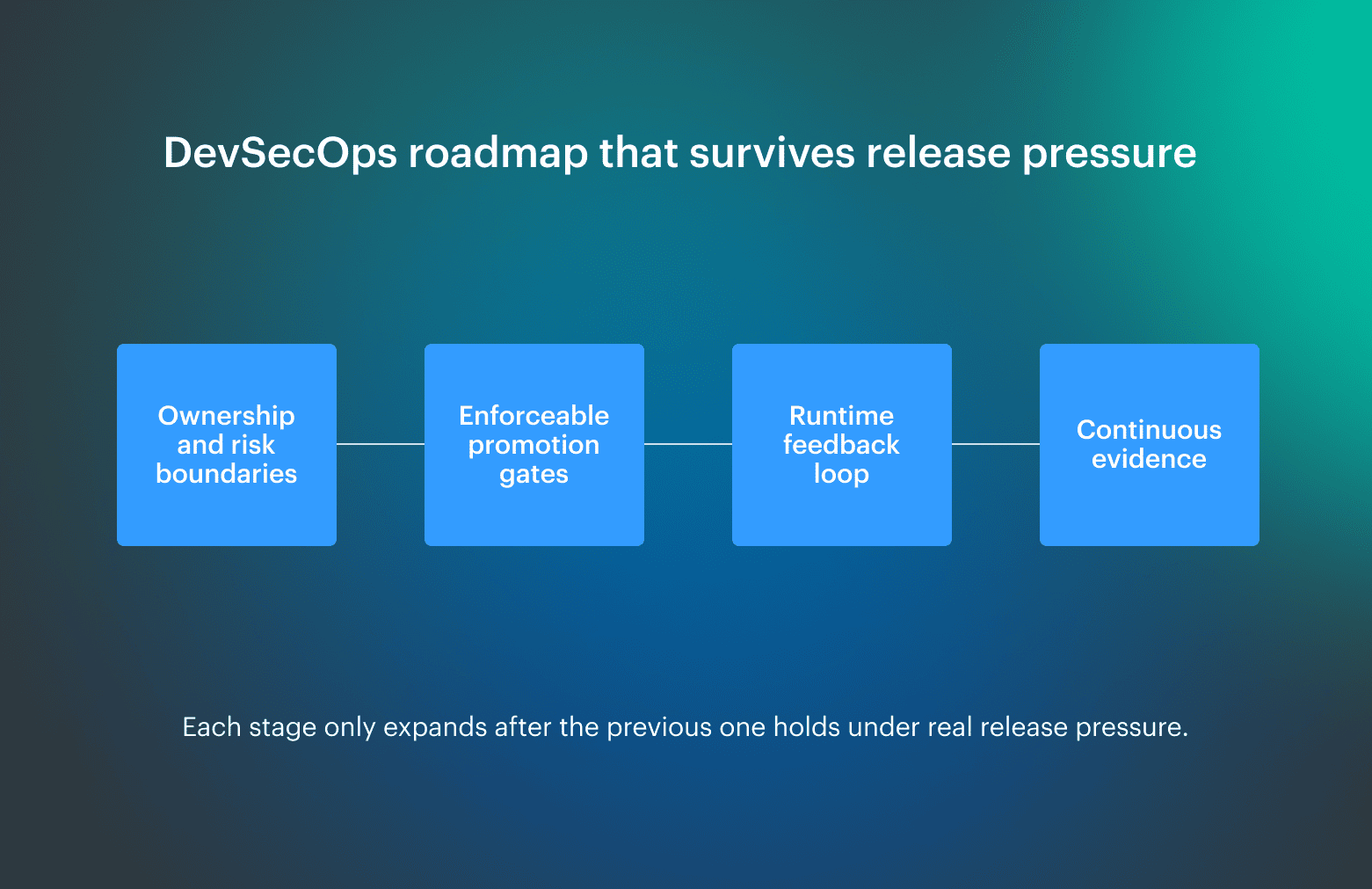
Step 1. Define ownership and risk boundaries
Start by assigning explicit risk ownership per service or workload, because without a named owner, every failed gate turns into a Slack discussion instead of an enforced decision. Teams also need to agree on what is production-blocking versus acceptable risk, so promotion gates reflect real tolerance rather than informal precedent.
Step 2. Instrument the pipeline with enforceable controls
Next, attach controls to concrete promotion gates in CI and CD, where some checks hard-block progression, and others emit signals for triage. Mature teams are deliberate about this split because treating every finding as blocking quickly leads to bypasses, waivers, and broken trust in the pipeline.
Step 3. Integrate runtime security feedback
Runtime signals such as configuration drift, exposed services, and incident patterns must feed back into pipeline policy; the same classes of issues reappear release after release. Fixing production symptoms without updating delivery rules leaves the system blind to its own failures.
Step 4. Establish continuous evidence for audits
Finally, decisions and gate outcomes are logged as evidence at execution time, which keeps the system audit-ready without turning audits into manual evidence collection. This reflects continuous authorization practices, where approval is an ongoing state rather than a periodic event.
Read also: 15 DevSecOps Tools - Software Features & Pricing Review
DevSecOps implementation checklist
Scope and ownership
- A pilot service has been selected.
- Its repository, pipeline, artifacts, cloud assets, and runtime dependencies are mapped.
- Application, infrastructure, remediation, and risk-approval owners are named.
- The service has a documented criticality and data classification.
Policy and delivery controls
- Blocking conditions are written before tools are configured.
- Each control runs at the earliest stage where it can make a reliable decision.
- Severity is combined with reachability, exposure, environment, and service criticality.
- The pipeline records the policy version and result for every evaluated release.
Exceptions
- Every exception has an owner, reason, compensating control, and expiry.
- Expired exceptions cannot remain silently active.
- Exception and false-positive rates are reviewed after each pilot phase.
Runtime feedback
- Production drift and exposure map back to the affected service.
- Incidents and repeat findings trigger policy or control reviews.
- New rules are tested against historical findings before they become blocking.
Measurement and scaling
- Baseline delivery and security metrics were captured before enforcement.
- Repeat findings and overdue exceptions are trending down.
- The pilot has completed several normal and high-pressure releases.
- Expansion is based on pilot evidence, not a fixed organization-wide deadline.
DevSecOps audit checklist and requirements
A working implementation retains policy evaluations, artifact and asset identifiers, approval records, exceptions, configuration changes, and remediation history as part of normal delivery. Teams preparing for continuous compliance or formal control assessment will need a broader audit model covering traceability, control effectiveness, and evidence retention.
See the dedicated DevSecOps compliance and audit requirements guide for that workflow.
How to implement AI in DevSecOps safely
Among teams that are using AI in DevSecOps today, the pattern that holds up best is using it to reduce cognitive load without letting it become a decision authority, because the fastest way to lose trust in a delivery system is when a model quietly starts influencing what ships. That’s why guidance like the NIST AI Risk Management Framework keeps coming back to explainability, governance, and drift, especially when AI output affects operational flow.
What’s working in practice is applying AI to assessment rather than approval. Teams use it to cluster findings, correlate signals across tools, or summarize evidence that already exists, while keeping release decisions deterministic. This is broadly consistent with how regulated environments approach automation under U.S. DOD authorization guidance, where assessment can scale, but approval remains rule-based and auditable.
The most troubles come when AI is placed directly in the enforcement path without clear boundaries. Models hallucinate, inherit bias, and drift as inputs change, which lines up closely with failure modes described in the OWASP Top 10 for LLM Applications and echoed repeatedly in practitioner discussions. Once a pipeline blocks “because the model said so,” trust drops and bypasses usually follow.
Read also: DevSecOps Framework in 2026 - How to Choose the Right One
Metrics that show whether DevSecOps implementation is working
Tool activity is not an outcome. Ten thousand scans can coexist with weak release control.
Track a small set of metrics that expose delivery impact, security learning, and governance quality.
| Metric | Calculation | What it reveals |
|---|---|---|
| Mean time to patch | Time from vulnerability identification to production patch | Whether urgent risk moves through the system quickly |
| Security escape rate | Production security failures that should have been detected earlier / total security failures | Whether controls sit at the right stages |
| Repeat finding rate | Findings with a previously observed root cause / total findings | Whether runtime lessons alter delivery rules |
| Exception rate | Releases using an exception / total releases | Whether gates are usable under real delivery pressure |
| Overdue exception rate | Expired unresolved exceptions / active exceptions | Whether temporary risk decisions quietly become permanent |
| Gate false-positive rate | Incorrect blocks / all blocked promotions | Whether teams can trust enforcement |
| Evidence latency | Decision time to evidence availability | Whether audit evidence is produced continuously |
| Change fail rate | Deployments requiring immediate intervention / total deployments | Whether added controls preserve delivery stability |
| Failed deployment recovery time | Time to recover from a failed deployment | How quickly the delivery system returns to normal |
The DoD guide includes mean time to patch, control-gate trends, feedback frequency, test results, and security posture against risk tolerances.
DORA’s current model uses five software-delivery metrics, including change lead time, deployment frequency, failed deployment recovery time, change fail rate, and deployment rework rate. Its research also cautions against turning one metric into a universal target or comparing unlike services.
Measure these per service or service group. An organization-wide average can hide one critical system behind fifty low-risk workloads.
How Cloudaware supports DevSecOps implementation
Cloudaware is most useful after security data leaves an individual scanner and needs production context.
Consider a container image that passed its pipeline checks. Two days after deployment, a cloud configuration change makes the workload publicly reachable. The image did not change, so rerunning the original build scan does not explain the new risk.
Cloudaware connects that runtime state to:
- the production asset;
- its cloud account and environment;
- related resources and dependencies;
- the mapped asset owner;
- vulnerability and exposure data;
- the policy that failed;
- configuration-change history;
- the remediation or exception workflow.
The resulting decision can be expressed in operational terms:
| Field | Example |
|---|---|
| Service | checkout-api |
| Environment | Production |
| Owner | Payments Platform |
| Runtime change | Administrative port became publicly reachable |
| Policy | Public administrative access prohibited |
| Decision | Remediate immediately |
| Evidence | Security-group change, affected asset, policy result |
| Feedback | Add a pre-deployment IaC rule for the same exposure pattern |
That closes the loop the pipeline cannot close by itself. A runtime finding becomes an owned remediation task, retained evidence, and a better control for the next release.
Cloudaware does not replace the CI/CD, SAST, SCA, container, ticketing, or incident-response tools already in use. It provides the asset relationships, ownership context, policy state, and history needed to make their findings actionable across cloud environments.