


Updated July 2026 | Expert reviewed by Valentin Kel, Cloudaware expert | Methodology: Cloudaware customer operating patterns, NIST SSDF, OWASP DevSecOps Guideline
You’re here because your pipeline works… until security shows up, and suddenly, nobody can answer one question: who owns what? You’ve got engineers shipping through CI/CD, a platform team building the paved road, and a security function that can’t be the human approval gate forever. So you’re trying to turn “shared responsibility” into real security ownership, with guardrails that don’t slow development.
We’ve seen this play out across teams running Cloudaware’s DevSecOps approach, from centralized platform groups to embedded security partners. The org charts only work when the handoffs are explicit, and the automation is baked in.
- Which DevSecOps roles actually belong in the loop, and which ones just need visibility?
- Where does policy as code live, and who maintains it?
- What does escalation look like when a release fails?
- How do you structure the platform-security relationship so it scales past one team?
Key takeaways on DevSecOps roles
DevSecOps roles and responsibilities define who owns secure delivery decisions: developers fix the change, platform teams automate safe paths, AppSec sets risk rules, GRC defines evidence, release managers enforce gates, and leadership accepts business risk when a release ships with exceptions.
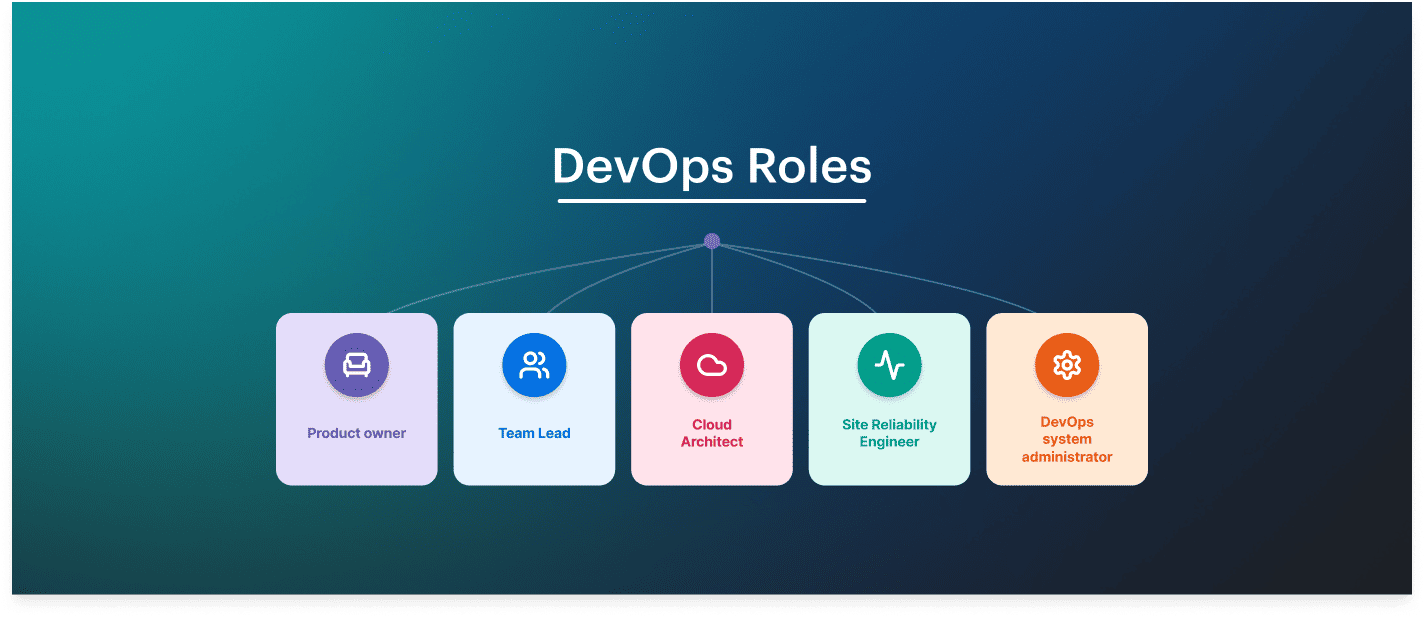
- DevSecOps roles and responsibilities only work when every check, exception, and fix has a clear owner. “Everyone owns security” turns into nobody owning it, and releases start stalling in Slack.
- Embedded champions fit fast-moving squads. Central enablement works when shared controls and governance matter. A platform team with built-in security wins when you can invest in paved roads. Whatever you pick, you need visibility into assets + changes, or it becomes opinion-driven management.
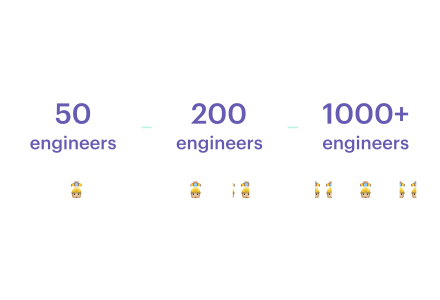
- At ~50 engineers, you can run on a champion + part-time AppSec + SRE-owned gates. Around 200, inconsistency shows up, and shared pipelines plus enablement become necessary. At 1000+, you split responsibilities across platform security, cloud security, GRC, and SOC so you don’t create a single bottleneck.
- If a control needs humans to collect evidence, it dies under load. Put checks in CI/CD, make exceptions time-boxed, and emit audit-ready proof automatically so development keeps moving.
- Engineers fix what they introduce through the standard release path. Security engineers keep rules consistent, tune noise, and decide what blocks vs. warns so teams don’t learn to bypass gates.
DevSecOps roles and responsibilities matrix
The fastest way to break DevSecOps is to make security “everyone’s job” and stop there. Everyone agrees. Nobody owns the failed gate. Nobody knows who can accept the risk. Nobody can prove what happened during the release.
A working DevSecOps team structure gives every recurring security decision a home. Not a meeting. Not a Slack thread. A home.
Use the matrix below as the operating map. If a scanner fails, a release exception expires, or an auditor asks for evidence, the owner should be obvious before anyone opens a ticket.
| Role | Owns | Does not own | Proof/output |
|---|---|---|---|
| Product engineering squad | The change: application code, service config, IaC changes, dependency updates, and remediation work. | The security standard, global gate logic, or enterprise exception policy. | PR fixes, linked owner, risk context, remediation ticket, change record. |
| DevSecOps / platform engineer | Golden pipelines, secure templates, scanner integrations, policy-as-code checks, secrets handling, and deploy guardrails. | Business risk acceptance or final audit interpretation. | Reusable pipeline controls, pass/fail logic, normalized scanner output, control evidence. |
| AppSec / security engineer | Threat modeling guidance, severity rules, secure design patterns, tuning noisy checks, and defining what blocks release. | Running every product team’s pipeline or manually approving routine releases. | Risk rules, secure coding patterns, exception criteria, validated findings. |
| SRE / DevOps | Reliability of the delivery path: environments, deployment safety, rollback, runtime baselines, and operational handoffs. | Security ownership for every finding created by the product. | Deployment record, rollback readiness, runtime alerts, operational runbook. |
| GRC / compliance | Control mapping, evidence requirements, audit trail, exception lifecycle, expiry rules, and framework alignment. | Fixing vulnerabilities or deciding whether the business should ship with risk. | Control-to-system mapping, evidence record, exception register, audit-ready report. |
| Release manager | Release calendar, cut lines, go/no-go rules, approval trail, and making sure exceptions cannot bypass the release path. | Changing severity policy or accepting business risk alone. | Release note, gate result, approval record, exception enforcement. |
| Product / engineering leadership | Priority calls and risk acceptance when a team needs to ship with known exposure. | Pretending the risk disappeared because the release was urgent. | Risk acceptance decision, SLA, compensating control, named accountable owner. |
Notice the pattern: engineers own the change, platform owns the paved road, AppSec owns the definition of “safe,” GRC owns the proof, release owns the path, and leadership owns the trade-off when the answer is not clean.
That is the difference between a DevSecOps org chart and a DevSecOps operating model. The chart tells people where they sit. The model tells them what to do when a release is blocked at 5:40 p.m.
DevSecOps responsibilities: team vs engineer
DevSecOps responsibilities sit at two levels. The team owns the repeatable system: standards, gates, exception rules, evidence, and escalation. The DevSecOps engineer owns the implementation path: pipeline templates, policy-as-code, scanner integrations, and feedback loops that developers can actually use.
That split matters. When the team owns everything, delivery waits on security. When engineers own everything, risk decisions happen inside pull requests. The healthier model keeps risk decisions explicit and makes the safe path faster than the workaround.
DevSecOps team structure
There is no single “best” DevSecOps team structure. The right model depends on how many engineers you have, how often you ship, and how much regulatory pressure sits on the business.
A 20-person SaaS team does not need the same setup as a multi-product enterprise with formal audit scope. What matters is simpler than most org charts make it look: clear ownership, fast security feedback, and standard delivery paths teams will actually use.
The pattern that usually works is this: keep security expertise centralized enough to stay consistent, but push day-to-day secure delivery into the teams that ship code. If security becomes a separate approval queue, delivery slows down. If security is fully decentralized with no standards, teams drift.
A practical DevSecOps team structure by company stage
| Company stage | What the team usually looks like | What works best |
|---|---|---|
| Early stage | Developers own delivery, one DevOps/platform lead, part-time security support | Use shared CI/CD templates, basic IaC guardrails, and simple vulnerability triage rules. Avoid hiring for five separate security roles too early. |
| Growing SaaS | Platform engineering, AppSec or security engineering, product squads, one or two security champions | Split ownership clearly: platform builds the paved road, AppSec defines standards, squads fix what they ship. |
| Regulated scale-up | Platform team, AppSec, cloud security, GRC/compliance, product engineering | Add control mapping, exception handling, and automated evidence capture. This is where structure starts to matter a lot. |
| Enterprise | Central security functions plus embedded champions across business units and product lines | Run a hub-and-spoke model. Central teams own standards and shared controls. Delivery teams own adoption and remediation. |
Who owns what in a healthy DevSecOps structure
In strong teams, responsibilities are split by function, not blurred into one “security person does everything” job.
- Platform engineering builds the delivery path: CI/CD templates, reusable infrastructure patterns, secrets handling, rollout controls, and logging baselines.
- AppSec or security engineering defines security requirements: threat modeling guidance, policy rules, scanner tuning, and what blocks a release versus what gets fixed later.
- Developers and product teams own the code, the infrastructure they change, and the fixes for issues they introduce.
- GRC or compliance maps controls, tracks evidence, manages exceptions, and makes sure audit proof does not depend on manual screenshot hunts.
- Security champions help each squad catch issues early and keep feedback loops short.
That split sounds obvious. In practice, it is where many teams break. If AppSec owns standards and tooling and triage and remediation, it becomes a bottleneck. If developers are told they “own security” without paved roads, they inherit chaos instead of ownership.
The team model most companies grow into
Most mature DevSecOps programs end up with a hub-and-spoke structure.
The hub is the central enablement layer. It usually includes platform engineering, AppSec, and compliance stakeholders. This group creates the shared standards, templates, integrations, and evidence model.
The spokes are the product and engineering teams. They use those standards in day-to-day delivery, own fixes, and escalate exceptions when the standard path does not fit.
That gives you consistency without turning every deployment into a ticket.
Simple DevSecOps structure diagram
You can visualize the model like this:
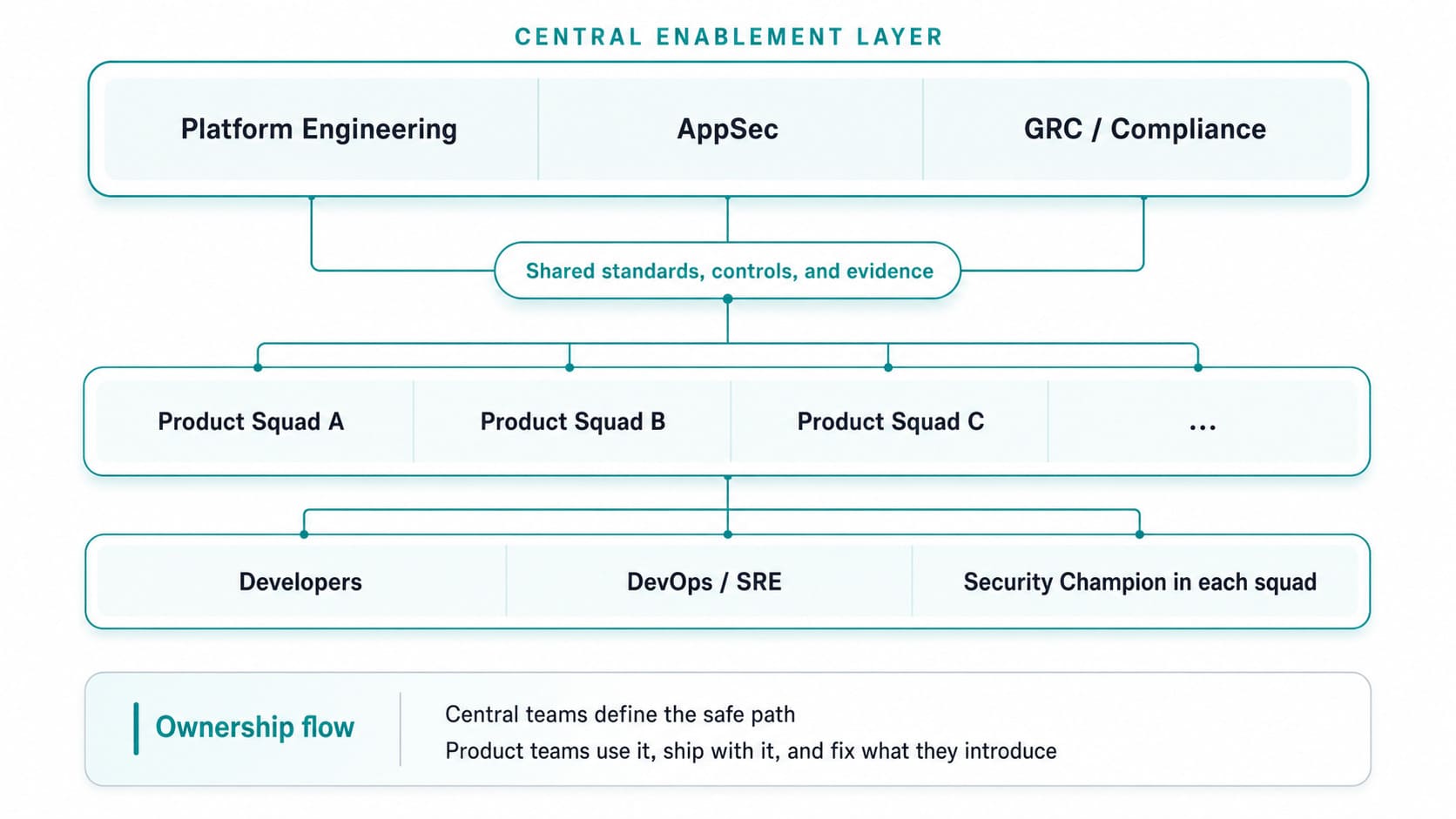
A good DevSecOps team structure does not try to separate delivery from security. It connects them. Central teams set the standards. Delivery teams own execution. Champions keep the feedback loop human. And the safest path is also the fastest path.
Next up, we’ll zoom into the role that usually gets misunderstood in all three stages 👇
Read also: DevSecOps vs Agile - Agile DevSecOps Explained for Delivery Teams
DevSecOps engineer roles and responsibilities
A DevSecOps engineer is the person who turns “be secure” into shipped defaults. Not by policing pull requests. By wiring security into the same paths your teams already trust: CI/CD templates, IaC modules, image pipelines, runtime baselines. Think builder + referee. They design the guardrails, then make it hard to fall off the road.
DevSecOps engineer roles and responsibilities:
- Own the “paved road” security controls inside shared pipelines (build, test, deploy).
- Codify policies as checks that can run on every change, fast enough to stay enabled.
- Define what blocks a release vs what files a ticket, with clear severity rules.
- Maintain reusable patterns: hardened base images, secure Terraform modules, secret handling, least-privilege CI credentials.
- Integrate scanners and signals, then normalize output so teams get one truth, not five dashboards.
- Build feedback loops: alert routing, ownership fields, and “fix-by” workflows tied to services.
- Measure friction and effectiveness (noise rate, time-to-fix, bypass attempts, change failure correlation).
Essential skills:
- Deep CI/CD fluency (GitHub Actions, GitLab CI, Jenkins, Argo, whatever you run).
- Infrastructure as Code and cloud permissions literacy (IAM is half the job).
- Policy-as-code mindset (OPA/Rego-style thinking, even if you use different tooling).
- Threat modeling basics, plus the pragmatism to prioritize what actually breaks prod.
- Developer experience chops: docs, templates, internal packages, golden paths.
- Data hygiene: dedupe findings, reduce false positives, route to the right owner.
- Calm communication under pressure. You will negotiate with strong opinions.
“Ordinary day” of our DevOps Engineer
And then reality hits: audits, evidence, control mapping, exceptions. That’s where GRC and Compliance enter the picture 👇
Read also: 9 DevSecOps Benefits for Security Leaders [With Proof]
GRC / Compliance role in a DevSecOps org
Here’s what happens right before an audit when you don’t have this role: someone pings six teams, asks for “proof,” and you get a folder of screenshots that no one trusts. GRC in a DevSecOps org exists to kill that panic. Their job is to make security verifiable every day, in the same places your engineers already work, so compliance doesn’t show up like a surprise exam.
They’re not the “policy police.” They’re the translator who turns frameworks into buildable work, then makes the proof automatic.
What they own: A good GRC lead starts with one question: “What control are we trying to prove, and where does the evidence naturally fall out of the system?” Then they wire the answer into how you ship.
GRC / Compliance responsibilities:
- Convert framework language into control statements that map to real systems.
- Partner with the platform team to bake controls into CI/CD and cloud guardrails so checks run on every change instead of once a quarter.
- Define evidence that’s machine-generated whenever possible: pipeline approvals, policy results, config snapshots, and access logs.
- Keep control mapping current as services change, owners change, or scope changes.
- Run the exception path like a product flow, not a side chat: owner, reason, mitigation, expiry date.
- Track posture over time and call out drift early, because a “green” point-in-time report can hide a month of exposure.
- Speak to management about outcomes: coverage percent, time-to-close exceptions, repeat violations, and audit readiness.
This role looks “non-technical” on org charts. In practice, they need enough technical depth to ask the right questions and enough influence to get answers.
Essential skills:
- Framework fluency (SOC 2, ISO 27001, PCI, HIPAA, CIS), plus the ability to simplify without dumbing down
- Systems thinking across cloud accounts, pipelines, identity, and logs
- Evidence design with an automation bias. If humans must screenshot it, the process will fail under load
- Risk communication that engineers can act on and leadership can approve
- Calm stakeholder management when a release is blocked or an auditor is impatient
- Data comfort. Trends beat anecdotes every time
GRC can make the risk visible and the proof automatic, but they can’t approve tradeoffs alone. The next section is Product and Engineering leadership: who gets to accept risk, how priorities are set, and what “we ship today” really means when a control fails.
Read also: What Breaks in Delivery When DevSecOps vs SDLC is Misunderstood
Product/Eng leadership (risk acceptance + priorities)
This is the point at which DevSecOps stops being a project for tools and starts being a way of doing things. Because only one group can legally and morally make the trade: ship now or fix first.
The platform can make the road smooth. AppSec can make the dangerous turns easier to see. GRC can show what's included. The only people who can say "We accept this risk" out loud and take responsibility for the blast radius if they're wrong are the leaders of Product and Engineering.
That clarity is important. The organization still makes decisions about risk even if leadership doesn't. In a quiet way. In direct messages. When it's late at night, and you just want to merge it.
What they really own: They don't agree with the findings. They are making plans for how decisions will be made.
- Set release thresholds that engineers can see coming. "Anything that is open to the public blocks." Anything that is internal ships with a mitigation and a 30-day expiration.
- Put money into the boring work that makes a difference, like platform capacity, pipeline hardening, least-privilege rollout, and evidence automation. That's where security will cost less next quarter.
- Figure out how to balance security work with roadmap work when both are urgent. No waving of hands. Real priority calls with owners and due dates. Treat the exception path like a product flow, not a favor. Every exception has a reason, a control that makes up for it, an expiration date, and a named owner who is responsible for it.
- Look for patterns that happen over and over. If the same misconfiguration happens on multiple teams, the solution is a guardrail, not another ticket.
- Make it clear who is responsible at all levels of management so that teams stop passing the buck on "who owns it."
Important skills:
- Risk fluency linked to business impact: data exposure, downtime chance, regulatory cost, and customer trust. Technical intuition across cloud and delivery that is strong enough to question "it's fine" answers.
- Decision hygiene: write down the call, set a time limit on the risk, and see if the mitigation worked. Talking lowers panic and raises standards.
- Discipline with metrics. You're managing by mood if you can't keep track of how long it takes to close exceptions or repeat policy violations.
To make it feel more real for you, I’ve asked a Caterpillar Product Leadership expert about his day:
The handoff is now getting interesting. Someone still has to turn those calls into a release that is predictable, auditable, and hard to get around, even though leadership can set limits and approve exceptions. That's the release manager's job, and that's where DevSecOps either grows or starts to leak.
Read also: DevSecOps vs DevOps: What’s the Difference [Explained by a Pro]
Release manager role in a DevSecOps org
Release managers are the people who make “we ship safely” true on Tuesday, not just in a policy doc. In DevSecOps, they sit at the intersection of code, cloud change, and risk decisions.
When security checks fail, or an exception is approved, the release manager is the one who turns that decision into an enforceable release path that engineers can’t accidentally bypas,s and management can audit without drama.
Release manager responsibilities:
- Own the release calendar, cut lines, and go/no-go criteria across teams and environments.
- Make security gates practical: decide what blocks, what warns, what needs approval, and where evidence is recorded.
- Coordinate cross-team change windows so shared services don’t get surprised by downstream releases.
- Enforce exception conditions from leadership: expiry dates, compensating controls, and required approvals.
- Keep release artifacts consistent: versioning, change logs, deployment records, and rollback plans.
- Run release retros focused on system fixes, not blame, then feed improvements back into platform pipelines.
- Track operational metrics that signal friction or risk: rollback rate, mean time to recover, bypass attempts, and “stuck in staging” time.
Essential skills:
- Strong CI/CD literacy plus enough cloud fluency to understand blast radius and dependencies
- Calm decision-making under pressure, with a bias for facts and repeatable processes
- Communication that works across AppSec, platform, squads, and leadership
- Evidence mindset. If it didn’t get recorded automatically, it didn’t happen
- Systems thinking. How one release affects shared infrastructure, identity, logging, and monitoring
“Ordinary day” of a Cloudaware release manager:
Next comes the role that removes the last fragile human link in this chain 👇
Read also: What Is DevSecOps - Definition, Security, and Methodology
Automation architect
An automation architect is the person who takes a “we should” and turns it into a workflow that runs at scale. They don’t write policies in a doc. They ship the machinery that executes them. When DevSecOps works, it’s because this role made the safe path the easiest path, then made it consistent across repos, teams, and environments.
They’re also the glue between the people you already met. The release manager defines the release path and what evidence must exist. Platform and DevSecOps engineers build the paved road controls. AppSec and GRC define what “good” looks like. The automation architect connects it all, wires the triggers, and makes it run without heroics.
Automation architect DevSecOps engineer roles and responsibilities:
- Design reusable automation patterns for CI/CD, IaC, and cloud changes that teams can adopt in minutes, not weeks.
- Build and maintain pipeline templates, shared actions, and internal tooling so security checks are standardized.
- Create event-driven flows for approvals, exceptions, and evidence capture, with full traceability.
- Normalize tool output into one set of signals: dedupe noise, map to ownership, route to the right queue.
- Enforce guardrails as code: policy checks, drift detection, environment segregation, and least-privilege runners.
- Measure friction and tune the system: execution time, false-positive rate, bypass attempts, bottlenecks by stage.
- Make rollbacks and emergency paths safe, fast, and auditable.
Essential skills:
- Strong engineering fundamentals plus pipeline depth (GitHub Actions, GitLab, Jenkins, Argo, etc.).
- Cloud and IAM fluency, because automation without permissions design is a security bug.
- Infrastructure-as-code expertise (Terraform, CloudFormation, Kubernetes manifests) and how to test it.
- API-first mindset: webhooks, event buses, idempotency, retries, and failure handling.
- Observability thinking: logs, metrics, tracing, and how to prove automation actually ran.
- DX instincts. If the template is ugly, teams will fork it and drift.
Here is an “Ordinary day” of a Cloudaware automation architect:
The next section is where all of this either gets adopted or ignored 👇
Read also: 4 DevSecOps Implementation Steps That Hold Under Release Pressure
Software Developer/Tester
A software developer in DevSecOps isn’t “also security.” They’re the owner of the change. They write the code, ship the config, and live with the blast radius when something goes sideways.
The trick is making that ownership practical. That’s why developers don’t operate alone here.
They build on the paved road from the platform team, follow the release path enforced by the release manager, lean on the automation architect for templates that don’t fight them, and pull in security engineers when a risk needs a real decision.
If DevSecOps is working, developers feel less friction, not more. A good pipeline catches issues in minutes, not in production. The feedback lands where they already are: PR checks, build logs, and clear ownership fields.
Software developer responsibilities in DevSecOps:
- Ship changes through the standard CI/CD path. No side doors, no “just this once” manual deploys.
- Fix what they introduce: vulnerable dependencies, insecure configs, secrets exposure, risky permissions.
- Treat security findings like bugs with severity and deadlines, not as optional cleanup work.
- Add guardrails in code when needed: input validation, auth checks, logging, safe defaults.
- Keep ownership and service metadata accurate so alerts route to the right humans.
- Participate in threat modeling and design reviews when the change expands blast radius.
- Work with the platform and automation teams to improve the paved road instead of forking it.
Essential skills:
- Solid software fundamentals plus comfort reading build output and tracing failures.
- Cloud basics for the services they touch, especially IAM and networking
- Dependency hygiene: understand SBOM-style thinking even if you don’t call it that
- Practical security literacy: common vuln patterns, secure auth, secrets handling
- Fast feedback habits: small PRs, clean rollback stories, clear commit intent
- Communication: when you need an exception, you can explain the risk and the mitigation like an adult
“Ordinary day” quote from the trenches of Valentin Kel - Cloudaware Software Developer
Next up is the role that makes those signals trustworthy in the first place 👇
Read also: DevSecOps Statistics (2026) - Market, Adoption, and AI Trends
Security Engineer
Security engineers are the people who decide what “unsafe” actually means in your environment, then make that definition executable. They’re not the team that throws findings over the wall. Their real output is a set of security practices that developers can follow without asking for permission, plus security automation that catches the stuff humans miss when they’re moving fast.
They also sit in the middle of the whole cast. They partner with DevSecOps and platform engineers to turn controls into pipeline checks. They give GRC clean evidence and a crisp control story. They help leadership understand the difference between “ship with mitigation” and “stop the line.” They make release managers’ gates predictable instead of random.
DevSecOps security engineer responsibilities:
- Define and tune the security processes that govern releases: severity rules, block vs warn criteria, and exception requirements
- Build security automation into CI/CD: SAST, dependency scanning, secret scanning, IaC checks, container/image policies
- Reduce noise aggressively so teams trust the signal: dedupe, suppress known-benign patterns, tune thresholds
- Own threat modeling for high-blast-radius changes and provide safe patterns teams can reuse
- Validate compensating controls when leadership accepts risk, then verify follow-through
- Partner with a platform on guardrails: identity standards, network baselines, logging requirements, encryption defaults
- Close the loop with detection and response: route high-confidence issues to the right owners fast
Essential skills:
- Strong application and cloud security fundamentals: auth, secrets, IAM, network exposure, data protection
- Tool depth plus skepticism: know what scanners miss, and what they hallucinate
- Ability to write and review policy as code and pipeline logic, not just guidelines
- Incident-style thinking without panic: triage, scope, prioritize, contain, learn
- Developer empathy: if it can’t fit into normal development security flow, it won’t stick
- Metrics discipline: false-positive rate, time-to-fix by severity, repeat offender patterns, gate bypass attempts
“Ordinary day” quote from the trenches of a Security engineer at Caterpillar:
The next section is the underrated ally in development security.
Read also: 10 DevSecOps Best Practices That Actually Survive Production
Quality Assurance (QA) engineer
QA in DevSecOps isn’t the “final boss” before release. It’s the system that catches reality early, while fixes are still cheap. If a broken auth flow reaches production, security teams get dragged into fire drills, developers lose a day, and management starts asking for more gates. QA prevents that chain reaction by turning risky behavior into tests that run on every commit.
Here’s the nuance: in DevSecOps, QA isn’t just proving features work. They’re proving controls don’t break the product.
Where QA fits with the rest of the crew: Platform and automation teams build the paved road. Security engineers add the checks. Release managers define what must be true before a deploy. QA stitches those pieces into confidence. If guardrails change, QA validates the user paths still survive. When tests fail, QA makes the failure actionable, not mysterious.
DevSecOps roles and responsibilities:
- Build coverage where it matters, not where it’s easy. Login, permissions, payment flows, data access, and admin actions.
- Turn security-relevant scenarios into automated regression that runs in CI/CD, fast enough to stay enabled.
- Pressure-test guardrails against real workflows, then feed findings back to the platform and security before teams start bypassing checks.
- Add negative testing on purpose: expired tokens, missing permissions, bad inputs, slow downstream services, and rate limits.
- Align release gates with the release manager: what blocks, what warns, what triggers rollback.
- Keep test environments and test data sane so results are stable and reproducible.
- Track “escapes” and fix the system: defects found post-release, repeat failures, time-to-detect, time-to-reproduce.
Essential skills: QA needs more than scripts. They need leverage.
- Automation testing depth across API, integration, and contract tests, with end-to-end used sparingly and wisely
- Security-aware testing instincts around auth, access control, session handling, and data leakage
- CI/CD fluency so tests parallelize, fail fast, and produce readable output
- Debugging skill that narrows the root cause instead of creating noise
- Clear writing, where a great bug report can save hours across engineers
“Ordinary day” of a QA in Cloudaware:
And now we zoom out. Because even perfect QA can’t save a messy org chart. The next section looks at the variants of DevSecOps organizational structure, what works at different sizes, and how teams split responsibilities without creating bottlenecks.
Read also: DevSecOps Architecture. A Practical Reference Model Teams Actually Use
Variants of DevSecOps organizational structure
You don’t need another debate about centralized vs embedded. You need an operating model you can defend when things break. So here are decision rules, the kind you can actually use on Monday.
Before we pick a shape, one truth: DevSecOps roles only work when the org can see what exists and what changed. If you can’t tie a release to the assets it touched, responsibility becomes opinion, and management ends up “governing” with Slack threads.
Model A: Embedded Security Champions (product-aligned)
Choose this when you have many squads, fast iteration, and you’re allergic to centralized queues. Champions sit with product teams. They pull security into planning, catch bad patterns early, and keep development moving because they speak the squad’s language.
Best for: lots of squads, high deploy frequency, distributed ownership.
Decision rule: if you ship daily across many repos, embed. Waiting for one team will collapse your cycle time.
Risk: inconsistency. Two teams solve the same problem in two different ways.
Needs: standards-as-code, plus a crisp exception process so “we’ll handle it later” has an owner and an expiry.
Model B: Central Security Enablement (AppSec as a platform)
Pick this when you’re regulated, you need shared controls, and you want repeatability across products. The enablement team builds patterns, templates, and guardrails that teams can self-serve. They’re successful when engineers barely notice them because the defaults are safe.
Best for: regulated orgs, shared control requirements, consistent governance.
Decision rule: if audits drive your roadmap, centralize the control design and evidence story, then distribute execution through self-service.
Risk: bottlenecks, especially if the team becomes “approval police.” That kills DevSecOps and resurrects ticket queues.
Needs: automation and paved self-service patterns. If a team can’t adopt a secure pipeline in hours, you built a dependency, not enablement.
Model C: Platform Team with Security Built-In (internal developer platform)
This is the “we’re serious” move. You invest in platform engineering and bake security into golden pipelines, shared IaC modules, identity patterns, and release paths. Engineers stop reinventing controls because the safest route is the easiest route.
Best for: mature orgs, platform investment, multi-team standardization.
Decision rule: if you’re spending more time maintaining pipelines than shipping product, centralize the paved road and ship it like a product.
Risk: the platform backlog becomes the company backlog. Every missing feature turns into “platform will build it,” and throughput drops.
Needs: shared tooling and golden pipelines with clear SLAs, plus ruthless scope control so the platform doesn’t become a dumping ground.