


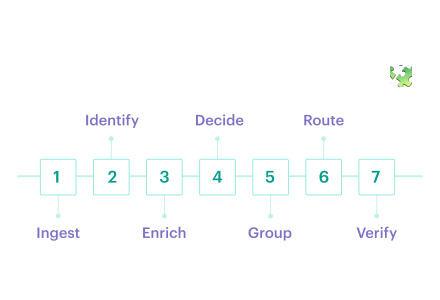
Many vulnerability programs already automate scanning and finding ingestion. The harder automation work begins after detection: scanners run continuously, cloud-native services generate findings, and security platforms keep producing new records.
The harder part of vulnerability management automation starts after detection: identifying the actual asset, reconciling duplicate observations, adding business context, finding the owner, creating the right unit of remediation work, and proving that the vulnerable condition is gone.
The gap between finding and fixing is huge. In the 2026 Verizon Data Breach Investigations Report, exploitation of vulnerabilities accounted for 31% of known initial access in the dataset. Verizon also reported that only 26% of critical KEV vulnerabilities were fully remediated during 2025, with a median of 43 days to full resolution.
Effective automation can reduce the coordination time between detection and verified remediation. In this article, the target is a workflow that preserves identity, context, ownership, remediation state, and technical evidence from the scanner finding through verified closure.
Key insights
- Vulnerability management automation should start after detection: The highest-value automation work is normalizing scanner findings, mapping them to active CIs, adding risk and business context, grouping remediation work, routing it to the right owner, and verifying closure
- The automation boundary should follow decision confidence and operational blast radius: Deterministic actions such as enrichment, deduplication, routing, retries, and synchronization are strong automation candidates, while ambiguous ownership, risk acceptance, and high-impact production changes still need human or change-control review
- Prioritization needs more than CVSS: CVSS severity, EPSS exploitation probability, and CISA KEV status become more useful when combined with production status, internet exposure, application criticality, ownership, and compensating controls
- One vulnerability finding should not automatically become one remediation ticket: Findings that share the same owner, fix, deployment boundary, change path, and validation method should be grouped into a remediation unit so automation creates executable work instead of ticket volume
- Scan coverage is part of the automation control plane: A missing vulnerability finding is not strong evidence of a clean asset when scanner coverage is stale or absent, so current scan state should be checked before prioritization or closure decisions rely on scanner data
- Verified closure requires fresh technical evidence: A Jira or ServiceNow ticket marked Done proves workflow progress, while a new scanner observation, endpoint state, configuration state, or deployed image version is what confirms that the vulnerable condition no longer exists
What is vulnerability management automation?
Vulnerability management automation uses integrations, rules, asset context, and workflow state to move vulnerability findings from detection through normalization, prioritization, ownership, remediation, and verified closure with less manual coordination.
That scope goes beyond automated vulnerability scanning. A scanner can report that CVE-X exists on a host, image, application endpoint, or cloud resource. The scanner may not know which business application depends on that asset, whether another scanner observed the same condition, which team controls the change path, whether an exception applies, or whether the eventual fix removed the exposure.
The operating flow looks more like this: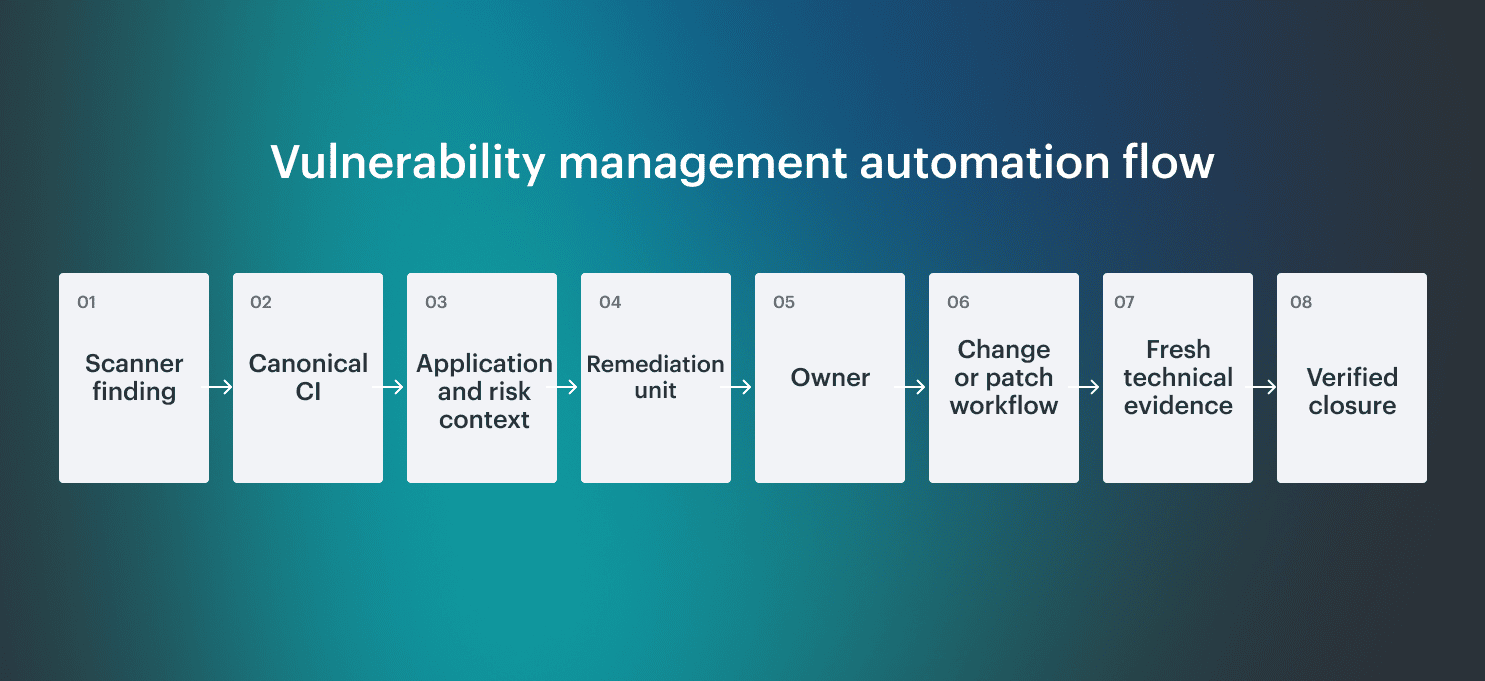 Each arrow is a potential failure point. The scanner can be correct while the program still fails because the finding maps to the wrong CI, reaches the wrong team, becomes one of hundreds of duplicate tickets, or closes without a later observation confirming remediation.
This is why ticket creation is a poor definition of automated vulnerability management. Automatically converting every scanner record into Jira or ServiceNow work can automate noise just as efficiently as it automates useful work.
A better automation target is the handoff between systems: A finding should retain its source identity and evidence while acquiring the CMDB, application, ownership, risk, and workflow context required for the next decision.
What should you automate, and where should humans stay in the loop?
In 2026, the question is which decisions can run unattended without turning incomplete context into bad remediation. Mandiant’s July 2026 guidance on AI-assisted vulnerability management, citing M-Trends 2026, reports a mean time-to-exploit of -7 days and warns that privileged AI agents without mature integration processes introduce new architectural risks.
The operating boundary also appears in established security practice. NIST SP 800-40 Rev. 4 defines enterprise patch management as identifying, prioritizing, acquiring, installing, and verifying patches, updates, and upgrades.
Cloudaware follows a similar operational pattern. Mikhail Malamud, General Manager at Cloudaware, has publicly described using AI to reconstruct the changes behind an operational incident, while the human SRE reviews the evidence and initiates the remediation action.
| Workflow action | Default posture | Keep a human gate when |
|---|---|---|
| Ingest scanner findings | Automate | Source integrity or connector health is uncertain |
| Normalize and deduplicate findings | Automate | Records cannot be mapped confidently across sources |
| Map a finding to an active CI | Automate conditionally | Asset identity is ambiguous |
| Add application, environment, and owner context | Automate | CMDB relationships are missing or stale |
| Add CVSS, EPSS, and CISA KEV context | Automate | Source data is unavailable or contradictory |
| Group findings into remediation units | Automate from explicit rules | Findings do not share a clear owner, fix, or change path |
| Route remediation work | Automate | No authoritative owner or assignment group exists |
| Approve a risk exception | Human gate | Always requires accountable risk acceptance |
| Execute a high-impact production change | Change-control gate | Availability, rollback, or blast radius requires review |
| Verify and close a finding | Automate conditionally | Technical evidence is incomplete or conflicts with workflow state |
The useful boundary is therefore decision confidence and operational blast radius, not an automation percentage. A team can automate most of the work required to normalize, enrich, group, and route findings while retaining approval for the small number of decisions where the cost of being wrong is high.
Automate orchestration when the input and decision rules are reliable
The best automation candidates are repetitive actions with stable inputs and predictable state transitions: normalization, deduplication, enrichment, grouping, owner lookup, task creation, synchronization, reminders, retries, escalation, and reporting.
For example: Same source finding + same active CI + same remediation unit → update existing work is safer than New scanner record → create new ticket
The first rule treats repeated scanner observations as state updates. The second can manufacture duplicate work every time a scanner observes the same condition again.
AWS Inspector, Qualys, Rapid7, or another source may report valid observations against the same underlying asset. The automation layer needs to preserve each source record while resolving those observations to a canonical CI before deciding how much remediation work actually exists.
Idempotency should therefore be designed into the workflow. If the same scanner event is processed twice, the second pass should update the existing state rather than create another task.
Keep execution gated when the change can break production or the evidence is weak
Automation should slow down when the workflow moves from coordinating work to making a production change with meaningful blast radius.
Suppose a critical CVE affects 180 database hosts. Automation can identify the affected CIs, reconcile duplicate scanner observations, map applications and owners, group hosts by remediation path, determine which systems are production, and prepare the required work. It should not automatically follow that 180 affected hosts → patch and reboot 180 hosts immediately
The execution decision may depend on database topology, availability requirements, maintenance windows, failover order, application testing, rollback procedures, and existing change controls. Automating the scope and preparation gives the reviewer a better decision package; it does not make those constraints disappear.
The same rule applies before execution. If a finding cannot be mapped confidently to an active CI, routing it automatically may send work to the wrong team. Mandiant makes the same distinction for AI-assisted vulnerability management: AI can accelerate discovery, analysis, and workflow preparation, but privileged agents require deterministic guardrails and human review around sensitive actions.
A practical automation contract should therefore answer four questions before an action runs:
- Which inputs authorize the action
- How confident is the workflow in those inputs
- What proves the action succeeded
- What state does the workflow enter if it fails
If those answers are unclear, the problem is not that the workflow needs more automation. It needs a better decision boundary.
Vulnerability management automation can execute the repeatable parts of that loop, including finding intake, routing, SLA tracking, escalation, ticket updates, and verification triggers, while analysts retain control of risk and treatment decisions.
How to automate vulnerability management: a six-step operating playbook
The operating model below is a practical synthesis of the controls and failure points that repeatedly appear across current vulnerability-management guidance and real enterprise workflows.
The sequence draws on NIST SP 800-40 Rev. 4, FIRST EPSS, CISA, and Cloudaware’s CMDB and vulnerability-management model. Follow the steps below and remember: when automating vulnerability management, the order matters. So do not begin with ticket creation, rather begin with the data contract that must remain trustworthy from scanner observation through verified closure.
1. Normalize every finding to a canonical asset and source record
Every automated decision needs a stable answer to two questions: what did the source observe, and which active asset does that observation belong to?
At minimum, preserve:
| Field | Why it matters |
|---|---|
| Scanner or source | Preserves provenance |
| Source finding ID | Supports idempotent updates |
| CVE or vulnerability identifier | Connects technical context |
| Affected CI | Connects the finding to operational context |
| Observed timestamp | Establishes freshness |
| Last seen | Supports aging and verification |
| Scanner state | Distinguishes active, resolved, and stale records |
| Source evidence | Allows review of the original observation |
Consider a common cloud case. Qualys reports CVE-X against 10.20.4.18. AWS Inspector reports the same CVE against an EC2 instance ID. CMDB data shows that the IP currently belongs to that instance.
The workflow may conclude that both records describe the same affected CI, but it should retain both source observations. Otherwise, deduplication destroys the evidence required to understand which scanner saw what and when.
Simple identity keys such as CVE + hostname can become unreliable when IPs are reassigned, instances are replaced, containers are short-lived, and infrastructure names are reused.
A practical automation contract therefore keeps two identities: Source observation identity and Affected asset identity. The first supports provenance and scanner-state tracking. The second connects the finding to application, owner, environment, and remediation context.
If either identity is uncertain, downstream automation should stop or enter a review state instead of guessing.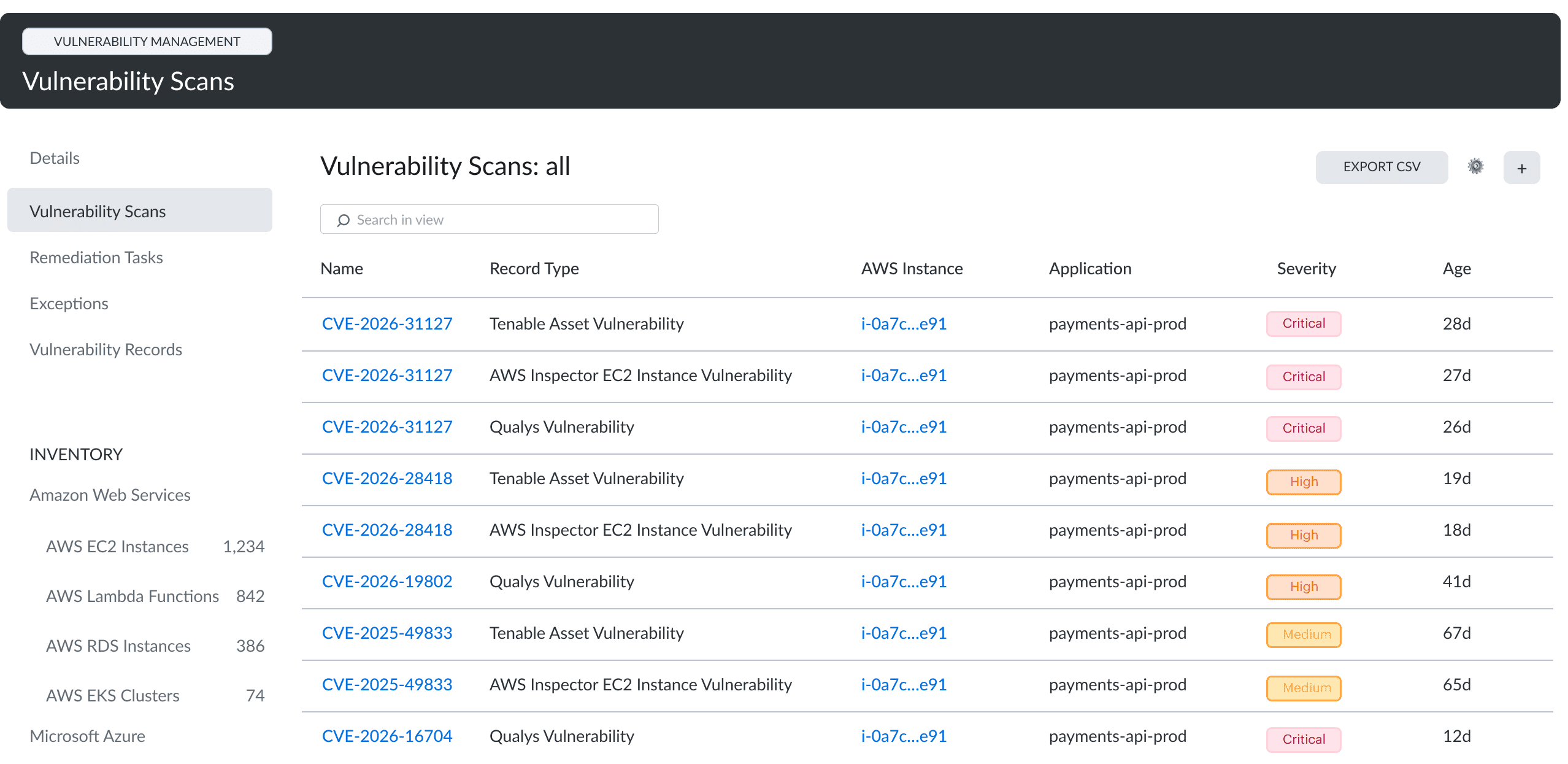 Cloudaware Vulnerability Scans view showing scanner findings, affected AWS instances, applications, severity, and finding age across vulnerability records.
2. Add exploit and business context before you prioritize
Severity tells you how serious a vulnerability can be. It does not tell you how urgently this specific occurrence should consume engineering capacity.
CVSS provides a standardized severity model. FIRST EPSS estimates the probability that a published CVE will be exploited in the wild in the next 30 days. The CISA Known Exploited Vulnerabilities catalog identifies vulnerabilities with evidence of exploitation and recommends using the catalog as an input to vulnerability prioritization.
Those signals still lack your environment. Compare two findings:
| Context | Finding A | Finding B |
|---|---|---|
| CVSS | 9.8 | 8.8 |
| Environment | Internal test | Production |
| Internet exposure | No | Yes |
| Exploitation context | No known exploitation | CISA KEV |
| Application | Internal batch job | Customer authentication |
| Business criticality | Low | High |
| Owner | Known | Known |
A severity-only queue can place Finding A first. A context-aware workflow has stronger operational reasons to escalate Finding B.
Useful enrichment may include:
- Application
- Environment
- Business service
- Accountable owner
- Asset criticality
- Internet exposure
- Data sensitivity
- Compensating controls
- Exploit intelligence
- Deployment dependencies
This context can also change scanning behavior. Business context can also influence scan scope and cadence. For example, ServiceNow application data can help distinguish a low-impact internal system from an externally exposed service supporting a critical business process. That context influenced both prioritization and scan cadence.
Do not turn CVSS, EPSS, and KEV into one universal numeric formula. They describe different aspects of risk. The automation rule should explain how those signals interact with asset and business context inside your environment.
For the broader model, see threat-informed vulnerability prioritization.
3. Group findings into remediation units instead of creating one ticket per finding
A finding is evidence of a vulnerable condition. It is not automatically the right unit of engineering work. Suppose 240 EC2 instances use the same vulnerable golden AMI. A one-finding-one-ticket design could create hundreds of repetitive tickets.
The actual remediation path may be: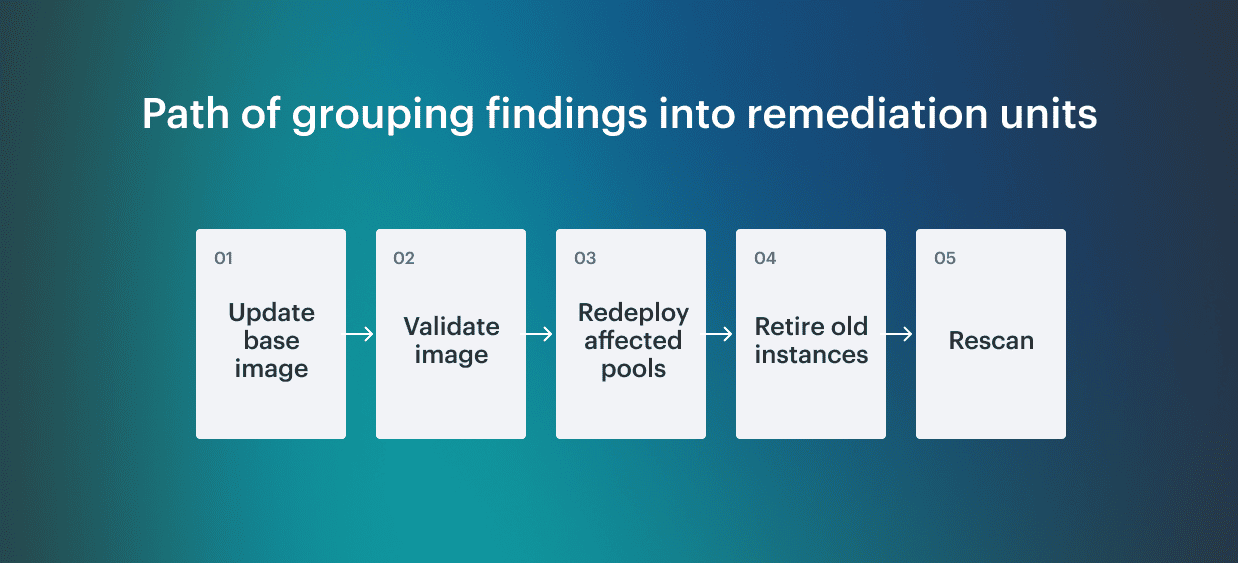 That is one remediation unit: a set of findings that can safely move through the same owner, fix, deployment boundary, change path, and validation method.
A useful grouping rule asks whether the findings share:
- Remediation mechanism
- Accountable owner
- Deployment boundary
- Maintenance or change path
- Verification method
- Exception requirements
The same CVE can still produce multiple remediation units.
For example, the same vulnerable package might appear in application containers and Kubernetes worker nodes. The application team may need to rebuild and deploy a container image, while the platform team needs a node-image upgrade during cluster maintenance.
Grouping both into one ticket would hide the operational split. Creating one ticket per affected node would create unnecessary work. The remediation unit sits between those extremes.
This distinction also improves reporting. Instead of asking only, “How many vulnerability records are open?”, the program can ask, “How many executable remediation units are blocked, who owns them, and what evidence is still missing?”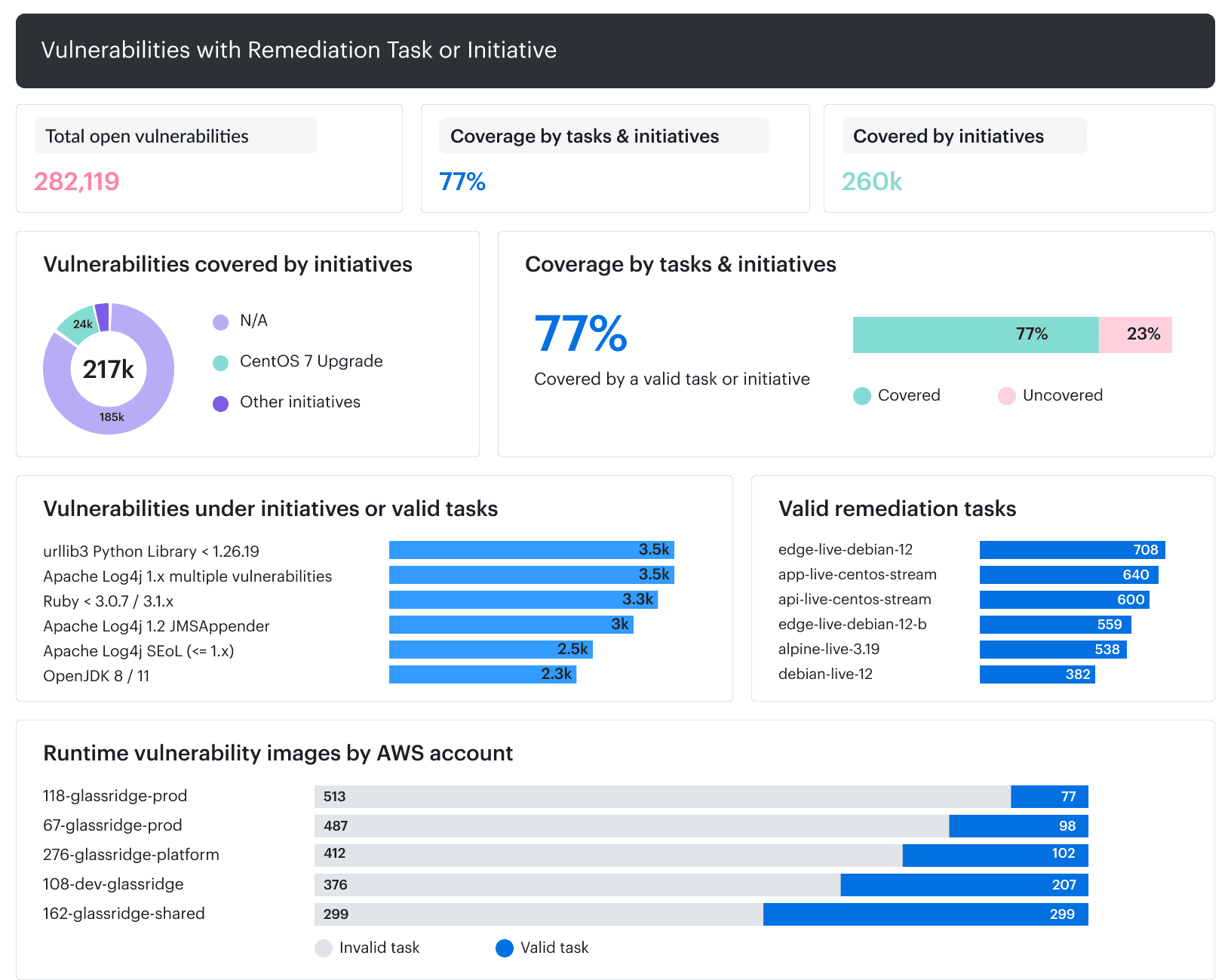 Cloudaware vulnerability remediation coverage dashboard showing total open vulnerabilities, coverage by remediation tasks and initiatives, valid remediation tasks, and runtime vulnerability images by AWS account.
4. Route remediation by ownership and change path, not severity alone
The team that owns an affected asset is not always the team that owns the required change.
Consider one CVE across three object types:
| Affected object | Operational owner | Change path |
|---|---|---|
| Application container | Application team | Rebuild and redeploy image |
| Kubernetes worker node | Platform team | Node-image or cluster maintenance |
| Windows VM | Infrastructure team | Patch workflow |
The vulnerability has the same identifier and may have the same severity. The remediation owner and execution path differ.
Routing logic therefore needs fields beyond a risk score:
- Accountable team
- Application owner
- Platform owner where different
- ITSM queue or project
- Remediation type
- Environment
- Change path
- Due-state logic
- Escalation path
- Exception status
An automated workflow should know whether the task reached a valid queue, whether ownership was accepted, and where rejected or unresolved assignments go next.
If an application has no owner, generating a ticket for a generic security queue does not solve the problem. The missing owner is itself an operational state that needs escalation.
This is where CMDB workflows become relevant. Asset and application relationships can supply the context needed to route remediation into Jira, ServiceNow, or another operational queue without asking security analysts to resolve ownership manually for every finding.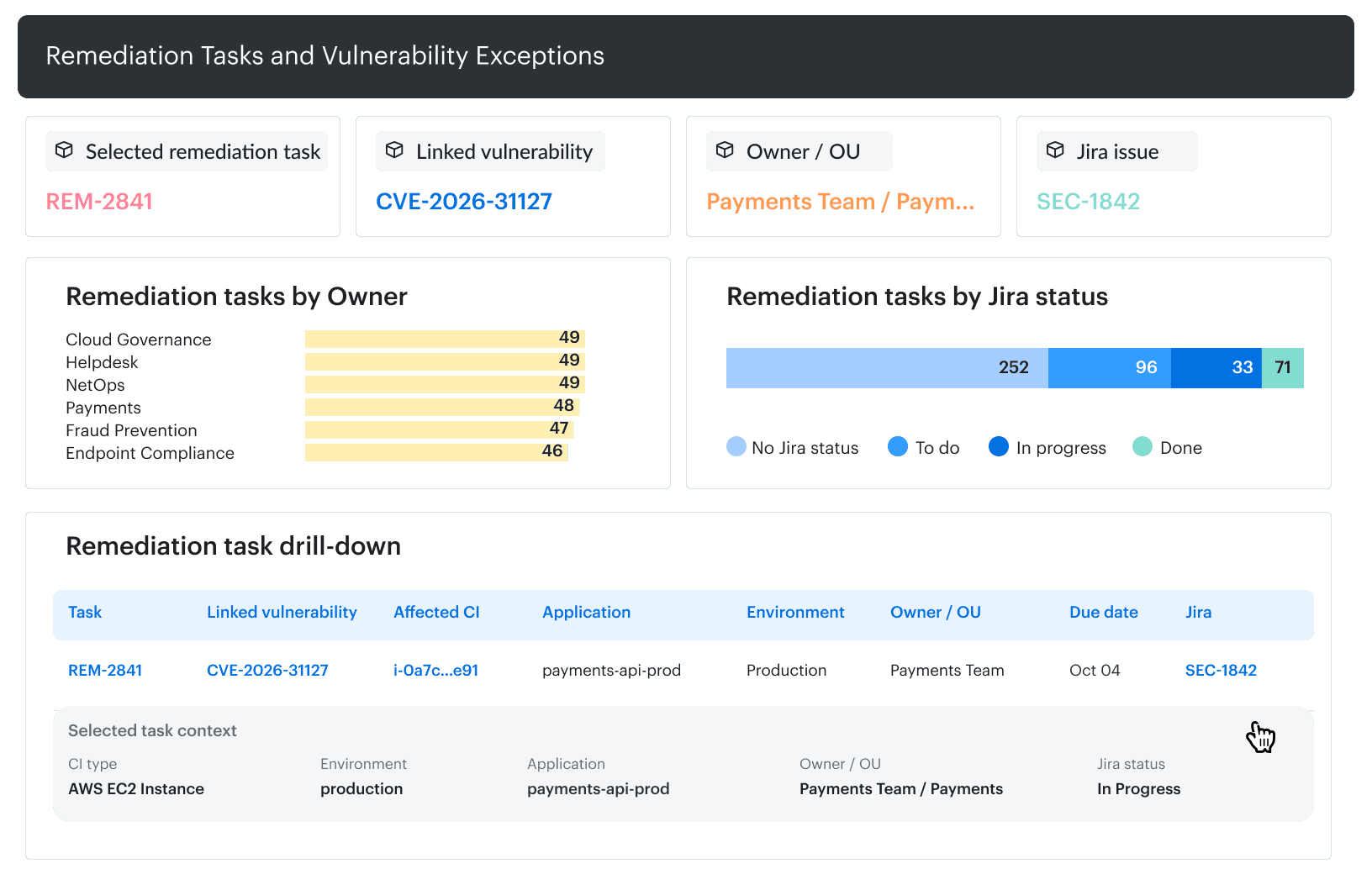 Cloudaware remediation task dashboard showing the linked vulnerability, affected CI, application, environment, Owner/OU, Jira issue, and remediation task status by owner.
5. Treat failures, retries, and exceptions as workflow states
A vulnerability automation design is incomplete until failure paths are visible and actionable. Production environments add the states that determine whether automation actually works.
| Failure state | Unsafe behavior | Better workflow response |
|---|---|---|
| Scanner feed becomes stale | Treat absence of findings as clean state | Mark source stale and block verification |
| CI mapping fails | Guess asset identity | Send to mapping-review queue |
| Owner is missing | Drop or park work | Route to ownership-resolution queue |
| ITSM API fails | Lose remediation task | Retry and expose integration failure |
| Owner rejects assignment | Recreate the same ticket | Review routing source and escalate |
| Patch or deployment fails | Close on attempted action | Keep remediation active |
| Exception expires | Leave finding suppressed | Return to active prioritization |
| Verification never arrives | Assume remediation worked | Mark verification overdue |
Exceptions should also be stateful records rather than permanent suppressions. At minimum, an exception needs a defined scope, accountable owner, rationale, review condition, and expiry.
The workflow should always be able to answer:
- What is currently blocked
- Why is it blocked
- Who owns the next decision
- What event moves it forward
A workflow that cannot answer those questions may still automate API calls, but it cannot reliably manage remediation.
This is also why integration health belongs in vulnerability reporting. A failed connector can make an apparently clean dashboard less trustworthy if new findings or verification evidence are no longer arriving.
6. Verify remediation from fresh technical evidence before you close the finding
NIST SP 800-40 Rev. 4 includes verification as part of enterprise patch management. That distinction matters in vulnerability-management automation because workflow systems and security evidence answer different questions.
The ticket shows that the assigned work reached a completion state. Fresh technical evidence shows whether the exposure remains.
Container environments create another version of the same problem. A patched image may exist in the registry while workloads continue running the old vulnerable image. A successful build or deployment job is useful execution evidence, but closure depends on the state of the affected workloads.
Depending on the vulnerability, verification evidence can include:
- Fresh scanner observation
- Endpoint package state
- Configuration state
- Deployed image version
- Application build state
- Asset removal or decommissioning evidence
The evidence type needs to match the vulnerable condition. Implemented means the remediation action was performed. Verified means later evidence shows that the original condition is no longer present.
If a later scan still detects the vulnerability, the workflow should remain open or re-enter remediation. If the asset disappeared, the workflow should distinguish remediation from decommissioning rather than treating every missing observation as a successful fix.
Worked example: from scanner finding to verified closure
Consider a hypothetical enterprise running AWS and Azure with more than one vulnerability scanner. A newly exploited CVE appears across compute workloads. Qualys reports part of the affected population, while AWS Inspector adds findings from AWS.
Raw scanner output is only the starting point.
| Stage | Illustrative example |
|---|---|
| Detect | 171 source observations arrive |
| Normalize | Records map to 126 unique active CIs |
| Enrich | Application, environment, owner, exposure, and criticality are added |
| Prioritize | 14 internet-facing production assets enter the urgent queue |
| Group | Findings become three remediation units based on change path |
| Route | Work goes to platform, application, and Windows infrastructure teams |
| Execute | Teams use their existing patch and deployment systems |
| Verify | Fresh evidence clears 119 CIs while seven remain detected |
| Close | 119 close and seven remain in active remediation |
The numbers are illustrative. The important part is how the record changes.
The program begins with 171 scanner observations. It does not create 171 tickets. It first determines which observations refer to the same active CI, then adds context that changes priority, then groups the resulting findings according to how the infrastructure will actually be fixed.
AI-assisted querying can shorten the investigation stage when the relevant data already exists in an authoritative operational model.
In a Cloudaware MCP SecOps demo, the CMDB contained data across 657 AWS accounts, 98 Azure subscriptions, and six vCenter data centers.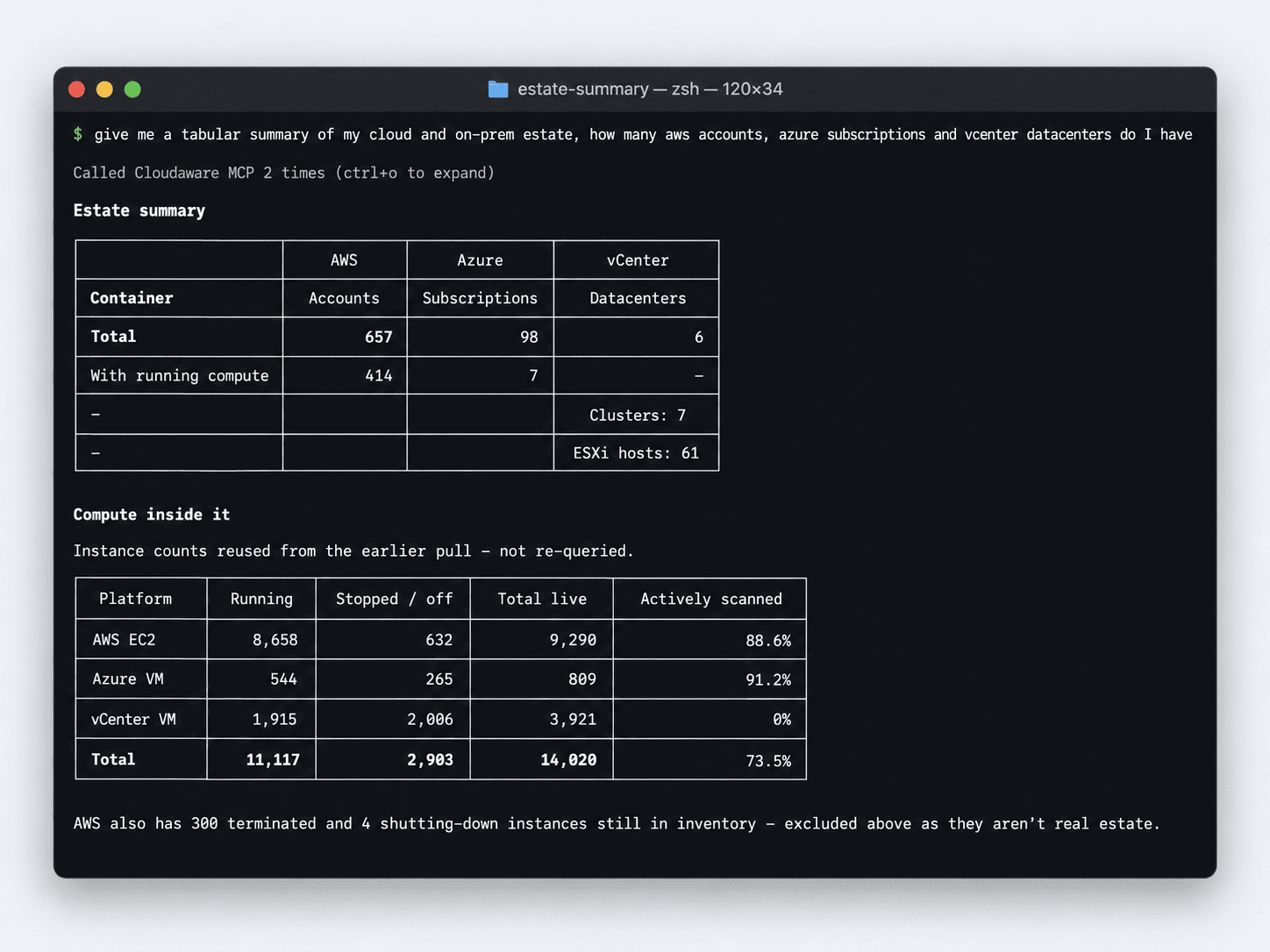 The query then broke vulnerability scan coverage down by scanner and recency. It surfaced Rapid7 records whose latest scans dated back to October 2025, while current Orca coverage remained active. It also showed that vCenter had no active vulnerability scanning in the last 30 days.
Because MCP was querying already aggregated CMDB data, the analysis did not require querying each AWS account, Azure subscription, or vCenter environment individually.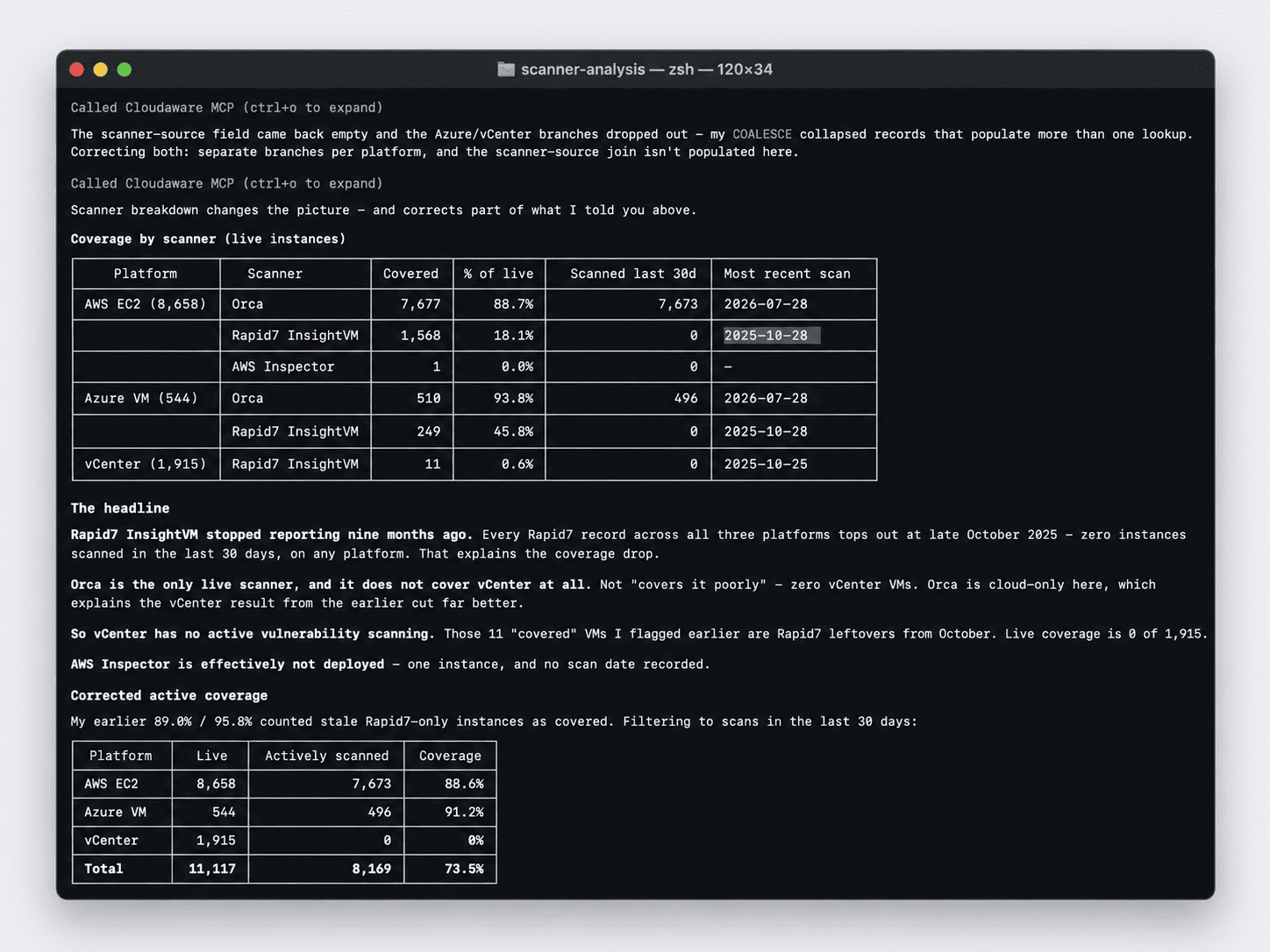 A separate MCP example queried operating systems past end of support across cloud providers, showing the same pattern for estate-wide remediation scoping.
That creates useful investigation questions during an urgent vulnerability event:
- Which affected assets are in production
- Which scanner records are stale
- Which affected applications have no confirmed owner
- Which assets are covered by multiple scanners
- Which parts of the environment have no current scan coverage
More advanced queries can combine vulnerability data with application, ownership, or infrastructure relationships where those relationships exist in the CMDB. They should be treated as queries against the available data model, not as proof that an AI agent should autonomously execute remediation.
Coordinate the handoffs between scanners, CMDB, ITSM, and remediation
Cloudaware is a context and orchestration layer between vulnerability evidence and the operational systems used to resolve it. Scanners continue to detect vulnerabilities. Patch, deployment, and engineering systems continue to execute changes.
For organizations running several scanners across AWS, Azure, GCP, VMware, and on-prem infrastructure, the first problem is often reconciliation. The same asset can appear differently across scanner and infrastructure systems, while some assets may have stale or missing coverage.
Cloudaware supports the workflow at several points between scanner evidence and verified remediation:
- Connect vulnerability findings to infrastructure context: Integrations and CMDB connect scanner observations with the assets, applications, environments, and relationships they describe.
- Add ownership and business context before routing: CMDB relationships associate findings with application, environment, owner, and other operational context so remediation can be grouped and assigned based on how the affected system is actually managed.
- Keep remediation work in existing operational queues: Route vulnerability work into Jira or ServiceNow so engineering and infrastructure teams can manage remediation in the systems they already use while Cloudaware retains the underlying asset context.
- Support patch-oriented remediation where patching is the right fix: Use Patch Management for patch-based execution, while application deployments, configuration changes, compensating controls, or infrastructure changes remain in their appropriate change paths.
- Query vulnerability and asset context with MCP: Let your LLM investigate the normalized CMDB data without replacing the underlying scanner, ITSM, or remediation systems. Demonstrated use cases include cross-environment scan-coverage analysis, stale scanner-data detection, scanner-overlap and gap analysis, and estate-wide end-of-support OS analysis.