


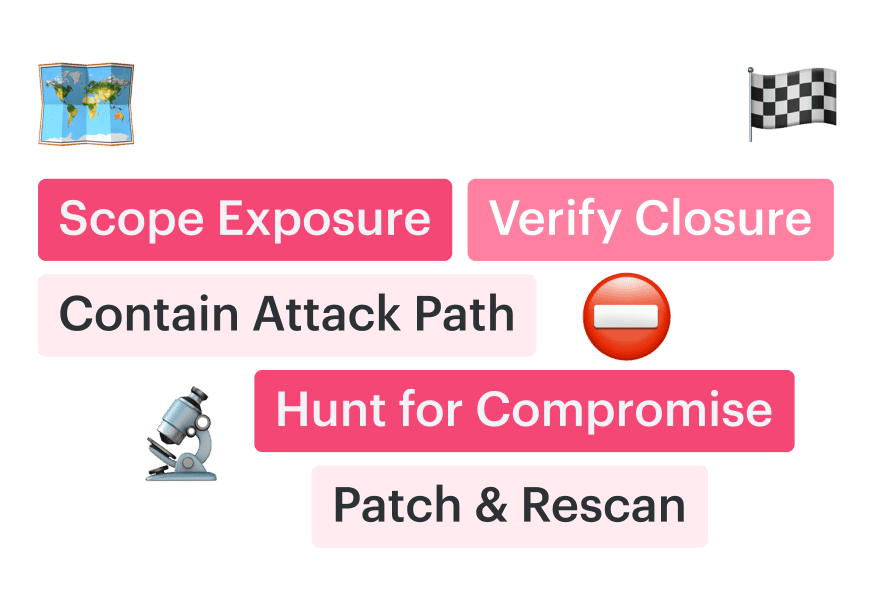
A zero-day vulnerability is a software weakness that attackers can exploit before a vendor releases a fix or defenders have had time to apply one. The urgent task is to establish where the affected condition exists, reduce the number of reachable attack paths, and prepare evidence for remediation and closure.
AI changes the response window, not the definition of a zero-day. In a 2024 study of 15 real-world one-day vulnerabilities, a GPT-4 agent exploited 87% when researchers supplied the CVE description; without it, success fell to 7%.
In May 2026, Google Threat Intelligence Group reported a planned mass-exploitation operation involving a zero-day it assessed was developed with AI assistance. For cloud security teams, this tightens the time available to scope exposure, assign ownership, apply containment, and verify the change.
Zero-day response at a glance
A zero-day response is governed by five decisions:
- Scope the condition: Match the affected product, package, image, version, feature, configuration, dependency, and provider boundary to the cloud inventory. Record affected, ruled-out, and still-unknown resources.
- Separate exposure from compromise: Reachability is determined through endpoints, network paths, identity controls, and configuration. Exploitation requires behavioral or forensic evidence from WAF, application, EDR, NDR, and cloud audit logs.
- Prioritize the attack path: Combine internet exposure, privilege, business impact, recovery constraints, and existing controls. A vulnerability’s severity score alone does not establish its priority in the estate.
- Contain before patching: Disable the affected feature where possible, restrict access, segment the workload, reduce privileges, increase monitoring, and assign an owner for each temporary control or exception.
- Close with evidence: After a fix becomes available, deploy it across affected resources, rescan or retest the condition, investigate suspected exploitation, remove temporary controls, and retain change and verification records.
Zero-day vulnerability, exploit, and attack: the difference
A zero-day vulnerability is the weakness itself. An exploit is the code or technique that abuses it. An attack is the malicious activity that uses the exploit against a target.
| Term | What it is | Defender signal | Response action |
|---|---|---|---|
| Vulnerability | The software weakness | Advisory, affected version, package, configuration | Scope resources and assess exposure |
| Exploit | Code or technique that abuses the weakness | Proof of concept, exploit telemetry, suspicious behavior | Tune detection and hunt for exploitation |
| Attack | Malicious use of an exploit against a target | Compromise evidence, unusual identity, network, or process activity | Contain, investigate, preserve evidence, and recover |
| N-day vulnerability | Known weakness with a fix or mitigation available | CVE, scanner finding, or vendor remediation guidance | Patch, rescan, and verify closure |
Why it is called zero-day
The name refers to the remediation time available to defenders, not the age of the defect. A flaw can remain in a library, operating system, appliance, or application for years before a researcher or threat actor identifies it.
Definitions vary. In this article, a zero-day is a vulnerability with no vendor patch available, especially when it is exploited before a patch exists. Once a fix is available, unremediated systems face n-day exposure.
For the broader discovery, prioritization, and remediation lifecycle, see cloud security vulnerabilities guide.
From hidden flaw to verified remediation
A critical vulnerability moves through several independent stages:
- A flaw exists in released software
- A researcher or threat actor discovers it
- Exploitation, disclosure, or both bring it to defender attention
- Vendors publish detection content, mitigations, or advisories
- The vendor releases a patch
- The organization deploys the fix and verifies closure
Once the weakness becomes known and standard remediation is possible, it enters the normal vulnerability management lifecycle of assessment, prioritization, treatment, and verification.
These events rarely occur in a neat sequence. Exploitation can precede public disclosure. Detection content can arrive before a patch. A patch can be available before an enterprise can test and deploy it safely.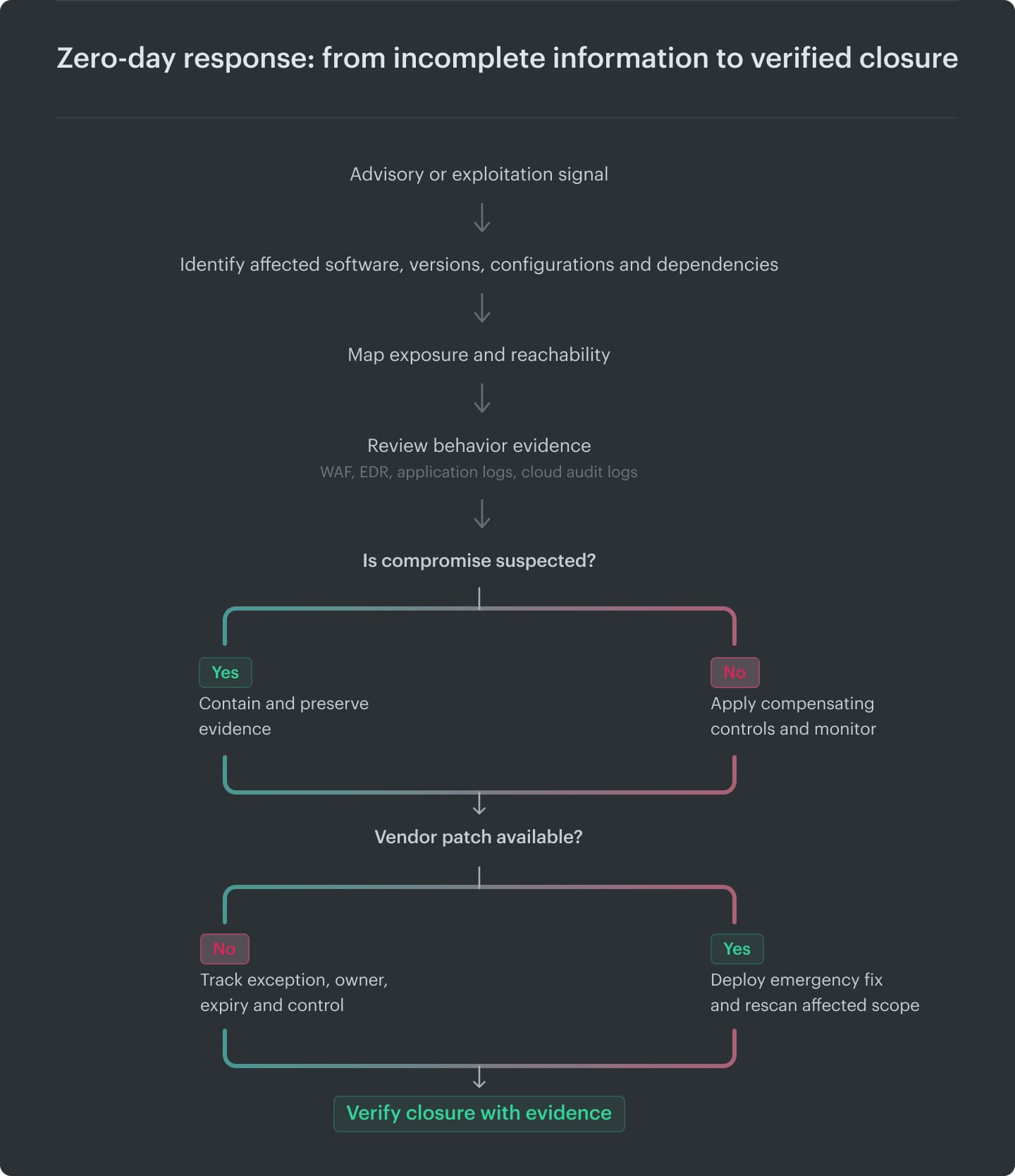 The key operational distinction is simple: vendor patch availability is not remediation closure. Closure requires evidence that the correct change reached every affected cloud resource.
How researchers find unknown flaws and defenders detect exploitation
The research and response problems diverge at disclosure. Researchers try to prove that a weakness can be triggered. Defenders must establish whether the affected condition exists in their estate, whether the vulnerable function is reachable, and whether exploitation left evidence.
An example of Log4Shell shows the scoping problem: the affected component could be hidden inside applications, services, and dependencies. An example of SharePoint illustrates the detection problem: exposed servers required investigation for web shells, credential theft, and other post-exploitation activity.
How researchers discover and test unknown vulnerabilities
Researchers combine source-code review, fuzzing, static and dynamic analysis, reverse engineering, and controlled exploitation. NIST’s Technical Guide to Information Security Testing and Assessment describes methods used to identify and validate security weaknesses. The objective is to demonstrate a reproducible impact such as authentication bypass, remote code execution, privilege escalation, or data exposure.
Enterprise teams usually face a different question: does the affected condition exist in our estate? A CVE identifier alone cannot answer it. The CISA Log4Shell advisory, for example, directed organizations to look beyond application names and identify vulnerable Log4j instances in applications, services, and dependencies.
For zero-day vulnerability testing, record the evidence needed to reproduce the finding and map it to:
- Product, package, image, or appliance version
- Enabled feature and required configuration
- Public endpoint, management interface, or internal route
- Dependent applications and cloud services
- Provider-managed components outside the team’s patching boundary
How security teams detect possible exploitation
A scanner can confirm an affected version after detection logic becomes available. It cannot reliably identify an unpublished flaw, prove that the vulnerable function is reachable, or establish that exploitation never occurred. Detection therefore combines asset evidence with behavior evidence.
The Microsoft SharePoint exploitation guidance illustrates the second workstream. Microsoft paired exposure identification with investigation for web shells, credential theft, ransomware deployment, and other post-exploitation activity.
Use each evidence source for a specific decision:
- Package, image, and configuration data: Is the vulnerable condition present?
- Cloud inventory and network exposure: Can an attacker reach the affected function?
- WAF, application, EDR, and NDR telemetry: Was exploit behavior observed?
- Cloud audit logs: Did identities, API calls, or network paths behave unusually?
- Per-asset behavior baselines: Did this host deviate from its own normal after the exposure window opened?
- Threat intelligence and vendor indicators: What artifacts should detection and hunting cover?
- CMDB ownership data: Which team can contain, patch, and verify the resource?
For a broader model of connecting telemetry with asset context, ownership, change history, and closure evidence, see the cloud security observability guide.
Practitioners on Reddit repeatedly returned to the same operational basics: clear runbooks, accurate environment mapping, strong identity controls, and recovery procedures. A clean scan reports tool coverage at one point in time. It does not prove that an unknown flaw is absent or that a resource was never compromised.
Zero-day vulnerability mitigation when no patch exists
If you need to know how to mitigate a zero-day vulnerability when no patch exists, start by scoping the affected condition, identifying reachable assets, and assigning an owner for each response action.
A vulnerability posture view helps security teams separate total asset scope from scan coverage, prioritize impactful findings, and track remediation age while vendor guidance is still changing.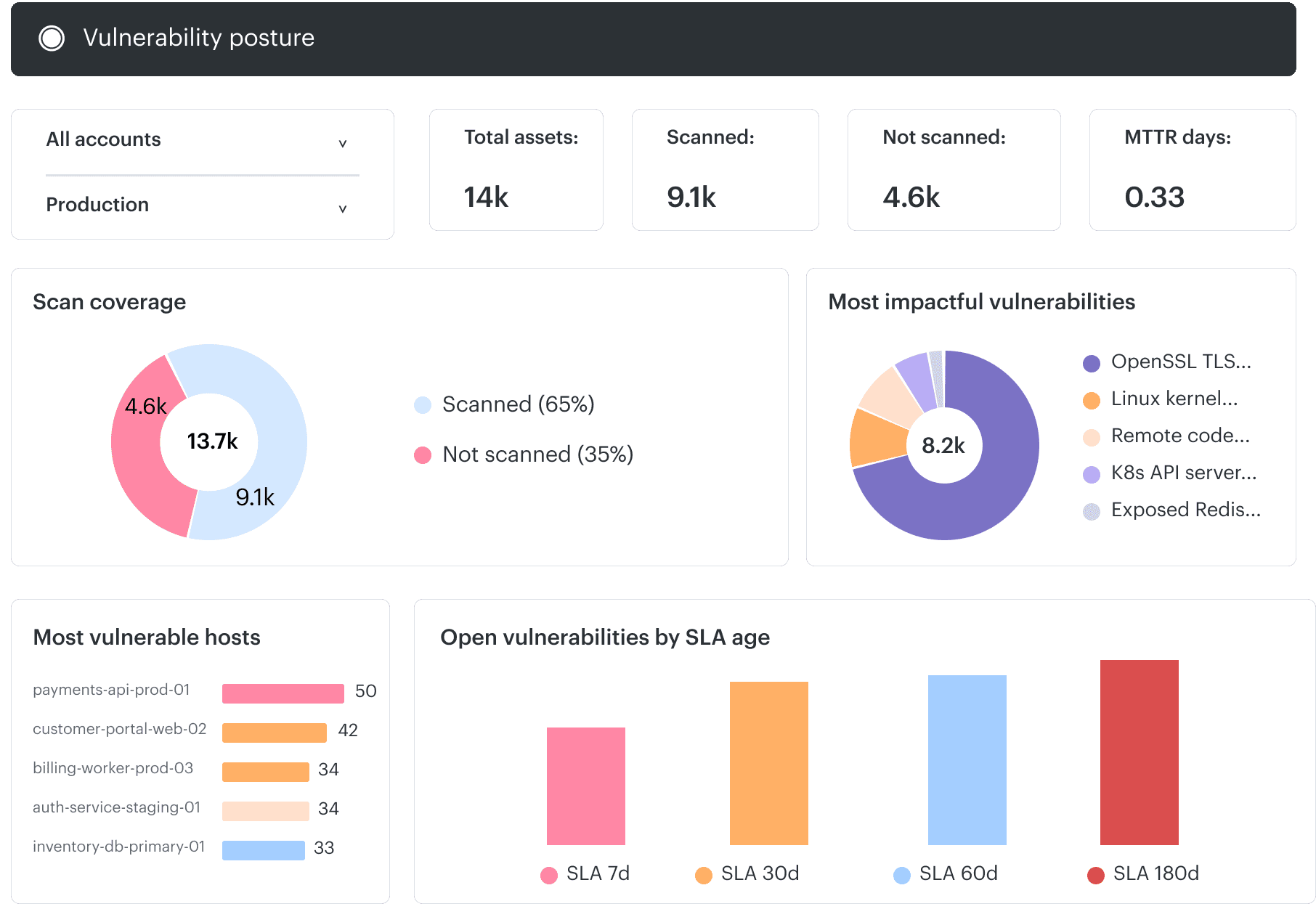 Cloudaware vulnerability posture dashboard: scan coverage, impactful vulnerabilities, vulnerable hosts, and remediation age.
Scope the affected conditions and assets
Start with the exact condition that makes a resource affected. It may be a product version, package, image, enabled feature, exposed endpoint, appliance model, or inherited dependency.
Then establish the context that changes the response priority.
| Decision factor | What to confirm | Why it matters |
|---|---|---|
| Software condition | Product, version, package, image, or configuration | Establishes potential applicability |
| Exposure path | Public endpoint, VPN, management plane, or internal-only service | Determines attacker access |
| Reachability | Whether the vulnerable function is enabled and usable | Prevents severity-only prioritization |
| Business impact | Application dependency, data sensitivity, and recovery constraints | Determines escalation and urgency |
| Owner | Team accountable for the resource and change | Prevents scope from stalling in triage |
| Existing controls | Segmentation, allowlists, EDR, MFA, or feature disablement | Defines residual risk before patching |
Document both affected and ruled-out resources. “Not affected” needs evidence, such as a verified version, disabled feature, managed-service boundary, or absence of the required configuration.
For provider-specific assessment baselines, see our guides on AWS cloud security assessment, Google Cloud security assessment, and Azure cloud security assessment.
Prioritize, contain, and hunt for compromise
Prioritize resources that combine active exploitation evidence with internet exposure, business criticality, privileged access, weak controls, or limited recovery options. A CVSS rating helps classify technical severity, but it does not establish practical exploitability in your environment.
When no patch exists, select controls that disrupt the attack path:
- Disable the affected feature, service, integration, or public endpoint where feasible
- Restrict network access through segmentation, private connectivity, temporary firewall rules, or allowlists
- Reduce privileges that could turn initial access into lateral movement
- Increase logging and monitoring around the affected service, identity, process, or route
- Hunt for indicators tied to the advisory, including suspicious child processes, web shells, privilege changes, and unusual outbound traffic
- Watch for behavior the advisory does not describe yet: Cloudaware NeoSec flags deviations from each asset’s baseline and investigates them, so hunting does not wait for published indicators
- Isolate suspected compromised resources while preserving the evidence needed for investigation
- Record temporary exceptions with an owner, compensating control, rationale, and expiry date
The critical path often is not detection. It is the time spent identifying the owner, confirming business impact, approving a safe change, and proving the change reached the full scope.
“AI may accelerate discovery and exploit development, but it does not change the first response decision: which resources are exposed, who owns them, and which control can remove the attack path today?” — Katerina L., Cloud Security Expert at Cloudaware
Patch, rescan, and verify closure
When the vendor releases a fix, confirm that it applies to the deployed architecture, including containers, images, dependencies, appliances, and provider-managed services. An emergency patch path still needs testing boundaries, rollback criteria, and recovery ownership.
Close the response only after collecting evidence such as:
- Updated product, package, image, or configuration version
- Targeted scan result or updated detection status
- Change record linked to the affected resource and owner
- Threat-hunting result when exploitation was suspected
- Removal or renewal of temporary controls and exceptions
- Updated CMDB relationship or asset record
A vendor patch turns a zero-day into an n-day exposure for systems that remain unpatched. The relevant metric then becomes verified remediation coverage, not advisory awareness.
For Kubernetes-specific controls around images, workloads, and runtime context, see Kubernetes security best practices for the cloud.
Lessons from Log4Shell, MOVEit, and SharePoint
These incidents show why patching is only one part of the response.
| Incident | Response challenge | Operational lesson |
|---|---|---|
| Log4Shell | The affected library could be embedded in applications, images, and third-party components | Search for the affected dependency and configuration, not only the application name. CISA documented active exploitation after disclosure. |
| MOVEit Transfer | A previously unknown SQL injection created a concentrated external attack path in a managed file-transfer product | Identify exposed instances quickly, restrict access when necessary, preserve logs, and follow the vendor remediation sequence. CISA and FBI’s advisory covers exploitation of CVE-2023-34362. |
| SharePoint ToolShell | An on-premises collaboration platform required patching and investigation for possible post-exploitation artifacts | Treat patch deployment and compromise assessment as separate workstreams. Microsoft’s threat guidance describes exploitation associated with web shells, credential theft, and ransomware activity. |
Each case begins with the same operating question: which resources meet the affected condition, which of them are exposed, and who can act on them?
None of these incidents needs an AI origin story to remain relevant. Their common failure mode is the same: teams struggle to connect an affected component to the right asset, exposure path, owner, and remediation evidence. AI can accelerate reconnaissance and exploit development, but it does not remove the need for disciplined inventory, containment, and verified closure.
Connect zero-day exposure to owned remediation across multi-cloud
Cloudaware connects vulnerability findings with cloud inventory, CMDB relationships, application context, ownership, remediation status, and closure evidence. This gives security teams a way to scope a newly disclosed issue while scanner coverage is still incomplete and coordinate the response across AWS, Azure, GCP, Kubernetes, and hybrid infrastructure.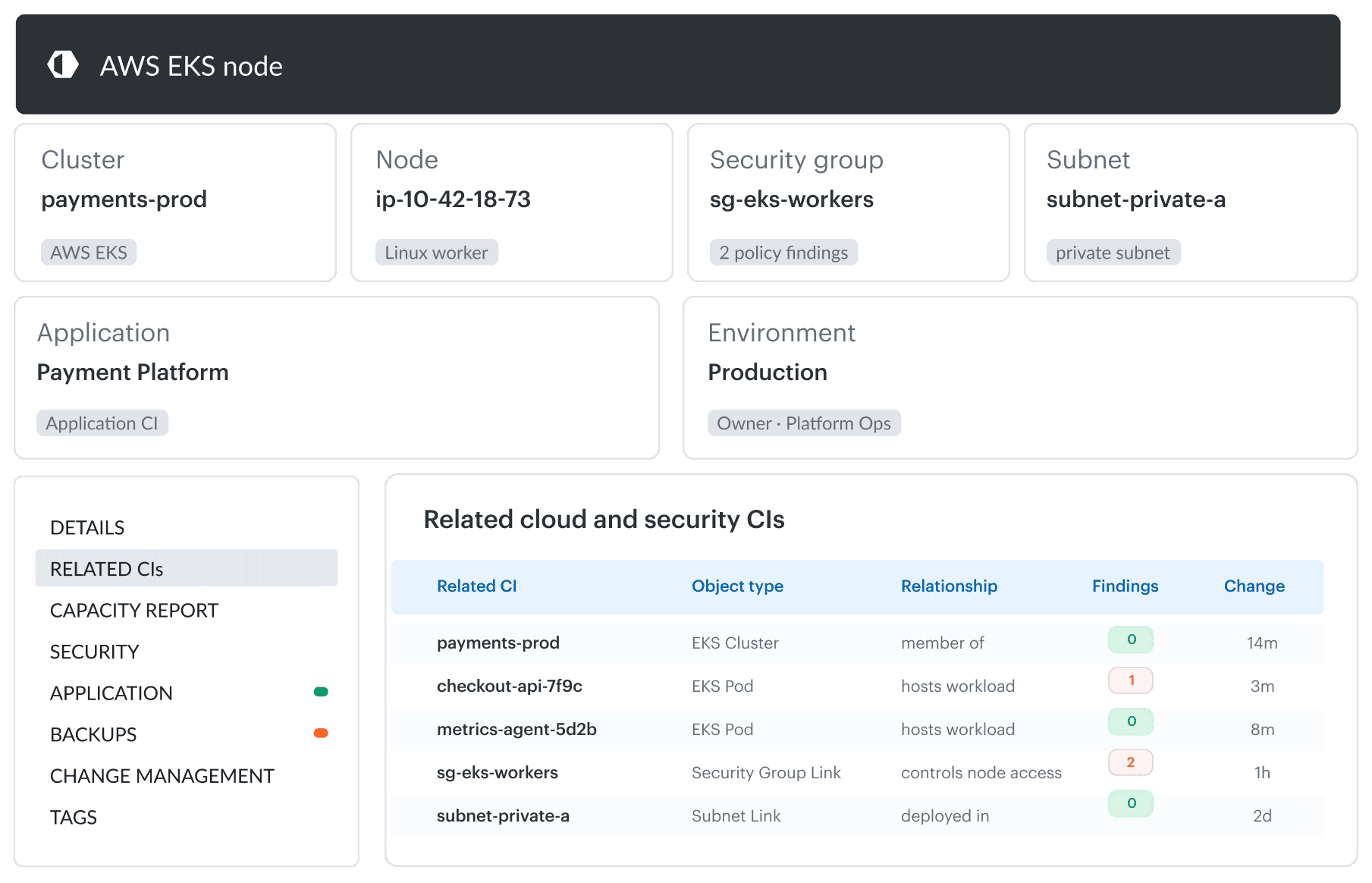 Cloudaware AWS EKS node view showing related cluster, workload, security group, subnet, application, environment, findings, and changes.
Cloudaware does not replace endpoint detection, threat intelligence, network controls, or vendor patching. Its role is to connect the affected condition to the resources and teams responsible for reducing and closing the exposure. NeoSec, a separate Cloudaware module, adds a behavior layer alongside those tools: it learns normal behavior for each asset, flags deviations after exposure, and tells the team whether an attack succeeded.
Core capabilities:
- Affected-resource scoping: Combine cloud inventory, CMDB relationships, tags, configuration data, and Breeze Agent package information to identify potentially affected resources before scanner signatures are complete. Record affected, ruled-out, under-investigation, and temporarily mitigated assets with supporting evidence.
- Application and ownership context: Group resources by application, platform, organizational unit, cloud account, environment, or owner. This helps security teams route work to the team that can change the affected resource.
- Coordinated remediation: The Critical Zero-Day Response playbook supports a Zero-Day Initiative that links affected assets to remediation tasks and status tracking. Teams can continue using established ITSM integrations and operational dashboards.
- Exceptions and closure evidence: Record the owner, rationale, compensating control, and expiry for temporary risk acceptance. Link patch, configuration, version, change, targeted scan, or updated-signature evidence to confirm that the affected condition has been removed.