


The CSA Cloud Controls Matrix v4.1 provides a cloud-specific security baseline: 207 controls across 17 domains, supported by CAIQ, implementation and auditing guidance, applicability mappings, continuous audit metrics, and machine-readable resources.
The harder work starts after the framework is selected. In a 2026 CSA survey, only 9% of enterprises said security policy management was fully integrated into development and deployment workflows.
CSA deliberately leaves provider-specific implementation in AWS, Azure, and GCP outside the scope of its vendor-neutral guidance. That translation from framework control to verified cloud state is the operating problem this article addresses.
TL;DR
- Operationalization starts with scope. Teams need to decide where a control actually applies and which part of the requirement remains with the cloud service customer before creating technical checks or collecting evidence.
- The same CCM control can require different technical checks across AWS, Azure, and GCP. For LOG-07 Logging Scope, CloudTrail event selectors, Azure diagnostic settings, and GCP Audit Logs expose different defaults and evidence surfaces.
- Normalize the security outcome, not provider product names. Map each CCM control to a testable condition first, then to provider-native configuration, evaluation logic, and evidence.
- CAIQ, STAR, and framework mappings support assurance but do not prove current technical state. Mappings can contain no, partial, or full gaps, so mapped requirements still need resource-level verification.
- Evidence should stay tied to the resource, owner, exception, and validation date. A closed remediation ticket does not prove the control now passes; the technical state has to be re-evaluated after the change.
What is the CSA Cloud Controls Matrix (CCM) v4.1?
The Cloud Controls Matrix is the Cloud Security Alliance's vendor-neutral control framework for cloud security and privacy. CCM v4.1 contains 207 controls across 17 domains and is designed for both cloud service providers (CSPs) and cloud service customers (CSCs).
CCM provides more than a catalog of cloud security controls. The CSA Introductory Guidance to CCM adds a Shared Security Responsibility Model and applicability criteria for deciding how controls relate to different service models, architectures, and organizational contexts.
| CCM v4.1 component | Current state |
|---|---|
| Framework version | CCM v4.1 |
| Controls | 207 |
| Security domains | 17 |
| CAIQ questions | 283 |
| Primary actors | Cloud service providers and cloud service customers |
| Applicability | Service model, architecture, organizational context, CSP/CSC responsibility |
| Supporting resources | Implementation guidance, auditing guidance, mappings, continuous audit metrics, machine-readable files |
Applicability should come before technical testing. A SaaS application, an IaaS workload, and a managed PaaS database expose different customer responsibilities even when they support the same business service.
Before implementing a CCM control, establish three things:
- Does the control apply to the service model and architecture in scope?
- Which part of the requirement remains the CSC's responsibility?
- Which cloud resources and internal owners fall under that responsibility?
Without those answers, a team can produce findings without knowing whether the affected resource should have been tested in the first place.
What changed in CCM v4.1?
CCM v4.1 added 11 controls and expanded the surrounding assurance material, including CAIQ v4.1, which has 283 assessment questions.
CSA's 2026 v4.1 update identifies new controls covering areas such as:
- AIS-08 API Security
- LOG-08 Audit Logs Sanitization
- STA-09 Service Bill of Material (BOM)
- TVM-04 Threat Analysis and Modelling
- TVM-10 Threat Response
- Datacenter resilience
- Incident management and records
- Supply chain risk management
These additions align with issues appearing in current cloud-risk research. In CSA's Top Threats to Cloud Computing 2026, inadequate identity and access management ranked first, insecure third-party resources third, insecure interfaces and APIs fourth, and misconfiguration and inadequate change control fifth.
For teams moving from v4.0.x, the update should trigger a review of the operational layer beneath the framework:
- Which v4.1 controls are new or materially changed?
- Which internal technical policies depend on those controls?
- Are framework mappings still current for v4.1?
- Do existing evidence requests test the current control requirement?
CSA's v4.1 transition guidance notes that mappings were being updated following the release. Treat the mapping version as part of the control record rather than assuming an older crosswalk remains complete. The same version discipline applies when teams maintain several cloud security compliance standards.
How to operationalize CCM controls across AWS, Azure, and GCP
A CCM control becomes operational when its intent is converted into an applicable resource scope, a testable provider-native condition, current evidence, accountable ownership, an exception path, and a re-evaluation step.
The challenge increases when one control objective spans several cloud providers. A 2026 CSA survey, commissioned by AlgoSec and based on 515 IT and security professionals, found that 92% reported at least some difficulty getting one accurate policy view across environments. 48% said policy changes are mostly or fully manual.
This means that CCM gives teams a common control objective but does not remove provider-specific implementation differences.
Scope each control to the right cloud resources and owners
"Customer responsibility" is still too broad for a technical control. AWS, Microsoft, and Google all use shared-responsibility models, but the boundary changes as services move from customer-managed infrastructure toward managed PaaS and SaaS offerings. The useful unit of responsibility is therefore smaller than "AWS" or "the customer."
Enterprise scope often needs additional dimensions:
- Production versus non-production
- Application or business service
- Data classification
- Account, subscription, or project
- Region
- Resource tags or labels
- Approved exclusions
A cloud security risk assessment can identify where a control is required. The technical evaluation still needs an enumerated resource scope that can be tested.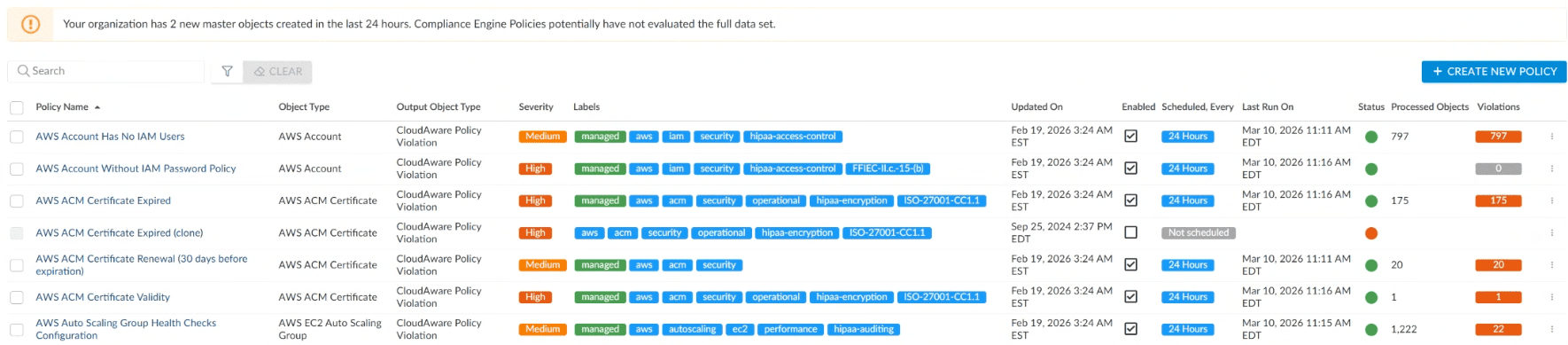 Example of how it works in Cloudaware: policies are tied to specific CMDB object types and show the evaluated scope, processing schedule, and resulting violations across cloud resources.
A failure pattern appears when scope exists only in policy language. Security may know that "production databases containing regulated data" require a control but still lack a reliable way to enumerate the databases currently matching that definition. Findings generated from an incomplete or stale scope cannot provide a trustworthy control-coverage metric.
Translate control intent into provider-native checks
Normalize the required security outcome across providers, then retain provider-specific configuration and evidence underneath it.
CCM LOG-07 Logging Scope provides a useful example. The control addresses which system events and metadata should be logged and how that scope is reviewed as requirements change. A test such as logging = enabled is too weak. Each provider exposes different logging boundaries and defaults.
| Control layer | AWS | Azure | GCP |
|---|---|---|---|
| CCM objective | Define required logging scope | Define required logging scope | Define required logging scope |
| Organizational scope | Accounts, Regions, organization trail | Subscription plus resource-level settings | Organization, folder, project |
| Main coverage question | Are the required event types included? | Which resources emit the required log categories? | Which required audit-log categories are enabled? |
| Critical detail | Trails log management events differently from data events | Subscription Activity Log and resource diagnostic settings cover different telemetry | Most Data Access audit logs require explicit configuration |
| Evidence | Trail configuration, event selectors, account and Region coverage | Diagnostic settings, categories, destinations | Audit configuration, services, log types, hierarchy |
For AWS, a CloudTrail organization trail can provide coverage across member accounts in AWS Organizations. However, CloudTrail event configuration distinguishes management events from data events. Showing that an organization trail exists does not prove that the data-access activity required by a control is being logged.
In Azure, Azure Monitor diagnostic settings determine which resource logs and metrics are collected and where they are sent. The subscription Activity Log and resource-level diagnostic settings represent different evidence surfaces, so "Azure logging enabled" collapses information a reviewer may need.
In Google Cloud, Cloud Audit Logs configuration distinguishes Admin Activity from Data Access logs. Most Data Access logs are disabled by default and must be configured when the control requires that activity.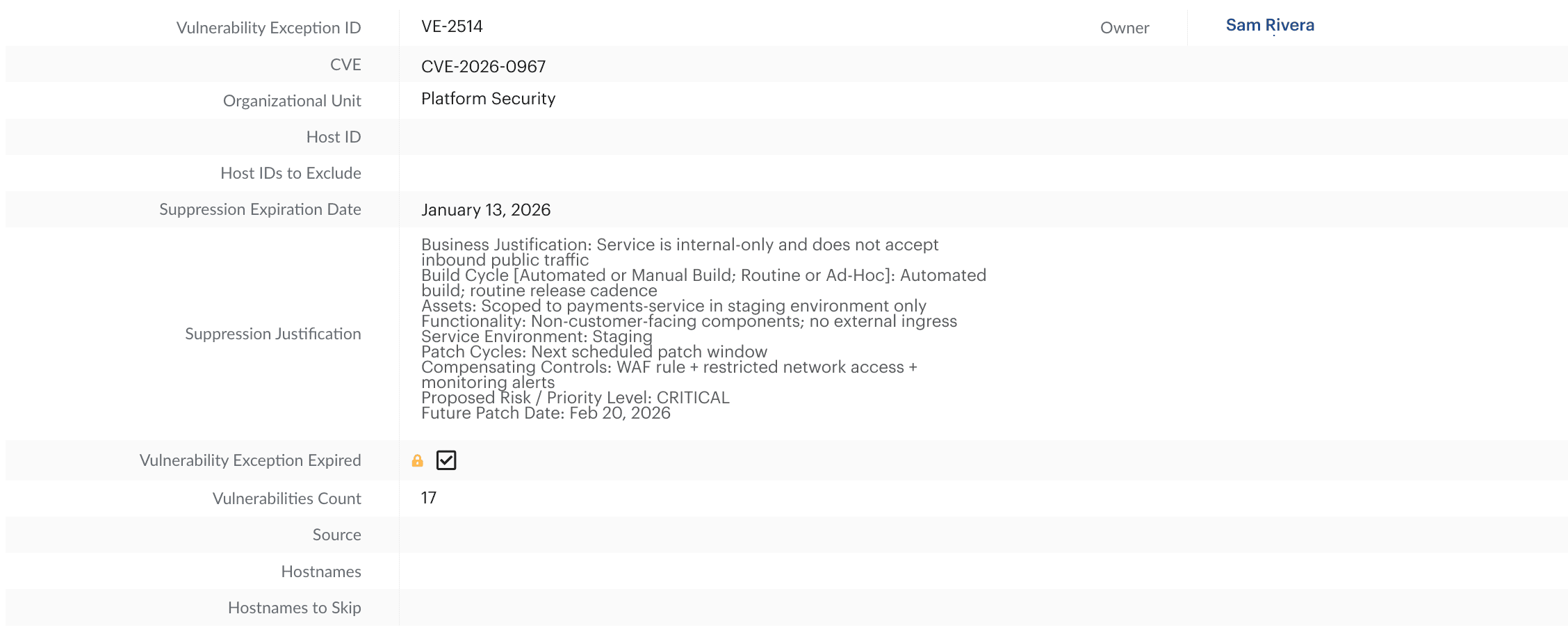 Example of how it works in Cloudaware: an AWS logging requirement is evaluated as a provider-specific benchmark check against in-scope cloud objects.
Avoid mapping a control directly to a provider product name. "CloudTrail," "Azure Monitor," and "Cloud Audit Logs" identify product surfaces. They do not define the condition that proves the CCM requirement. The same pattern applies to identity, encryption, network isolation, vulnerability management, and change control.
Capture evidence, ownership, and exceptions
Evidence should let a reviewer determine what was tested, which resource was tested, what state was observed, and when.
A useful CCM operationalization record can include:
| Field | Example value |
|---|---|
| CCM control ID | LOG-07 Logging Scope |
| Applicability | Production cloud workloads |
| CSP / CSC responsibility | CSC responsible for configuring and reviewing logging scope |
| Cloud/resource scope | AWS production accounts running customer-facing workloads |
| Technical condition | Required management and data events are logged for in-scope resources |
| Evidence source | CloudTrail trail configuration and event selectors |
| Control owner | Cloud Security |
| Resource owner | Payments Platform team |
| Exception | EXC-1042, approved until 2026-12-31 |
| Ticket | SEC-4821 |
| Last validated | 2026-08-24 |
The control owner and resource owner may be different. Security or GRC can govern the requirement, while a platform or application team owns the configuration that must change.
Exceptions need the same precision. An accepted risk should preserve the affected control or resource, reason, approver, compensating control where applicable, and review or expiry date. Otherwise, a temporary exception can become a permanent blind spot with no explicit decision to keep accepting the risk.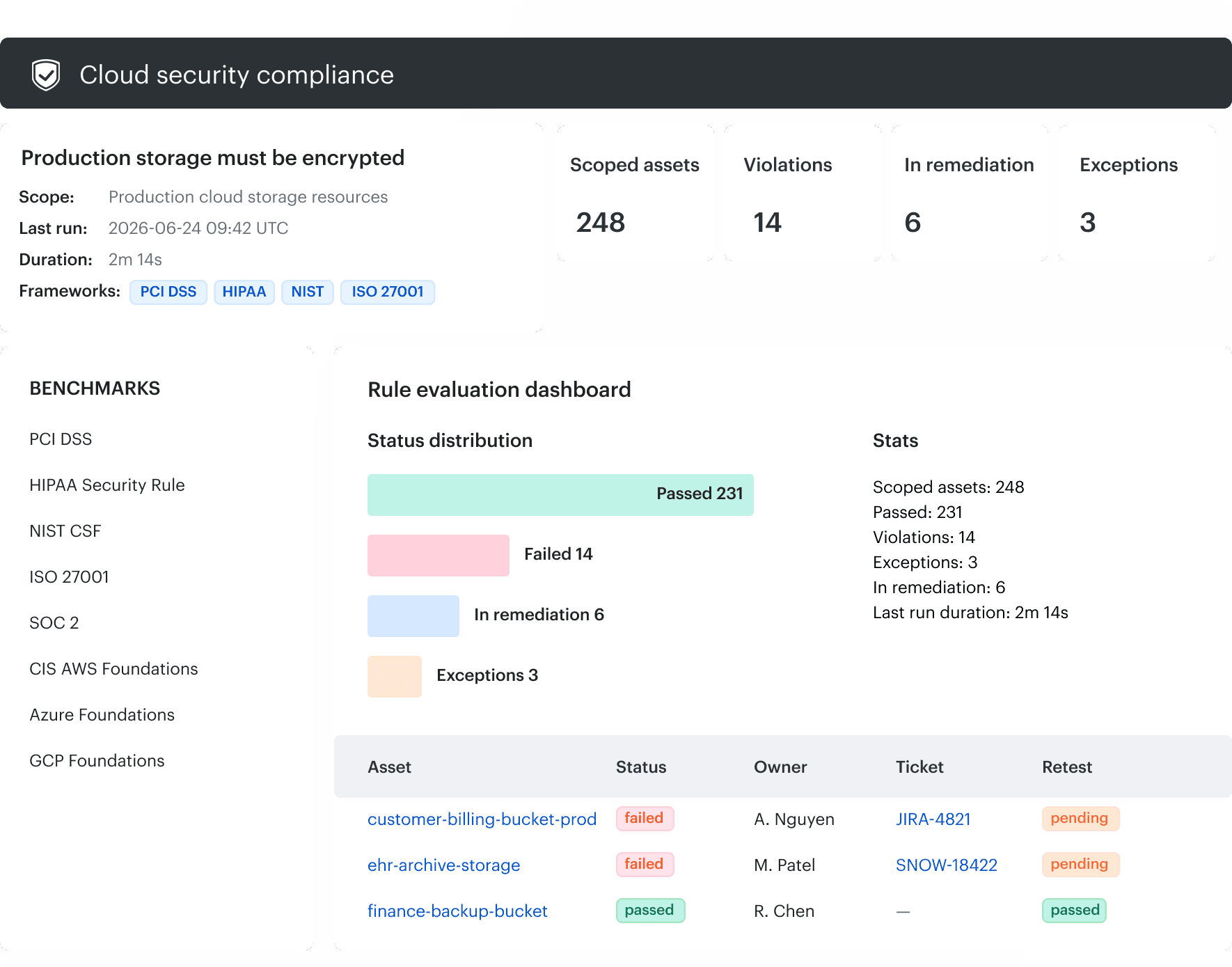 Example of how it works in Cloudaware: an exception record keeps the affected risk tied to an owner, business justification, compensating controls, and an expiration date so the risk remains reviewable.
That lifecycle belongs to cloud security governance as much as it belongs to the scanner producing the finding.
Revalidate control state after remediation
Ticket closure and control closure are different states. CSA's 2026 Continuous Audit Metrics Catalog includes 34 metrics mapped to CCM v4.1 and is designed to support more continuous measurement of control effectiveness.
That makes evidence freshness part of the control model. A resource that passed a configuration check three months ago may have drifted since then. Continuous cloud security monitoring should therefore answer whether the required technical condition still holds after remediation or configuration change.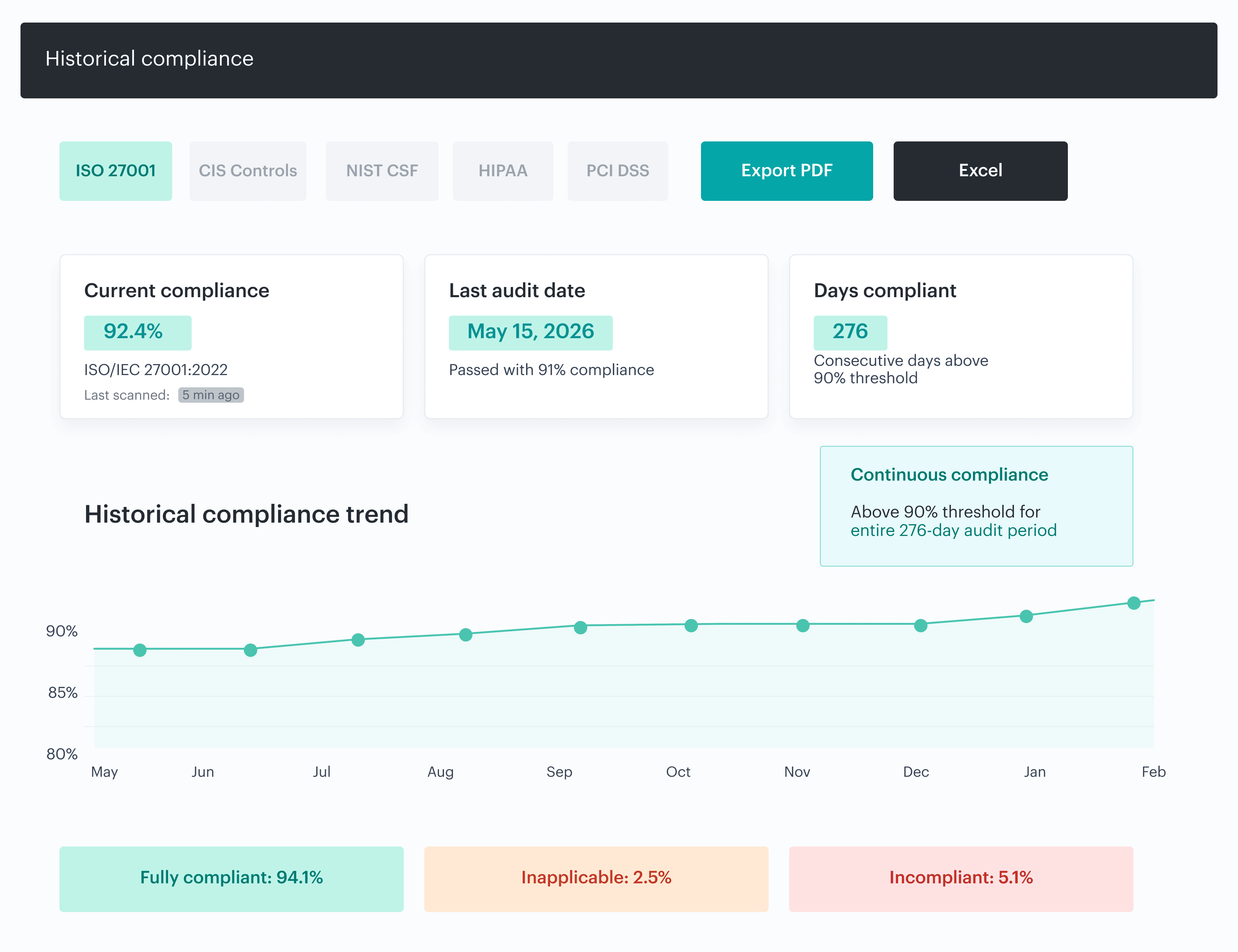 Example of how it works in Cloudaware: this way, teams can distinguish remediation in progress from a control that has passed re-evaluation.
The same verification principle supports zero-trust cloud security, where trust decisions depend on repeated validation rather than permanent approval.
How CAIQ, STAR, and framework mappings fit into CCM assurance
CCM defines control objectives. CAIQ provides assessment questions. STAR applies CSA assurance mechanisms in a broader assurance and registry program. Framework mappings relate CCM requirements to other standards. None of these, by itself, proves the current configuration of a cloud resource.
| Component | Primary role | What it does not prove |
|---|---|---|
| CCM | Defines cloud security and privacy controls | Current technical implementation |
| CAIQ | Provides questions for evaluating implementation | Resource-level technical state |
| STAR | Provides CSA assurance and registry mechanisms | Automatic CCM compliance |
| Framework mapping | Relates CCM requirements to other standards | One-to-one equivalence |
CCM v4.1 contains 207 controls, while CAIQ v4.1 contains 283 questions because one control can require several questions to assess its implementation.
Mappings require similar care. CSA's guidance describes relationships using No Gap, Partial Gap, and Full Gap classifications. A mapped ISO, NIST, CIS, or other requirement should therefore be treated as a relationship that still needs coverage analysis.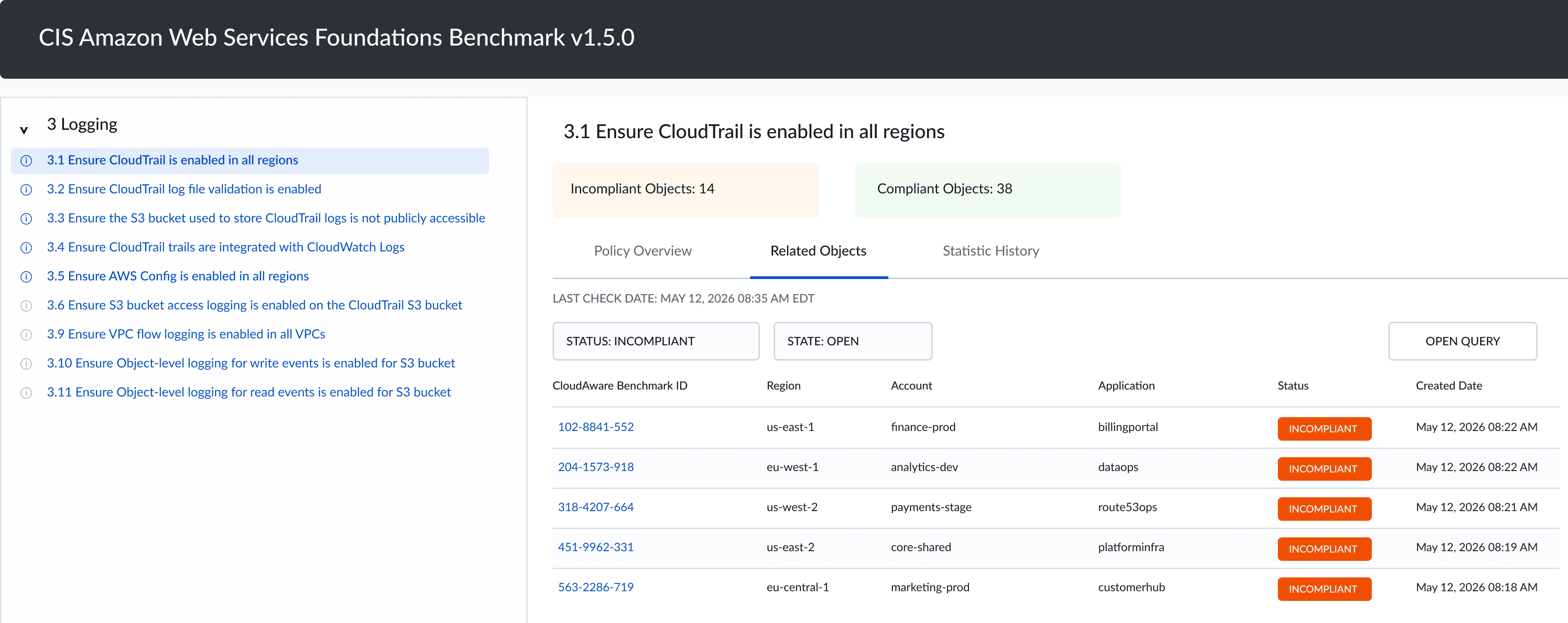 Example of how it works in Cloudaware: a framework requirement is supported by audit evidence tied to evaluated cloud resources.
For teams maintaining several cloud security frameworks, three questions keep the crosswalk operational:
- Is the mapping current for CCM v4.1?
- Does the mapping identify no gap, a partial gap, or a full gap?
- Which technical evidence proves the mapped requirement in this environment?
A framework mapping can reduce duplicate interpretation. It does not replace resource-level evaluation.
Support your CCM operating layer with Cloudaware
Once applicable CCM requirements have been translated into technical policies, Cloudaware can provide the operating context used to evaluate those policies against current cloud resources and manage the resulting findings.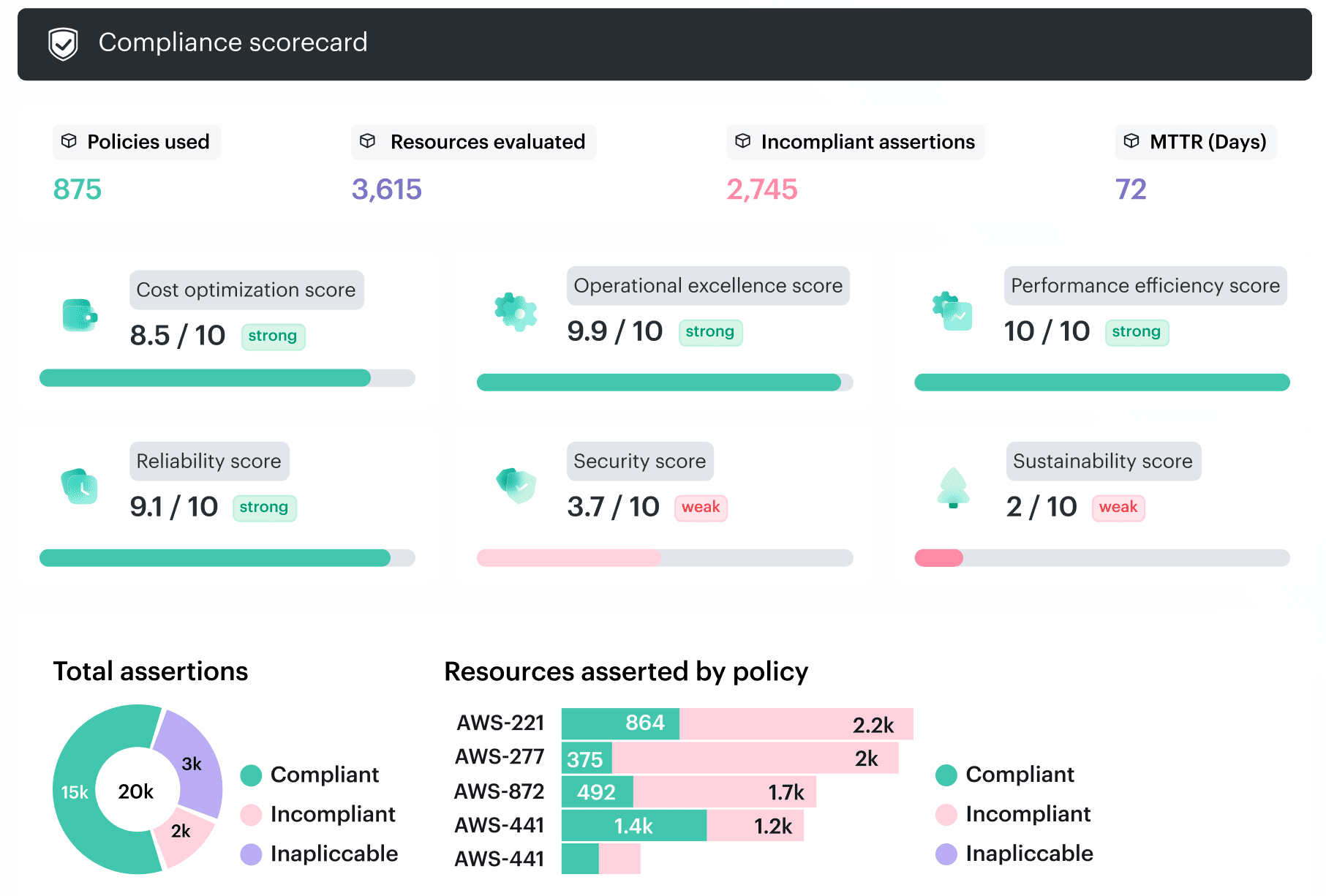 Cloudaware's Compliance Engine works against resources discovered in the CMDB, which lets the technical control lifecycle retain resource and ownership context.
- Scope technical policies: Target resources with CMDB-backed policy scoping so you evaluate the intended environment, account, subscription, location, tags, or other CMDB-defined scope
- Preserve structured findings: Keep the evaluated CMDB object, policy reference, status, timestamps, and evidence together so you can trace every finding back to the resource and observed control state
- Route findings with ownership context: Connect violations to CMDB relationships, cloud ownership, tags, and application context so the responsible team receives the finding with enough context to act
- Govern accepted risk: Record exceptions with the affected resource, reason, approver, compensating controls, and review or expiry date so accepted risk remains explicit and reviewable
- Connect remediation workflows: Route findings into Jira or ServiceNow so remediation stays linked to the policy evaluation and underlying cloud resource
- Report control posture: Review findings and evaluation results in dashboards, reports, and exports so you can see current control status across the infrastructure
The CCM remains the source of the control objective. Cloudaware connects translated technical policies to current inventory, evidence, ownership, exceptions, and remediation state.
That distinction is important at enterprise scale. A cloud security strategy can define control ownership and acceptable risk, while the operational control system still needs current resource context to determine whether the requirement is being met.