


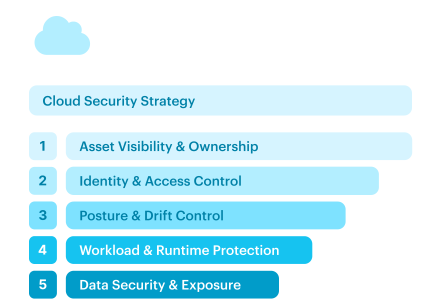
A cloud security strategy defines how cloud risk becomes owned work across AWS, Azure, GCP, Oracle Cloud, Alibaba Cloud, VMware, and on-prem systems. It maps assets to owners, environments, policies, findings, tickets, exceptions, remediation records, and audit evidence.
The problem starts when that path breaks. A scanner flags a critical CVE, CSPM shows an internet-facing workload, SIEM records suspicious activity, and ITSM routes the ticket to the wrong team because the asset owner is missing.
This guide shows how to build a cloud security strategy from the operating layer: asset scope, control paths, ownership, routing, exceptions, provider differences, evidence, and metrics.
Key insights
- A cloud security strategy defines how cloud risk becomes owned work across cloud and hybrid systems. It maps assets to owners, environments, policies, findings, remediation routes, exceptions, metrics, and audit evidence.
- Tool coverage is not the same as strategy coverage. CSPM, vulnerability scanners, SIEM, ITSM, and compliance tools each hold part of the record, but findings stay weak until they are tied to asset context, ownership, policy status, and evidence.
- Multi-cloud strategy needs normalized control intent, not identical provider implementation. AWS, Azure, GCP, Oracle Cloud, Alibaba Cloud, Kubernetes, VMware, SaaS, and on-prem systems use different structures, but the strategy should keep ownership, policy mapping, routing, and evidence comparable.
- The first 90 days should produce a working route from failed control to owner, ticket, remediation, and evidence. A roadmap that starts with controls before asset ownership will create findings that nobody can route cleanly.
- The 7 core control areas are asset visibility, identity, posture, workload, data, detection and response, and governance. Each area needs an owner, enforcement point, exception path, remediation route, and evidence requirement.
- Frameworks should support one shared control model. NIST CSF 2.0, CSA CCM, MITRE ATT&CK Cloud Matrix, ISO 27017, PCI DSS, HIPAA, SOC 2, and FedRAMP should map to common controls rather than create separate compliance backlogs.
- Metrics should measure execution quality, not dashboard volume. Useful metrics include asset coverage, owner assignment, policy evaluation coverage, mean time to route, MTTR after assignment, exception age, tickets closed with evidence, and quarterly control review completion.
What is a cloud security strategy?
A cloud security strategy defines how security decisions get made and executed across cloud environments before an incident, audit, or urgent remediation request forces the team to improvise.
A document that says “critical risks must be remediated within 7 days” is not enough. It also has to explain how severity varies with exposure, data sensitivity, exploitability, environment, and ownership. Otherwise, the strategy pushes vague urgency into a ticket queue and calls it governance.
Strategy is also not the same as policy, architecture, governance, or tooling:
| Artifact | What it does | What it does not do |
|---|---|---|
| Cloud security strategy | Defines priorities, ownership, roadmap, control path, metrics, and evidence model | Replace policies, architecture, governance, or tools |
| Cloud security policy | Documents required rules and exceptions | Decide sequencing, ownership, or measurement |
| Cloud security architecture | Defines technical design and control placement | Decide risk priorities across the program |
| Governance model | Assigns decision rights and accountability | Enforce cloud controls by itself |
| Security tools | Detect, enforce, route, or report specific issues | Create a shared operating model across teams |
Policy says what must be true, architecture shows how it can be built, governance decides who is accountable, and strategy ties those pieces to work.
Read also: 10 Best Cloud Security Tools in 2026 with Comparison, Pricing, and Reviews
Why cloud security strategy fails in multi-cloud environments
Most failures start when a finding cannot be tied to the asset, owner, environment, policy, exposure path, and remediation route.
IBM reported a USD 4.4 million global average breach cost, found that 97% of organizations with an AI-related security incident lacked proper AI access controls, and reported USD 1.9 million in savings from extensive use of AI in security compared with organizations that didn’t use those tools.
The control lesson is narrower than “use AI.” Cloud teams need faster asset classification, owner routing, containment decisions, and evidence capture before a finding becomes an incident cost center.
Tool coverage is not the same as strategy coverage
CSPM can tell you a resource violates policy. A vulnerability scanner can show package exposure. SIEM can show activity. ITSM can show whether a ticket exists. Compliance tooling can show control status.
Each tool is useful inside its boundary. The operating failure appears when no shared record carries the fields needed to act.
A finding should reach ITSM with:
- Affected configuration item
- Business owner
- Application or service
- Environment
- Exposure status
- Exception status
- Remediation SLA
- Evidence requirement
Multi-cloud asset context breaks before remediation
A multi cloud security strategy needs a normalized asset model above those provider-native structures. A customer-facing service may depend on an Azure subscription, AWS storage, Kubernetes workloads, a SaaS integration, CI/CD runners, and a private database. The strategy has to map those assets to one service owner and one control model.
If those assets don’t map back to one application owner and one service model, the security team can’t prioritize remediation or prove coverage. It can only chase fragments.
Google’s March 2026 Cloud Threat Horizons found that externally managed software vulnerabilities accounted for 44.5% of initial access vectors in tracked cloud intrusions in the second half of 2025. Weak or missing credentials accounted for 27.2%, and misconfigurations for 21%.
That data reinforces the scope problem. Cloud security strategy has to include SaaS integrations, CI/CD tools, third-party applications, OAuth tokens, and developer tooling, not only cloud provider resources.
Read also: What Is the Future of AI in Cloud Security? Trends & Benefits for 2026
How to build a cloud security strategy and roadmap
The first version of a cloud security strategy should make the environment governable. It doesn’t need to solve every control problem yet.
The first 90 days should produce one working path from failed control to owner to ticket to evidence. Below, we drop down what can be done each 30 days.
First 30 days: baseline assets, identities, and tool coverage
Start with scope. Inventory cloud accounts, subscriptions, projects, tenancies, compartments, clusters, SaaS platforms, CI/CD systems, VMware assets, on-prem systems, data stores, internet-facing services, and current tools.
Then inventory identities. Include privileged users, service principals, workload identities, break-glass accounts, API tokens, secrets, CI/CD identities, and SaaS integration users.
For 2026 programs, include AI-related assets where they exist:
- Models;
- Agents;
- Prompts;
- Data pipelines;
- Internal AI environments;
- Shadow AI use.
Google Cloud’s 2026 Cloud Next security discussion framed AI as an asset-scope expansion: models, agents, prompts, data pipelines, shadow AI, and supply chain paths become part of what security teams must inventory and control.
The first 30 days should produce an honest coverage view:
| Baseline question | Output |
|---|---|
| Which environments are visible? | Account, subscription, project, cluster, SaaS, and hybrid coverage |
| Which assets lack owners? | Ownerless CI report by environment and application |
| Which identities can change production? | Privileged and non-human identity review scope |
| Which tools cover each control area? | CSPM, scanner, SIEM, ITSM, compliance, and CMDB coverage map |
| Which assets are outside evaluation? | Coverage gaps by provider, business unit, and environment |
Days 31-60: define control areas and routing
After the baseline, define the control areas. Most cloud security strategies need identity, posture, workload, data, detection, response, and governance.
A failed CSPM check, vulnerability finding, SIEM detection, or compliance failure should not land as raw text in a shared queue. It should carry enough context for the receiving team to act. For example:
| Field | Why it matters |
|---|---|
| Asset or CI | Identifies the affected object across tools |
| Owner | Routes work to the accountable team |
| Application or service | Shows business impact |
| Environment | Changes urgency and SLA |
| Exposure | Separates internal risk from internet-facing risk |
| Data sensitivity | Connects technical risk to compliance and impact |
| Exception status | Prevents duplicate approval work |
| Required evidence | Shows what must be attached before closure |
Read also: How to Perform a Cloud Security Risk Assessment in 2026
Days 61-90: turn controls into owned work
Start with production, regulated workloads, internet-facing assets, privileged identities, and high-value services.
Define SLA tiers by severity, asset criticality, exposure, exploitability, data sensitivity, and exception status. Then require every exception to have a justification, owner, expiration date, and review record.
Metrics should start before the numbers look good, so minimum numbers to track are:
- Owner coverage
- Policy evaluation coverage
- Mean time to route
- MTTR
- Exception age
- Privileged access review
- Tickets closed with evidence
Read also: Healthcare Data Security Challenges. The 4 Biggest Threats Facing Hospitals and Health Plans in 2026
The 6-phase cloud security roadmap
A cloud security roadmap should scale from visibility to execution.
Skipping a phase is not recommended because each phase supplies the control context the next one depends on:
- If you roll out controls before asset ownership is usable, the backlog will fill with work nobody can route.
- If you measure MTTR before tickets reach the correct owners, the metric will punish the wrong team.
- If you skip a quarterly review, temporary exceptions become permanent architecture decisions.
| Phase | Goal | Output |
|---|---|---|
| 1. Baseline | See the actual environment | Asset, identity, data, and tool coverage |
| 2. Control model | Define security outcomes | Control areas, owners, and framework mapping |
| 3. Context and routing design | Attach context before work reaches ITSM | CMDB, CSPM, scanner, SIEM, ITSM, and evidence path |
| 4. Risk-based rollout | Start where impact is highest | Production, regulated, exposed, and privileged scopes |
| 5. Remediation path | Make findings owned work | Tickets, SLAs, exceptions, and closure evidence |
| 6. Quarterly review | Improve the working model | Coverage updates, aged exception review, and metric changes |
Read also: Multi-Cloud Security Architecture: Reference Model and Best Practices
The 7 pillars of a cloud security strategy
The 7 pillars are not a checklist of every possible control. They are the control areas that decide whether the strategy can run without manual reconstruction every time something fails.
A good rule: every pillar should answer four questions.
- Who owns it?
- What gets blocked or ticketed?
- How are exceptions approved and expired?
- What proves closure?
1. Asset visibility and ownership
Unknown assets don’t get remediated. They get discovered later, usually by an incident, audit, or spend review, which is a charmingly terrible discovery method.
Asset visibility is the first dependency. Discovery should cover cloud resources, Kubernetes workloads, SaaS configuration, CI/CD systems, identities, data stores, private infrastructure, and AI-related assets where they exist.
Every production asset needs:
- Owner
- Application or business service
- Environment
- Exposure status
- Data classification
- Relationship context
- Change history
- Control coverage
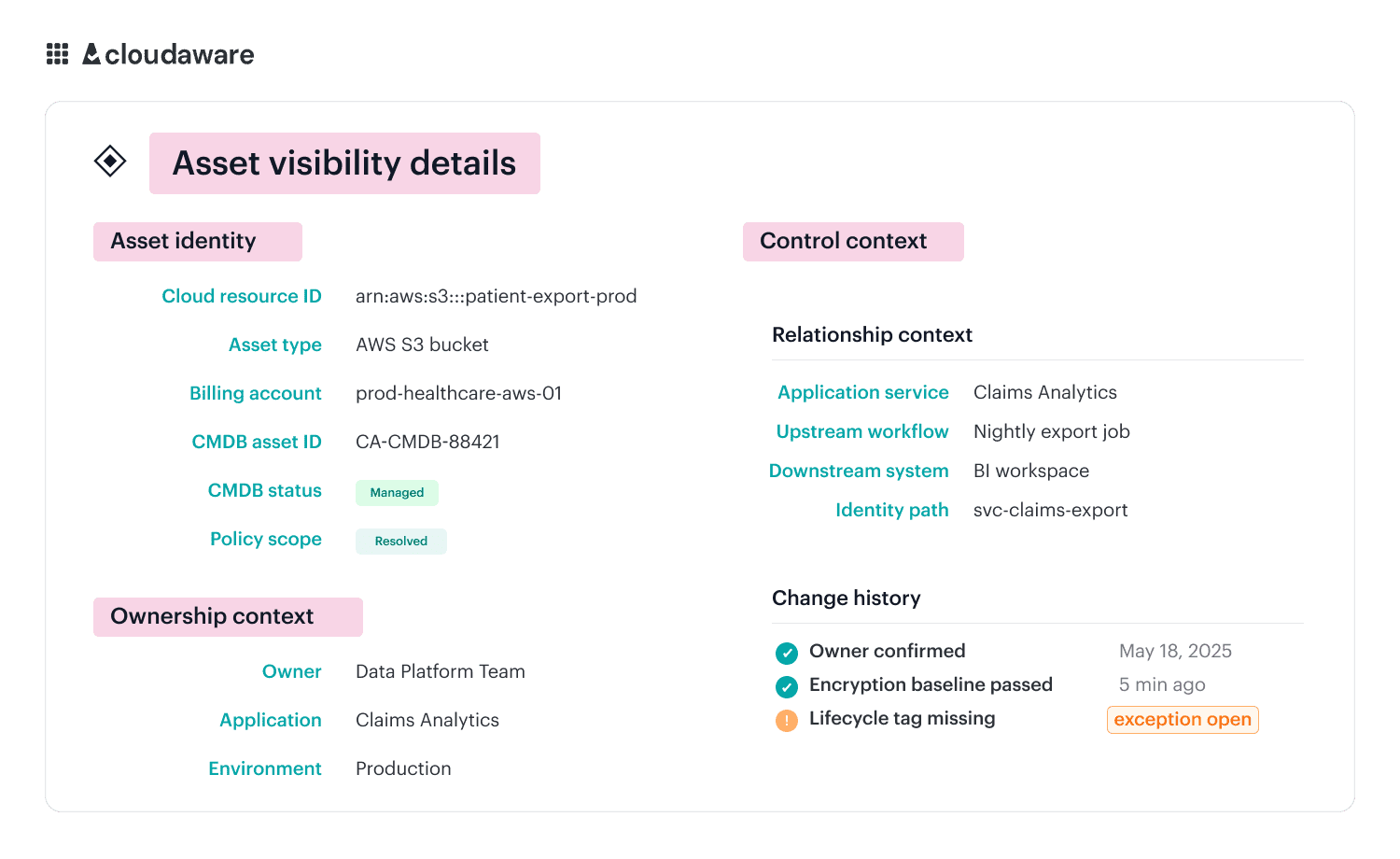 Example of asset visibility in Cloudaware: a cloud resource is tied to owner, application, environment, data class, control coverage, relationship context, and recent policy signals before findings move into remediation.
A resource that exists in billing but not in the CMDB is not a reporting issue. It is an unmanaged asset until ownership and policy scope are resolved.
2. Identity and access control
The old network perimeter can’t carry cloud trust, but identity does. Larry Biagini put this directly in the GE discussion: once the network perimeter is gone, identity becomes the new perimeter. He also highlights that enterprises need identity management structures above any single cloud provider, because security cannot depend only on each provider’s native model.
A cloud security strategy should separate human privileged access from non-human access:
| Identity type | Strategy decision |
|---|---|
| Human privileged users | Approval, least privilege, session visibility, emergency access, periodic review |
| Non-human identities | Ownership, permission boundaries, secret rotation, workload relationship |
| Service principals | Application owner, access purpose, expiration, review cycle |
| CI/CD identities | Deployment scope, environment boundary, rollback authority |
| Break-glass accounts | Approval path, logging, expiration, post-use review |
AWS IAM, Azure Entra ID, GCP IAM, Kubernetes RBAC, and SaaS roles won’t look the same. The control intent should.
3. Posture, configuration, and drift control
Posture work defines the secure baseline: cloud configuration, IaC checks, benchmark alignment, hardening rules, exception handling, and runtime verification.
The strategy should not treat every failed check equally. Some misconfigurations should block deployment. Some should create a ticket. Some can be accepted for a limited period with compensating controls.
Example: “No public storage” is a policy statement. The strategy has to define how it behaves.
| Scenario | Strategy response |
|---|---|
| Public storage in production with sensitive data | Block or urgent ticket, owner escalation, evidence required |
| Public storage in dev with no sensitive data | Ticket with lower SLA, exposure review, no data path confirmation |
| Public storage with approved exception | Validate expiration, compensating control, and evidence |
| Public storage with expired exception | Reopen as policy violation and route to owner |
4. Workload and runtime protection
Workload strategy covers VMs, containers, Kubernetes workloads, serverless functions, images, packages, and runtime exposure. A critical vulnerability on an unused development instance does not need the same route as the same CVE on a public production service that can reach a database with customer records.
Workload risk should be adjusted by:
- Deployment state
- Exploitability
- Internet exposure
- Application criticality
- Data access
- Owner readiness
- Compensating controls
- Required evidence
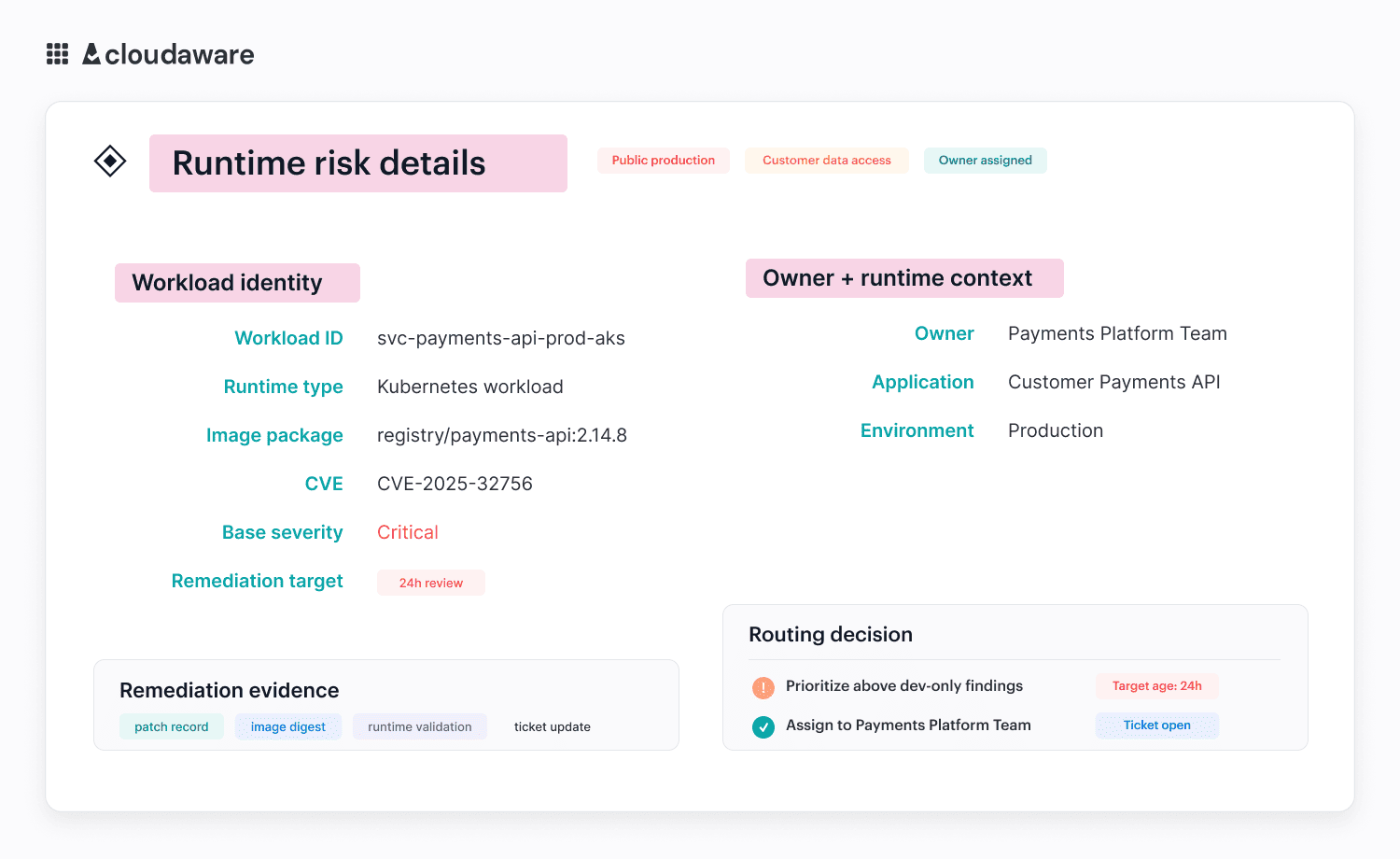 Example of runtime risk context in Cloudaware: a critical CVE is prioritized based on workload identity, production exposure, customer data access, owner assignment, remediation target, and required evidence.
If the team can’t connect those fields, the strategy will overreact to some findings and miss the ones that matter.
5. Data security and exposure control
“Encrypt at rest and in transit” is table stakes; it does not answer the hard part.
The strategy has to define which data categories require stronger controls, who owns keys, where KMS boundaries sit, when provider-managed keys are acceptable, which cloud security services can decrypt data, and what evidence proves enforcement.
| Data decision | Why it belongs in strategy |
|---|---|
| Customer-managed vs. provider-managed keys | Changes control ownership and evidence |
| Data classification | Changes access, logging, and remediation priority |
| Service access to decrypted data | Changes provider and workload risk |
| Key rotation and ownership | Changes operational accountability |
| Evidence for encryption controls | Changes audit readiness |
For regulated data, the difference between customer-managed keys and provider-managed keys may change risk acceptance, audit evidence, and incident response.
6. Detection, response, and ticketing
Detection is incomplete until it reaches the team that can act.
SIEM, SOAR, cloud-native logs, threat intelligence, and cloud detection tools should feed a response process that understands the affected asset. An alert tied to an unknown resource is slower to triage. An alert tied to a production CI with owner and data context is work.
The routing logic should be explicit. A high-severity finding in production may pass through a filter, join with CMDB data, inherit application owner and business unit, map to a case priority, check whether an active case already exists, and only then create a ticket. That sequence prevents duplicate cases and keeps assignment tied to asset context instead of raw alert text.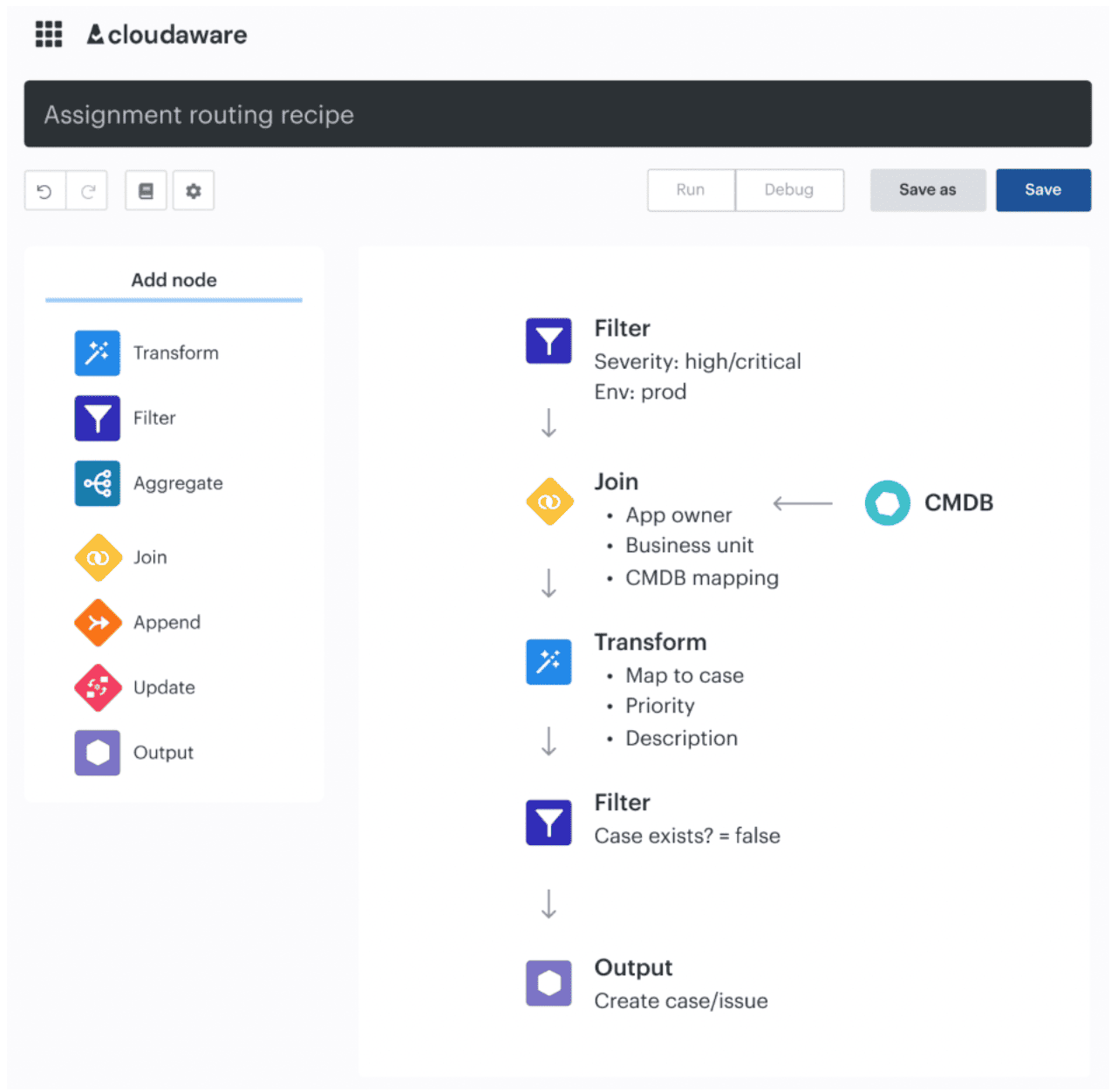 Cloudaware assignment routing workflow showing high or critical production findings filtered, joined with CMDB owner and business-unit context, transformed into case priority and description, checked for existing cases, and output as a case or issue.
AI can speed up detection and investigation, but it does not remove the routing problem. During Google Cloud’s 2026 discussion, speakers reported a 90% reduction in threat detection time from AI-assisted SOC workflows, including agent support for investigation, threat hunting, and remediation. Faster detection still needs asset context: owner, environment, priority, and evidence requirement.
7. Governance, compliance, and audit evidence
Governance is where control language gets an owner, reviewer, exception path, and escalation route. Framework mapping belongs here, but it should not create a separate control backlog for every standard.
For cloud security strategy, this includes:
- RACI
- Control ownership
- Approval rules
- Exception expiration
- Evidence requirements
- Quarterly review
- Executive reporting
NIST CSF 2.0 helps organizations manage cybersecurity risk and provides resources such as profiles, informative references, and quick-start guides.
CSA’s Cloud Controls Matrix sits inside CSA’s governance, risk, and compliance tooling for cloud control mapping.
MITRE ATT&CK’s Cloud Matrix helps detection teams map activity to cloud attack techniques rather than only compliance categories.
The rule is simple: define a shared technical control once, assign an owner, map it to applicable obligations, and collect evidence in the same place.
Multi-cloud and hybrid cloud strategy decisions architects need to make
A multi-cloud security strategy should standardize control intent. AWS, Azure, GCP, Kubernetes, SaaS, and private infrastructure all express identity, network, logging, policy, resource hierarchy, and evidence differently.
If each platform team builds its own strategy, the company ends up with multiple security programs using different languages for the same risk.
Multi-cloud strategy starts with normalized intent, not identical controls
Write the control outcome in provider-neutral terms first.
| Provider-neutral outcome | Provider-native implementation examples |
|---|---|
| Sensitive storage must not be public | AWS S3 Block Public Access, Azure Storage public access controls, GCP Cloud Storage public access prevention |
| Privileged access must be approved and logged | AWS IAM Identity Center, Azure Entra ID, GCP IAM and audit logs |
| Production workloads must emit security telemetry | CloudTrail, Azure Monitor/Sentinel, Google Cloud Logging/SCC, Kubernetes audit logs |
| Critical findings must route to owners | ITSM ticketing enriched with CMDB owner and application context |
| Exceptions must expire | ITSM/GRC exception record tied to asset and control |
| Evidence must attach to the control | API snapshot, configuration export, ticket closure, approval record |
Hybrid cloud strategy has a different visibility problem
Hybrid cloud adds systems that don’t behave like cloud-native resources. VMware workloads, on-prem databases, private network appliances, legacy identity dependencies, and private connectivity paths may still support critical applications.
If those systems are outside the strategy, cloud risk analysis is incomplete.
The important move is to connect hybrid assets to the same ownership and evidence model where possible. A legacy database doesn’t need to look like an S3 bucket. It does need an owner, business service, data classification, access path, and control record.
Otherwise, the cloud team secures the front end while the critical dependency stays undocumented behind it. This is how architecture diagrams become comforting fiction.
For private cloud environments, use the Private Cloud Data Security: How to Operate and Prove Controls Across Infrastructure guide.
AWS and Azure roadmap differences belong in execution, not strategy
An AWS cloud security strategy and an Azure cloud security roadmap will use different services. That is expected. The mistake is letting those differences split the operating model.
Example:
- Strategic requirement: privileged access must be approved, logged, reviewed, and tied to an accountable owner.
- AWS implementation: IAM Identity Center, IAM roles, CloudTrail, access review workflow.
- Azure implementation: Entra ID, privileged identity management, Azure activity logs, access review workflow.
- Shared metric: percentage of privileged access paths reviewed on schedule.
Same for posture, detection, ticketing, and evidence. If AWS and Azure teams report different metric definitions, the CISO isn’t seeing cloud risk. They’re seeing provider-specific reporting artifacts.
Read also: 10 Azure Cloud Security Best Practices for 2026
What a cloud security strategy document should contain
A cloud security strategy document should not move from draft to approval in one review round. Mikhail M., General Manager at Cloudaware, shared a practical point that matters here: review should expose operating failure before the audit does.
A useful cloud security strategy document separates decision logic from control detail. Keep the main document short enough for review. Put full benchmark mappings, policy clauses, implementation checklists, and raw control catalogs in supporting material.
One-page strategy summary
The executive summary should explain what changes because this cloud security strategy exists. It is not a motivational page. It is the decision record for scope, risk, investment, and operating priorities.
Use it to define:
- Business drivers
- Cloud and hybrid scope
- Current risk state
- 12-month security objectives
- Top control priorities
- Target maturity
- Investment assumptions
- Known constraints
For an enterprise cloud security strategy, this page should connect business risk to operational work.
Examples: unmanaged production assets, privileged access gaps, public exposure, aged exceptions, missing evidence, and audit findings that no owner can close.
Cloud security strategy template
A cloud security strategy template should give teams reusable structure without forcing every control into the main document. The main body should define decisions. The appendices should carry detail.
| Section | What it should define |
|---|---|
| Executive summary | Goals, business drivers, risk posture, scope |
| Environment scope | AWS, Azure, GCP, Oracle Cloud, Alibaba Cloud, VMware, SaaS, hybrid assets |
| Strategic principles | Shared responsibility, risk prioritization, automation posture |
| Asset and ownership model | CMDB model, owner fields, application mapping, environment tags |
| Control domains | Identity, posture, workload, data, detection, response, compliance |
| Framework crosswalk | NIST CSF 2.0, CSA CCM, MITRE ATT&CK Cloud Matrix, ISO 27017, required regulations |
| Integration architecture | CSPM, vuln scanners, SIEM, ITSM, CMDB, evidence flow |
| Roadmap | Phases, milestones, dependencies, owners |
| RACI | CloudSec, CloudOps, SOC, GRC, AppSec, platform, application teams |
| Metrics | Coverage, consistency, response, resilience, governance |
| Exception model | Approval, expiration, compensating controls, evidence |
| Review cadence | Quarterly review and annual framework refresh |
Roadmap page for engineering and security teams
The roadmap page converts the strategy into work. It should show milestones, owners, dependencies, tooling changes, control rollout, remediation SLA, evidence outputs, and operational metrics.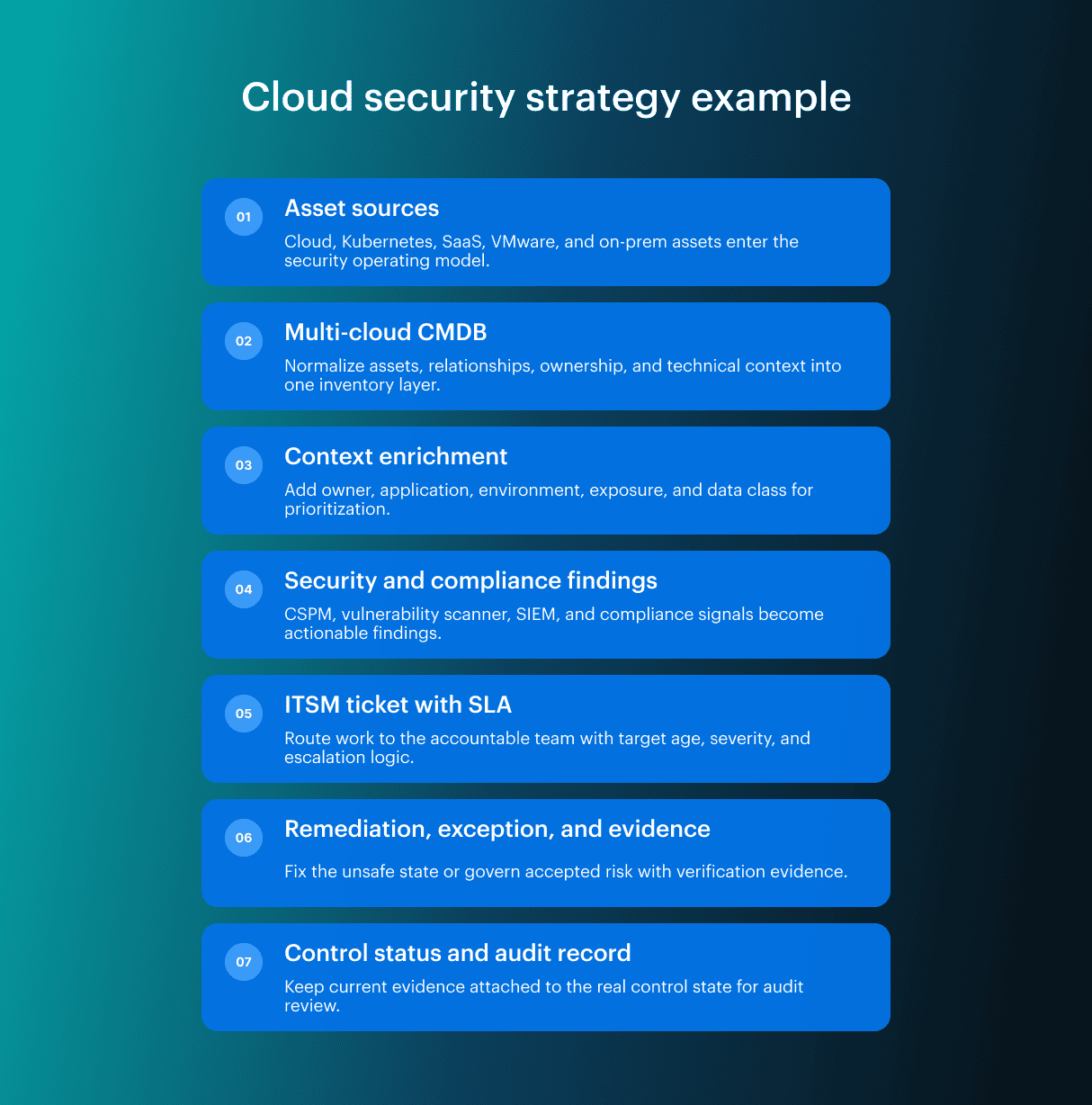 A cloud security roadmap should define sequencing criteria. Each item needs a reason for its position: production impact, internet exposure, data sensitivity, privileged access, regulatory scope, owner readiness, and dependency on tooling or policy.
For example, production asset coverage should come before lower-environment cleanup because every downstream metric depends on knowing which production resources exist and who owns them. Privileged access review should come before broad IAM refactoring because standing admin paths can change controls, disable logging, or approve risky exceptions. Internet-facing workload remediation should precede internal posture cleanup when exposure provides a direct path to production data.
The roadmap should make dependencies visible:
- Which asset groups are in scope
- Which owner fields must be complete
- Which policy or CSPM rule triggers the finding
- Which ITSM queue receives the ticket
- Which SLA applies by environment and exposure
- Which evidence is required before closure
- Which exceptions must expire or be reviewed
Read also: 9 Reasons Cloud Security Posture Management Matters in 2026
Cloud security strategy example: integration hub model
A useful cloud security strategy example starts with the asset record, not the alert.
The central record should carry provider, account or subscription, resource ID, application, owner, environment, exposure, data sensitivity, relationships, exception status, recent changes, and evidence links.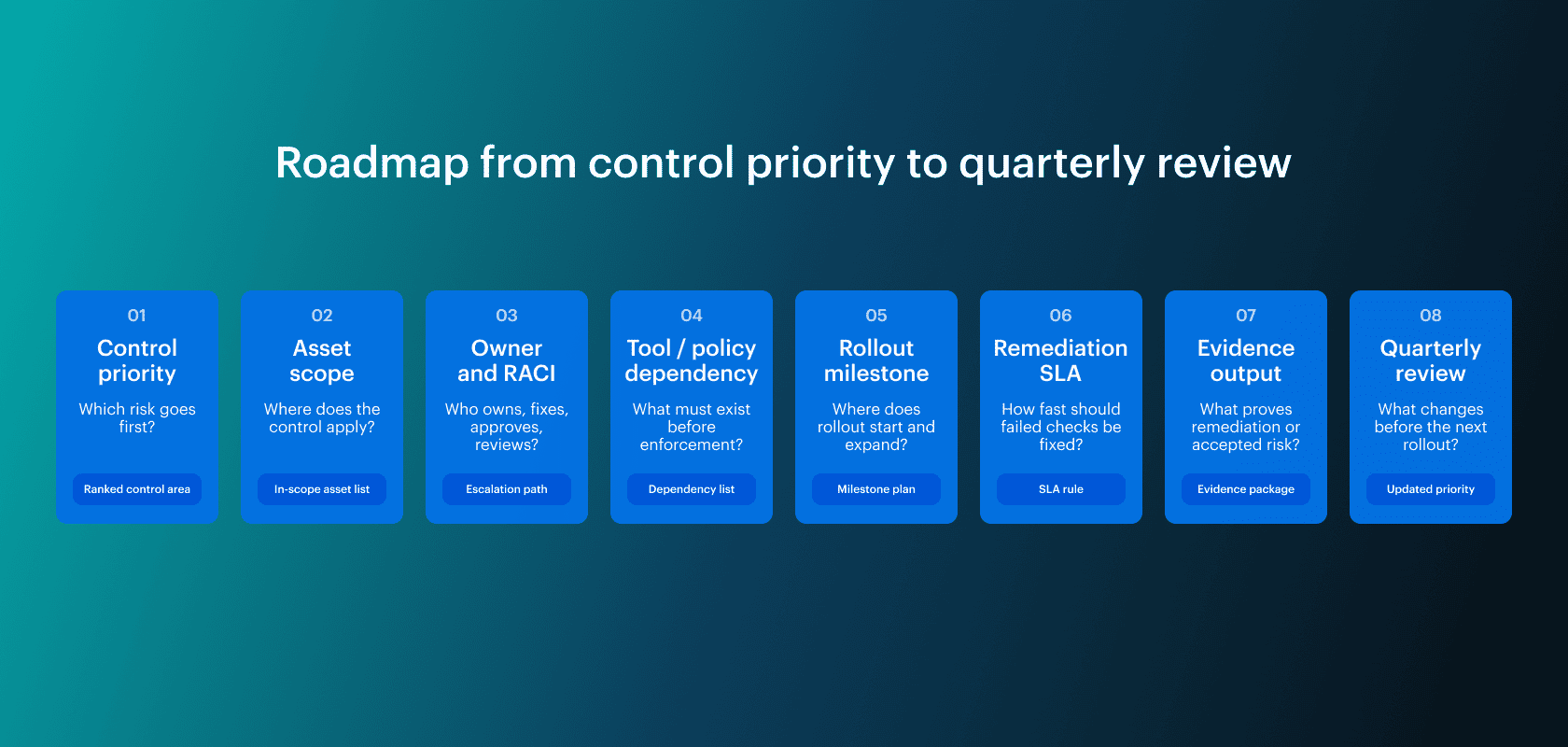 A public-storage example:
- CSPM flags public access on a storage resource.
- CMDB maps the resource to a production customer-facing service.
- The asset record shows regulated data classification and no active exception.
- ITSM routes the ticket to the application owner.
- SLA is set by exposure and data sensitivity.
- Remediation changes the storage configuration.
- Closure records configuration evidence, ticket history, and control mapping.
Read also: Cloud Security Threats in 2026. Top Risks & How to Defend
Framework crosswalk for cloud security strategy
A cloud security strategy should use frameworks for four things:
- Control domains
- Evidence expectations
- Risk language
- Reporting structure
Do not manage a separate control set for every framework. That creates duplicate work, conflicting owners, and evidence gaps. Map one technical control to every framework or regulation it supports.
How to use frameworks without duplicating controls
| Framework or regulation | Strategy use | What it helps answer |
|---|---|---|
| NIST CSF 2.0 | Program-level structure | Are governance, protection, detection, response, and recovery covered? |
| CSA CCM | Cloud-specific control mapping | Which cloud controls apply across providers and service models? |
| MITRE ATT&CK Cloud Matrix | Threat-informed detection | Which cloud attack techniques should detection cover? |
| ISO 27017 | Cloud control guidance | Which cloud-specific responsibilities need formal controls? |
| PCI DSS | Payment environments | Which workloads and evidence paths affect cardholder data? |
| HIPAA | Healthcare workloads | Which systems touch PHI and require stronger controls? |
| SOC 2 | Customer assurance | Which controls support trust and audit readiness? |
| FedRAMP | Federal cloud workloads | Which controls require stricter authorization and monitoring? |
Example: storage containing regulated data must not be publicly exposed. That control may support PCI DSS, HIPAA, SOC 2, and internal security policy at the same time. The implementation differs by provider, but the evidence path should be the same: asset record, policy evaluation result, exception state, remediation ticket, and current configuration proof.
That is what an effective cloud security strategy for enterprise teams needs from frameworks. Not more spreadsheets. Control mapping that engineering can enforce and audit can trace.
Read also: Popular DevSecOps Frameworks for Cloud Security in 2026
Metrics that show whether the strategy is working
Start by removing weak metrics. Total finding count is not enough. A higher count may mean coverage improved. A lower count may mean scans broke, assets fell out of scope, or exceptions suppressed work.
Coverage metrics
Coverage metrics show whether the strategy applies to the real environment.
| Metric | What it verifies |
|---|---|
| % of cloud accounts, subscriptions, projects, clusters, and SaaS platforms discovered | Asset inventory coverage |
| % of assets with owner, application, and environment assigned | Owner mapping and routing readiness |
| % of assets included in policy evaluation | Control coverage |
| % of internet-facing assets with risk classification | Exposure-aware prioritization |
Control consistency metrics
Control consistency metrics show whether the same intent holds across providers.
| Metric | What it verifies |
|---|---|
| % of baseline controls mapped across AWS, Azure, GCP, Kubernetes, and hybrid assets | Shared control intent |
| Number of policy exceptions by provider and environment | Accepted-risk distribution |
| Average exception age | Long-lived risk acceptance |
| Configuration drift rate by control domain | Runtime state after approval |
Response and remediation metrics
Response metrics show whether detection turns into owned work.
| Metric | What it verifies |
|---|---|
| MTTD | Detection speed |
| Mean time to route | Assignment path quality |
| MTTR after assignment | Remediation speed after ownership is clear |
| % of high-risk findings with assigned owner | Accountability for critical work |
| % of overdue remediation tickets | SLA failure |
| % of tickets closed with evidence | Verified closure |
Governance and evidence metrics
Governance metrics show whether decisions are traceable.
| Metric | What it verifies |
|---|---|
| % of controls with assigned owner | Control ownership |
| % of findings with documented exception or remediation state | Decision traceability |
| % of audit evidence collected automatically | Evidence continuity |
| Quarterly control review completion rate | Review cadence |
For a top cloud security strategy for enterprise teams, evidence should stay attached to the asset, finding, exception, ticket, and control record. Evidence rebuilt after the audit request is weak evidence. It may pass a review. It will not survive a serious incident reconstruction without wasting everyone’s week, because apparently time is infinite now.
Read also: 10 Cloud Data Security Challenges That Slow Down Multi-Cloud Programs
How Cloudaware supports a cloud security strategy
Cloudaware helps close that operational gap by connecting discovered assets to CMDB context. Native cloud controls, SIEM, IAM, vulnerability scanners, ITSM, and GRC processes keep their roles, while Cloudaware adds the asset, owner, application, environment, and policy context needed to make a cloud security strategy executable.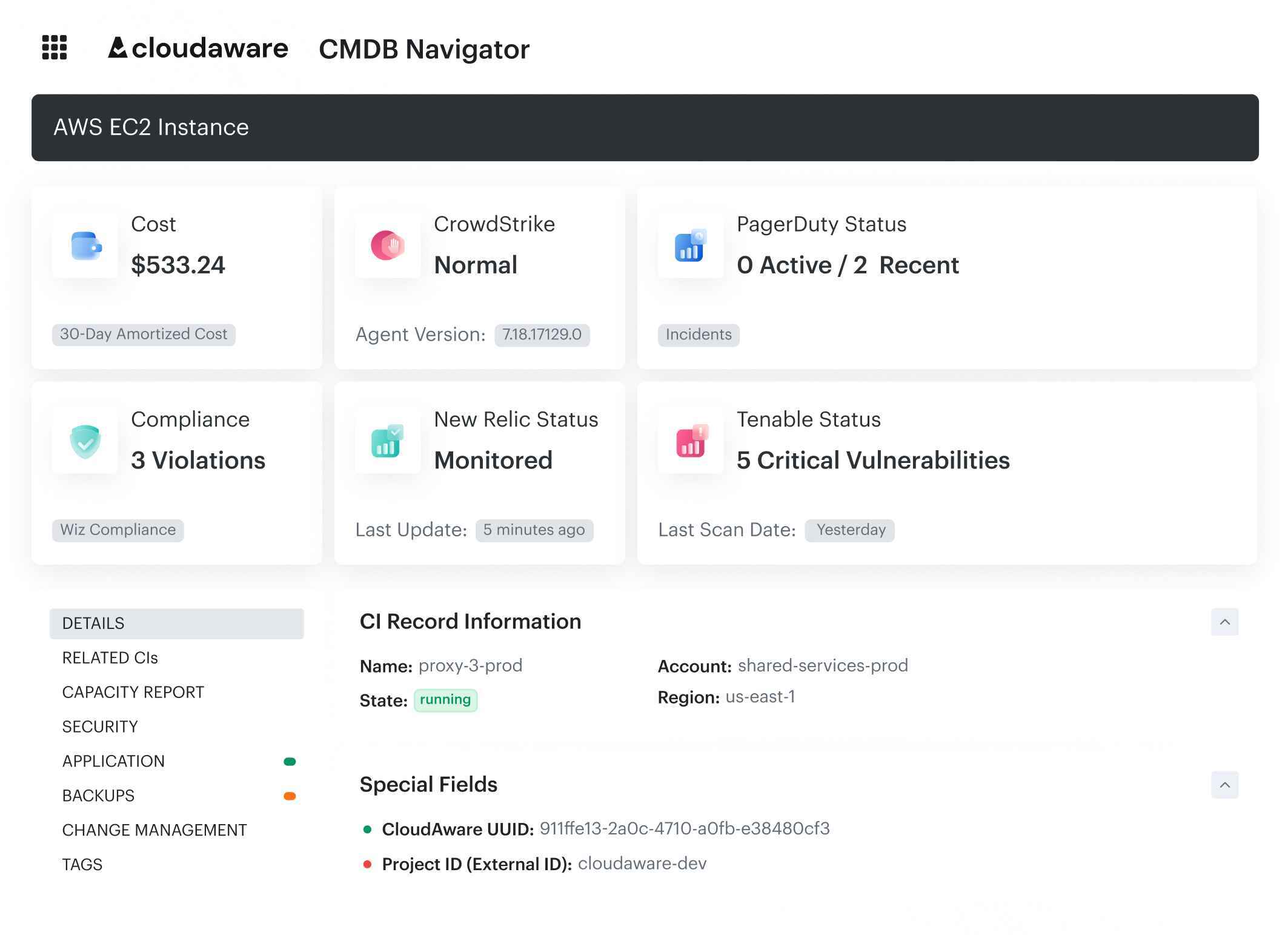 Core capabilities:
- Multi-cloud CMDB. Build the strategy on governed asset records across AWS, Azure, GCP, Oracle Cloud, Alibaba Cloud, VMware, and on-prem environments. Link each resource to owner, application, environment, relationships, and operational context before using it in policy evaluation, remediation, or audit review.
- Asset ownership and application mapping. Require every governed asset to carry ownership and service context. Use those fields to route failed checks to the team that can fix them, instead of sending CSPM findings, vulnerabilities, or policy violations into a shared queue with no accountable owner.
- Policy evaluation against CMDB data. Run policy checks against tracked infrastructure resources and create violations when assets fail required conditions. This turns policy from approved language into tested control logic tied to real assets, environments, and remediation paths.
- Framework mapping and audit evidence. Connect operational controls with PCI DSS, HIPAA, NIST, ISO, GDPR, CIS Benchmarks, and other required references.
- Exception and suppression governance. Keep exceptions tied to asset scope, owner, justification, expiration date, compensating control, and remediation state. Treat expired exceptions as failed controls, not as permanent permission to ignore the same risk every
- Workflow routing through Jira, ServiceNow, and ServiceDesk. Send failed checks, policy violations, and exception tasks into existing workflows with CMDB context attached. The ticket should explain what failed, where it lives, who owns it, which SLA applies, and what evidence is required before closure.