


Most cloud teams already “do DevSecOps.” Fewer can prove which model they follow when the board, auditor, or federal buyer asks.
DevSecOps frameworks for cloud security are structured operating models that turn secure SDLC, software supply chain security, shift-left controls, runtime monitoring, and continuous compliance into repeatable evidence across AWS, Azure, GCP, Kubernetes, and hybrid infrastructure.
The hard part is not naming the usual suspects. NIST SSDF plus 800-204, OWASP SAMM and DSOMM, BSIMM, DoD DevSecOps, CSA, and MITRE ATT&CK Cloud all look useful on a slide.
- But which one survives contact with a messy cloud estate?
- Which gives engineers a maturity path instead of another policy PDF?
- Which helps security prove that pipeline gates, asset ownership, SBOMs, and cloud controls actually exist?
That is what this guide unpacks: the comparison matrix, maturity lens, and operationalization path CISOs can use without pretending one framework solves everything.
Key insights
- Popular DevSecOps frameworks for cloud security are not interchangeable. NIST SSDF gives regulated teams a secure development baseline. OWASP SAMM and DSOMM help you measure maturity. BSIMM shows how your program compares to real-world peers. DoD DevSecOps gives the most concrete software factory blueprint. CSA plus MITRE ATT&CK Cloud adds cloud-native threat context.
- NIST SSDF is the safest default when procurement, audit, or federal buyers are in the room. It gives CISOs clean language for secure SDLC, SBOMs, artifact protection, vulnerability response, and attestation-style evidence. Pair it with the NIST SP 800-204 series when microservices, service mesh, and cloud-native delivery enter the picture.
- SAMM and DSOMM are better when the question is maturity, not compliance. SAMM shows where the software security program stands across governance, design, implementation, verification, and operations. DSOMM gets closer to the delivery floor: automation, feedback loops, build controls, security culture, and what still depends on humans remembering to do the right thing.
- BSIMM is useful when leadership wants peer reality, not a theoretical target state. It does not tell you exactly what to implement next. It shows what mature software security programs actually do, which makes it valuable for board conversations, budget defense, and “are we behind?” moments.
- The DoD Enterprise DevSecOps Reference Design is the heavy blueprint. Most commercial teams should not copy it end to end. Still, its hardened pipeline, Iron Bank container model, continuous ATO logic, and software factory patterns show what good looks like when cloud delivery needs serious assurance.
- CSA and MITRE ATT&CK Cloud make DevSecOps threat-informed. CSA gives cloud operating principles. MITRE shows how attackers move through identity, workloads, exposed services, credentials, and control planes. Together, they help teams ask a better question: which cloud attack path does this control interrupt?
- Framework adoption only counts when it reaches the estate. A CISO does not need another slide saying “we align to NIST.” They need policy coverage, asset visibility, owner mapping, drift detection, remediation status, exception age, and evidence across AWS, Azure, GCP, Kubernetes, and hybrid infrastructure.
“When we talk to CISOs, the question is no longer ‘Should we do DevSecOps?’ — it’s ‘Whose definition of DevSecOps will we be audited against?’ That’s why frameworks matter: they give your security program a noun the board can write down.”
What is a DevSecOps framework for cloud security?
A DevSecOps framework for cloud security is an operating model that tells teams how security gets built, tested, approved, monitored, and proven across cloud delivery. Not as a slogan. As evidence. Think secure SDLC, pipeline security, policy as code, runtime checks, ownership, exceptions, and audit trails working across AWS, Azure, GCP, Kubernetes, and hybrid infrastructure.**
That distinction matters.
A general security program can say, “We have controls.” A DevSecOps program has to answer a sharper question: where exactly does this control run in the delivery path, who owns the failure, and how do we prove it happened before production changed?
For a more comprehensive overview of governance, refer to our guide on [cloud security frameworks]. In this section, we focus specifically on the DevSecOps models that security leaders utilize to enhance the safety of cloud delivery without delaying each release for committee discussions.
Why “framework” matters more in the cloud than on-prem
On-prem had a hidden security feature: friction.
Servers needed procurement. Network changes needed tickets. Access requests moved slowly enough for someone to notice. Cloud broke that pattern, mostly in useful ways. Now a Terraform change can alter IAM permissions, expose a storage bucket, update a container image, and push a production deployment before lunch.
That is not a process problem anymore. It is a visibility problem with process consequences.
A framework gives CISOs a common contract for fast-moving teams. It defines what must happen before code ships, what gets checked automatically, where guardrails stop unsafe changes, and which evidence supports continuous compliance later.
A useful way to frame it: “Shift-left only works when security has somewhere to land. In cloud, that place is the delivery workflow, not a policy PDF.” Without that, popular DevSecOps frameworks for cloud security become wall art. Nice names. No operating teeth.
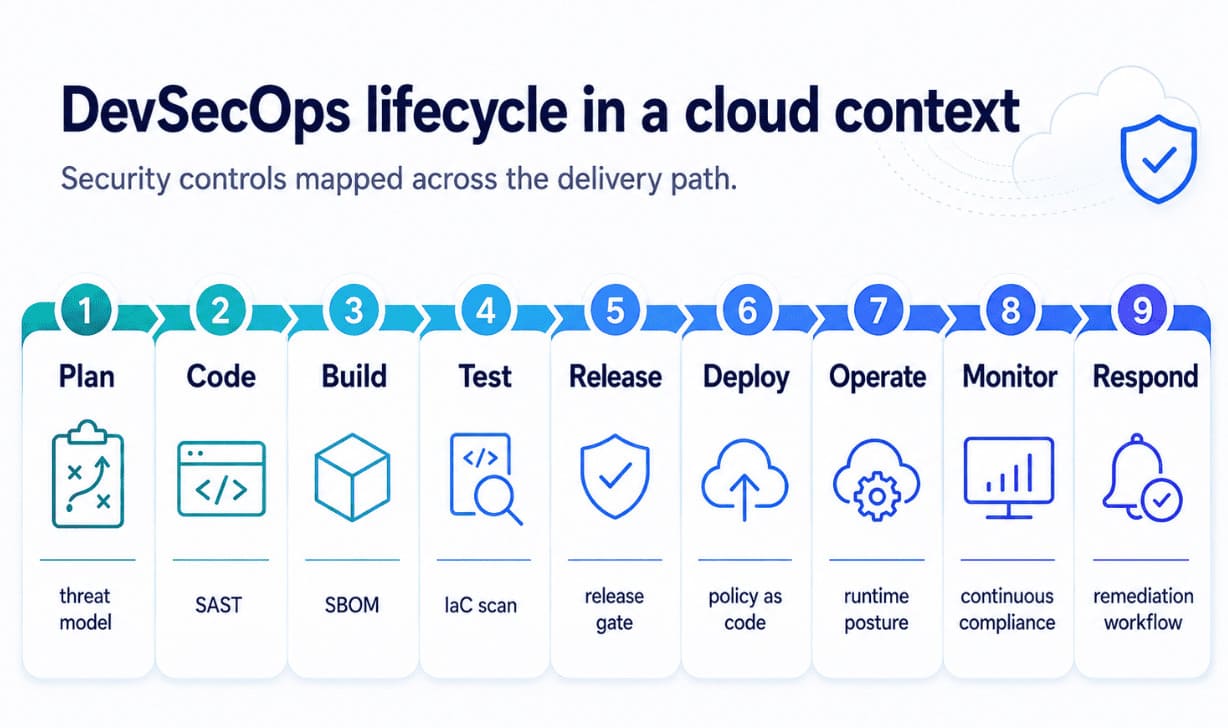
Where devsecops frameworks for cloud security show up in the lifecycle
Cloud DevSecOps does not live in one tool. It moves through the delivery chain.
- Plan starts with threat modeling, ownership, and architecture rules.
- Code brings SAST, secrets detection, dependency checks, and secure patterns.
- Build adds SBOMs, signed artifacts, and container image scanning.
- Test validates IaC, policy as code, and misconfiguration risks. Release uses gates and approvals.
- Deploy applies guardrails in real accounts, subscriptions, projects, and clusters.
- Operate watches drift.
- Monitor collects evidence.
- Respond routes findings back to the owner before “temporary exception” becomes production architecture.
Framework vs. standard vs. control catalog
This is where many teams quietly get tangled.
A framework is not always a compliance requirement. A standard is not always a maturity model. A control catalog does not tell your teams how to run DevSecOps day to day.
| Term | The question it answers | Cloud security example | What CISOs do with it |
|---|---|---|---|
| Framework | How should the program operate? | OWASP SAMM, OWASP DSOMM, DoD DevSecOps | Set maturity, roles, workflow, and cadence |
| Standard | What must we satisfy or align to? | NIST SSDF, ISO 27001, PCI DSS | Define obligations, reporting, and evidence needs |
| Control catalog | Which checks prove the requirement? | NIST 800-53, CIS Controls | Map controls to assets, owners, pipelines, and findings |
The mature move is not choosing one label and forcing it to do every job. Use a framework to shape the program, a standard to anchor obligations, and a control catalog to prove the work happened in the real cloud estate.
Top 5 popular DevSecOps frameworks, explained
This list is based on two inputs: the formal framework documentation and what Cloudaware teams see when mid-size and enterprise clients try to make DevSecOps work across AWS, Azure, GCP, Kubernetes, and hybrid infrastructure.
Valentin Kel and Igor K. see the engineering side of this in practice: pipelines, integrations, asset data, noisy findings, and ownership gaps. Our clients provide the other half of the story: audit pressure, fragmented tooling, board reporting, and the very real problem of proving that security controls actually ran before production changed.
So no, this is not “five logos to put on a slide.”
These are the five popular DevSecOps frameworks for cloud security CISOs usually end up comparing when they want secure cloud delivery to become repeatable:
- NIST SSDF plus NIST SP 800-204 series
- OWASP SAMM plus OWASP DSOMM
- BSIMM
- DoD Enterprise DevSecOps Reference Design
- CSA DevSecOps Pillars plus MITRE ATT&CK for Cloud
Each one answers a different leadership question. What should secure software development include? How mature are we? What are peers doing? What does a hardened software factory look like? How do we make cloud DevSecOps threat-informed?
NIST SSDF (SP 800-218) and the NIST SP 800-204 series
NIST SSDF is usually the first serious stop for U.S. enterprises, regulated software teams, and vendors selling to federal or federal-adjacent buyers—because procurement, audit, legal, and security can all point to it without a translation layer. The source is NIST SP 800-218 v1.1, published February 2022, designed to fold secure development practices into whatever SDLC a team already runs.
One 2026 caveat worth naming up front: EO 14028 pushed SSDF into federal conversations, and OMB M-22-18 made attestation operational. OMB M-26-05 has since rescinded both M-22-18 and M-23-16 as government-wide requirements, shifting agencies toward risk-based software and hardware assurance.
That does not erase SSDF — it sharpens its role as the practical language teams use to explain secure SDLC, SBOMs, supply chain controls, and attestation evidence without sounding improvised.
Core idea
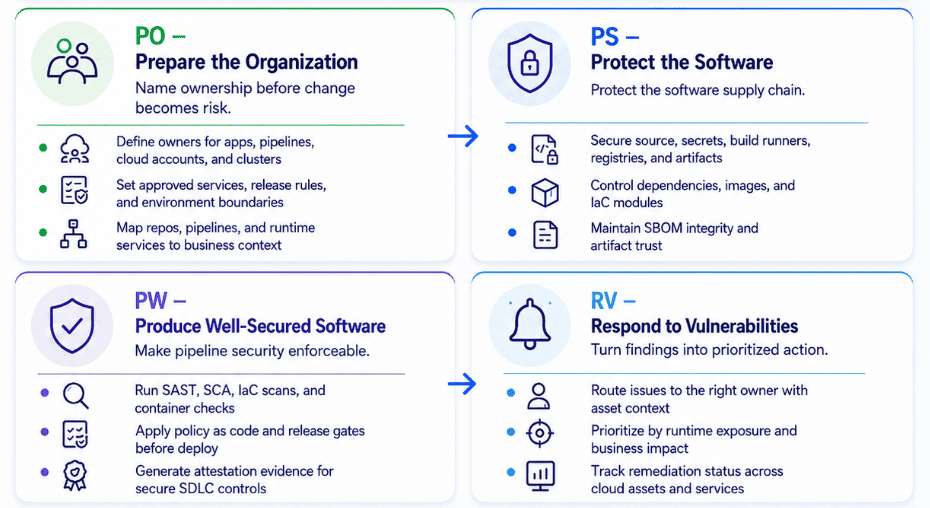
SSDF says secure software comes from repeatable practices, not heroic cleanup after release. Its four practice groups:
| SSDF group | Plain-English meaning | Cloud delivery translation |
|---|---|---|
| PO: Prepare the Organization | Set up people, roles, tooling, processes | Name owners for apps, pipelines, cloud accounts, clusters, repos, release paths |
| PS: Protect the Software | Keep code and artifacts from tampering | Protect source, secrets, build runners, registries, IaC modules, images, dependencies |
| PW: Produce Well-Secured Software | Build and test securely before release | SAST, SCA, IaC scanning, container checks, SBOM generation, policy-as-code, release gates |
| RV: Respond to Vulnerabilities | Find, analyze, fix, learn | Route findings to the right owner with asset context, runtime exposure, remediation status |
Why it works for cloud delivery
Cloud delivery does not separate "software" from "infrastructure." A single PR can change app code, Terraform, IAM, K8s manifests, images, secret references, and API exposure in one release.
So SSDF stops being a checklist and becomes a way to ask whether the delivery path itself is controlled:
- Ownership before incidents (PO),
- Software supply chain integrity (PS),
- Pipeline gates that actually block (PW),
- Vulnerability response that handles a bad package showing up in 18 images across 4 clusters with different owners (RV).
Where SSDF gets thin for cloud-native teams, the SP 800-204 series picks up: 204A on microservices and service mesh, 204B on AuthN/AuthZ in a mesh, and 204C on DevSecOps primitives for cloud-native pipelines—much closer to how modern teams actually ship.
Where SSDF stops: SSDF gives you the operating language. It will not discover your cloud estate. It will not tell you that a production workload has no owner, that a build runner has excessive permissions, or that an old GCP project still deploys through a pipeline nobody reviews. That is the boundary of the framework, not a flaw in it.
CISO takeaway: SSDF is a strong default for U.S. enterprises and federal-facing vendors. Pair it with the SP 800-204 series when your architecture is cloud-native. Then map it to the live estate, not the policy binder.
OWASP SAMM and OWASP DSOMM
OWASP SAMM and OWASP DSOMM are the pair to reach for when the room is done debating “do we do DevSecOps?” and starts asking the better question: how mature are we, really?
The source of truth here is OWASP. SAMM, the Software Assurance Maturity Model, is an OWASP flagship project for assessing and improving software security programs.
OWASP lists the current SAMM version as 2.0.3, released in 2022.
DSOMM, the DevSecOps Maturity Model, is also an OWASP project and focuses more directly on security inside DevOps workflows, automation, and delivery practices.
Origin and authority
SAMM matters because it gives security leaders a maturity backbone without forcing every team into the same mold.
It breaks software security into five business functions:
- Governance,
- Design,
- Implementation,
- Verification,
- and Operations.
Inside those sit three security practices per function, giving the model 15 practices total. Each practice can be scored across four maturity levels, from early, inconsistent activity to more defined, measured, and optimized behavior.
That structure is useful for CISOs because it creates a roadmap. Not a vibe check.
DSOMM is more tactical. It gives engineering-led organizations a faster way to self-score DevSecOps maturity across areas like Build & Deployment, Culture & Organization, Implementation, and Information Gathering. Bring it into a workshop with DevSecOps, platform, cloud security, and one app team. In 90 minutes, you can usually see where the security culture is real, where the automation level is still mostly manual, and where feedback loops quietly die after deployment.
Core idea
| SAMM asks, “How mature is our software security program?” | DSOMM asks, “How much of that maturity actually shows up in the way we build, ship, and operate software?” |
|---|
That is the reason this pair shows up in conversations about devsecops frameworks for cloud security. SAMM gives leadership the maturity model. DSOMM gives the delivery teams a mirror.
How it maps to cloud delivery specifically
Cloud makes maturity painfully visible. A team can have a secure coding policy and still deploy Terraform with broad IAM permissions. Another team may run dependency checks but skip container image gates. A third team may scan IaC beautifully, then leave runtime findings floating because nobody mapped the workload to an owner.
SAMM helps organize the cloud delivery conversation:
| SAMM function | What the CISO sees | What cloud teams must prove |
|---|---|---|
| Governance | Risk ownership and policy direction | Accounts, clusters, apps, and exceptions have owners |
| Design | Secure architecture before build | IAM, APIs, data flows, and Kubernetes patterns are reviewed |
| Implementation | Secure engineering habits | Secrets, dependencies, IaC modules, and images are controlled |
| Verification | Testing before release | SAST, SCA, IaC scans, container checks, and gates run in CI/CD |
| Operations | Security after deploy | Runtime drift, vulnerabilities, monitoring, and remediation feed back into delivery |
DSOMM turns that table into a working session. Ask the team four blunt questions:
- What security checks block a risky release?
- Which controls only alert after production changed?
- Where does evidence live when audit asks?
- Who gets the finding when the asset owner is missing?
That is usually where the truth comes out.
Strengths
| SAMM is strong because it lets CISOs compare maturity across teams without pretending all applications carry the same risk. A public payments API should not be scored like an internal reporting widget. Different target maturity. Different control depth. Same model. | DSOMM wins with engineering teams because it speaks closer to their day: builds, deployments, automation, logs, feedback, and implementation gaps. No one has to sit through a 40-page compliance lecture before the model becomes useful. |
|---|
The best part? It gives you a practical first step. Score one application delivery path from plan to production. Then score the same path again after you add pipeline gates, ownership routing, and runtime feedback. Progress becomes visible.
Limitations and what it leaves out
- SAMM can look better on paper than it does in the cloud. Self-assessments are risky that way. A team says “Level 2 verification,” but the GKE workload running customer data never passed image policy.
- DSOMM can swing too far into tactics. Great for engineers. Harder for board reporting unless someone rolls the results into a maturity story the business can understand.
- Neither model discovers forgotten cloud assets. Neither maps every repo to a service, every pipeline to a runtime workload, or every exception to an expiration date.
So use them together. SAMM sets the maturity direction. DSOMM pressure-tests the delivery reality. The operating layer underneath still has to connect the model to cloud assets, owners, controls, and evidence. That is where maturity stops being a score and starts changing how releases happen.
BSIMM (Building Security In Maturity Model)
BSIMM is the framework to understand what other security teams are actually doing, not what some standards committee thinks you should be doing. That distinction is the entire reason it has lasted as long as it has.
Origin and authority
BSIMM started in 2008 as a research project at Cigital, led by Gary McGraw, Sammy Migues, and Brian Chess. The premise was unusual at the time: instead of writing another prescriptive guide, go look at how real software security programs operate, write it down, and let the data speak. Cigital was acquired by Synopsys in 2016. When Synopsys spun off its Software Integrity Group in 2024, the model moved under Black Duck, which now maintains the research.
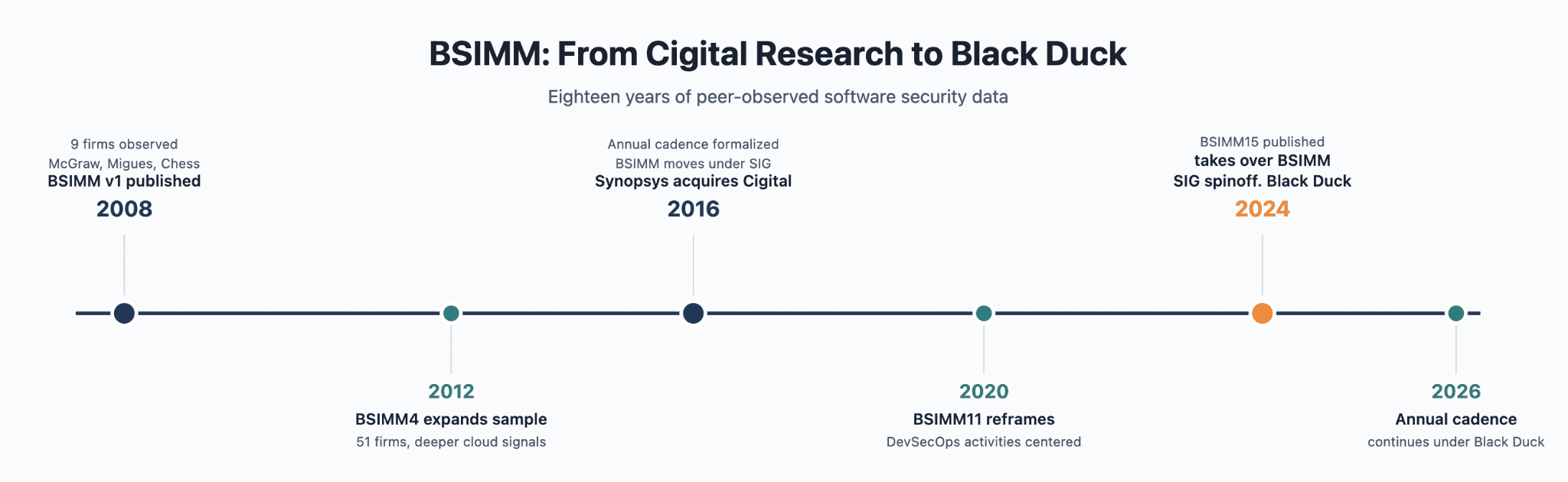
New editions come out about every year. That cadence is part of why CISOs trust the data. When you benchmark against BSIMM, you are looking at peer behavior captured in the last 12 to 18 months, not a five-year-old snapshot of what application security used to mean.
The core idea, in plain language
BSIMM does not tell you what to do. It tells you what your peers are doing. NIST SSDF answers the regulator's question. BSIMM answers the boardroom question, which usually sounds like, "Where do we stand compared to companies that look like us?"
That is the entire pitch. And it is also why BSIMM keeps showing up in CISO conversations even though no auditor will ever ask for a BSIMM attestation.
The 4 domains and 12 practices
Every BSIMM observation maps into a clean structure: four domains, twelve practices, and roughly 125 activities (verify URL post-rebrand) sitting underneath them.
| Domain | Practices |
|---|---|
| Governance | Strategy & Metrics, Compliance & Policy, Training |
| Intelligence | Attack Models, Security Features & Design, Standards & Requirements |
| SSDL Touchpoints | Architecture Analysis, Code Review, Security Testing |
| Deployment | Penetration Testing, Software Environment, Configuration & Vulnerability Management |
Memorizing the domains is the easy part. The interesting reading lives in the activity-level data, where BSIMM tells you what percentage of organizations are running fuzz testing at scale, or red team exercises in production-like cloud environments, or signed-build enforcement at the pipeline layer. That activity-level granularity is what makes the report a genuine comparative benchmarking asset rather than a marketing artifact.
How BSIMM maps to cloud delivery
Here is where BSIMM gets misread. People assume that because the model is descriptive, it must be too generic for cloud-native estates. That used to be a reasonable complaint. It is not anymore. Recent editions track cloud-relevant activities explicitly:
- container security gates in CI/CD, IaC scanning,
- runtime telemetry feeding back into the SSDLC,
- signed artifacts and provenance via projects like Sigstore and in-toto,
- and the practice everyone wants metrics on right now,
which is shifting feedback closer to the engineer rather than the security team.
Reading the four domains through a cloud delivery lens reshapes what the data tells you.
Governance is no longer just about who owns the AppSec program on paper. In the cloud, it shows up as ownership of a specific Lambda, an EKS namespace, a Terraform module, or a build pipeline. BSIMM benchmarks tell you whether your peers have figured that out yet. Most have not, which is useful context the next time a board member asks why your cloud asset inventory is messy.
Intelligence is where threat models and security requirements live, and in cloud-heavy organizations, this practice tends to lag because nobody has time to threat-model every microservice. BSIMM data confirms the lag, which becomes useful ammunition when you are arguing for investment.
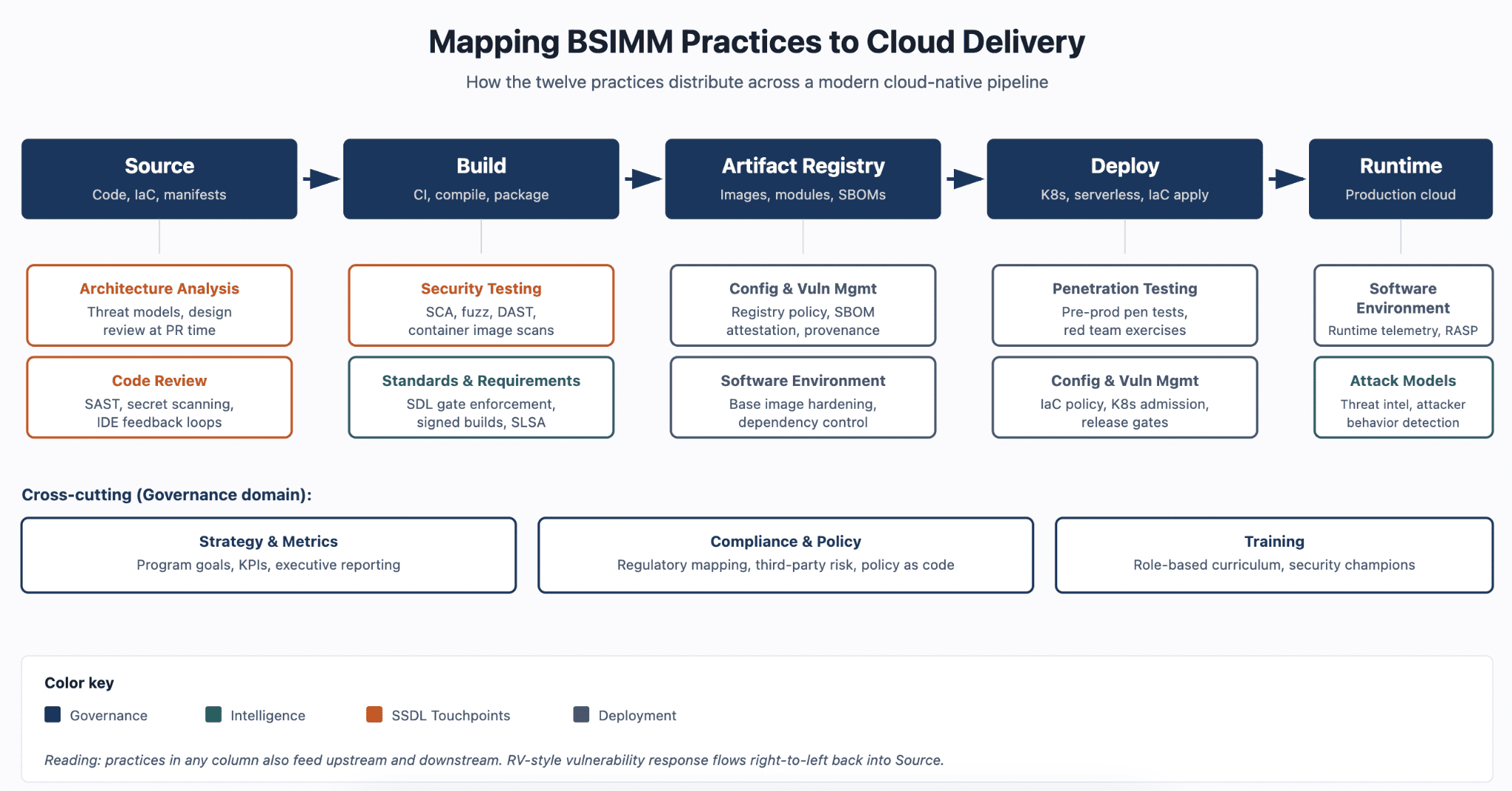
SSDL Touchpoints is the practice most visibly reshaped by modern devsecops frameworks for cloud security. Code review still matters. Architecture analysis still matters. What changed is where those activities happen and how automated they are. BSIMM tracks the migration toward IDE-integrated review, automated architecture risk analysis, and policy-as-code at merge.
Deployment maps almost one-to-one onto cloud platform engineering works. Configuration management is now your IaC and Kubernetes posture. The software environment is your runtime. Vulnerability management spans registries, running images, serverless functions, and dependencies, which is where SBOM workflows and the CISA Known Exploited Vulnerabilities catalog increasingly drive prioritization. BSIMM gives you peer data on which of these are mature in practice, not just mature on a slide.
Strengths
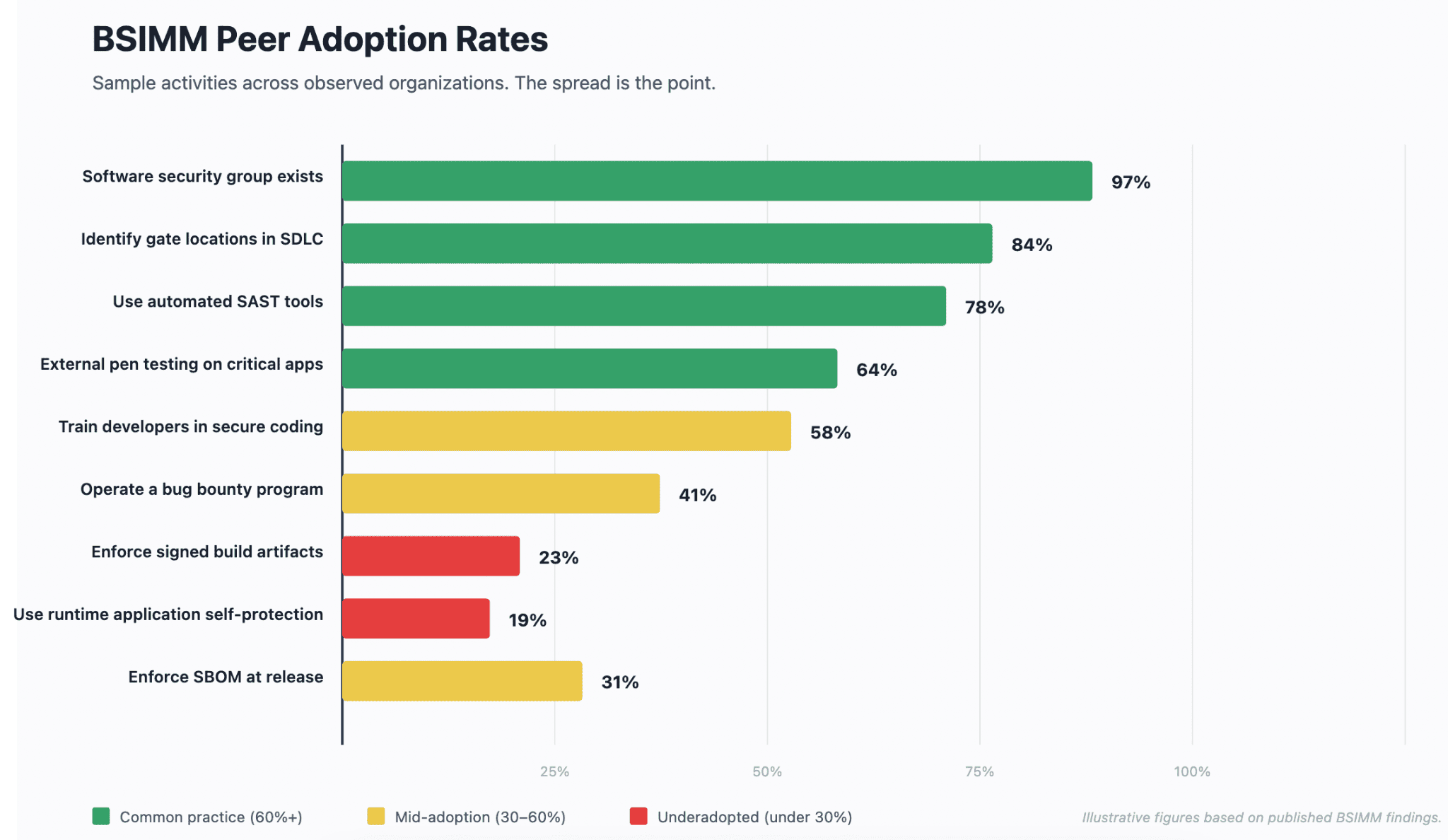
The biggest strength is honesty. BSIMM does not flatter participants. If only 19% of organizations are doing something, the report says so. That makes it a rare artifact in security: a document with no incentive to oversell.
For CISOs preparing a budget review, BSIMM is the cleanest "show me where we are versus where we should be" reference available. Peer comparison is the one currency that consistently moves money in security programs, and BSIMM is built to produce exactly that comparison without needing a consultant to translate it.
Security architects get something different out of it. The activity-level granularity is the real prize. You can pull one practice, look at the underlying activities, and quickly identify which two or three would improve your maturity without restructuring the entire program.
Limitations and what it leaves out
BSIMM will not tell you what to do tomorrow morning.
If your team is small and looking for a starting point, the model can feel overwhelming, because it shows you the full range of what mature programs do without telling you which ones to start with. Pair it with something prescriptive, like OWASP SAMM or NIST SSDF, when that is the gap.
There is also a self-knowledge problem baked in. BSIMM assumes visibility into your own program. If you cannot answer the question "do we do automated SAST in our pipelines?" with confidence, you cannot benchmark yourself accurately. The gap between believed posture and actual posture is where most BSIMM self-assessments quietly go wrong, especially in cloud estates where the answer often depends on which team and which pipeline.
One more honest caveat. BSIMM does not tell you whether your peers are right. A practice can be common but still be wrong for your specific context. The annual report is a mirror, not a map.
CISO takeaway: read the latest edition, mark every practice where you sit clearly below peer median, and walk those gaps into your roadmap with peer data attached. No auditor will ever ask you for it. Your CFO might.
Read also: Cloud Security Controls - Types, Checklist & How to Implement Them Across Multi-Cloud
DoD enterprise DevSecOps reference design
The DoD Enterprise DevSecOps Reference Design is what you read when a CISO says, “Show me the whole machine.” Not a maturity score. Not a control list. The machine.
This section is based on the public U.S. Department of Defense DevSecOps reference design, especially the CNCF Kubernetes version released in 2021, plus the way regulated cloud teams borrow its patterns for commercial environments: financial services, healthcare, defense contractors, critical infrastructure, and SaaS platforms with strict assurance requirements.
Origin and authority
The model comes from the DoD Enterprise DevSecOps initiative. It matters because it is unusually concrete.
Where many frameworks say “secure the pipeline,” the DoD design shows the shape of a hardened software factory: approved code paths, hardened CI/CD, artifact repositories, container security, Kubernetes deployment patterns, continuous monitoring, and evidence for continuous ATO.
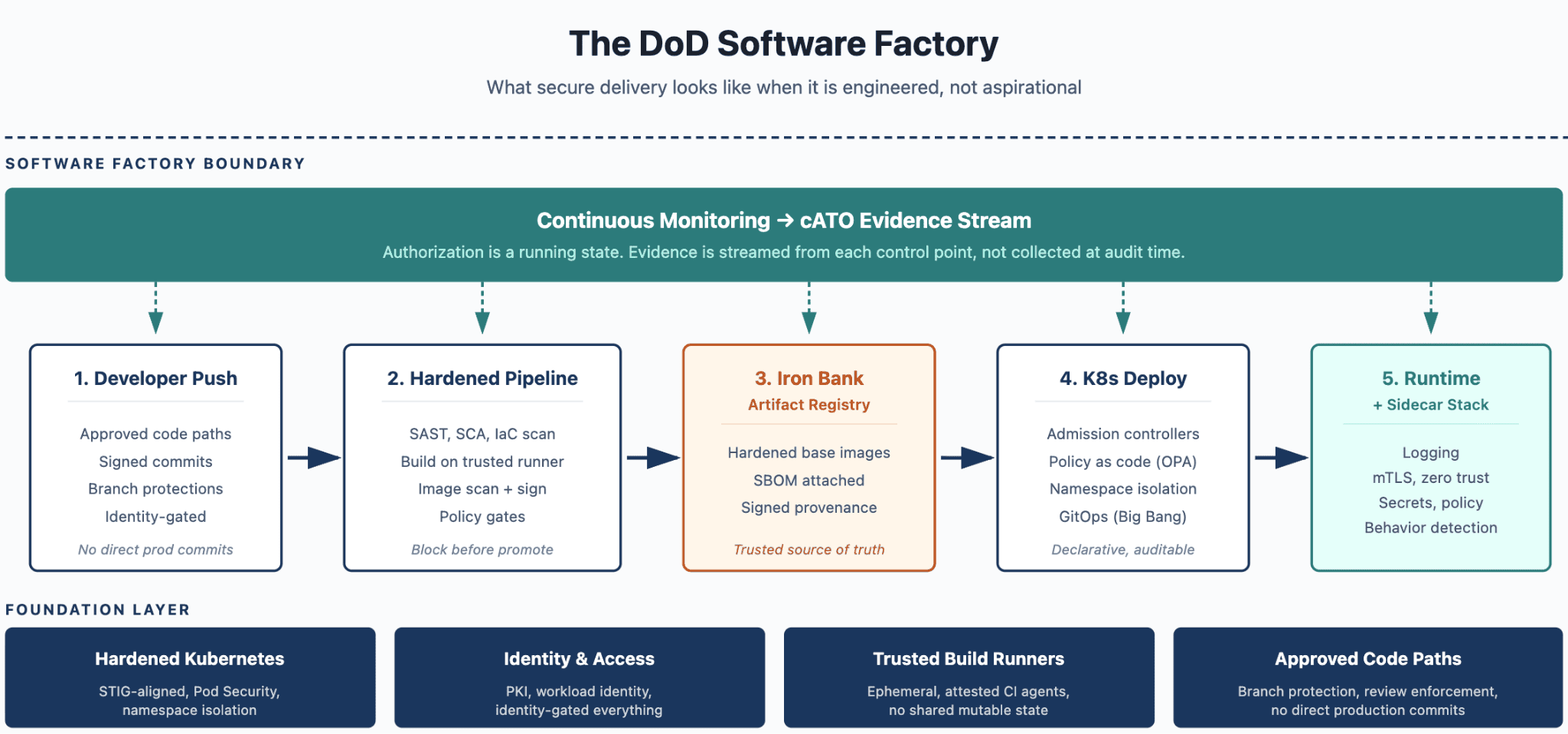
Iron Bank is the cleanest example. Iron Bank provides the software factory with a source of hardened, scanned, and signed containers, rather than allowing every engineering team to pull random base images from the public internet.
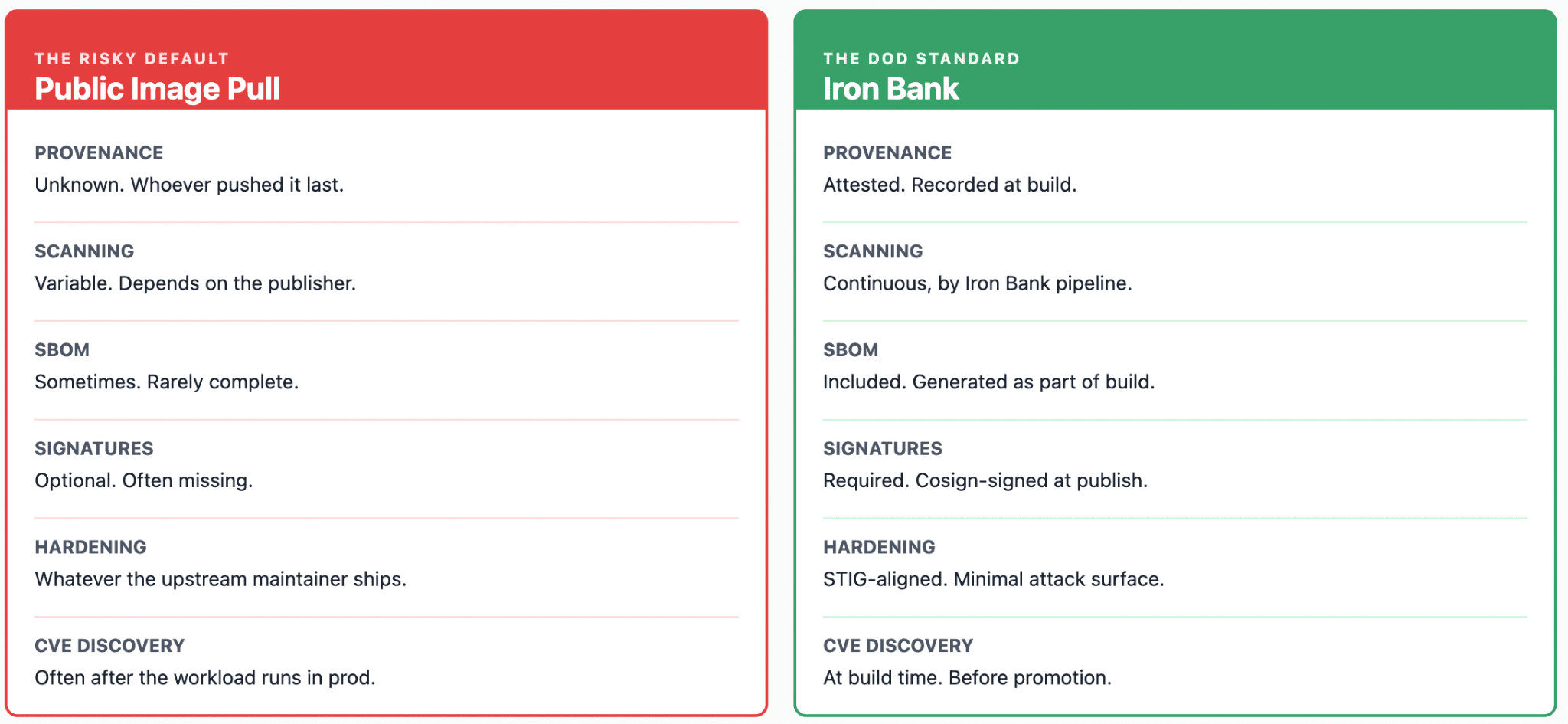
That one design choice changes the risk conversation.
Core idea
The core idea is simple: secure the factory, then let the factory produce safer releases.
A software factory controls how code becomes an artifact, how that artifact becomes a deployment, and how the deployed workload continues to report its security state after release.
How it maps to cloud delivery specifically
For cloud teams, the DoD model maps best to container-heavy delivery across Kubernetes, AWS, Azure, GCP, and hybrid platforms.
A practical mapping looks like this:
- Hardened pipeline: CI/CD enforces checks before promotion.
- Container hardening: trusted images reduce supply chain risk before deployment.
- Continuous ATO: authorization is supported by live evidence instead of audit-season archaeology.
- Sidecar security stack: telemetry, zero trust controls, logging, and behavior detection stay close to the workload.
The lesson: in this model, the delivery path becomes the security architecture.
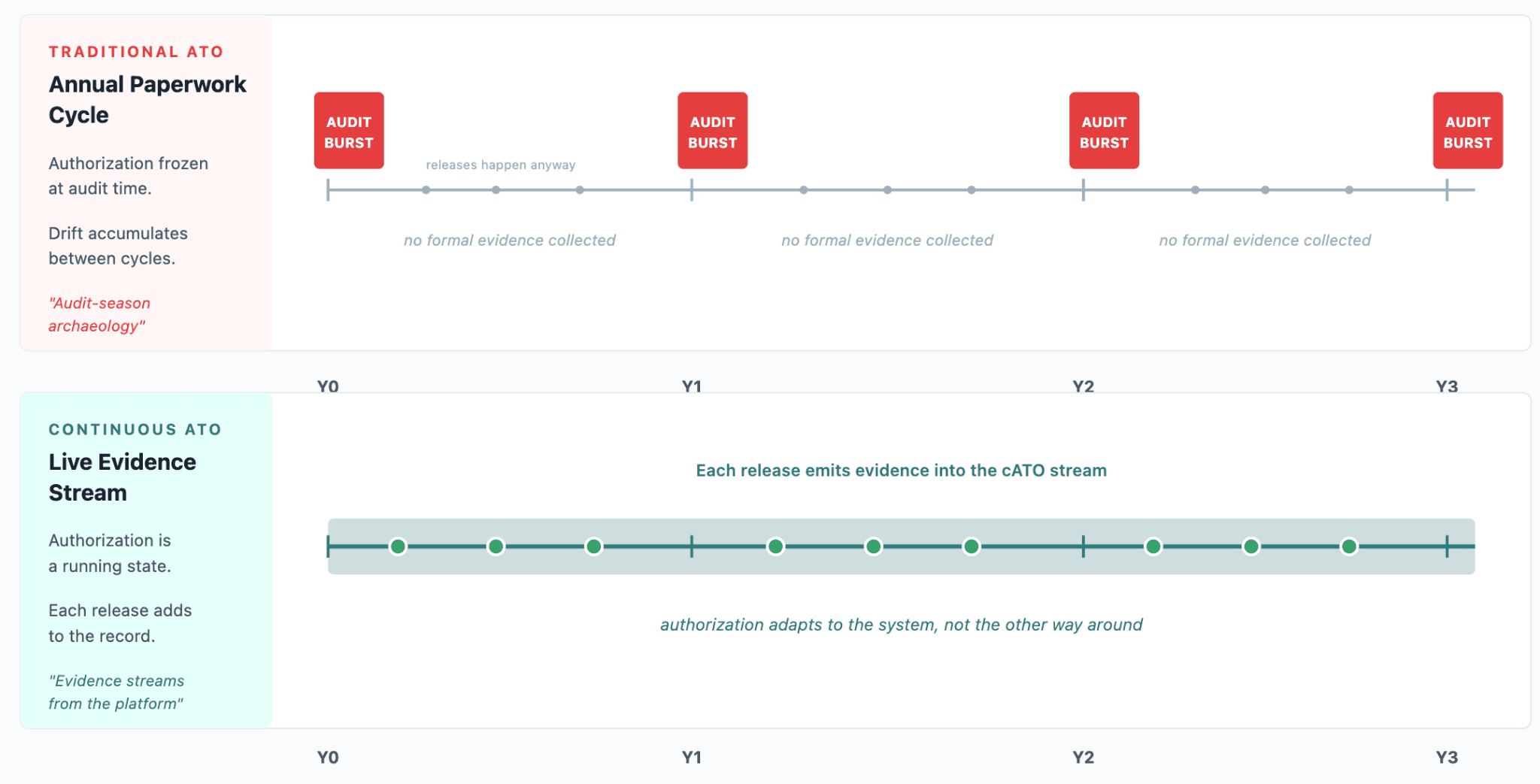
That is why the DoD reference design is useful even outside government. It shows what “good” looks like when secure delivery needs architecture, not aspiration.
Strengths
Its strongest value is the reference architecture detail. A security architect can use it to design a hardened pipeline. A platform team can use it to standardize trusted artifacts and Kubernetes controls. A GRC lead can use continuous ATO logic to move evidence collection closer to real delivery events.
That is rare. Most DevSecOps frameworks tell teams what mature behavior should look like. This one gets closer to the actual build room.
Limitations and what it leaves out
The obvious problem: weight. A mid-market SaaS team probably does not need the full DoD operating model. Copying it too literally can create a platform program bigger than the engineering team can run.
Better move: borrow the patterns that survive commercial reality. Trusted base images. Automated gates. Runtime telemetry. Evidence tied to release events. Clear ownership for the pipeline, artifact, workload, and finding.
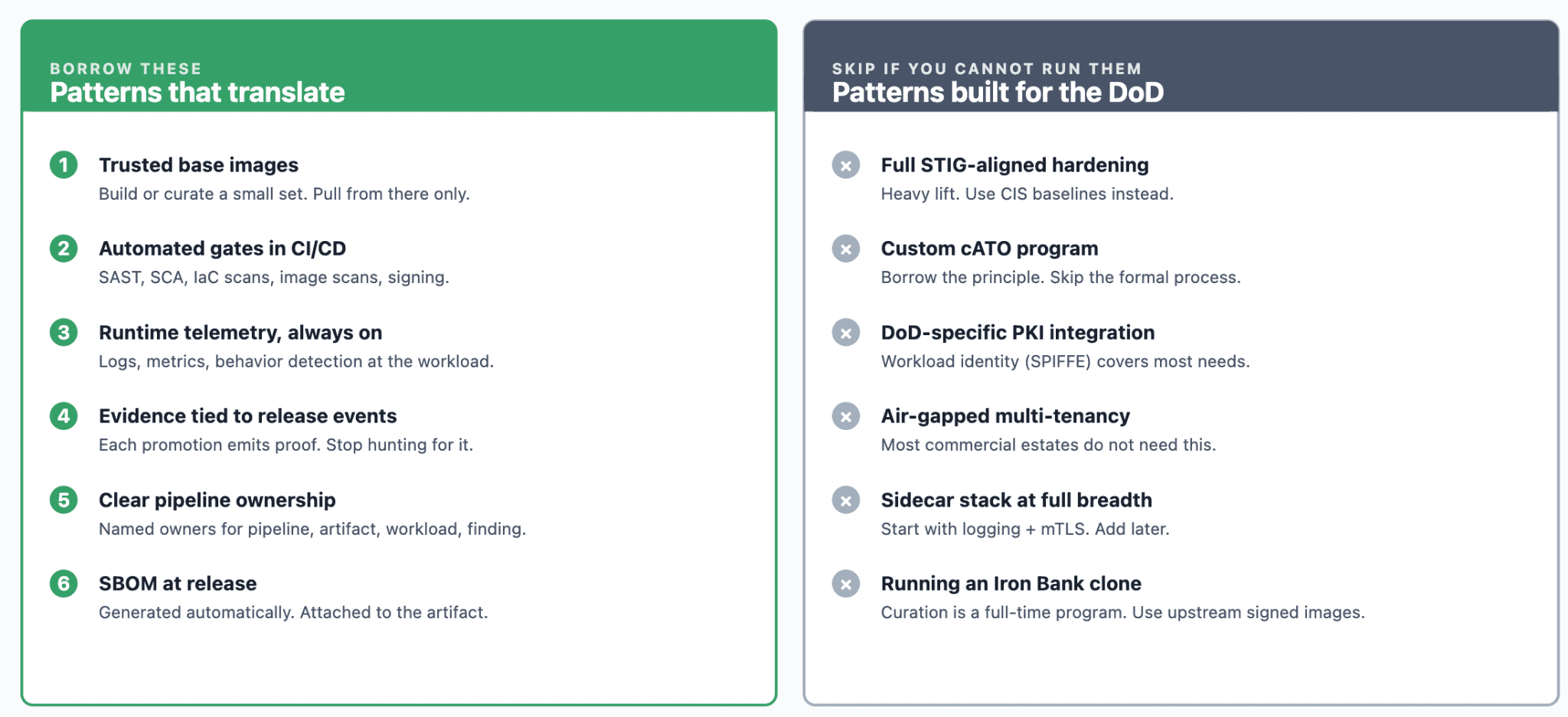
Used that way, DoD DevSecOps becomes less a “government blueprint” and more a stress test for cloud delivery: is your pipeline engineered for trust, or just decorated with scanners?
Read also: The Future of AI in Cloud Security - Trends & Benefits for 2026
CSA DevSecOps Pillars and MITRE ATT&CK for Cloud
Most cloud devsecops programs treat CSA's DevSecOps Pillars and MITRE ATT&CK for Cloud as two different conversations. Run inside a cloud-native estate, the conversation is the same one. Cloud Security Alliance publishes the pillars through its DevSecOps Working Group; MITRE refreshes ATT&CK for Cloud several times a year inside the Enterprise matrix. Read together, they describe what cloud-native security looks like when you stop performing it.
Why this combination earns the headline
The operating model comes from CSA. Six pillars: Collective Responsibility, Collaboration and Integration, Pragmatic Implementation, Bridging Compliance and Development, Automation, and Measure, Monitor, Report, and Action.
MITRE handles the threat layer. Dedicated cloud sub-matrices cover IaaS, SaaS, Microsoft Entra ID (formerly Azure AD), and Google Workspace, with each technique pinned to documented attacker behavior.
Neither is new. The thing nobody does is pair them.
What this looks like in practice
The pairing only matters when you can ask a control to defend against a specific technique. Pillar by pillar, the conversion looks like this:
- Collective Responsibility: name the account owner, platform owner, and app owner who detect Cloud Account abuse (T1078.004). Three people pointing at each other means the pillar is broken.
- Collaboration and Integration: cloud telemetry findings route to the engineer who owns the workload, not to a shared AppSec inbox.
- Pragmatic Implementation: scope controls to techniques attackers actually use against your cloud surface, never a generic policy library.
- Bridging Compliance and Development: audit evidence and engineering evidence come from the same telemetry, not two parallel paper trails.
- Automation: defenses run as code at every release. Manual gates are not controls.
- Measure, Monitor, Report and Action: coverage gets reported per ATT&CK technique. Per-policy reporting was always a vanity metric.
"Every DevSecOps control should be testable against at least one ATT&CK technique." That one rule is what separates a real cloud devsecops program from a performance of one.
Where it stops
It is a diagnostic, not a prescription. CSA stays at principles. ATT&CK draws the line at techniques. Your team still owns the control catalog, the delivery model, and the ownership chains that connect them. Nothing about this pairing relieves you of that work.
That is also why competitors rarely combine the two. It requires fluency in both.
Valentin Kel, Cloudaware DevOps Engineer:
Read also: Cloud Data Security Challenges - 10 Issues & Fixes
Comparison matrix: which framework fits your cloud?
This matrix is based on the framework docs plus what Cloudaware teams see when CISOs, platform leaders, and GRC stakeholders try to turn DevSecOps from “we scan in CI” into something provable across AWS, Azure, GCP, Kubernetes, and hybrid infrastructure.
Don’t pick a framework because it has the most authority. Pick it because it answers the question that is actually holding your organization back.
- A federal-facing software vendor usually needs NIST language because procurement and attestation conversations already speak that language.
- An engineering-led SaaS team may get faster traction from DSOMM because it exposes what is manual, missing, or stuck in Slack.
- A regulated Kubernetes-heavy team may borrow from the DoD Reference Design because it shows the architecture of a hardened software factory, not just the idea of one.
The real trap is treating these frameworks like competitors.
They are not always competing. Often, they stack. NIST SSDF gives the secure software development lifecycle in the cloud a defensible control language. SAMM and DSOMM give maturity scoring. BSIMM gives peer comparison. DoD shows the reference architecture. CSA plus MITRE ATT&CK Cloud adds cloud-native threat context.
Now the CISO question gets cleaner: which one leads, which one supports, and which one becomes evidence?
Comparison table
| Framework | Type | Strongest for | Cloud-native fit | Maturity lens? | Effort to adopt |
|---|---|---|---|---|---|
| NIST SSDF + 800-204 | Prescriptive | Regulated U.S. enterprises, federal vendors | High (esp. 204A/B/C) | No (use with DSOMM) | Medium–High |
| OWASP SAMM | Maturity model | Programs needing a self-score | Medium | Yes | Medium |
| OWASP DSOMM | Maturity model | Engineering-led DevSecOps teams | High | Yes | Low–Medium |
| BSIMM | Benchmark | Comparing program to peers | Medium | Benchmarked, not scored | Medium |
| DoD DevSecOps Ref. Design | Reference architecture | High-assurance / regulated workloads | Very High | Implicit | High |
| CSA Pillars + MITRE ATT&CK Cloud | Principles + threat model | Cloud-native, threat-informed orgs | Very High | Principle-based | Low–Medium |
- If the board asks, “What standard do we align to?” start with NIST SSDF.
- If engineering asks, “Where are we immature?” use SAMM or DSOMM.
- If the platform team asks, “What should the target architecture look like?” pull from DoD DevSecOps.
- If security operations asks, “Are our controls mapped to real attacker behavior?” bring in MITRE ATT&CK Cloud, with CSA as the cloud operating lens.
Read also: Cloud Security Automation - Framework, Tools & Best Practices
How to operationalize a DevSecOps frameworks across a multi-cloud estate with Cloudaware
A framework becomes useful only when it can survive the estate.
Not the neat architecture diagram. The real one.
AWS accounts with different tag hygiene. Azure subscriptions owned by three business units. GCP projects created for pilots. Kubernetes namespaces that outlived the team that launched them. ServiceNow approvals in one workflow, Jira remediation in another, Slack noise everywhere. That is where DevSecOps frameworks either turn into an operating system or become another executive slide.
The practical move is to make Cloudaware the working layer between the framework and the estate: CMDB context, compliance-as-code, policy results, ownership, routing, exceptions, dashboards, and evidence history in one flow.
First, scope the framework against the CMDB
Do not start with “we need to implement NIST SSDF.”
Start with: which cloud assets are in scope, and can we prove it?
Cloudaware evaluates compliance against CMDB data rather than one-off live cloud API scrapes. That means teams can scope checks using service catalog attributes such as app, owner, environment, account, tag, business unit, or dataset.
It also supports multi-source inputs across cloud, VMware or physical infrastructure, billing, and custom datasets.
That changes the whole posture. A NIST SSDF practice like “protect the software” can be scoped to production workloads owned by Commerce. A DoD-style trusted artifact rule can apply only to Kubernetes workloads in regulated environments. A CSA cloud guardrail can exclude approved sandbox accounts for 30 days, then expire the exception automatically.
A useful starting view:
| Scope question | Cloudaware object or field |
|---|---|
| Which systems are production? | Environment |
| Who owns the workload? | Owner / team / service catalog |
| Which app does it support? | Application / business service |
| Which cloud boundary applies? | Account, subscription, project, region |
| Which exception exists? | Time-boxed exemption with review state |
| Which framework applies? | Policy pack, custom policy, UCF mapping |
This is multi-cloud governance without pretending the clouds speak the same language.
Then turn framework language into Cloudaware policies
Frameworks speak in intentions. Cloud estates fail in specifics.
“Use approved encryption” becomes a policy against storage, databases, backups, restored datasets, and key patterns. “Maintain secure configuration” becomes checks for public exposure, over-permissioned identities, weak logging, missing backup coverage, unsafe regions, unapproved services, and exception drift.
Cloudaware IT compliance is strongest here when the control needs CMDB context. Its CSPM model merges CMDB data with multi-cloud and on-prem checks, then scopes controls by app, environment, risk, tags, and exceptions. That means the same policy can behave differently for production, dev, regulated workloads, sandbox accounts, and time-boxed exceptions.
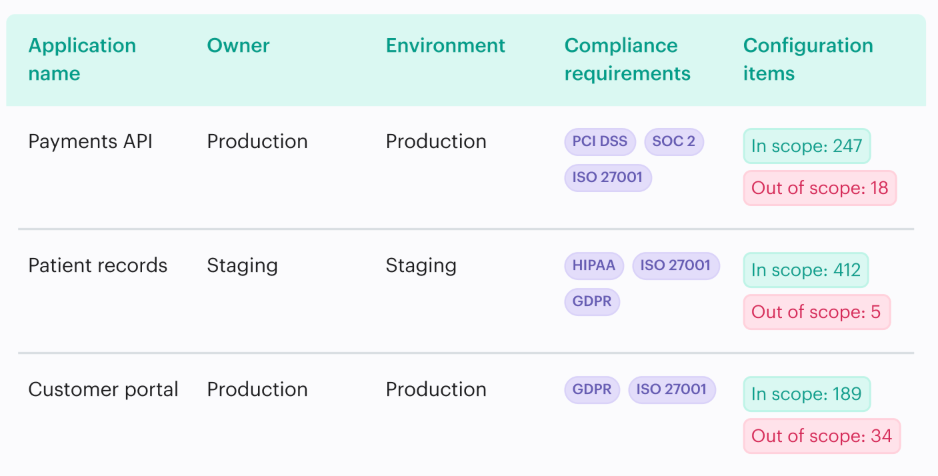
The operating shift is small but brutal in the right way. Not “someone checked the AWS console before audit.” More like: this control runs against the right slice of the estate, with owner, environment, application, and compliance scope already attached.
A practical mapping could look like this:
| Framework language | Cloudaware policy view |
|---|---|
| Approved encryption | Storage, database, backup, restore, and key-pattern checks |
| Secure configuration | Public exposure, IAM scope, logging, regions, approved services |
| Continuous compliance | Ongoing control status by asset, app, owner, and environment |
| Exception management | Time-boxed exceptions with scope and review context |
| Audit evidence | Policy result, affected asset, timestamp, owner, and lifecycle |
Protecting deployment artifacts is the one I’d phrase more carefully. Cloudaware can support that control when artifact, registry, image, pipeline, or runtime data is available through CMDB records or integrations. I would not claim native signed-artifact enforcement unless your team confirms it.
Make failed controls behave like work, not alerts
Here’s where many programs quietly lose the plot.
They find the issue. They do not move the issue.
Cloudaware treats failed checks as rule findings. Each finding can carry owner, severity, SLA, evidence, and lifecycle status and then be routed into context-rich tickets using CMDB fields. CSPM materials also support auto-routing findings to Jira, ServiceNow, and email; assigning owners from CMDB context; and auto-closing tickets when fixes land.
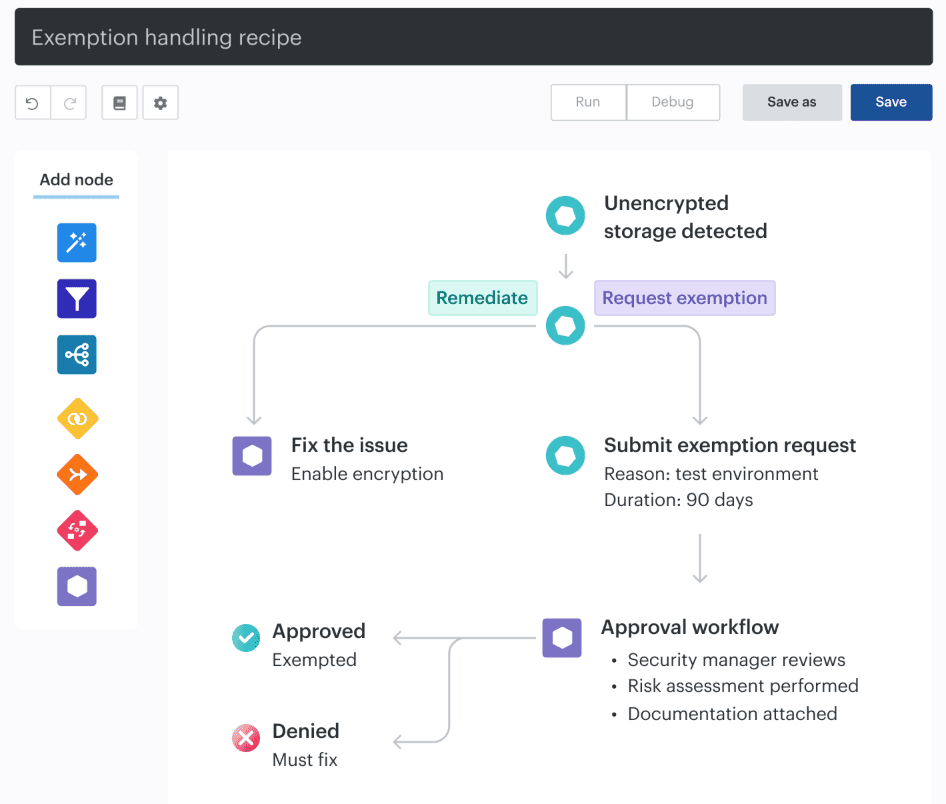
That gives DevSecOps teams something engineers can act on.
Not this: “Policy failed: encryption mismatch.”
This: claims-restore-db is a test restore of a production claims database. A custom compliance policy flags that its encryption pattern does not match the source system. The asset has no assigned owner, sits in a regulated data scope, and needs one of three outcomes: assign ownership, restore the required key pattern, or approve a time-boxed exception.
Now the finding has a route.
And the route is the difference between dashboard theater and remediation.
Use CMDB context to reduce noise before teams stop listening
A framework without context creates noise.
A public endpoint on a production payment API is different from the same condition in a temporary sandbox. Missing backup coverage on a regulated database is not the same as missing backup coverage on a disposable test VM. An overbroad deployment role used by a shared platform pipeline carries a different blast radius than a stale role in an isolated lab account.
The useful view is not “all failed controls.”
It is:
- Production vs. non-production
- Compliance-scoped vs. out of scope
- Owner assigned vs. unassigned
- Exposed vs. internal
- Active vs. retired, where lifecycle data exists
- Approved exception vs. policy breach
- New drift or boundary violation vs. trend over time
That is how drift detection becomes useful. Not “something changed.” More like: a production control changed, the owner is known, the framework impact is visible, and the SLA clock started.
Build the evidence pipeline while fixes happen
The evidence pipeline should not be a separate audit project.
It should form while the cloud security work happens: policy result, affected asset, owner, timestamp, severity, exception, linked ticket, remediation status, and history.
That is the part CISOs feel immediately. A board update can move from “_we are aligning to NIST and improving DevSecOps maturity_” to something far more useful:
| Board or audit question | Cloudaware-backed answer |
|---|---|
| What is covered? | Assets in scope vs. out of scope by account, app, environment |
| What is failing? | Policy violations by severity, owner, framework, and SLA |
| What changed? | Drift by asset, policy, boundary, or rule revision |
| Who is fixing it? | Jira or ServiceNow ticket linked to the finding |
| What is accepted risk? | Approved exceptions with review and expiry |
| Can we prove history? | Run archive, evidence trail, policy diffs, exportable reports |
That is the kind of evidence GRC can use without chasing screenshots for two weeks.
And for the CISO, it turns framework adoption into a measurable operating story: coverage, violations, owners, exception age, SLA movement, and evidence freshness.
Show the operating dashboard
This is the dashboard a CISO would actually screenshot.
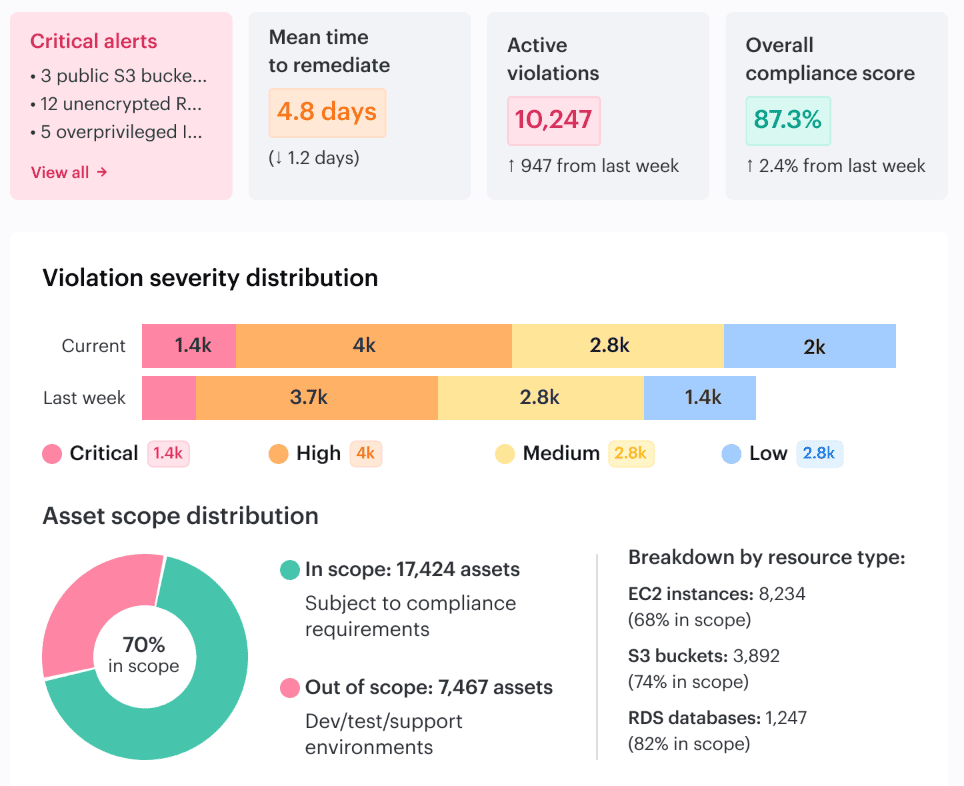
No “platform saves the day” story needed.
The table shows the values: framework, asset, owner, drift, workflow, and evidence. That is what security leaders need when the board asks, “Are we actually operating this framework, or did we just adopt it?”