


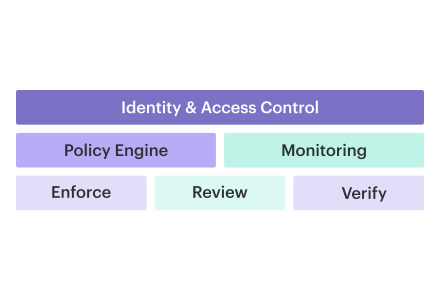
Most cloud failures start with something simple: an identity nobody reviewed, a workload nobody owns, an API call nobody traced, or a data store outside the policy path.
Zero Trust cloud security removes implicit trust from access to cloud resources. Every request from a user, device, workload, service, or API must pass a policy decision based on identity, resource context, risk, and the requested action. The decision is enforced at the relevant control point and generates telemetry that feeds the next evaluation.
Across AWS, Azure, GCP, Kubernetes, and SaaS, this creates an operating loop: identify the subject and target resource, evaluate policy, enforce the decision, observe the result, and adjust access or controls when context changes.
This guide explains:
- Zero Trust architecture
- Seven principles behind it
- Boundaries between Zero Trust tooling layers
- 90-day implementation plan
Key insights
- Zero Trust removes implicit trust from every access request. Users, devices, workloads, services, and APIs receive access only after policy evaluates their identity, context, target resource, requested action, and current risk.
- Every access decision needs context, enforcement, and feedback. Identity and resource data inform the policy decision, the relevant control point enforces it, and telemetry supports the next evaluation.
- Zero Trust covers five CISA pillars. These are Identity, Devices, Networks, Applications and Workloads, and Data, supported by visibility, automation and orchestration, and governance.
- Seven operating principles turn Zero Trust into a working cloud model. They cover explicit verification, least privilege, assumed breach, complete context, resource-level enforcement, continuous telemetry, and governed exceptions.
- No single security tool operates the complete Zero Trust model. IAM, CIEM, ZTNA, CSPM, CWPP, CNAPP, service mesh, and cloud-native controls provide different signals, policy functions, or enforcement points.
- Implementation should begin with one bounded resource path. Map its identities, policies, enforcement points, telemetry, owners, and exceptions before expanding the pattern across the cloud estate.
- Measure control outcomes instead of tool deployment. Useful metrics include policy coverage, excessive privilege, unmanaged identities, enforcement failures, exception age, telemetry gaps, and verified remediation.
What is Zero Trust cloud security?
Zero Trust cloud security applies explicit, resource-level access decisions across cloud infrastructure, applications, workloads, and data. Network location, asset ownership, or a previously authenticated session does not grant continuing trust.
In a cloud estate, the request may come from a user, device, workload identity, service account, container, function, or API. The target may be an AWS resource, Azure service, GCP workload, Kubernetes service, SaaS application, or data store. Each request must be evaluated against the identity, target resource, requested action, current conditions, and applicable policy.
This follows the architecture defined in NIST SP 800-207, where a policy decision point determines whether access should be granted and a policy enforcement point allows, denies, or terminates the connection.
How the Zero Trust decision loop works
A working Zero Trust architecture needs five connected functions:
- Identify the subject and resource. Resolve the requesting identity, device or workload, target resource, requested action, and relevant relationships.
- Collect decision context. Add device posture, workload state, environment, data sensitivity, known vulnerabilities, behavioral signals, location, session history, and current risk.
- Evaluate policy. The policy decision point compares the request and its context with access rules, organizational policy, and risk thresholds.
- Enforce the decision. IAM controls, gateways, service meshes, Kubernetes admission or network policies, proxies, and application controls allow, deny, restrict, or terminate access.
- Use telemetry to adjust the next decision. Authentication events, access logs, runtime signals, configuration changes, and policy outcomes reveal whether access should continue or whether policy needs to change.
For cloud-native applications, NIST SP 800-207A extends this model to granular application-level policies across multi-cloud and hybrid environments. It also describes telemetry as part of a runtime feedback loop: teams deploy a policy, observe its effect, and refine access based on actual application behavior.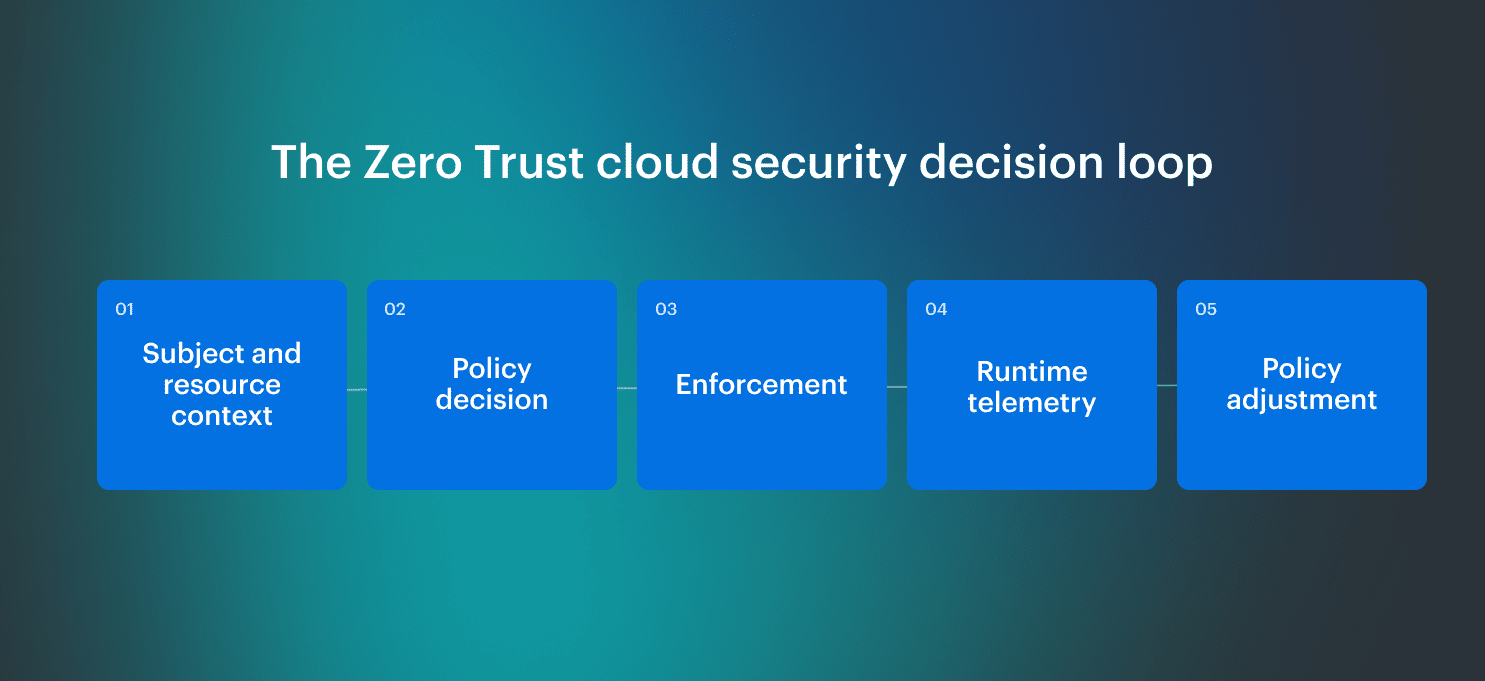 A control breaks when one of these functions is missing. Accurate authentication cannot compensate for an unknown target resource. A correct policy produces little protection when no enforcement point applies it. Enforcement without telemetry leaves the team unable to verify the outcome or respond when context changes.
Zero Trust vs. perimeter-based security
| Area | Perimeter-based security | Zero Trust cloud security |
|---|---|---|
| Trust basis | Uses network location and entry through the perimeter as major trust signals. | Evaluates each request using identity, resource, context, policy, and current risk. |
| Decision scope | Often grants broad access after authentication or network entry. | Grants scoped access to a specific resource and action. |
| Identity coverage | Focuses primarily on human users and managed endpoints. | Covers users, devices, workload identities, service accounts, and APIs. |
| Cloud traffic | Concentrates on traffic entering and leaving the environment. | Evaluates north-south and east-west access across accounts, projects, clusters, and services. |
| Verification | Relies heavily on preventive boundary controls. | Uses enforcement outcomes and runtime telemetry to inform later decisions. |
Why cloud workloads require Zero Trust
Cloud access paths change faster than a network-centered security model can represent. Accounts, subscriptions, projects, clusters, APIs, service accounts, pipelines, and short-lived workloads create new relationships without passing through one persistent perimeter.
Zero Trust must therefore cover two paths:
- Control plane: Requests that create identities, attach policies, change routes, deploy workloads, modify logging, or alter security configuration.
- Data plane: Requests that read, write, move, process, or delete application data.
A team that monitors only network traffic can miss a valid identity changing a storage policy, a CI/CD role creating an exposed workload, or a service account gaining access to secrets. A team that focuses only on IAM can miss lateral movement between workloads using permissions that appear legitimate in isolation.
Cloud-native controls can enforce decisions within their respective providers and platforms. The operating challenge is maintaining enough current identity, resource, relationship, ownership, and risk context to make those decisions consistently across AWS, Azure, GCP, Kubernetes, and SaaS.
Seven principles of Zero Trust cloud security
The Zero Trust decision loop describes how access is evaluated. The following principles determine whether that loop remains reliable as identities, resources, and risk change.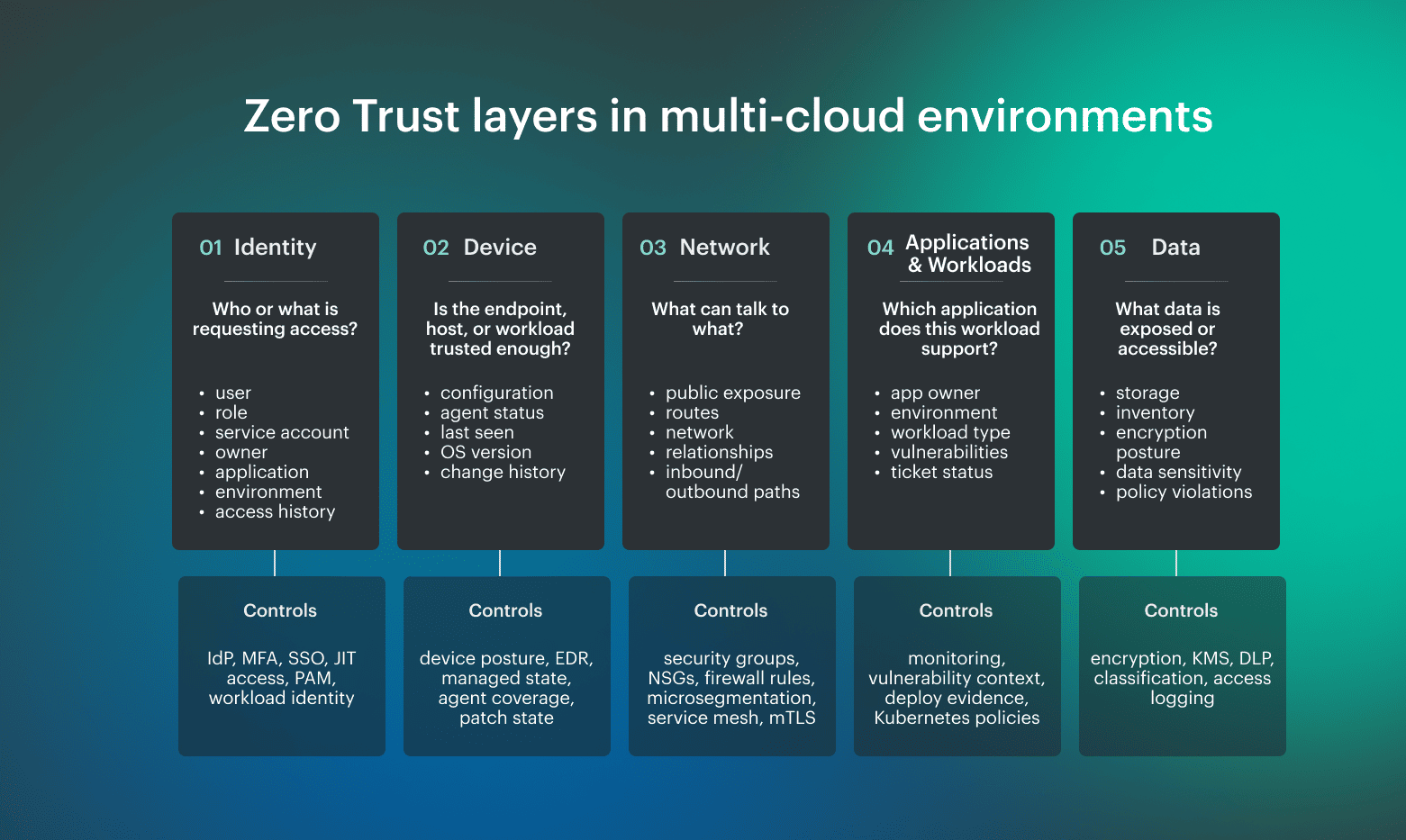
1. Verify every request explicitly
Evaluate the requesting subject, target resource, requested action, and current conditions each time policy requires a decision. Relevant inputs may include identity assurance, device posture, workload state, environment, data sensitivity, behavior, location, and session risk.
Verification must match the access path. A workforce identity accessing an application may require MFA and device posture. A Kubernetes workload calling an internal API may require workload identity, mTLS, namespace context, and service-level authorization.
2. Grant the minimum required access
Scope permissions to the resource and action the identity needs. Prefer short-lived credentials, just-in-time elevation, workload identities, and narrowly defined roles over permanent administrative access, shared accounts, and reusable keys.
Least privilege also requires removal. Unused permissions, dormant service accounts, inherited roles, and access retained after a migration or ownership change must enter a review and revocation workflow.
Apply the same least-privilege model inside clusters with Kubernetes security practices for cloud workloads, covering API access, admission, network paths, and workload credentials.
3. Design for a compromised identity or workload
Assume that credentials, tokens, endpoints, or workloads can be compromised. Controls should prevent one successful compromise from becoming unrestricted lateral movement across accounts, projects, clusters, services, and data stores.
Apply segmentation, deny-by-default policies, scoped service identities, credential rotation, and independent logging around sensitive access paths. The practical question is how far an attacker could move before another policy decision or enforcement point stops the request.
4. Maintain current identity and resource context
A policy engine cannot make a reliable decision about an identity or resource it cannot classify. Teams need a current inventory of human and machine identities, cloud resources, applications, environments, owners, relationships, exposure, and data sensitivity.
Context must remain usable after deployment. Ephemeral workloads, newly created accounts, ownership changes, missing tags, and orphaned resources should be detected before they fall outside policy evaluation and remediation.
5. Enforce policy at the relevant control point
Place enforcement close enough to the resource and action to control the actual access path. Depending on the request, this may involve IAM, an identity-aware proxy, API gateway, security group, service mesh, Kubernetes admission or network policy, database authorization, or application-level control.
One enforcement layer cannot substitute for another. ZTNA may control user-to-application access, while workload-to-workload traffic and access to data require separate enforcement points.
6. Feed outcomes back into policy decisions
Authentication events, access logs, configuration changes, runtime behavior, denied requests, and enforcement failures should inform later decisions. Otherwise, policy continues operating on the assumptions available when it was first deployed.
Telemetry also provides evidence that the control worked. Teams should be able to determine which policy was evaluated, what decision it produced, where that decision was enforced, and whether the resource remained expected.
7. Govern exceptions as temporary policy states
Operational exceptions are sometimes necessary, but they must remain visible and bounded. Record the affected resource or identity, policy, justification, owner, approved scope, compensating control, expiration date, and remediation status.
An expired exception should return to review or active remediation. Permanent suppressions without ownership and revalidation create implicit trust through the exception process.
These principles apply across the environment, but they do not all belong to the same control layer. The next step is to map them to the five CISA pillars and distinguish which tools provide context, make decisions, enforce access, or verify outcomes.
How to implement Zero Trust cloud security in 90 days
A 90-day Zero Trust rollout should prove one complete access path rather than deploy disconnected controls across the entire cloud estate. Select a bounded application, workload group, or data service with identifiable users and machine identities, known enforcement points, usable telemetry, and an accountable owner.
The objective is to establish a repeatable operating pattern:
- Define the protected resource and access paths.
- Reconcile identities, resources, and relationships
- Write and enforce scoped policies
- Observe actual behavior
- Govern exceptions
- Verify the result before expanding scope.
Days 1-30: Define scope and establish the baseline
Begin with one production-relevant resource path. Examples include workforce access to an internal application, a Kubernetes workload calling an API, a CI/CD role deploying to a cloud account, or an analytics service reading a sensitive data store.
Document:
- protected resources and their owners
- human and machine identities that access them
- permitted actions and business justification
- control-plane and data-plane access paths
- existing policy decision and enforcement points
- logs and runtime signals available for verification
- current exceptions, shared credentials, and standing privilege
Reconcile the expected population with what the environment actually contains. Unknown identities, orphaned resources, missing owners, stale accounts, and telemetry gaps should be recorded as baseline findings rather than silently excluded.
By day 30, the team should have an approved scope, an access-path map, an identity and resource baseline, named owners, and a finding register.
Exit criteria
- Every in-scope resource and identity has a recorded owner or an active ownership issue.
- Required access paths and actions are documented.
- Policy and enforcement points are identified.
- Required telemetry is available or tracked as a blocking gap.
- Baseline exceptions and excessive access have owners and due dates
Days 31-60: Build and test the policy loop
Translate the approved access model into enforceable policy. Begin with observation or warning mode where the control supports it, then compare expected access with actual activity before denying production requests.
Policy should distinguish:
- human users from workload identities
- routine access from privileged actions
- production from non-production
- control-plane changes from data-plane access
- expected service communication from unexplained lateral paths
- standard access from time-bound exceptions
Test allow, deny, elevation, credential expiry, identity removal, and enforcement-failure scenarios. Confirm that each decision can be traced to the evaluated policy, relevant context, enforcement point, and resulting event.
Teams should also define an exception workflow during this phase. Each exception needs an owner, justification, affected identity or resource, approved scope, compensating control, expiration date, and review state.
By day 60, the selected path should have enforceable policies, observable decisions, tested failure cases, and a governed exception process.
Exit criteria
- Expected requests are allowed at the correct scope.
- Unauthorized or excessive requests are denied or routed for remediation.
- Policy decisions and enforcement outcomes generate usable telemetry.
- Privileged access is temporary where the platform permits it.
- Exceptions expire and return to review.
- Enforcement failures create an owned operational response
Days 61-90: Enforce, verify, and prepare expansion
Move the validated policies into enforcement for the agreed scope. Monitor denied requests, broken dependencies, policy bypasses, stale exceptions, missing signals, and differences between the approved access model and observed behavior.
Verification should cover both the access decision and the resulting resource state. A closed IAM ticket, for example, does not prove that a role was removed from every affected account. A policy deployment does not prove that the relevant gateway, workload, or data service is enforcing it.
Run an adversarial test against the selected path. Attempt access through an unmanaged identity, an excessive role, an unexpected workload relationship, an expired exception, or a path with missing posture data. Record where the request was stopped and what evidence was produced.
By day 90, the team should have one production-tested Zero Trust pattern, documented limitations, measurable control outcomes, and a decision on whether the model is ready to expand.
Exit criteria
- Enforcement is active for the approved scope.
- Denied and failed requests have defined owners and response paths.
- Remediation is verified against current production state.
- Exceptions remain within approved age and scope.
- The team can reconstruct representative decisions from request through enforcement.
- Remaining limitations are documented before expansion.
90-day rollout summary
| Period | Primary objective | Required output | Decision at the gate |
|---|---|---|---|
| Days 1-30 | Establish trusted scope and context | Access-path map, baseline, owners, findings, telemetry requirements | Is the selected path sufficiently known to design policy? |
| Days 31-60 | Build and test the decision loop | Scoped policies, enforcement tests, telemetry, exception workflow | Does policy produce the expected decisions and evidence? |
| Days 61-90 | Enforce and verify in production | Verified controls, failure tests, limitations, expansion package | Can the pattern expand without carrying unresolved trust gaps forward? |
The rollout identifies several different control functions: collecting context, making policy decisions, enforcing access, detecting exposure, and verifying outcomes. Those functions are distributed across the five CISA pillars and multiple security tool categories.
Five pillars of Zero Trust cloud security
The CISA Zero Trust Maturity Model organizes Zero Trust around five pillars: Identity, Devices, Networks, Applications and Workloads, and Data. Visibility and Analytics, Automation and Orchestration, and Governance operate across all five.
These pillars provide a coverage model rather than a product architecture. Each pillar may contribute identity or resource context, policy inputs, enforcement points, telemetry, and evidence to the same access decision.
| CISA pillar | Cloud scope | Zero Trust requirement | Example evidence |
|---|---|---|---|
| Identity | Workforce users, privileged accounts, service accounts, workload identities, roles, tokens, and credentials | Authenticate identities, evaluate entitlement and risk, limit privilege, and revoke access when conditions change | Authentication event, evaluated role, elevation approval, credential age, revocation result |
| Devices | Endpoints and managed devices used to reach cloud resources | Evaluate device identity, ownership, posture, configuration, and risk before or during access | Device record, posture result, compliance status, access decision |
| Networks | Cloud networks, routes, gateways, service communication, and ingress and egress paths | Segment access paths and restrict communication to approved subjects, resources, ports, protocols, and services | Flow log, gateway decision, network policy result, denied connection |
| Applications and Workloads | Applications, APIs, containers, functions, VMs, clusters, pipelines, and their machine identities | Apply application- and workload-level authorization, isolate services, and verify runtime behavior | API authorization event, workload identity, service policy, runtime signal |
| Data | Object stores, databases, volumes, backups, secrets, and data exchanged between services | Classify sensitive data and control who or what can read, modify, move, share, or delete it | Data classification, access event, encryption state, policy result |
A mature implementation must connect the pillars. Device posture may affect an identity decision. A workload identity may receive access to an API but remain unable to read the underlying data store. A network policy may permit a connection while application authorization rejects the requested operation.
What the cross-cutting capabilities do
- Visibility and Analytics provide the current identity, resource, posture, relationship, behavior, and risk signals needed to evaluate policy and investigate outcomes.
- Automation and Orchestration propagate policy changes, revoke access, isolate resources, open remediation workflows, and respond when risk or resource state changes.
- Governance defines ownership, policy authority, acceptable risk, exceptions, evidence requirements, review frequency, and accountability across the five pillars.
These capabilities support Zero Trust only when they remain connected to an access or remediation decision. Collecting more telemetry does not improve control if teams cannot resolve the affected identity, resource, policy, enforcement point, and owner.
Where Zero Trust tools fit in the decision loop
Zero Trust products should be evaluated by the function they perform in a protected access path. A category name alone does not show whether the product supplies context, makes a policy decision, enforces it, or verifies the outcome.
| Tool or control category | Primary role in the Zero Trust loop | Important boundary |
|---|---|---|
| IAM and CIEM | Authenticate identities, manage entitlements, evaluate access conditions, and reduce excessive cloud permissions | They do not independently control every network, workload, application, or data path |
| ZTNA and identity-aware proxies | Evaluate and enforce user or device access to applications | They may not govern workload-to-workload communication or direct cloud API activity |
| Cloud-native IAM, network, and data controls | Enforce provider-specific permissions, connectivity, and resource access | Policies differ across AWS, Azure, and GCP and may lack shared ownership and application context |
| API gateways and service meshes | Authenticate services and enforce API- or workload-level communication policies | They cover traffic routed through the relevant gateway, proxy, or mesh |
| Kubernetes admission and network policies | Control workload deployment and communication within configured cluster boundaries | They do not govern access paths outside those clusters |
| CSPM | Detect configuration exposure, policy violations, and posture drift | CSPM primarily supplies posture context and findings it is not a universal inline access-enforcement layer |
| CWPP | Provide workload posture, runtime telemetry, and, in some implementations, runtime protection | Coverage depends on supported workloads, deployed sensors, and enabled controls |
| CNAPP | Combine several cloud security capabilities and correlate findings across layers | A combined platform category does not create one universal policy or enforcement point |
| SIEM and SOAR | Aggregate telemetry, correlate events, and coordinate investigation or response | They usually observe or orchestrate outcomes rather than enforce every original access request |
| CMDB and asset inventory | Resolve resources, applications, environments, owners, and relationships needed for policy and remediation context | They support decisions and evidence but do not provide inline enforcement |
The practical test is whether the team can trace a representative request through the complete loop:
- Which user, device, workload, service, or API initiated it?
- Which resource and action did it target?
- What context and policy informed the decision?
- Which control point enforced the result?
- What telemetry proves what happened?
- Who owns remediation when the policy, context, or enforcement fails?
If several tools contribute to the path, the team must preserve this trace across them. Buying a broader platform may reduce integration work, but it does not remove the need to define ownership, enforcement boundaries, evidence, and failure handling.
Zero Trust cloud security examples
The same Zero Trust principles apply to workforce access, machine-to-machine communication, and data access, but each path uses different context and enforcement points. The following examples show what a complete policy loop looks like in practice.
Example 1: AWS EC2 instance with fragmented security context
A production EC2 instance generates signals across several systems. CrowdStrike reports its endpoint status, Tenable identifies critical vulnerabilities, New Relic confirms monitoring coverage, PagerDuty retains recent incidents, and the compliance engine reports active violations.
Viewed separately, these records do not show whether they refer to the same production resource or which issue should take priority. The CMDB record resolves them to one EC2 instance, its AWS account, region, current state, cost, and operational identifiers. Cloudaware CMDB Navigator consolidates compliance, vulnerability, endpoint, monitoring, incident, cost, and resource data for an AWS EC2 instance.
Cloud-native security tools still detect findings and enforce changes. The shared CI context helps the team determine which resource is affected, compare its security and operational state, route remediation, and verify that the expected controls remain active after the change.
Example 2: Public Azure storage with weak policy state
An Azure storage account violates public-access or encryption policy. Its ownership data is incomplete, and the resource appears connected to a deprecated application. The immediate exposure is only part of the problem: the team must also establish who can approve the change, which workloads still depend on the account, and whether the resource should remain active.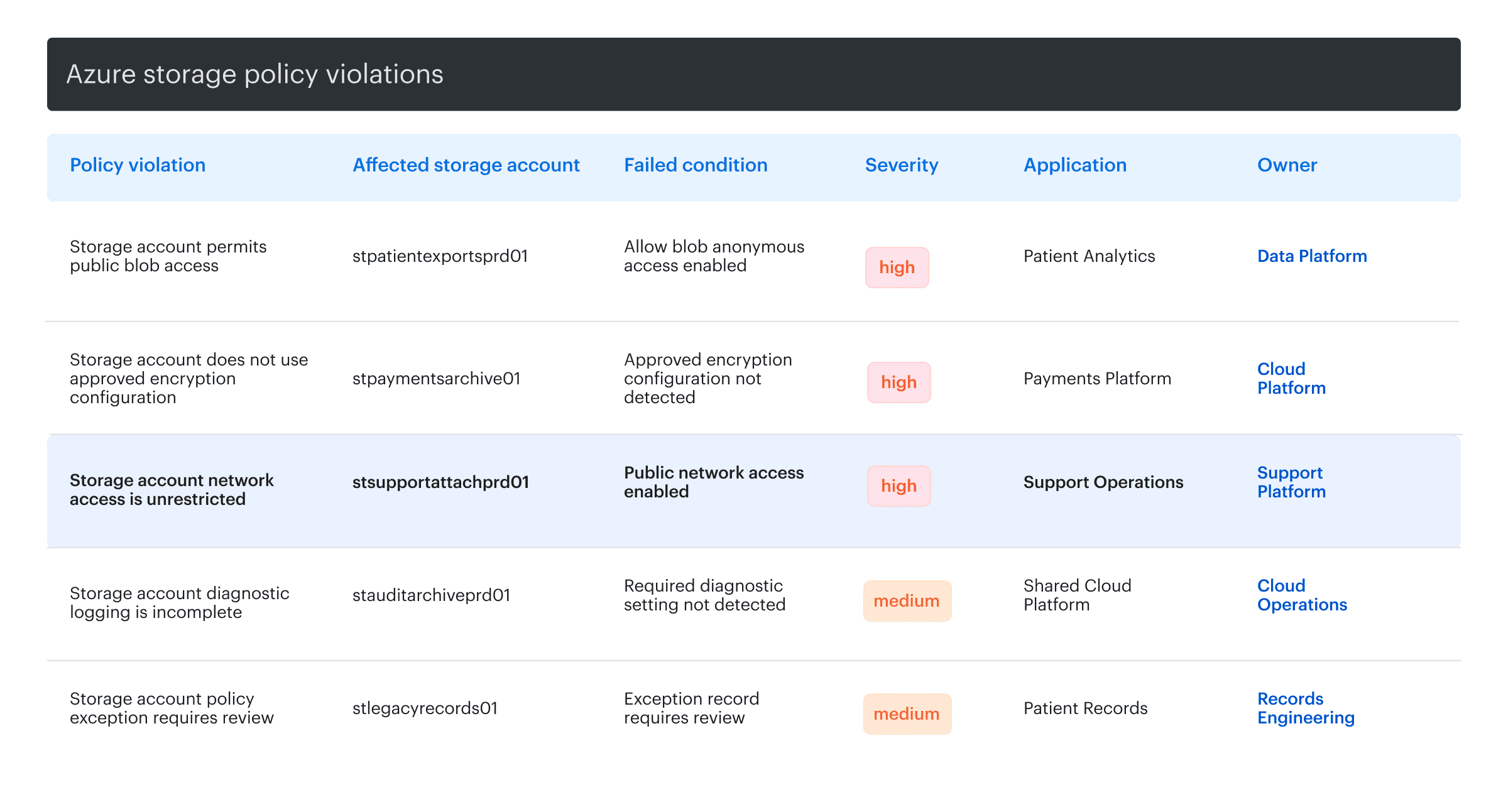 The team assigns an owner, restricts public access, enforces the required encryption configuration, and records the before-and-after state. The evidence trail should connect the affected storage account, failed policy, severity, application context, remediation owner, configuration change, and subsequent compliance evaluation.
Example 3: Kubernetes workload with unexpected east-west traffic
A customer-facing Kubernetes workload begins communicating with an internal API outside its approved application path. Runtime monitoring, service-mesh telemetry, IDS, or network-flow analysis detects the connection, but the raw event alone may not identify the business context or responsible team.
The enriched record connects the source workload with the destination service, namespace, environment, application relationship, owner, policy reference, severity, and Jira remediation ticket. The platform team can then apply a Kubernetes network policy or service-mesh authorization rule and monitor whether the unexpected path disappears.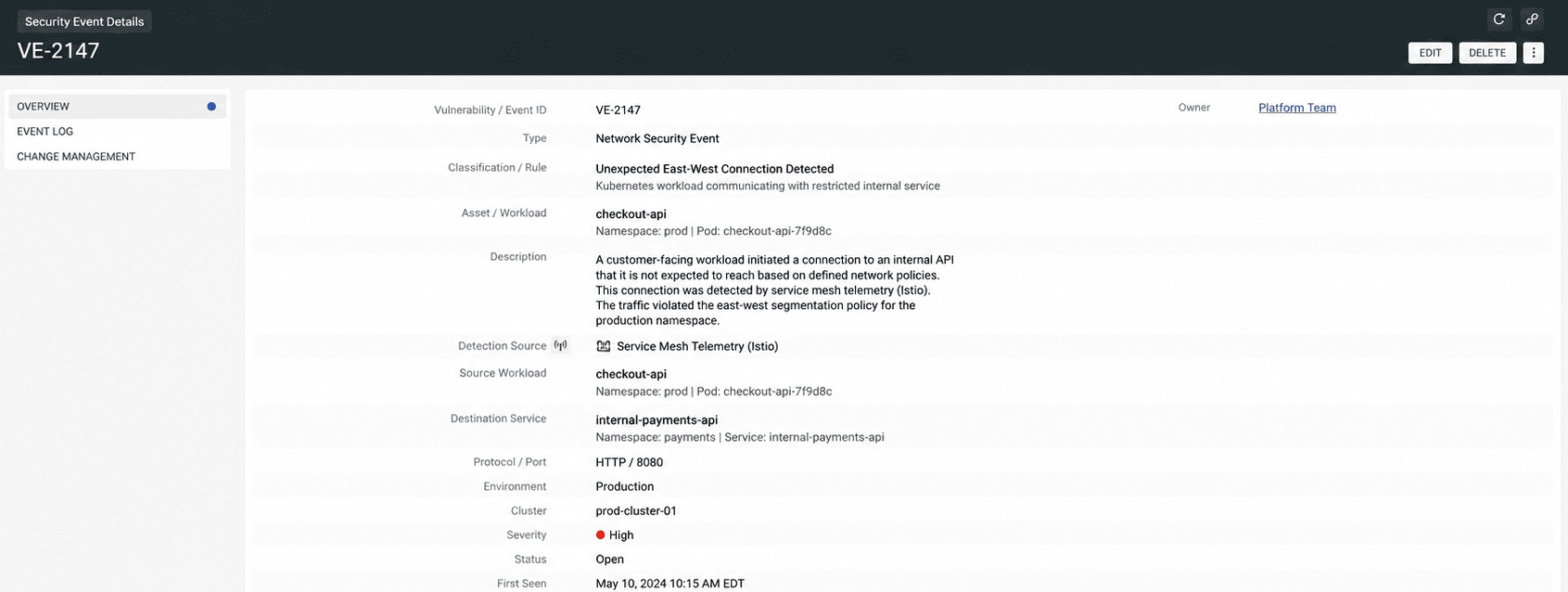 Cloudaware enriches unexpected Kubernetes east-west traffic with workload, destination, ownership, policy, severity, and remediation context.
The evidence trail should retain the original event, affected workloads, assigned owner, ticket, rule change, and follow-up verification. This proves that the communication path was closed in the running environment rather than merely marked resolved in the workflow system.
How to measure Zero Trust cloud security
Zero Trust progress should be measured through control outcomes across defined identities, resources, and access paths. Deployment activity can show that a capability exists, but it does not prove that the required population is covered, policy is enforced, or remediation changed the production environment.
Start with the protected paths defined during implementation. For each one, measure whether the team can identify the subject and resource, evaluate the required policy, enforce the decision, observe the outcome, and resolve failures.
| Measurement area | Core metric |
|---|---|
| Policy coverage | In-scope identities and resources evaluated by the required policy ÷ total in-scope population |
| Excessive privilege | Identities with permissions beyond the approved role or current operational need |
| Enforcement reliability | Required decisions successfully enforced ÷ total decisions requiring enforcement |
| Telemetry coverage | In-scope enforcement points producing valid, current, queryable signals ÷ total required enforcement points |
| Exception exposure | Open exceptions by age, scope, criticality, and expiration state |
| Verified remediation | Closed findings confirmed against current identity, policy, or resource state ÷ total findings marked resolved |
Policy coverage
Calculate coverage against the expected population, not only the resources visible to a security tool.
For example: Segment the result by provider, account, subscription, project, cluster, environment, application, resource type, and owner. A high estate-wide percentage can conceal an uncovered production account or a small population of privileged service identities.
Track partial coverage separately. A workload may be subject to network policy while lacking application authorization, runtime telemetry, or data-level enforcement.
Excessive and persistent privilege
Measure the permissions identities hold against the permissions required for their current role and observed activity. Useful indicators include:
- standing administrative roles
- unused permissions and credentials
- dormant privileged identities
- shared accounts and reusable keys
- elevation that outlives its approval window
- machine identities with access across unrelated environments
- access retained after application, team, or ownership changes.
A reduction in privileged identities is useful only when the remaining access still supports approved operations. Track revocation failures and recurring re-grants alongside the headline count.
Enforcement and telemetry failures
Separate policy decisions from enforcement outcomes. A correct deny decision provides no protection when the relevant gateway, IAM control, service mesh, Kubernetes policy, or data service fails to apply it.
Track:
- decisions with no applicable enforcement point
- enforcement errors and bypasses
- policies remaining in warning mode
- denied requests by access path and cause
- missing or stale signals from enforcement points
- median and p95 time between an event and its availability for investigation.
Telemetry coverage should resolve to the affected identity, resource, policy, enforcement point, and event time. Log volume alone cannot establish this.
Exception age and scope
Report exceptions by affected identity or resource, policy, environment, owner, criticality, approval state, and expiration date.
At minimum, distinguish:
- active exceptions within the approved period
- exceptions approaching expiration
- expired exceptions awaiting review
- exceptions without an owner
- repeated extensions
- exceptions whose compensating controls cannot be verified.
A falling exception count can be misleading if teams renew the same broad bypass under a new record. Track cumulative age and extension history.
Verified remediation
Workflow closure and control restoration are separate events. Verification should query the authoritative identity, policy, configuration, or runtime state after remediation.
Examples include confirming that:
- a privileged role was removed from every affected account
- an expired service credential can no longer authenticate
- a Kubernetes workload can no longer use the unauthorized communication path
- public access remains disabled on the affected data store
- the enforcement point produces the required telemetry after the change.
Report ticket closure and production-state verification separately. The gap between them exposes remediation processes that appear complete while the original access condition remains.
Use metrics as expansion gates
Before extending a Zero Trust pattern to another application or access path, confirm that:
- policy coverage meets the agreed threshold for the current scope
- critical identities and resources have accountable owners
- enforcement failures have an operational response
- required telemetry is current and queryable
- exceptions remain within approved scope and age
- representative remediations have been verified in production.
Thresholds should reflect the criticality of the protected path. The important requirement is that the denominator, exclusions, and verification method remain explicit.
How Cloudaware operationalizes Zero Trust
Zero Trust controls operate across identity providers, cloud IAM, network gateways, service meshes, Kubernetes controls, data services, and security platforms. Cloudaware provides the shared infrastructure context needed to understand where those controls apply, who owns the affected resources, and whether remediation changed the expected state.
Cloudaware does not replace the enforcement points that permit or deny access. Its CMDB connects cloud and hybrid resources with their applications, environments, accounts, owners, relationships, security findings, monitoring status, and operational workflows.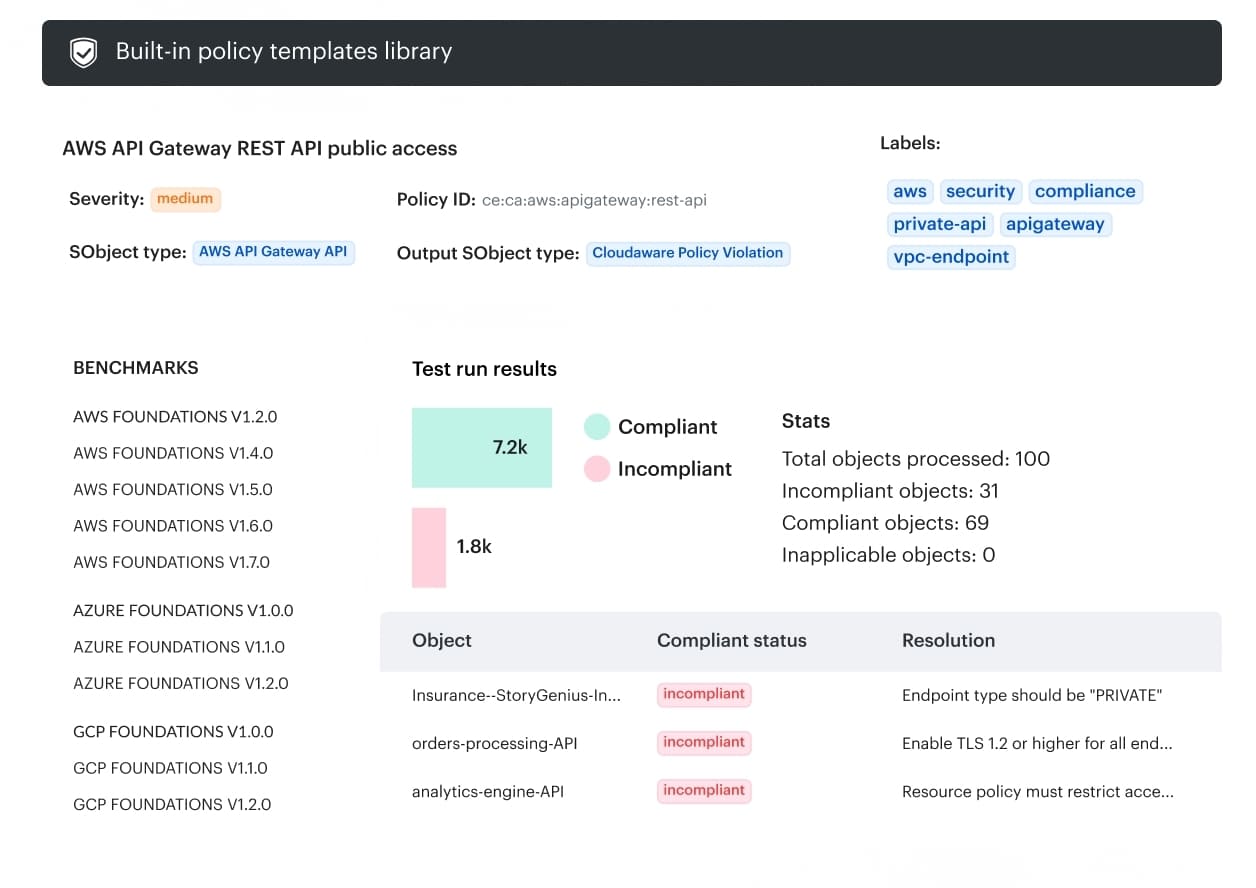 Core capabilities:
- Multi-cloud CMDB as the visibility foundation. A unified CMDB shows what exists across AWS, Azure, GCP, Oracle, Kubernetes, and connected systems, then links assets to owners, applications, environments, and operational context.
- Compliance Engine for policy evaluation. Policies are evaluated against CMDB data, and violations are created when tracked entities fail required conditions.
- Framework mapping and audit readiness. Operational controls can be mapped to CIS, NIST, FedRAMP, SOC 2, PCI DSS, GDPR, HIPAA, ISO 27001, ISO 27002, and UCF references.
- Exception and suppression governance. Exceptions remain part of the audit trail with owner, justification, scope, expiration date, and remediation state.
- Vulnerability and remediation workflows. Findings from scanners are enriched with owner, application, environment, platform, remediation group, and ticket status.
- IDS, logging, and event enrichment. Security events and logs get CMDB context such as ownership, application, environment, infrastructure relationships, and governance state, so investigations do not stop at raw provider logs.