


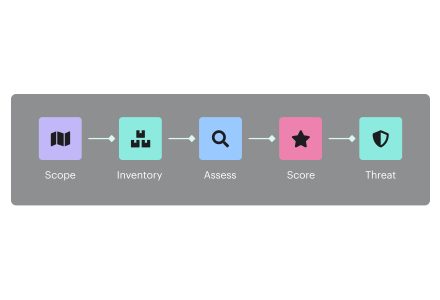
Cloud environments are harder to assess and easier to misjudge. Verizon’s 2026 breach research found that 31% of incidents began with vulnerability exploitation, while cloud attacks continue to rise, breakout times keep shrinking, and identity weaknesses remain a common factor in successful intrusions.
A cloud security risk assessment helps teams move beyond alert volume and determine which risks actually matter. It connects assets, identities, data, controls, and attack paths to likelihood, impact, and business context across multi-cloud and hybrid cloud environments.
What to expect:
- How cloud risk assessment differs from vulnerability assessment and audit
- Four best practices for identifying, prioritizing, treating, and monitoring cloud risk
- Frameworks, examples, and assessment outputs security teams can use without turning the process into spreadsheet theater
Key insights
- A cloud security risk assessment is not the same as a vulnerability assessment. Vulnerability assessment finds technical weaknesses; risk assessment connects those weaknesses to likelihood, impact, asset criticality, business context, and a named risk owner.
- Identity risk belongs in cloud risk management. Overprivileged users, service accounts, federated identities, and unmanaged access paths can create more exposure than a single misconfigured resource.
- CVSS does not equal risk. A critical vulnerability on an isolated dev instance and the same CVE on an internet-facing production workload may have the same score, but the attack path, data exposure, and business impact are completely different.
- Residual risk needs explicit ownership. Remediation is not finished when a ticket is opened; the remaining exposure must be accepted, mitigated, transferred, or avoided by the right risk owner.
- Effective cloud security risk management is continuous. Multi-cloud and hybrid cloud environments change too quickly for annual reviews to stay accurate, so teams need ongoing monitoring of assets, identities, controls, vulnerabilities, and treatment status.
- For AWS environment readiness, see our guide to the five readiness gates for an AWS cloud security assessment.
What is a cloud security risk assessment?
A cloud security risk assessment is the decision layer of cloud security assessment. It takes findings from vulnerability scans, CSPM tools, IAM reviews, audits, and incident data, then determines which scenarios create material business risk.
NIST SP 800-30 frames risk assessments as part of the overall risk management process, giving leaders the information needed to choose an appropriate response to identified risks.
A practical cloud risk assessment should answer:
- What risk scenario could occur?
- Which cloud assets, identities, data, or services are affected?
- What is the inherent risk before controls are considered?
- Which controls reduce likelihood or impact?
- Who is the risk owner?
- Should the risk be mitigated, accepted, transferred, or avoided?
- What residual risk remains after treatment?
Why cloud risk assessment is different from traditional infrastructure assessments
Traditional infrastructure risk assessment assumes a more stable asset base. But it’s not a cloud’s case, where cloud resources, services, and identities can change faster than ticket-based inventory or quarterly review cycles can keep up.
The shared responsibility model also changes the risk boundary. Microsoft’s cloud responsibility guidance notes that responsibilities vary across IaaS, PaaS, and SaaS, but customers always retain responsibility for data, endpoints, accounts, and access management.
For a risk assessment, that context matters because risk is rarely tied to one isolated resource.
A single risk scenario may involve:
- exposed workload + exploitable CVE + privileged identity
- public storage + sensitive data + missing owner
- SaaS integration + excessive OAuth permissions + weak monitoring
- production service + failed control + no tested response path
A traditional assessment may log these as separate issues. A cloud risk assessment connects them into an attack path, estimates likelihood and impact, assigns ownership, and tracks residual risk after treatment.
Risk assessment vs. vulnerability assessment vs. security audit
A cloud security risk assessment should not compete with a cloud vulnerability assessment, CSPM review, security posture assessment checklist, or audit. Those activities provide inputs, while risk assessment turns those inputs into decisions.
| Activity | Main question | Typical output |
|---|---|---|
| Cloud security risk assessment | Which scenarios create material business risk, and what should we do about them? | Risk register, risk owners, treatment plan, residual risk report |
| Cloud vulnerability assessment | Which workloads, packages, or configurations are technically weak or exploitable? | CVE findings, severity scores, remediation tickets |
| CSPM / security posture assessment checklist | Which cloud resources violate expected configuration or policy baselines? | Misconfiguration alerts, posture score, policy findings |
| Security audit | Can we prove that required controls are designed, documented, and operating? | Audit report, control evidence, exceptions |
A vulnerability assessment can tell the team what is weak. A CSPM review can show where the environment is out of policy. A security audit can prove whether controls meet requirements. A cloud security risk assessment decides what deserves action first, who owns the risk, and what exposure remains after the chosen treatment.
Read also: Cloud Security Assessment. Methodology, Checklist, Best Practices, and Remediation
Why cloud risk assessments fail in practice
A CSPM alert, SIEM event, IAM issue, failed control, or missing patch may be important, but none of them explains risk by itself. Cloud security risk management breaks down when teams cannot connect the finding to the affected asset, owner, data, exposure path, control owner, and compliance evidence.
Palo Alto Networks’ 2026 incident response coverage found that 87% of breaches involved at least two attack surfaces, while SaaS appeared in 23% of incidents. When cloud risk management ignores those relationships, the assessment becomes a list of issues instead of a map of attack paths.
Visibility gaps create inaccurate risk decisions
Teams often lack the complete context needed to assess risk accurately. Your CMDB may not track the workload, CSPM may identify a misconfiguration without business context, or SIEM may detect activity without ownership information.
A useful assessment needs to connect:
- Asset inventory and CMDB records
- Cloud exposure and CSPM findings
- Identity permissions and IAM relationships
- SIEM events and incident history
- Control owner, exception status, and compliance evidence
Risk scoring without context creates false priorities
Cloud risk scoring breaks when it treats severity as the main proxy for risk. A critical CVE on an isolated development workload and the same CVE on an internet-facing production service may receive the same technical severity, but they do not have the same likelihood, blast radius, or treatment path.
The assessment should adjust scoring based on context that changes actual exposure:
| Factor | Risk signal |
|---|---|
| Environment | Production usually changes impact, but exposed dev systems can still create lateral movement paths |
| Exposure | Internet-facing, cross-account, cross-tenant, or reachable through trusted SaaS integrations |
| Data | PII, PHI, PCI data, secrets, customer metadata, or operational telemetry |
| Identity path | Privileged roles, stale service accounts, federated access, or excessive OAuth scopes |
| Controls | Missing logging, weak segmentation, untested response, or expired exception |
| Ownership | Named risk owner, unclear service owner, or asset missing from the CMDB |
Good cloud security risk management does not ask, “What has the highest score?” It asks, “Which scenario is most likely to become a material incident, who can treat it, and what residual risk remains if we do not fix it now?
Read also: How to Conduct a Cloud Security Assessment - A Step-by-Step Guide
Best practice #1: Define scope before you score risk
A cloud computing risk assessment should start with scope, not scoring. If the assessment does not know which assets, identities, data classes, and business services are in scope, every risk score is built on partial evidence.
NIST SP 800-37 supports this sequence through the RMF “prepare” step, where organizations establish context before selecting, assessing, and monitoring controls.
Identify assets, data, accounts, and business services
Start with the inventory layer. In a multi-cloud environment, scope usually includes:
- AWS accounts, Azure subscriptions, and GCP projects
- Production, staging, development, and sandbox environments
- SaaS applications and third-party integrations
- Workloads, storage, containers, serverless functions, and managed services
- ServiceNow CIs, business services, owners, and cost centers
- Data classes such as PII, PHI, PCI cardholder data, secrets, and operational telemetry
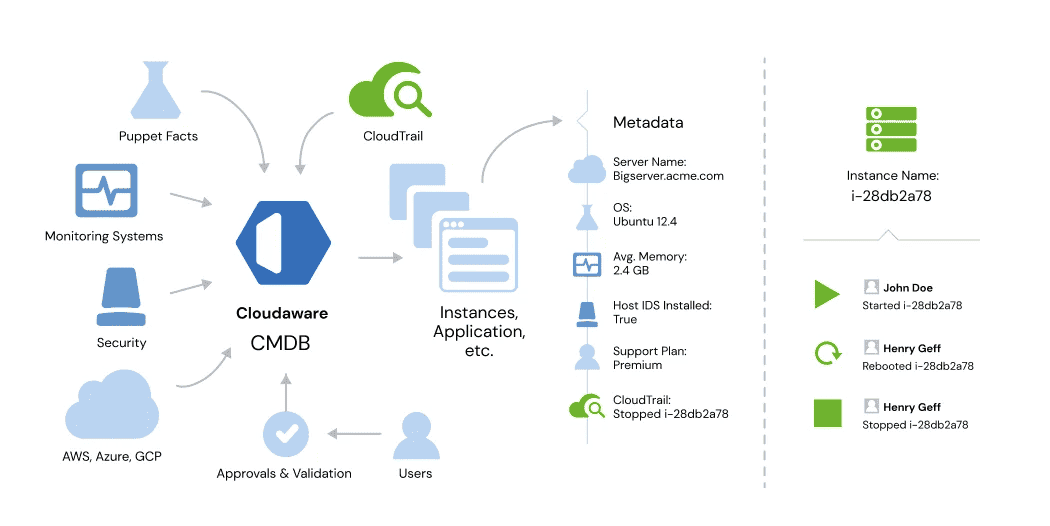 Cloudaware CMDB connects cloud assets, metadata, users, security signals, monitoring data, approvals, and change history into one inventory layer for assessment scope.
Define risk criteria before collecting findings
Scope also needs scoring rules. Otherwise, every team applies its own urgency model, and the assessment turns into a prioritization argument.
Define criteria before collecting findings:
- Likelihood: exploitability, exposure, active threat activity, and control weakness
- Impact: data sensitivity, service criticality, regulatory exposure, and operational dependency
- Risk appetite: what the organization is willing to tolerate
- Risk tolerance: measurable thresholds by environment or business process
- Risk acceptance: who can approve residual risk and for how long
This prevents a CVSS 9.8 in a dead-end dev environment from automatically outranking a lower-severity issue on a customer-facing production service. Technical severity matters, but it should not replace business risk.
Events that should trigger a cloud security risk assessment
A cloud security risk assessment should run on a schedule, but major environment changes should trigger reassessment sooner.
| Trigger | Why reassessment is required |
|---|---|
| Cloud migration | Changes account structure, network exposure, IAM, data location, and inherited controls |
| Acquisition or divestiture | Introduces unknown assets, identities, SaaS apps, and trust relationships |
| New SaaS integration | Expands third-party access, OAuth scopes, API dependencies, and data-sharing paths |
| Regulatory change | Changes evidence requirements, control expectations, and data handling |
| Production launch | Creates new business impact, owner accountability, monitoring needs, and response paths |
| Major vulnerability | Changes likelihood when affected assets are exposed, exploitable, or tied to critical services |
Read also: 10 Azure Cloud Security Best Practices for 2026
Best practice #2: Identify threats, exposures, and attack paths
A cloud security risk assessment should identify how a threat actor could move through the environment, not only which resources violate a policy.
Google Cloud’s 2026 threat reporting found that third-party software vulnerabilities accounted for 44.5% of cloud initial intrusions in late 2025, while 21% of cloud intrusions involved compromised trusted third-party relationships such as SaaS integrations. That is the operating model risk assessments need to reflect.
Move beyond misconfiguration scanning
CSPM findings are useful, but they are not enough. Looking at CSPM alone is like finding an unlocked door without knowing what is behind it. A public IP, permissive security group, disabled logging rule, or unencrypted bucket may generate a high-severity alert, but the actual risk depends on context.
For example:
- CSPM finds an internet-facing VM with an overly permissive security group.
- CWPP shows the VM is running a vulnerable version of Apache.
- CIEM reveals the workload uses an overprivileged service account.
- DSPM identifies customer PII stored in a connected database.
- CNAPP maps the full attack path from the exposed VM to the sensitive data.
Individually, these findings look like routine issues. Together, they describe a realistic breach scenario: an attacker exploits the vulnerable workload, abuses the service account, reaches the database, and accesses regulated data.
That does not mean security teams need 15 disconnected tools to track CSPM, CWPP, CIEM, DSPM, SIEM, and compliance evidence in separate queues. The better model is to combine the right cloud security assessment tools into a shared risk view where exposure, vulnerability, identity, data, and control context can be evaluated together.
Identity risk should be part of every assessment
Identity is now one of the main answers to “what are the security risks of cloud computing?” Palo Alto Networks’ 2026 incident response coverage reported that weak identity controls appeared in 90% of incidents, and 99% of analyzed identities were overprovisioned.
For assessment, check identity paths across:
- AWS IAM roles, policies, and IAM Access Analyzer findings;
- Microsoft Entra ID users, groups, service principals, and conditional access;
- GCP IAM roles, service accounts, and IAM Recommender signals;
- Federated access, stale service accounts, OAuth scopes, and emergency admin paths.
Industries with the highest cloud data security risks
The industries with the highest cloud data security risks usually combine sensitive data, regulatory exposure, and operational dependency:
| Industry | Main cloud risk driver |
|---|---|
| Healthcare | PHI, ransomware impact, HIPAA evidence, clinical system dependency |
| Financial services | PCI cardholder data, fraud risk, transaction systems, regulatory reporting |
| Government | FedRAMP expectations, citizen data, third-party access, mission systems |
| SaaS | Tenant data, OAuth integrations, API exposure, customer trust |
| Retail | PCI DSS scope, loyalty data, e-commerce availability, seasonal traffic spikes |
Check our Healthcare Data Security Multi-Cloud Guide to Protecting PHI in 2026
Best practice #3: Quantify and prioritize business risk
A cloud risk assessment should not rank findings by technical severity alone. Verizon’s 2026 DBIR coverage found that vulnerability exploitation accounted for 31% of confirmed breaches, while only 26% of critical vulnerabilities were fully remediated in 2025, with median patch time at 43 days. When the backlog is that large, the risk score has to separate “severe” from “material.”
Public vulnerability metadata also has limits. CVE submissions increased 263% from 2020 to 2025, and NIST began prioritizing NVD enrichment for KEV-listed, federal, and critical-software vulnerabilities in 2026.
Build a repeatable scoring model
Use CVSS as one input, not the decision engine. A practical security risk analysis in cyber security should combine:
| Signal | Use in scoring |
|---|---|
| CVSS | Technical severity |
| EPSS | Probability of exploitation in the wild |
| KEV catalog | Confirmed known exploitation |
| Exposure | Internet-facing, cross-account, or reachable through trusted paths |
| Asset criticality | Production, revenue, operational, or customer-facing dependency |
| Data sensitivity | PII, PHI, PCI data, secrets, or customer records |
| Control state | Logging, segmentation, WAF, EDR, patch status, or compensating controls |
| Ownership | Named owner, unclear owner, or orphaned asset |
FAIR can support quantitative risk analysis when the business needs financial loss estimates, but most teams first need a scoring model that consistently reflects likelihood and impact.
Focus on business impact, not alert volume
A CVSS 9.8 on an isolated dev VM and the same CVE on an internet-facing production database should not land in the same queue. The second case has higher likelihood, larger blast radius, and clearer business impact.
Prioritization should answer:
- Can a threat actor reach the asset?
- Can exploitation support lateral movement?
- What data or service is exposed?
- Are compensating controls working?
- Who owns remediation or risk acceptance?
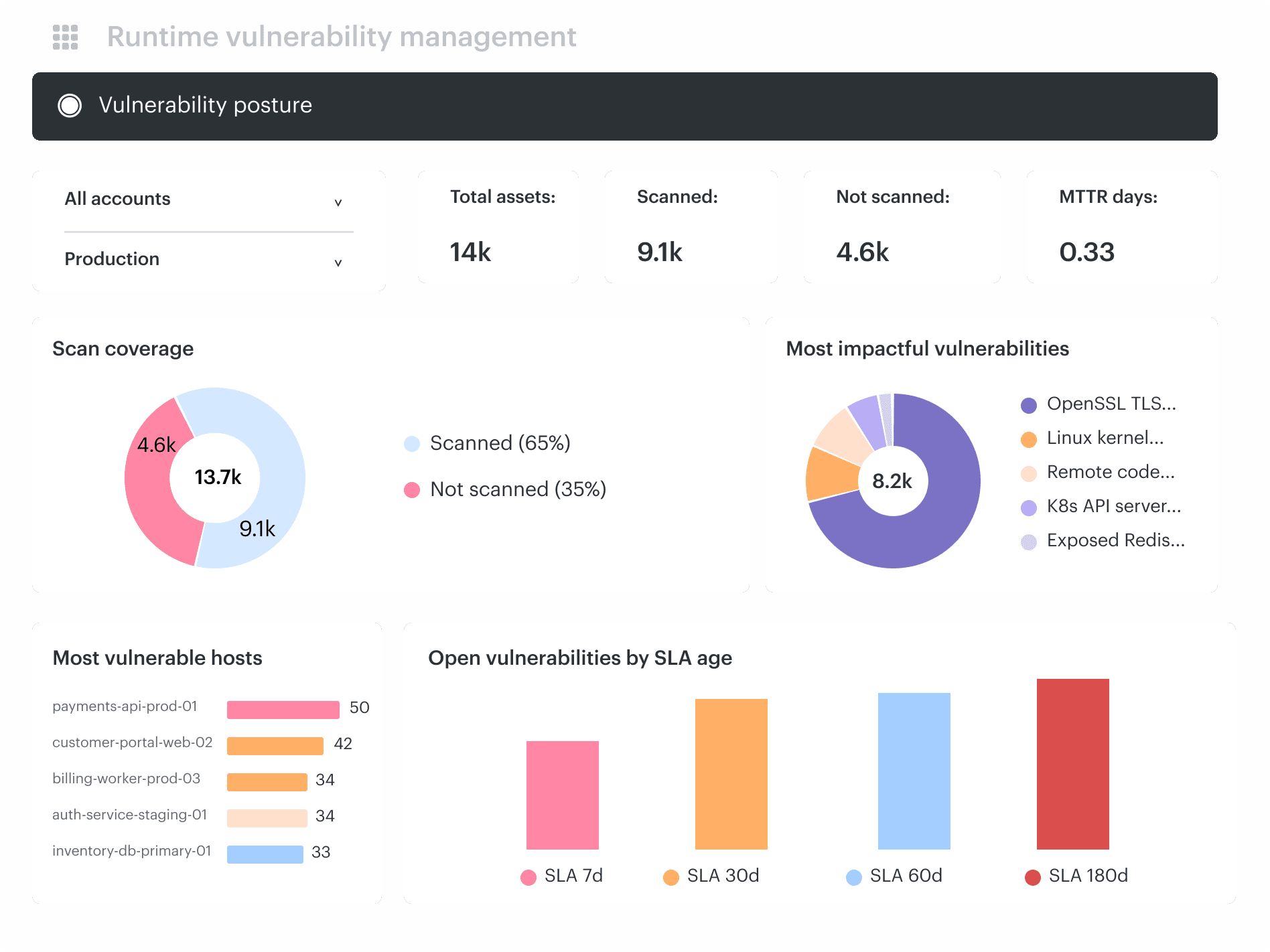 Cloudaware dashboard example: vulnerability prioritization by environment, asset criticality, risk level, CVE, host impact, and remediation SLA.
What should a cloud risk register include?
| Field | Purpose |
|---|---|
| Risk scenario | What could happen |
| Asset or service | Affected resource or business service |
| Owner | Risk owner or control owner |
| Likelihood | Probability based on exposure, exploitability, and threat activity |
| Impact | Business, compliance, operational, or data impact |
| Treatment | Mitigate, accept, transfer, or avoid |
| Residual risk | Exposure remaining after treatment |
| Review date | Date for reassessment or exception expiry |
Read also: What Is the Future of AI in Cloud Security? Trends & Benefits for 2026
Best practice #4: Treat risk and track residual exposure
Cloud security risk management does not end when the assessment produces a ranked list. The point of risk management in cloud computing is to decide what to do with each material risk, assign accountability, and track what remains after action is taken.
This is where many assessments lose value. Effective cloud risk management needs treatment status and residual risk tied back to live cloud context.
Choose the right treatment option
Risk treatment should be explicit. Every material risk should have one of four outcomes:
| Treatment option | What it means in cloud security |
|---|---|
| Mitigate | Reduce likelihood or impact by fixing the issue, changing configuration, removing exposure, reducing permissions, or adding controls |
| Transfer | Shift part of the impact through cyber insurance, contractual terms, vendor responsibility, or managed service agreements |
| Avoid | Remove the risk by retiring the workload, disabling the integration, changing architecture, or stopping the risky process |
| Accept | Approve the residual risk for a defined scope, owner, reason, and expiration date |
Turn assessments into an ongoing process
A cloud risk management framework has to support continuous monitoring, reassessment, and compliance monitoring. NIST RMF reinforces this through continuous monitoring, where organizations track control effectiveness, environment changes, and risk posture over time rather than treating authorization as a one-time event.
In cloud environments, reassessment should happen when risk context changes:
- Exposure changes
- Identity permissions change
- Workload moves to production
- New SaaS integration is approved
- Control fails
In other words, risk treatment needs current inventory, ownership, vulnerability status, control evidence, and compliance context in one place. Otherwise, the assessment becomes a point-in-time document while the environment keeps moving, naturally without asking permission.
Assessment deliverables security leaders should expect
A cloud security risk assessment checklist or cloud risk assessment checklist should produce decision artifacts, not just evidence exports.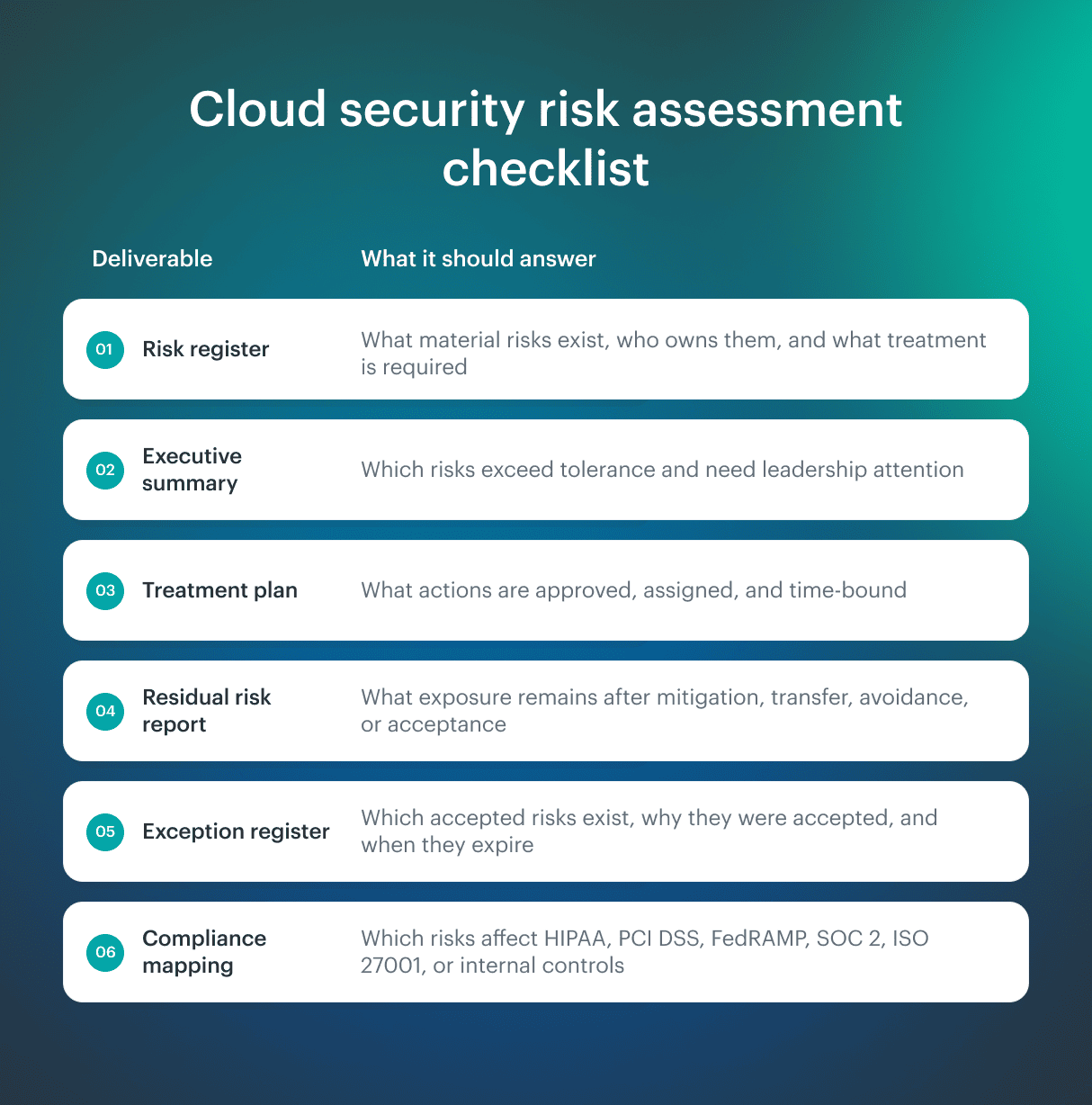
Frameworks that strengthen cloud security risk assessments
A cloud risk management framework should give structure to the assessment, but it should not replace engineering judgment. In cloud environments, frameworks are most useful when they define how to scope risk, assess likelihood and impact, select controls, and monitor residual exposure.
NIST, CSA, ISO, and FAIR serve different purposes
For cloud security engineers, the useful approach is usually blended. Use NIST SP 800-30 for risk analysis, NIST SP 800-37 for lifecycle discipline, CSA CCM for cloud control mapping, and FAIR when leadership needs quantified loss exposure.
If the assessment includes CI/CD, IaC, application delivery, or runtime security gates, connect it to existing DevSecOps frameworks rather than treating pipeline risk as a separate universe.
| Framework | Best use in cloud risk assessment |
|---|---|
| NIST SP 800-30 | Risk assessment method: threats, vulnerabilities, likelihood, impact, and risk response |
| NIST SP 800-37 / NIST RMF | Lifecycle model: prepare, categorize, select, implement, assess, authorize, and monitor |
| NIST CSF | Executive-level structure for identifying, protecting, detecting, responding, and recovering |
| CSA CCM | Cloud-specific control mapping across identity, data, infrastructure, logging, governance, and compliance domains |
| ISO 27005 | Information security risk management process, especially for ISO 27001-aligned programs |
| FAIR | Quantitative analysis when teams need to express risk in financial terms |
Read also: Cloud Data Security Best Practices - A Playbook for Multi-Cloud and Migration
How Cloudaware supports cloud security risk assessment
A cloud security risk assessment only works when security teams can connect risk signals to the assets, owners, controls, and evidence behind them.
Cloudaware helps by bringing cloud inventory, CMDB context, vulnerability data, compliance evidence, and operational signals into one working model for cloud security risk management.
Instead of treating CSPM findings, vulnerability results, SIEM events, and compliance gaps as separate queues, teams can use Cloudaware to understand the affected asset and its context.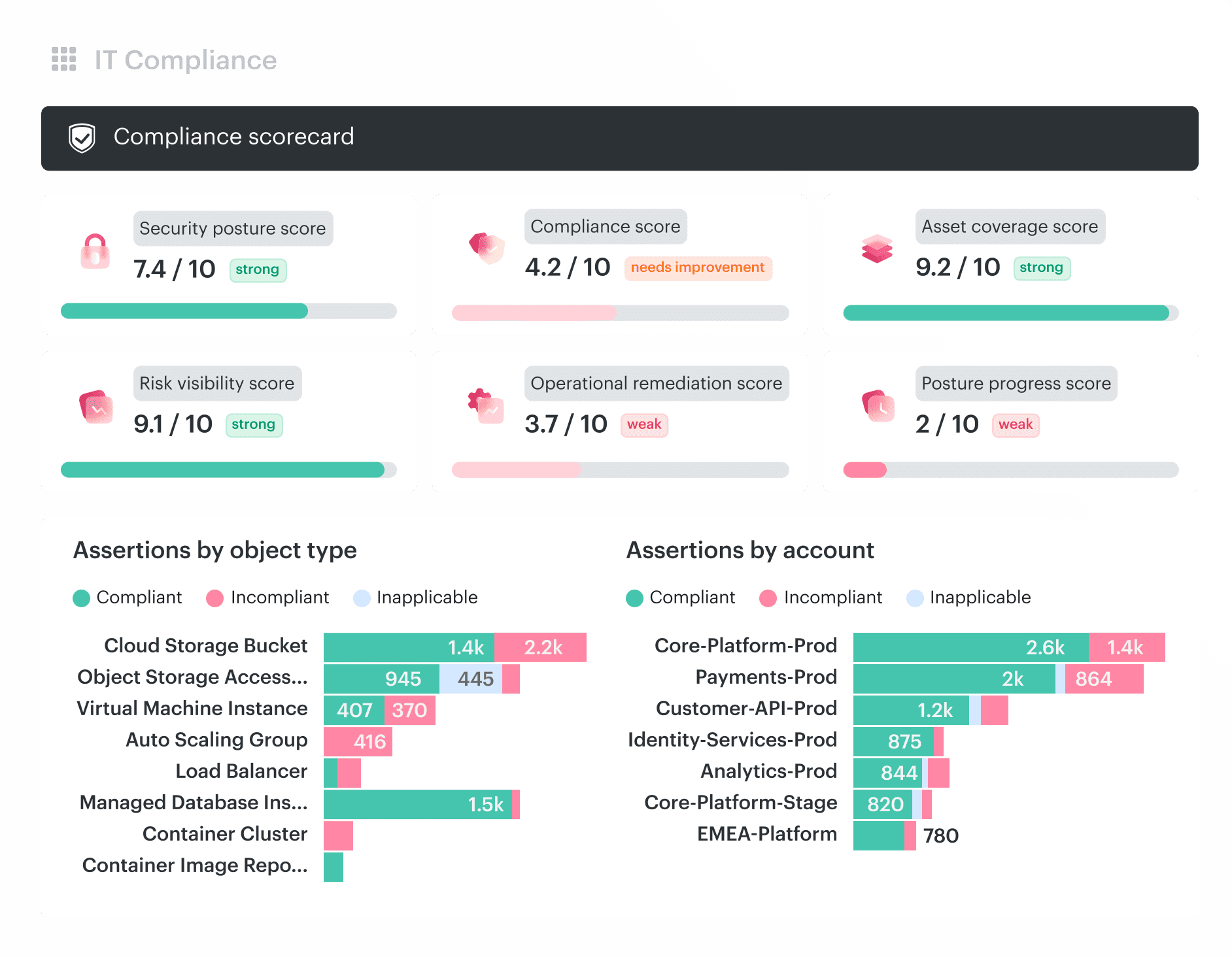 Core capabilities:
- CMDB-backed asset inventory: Gives teams a current view of resources across AWS, Azure, GCP, Oracle Cloud, Alibaba Cloud, VMware, Kubernetes, SaaS, and on-prem environments, so assessment scope starts from known assets instead of partial exports.
- Security posture context: Connects CSPM findings and policy violations to affected assets, owners, support groups, business services, environments, and compliance scope, so teams can separate hygiene issues from material risk.
- Vulnerability management context: Enriches vulnerabilities with ownership, exposure, environment, business service, and compliance context, so remediation can be prioritized by operational risk instead of CVSS alone.
- Compliance evidence: Links failed checks, exceptions, remediation status, and verification evidence to the affected resource, so audit support is tied to real assets rather than scattered across tickets and spreadsheets.
- Change history: Shows resource-level changes for drift detection, incident review, and compliance investigation, so teams can see when risk appeared and whether remediation held.
- Remediation workflows: Routes findings to accountable owners through Jira, ServiceNow, email, and existing ITSM processes, so treatment can move from assessment output to assigned action.
- SIEM enrichment: Adds asset, owner, environment, and app context to security events, so investigation data can support risk scoring, treatment decisions, and residual risk review.