


An AWS cloud security assessment can contain technically correct findings and still misrepresent the estate. Security Hub may evaluate only enabled controls with available data. AWS Config may aggregate only accounts where recording is active. GuardDuty, Inspector, and Macie may cover different account and Region populations.
The assessment becomes trustworthy only when the team can prove five inputs before testing begins: scope, baseline, evidence coverage, business context, and remediation governance.
The readiness review leads to one of three decisions: proceed, proceed with documented limitations, or pause and repair the assessment inputs.
TL;DR
- An AWS cloud security assessment is trustworthy only when its scope, baseline, evidence coverage, business context, and remediation process are verified before testing begins.
- Correct findings do not prove complete coverage. AWS Config, Security Hub, GuardDuty, Inspector, and Macie may represent different account, Region, resource, and scan populations.
- Reconcile the authoritative AWS Organizations inventory with every evidence source. Unknown coverage of production, identity, logging, shared-services, or security accounts is a hard stop.
- Use a versioned control baseline with explicit applicability and test methods. For example, CIS released AWS Foundations Benchmark v7.0.0 in April 2026, while Security Hub currently documents support only through v5.0.0.
- Treat “no findings” as evidence only when collection health, freshness, retention, exclusions, and account and Region coverage are known.
No data, disabled standards, or suppressed findings can create a cleaner score without proving a secure state. - Scanner severity alone does not establish business risk. Add application, environment, owner, data classification, exposure, dependencies, and recent-change context before prioritizing critical findings.
- A closed ticket is not proof that the control now passes. Define assignment, escalation, exception approval, remediation evidence, retesting, and closure before findings arrive.
- Score the five readiness gates, then decide whether to proceed, proceed with documented limitations, or pause and repair. Any unresolved hard stop overrides the numerical score.
- For GCP-specific execution, use the Google Cloud security assessment guide to validate GCP scope, native evidence, coverage, and remediation closure.
What is an AWS cloud security assessment?
An AWS cloud security assessment evaluates architecture, technical controls, operational practices, governance, and supporting evidence against agreed security criteria. Automated configuration checks contribute evidence, but they do not constitute the full assessment.
The expected activity depends on the question being asked.
| Activity | Primary question | Typical output |
|---|---|---|
| AWS cloud security assessment | Are security controls effective across the defined AWS estate? | Findings, coverage limitations, priorities, and remediation plan |
| AWS Well-Architected security review | Does the workload follow AWS architectural guidance? | Improvement recommendations organized around Security Pillar questions |
| AWS cloud security audit | Can the organization demonstrate conformity with defined audit criteria? | Audit evidence, control conclusions, and assurance opinion |
| Automated security scan | Which observed resources fail the configured technical checks? | Machine-generated findings |
A full assessment may use Security Hub CSPM, AWS Config, GuardDuty, Inspector, Macie, CloudTrail, IAM Access Analyzer, architecture diagrams, incident records, interviews, and policy documentation. Each source answers a different question and has its own coverage boundary.
Organizations that need a wider operating methodology can use a cloud security assessment framework to define objectives, evidence, analysis, reporting, and follow-through. External cloud security services may perform parts of the work, but the internal team still needs to establish a reliable estate population and evidence set.
Why assessment readiness matters before control testing
Finding accuracy and assessment validity are separate qualities.
A scanner can correctly report that every observed S3 bucket is encrypted. That result does not establish that every in-scope account was connected, every relevant Region was evaluated, or every bucket appeared in the source population. The resource-level finding may be accurate while the estate-level conclusion remains unsupported.
The same problem appears when a security score is interpreted without its denominator. According to the AWS Security Hub scoring documentation, controls with No data are excluded from the score. Archived and suppressed findings do not affect control status. Suppressing failed findings can therefore change the reported control status without changing the underlying resource configuration.
Continuous cloud security monitoring can supply current findings between formal reviews. It does not prove that the monitored population matches the intended assessment scope.
As one AWS practitioner put it: “Config Manager will get you best-practices for the services you are using but is in no way meant to be a one-size-fits-all.”
Configuration checks test represented conditions. They do not decide whether the assessment population, criteria, or evidence are sufficient.
The five-gate AWS assessment readiness model
The five-gate model scores the quality of assessment inputs, not the security posture of AWS itself.
Score each gate from 0 to 2:
| Score | Readiness state | Meaning |
|---|---|---|
0 | Not ready | A material input is missing or cannot be verified |
1 | Limited | The input exists, but coverage, ownership, or decision rules remain incomplete |
2 | Ready | The input is documented, reconciled, owned, and usable |
Add the five scores, then check for hard stops.
| Total | Default decision | Required response |
|---|---|---|
8–10 | Proceed | Record minor limitations in the assessment charter |
5–7 | Proceed with limitations | Define exclusions, confidence boundaries, and repair actions before testing |
0–4 | Pause and repair | Correct the inputs before producing estate-level conclusions |
A high total does not cancel a hard stop. A team might score well on baseline selection, business context, and remediation while remaining unable to prove whether production accounts are represented. The scope gap overrides the aggregate score.
Typical hard stops include:
- Unknown production, identity, logging, shared-services, or security account coverage
- No authority to approve control applicability
- No evidence that required telemetry sources operate in the relevant Regions
- Critical findings that cannot be connected to an owner
- No process for remediation, exception approval, retesting, or closure
Gate 1: Can you prove the AWS assessment scope?
Scope is credible only when the authoritative AWS estate population has been reconciled with every assessment source.
Start with AWS Organizations, but do not stop there. The current account export distinguishes PENDING_ACTIVATION, ACTIVE, SUSPENDED, PENDING_CLOSURE, and CLOSED states. Suspended, acquired, or closing accounts may still contain data, identity infrastructure, snapshots, logging dependencies, or unmanaged workloads. See the AWS Organizations account export documentation.
The scope manifest should record:
- Account ID and account state
- Organizational unit
- Included and excluded Regions
- Workload or application
- Environment
- Service owner
- Data classification
- Inclusion status
- Exclusion reason and approving authority
- Coverage in every planned evidence source
Reconcile this manifest with AWS Config, Security Hub, GuardDuty, Inspector, Macie, and any third-party assessment inputs.
AWS Config shows why a source cannot serve as its own denominator. An organization aggregator collects configuration and compliance data from accounts where AWS Config is enabled. It provides a read-only view of data recorded by those sources. The aggregator therefore cannot, by itself, prove complete Config coverage.
A reconciliation might produce the following illustrative list:
| Evidence source | Accounts expected | Accounts represented | What to investigate |
|---|---|---|---|
| AWS Organizations | 214 | 214 | Authoritative account population |
| AWS Config | 214 | 209 | Recorder, authorization, or Region gaps |
| Security Hub | 214 | 207 | Central configuration and member status |
| GuardDuty | 214 | 211 | Membership and regional enablement |
| Inspector | 214 | 204 | Scan activation by account and scan type |
| Macie | 78 | 73 | S3 population and regional configuration |
The different counts do not prove that any dashboard is wrong. They show that the assessment population has not yet been reconciled.
Pause the assessment when the missing population may include production workloads, privileged identity systems, shared networking, centralized logging, sensitive data, or security administration.
2026 implementation note: AWS plans to retire the Organizations API Status response parameter on September 9, 2026. Inventory scripts should use State instead. See the ListAccounts API documentation.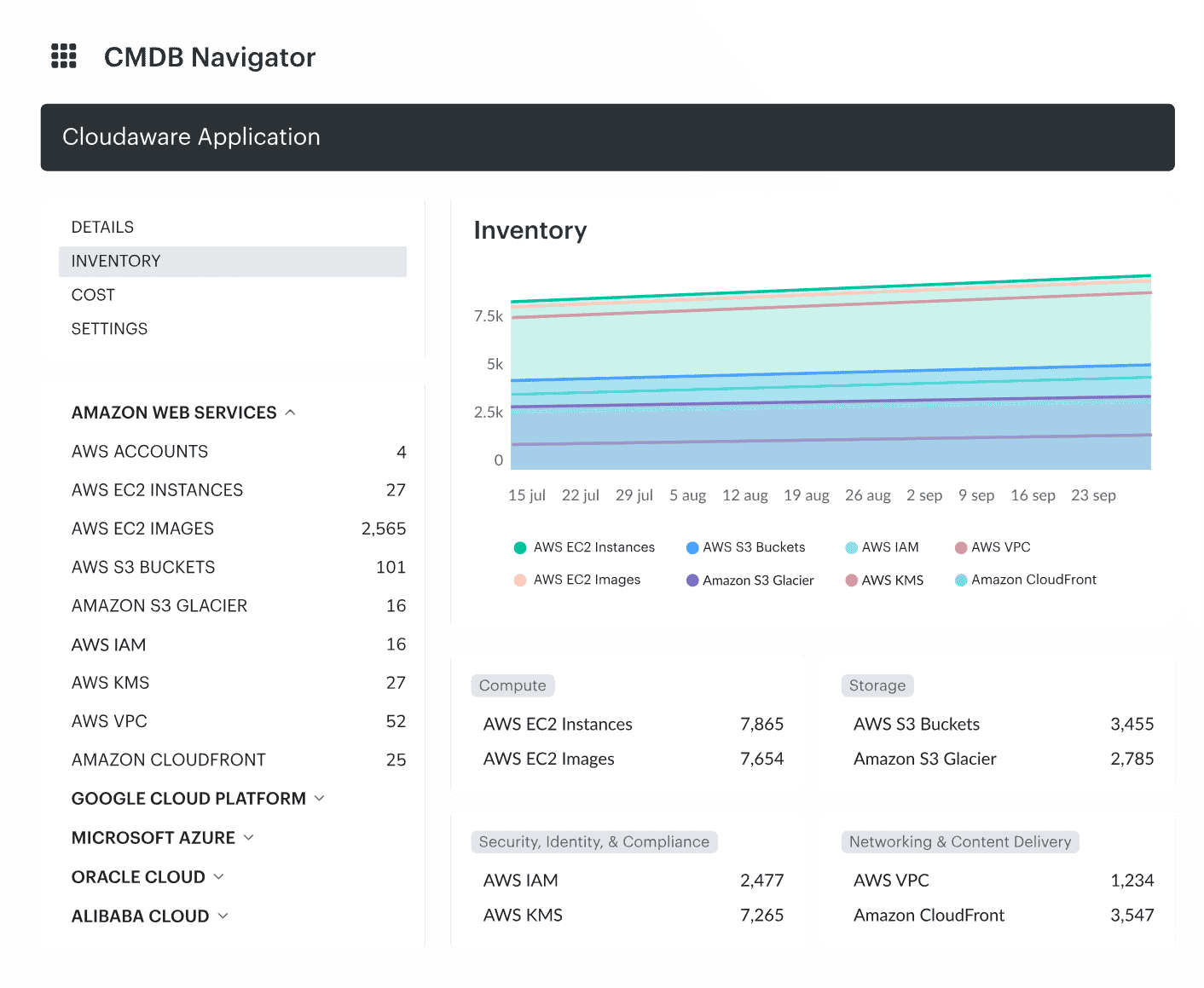 Example of Cloudaware UI. Multi-cloud CI inventory shows account and resource populations that teams can use to reconcile assessment scope.
Gate 2: Are the baseline and decision rules agreed?
A baseline is usable only when its version, applicable scope, test method, overlays, exceptions, and decision authority are explicit.
Writing “assess against CIS” in the charter is insufficient. CIS published the CIS Amazon Web Services Foundations Benchmark v7.0.0 in April 2026. AWS Security Hub CSPM currently documents support for versions 5.0.0, 3.0.0, 1.4.0, and 1.2.0. See the CIS April 2026 update and AWS Security Hub CIS benchmark documentation.
This creates an immediate decision: If CIS v7.0.0 is authoritative but the automated source covers v5.0.0, how will the assessment test change or add additional requirements?
The answer belongs in a control-applicability matrix.
| Required field | What it establishes |
|---|---|
| Baseline and version | Authoritative control set |
| Requirement ID | Traceability to the source requirement |
| Applicable scope | Relevant accounts, Regions, workloads, or environments |
| Test method | Automated test, manual review, interview, or design assessment |
| Evidence source | Source used to support the conclusion |
| Coverage limitation | Requirements or populations the source cannot evaluate |
| Decision authority | Person or group responsible for applicability and interpretation |
| Exception reference | Approved reason an applicable requirement is not currently met |
Regulatory, contractual, and internal requirements should appear as traceable overlays rather than an unstructured mixture of controls. The organization’s cloud security policy should define authority for applicability, exceptions, and risk acceptance. A separate mapping can connect the baseline to relevant cloud security compliance standards.
Passing an automated check does not establish compliance. AWS states that Security Hub standards and controls cannot guarantee compliance with a regulatory framework or audit. Technical checks contribute evidence, while cloud security compliance also depends on scope, governance, procedures, and human review.
Use AWS cloud security best practices when implementing controls. Do not substitute a best-practices list for versioned assessment criteria.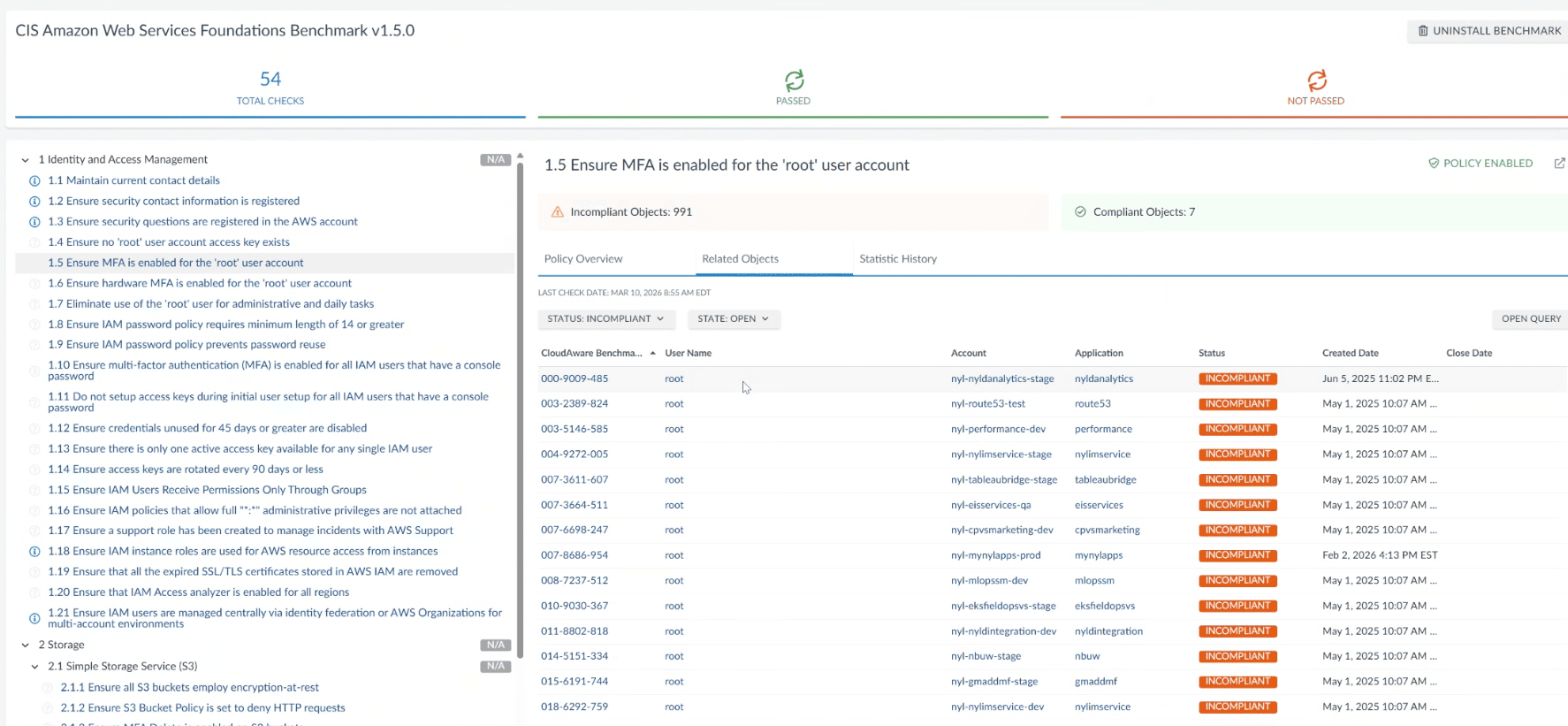 Example of Cloudaware UI. CIS AWS Foundations Benchmark results link a failed IAM control to the affected accounts, applications, and remediation status.
Gate 3: Can you distinguish evidence from a blind spot?
“No findings” is useful evidence only when source coverage, freshness, collection health, retention, and exclusions are known.
Maintain an evidence manifest for every source:
| Field | Assessment question |
|---|---|
| Source and owner | Who maintains the evidence pipeline? |
| Account coverage | Which AWS accounts are represented? |
| Region coverage | Which Regions are enabled and aggregated? |
| Resource coverage | Which resource and scan types are evaluated? |
| Collection health | Is the recorder, integration, or detector operating? |
| Freshness | When was the evidence last produced? |
| Retention | Is the required assessment period available? |
| Exclusions | Which findings, controls, or resources are omitted? |
| Known limitation | Which conclusion cannot be supported? |
Security Hub scoring makes the distinction concrete. A control with No data is excluded from the score. Suppressed and archived findings are ignored when determining control status. Central configuration policies can enable Security Hub, standards, and controls across accounts, but they do not configure AWS Config recorders. Recording for the required resource types must be enabled separately before applicable control findings can be generated.
| Observed result | What is known | Assessment conclusion |
|---|---|---|
| No failed checks; control evaluated; account managed; recording verified | The observed resource passed the test | Valid clean evidence for that criterion |
No failed checks; control has No data | No evaluation result exists | Blind spot until explained |
| No findings; standard disabled in the Region | The check is not running | No evidence of compliance |
| Passed after failed findings were suppressed | Workflow treatment changed the score | Review the suppression and exception |
| Account absent from central configuration | The account is not represented | Scope gap |
| Evidence predates the assessment period | A previous condition is known | Current state remains unverified |
Regional behavior adds another boundary. GuardDuty is a Regional service, and AWS recommends enabling it in all supported Regions. Incomplete regional enablement also reduces its ability to detect activity involving global services such as IAM.
Macie creates and maintains its S3 inventory in the current Region. Inspector administration and scan activation must also be verified by account, Region, and scan type rather than inferred from the presence of a delegated administrator.
This is also the boundary of cloud security posture management. CSPM provides continuous configuration evaluation within its connected scope. Assessment readiness verifies whether that scope and its data support the intended conclusion. Teams comparing evidence sources can apply the same manifest fields when evaluating cloud security monitoring tools.
Gate 4: Does every critical finding have business context?
A critical technical finding needs application, environment, data, exposure, dependency, and owner context before the team can assign a defensible priority.
Native AWS metadata can identify the account, Region, service, and resource ID. It does not automatically determine whether the resource supports a regulated workflow, sits on a shared production path, or has an owner authorized to accept risk.
AWS tagging guidance recommends business dimensions such as department, project, and environment because native resource and cost records do not contain this context automatically.
For each critical finding, resolve the affected resource to:
- Application or business service
- Production, development, test, or shared environment
- Finding owner
- Data classification
- Internet and internal exposure
- Upstream and downstream dependencies
- Business unit
- Regulatory or contractual scope
- Recent configuration changes
- Existing exception or compensating control
Consider two internet-exposure findings with the same technical severity. One affects a temporary development endpoint with no sensitive data. The other affects a shared production component used by 12 customer-facing applications. Without application mapping, data classification, dependencies, and ownership, the report preserves the scanner severity but loses the operational difference.
Regulated workloads sharpen this distinction. A finding affecting protected health information may require a HIPAA cloud security review. If the resource supports clinical access or data exchange, availability and integrity failures may create operational consequences beyond confidentiality, as discussed in common healthcare data security challenges. Financial services teams may apply different exposure, resilience, and evidence requirements under their cloud security operating model.
This gate does not replace a formal risk methodology. Once the affected service, data, dependencies, and owner are known, an ISO 27001 risk assessment or another approved process can evaluate likelihood, consequence, treatment, and residual risk.
Readiness test: Sample the highest-severity findings. For each resource ID, verify that the assessment team can identify the application, environment, owner, classification, exposure, and dependency path without reconstructing the record across several disconnected systems.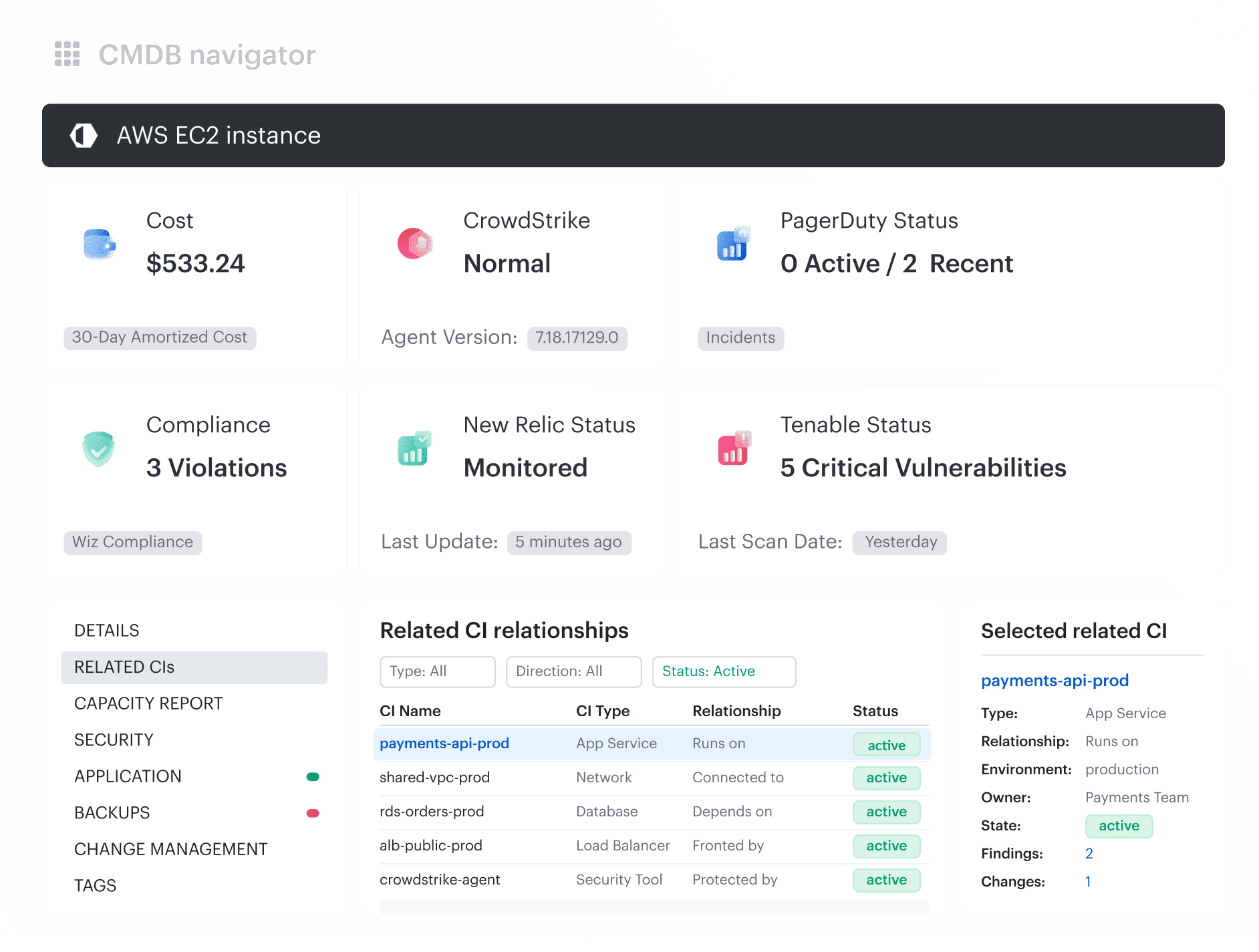 Example of Cloudaware UI. An EC2 CI record combines compliance violations, critical vulnerabilities, monitoring status, recent incidents, ownership, and service dependencies for assessment triage.
Gate 5: Is remediation governance defined before findings arrive?
An assessment is not operationally ready when it can generate critical findings but cannot assign, escalate, retest, or close them with evidence.
The remediation contract should exist before testing begins. Otherwise, teams negotiate ownership, deadlines, evidence, and exceptions one finding at a time.
At minimum, define:
- Finding owner
- Severity and priority rules
- Target response and remediation times
- Ticketing destination
- Required remediation evidence
- Retest owner and method
- Escalation path
- Exception approver
- Business justification
- Compensating controls
- Exception review and expiration dates
- Closure authority
Closure should mean that the control passed a new evaluation or that a valid approved exception remains traceable. Moving the ticket to Done is not sufficient evidence.
Security Hub reflects part of this logic. A finding marked RESOLVED can return to NEW when its compliance status changes from Passed to Failed, Warning, or Not Available.
Ticket creation alone does not solve remediation governance. The ticket needs the affected resource, application, environment, owner, assessment scope, exception state, dependencies, and evidence required for retesting.
These decisions belong within the wider cloud security governance model because someone must own applicability, escalation, exception approval, residual risk, and closure.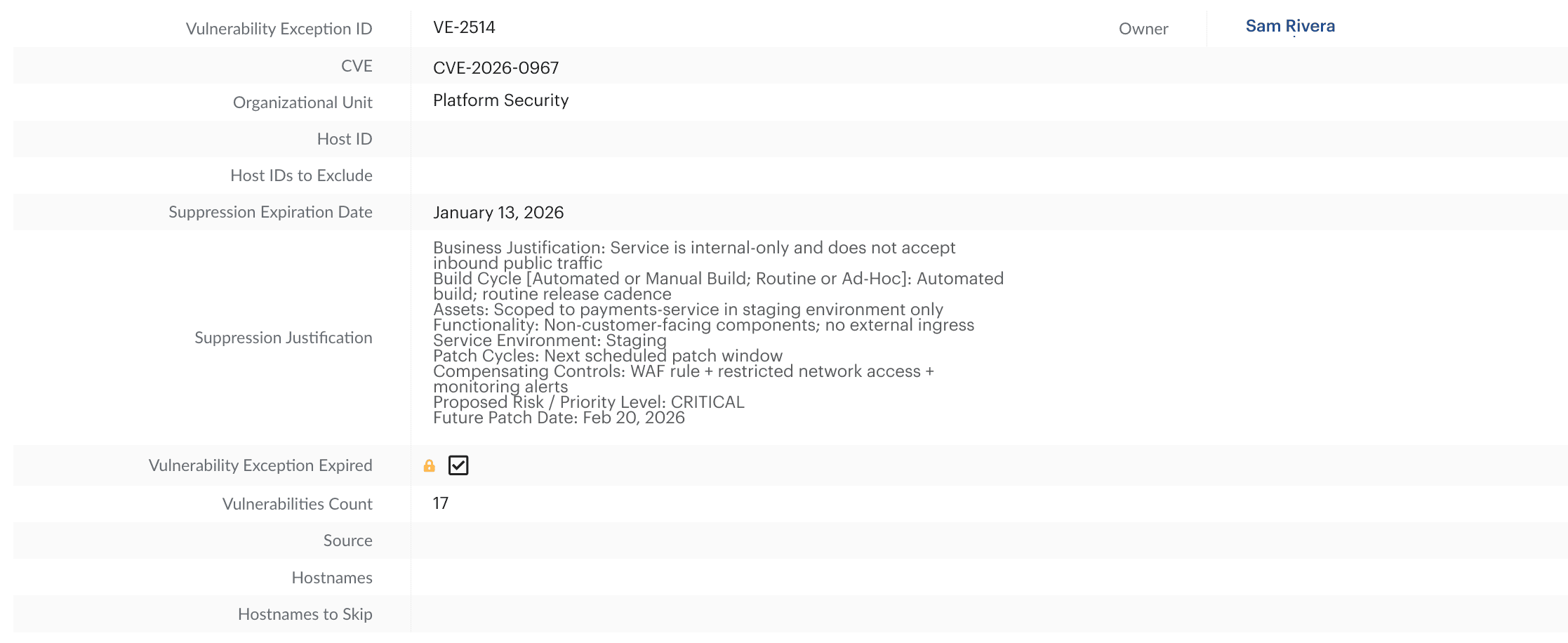 Example of Cloudaware UI. A governed vulnerability exception records the owner, business justification, compensating controls, affected assets, review date, and expiration.
Proceed, proceed with limitations, or pause the assessment?
The assessment lead should issue a documented kickoff decision after scoring the five gates and reviewing hard stops.
| Decision | When to use it | What leadership should receive |
|---|---|---|
| Proceed | Inputs are reconciled, owned, and usable; no hard stops remain | Charter, scope, baseline, evidence manifest, and remediation contract |
| Proceed with limitations | Known gaps are bounded and do not invalidate the entire assessment | Limitation statement, affected population, confidence boundary, repair owner, and due date |
| Pause and repair | Scope or evidence gaps could materially distort conclusions, or findings cannot be governed | Readiness repair plan with owners and a new kickoff condition |
“Proceed with limitations” is not permission to hide missing data in an appendix. The limitation statement should specify:
- Affected accounts, Regions, resources, or controls
- Reason the evidence is unavailable or incomplete
- Conclusions that cannot be made
- Whether critical workloads may be involved
- Person who accepted the limitation
- Repair or reassessment date
The final pre-kickoff package should contain the assessment charter, readiness score, scope manifest, control-applicability matrix, evidence manifest, blind-spot register, business-context coverage report, and remediation contract.
How Cloudaware supports assessment readiness and follow-through
Cloudaware provides the inventory, relationship, policy, and workflow layer around AWS assessment evidence.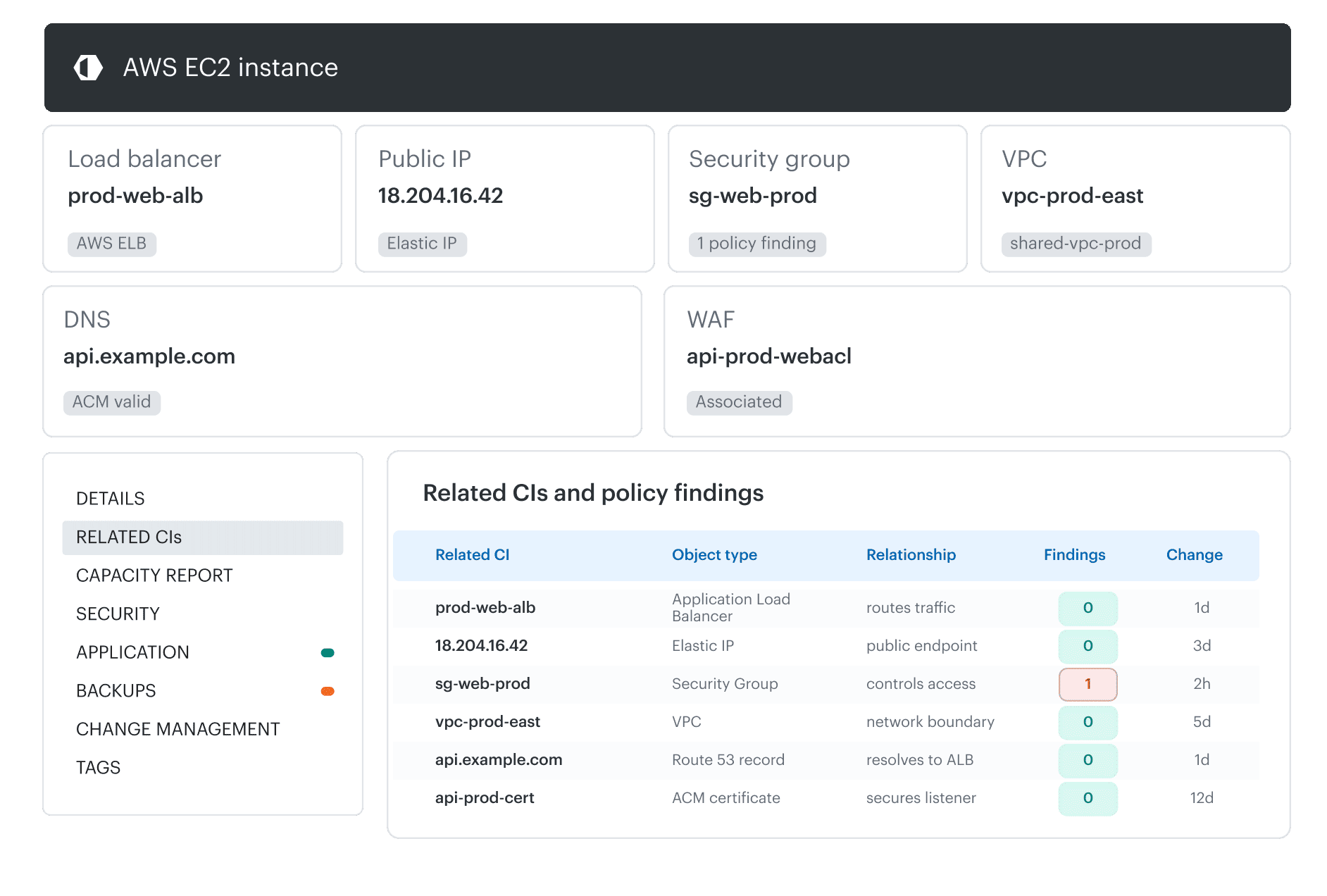 It helps teams prove which assets were represented, add operational context to findings, track configuration changes, and carry violations through remediation or governed exception handling.
Core capabilities:
- AWS estate discovery and scope reconciliation: Automatically collect AWS Organizations member accounts and inventory based on granted IAM permissions, then use account and resource populations as the assessment denominator.
- CMDB-enriched finding context: Connect AWS resources and security findings with applications, environments, owners, business units, tags, data context, and related CIs.
- Dependency and exposure mapping: Trace relationships between EC2 instances, VPCs, subnets, security groups, load balancers, databases, applications, and other connected CIs.
- CMDB-aware policy evaluation: Run CIS benchmark checks and custom security policies against CMDB data, with controls scoped by account, application, environment, resource attributes, tags, or risk context.
- Configuration and remediation history: Review changes to AWS resource attributes, tags, security status, and other tracked fields, with before-and-after values and CloudTrail identity context where available.
- Owned remediation and exception workflows: Route policy violations or vulnerability findings to Jira, ServiceNow, Slack, or email with the affected CI and its CMDB attributes.