


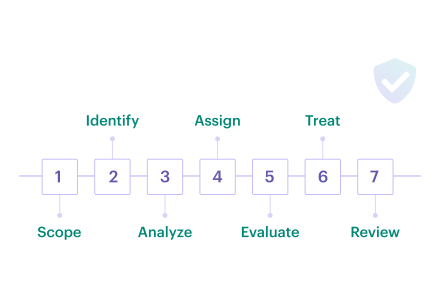
An ISO 27001 risk assessment identifies information security risk scenarios, analyzes their likelihood and consequences, evaluates them against defined criteria, and determines which risks require treatment.
The process becomes harder when the ISMS scope spans AWS accounts, Azure subscriptions, GCP projects, SaaS applications, identities, and shared services that change faster than a manually maintained risk workbook. The 2025 Thales Cloud Security Study found that organizations use an average of 2.1 public cloud providers and 85 SaaS applications. That operating footprint makes current scope and ownership data part of the assessment problem, not administrative detail.
A cloud security assessment and audit can supply findings about current technical conditions. The ISO 27001 process has a different job: turn relevant evidence into consistent, accountable risk decisions.
TL;DR
- ISO/IEC 27001:2022 requires a repeatable assessment process, but it does not prescribe one universal scoring formula.
- Define the methodology, likelihood and impact criteria, acceptance thresholds, and ownership rules before populating the risk register.
- A CVE, policy violation, or exposed resource is evidence. Risk assessment connects that evidence to a credible scenario, affected information or service, consequence, and owner.
- Risk assessment should drive treatment and control selection. Starting from Annex A as a flat implementation checklist reverses that logic.
- Cloud evidence can update continuously, while formal reassessment remains governed through planned intervals and defined change triggers.
- For the commercial evaluation layer, compare the best cloud security assessment tools by how well they support context, ownership, evidence collection, prioritization, and remediation workflow rather than by scanner coverage alone.
What is an ISO 27001 risk assessment?
An ISO 27001 risk assessment is a repeatable process for identifying, analyzing, and evaluating information security risks within the scope of the ISMS.
At a practical level, it looks like: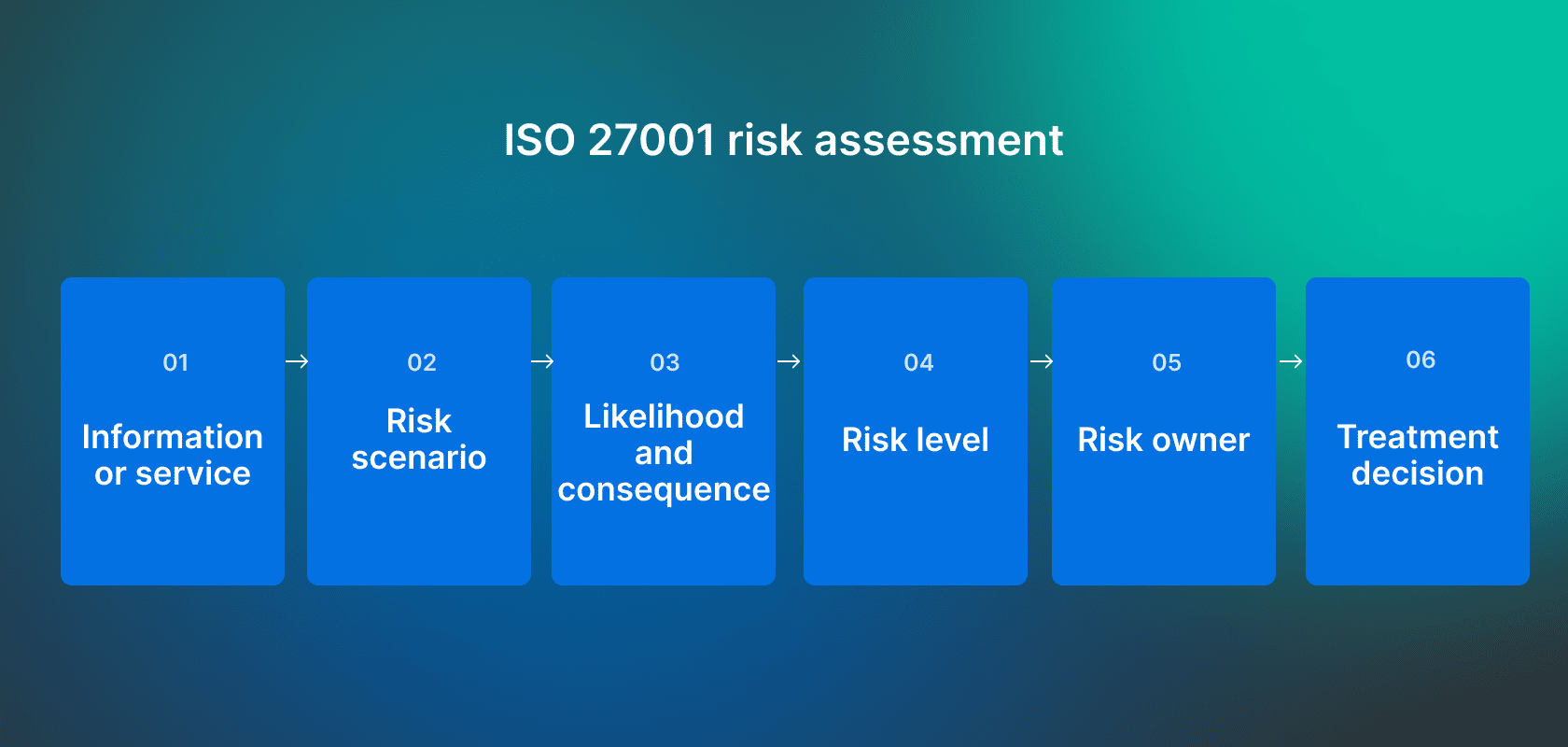 ISO/IEC 27005:2022 supports ISO/IEC 27001 implementation with guidance on identifying, assessing, and treating information security risk. NIST IR 8286A Rev. 1 uses compatible risk mechanics: scenarios are documented around threats, vulnerabilities, enterprise assets, likelihood, and impact so organizations can prioritize and communicate risk responses.
One workload may be an isolated development instance with synthetic data and no path to production. The other may be an internet-reachable production service whose workload identity can access customer data. The technical weakness is similar. The scenario, potential consequence, and treatment priority are not.
A useful working distinction is:
- Finding: observed technical or control condition
- Risk scenario: credible way that condition could contribute to harm
- Risk analysis: assessment of likelihood and consequence
- Risk evaluation: comparison of the result against established criteria
- Treatment decision: what the organization will do about the risk
What ISO/IEC 27001:2022 Clause 6.1.2 requires
ISO/IEC 27001:2022 Clause 6.1.2 defines the core requirements for the information security risk assessment process: organizations must establish risk criteria, produce consistent and comparable results, identify risks and risk owners, and analyze and evaluate those risks.
The operational requirements of Clause 6.1.2 can be translated into four practical questions:
| Clause 6.1.2 requirement | Practical meaning | Cloud implementation question |
|---|---|---|
| Establish and maintain risk criteria | Define how risks will be assessed and what level is acceptable | Are likelihood, impact, and acceptance rules consistent across cloud providers and business units? |
| Produce consistent, valid, and comparable results | Repeated assessments should support comparable decisions | Would two teams assessing similar cloud services reach reasonably compatible conclusions? |
| Identify risks and risk owners | Describe relevant scenarios and assign accountable decision ownership | Can the organization connect the affected service to a person with authority over the risk decision? |
| Analyze and evaluate risks | Assess likelihood and consequences, determine risk level, and compare it with predefined criteria | Does prioritization reflect exposure, identity access, information sensitivity, dependencies, and control state? |
ISO/IEC JTC 1/SC 27 guidance describes risk assessment in terms of identifying risks associated with loss of confidentiality, integrity, and availability, then evaluating likelihood and potential consequences.
Clause 6.1.3 carries the process into risk treatment. Clause 8.2 applies risk assessment operationally at planned intervals and when significant changes require reassessment.
The point is continuity between decisions. A score without a treatment path leaves the process incomplete. A selected control without implementation or effectiveness evidence leaves the organization with an intention rather than a demonstrated response.
Preparation for the ISO 27001 risk assessment process
The risk assessment process starts with defined scope, methodology, ownership, and risk criteria, not with a list of findings to score. ISO 27001 implementation guidance treats those elements as prerequisites for consistent and comparable assessment results.
In cloud environments, that preparation has four practical components: a defined ISMS scope, current service and asset context, accountable owners, and predefined risk criteria.
Define the ISMS scope around information and business services
An ISMS scope should not collapse into a list of cloud account IDs. Start with the information and business services in scope, then map the technology and dependencies supporting them.
Depending on the environment, this may include:
- Production applications
- AWS accounts, Azure subscriptions, and GCP projects
- Databases, object storage, warehouses, and backups
- Workload identities, service accounts, and privileged access paths
- Shared DNS, networking, logging, and key management
- SaaS applications that process in-scope information
- External service providers and critical integrations
A SaaS tenant can be relevant to the scope even when the organization does not operate the underlying infrastructure. The assessment still needs to understand what information enters that tenant, who administers access, which integrations move data, and what failure scenarios matter.
Build a current cloud asset register with owners and relationships
A useful asset register should support assessment questions, not merely answer, “What resources exist?” For cloud risk work, use the following relationship model: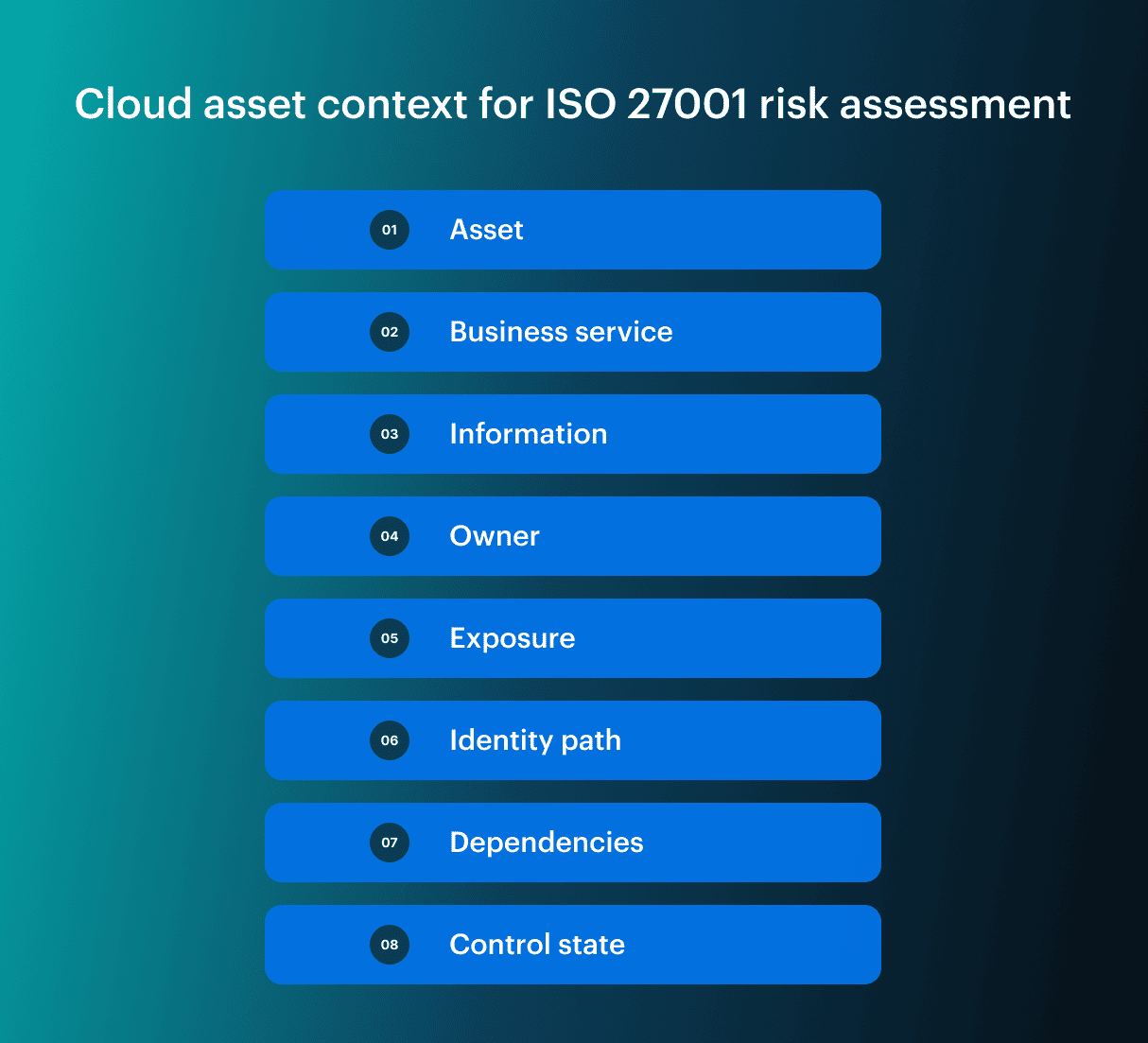 That is not ISO terminology; rather, it is a practical way to prevent context loss during the transition from asset discovery to risk analysis.
For example, knowing that an RDS instance exists is useful for inventory. The assessment needs more: which application depends on it, whether it contains sensitive information, which identities can reach it, whether it is exposed through another workload, who owns the service, and which controls affect the scenario.
Native cloud history can support this evidence, but retention behavior differs. AWS Config supports configurable Configuration Item retention from 30 days to seven years. Azure Resource Graph Change Analysis makes changes queryable for 14 days unless data is exported for longer retention. Google Cloud Asset Inventory provides asset history for up to 35 days.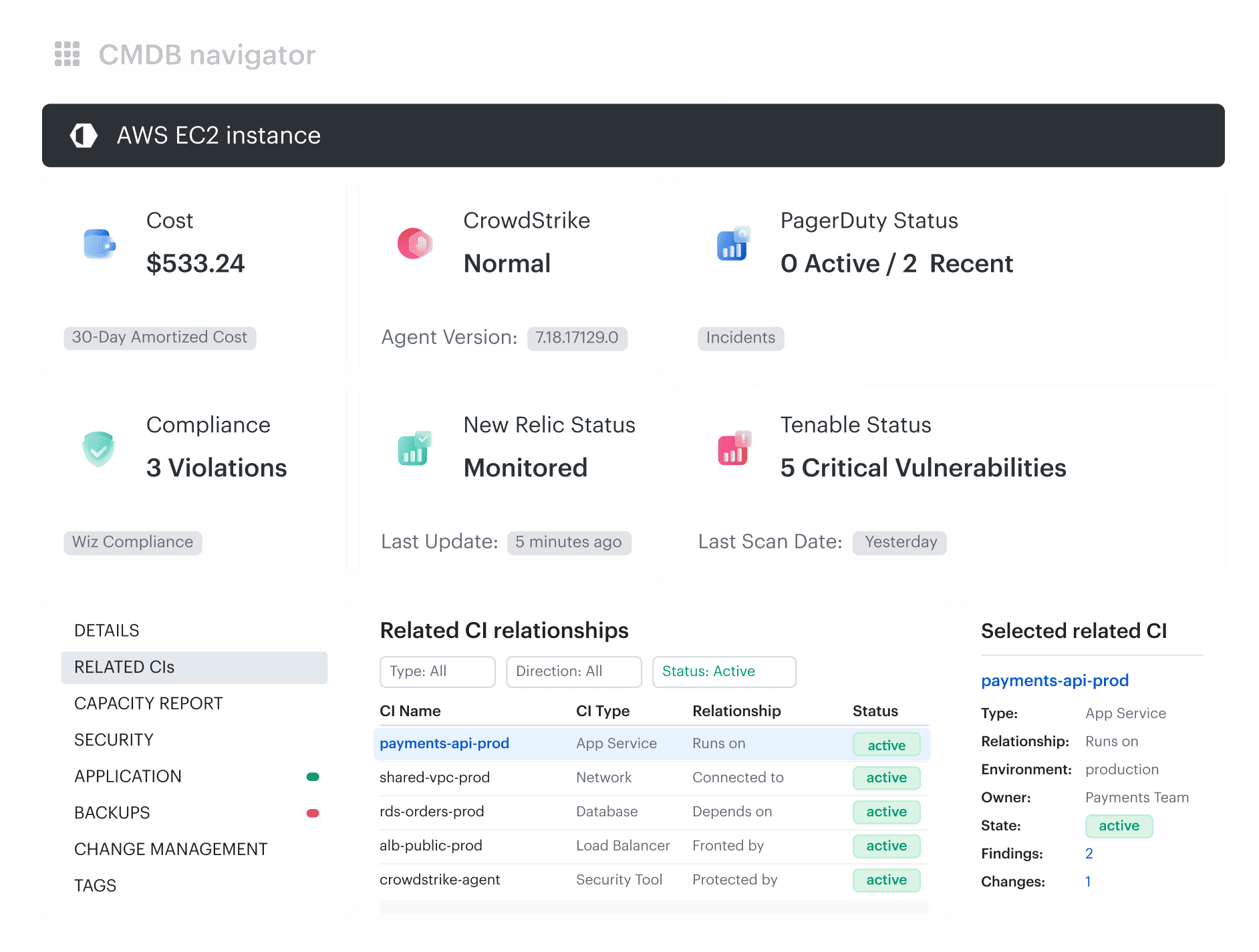 That’s why multi-cloud CMDB becomes relevant here. Assessment scope depends on current relationships and ownership across providers, accounts, regions, and hybrid infrastructure. Data-specific scope decisions should also connect with the broader cloud data security lifecycle.
Set likelihood, impact, and risk acceptance criteria before scoring
Define the assessment rules before reviewing the findings:
- Likelihood definitions
- Consequence or impact definitions
- Calculation or rating logic
- Acceptance threshold
- Escalation conditions
- Required approval authority
- Reassessment criteria
Otherwise, teams tend to discover that too many risks have landed in the same category and then adjust the method after seeing the result.
A score of 16 has little meaning unless everyone understands what the underlying likelihood and impact values mean, how the score was derived, and what decision threshold follows.
Read also: Cloud Security Compliance. How to Build Evidence-Ready Cloud Controls
ISO 27001 risk assessment process: 7 steps for cloud environments
ISO/IEC 27001:2022 requires a defined process for identifying, analyzing, evaluating, and prioritizing information security risks. Practical implementation guidance further separates risk identification, analysis, and evaluation into distinct decision stages.
For cloud teams, the workflow therefore starts with service, asset, and ownership context and ends with a documented risk decision, rather than treating scanner findings as ready-made risks.
1. Confirm the scope and assessment criteria
Before identifying risk scenarios, establish what the assessment covers and how decisions will be made.
Confirm:
- Information and services in scope
- Supporting environments and dependencies
- Likelihood and impact criteria
- Risk calculation method
- Acceptance threshold
- Escalation rules
- Who can accept residual risk
The method should produce repeatable decisions across assessments. That does not mean every department must use identical business-impact language, but comparable scenarios should not be rated on incompatible assumptions.
A smaller organization may be able to operate a straightforward qualitative method. A complex enterprise may need service-specific impact criteria, several escalation tiers, and explicit links to enterprise risk governance. Complexity should follow decision needs, not the desire to make the model look sophisticated.
2. Identify services, information, assets, and dependencies
An information security risk assessment under ISO 27001 should begin with the business and information context, then resolve the infrastructure supporting it. The purpose is to understand enough of the environment to describe a credible scenario and assign ownership.
This matters in multi-cloud systems because the risk path may cross provider and organizational boundaries. An application running in AWS may authenticate through an external identity provider, send logs to a SaaS platform, create exports in object storage, and depend on a shared network service managed by another team.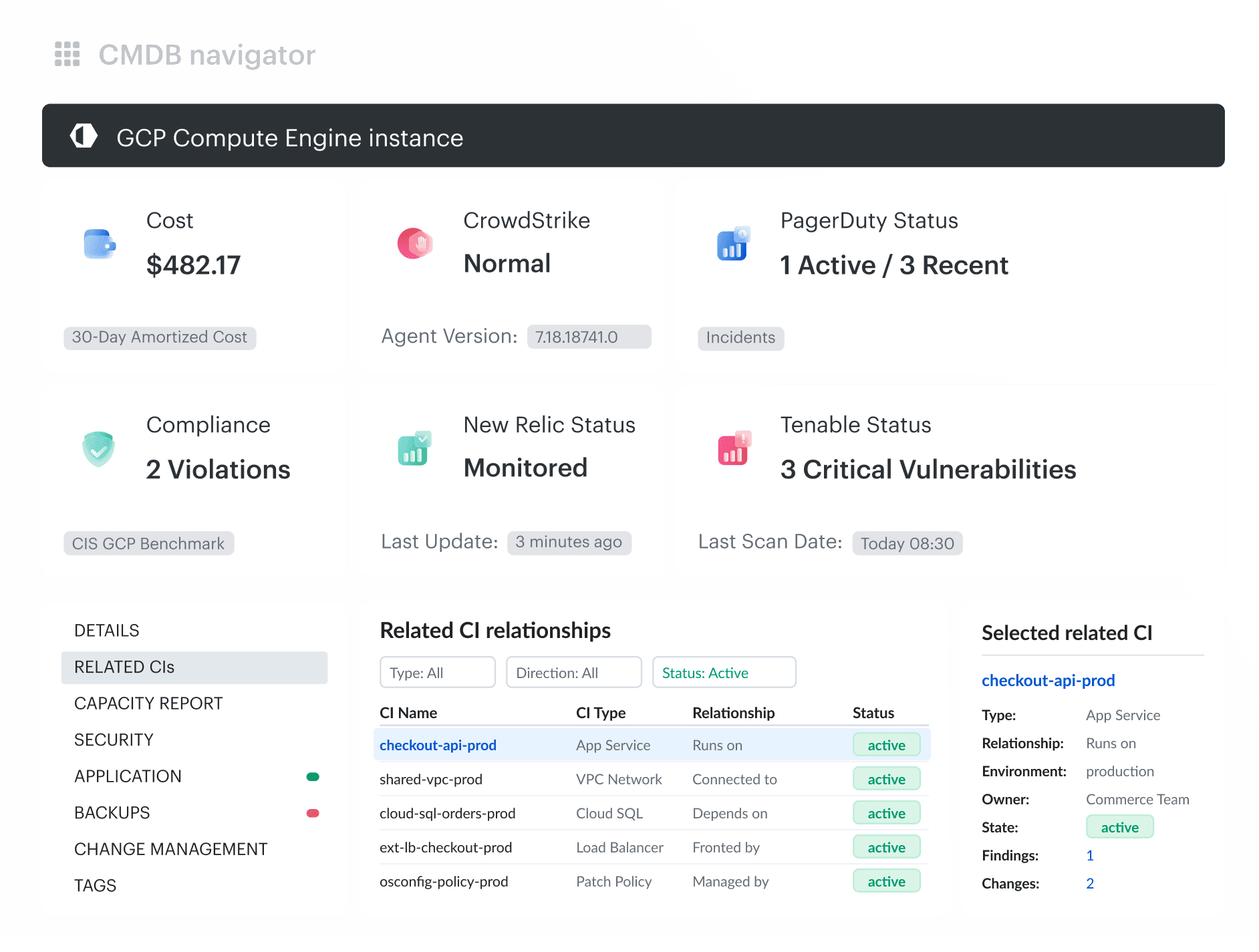 Cloudaware CMDB connects an asset with the services, dependencies, owner, and environment needed for risk context.
3. Identify risk scenarios, not isolated findings
A strong risk statement should describe:
- What matters
- What event could occur
- Which weakness or exposure contributes
- What consequence could follow
Weak entry: Critical CVE on production VM.
Stronger risk scenario: Exploitation of an externally reachable production workload could allow an attacker to use the workload identity to access confidential customer exports.
The second version gives the assessor something meaningful to analyze. Reachability, exploit availability, identity permission, information sensitivity, and compensating controls can now contribute to likelihood and consequence reasoning.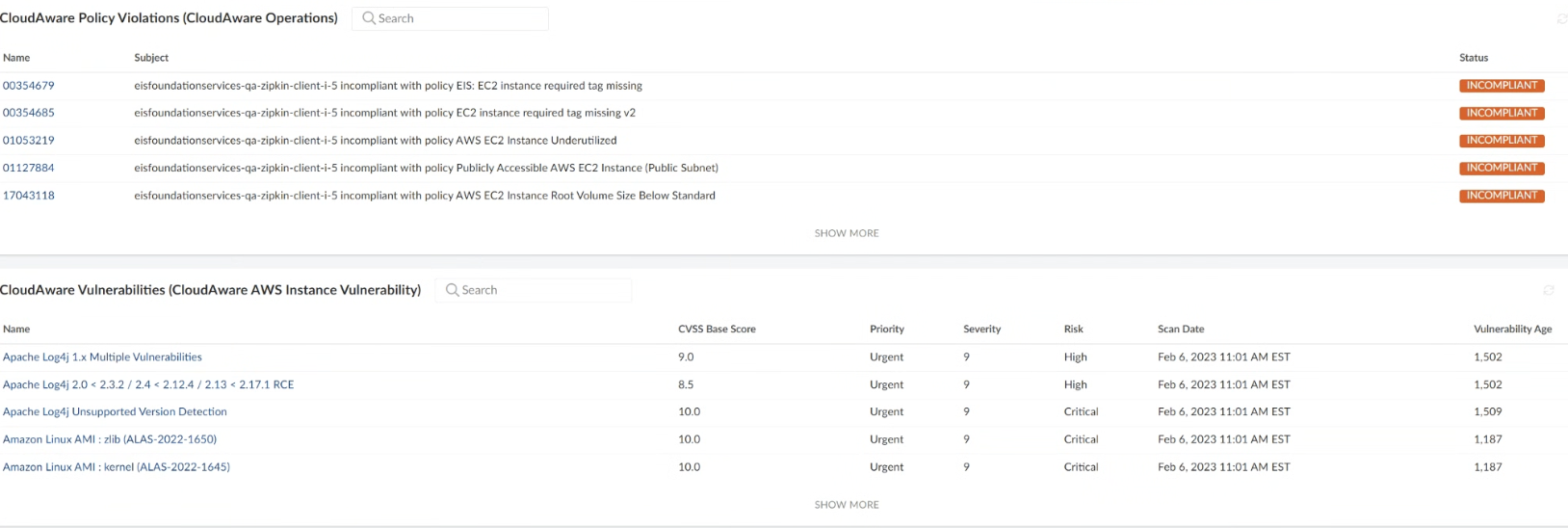 Risk scenario evidence in Cloudaware. Policy violations and vulnerability findings can be reviewed together before the assessor connects them to exposure, service context, and potential consequences.
NIST IR 8286A Rev. 1 similarly structures risk analysis around documented scenarios, threats, vulnerabilities, assets, likelihood, and impact.
4. Assign an accountable risk owner
The security team can identify and analyze the scenario without automatically owning the business risk.
Keep these roles distinct:
- Asset owner: accountable for the asset or its lifecycle
- Service owner: accountable for the business or technical service
- Control owner: operates or maintains a control
- Risk owner: has authority to make, sponsor, or escalate decisions about the risk
In a major service-availability scenario, infrastructure operations may own backup and recovery controls, while a business or service leader owns the consequence of prolonged outage.
Assigning every cyber risk to the CISO or security engineering team creates a governance dead end. Those teams can facilitate assessment and monitor treatment, but they may not control the business priorities, funding, or operational decisions required to accept or reduce the risk.
5. Analyze likelihood and consequences
Risk analysis determines significance. It should use evidence relevant to the scenario rather than a flat list of technical severity scores.
Useful cloud inputs include:
- Internet or partner exposure
- Exploit availability
- Privilege level
- Reachable identities and services
- Information sensitivity
- Business-service criticality
- Dependency chain
- Control state
- Compensating controls
- Realistic blast radius
External threat data can help calibrate assumptions, but it does not determine the likelihood of a specific local scenario.
The 2026 Verizon DBIR reports that vulnerability exploitation accounted for 31% of breach initial access in its dataset, while credential abuse accounted for 13%. That is a useful threat signal, but the assessment still has to determine whether a particular vulnerable workload is exposed, exploitable, privileged, and connected to valuable information or services.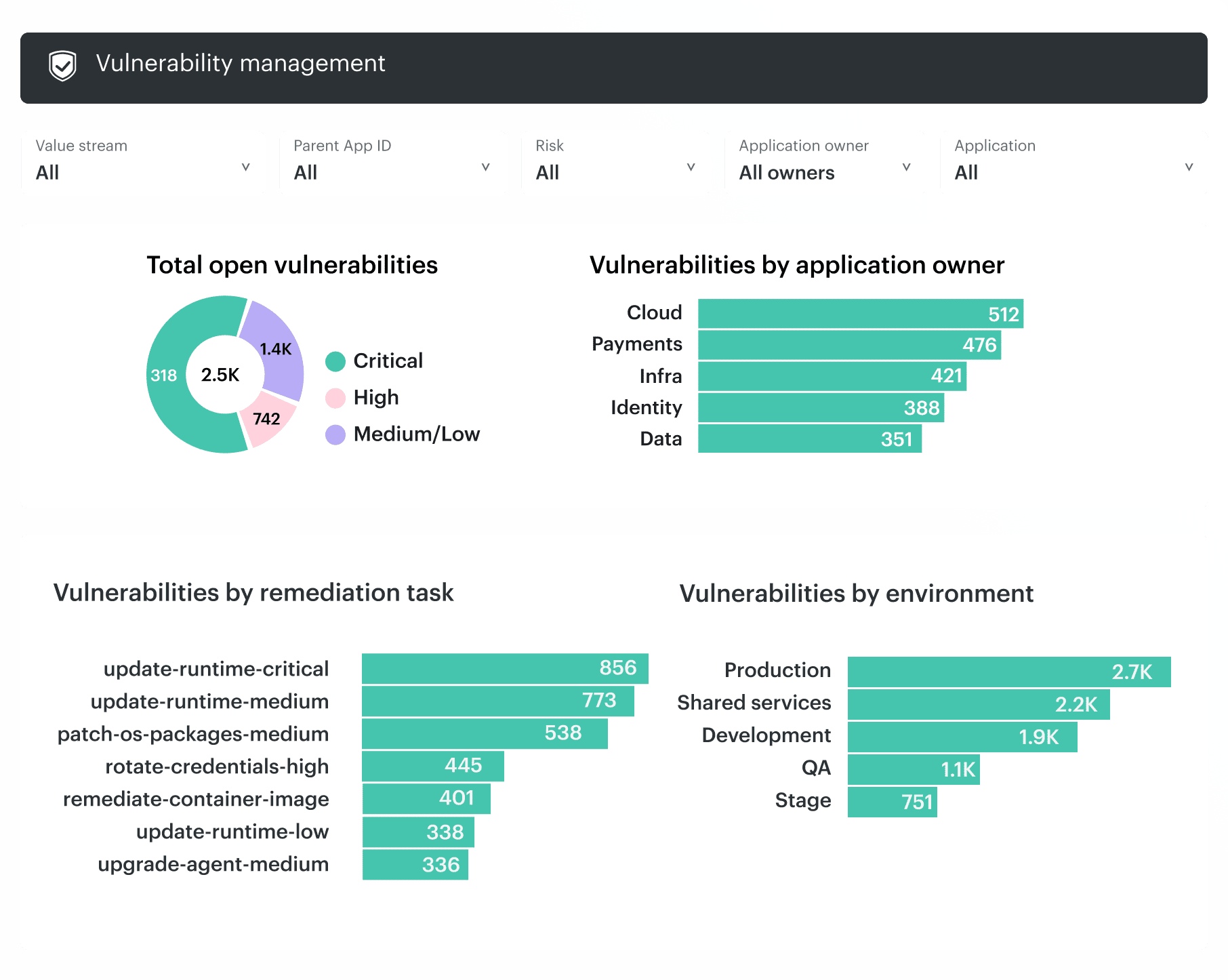 Vulnerability evidence with service context in Cloudaware. Teams can analyze findings by application, owner, environment, risk category, and remediation task before applying the organization's likelihood and consequence criteria.
6. Evaluate and prioritize risks
ISO 27001 risk assessment and prioritization perform different jobs. Risk analysis determines how significant a scenario is; risk evaluation compares that result with predefined criteria and determines what decision follows.
The output may be:
- Acceptable under current criteria
- Treatment required
- Immediate escalation required
- Further investigation required because evidence is insufficient
This is the decision layer between technical findings and limited remediation capacity.
AWS Security Hub documentation notes that a vulnerable resource with an overprivileged IAM role can present a larger potential blast radius than one operating with least-privilege permissions.
The assessment methodology still belongs to the organization. Cloud security products can supply context; they do not determine the organization's ISO risk criteria.
7. Record the decision, treatment path, and review conditions
The risk record should make the decision reconstructable.
Useful fields include:
- Risk scenario
- Affected service or information
- Evidence references
- Likelihood rationale
- Consequence rationale
- Risk level
- Risk owner
- Treatment decision
- Treatment owner
- Status
- Residual risk
- Acceptance authority
- Next review date
- Reassessment trigger
ISO does not prescribe this exact field set. It is a practical structure for keeping the risk record useful after the assessment meeting.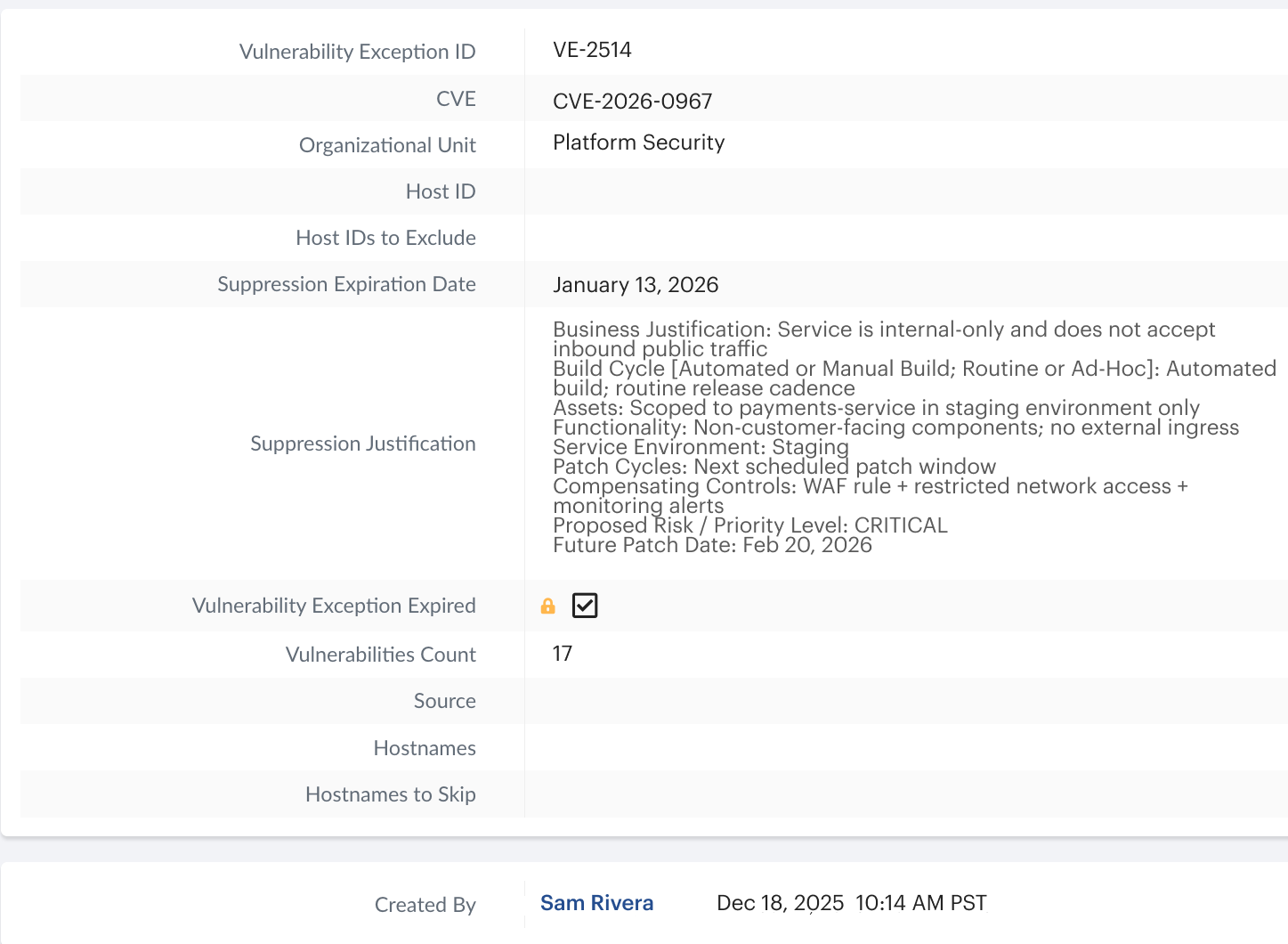 Exception and review evidence in Cloudaware. The record preserves ownership, business justification, compensating controls, expiration date, proposed priority, and the next planned action.
NIST publishes risk-register guidance and supporting schemas as part of the updated IR 8286 series, reinforcing the need to connect scenarios, likelihood, impact, prioritization, response, and monitoring.
Teams that prefer to begin from an ISO 27001 risk assessment template should adapt the fields and scoring rules to their own methodology rather than adopting another organization's acceptance thresholds unchanged. Related cloud security assessment checklists and working artifacts can help structure the technical evidence side of the process.
How to prioritize and treat ISO 27001 risks
Risk prioritization compares analyzed risks against predefined criteria. Risk treatment determines what the organization will do about the risks requiring action.
Choose a methodology that produces repeatable decisions
ISO 27001 does not require every organization to use the same scoring model. The useful question is whether the chosen method produces consistent decisions with the data available.
| Approach | Best fit |
|---|---|
| Qualitative | Broad assessments where reliable loss data is limited |
| Semi-quantitative | Portfolio ranking using clearly defined scales and thresholds |
| Quantitative | Decisions supported by sufficient data for economic analysis |
A 5×5 matrix may be entirely appropriate. The problem begins when precise-looking arithmetic hides undefined assumptions.
FAIR Model v3.0, published in January 2025, takes a quantitative approach by decomposing risk into underlying factors for analysis and communication. OCTAVE Allegro provides a different model centered on information assets and their operational context. ISO 27001 risk assessment methodology should fit the organization's decision needs, evidence maturity, and operating complexity.
Choose the treatment option and document residual risk
For risks requiring action, common treatment directions are:
- Modify or reduce the risk
- Avoid the activity creating the risk
- Share or transfer aspects of the risk
- Retain or accept the risk under defined criteria and authority
Treatment should follow this chain: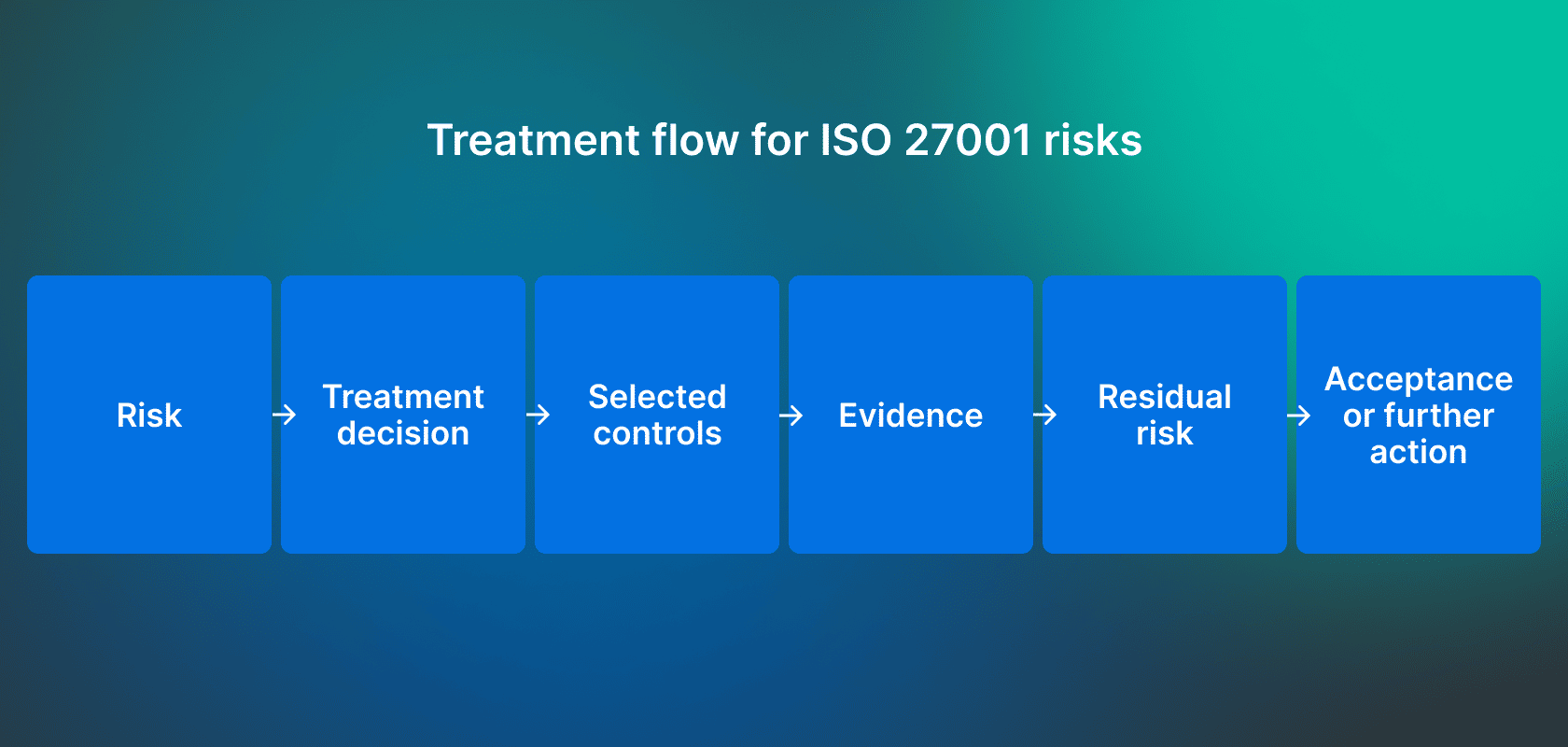 Risk assessment should drive control selection. Starting from the 93 Annex A controls and attempting to implement each one without reference to risk treatment reverses the management logic.
The wider vulnerability-management field is also moving toward contextual prioritization. In June 2026, CISA issued BOD 26-04 for U.S. federal civilian agencies, consolidating vulnerability remediation requirements around risk-based prioritization. Its legal scope is specific to those agencies, but the operating principle is relevant: remediation capacity should focus on what creates the most material exposure, not on undifferentiated queues.
Read also: Cloud Security for Financial Services. The Evidence Model That Holds Up Under Audit Pressure
ISO 27001 risk assessment requirements: records and audit evidence
Audit readiness depends on traceable decisions. A reviewer should be able to reconstruct what was assessed, how it was evaluated, who owned the decision, what treatment followed, and what changed afterward.
| Record or evidence | What it demonstrates |
|---|---|
| Assessment methodology | The process is defined and repeatable |
| Risk criteria and acceptance rules | Decisions use established thresholds |
| Risk register or assessment results | Risks were identified, analyzed, and evaluated |
| Named risk owners | Accountability is assigned |
| Risk Treatment Plan | Required actions are assigned and tracked |
| Statement of Applicability | Control applicability and implementation decisions are documented |
| Residual risk and acceptance record | Remaining risk has an accountable decision |
| Reassessment history | Planned reviews and significant changes are reflected |
Cloud environments add another evidence layer. Depending on the scenario, relevant inputs may include configuration state, IAM relationships, exposure status, vulnerability findings, ownership records, exception approvals, remediation tickets, and change history.
These sources do different jobs. A vulnerability record may prove that a weakness existed. A configuration history may show when exposure changed. A ticket may show remediation activity. The risk record preserves the organization's assessment and decision about that evidence.
For the operating process behind that technical evidence, ISO 27001 vulnerability management connects vulnerability identification, risk evaluation, treatment, ownership, remediation evidence, and ISMS review.
The ISO 27001 risk assessment report, risk register, SoA, and Risk Treatment Plan should therefore remain connected rather than becoming separate audit artifacts maintained by different teams.
Read also: Cloud Security Compliance Standards. The 8 Frameworks Every Cloud Team Should Know in 2026
A continuous ISO 27001 risk assessment framework for multi-cloud operations
ISO/IEC 27001:2022 requires risk assessments to be repeated at planned intervals and when significant changes occur, while current risk-management guidance emphasizes ongoing monitoring, risk-informed response, and links between operational evidence and enterprise risk decisions.
NIST SP 1308 and the updated NIST IR 8286 series reinforce that model by connecting changing cybersecurity conditions with risk communication, response, and governance.
Cloud environments generate constant technical change: new resources appear, IAM trust relationships change, network exposure shifts, vulnerabilities are disclosed, and applications gain new dependencies. Treating every event as a formal risk review would make the process unworkable.
A practical ISO 27001 risk assessment framework can separate continuous evidence collection from governed reassessment: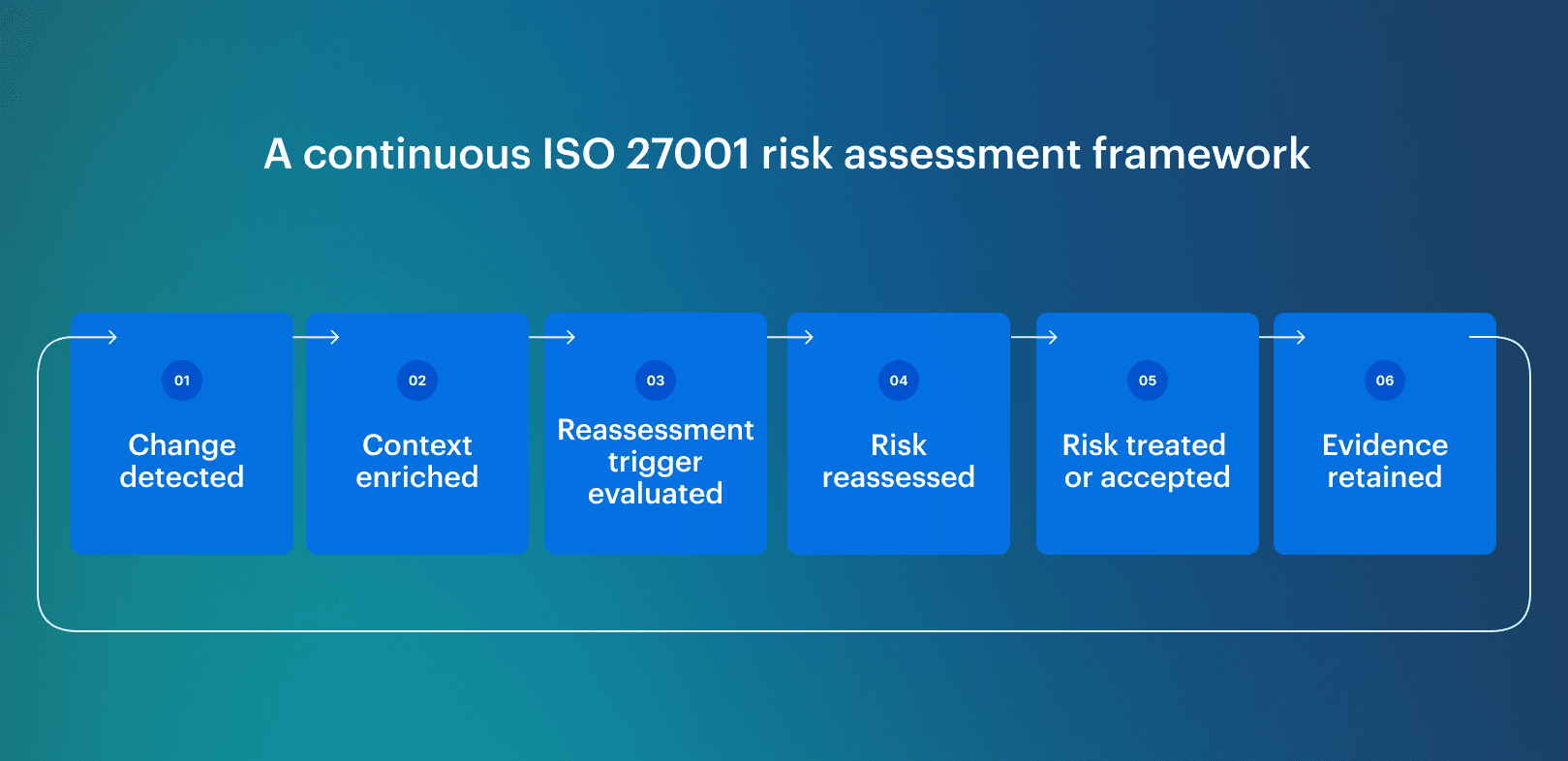 A reassessment trigger should be material enough to change the scenario, likelihood, consequence, ownership, treatment, residual risk, or acceptance decision.
Typical reassessment triggers include:
- New account, subscription, project, or SaaS processor entering scope
- New public exposure or material IAM privilege change
- Sensitive information added to an existing service
- Major architecture change or acquisition
- Critical vulnerability affecting an important service
- Security incident or control failure
- Change in service ownership
- Treatment or compensating control no longer operating as intended
The underlying vulnerability management program should define when a critical finding triggers reassessment, who owns treatment, what evidence closes the issue, and when accepted risk must be reviewed again.
CMDB-aware CSPM policies can support this operating model by connecting a finding to the affected resource, application, environment, owner, and related context before the team decides whether formal reassessment is required. Learn more about CSPM in our guide.
ISO 27001 risk assessment example for a cloud data service
A useful ISO 27001 risk assessment example shows the path from technical condition to business consequence, ownership, treatment, residual risk, and review triggers. The example below is based on a common risk pattern Katerina L., Cloud Security Expert at Cloudaware, encounters in client environments.
In Katerina's work with customers, this type of case usually becomes material when several conditions overlap:
- Production workload is externally reachable
- Workload has a serious vulnerability
- Its identity can reach sensitive data
| Field | Entry |
|---|---|
| Business context | Production customer export service used to generate and deliver customer data extracts |
| Technical condition | Internet-reachable workload with a high-risk vulnerability |
| Identity and access context | Workload identity can read object storage containing customer exports |
| Risk scenario | Exploitation of the workload could allow an attacker to use the workload identity to access confidential customer information |
| Likelihood evidence | External reachability, exploit availability, identity path, current control state, and compensating controls |
| Consequence evidence | Information classification, affected customers, contractual obligations, business-service impact, and incident-response burden |
| Risk owner | Accountable service or business owner with authority over treatment and acceptance decisions |
| Treatment | Patch or replace the workload, restrict unnecessary exposure, reduce identity permissions, validate compensating controls, and improve detection coverage |
| Residual risk | Reassess after treatment is implemented and supporting evidence confirms the changed exposure and access conditions |
| Review triggers | Exposure change, IAM relationship change, new integration, information-classification change, control failure, or material architecture change |
“Technical severity becomes decision-grade risk evidence only after the team connects the finding to reachability, identity access, data sensitivity, service criticality, and ownership.” — Katerina L., Cloud Security Expert at Cloudaware
This is also the direction cloud-native security tooling is moving in. Google Security Command Center's predefined graph rules combine high-risk CVEs with conditions such as external exposure, available exploits, service-account impersonation, access to high-value resources, and access to sensitive data. AWS Security Hub also uses identity privilege and resource relationships as exposure context.
These tools do not especially define the organization's ISO 27001 methodology. They provide the technical context needed to make the assessment more specific, explainable, and defensible.
Strengthen risk assessment evidence with Cloudaware
Cloudaware can support the evidence and context behind risk assessment decisions by connecting cloud inventory, ownership, relationships, configuration, compliance findings, vulnerability data, and reporting.
Its role is narrower than the ISMS itself. The organization still defines the methodology, assigns risk ownership, selects treatment, and approves residual risk.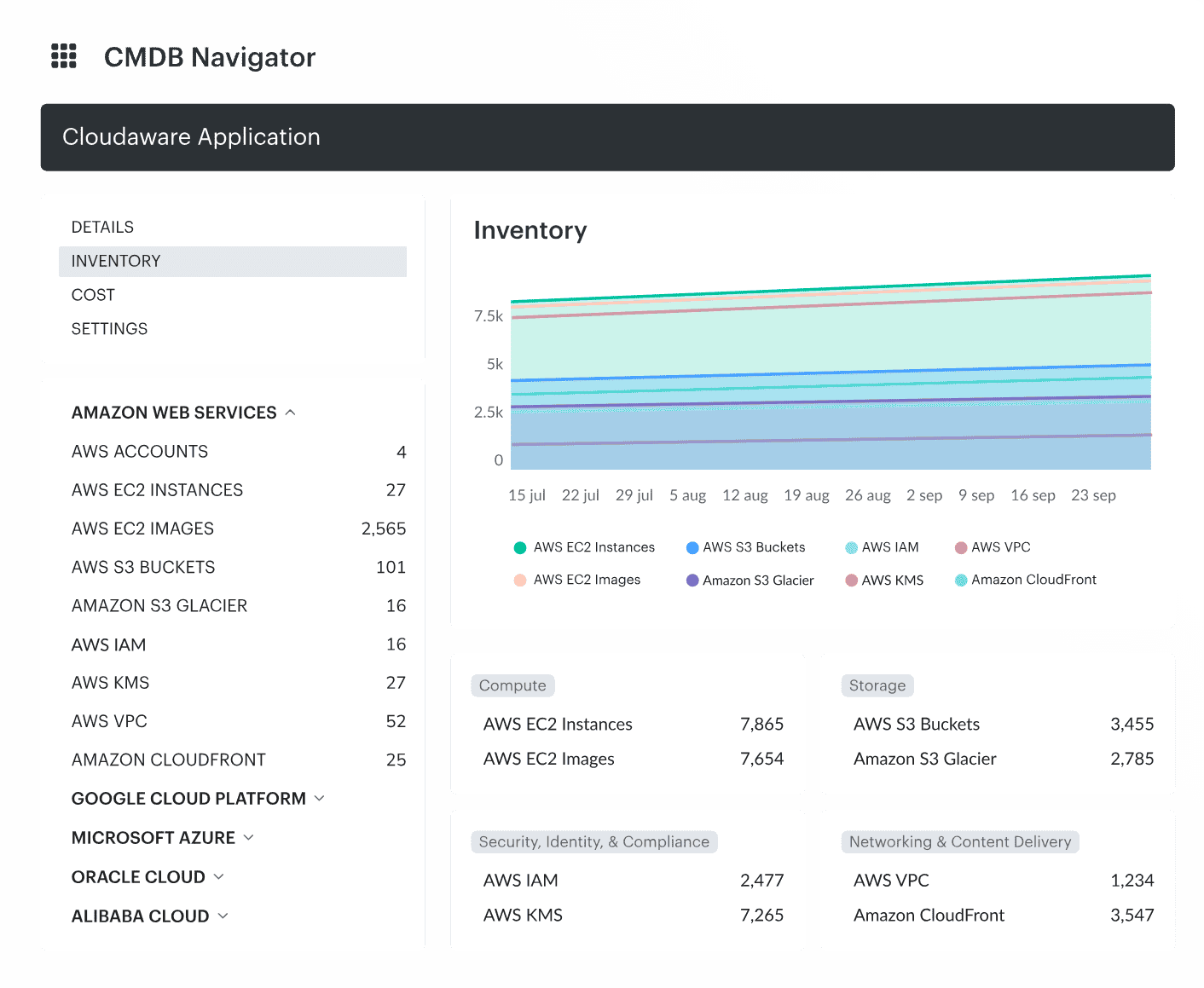 Core capabilities:
- Application mapping: Group cloud and non-cloud resources by naming convention, tag, or custom logic to reflect applications, teams, projects, departments, customers, or other operating structures.
- Dependency context: Use CMDB to aggregate and cross-reference data across AWS, Azure, GCP, VMware, on-premises infrastructure, and additional sources, then use discovery and dependency mapping to trace relationships around affected assets.
- Compliance evidence: Evaluate policies against CMDB data using built-in CIS Benchmarks and mappings to ISO, NIST, HIPAA, and PCI. Turn failed checks into traceable findings with an owner, severity, SLA, evidence, and lifecycle status
- Vulnerability context: Review vulnerability data directly within the CMDB, including last scan date, severity counts, vulnerability age, CVE-specific exposure, and remediation status.
- Change and review evidence: Track changes to object attributes, retain object history, and use approval processes to route changes through defined decision paths.