


CSA and Tenable found that 63% of organizations use more than one cloud provider, 82% run hybrid infrastructure, and 59% rank insecure identities and risky permissions as the top cloud infrastructure risk.
Now picture the audit request. The auditor asks for proof that production storage is encrypted, privileged access was reviewed, logs are retained, and exceptions are approved. Security has posture findings. Platform has cloud-native exports. GRC has a control spreadsheet. IT operations has CMDB records. Engineering has remediation tickets. The evidence exists, but it does not join cleanly.
That is where cloud security compliance breaks. This guide explains cloud security compliance from that angle:
- What it means?
- Which standards matter?
- Why compliance fails in multi-cloud environments?
- How to keep evidence useful without turning every audit into a manual evidence project?
What is cloud security compliance?
Cloud security compliance is the process of proving that cloud environments meet required security, privacy, regulatory, contractual, and internal control obligations. It ties cloud assets, configurations, identities, owners, exceptions, remediation, and audit evidence into a record that can survive review.
Cloud computing security compliance has to answer 5 questions:
- Which assets are in scope?
- Which controls apply?
- Who owns the asset and the control?
- What evidence proves the control is operating?
- What happens when the control fails, expires, or changes?
AWS Executive Insights mentions a useful phrase: “measure your security compliance like an auditor would.” That is the right mental model. Security teams often ask, “Are we protected?” Auditors ask, “Can you prove the control operated during the review period?” Those are related questions, but they are not the same question.
Cloud security and compliance are not the same job
Cloud security asks whether a control reduces risk. Cloud compliance asks whether the organization can prove that the control applied to the right asset, under the right owner, at the right time.
| Question | Cloud security answer | Cloud compliance answer |
|---|---|---|
| What are we reducing? | Exposure, weak access, exploitable systems, attack paths | Failure to prove a required control operated |
| Who uses the output? | Security, engineering, operations | GRC, audit, regulators, customers, leadership |
| What breaks first? | Excessive permission, exposed service, detection gap | Missing scope, stale owner, old evidence, expired exception |
| What proves progress? | Lower risk and faster remediation | Current evidence, control history, exception trail, retest proof |
A workload can be secure enough for operations and still fail an audit because the evidence is stale. A system can also pass a narrow control while carrying real risk. That is why cloud security and compliance need to share data, but they should not be treated as one discipline.
Shared responsibility does not remove customer evidence
Shared responsibility is where many teams overestimate what the cloud provider gives them.
AWS says security and compliance are shared between AWS and the customer, with AWS responsible for operating components from the host operating system and virtualization layer down to physical facilities.
Microsoft makes the customer-side boundary explicit: customers remain responsible for protecting data, identities, on-premises resources, and cloud components they control.
Provider compliance proves the provider’s control boundary. If a customer asks for SOC 2 evidence on production logging, the AWS SOC report may help with provider infrastructure. It will not prove that CloudTrail is enabled in every in-scope account, logs are centralized, retention meets policy, and exceptions are approved.
Cloud security compliance standards
SOC 2, ISO 27001, NIST, PCI DSS, HIPAA, FedRAMP, GDPR, CIS Benchmarks, and CSA Cloud Controls Matrix do not use the same structure. They often ask for evidence around the same control areas:
- AICPA describes SOC reports as assurance reports that help users assess risks associated with outsourced services.
- ISO describes ISO/IEC 27001 as a standard for information security management systems.
- NIST CSF 2.0 gives organizations a structure for cybersecurity governance and risk management.
- PCI SSC describes PCI DSS as technical and operational requirements for protecting payment account data.
- FedRAMP defines itself as a government-wide program for security assessment, authorization, and continuous monitoring for cloud products and services.
The trick is not to create a separate evidence universe for every framework. Instead, align these standards around shared control areas so the same evidence can support multiple requirements:
| Common control | Compliance angle | Cloud evidence needed |
|---|---|---|
| Encryption | Confidentiality, privacy, regulated-data protection | Asset scope, encryption state, key metadata, owner, exception |
| Access review | Least privilege and approved access | Identity, role, reviewer, owner, removed access, open exception |
| Logging | Auditability and investigation support | Log source, retention, coverage, timestamp, failed source |
| Vulnerability remediation | Risk treatment and known-weakness handling | Affected asset, severity, exposure, owner, SLA, ticket, retest |
| Data location | Privacy, residency, contractual commitments | Region, workload, data class, approved location, exception |
One encryption control can support SOC 2, ISO 27001, PCI DSS, HIPAA, GDPR, and internal policy. The evidence model should be shared, but the reporting view can change by framework.
For full guidance, read Cloud Security Compliance Standards: The 8 Frameworks Every Cloud Team Should Know in 2026.
Why cloud security compliance breaks at enterprise scale
Cloud security compliance breaks at enterprise scale when control state changes faster than evidence ownership. The control may still exist, but the proof chain breaks: scope is incomplete, owner is stale, exception has no expiry, or remediation closed without retest.
1. Misconfigurations and coverage gaps leave partial evidence
Unit 42 reports that over 90% of breaches were enabled by misconfigurations or gaps in security coverage, rather than novel exploits.
That is also a compliance problem. A control can be written correctly and still fail in practice because it is not applied everywhere it should be.
If logging is enabled in 80 AWS accounts but missing in 12, the organization does not have a logging control problem on paper. It has a control coverage problem. The audit question becomes simple: which accounts were in scope, which ones were excluded, who approved the gap, and what evidence proves the current state?
The same pattern shows up with encryption, backup policies, public exposure rules, vulnerability scanning, and region restrictions. A compliance report that shows only passing resources is not useful unless it also proves the tested population was complete.
2. Identity and permission sprawl break accountability
CSA and Tenable found that 59% of organizations rank insecure identities and risky permissions as the top cloud infrastructure risk.
A user account, role, service principal, workload identity, API key, or CI/CD token can all become privileged access. Some belong to people. Some belong to pipelines. Some belong to vendors or old applications. In many environments, the access review says “approved,” but the reviewer does not know what the identity actually does.
Example: a service principal has Owner on an Azure subscription. It was created for a deployment pipeline 2 years ago. The pipeline still runs, but the original application team changed. The access review shows approval, but there is no current application owner, no rotation evidence, and no exception record.
3. Engineering velocity outpaces audit evidence
Cloud teams do not wait for the next audit cycle before changing infrastructure. They ship through CI/CD, infrastructure as code, service catalogs, provider consoles, and emergency workflows.
That speed is normal. The issue is that many compliance processes still rely on periodic evidence collection.
Common failure pattern:
- A storage bucket becomes public after the last evidence export
- A privileged IAM role is created for an incident and never removed
- Logging is disabled during troubleshooting and not restored
- A workload moves to a region outside approved scope
- A temporary exception outlives the risk approval
- A ticket closes without control retesting
This is where cloud DevOps security & compliance overlap. If controls are evaluated only during audit prep, evidence will always lag behind the environment. Testable controls need to run close to change, otherwise, teams keep proving yesterday’s cloud.
Read also: Popular DevSecOps Frameworks for Cloud Security. How CISOs Choose, Map and Operationalize Them
The operating model for cloud security and compliance
A working cloud security and compliance program has to keep the proof chain intact after cloud changes. That means every control result should still resolve to 5 things:
- Scope
- Asset
- Owner
- Exception state
- Remediation status
The working end-to-end model is pretty simple: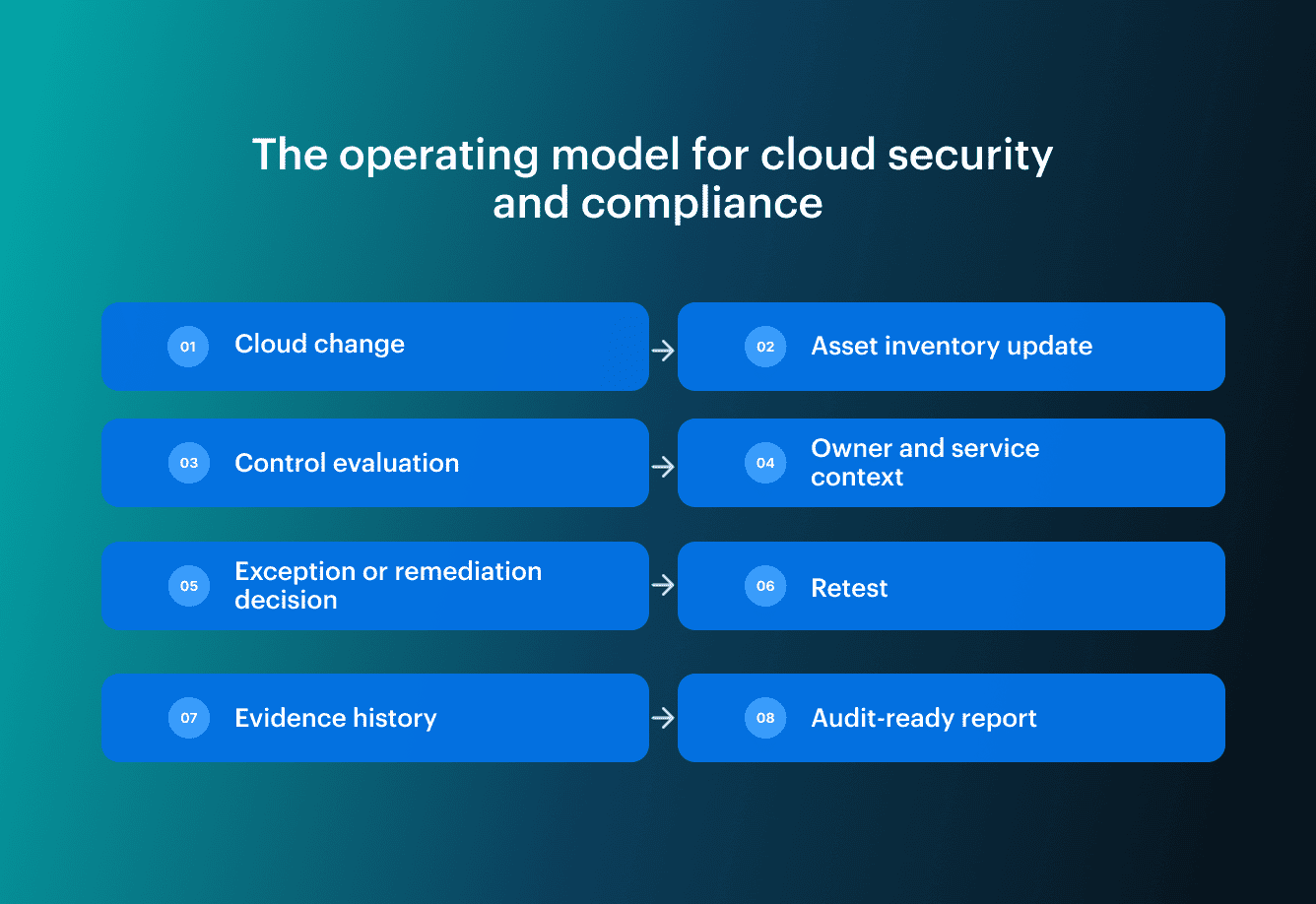
Start with scope and inventory before controls
Compliance scope has to start with the real environment, not with a framework spreadsheet. The team needs to know which providers, accounts, subscriptions, projects, regions, SaaS platforms, workloads, environments, and business services are in scope.
Inventory also needs decision context:
- Owner
- Application
- Environment
- Data class
- Criticality
- Region
- Lifecycle state
- Cost center
- Business service
Stale CMDB data creates audit risk. If the CMDB says an application has 40 infrastructure components, but the cloud estate has 85 related resources, the compliance team cannot prove control coverage. If the asset exists in AWS but not in the service map, the control may pass technically while the business owner stays invisible.
Turn requirements into testable controls
Framework language has to become something that engineering and compliance can both use.
| Layer | Example |
|---|---|
| Requirement | Production data must be protected from unauthorized access |
| Control objective | Production data stores must enforce encryption and restricted access |
| Control activity | Check encryption, exposure, IAM policy, logging, and exception status |
| Evidence | Current configuration record, timestamp, owner, control result, exception or ticket |
| Remediation | Assigned work item, SLA, closure evidence, retest result |
Each control also needs ownership. There may be a policy owner, technical owner, asset owner, remediation owner, and exception approver. Those roles cannot be implied because implied ownership is how findings sit unresolved until the audit team asks for status.
Treat exceptions as risk records
Exceptions are risk records. A useful exception includes the affected asset, control requirement, business reason, approver, compensating control, residual risk, expiry date, and review cadence.
The dangerous exception is the one that becomes permanent without anyone admitting the policy has changed. A production database cannot meet a logging requirement, so a team gets a temporary exception. Six months later, the exception is still open, the owner changed roles, and the compensating control was never retested.
Mikhail M., General Manager at Cloudaware, describes this as one of the harder compliance failure modes: the exception exists somewhere, but it is not connected to the current asset, owner, control, and remediation record. Once that link breaks, leadership cannot tell whether the risk was accepted or forgotten.
Make remediation update the evidence
A compliance finding should create work in the systems teams already use. For most enterprises, that means Jira, ServiceNow, or another ITSM system.
The ticket should carry the affected asset, control, owner, environment, severity, SLA, evidence, remediation task, and retest result. When remediation closes without retesting, the ticket proves work was done, but the compliance record still proves the old failure.
The evidence record has to show what changed, who changed it, and whether the control now passes.
Cloud security compliance automation
Cloud security compliance automation should keep evidence current after infrastructure changes. A useful workflow discovers the asset, evaluates the control, resolves the owner, checks exception state, opens remediation, reruns the control, and stores the result with history.
NIST SP 800-137 frames continuous monitoring around ongoing awareness of control effectiveness and risk posture.
For cloud compliance, the useful part is control effectiveness over time. A point-in-time pass result has limited value if the team cannot show when the asset entered scope, when the rule failed, who owned remediation, and whether the control passed after the fix.
1. Automation controls with clear evaluation logic
Automation works for controls with known scope, structured source data, and a clear pass/fail rule. Examples include encryption enabled, public access disabled, logs retained, backup policy attached, approved region enforced, and privileged access reviewed.
The dashboard should prove the tested population, not only the failed resources.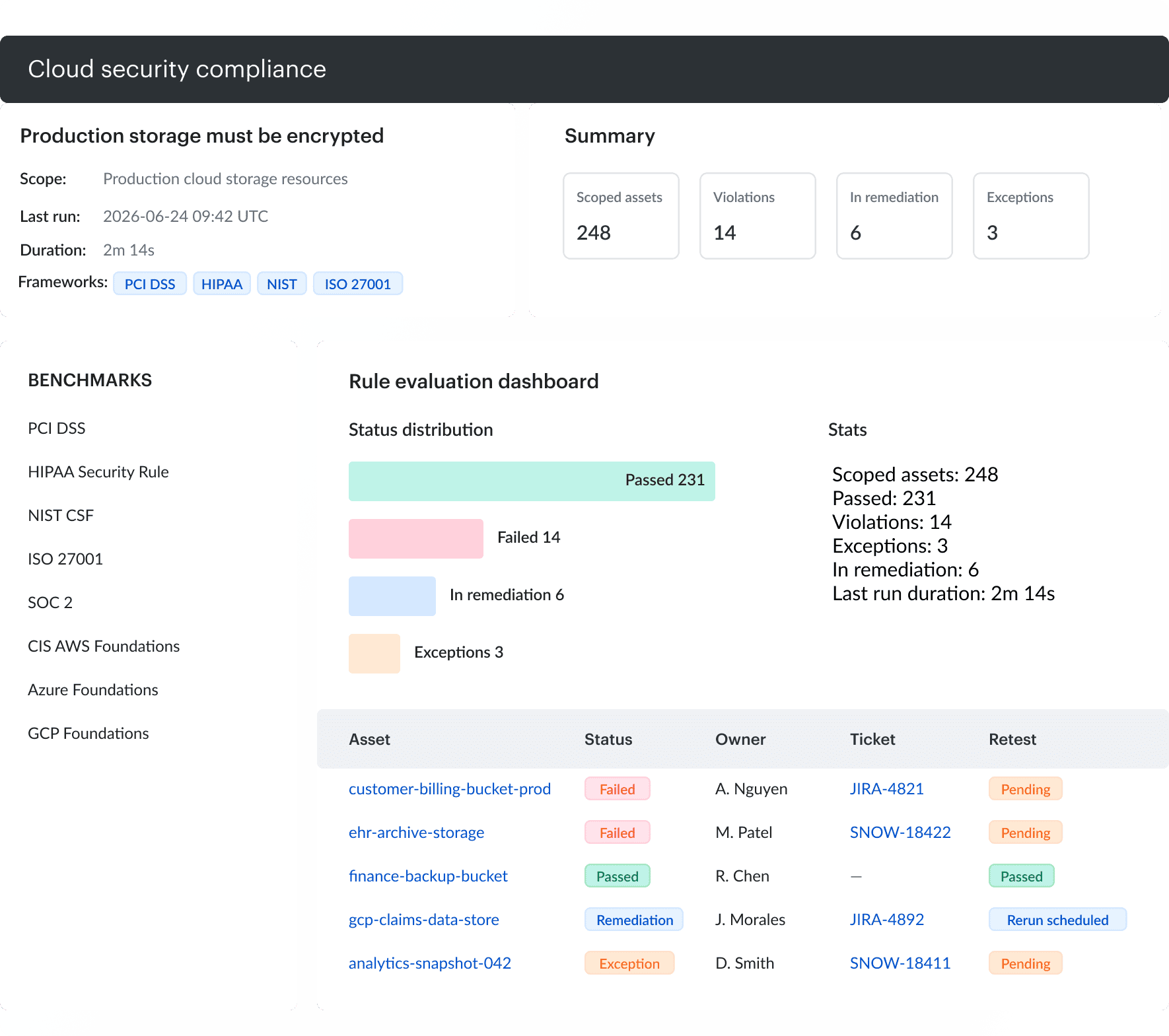 Cloudaware can show the rule, scoped assets, affected CIs, cloud account or subscription, owner, application, environment, and mapped framework.
2. Keep risk decisions accountable
Automation can route risk decisions, but the approval needs a named owner. Exception approval, compensating-control review, customer commitment interpretation, and residual-risk acceptance need a record that an auditor can inspect.
NIST defines risk response as an informed action to accept, avoid, mitigate, share, or transfer risk.
3. Bring AI and non-human identities into scope
In 2026, compliance scope includes more than human users and standard cloud resources. AI agents, MCP servers, service accounts, API keys, and workload identities now behave like part of the cloud control plane.
Wiz reports that 57% of organizations deploy self-hosted AI agents, and 80% have adopted Model Context Protocol servers.
Those components create specific evidence questions:
- Which AI service has access to regulated data?
- Which identity does it use?
- Who owns it?
- Which systems can it call?
- Which logs prove what it accessed?
- Which approval path allowed it into production?
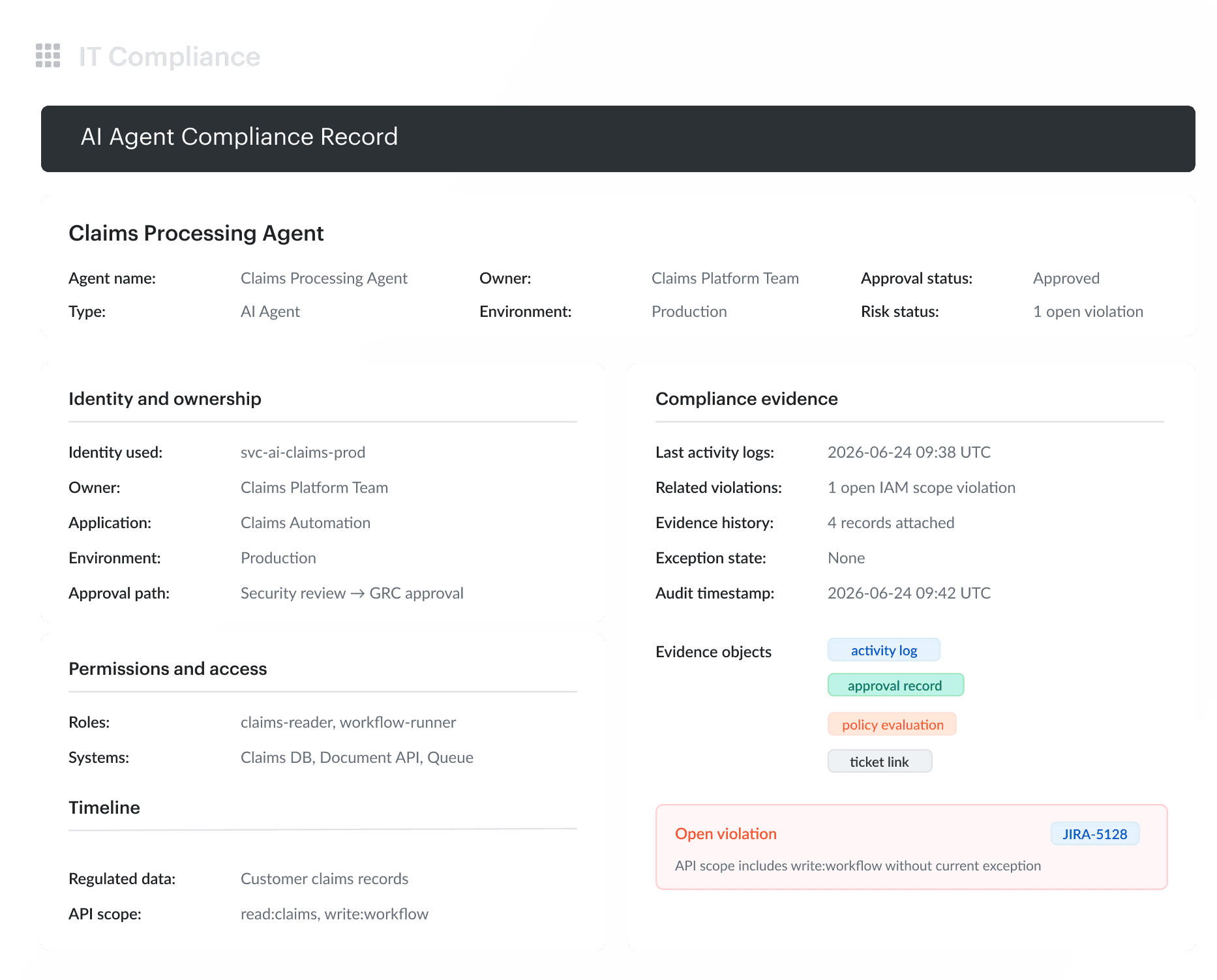 Cloudaware’s dashboard ties the identity- or agent-related asset to its owner, application, environment, permissions, data access, related violations, and evidence history.
Read also: Cloud Security for Financial Services. The Evidence Model That Holds Up Under Audit Pressure
What to verify before the audit: cloud security compliance checklist
A cloud security compliance checklist should test evidence readiness across the live cloud estate. The useful question is whether the team can prove control population, current control state, accountable owner, exception status, remediation path, and reporting history without rebuilding the audit package by hand.
Start with 4 audit checks:
- The tested population is complete
- Ownership is current
- Evidence matches the review period
- Failed controls have remediation, retest evidence, or approved risk acceptance
Each checklist row should map to an audit mechanism. Scope and inventory define the control population. Framework mapping explains why the control exists. Shared responsibility separates inherited provider controls from customer-owned configuration, identity, data, and application controls. Evidence freshness proves the result during the review period. Exception and remediation rows show whether a failed control was accepted, fixed, retested, or still open.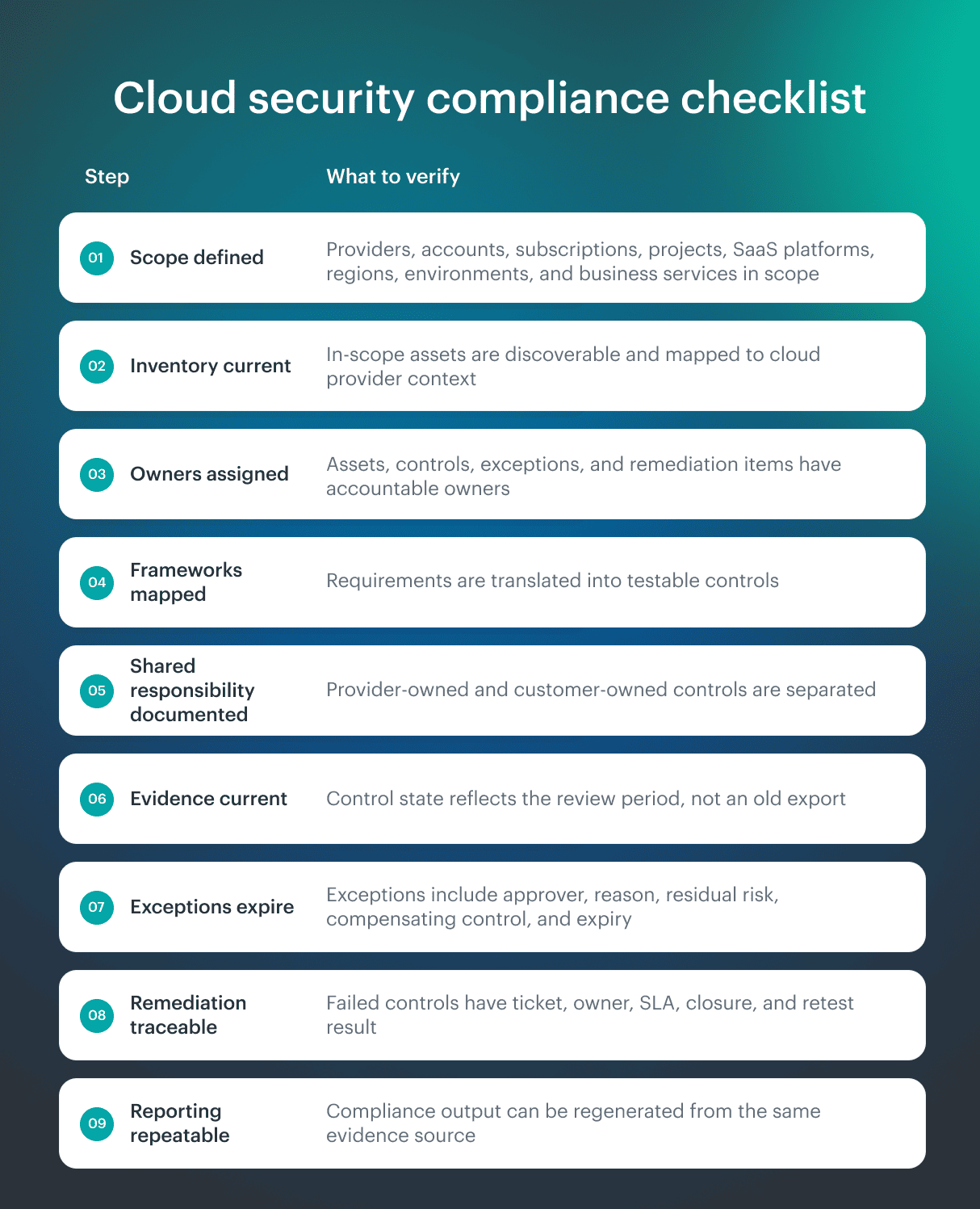 For example, a logging control should produce the in-scope accounts, log sources, retention setting, owner, evaluation time, exception state, and remediation status. An access-control row should produce the identities reviewed, privileged roles, reviewer, approval date, removed access, and open exceptions. Without those fields, the team has a policy statement rather than defensible cloud evidence.
During migration, cloud migration data security should be checked before audit evidence is collected, because data movement can change access, residency, encryption, and control scope.
Read also: Cloud Security Assessment Framework. Checklist, Questionnaire & Template Every Cloud Team Needs in 2026
Best practices for maintaining cloud compliance continuously
Most cloud compliance advice starts too late: collect evidence, update the control matrix, prepare for the audit. That workflow fails in multi-cloud environments because the estate changes before the evidence package is reviewed.
Cloud security compliance best practices should focus on evidence freshness. Continuous cloud compliance depends on knowing which assets are in scope, which controls apply, who owns the result, what changed since the last check, and whether failed controls were fixed, retested, or accepted as risk.
- CIS Controls prioritize asset inventory, secure configuration, account management, access control, vulnerability management, audit logs, and recovery.
- AWS Shared Responsibility guidance separates provider-operated controls from customer-owned configuration, identity, data, and application controls.
- CSA Cloud Controls Matrix helps map cloud controls across standards and responsibility boundaries.
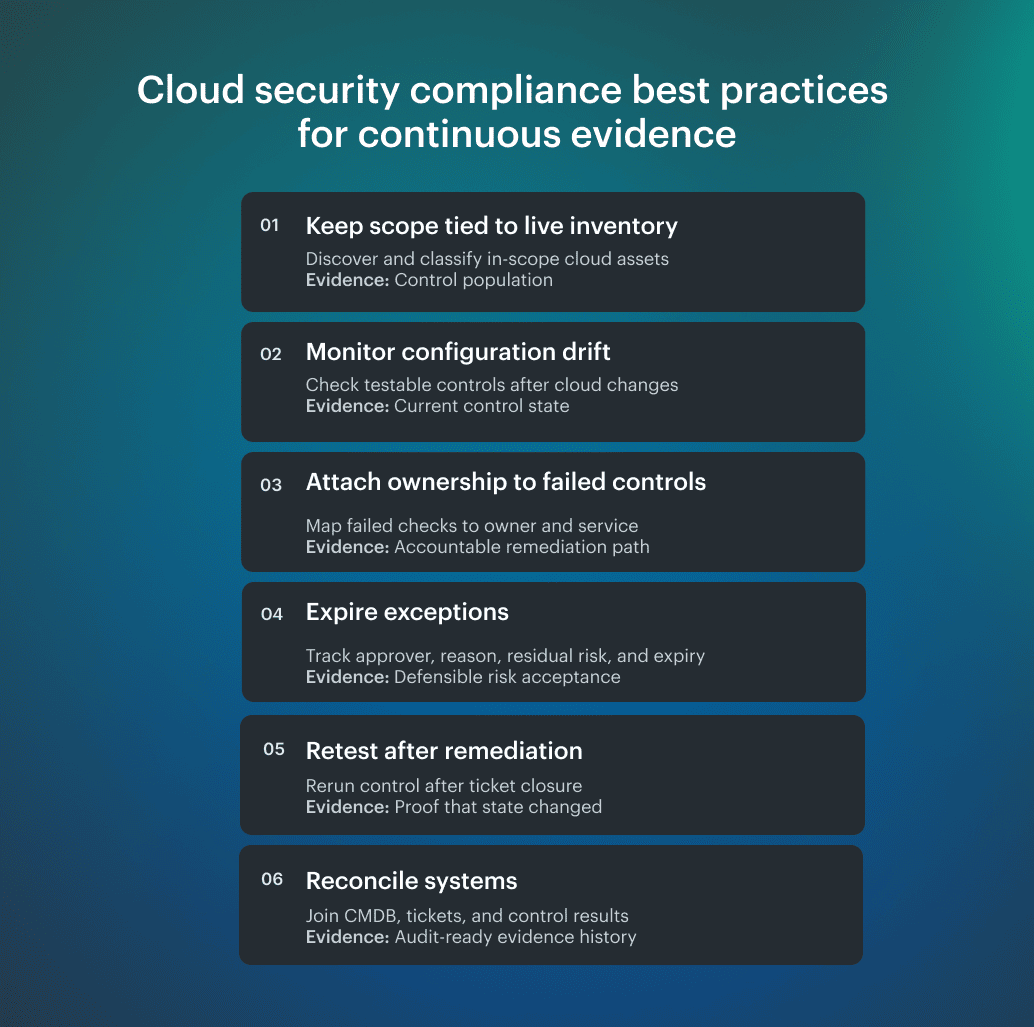 Cloud compliance monitoring should make those records reusable. If every audit requires a new spreadsheet join across cloud consoles, tickets, CMDB exports, and exception trackers, the program is still proving controls manually.
Read also: Cloud Security Monitoring. What It Is, How It Works, and What to Monitor?
How to measure cloud security compliance maturity
Cloud security compliance maturity is measured by how reliably the organization can prove scope, control state, ownership, exceptions, and remediation without rebuilding evidence manually.
| Maturity level | Operating pattern | Evidence pattern |
|---|---|---|
| Level 1: Manual | Evidence is rebuilt for each audit | Screenshots, spreadsheets, manual exports |
| Level 2: Fragmented | Teams collect evidence from separate tools | Provider reports, ticket exports, disconnected CMDB data |
| Level 3: Mapped | Controls are mapped to assets, owners, and systems | Control matrix, owner model, scope register |
| Level 4: Continuous | Control state is monitored and routed into workflows | Continuous checks, remediation tickets, exception records |
| Level 5: Evidence-ready | Evidence is produced through daily operations | Unified reporting, audit trail, current asset context |
The Cloud Controls Matrix gives compliance teams a cloud-specific way to map control intent across identity, data protection, logging, governance, and infrastructure security. The maturity test is simple: can the organization answer an audit question today without assembling a temporary task force?
For example:
- Which production storage assets are in scope for encryption controls?
- Which assets failed in the last 30 days?
- Who owns each failed asset?
- Which failures have approved exceptions?
- Which exceptions expire this month?
- Which remediation tickets are overdue?
- What changed since the last evidence export?
If those answers require manual joins across cloud consoles, spreadsheets, tickets, SIEM logs, CMDB records, and chat threads, the compliance program is still operating below the maturity level its cloud environment requires.
Gather scattered evidence in one place with Cloudaware
Compliance evidence loses value when evidence context lives in separate systems. Cloudaware gives compliance, security, and infrastructure teams a CMDB-driven layer for connecting cloud assets to control evidence, ownership, exceptions, and remediation history across multi-cloud and hybrid environments.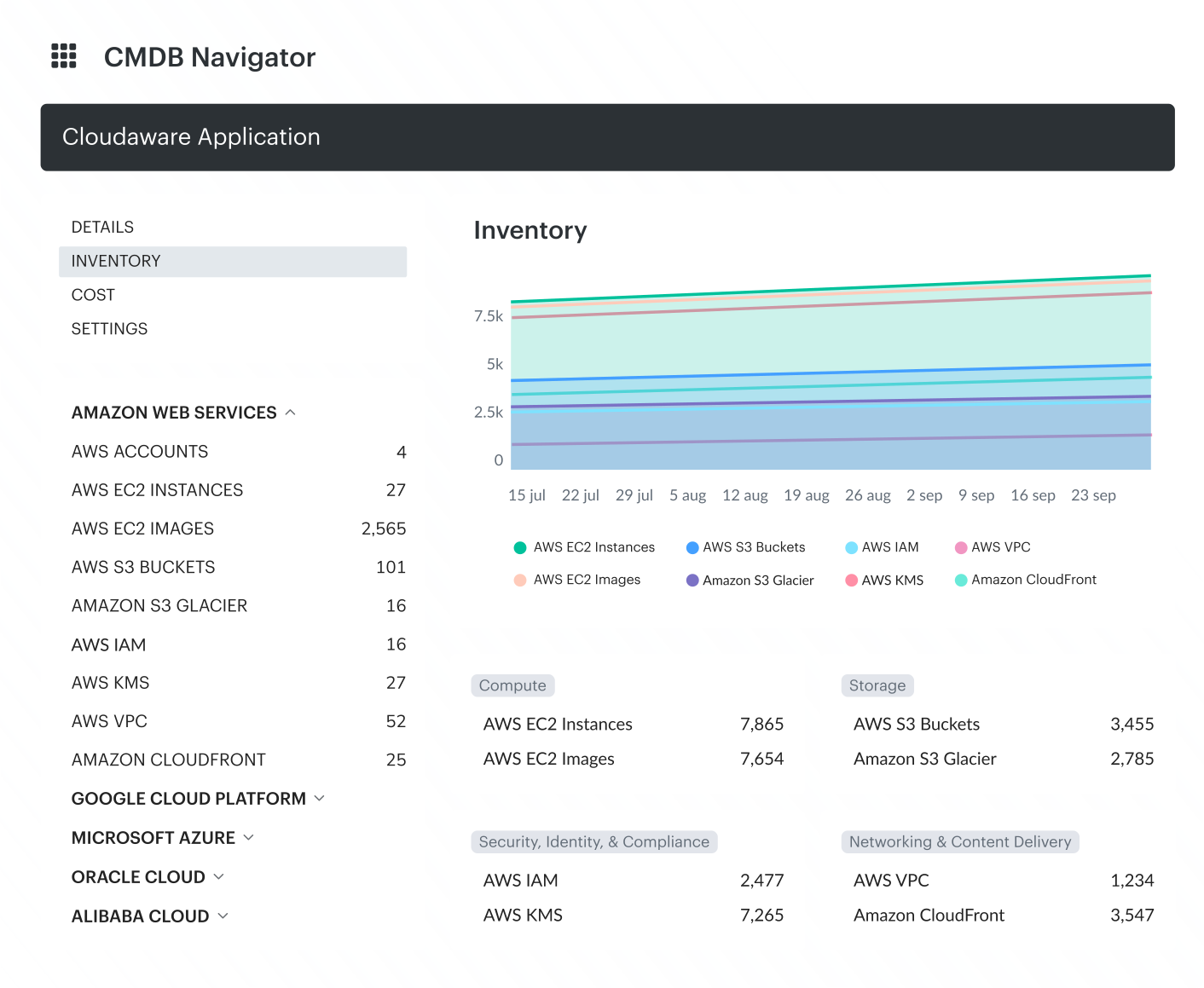 Core capabilities:
- Unified asset context: Discover and normalize multi-cloud and hybrid infrastructure, then tie each resource to the owner, environment, application, account, region, and related CIs needed for investigation.
- CMDB-based scope assertion: Use service catalog and CMDB attributes to define which assets belong in a compliance run, instead of testing an unclear or manually assembled asset population.
- Compliance-as-code policies: Evaluate controls with version-controlled, declarative policies that can be reviewed, tested, changed, and mapped to standards such as HIPAA, PCI, CIS, NIST, and ISO.
- Control results with owner context: View pass/fail results together with the affected CI, application, environment, owner, mapped framework, and policy that produced the result.
- Trackable violations: Turn failed checks into violation or rule-finding records with status, owner, SLA, timestamps, and lifecycle history, so the evidence record shows what failed and how the team responded.
- Exception handling: Keep approved deviations tied to the affected asset, control, owner, expiry, and compensating-control context, instead of letting suppressed findings disappear from compliance reporting.
- Remediation workflow integration: Route failed controls into operational systems such as Jira or ServiceNow, then keep remediation status connected to the original control result.
- Reusable audit evidence: Work from current control data, archived results, rule history, exception state, and remediation records instead of rebuilding the same evidence from cloud exports, screenshots, tickets, and spreadsheets every audit cycle.