


In 2026, cloud security compliance standards rarely arrive one at a time.
A healthcare SaaS team may need HIPAA + SOC 2 + ISO 27001 + PCI DSS before the first enterprise buyer signs. Add federal work, and now FedRAMP and NIST 800-53 enter the room. Each one brings a different auditor, evidence format, renewal rhythm, and wording for controls that often do the same job.
It’s built from fresh field notes by Valentin Kel, Head of Cloud Security Engineering at Cloudaware, Igor K., DevSecOps and Cloud Security Expert, and Cloudaware clients, including CISOs, cloud security managers, compliance leads, GRC teams, and security architects.
This guide breaks down the 8 cloud security compliance frameworks your team is most likely to face:
- Which key compliance standards for cloud security actually apply to your environment?
- Where do HIPAA, SOC 2, ISO 27001, PCI, NIST, and FedRAMP secretly reuse the same controls?
- What evidence do auditors ask for when your infrastructure changes daily?
- How do mature teams stop compliance from turning into spreadsheet archaeology?
Key insights: which standard for which goal
- Best for U.S. federal contracts: FedRAMP, with NIST SP 800-53 Rev. 5 underneath. If agencies are the buyer, start here.
- Best for international B2B trust: ISO/IEC 27001. Pair it with ISO/IEC 27017 when customers ask how your ISMS handles cloud-specific responsibility splits.
- Best for U.S. SaaS vendors: SOC 2 Type II. Security is the baseline; Availability, Confidentiality, Processing Integrity, and Privacy depend on your customer promises.
- Best for payment data: PCI DSS v4.0.1. Scope the CDE tightly before the auditor pulls in every connected cloud service.
- Best for healthcare PHI: HIPAA Security Rule. Add HITRUST CSF only when customers require a more formal control framework.
- Best executive language: NIST CSF 2.0. Use it to explain risk posture across Govern, Identify, Protect, Detect, Respond, and Recover.
- Best operating model: one control library, mapped through UCF, operated continuously, and reported across frameworks without re-collecting the same evidence five times.
- For teams mapping cloud controls across frameworks, the Cloud Controls Matrix is useful because it translates broad compliance expectations into cloud-specific control objectives.
What are cloud security compliance standards?
Cloud security compliance standards are documented sets of controls organizations use to prove they handle cloud systems, workloads, identities, and data responsibly.
That proof may go to a customer during procurement. A regulator after an inquiry. An auditor during an annual review. Or a board asking whether the company can keep scaling without turning risk into a guessing game.
The tricky part? Teams often use four words as if they mean the same thing.
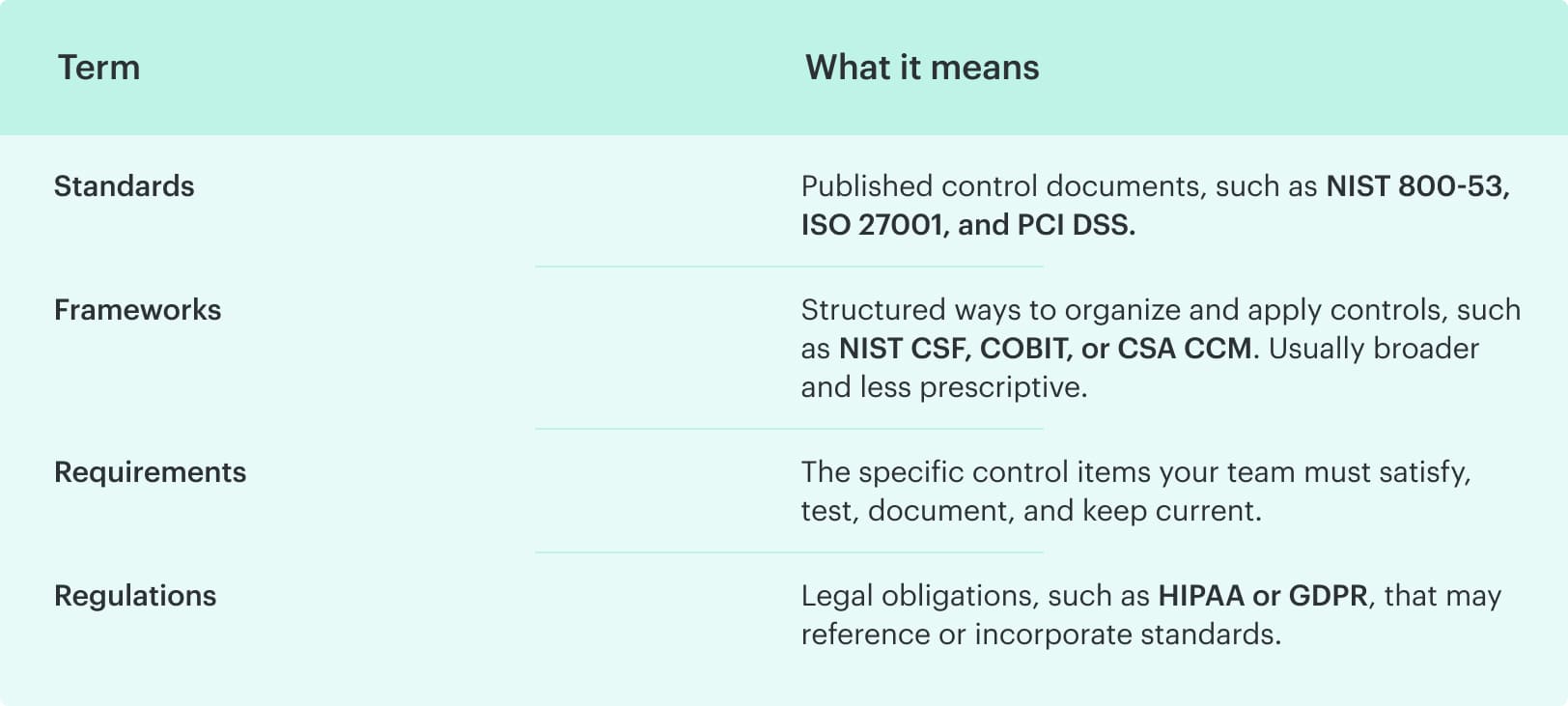
In the cloud, one more layer changes everything: shared responsibility.
Your cloud provider may be certified. Great. That does not make your workload compliant.
A SOC 2 audit for an application running on AWS does not inherit AWS’s SOC 2 report. It reviews your controls implemented on AWS: access, logging, encryption, change management, incident response, vendor risk, data retention, and evidence quality.
That’s why cloud security managers, CISOs, GRC teams, and security architects need a mapped view of controls across frameworks before the audit calendar starts eating the year.
Cloud security observability helps connect control failures with affected resources, recent changes, responsible owners, and machine-observed validation.
Valentin Kel, Cloudaware DevOps Engineer:
At-a-glance comparison: the 8 frameworks side by side
Before you pick a framework, compare the operating burden.
Some standards are mandatory because of your market. Some become mandatory because a customer asks for them in procurement. Others help your team organize cloud risk before an auditor turns it into a finding.
Use this side-by-side view to see who maintains each framework, when it applies, how cloud-specific it is, and what kind of renewal or audit cycle your team should expect.
| Framework | Maintained by | Mandatory for | Cloud focus | Renewal / audit |
|---|---|---|---|---|
| NIST 800-53 | NIST (U.S.) | Federal agencies + contractors | Cloud control overlay (rev. 5) | Continuous; annual ATO |
| NIST CSF 2.0 | NIST (U.S.) | Voluntary; widely adopted | Risk-driven, cloud-applicable | Continuous |
| ISO/IEC 27001 | ISO + IEC | Voluntary; commercial signal | General; broader than cloud | Recertification every 3 years + surveillance audits |
| ISO/IEC 27017 | ISO + IEC | Cloud service providers and customers | Cloud-specific overlay to 27001 | Audited alongside ISO 27001 |
| SOC 2 (Type II) | AICPA | U.S. SaaS / service providers | Cloud-resident services common | Annual report covering ~12-month period |
| PCI DSS v4.0.1 | PCI Council | Anyone storing / processing / transmitting card data | Cloud-resident CDE covered | Annual + quarterly scanning |
| HIPAA | HHS (U.S.) | Covered entities + business associates handling PHI | Cloud-hosted PHI covered | No annual audit; OCR investigations after incidents |
| FedRAMP | GSA + JAB / agency | Cloud services for federal use | Cloud-only by definition | Continuous monitoring + 3-year reauthorization |
NIST SP 800-53: The U.S. federal control baseline
| Maintained by | NIST, the National Institute of Standards and Technology |
| Applies to | U.S. federal agencies and contractors handling federal information |
| Cloud focus | Cloud-applicable through tailoring, overlays, inherited controls, and OSCAL machine-readable control data |
| Audit cadence | Continuous monitoring, assessment, authorization, and ATO renewal |
| Key documents | NIST SP 800-53 Rev. 5, NIST SP 800-53B, NIST OSCAL |
NIST SP 800-53 is the master control catalog behind most U.S. federal security programs. It gives security and compliance teams a deep library of controls across 20 families, including Access Control, Audit and Accountability, Configuration Management, Assessment and Authorization, System and Information Integrity, Supply Chain Risk Management, and more.
For cloud teams, the value is not “copy every control and call it governance.” That is how a moderate-impact workload turns into a high-friction audit monster.
The practical move is tailoring.
Start with the right baseline: Low, Moderate, High, plus the privacy baseline where needed. Then document what applies, what is inherited from the cloud provider, what is customer-managed, and what does not apply to the system scope.
In a real cloud estate, that means mapping controls like AC-3, AU-2, CM-6, CA-7, and SC-13 to live AWS, Azure, GCP, Kubernetes, and on-prem configurations. Not once before the audit. Continuously.
NIST 800-53 becomes workable when tailoring is visible at the workload level. A Cloudaware dashboard should show the selected baseline, mapped control IDs, inherited CSP controls, customer-managed findings, exceptions, owners, and continuous-monitoring evidence in one view.
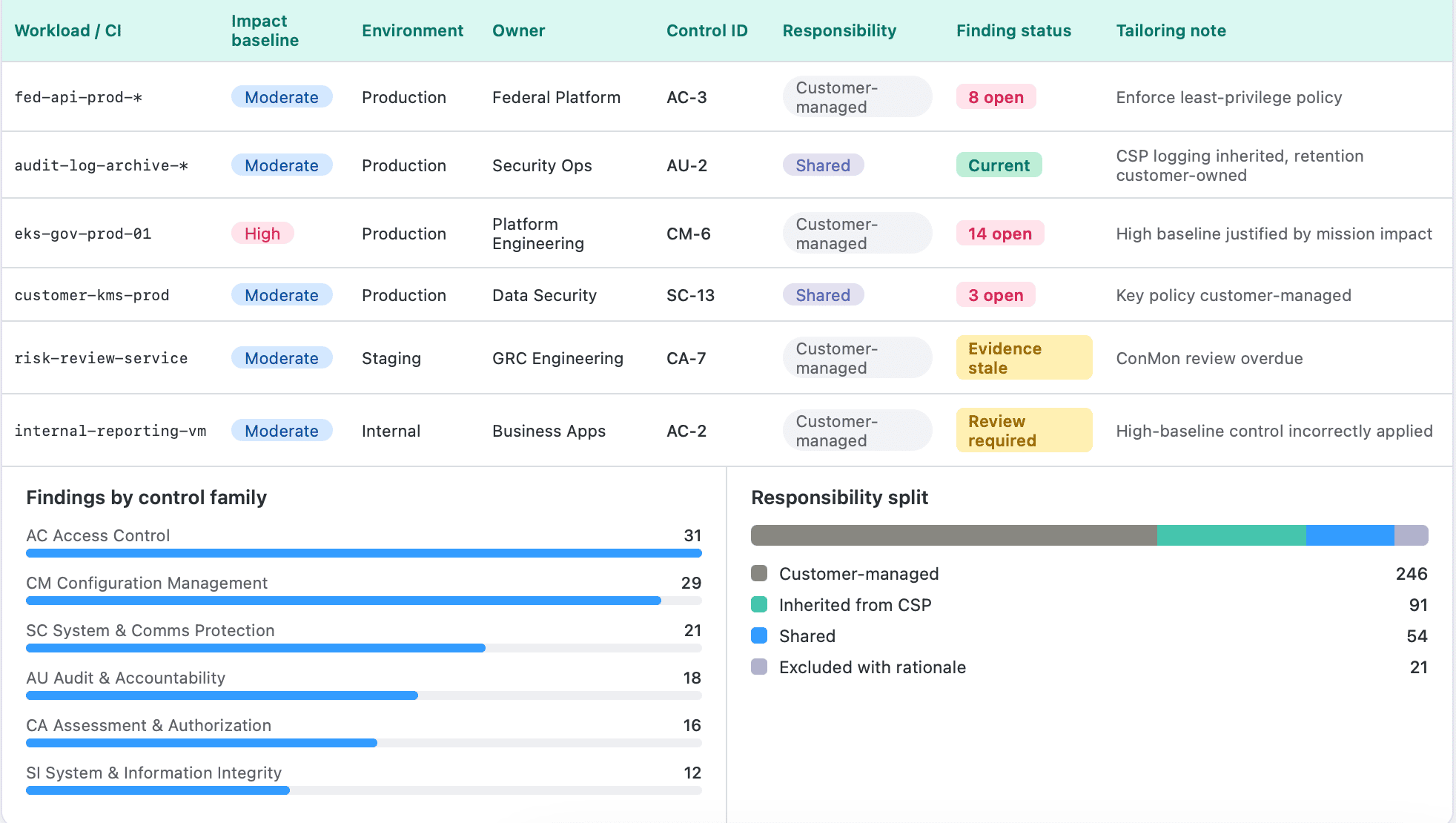
Element of the Cloudaware violations report. Schedule a demo to see it live.
So instead of treating SP 800-53 as a 1,000-control checklist, teams can use it as intended: a baseline, mapped to reality.
Common pitfall is over-applying High baseline controls to Moderate systems. This often begins with a desire to be cautious. A team wants to be “extra safe,” so they apply the strictest NIST SP 800-53 baseline across every cloud workload. Then the audit backlog explodes.
A public-facing federal application with sensitive mission data may justify a High baseline treatment. A lower-impact internal reporting service typically does not require the same level of baseline treatment. When both inherit the same control set, security teams end up testing controls that do not match the system’s real risk profile.
That creates three problems fast:
- False urgency: findings look critical because the wrong baseline was used.
- Noisy remediation: engineers chase low-value fixes instead of real exposure.
- Audit fatigue: GRC teams keep explaining why controls were applied, failed, waived, or marked “not applicable.”
The fix is formal tailoring. Document the workload’s impact level, inherited CSP controls, customer-managed controls, compensating measures, and exclusions before assessment starts.
Auditors do not expect every system to carry all controls. They expect a defensible rationale.
NIST Cybersecurity Framework CSF 2.0: The risk-driven framework
| Maintained by | NIST, the National Institute of Standards and Technology |
| Applies to | Voluntary; widely used across private sector, critical infrastructure, and enterprise risk programs |
| Cloud focus | Cloud-agnostic, but explicitly applicable to cloud environments |
| Audit cadence | No formal certification audit; usually used for self-assessment, maturity tracking, board reporting, and risk prioritization |
| Key documents | NIST CSF 2.0, Implementation Examples, Quick Start Guides, Organizational Profile templates |
NIST CSF 2.0 is not a control catalog.
That is the first thing CISOs, GRC teams, and cloud security managers need to get right. CSF does not tell your engineers which exact AWS, Azure, GCP, Kubernetes, or on-prem control to configure. It gives leadership and security teams a shared structure for explaining cybersecurity outcomes.
The framework is built around six functions: Govern, Identify, Protect, Detect, Respond, and Recover.
CSF 2.0 added Govern as a peer function, and that changed the tone of the framework. Security is no longer framed as a technical program that occasionally reports to leadership. Governance sits at the center: strategy, accountability, policy, oversight, supply chain risk, and risk appetite.
What NIST CSF 2.0 covers in cloud environments
For cloud teams, CSF 2.0 works best as the operating map above detailed controls.
| CSF Function | What it means in a cloud estate |
|---|---|
| Govern | Assign cloud risk ownership, define policies, set risk tolerance, track third-party and CSP accountability |
| Identify | Maintain inventory across AWS, Azure, GCP, Kubernetes, VMware, SaaS, data stores, identities, and business services |
| Protect | Enforce access, encryption, secure configuration, segmentation, backup, and hardening policies |
| Detect | Monitor logs, misconfigurations, policy drift, anomalous behavior, and control violations |
| Respond | Route findings, trigger tickets, document decisions, notify owners, and manage containment workflows |
| Recover | Prove resilience through restoration plans, backup validation, recovery ownership, and post-event improvements |
That is why CSF 2.0 lands so well in board reporting. A board member may not care that AC-3 or CM-6 failed on a specific cloud asset. They do care that the company has a material gap in Protect because privileged access reviews are inconsistent across production accounts.
Read our complete guide about NIST cloud security with controls and audit readiness checklist.
How to implement NIST CSF 2.0 in a cloud estate
- Start with a Current Profile. What outcomes can your team prove today?
- Then define a Target Profile. Not a fantasy-state maturity model. A risk-based target tied to the business: federal expansion, healthcare customers, financial data, production resilience, AI workloads, or multi-cloud growth.
- The next move is mapping. CSF gives the outcome language. Underneath it, teams need control-level evidence from frameworks such as NIST SP 800-53, ISO 27001, PCI DSS, HIPAA, SOC 2, and FedRAMP.
A practical CSF 2.0 dashboard for cloud risk could look like this:
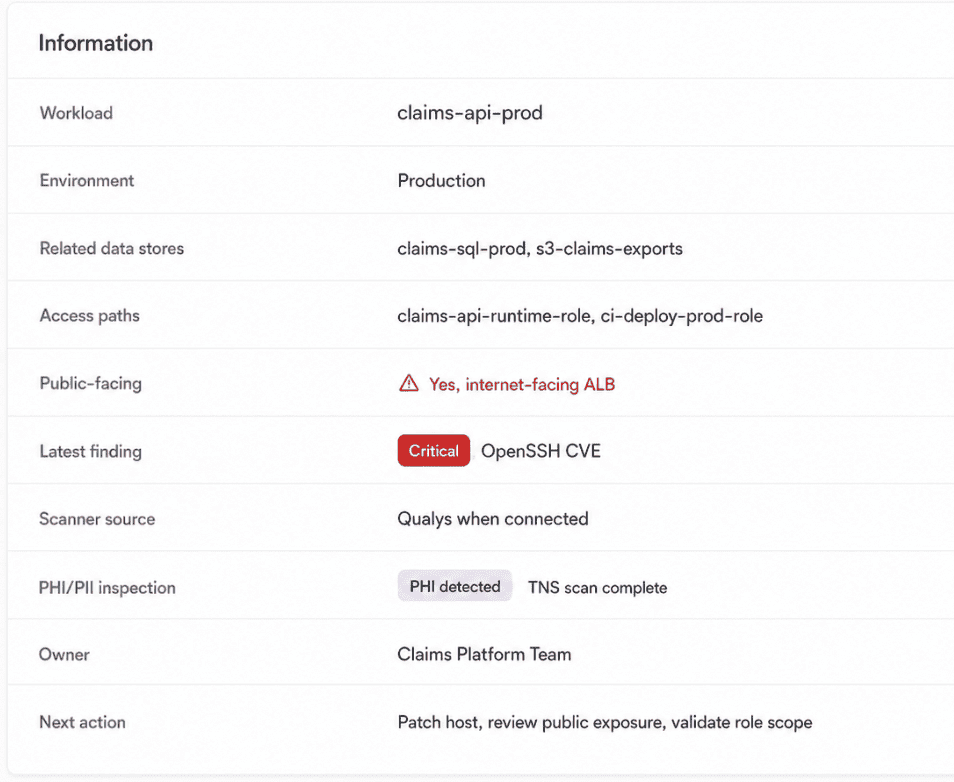
Element of Cloudaware violations report. Schedule a demo to see it live.
| Function | Evidence source | Example cloud signal |
|---|---|---|
| Govern | CMDB ownership, policy scope, exception approvals | Production workloads without assigned control owner |
| Identify | CMDB discovery, asset relationships, tags | Unclassified cloud databases in customer-facing services |
| Protect | CSPM policies, IAM checks, encryption rules | Public storage, missing MFA, weak security group rules |
| Detect | SIEM signals, policy findings, log coverage | Critical services without required audit logging |
| Respond | Jira, ServiceNow, Slack, PagerDuty workflows | Findings opened, routed, escalated, accepted, or remediated |
| Recover | Backup and resilience evidence | Critical workloads without verified recovery ownership |
In Cloudaware, teams can keep CSF as the executive layer while the evidence stays technical and traceable. IT Compliance maps findings through UCF to underlying control IDs, CSPM policies are tagged to NIST-oriented control language from day one, and CMDB-aware scoping keeps reporting tied to the right environment, owner, application, and business service.
That gives security leaders a clean board story without flattening the real engineering detail.
Igor, Cloudaware DevOps Engineer:
Read also: Top 9 Cloud Security Controls: Types & Checklist for 2026
ISO/IEC 27001: The international information security standard
| Maintained by | ISO and IEC joint technical committee |
| Applies to | Voluntary, but widely expected in B2B, SaaS, finance, healthcare, and enterprise procurement |
| Cloud focus | Cloud-neutral; Annex A controls are broadly cloud-applicable |
| Audit cadence | Stage 1 documentation audit, Stage 2 certification audit, annual surveillance, 3-year recertification |
| Key documents | ISO/IEC 27001:2022, ISO/IEC 27002:2022, ISO/IEC 27017 |
ISO/IEC 27001 is the standard teams use when they need to prove they run security as a managed system, not as a pile of policies in a shared drive.
It requires an Information Security Management System, or ISMS: a documented, auditable way to define scope, assess risk, choose controls, assign ownership, review performance, and improve over time.
The 2022 version reorganized Annex A into 93 controls across four themes: Organizational, People, Physical, and Technological. For cloud teams, that includes familiar territory: access control, privileged identities, logging, encryption, vulnerability management, supplier risk, backup, configuration, change management, and incident response.
What ISO/IEC 27001 covers in cloud environments
ISO 27001 does not tell you “configure AWS Security Groups this way” or “set this Azure policy.” It asks a harder operational question: can you prove your security process works across the cloud estate you defined in scope?
That means auditors look at the following:
- Clauses 4-10: context, leadership, planning, support, operation, performance evaluation, and improvement.
- Annex A controls: selected, excluded, and justified through the Statement of Applicability.
- Mandatory ISMS evidence: scope, security policy, risk assessment method, risk treatment plan, internal audit, management review, corrective actions, and SoA.
- Cloud implementation proof: live configurations, review notes, tickets, exceptions, remediation history, and control ownership.
The Statement of Applicability matters more than many teams expect. It is not a spreadsheet for the auditor. It is the logic layer of your ISMS. Every included control needs an owner and evidence. Every excluded control needs a defensible reason.
How to implement ISO/IEC 27001 in a cloud estate
- Start with scope. Not “the cloud.” Too vague.
- Define the environments, accounts, subscriptions, projects, Kubernetes clusters, data stores, applications, regions, and business services included in the ISMS.
- Then map cloud assets to owners and risk context.
- From there, build the SoA around real cloud operations.
A mature ISO 27001 dashboard usually tracks something like this:
| ISMS area | Cloud evidence auditors expect |
|---|---|
| Access control | IAM reviews, privileged access approvals, MFA coverage, stale account findings |
| Logging and monitoring | Enabled log sources, retention settings, alert routing, investigation records |
| Configuration management | CSPM findings, baseline drift, approved exceptions, remediation tickets |
| Supplier and cloud risk | CSP certifications, shared responsibility notes, data processing scope |
| Risk treatment | Accepted risks, treatment plans, target dates, business owners |
| Continual improvement | Internal audit findings, corrective actions, management review notes |
Cloudaware clients usually operate this through a control-and-evidence view tied to the CMDB. Cloud assets are scoped by environment, service, owner, account, region, and business application. IT Compliance maps rule findings to ISO 27001 controls through UCF, while CSPM findings show whether the technical side of the ISMS is actually running.
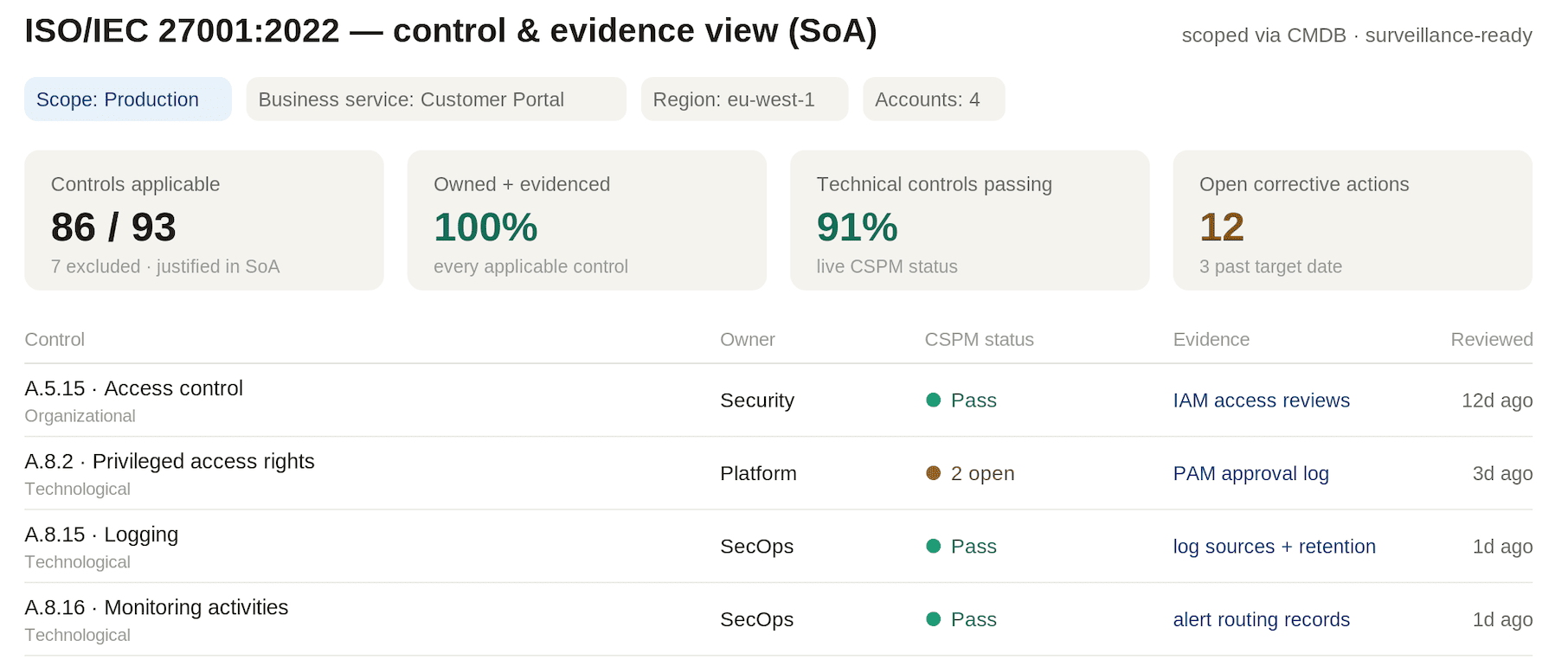
Element of the Cloudaware IT compliance report. Schedule a demo to see it live.
That matters during surveillance audits.
Instead of collecting screenshots two weeks before the auditor arrives, teams can show finding lifecycles, ticket histories, exception approvals, remediation dates, and control status over time.
A common pitfall of working with ISO 27001 is building documentation that no one operates.
ISO 27001 certification does not reward beautiful PDFs if the ISMS has no pulse. Stage 2 and surveillance audits look for evidence that the process runs: risk reviews happened, exceptions were approved, owners responded, findings moved, corrective actions closed, and management reviewed the right inputs.
A clean policy library helps. Operating evidence passes the audit.
ISO/IEC 27017: Cloud-specific security controls
| Maintained by | ISO and IEC joint technical committee |
| Applies to | Cloud service providers and cloud service customers, usually alongside ISO 27001 |
| Cloud focus | Purpose-built guidance for cloud security controls |
| Audit cadence | Assessed as an extension to an ISO 27001 ISMS, not as a standalone certification path |
| Key documents | ISO/IEC 27017:2015, ISO/IEC 27001:2022, ISO/IEC 27002:2022, ISO/IEC 27018:2019 |
ISO/IEC 27001 proves you run an ISMS.
ISO/IEC 27017 gets more specific: how does that ISMS work when infrastructure, platforms, identities, storage, logging, and security duties are split between you and a cloud provider?
That split is the whole point.
ISO 27017 gives cloud-specific guidance for cloud service providers and cloud service customers. It builds on ISO 27002, adds guidance for existing controls, and introduces additional cloud controls for areas traditional security programs often treat too vaguely: shared responsibility, virtual environments, cloud admin procedures, customer asset removal, and tenant separation.
Read our complete guide to ISO 27001 risk assessment for the process, requirements, and practical examples. And our ISO 27017:2026 Cloud Security Controls Guide for cloud-specific control updates, shared-responsibility mapping, and evidence requirements across AWS, Azure, and GCP.
What ISO/IEC 27017 covers in cloud environments
For CISOs, compliance managers, and security architects, ISO 27017 is useful because it turns “the cloud provider handles that” into a testable statement.
| ISO 27017 area | What cloud teams need to prove |
|---|---|
| Shared roles and responsibilities | Which controls belong to the CSP, the customer, or both |
| Cloud customer asset removal | What happens to customer data, snapshots, accounts, and storage when services are terminated |
| Virtual machine hardening | Baselines for images, admin access, configuration drift, and workload isolation |
| Cloud admin operations | Documented procedures for privileged operations in cloud consoles and APIs |
| Network segregation | Tenant separation, segmentation, firewall rules, private endpoints, and exposure paths |
| Monitoring and logging | Evidence that cloud activity is recorded, retained, reviewed, and routed |
That “customer versus provider” split cannot live in a policy PDF. Auditors will want to see it at the service level.
How to implement ISO/IEC 27017 in a cloud estate
Start with a cloud services inventory. Then attach responsibility metadata to each service.
| Cloud service | Responsibility split | Customer-side evidence |
|---|---|---|
| AWS S3 / Azure Blob / GCP Cloud Storage | Shared | Encryption status, public access checks, retention settings, owner, exception history |
| AWS EC2 / Azure VM / GCE | Shared | Hardened image baseline, patch status, admin access, network exposure |
| Kubernetes clusters | Mostly customer-managed | RBAC, namespace isolation, admission controls, audit logging |
| Managed databases | Shared | Encryption, backup settings, access control, data classification, deletion workflow |
| IAM / Entra ID / GCP IAM | Mostly customer-managed | MFA, privileged roles, stale identities, access review records |
Cloudaware clients usually anchor this in the CMDB because ISO 27017 evidence only works when every cloud service has context: account, region, owner, environment, application, data sensitivity, business service, and inherited CSP responsibility.
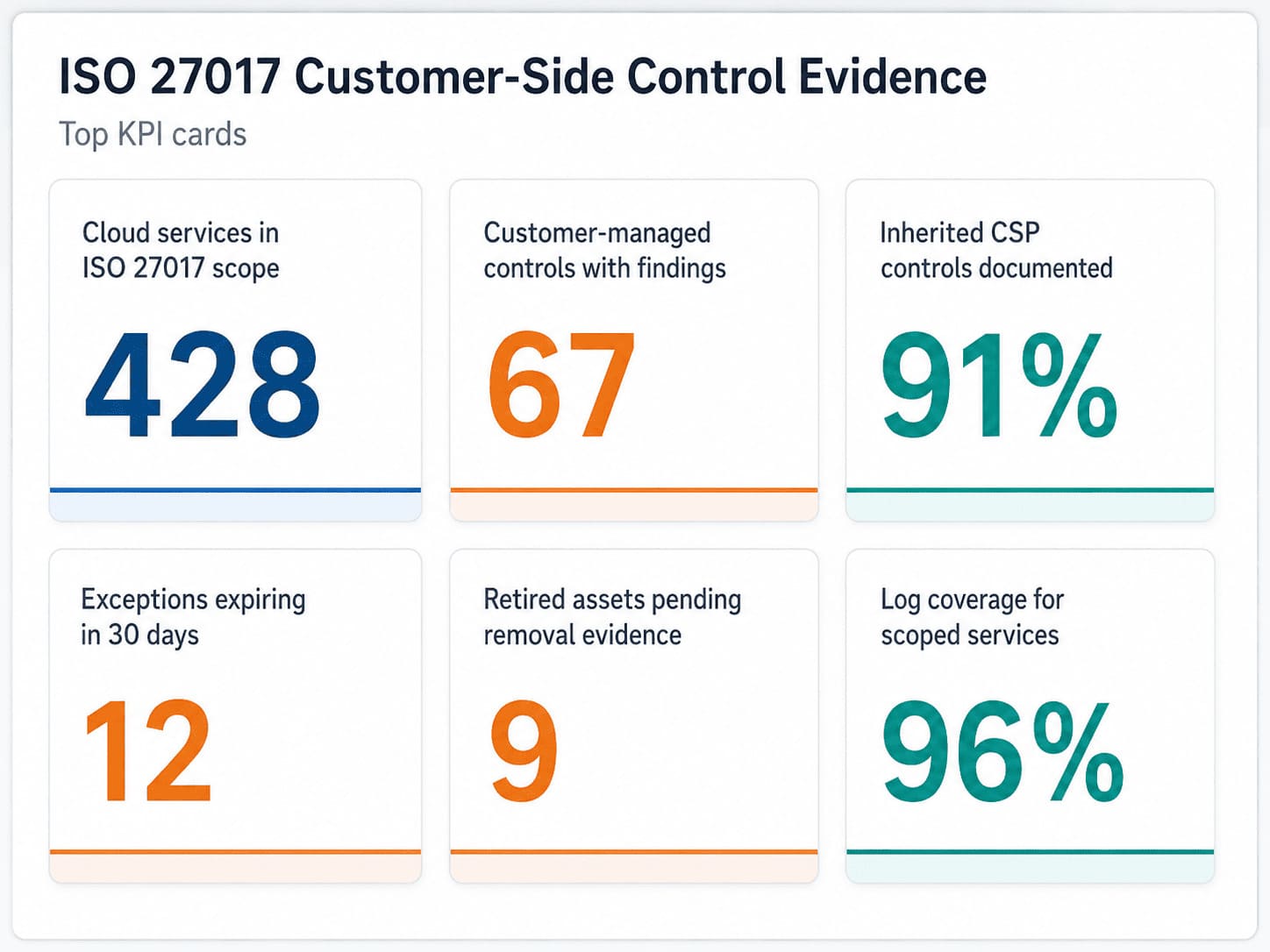
Then IT Compliance connects the technical evidence to the control library. CSPM findings show whether customer-side duties are actually being met. Exceptions carry owners and expiry dates. Ticket histories show remediation. Decommissioned assets keep their removal trail.
A useful view shows:
- Cloud services covered by ISO 27017 scope
- Controls inherited from the CSP
- Customer-managed controls with live findings
- Accepted exceptions by owner and expiry date
- Data-removal status for retired accounts, buckets, volumes, and databases
- CSP attestations attached to the relevant services
Valentin Kel, Cloudaware DevOps Engineer:
SOC 2: Type I and Type II for service providers
| Maintained by | AICPA, the American Institute of CPAs |
| Applies to | SaaS companies and service providers that store, process, or manage customer data |
| Cloud focus | Common for AWS, Azure, GCP, Kubernetes, and hybrid service environments |
| Audit cadence | Type I at a point in time; Type II over an observation period, often 6 to 12 months |
| Key documents | AICPA Trust Services Criteria, SOC 2 Description Criteria, management assertion, auditor report |
| SOC 2 | SOC 2 report |
|---|---|
| is the compliance signal U.S. enterprise buyers ask for when they need proof that a vendor’s service can be trusted with customer data | is an independent CPA attestation on whether controls are designed, and for Type II, whether they operated effectively across the audit period. |
What SOC 2 covers in cloud environments
SOC 2 uses the AICPA Trust Services Criteria. Security is the core category. The other four are added when they match the service commitments made to customers.
| Trust Services Category | What auditors look for in a cloud service |
|---|---|
| Security | Access control, risk management, change management, monitoring, vulnerability handling, incident response |
| Availability | Uptime commitments, capacity planning, resilience, backup, recovery testing |
| Processing Integrity | Complete, valid, accurate, timely, and authorized processing |
| Confidentiality | Protection of confidential business data, encryption, access limits, retention |
| Privacy | Collection, use, retention, disclosure, and disposal of personal information |
- Type I answers: are the controls suitably designed at this date?
- Type II asks the harder customer-trust question: did those controls actually operate during the audit window?
That is why enterprise buyers prefer Type II. They are not buying a diagram. They want proof of behavior over time.
How to implement SOC 2 in a cloud estate
Begin with the system boundary. Not “our platform.” Too soft. Define the services, cloud accounts, environments, data flows, subservice organizations, people, tools, infrastructure, and processes that support the commitments in scope.
Then build evidence collection around the audit period.
| Evidence area | Cloud evidence to keep audit-ready |
|---|---|
| Access control | IAM reviews, MFA status, privileged role changes, joiner-mover-leaver records |
| Change management | Pull requests, approvals, deployment records, emergency change logs |
| Vulnerability management | Findings, severity, ownership, remediation SLAs, accepted exceptions |
| Configuration management | CSPM findings, baseline drift, security group changes, encryption status |
| Monitoring | SIEM events, alert routing, investigation notes, escalation history |
| Incident response | Triage records, containment steps, customer notification decisions, postmortems |
Cloudaware clients usually keep this evidence tied to the CMDB, because SOC 2 auditors sample across systems and time.
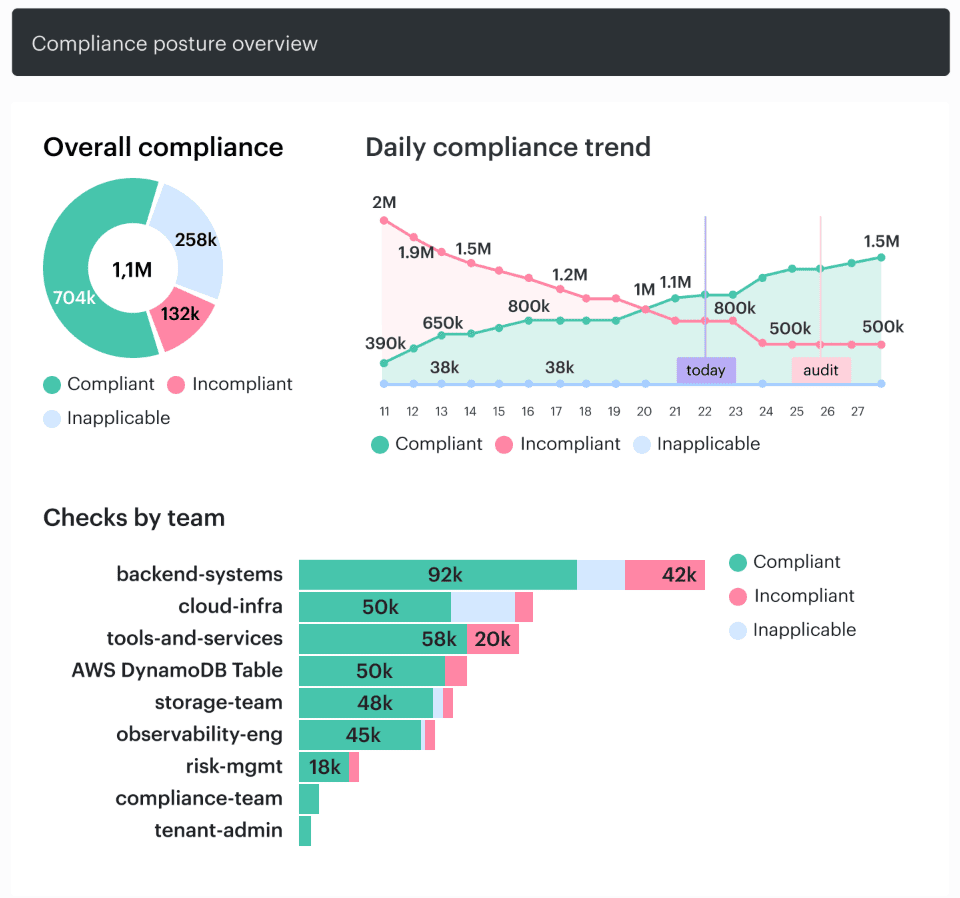
Element of Cloudaware IT compliance report. Schedule a demo to see it live.
SOC 2 cloud security and compliance: the audit perspective
In cloud-resident SOC 2, auditors spend a lot of time on traceability.
They need to understand what the system does, where customer data lives, who can access it, which subservice organizations support it, how changes move into production, and how management knows controls are working.
Cloud complicates that because assets change constantly. New storage buckets appear. IAM roles drift. Kubernetes workloads move. Logs may sit in different accounts. A static evidence folder turns stale before the observation period ends.
CMDB-anchored evidence cuts that noise. It connects the control to the live asset, the owner, the policy finding, the ticket, and the audit trail.
The 2022 revised implementation guidance for SOC 2 Description Criteria also pushed teams to explain how controls meet process or framework requirements and how risk assessment works. That favors continuous evidence over last-minute screenshots.
Igor, Cloudaware DevOps Engineer:
Read also: Popular DevSecOps Frameworks for Cloud Security in 2026
PCI DSS v4.0.1: For cloud-resident payment data
| Maintained by | PCI Security Standards Council |
| Applies to | Any merchant or service provider that stores, processes, or transmits cardholder data |
| Cloud focus | Cloud-resident cardholder data environments are in scope |
| Audit cadence | Annual SAQ or QSA-led ROC, depending on merchant or service-provider level; quarterly external ASV scans |
| Key documents | PCI DSS v4.0.1, ROC and SAQ templates, PCI SSC Cloud Computing Guidelines |
PCI DSS is the standard that makes vague cloud security language expensive.
It does not stop at “protect customer data.” It asks where cardholder data enters, where it moves, where it rests, which systems can affect its security, who can access it, how activity is logged, and whether network segmentation actually reduces the cardholder data environment.
That environment is the CDE, and in cloud, scoping the CDE becomes the highest-leverage decision in the whole PCI program.
One public payment API can pull in load balancers, web apps, containers, databases, IAM roles, logging pipelines, CI/CD systems, jump hosts, secrets managers, monitoring tools, and third-party processors. PCI does not care that the infrastructure is elastic. If a system stores, processes, transmits, or can impact the security of cardholder data, it needs a scope decision.
What PCI DSS v4.0.1 covers in cloud environments
PCI DSS is organized around 12 requirements across technical and operational control areas.
| PCI area | What it means in a cloud CDE |
|---|---|
| Network security controls | Security groups, firewalls, routing, private endpoints, segmentation, inbound and outbound traffic rules |
| Secure configuration | Hardened cloud services, baseline drift detection, default account removal, secure build standards |
| Cardholder data protection | Encryption, key management, storage location, retention, masking, data discovery |
| Vulnerability management | Internal scanning, external ASV scanning, remediation, authenticated scanning, patch SLAs |
| Access control | Least privilege, MFA, privileged admin access, service accounts, access reviews |
| Logging and monitoring | CloudTrail, Azure Activity Logs, GCP audit logs, SIEM routing, daily review workflow |
| Testing and validation | Penetration testing, segmentation testing, quarterly scans, change-triggered testing |
| Security policy and governance | Roles, procedures, evidence ownership, third-party responsibility, annual review |
PCI DSS v4.0.1 also keeps the Customized Approach model from v4.0. That gives mature teams more flexibility, but it raises the evidence bar. If you use an alternative control, you need to prove it meets the stated objective.
How to implement PCI DSS v4.0.1 in a cloud estate
Start with data flow, not tooling.
Map every place cardholder data touches: checkout, tokenization, payment processor handoff, temporary logs, data warehouse feeds, support workflows, backups, monitoring, and exports. Then classify each asset as in scope, connected to scope, security-impacting, or out of scope.
| Scope layer | What to track |
|---|---|
| CDE assets | Payment apps, databases, storage, queues, APIs, containers, VMs |
| Connected systems | CI/CD, logging, monitoring, identity, secrets, admin access paths |
| Segmentation controls | Security groups, firewalls, route tables, private endpoints, network policies |
| Data classification | dataclass=PCI, CHD presence, tokenized data, encrypted storage, retention rules |
| Ownership | Service owner, control owner, remediation owner, approver |
| Evidence | Findings, tickets, scan results, exceptions, compensating controls, audit trail |
Cloudaware clients typically make PCI scoping explicit in the CMDB. Assets carrying payment data get tagged with PCI data class, environment, owner, application, account, and business service. CSPM policies enforce PCI-mapped checks across cloud accounts. SIEM captures Requirement 10 evidence with CMDB context, so a log review is tied to the actual service, not a pile of raw events.
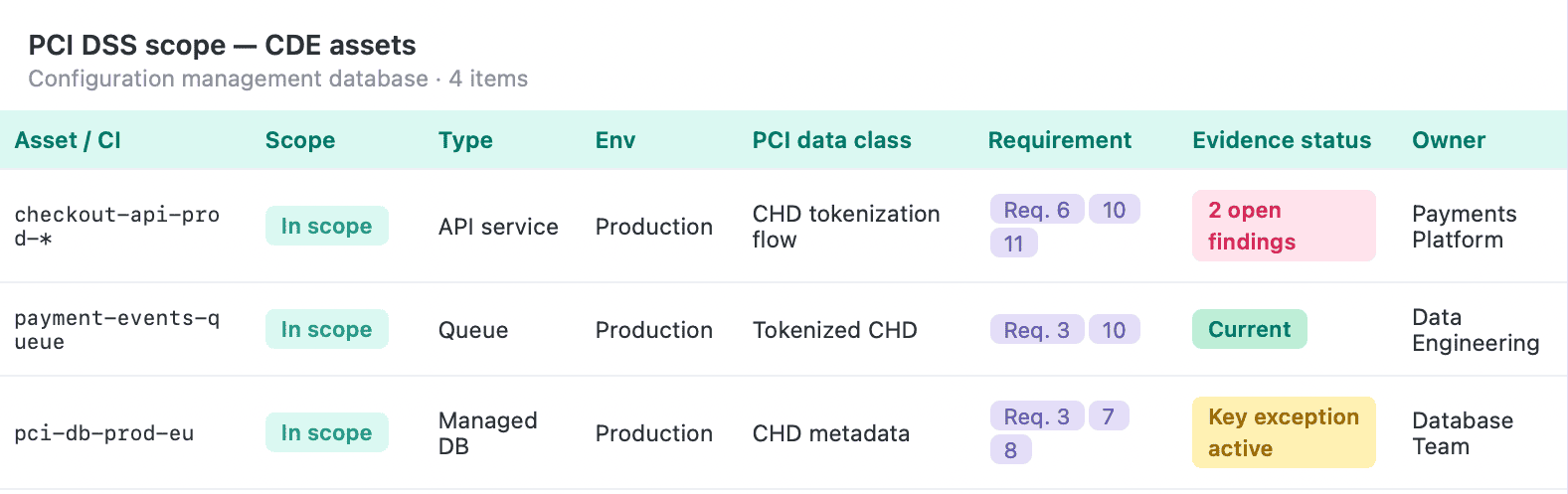
Cloudaware dashboard for PCI Requirement Coverage. Schedule a demo to see it live.
That structure matters because PCI auditors sample evidence across requirements. A failed encryption check, missing log source, stale admin role, or unresolved scan result needs a trail: when it appeared, who owned it, what changed, and why the CDE remained protected.
HIPAA: For cloud-hosted protected health information
| Maintained by | U.S. Department of Health and Human Services, enforced by the Office for Civil Rights |
| Applies to | Covered entities and business associates that create, receive, maintain, or transmit PHI |
| Cloud focus | Any cloud service that stores, processes, transmits, or can access ePHI |
| Audit cadence | No annual certification audit. OCR investigates complaints, breach reports, and enforcement triggers |
| Key documents | HIPAA Security Rule, Privacy Rule, Breach Notification Rule, BAA requirements |
HIPAA is different from most cloud security compliance standards in this guide because it is not voluntary.
There is no “HIPAA certified” badge that proves a cloud environment is safe. For cloud security, the real work sits inside the Security Rule, where HIPAA requires administrative, physical, and technical safeguards for electronic protected health information.
The hard part is scope.
In a cloud estate, PHI rarely sits in one clean system. It moves through patient portals, EHR integrations, claims workflows, support tickets, analytics exports, backups, object storage, logs, queues, email notifications, data warehouses, and third-party tools.
That is why a HIPAA program starts with one practical task: find every system that creates, receives, maintains, transmits, or can expose ePHI.
What HIPAA covers in cloud environments
| HIPAA area | What security and compliance teams need to prove |
|---|---|
| Administrative safeguards, §164.308 | Risk analysis, risk management, workforce access, assigned security responsibility, contingency planning |
| Physical safeguards, §164.310 | Workstation controls, device handling, media disposal, facility access where relevant |
| Technical safeguards, §164.312 | Access control, audit controls, integrity controls, authentication, transmission security |
| Organizational requirements, §164.314 | Business Associate Agreements, subcontractor responsibility, permitted PHI use |
| Breach Notification Rule | Breach assessment, affected individuals, OCR reporting, business associate notification workflows |
The risk analysis under §164.308(a)(1)(ii)(A) deserves its own spotlight. OCR enforcement actions often come back to the same weakness: the organization could not show a complete, current view of where ePHI lived and how risk was evaluated.
For cloud teams, that means a generic asset inventory will not hold. You need PHI context attached to the asset.
Read also: Healthcare Data Security. A Multi-Cloud Guide to Protecting PHI in 2026
How to implement HIPAA in a cloud estate
Start with a PHI scope map. A useful HIPAA cloud view should show:
| Field | Why it matters |
|---|---|
| Asset / CI | The cloud resource, application, database, queue, endpoint, or integration in scope |
| PHI status | Confirmed PHI, possible PHI, no PHI, or unknown |
| Business service | Patient portal, claims, billing, clinical workflow, analytics, support |
| Owner | The person accountable for risk decisions and remediation |
| BAA status | Signed, missing, expired, under review, or not required |
| Safeguard evidence | Access, logging, encryption, integrity, transmission, backup, and exception records |
| Open findings | Misconfigurations, policy breaches, missing logs, weak access, exposed storage |
| Exception expiry | Accepted risks that must be reviewed before they become permanent gaps |
This is where Cloudaware clients usually make HIPAA operational rather than document-heavy. The CMDB tracks cloud assets, business services, owners, environments, PHI data class, and business associate relationships.
IT Compliance maps safeguards to HIPAA citations through the UCF. CSPM findings show customer-side cloud misconfigurations. SIEM events carry CMDB context, so audit-control evidence can be tied back to the actual PHI system.
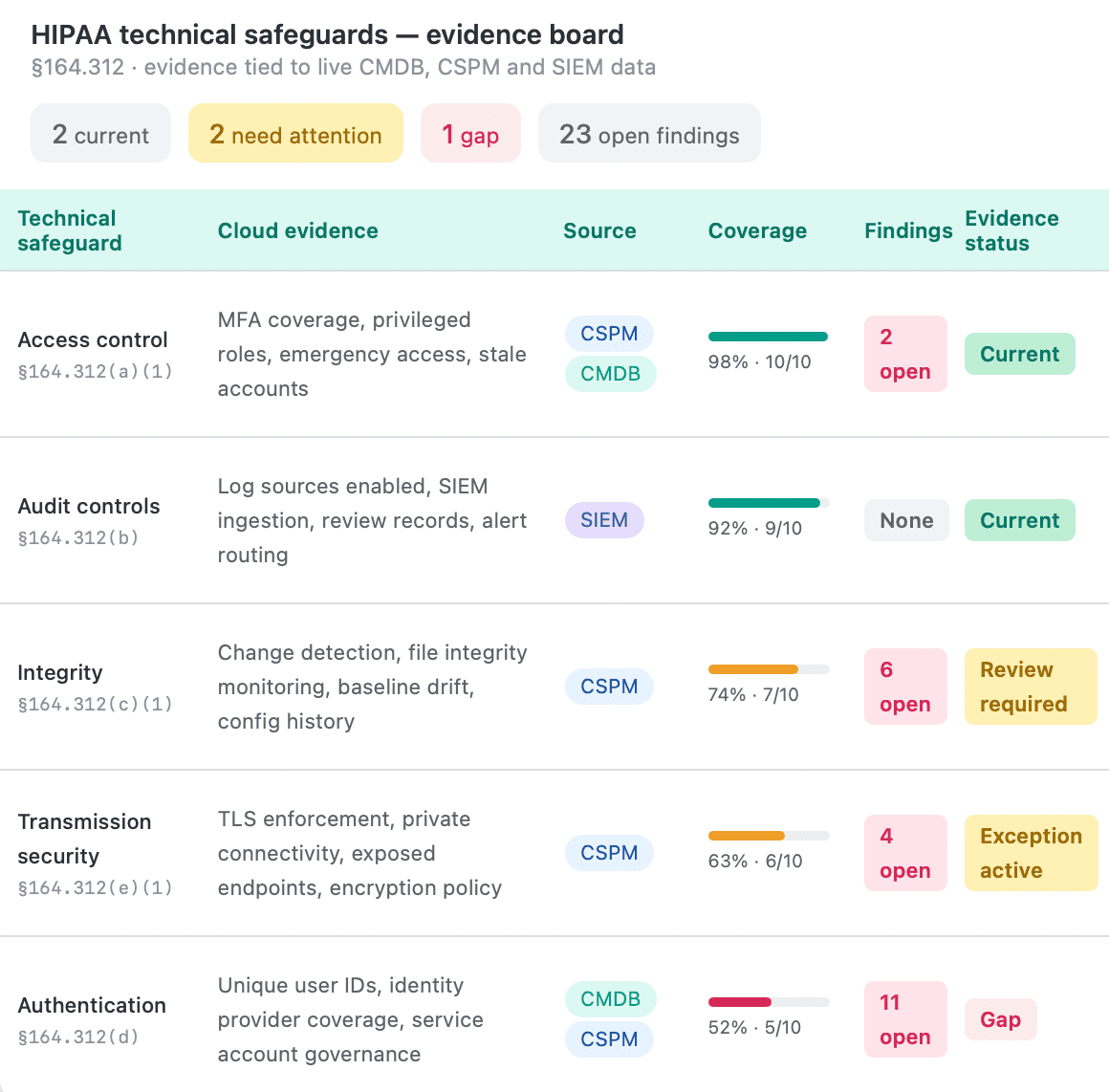
An element of the Cloudaware HIPAA report. Schedule a demo to see it live.
For §164.312, the dashboard should not show abstract compliance scores only. It should expose the working evidence:
| Technical safeguard | Cloud evidence |
|---|---|
| Access control | MFA coverage, privileged roles, emergency access, stale accounts, access review history |
| Audit controls | Log sources enabled, SIEM ingestion, review records, alert routing, investigation notes |
| Integrity | Unauthorized change detection, file integrity monitoring, baseline drift, configuration history |
| Authentication | Unique user IDs, identity provider coverage, service account governance |
| Transmission security | TLS enforcement, private connectivity, encryption policy findings, exposed endpoints |
Igor, Cloudaware DevOps Engineer
Read also: Cloud Data Security Challenges: 10 Issues & Fixes
FedRAMP: For cloud services serving U.S. federal agencies
| Maintained by | GSA FedRAMP PMO, with federal agency authorizing officials and FedRAMP-recognized assessors |
| Applies to | Cloud service providers used by U.S. federal agencies |
| Cloud focus | Federal cloud services only |
| Audit cadence | Initial assessment, authorization or certification path, monthly continuous monitoring, annual assessment, significant-change reviews |
| Key documents | FedRAMP Rev5 baselines, SSP, SAR, POA&M, Continuous Monitoring Playbook, OSCAL templates |
FedRAMP is the federal operating model for cloud authorization.
Not a badge. Not a PDF package. Not a one-time audit.
A cloud service provider has to define the system boundary, select the right baseline, document control implementation in the SSP, pass an independent assessment, maintain a POA&M, submit monthly continuous monitoring evidence, and keep the authorization boundary accurate as the service changes.
That last part is where teams usually feel the pain.
A new AWS account, region, container cluster, logging pipeline, support tool, or external dependency can change the boundary. A vulnerability scan can create POA&M items overnight. An expired deviation can turn into an agency risk discussion. A missing inventory update can make the ConMon package look unreliable even when the engineering team is doing the work.
What FedRAMP covers in cloud environments
| FedRAMP area | Practitioner view |
|---|---|
| Baseline | LI-SaaS, Low, Moderate, or High based on federal data and system impact |
| Authorization boundary | The exact cloud service offering, components, integrations, regions, accounts, and external services in scope |
| SSP | Control implementation details written for the actual system, not pasted from policy language |
| SAR | Independent assessment results, tested controls, weaknesses, and risk exposure |
| POA&M | Open findings, vulnerabilities, deviations, owners, target dates, and remediation plans |
| Continuous monitoring | Monthly inventory, POA&M updates, vulnerability scans, significant changes, and annual assessment evidence |
| OSCAL | Machine-readable package structure for control and authorization data |
Moderate is the common SaaS path because many federal workloads sit there. High raises the control burden, evidence expectations, and tolerance level for unresolved findings.
How to implement FedRAMP in a cloud estate
Start with the boundary. Everything else depends on it.
| Boundary field | What the report should show |
|---|---|
| Cloud account / subscription / project | Included, excluded, pending review |
| CI / asset | Service, database, VM, container, cluster, storage, IAM system, logging component |
| FedRAMP baseline | LI-SaaS, Low, Moderate, High |
| Control owner | Named technical owner and compliance owner |
| Environment | Production, staging, federal enclave, shared service |
| External dependency | CSP service, subservice organization, support tool, integration |
| Evidence status | Current, stale, missing, exception accepted |
Cloudaware clients usually keep this boundary in the CMDB instead of maintaining it in a spreadsheet beside the SSP. Each CI carries environment, owner, baseline, business service, account, region, and authorization-boundary status. That gives security, GRC, and engineering the same scope when a 3PAO asks for evidence.
The monthly ConMon view should be even more direct.
| ConMon item | Evidence to track |
|---|---|
| Inventory update | New, retired, changed, and unowned assets inside the boundary |
| POA&M | Weakness source, control ID, severity, owner, target date, status |
| Vulnerability scans | Authenticated scan coverage, overdue findings, false positives, deviation requests |
| CSPM findings | Misconfigurations mapped to FedRAMP and NIST 800-53 controls |
| SIEM evidence | Log source coverage, event routing, alert history, investigation trail |
| Significant changes | Architecture changes, new services, boundary changes, security-impacting releases |
| Exceptions | Business justification, compensating control, approver, expiry date |
IT Compliance maps findings through UCF to FedRAMP and NIST 800-53 control IDs. CSPM policies show configuration drift against the selected baseline. Vulnerability Management keeps scan results tied to affected CIs. SIEM adds monitoring evidence with asset context, so AU and IR controls do not rely on raw logs with no owner.
That turns ConMon into a reportable operating rhythm:
- POA&M items past target date
- Findings by control family
- Vulnerabilities affecting boundary assets
- Deviations expiring in the next 30 days
- Unowned CIs inside the boundary
- Scan coverage gaps
- Changes waiting for security-impact review
Alla L. ITAM expert from Cloudaware
Mapping one set of controls across multiple frameworks
A healthcare SaaS company can easily run HIPAA, SOC 2, ISO 27001, PCI DSS, NIST 800-53, and FedRAMP in the same cloud estate.
Running six separate control libraries is how the program breaks.
MFA gets tested six times. Encryption evidence lands in six folders. Logging screenshots age out before the next auditor asks. One framework marks an exception approved. Another shows the same control as failed. Engineering sees five tickets for one root issue.
The cleaner model is a single control library mapped to every applicable framework.
One operated control: administrative access to regulated systems requires MFA.
| Control evidence | Mapped reporting views |
|---|---|
| IdP MFA status, privileged roles, access review, exception record, affected CIs | NIST 800-53 IA-2, FedRAMP IA-2, PCI DSS 8.4, SOC 2 CC6.x, ISO 27001 access-control requirements, HIPAA access and authentication safeguards |
The control runs once. Evidence stays in one place. Reports change by framework.
UCF supports that model by mapping common controls across over 1,000 authority documents, including standards, regulations, and frameworks that use different language for similar obligations. The value is not academic. Once the audit count passes three, manual crosswalks become a maintenance problem.
| Operated control | Evidence source | Framework mappings | Current status |
|---|---|---|---|
| MFA for privileged access | IdP, IAM, CMDB, exception register | SOC 2, ISO 27001, PCI DSS, HIPAA, NIST 800-53, FedRAMP | 94% compliant, 6 exceptions |
| Encryption on regulated data stores | CSPM, key policy, dataclass tag | PCI DSS, HIPAA, SOC 2, ISO 27001, NIST 800-53 | 11 open findings |
| Audit logging enabled | SIEM ingestion, log-source coverage | HIPAA, PCI DSS, SOC 2, FedRAMP | 3 missing log sources |
| Vulnerability remediation | Scanner, ticket, SLA, POA&M | FedRAMP, PCI DSS, SOC 2, ISO 27001 | 17 overdue items |
| Configuration baseline | CSPM policy, affected CI, owner | ISO 27001, SOC 2, PCI DSS, FedRAMP | 42 policy breaches |
In Cloudaware, clients usually anchor the mapping in IT Compliance + CMDB. UCF handles the citation mapping. CSPM, SIEM, Vulnerability Management, and ticketing integrations produce the evidence. The CMDB keeps the evidence tied to the asset, owner, environment, data class, application, and business service.
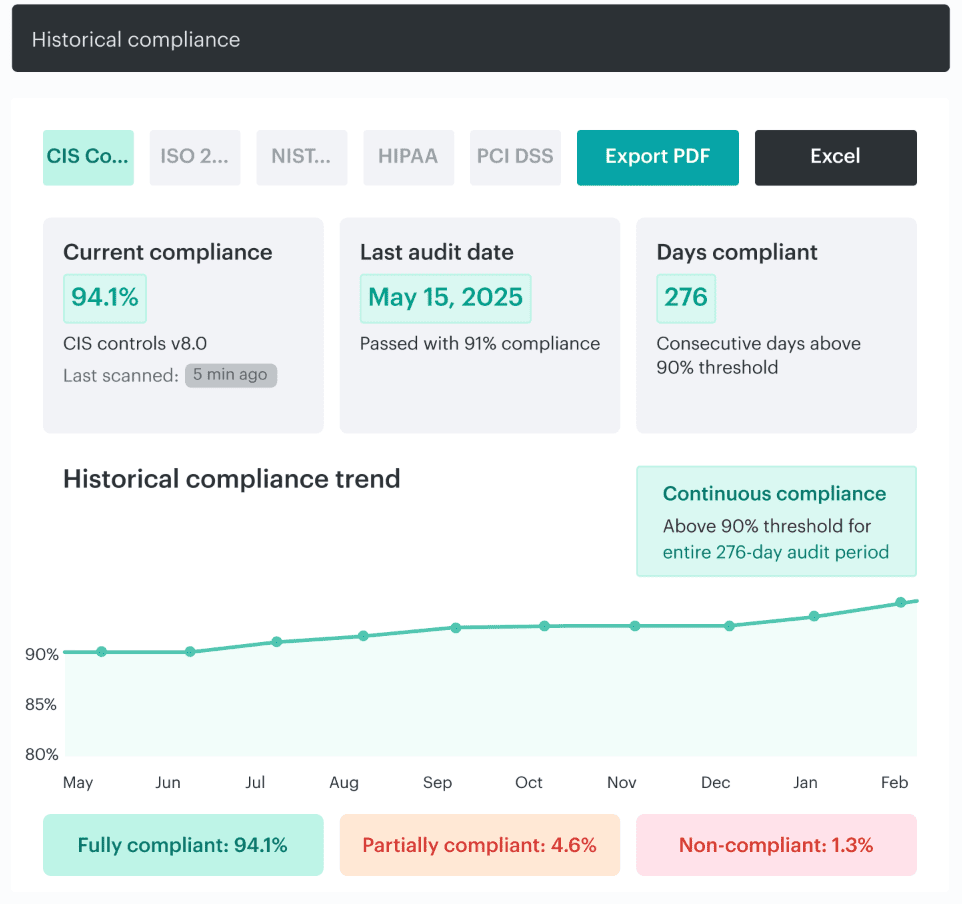
Cloudaware's history provides evidence for cloud security auditors. Schedule a demo to see it live.
A useful report should show one thing fast: how many audit requests can be answered from the same control record.
Track:
- Control ID and control owner
- Mapped citations by framework
- Live evidence sources
- Affected assets and business services
- Open findings
- Exceptions with expiry
- Evidence freshness
- Tickets linked to remediation
- Frameworks already using the same evidence
The failure pattern is easy to spot. Same MFA control, same storage-encryption control, same logging control, five different evidence requests, and five owners arguing over whose spreadsheet is current. Mature teams stop organizing compliance by audit. They organize by operated control. UCF gives the crosswalk.
The CMDB gives the scope. Continuous evidence keeps it from becoming a quarterly archaeology project.
Common mistakes when implementing cloud security compliance standards
Mistake #1: Confusing CSP compliance with customer compliance
A cloud provider’s compliance report is not your compliance report.
AWS, Azure, and GCP can be SOC 2 audited, FedRAMP authorized, and HIPAA-eligible. That proves the provider has been assessed for the services, facilities, processes, and controls they operate. It does not prove your workload is configured correctly on top of that provider.
This is where teams get burned in cloud audits.
They download the CSP attestation, attach it to the evidence folder, and assume the control is covered. Then the auditor asks for customer-side proof: Who has admin access? Is MFA enforced? Are storage buckets public? Are logs enabled and reviewed? Is PHI encrypted? Are vulnerability findings tied to remediation? Was the exception approved? When does it expire?
The provider’s report helps with inherited controls. It does not cover your IAM design, network segmentation, logging pipeline, key policies, backup configuration, change process, or incident response workflow.
In practice, every cloud security compliance standard has a customer-side evidence layer.
- For SOC 2, the auditor reviews how your service operates on AWS, Azure, or GCP.
- For HIPAA, the BAA confirms the relationship. Your PHI safeguards still need evidence.
- For FedRAMP, inherited controls reduce work only when the boundary, responsibility split, and implementation details are documented.
Cloudaware clients usually track this split at the asset level inside the CMDB. Each CI carries provider, account, region, environment, data class, business service, owner, inherited control status, customer-managed controls, and open findings.
| Control area | CSP-side evidence | Customer-side evidence |
|---|---|---|
| Identity | CSP IAM service attestation | MFA status, privileged roles, stale accounts, access reviews |
| Encryption | Managed KMS service documentation | Key policy, rotation, encrypted resources, exception records |
| Logging | Cloud logging service availability | Enabled log sources, SIEM ingestion, review history |
| Network security | CSP infrastructure controls | Security groups, private endpoints, segmentation proof |
| Vulnerability management | Provider patching for managed services | Scanner findings, tickets, SLAs, accepted risk |
The safest operating rule: never mark a control as inherited until you can show what remains on your side.
CSP compliance gives you a starting point. Customer compliance starts where your configuration, evidence, and ownership begin.
Mistake #2: Letting the auditor define the scope
Audit scope is not something you ‘discover’ during kickoff. By then, it is too late.
If your team cannot prove the boundary, the auditor will follow every dependency that could affect the environment. That means identity providers, shared logging, CI/CD, backup systems, support tools, admin jump paths, cloud accounts, network routes, databases, queues, and monitoring services can all get pulled into testing.
- For PCI, define the CDE before assessment starts: systems that store, process, transmit, or can impact cardholder data. Show segmentation. Show connected systems. Show why excluded assets are excluded.
- For ISO 27001, lock the ISMS scope by business service, cloud environment, team, process, geography, and supporting technology. A vague ISMS scope turns surveillance audits into debates.
- For FedRAMP, the system boundary needs asset-level precision: accounts, regions, services, external dependencies, inherited controls, customer-managed controls, and authorization-boundary status.
A useful scope report shows:
| Scope field | What practitioners need before audit |
|---|---|
| In-scope assets | CIs, accounts, regions, apps, databases, clusters, shared services |
| Scope reason | CHD, PHI, federal data, regulated workload, control impact |
| Dependencies | IAM, logging, CI/CD, monitoring, backups, integrations |
| Excluded systems | Rationale, segmentation proof, no regulated data, no control impact |
| Inherited controls | CSP responsibility, managed service coverage, attestation link |
| Open risk | CSPM findings, vulnerabilities, exceptions, overdue remediation |
The expensive audit is not the audit with more requirements. It is the audit where the boundary changes after evidence collection starts.
Mistake #3: Skipping the risk-analysis step
A lot of teams jump straight from framework selection to control implementation. That feels efficient until the auditor asks why a control applies, why an exception was accepted, why one workload is High impact, why another is Moderate, or why PHI in a support export was not included in the risk register.
Risk analysis is not an intro task. It is the logic behind the whole compliance program.
HIPAA puts it directly in §164.308(a)(1)(ii)(A). ISO 27001 builds planning around risk in Clause 6. NIST 800-53 has the RA family. FedRAMP expects risk assessment through RA-3 and carries the output into the SSP, SAR, POA&M, and continuous monitoring process.
Same pattern, different language: identify risk, assess likelihood and impact, assign ownership, decide treatment, document the decision, keep evidence current.
In a hybrid cloud, a useful risk-analysis record needs more than a risk title. It needs the affected assets, data class, business service, exposure path, control gap, owner, treatment decision, compensating control, target date, and audit mapping.
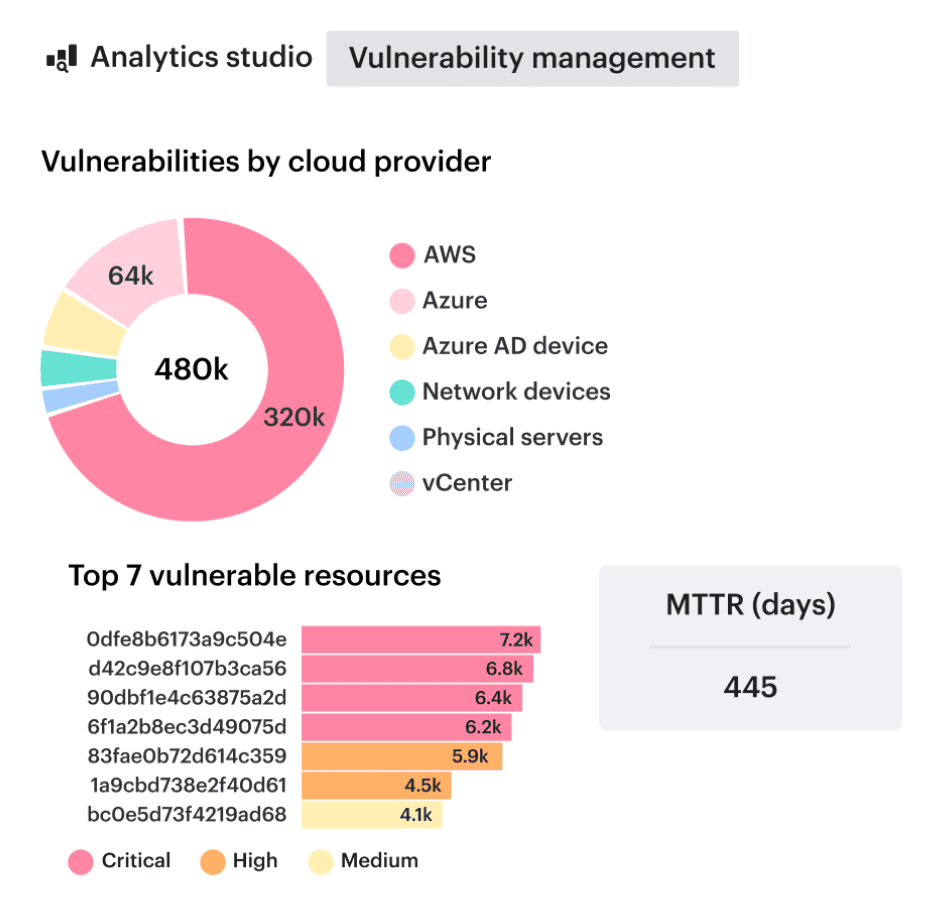
An element of the Cloudaware vulnerabilities report. Schedule a demo to see it live.
| Risk-analysis field | Practitioner-level evidence |
|---|---|
| Affected asset / CI | Cloud account, database, cluster, VM, storage bucket, SaaS integration, on-prem dependency |
| Data class | PHI, PCI, federal data, confidential customer data, production operational data |
| Framework mapping | HIPAA, ISO 27001, NIST 800-53, FedRAMP, SOC 2, PCI DSS |
| Risk source | CSPM finding, vulnerability, SIEM signal, architecture review, audit exception |
| Business impact | Service affected, customer exposure, compliance exposure, operational dependency |
| Treatment decision | Remediate, accept, transfer, avoid, compensate |
| Evidence trail | Ticket, exception approval, compensating control, owner, expiry, review date |
Cloudaware clients usually anchor this in the CMDB, so risk is tied to real infrastructure, not a spreadsheet row. CSPM findings show configuration risk. Vulnerability Management adds an exploitable weakness context. SIEM brings detection evidence. IT Compliance maps the risk back to control citations, so one accepted encryption exception can be reviewed against HIPAA, ISO 27001, NIST 800-53, and FedRAMP without rebuilding the story four times.
The failure pattern is obvious during audit: controls exist, but no one can explain the risk decision behind them. That is when teams look immature, even if the tooling is strong.
Read also: 10 Best Cloud Security Tools in 2026 with Comparison, Pricing, and Honest Reviews
Run one control library across every framework with Cloudaware
Cloud compliance gets expensive when every framework becomes its own mini-program. Cloudaware is built for the cleaner operating model: one control library, mapped to many frameworks, tested continuously, and reported by audit need.
That is why CISOs, cloud security managers, GRC teams, and security architects use it across AWS, Azure, GCP, Kubernetes, VMware, and on-prem environments. They need evidence that stays tied to live infrastructure, not screenshots collected two weeks before the auditor arrives.
Here’s how the modules map to the work:
- IT Compliance is the lead module. It treats compliance-as-code as an operating layer: rule findings have owners, SLAs, evidence, lifecycle, and status. UCF maps controls to 900+ authority documents, including CIS, NIST 800-53, NIST CSF, ISO 27001, ISO 27017, SOC 2, PCI DSS, HIPAA, and FedRAMP. Rules live in YAML / DSL, versioned in Git, and reviewed through PRs.
- CSPM evaluates CMDB-aware policies across cloud and on-prem environments. One policy can be tested continuously and reported against several frameworks at once.
- CMDB gives every framework its substrate: assets, owners, environments, data classes, dependencies, business services, and scope. Without that layer, PCI CDE, ISO ISMS scope, and FedRAMP boundaries turn fuzzy fast.
- SIEM / Conflux produces audit evidence for logging requirements: PCI Req. 10, HIPAA §164.312(b), SOC 2 CC7, ISO A.8.15, and the NIST AU family. Events carry CMDB context, so reviewers can see the affected service, owner, and asset.
- Vulnerability Management supports PCI Req. 6 and 11, HIPAA risk management, and NIST RA / SI controls. It integrates with Tenable, Qualys, Wiz, Nessus, CrowdStrike, and AWS Inspector.
- Intrusion Detection covers file integrity and log inspection evidence for PCI Req. 11.5, HIPAA §164.312(c)(1), and SOC 2 CC6.6.