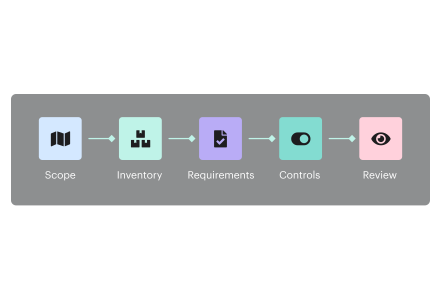
Learning how to create a cloud security policy should start with live scope. Microsoft’s shared responsibility guidance makes the operating boundary clear: as organizations move to the cloud, some responsibilities shift to the provider, but customers still own their data, identities, configurations, and the cloud components they control. The policy has to turn that responsibility into decisions teams can enforce.
Many organizations reverse the sequence. They write policy language first, then try to map it back to AWS accounts, Azure subscriptions, Google Cloud projects, Kubernetes clusters, SaaS systems, owners, controls, and audit evidence. By then, the document already has clauses that sound reasonable but cannot be tested, routed, or defended.
This guide explains how to build the policy as a working control model. We’ll cover scope, ownership, asset context, requirement mapping, enforceable statements, evidence, stakeholder review, and lifecycle management so the final document can survive production reality.
8 steps to create a cloud security policy
The steps to create a cloud security policy should follow the same path the policy will take in production: scope first, evidence last, with ownership and control mapping in between.
Creating a cloud security policy this way keeps the document tied to real assets, technical enforcement, compliance requirements, and audit review instead of letting it become a signed artifact nobody can operate.
- Define policy scope and ownership across cloud providers, accounts, subscriptions, projects, clusters, SaaS platforms, and environments.
- Inventory cloud assets, identities, workloads, data stores, managed devices, and business owners.
- Map business, regulatory, contractual, and internal control requirements.
- Separate policy from standards, procedures, and guidelines so each layer has a clear job.
- Draft enforceable policy statements with scope, owner, evidence expectation, and exception path.
- Map each statement to cloud controls, guardrails, evidence sources, and exception records.
- Review and ratify the policy with Security, Compliance, Legal, HR, Risk, IT, and Engineering.
- Publish, enforce, audit, and revise the policy through a defined policy lifecycle.
But before you start: what the policy must actually produce
A cloud security policy is a decision system for cloud risk: it defines what must be protected, who owns the decision, which controls apply, how exceptions are approved, what evidence proves the control is working, and when the policy must be reviewed. If it only describes intent, it will read well during stakeholder review and fail the first time the audit asks for proof.
Microsoft states that, across cloud deployment types, customers own their data and identities and are responsible for protecting data, identities, on-premises resources, and customer-controlled cloud components. Microsoft also lists customer data, configurations and settings, identities, and users as customer responsibilities across cloud models.
AWS makes a similar distinction between security “of” the cloud, which AWS owns, and security “in” the cloud, where customer responsibility depends on the services selected and the configuration work required.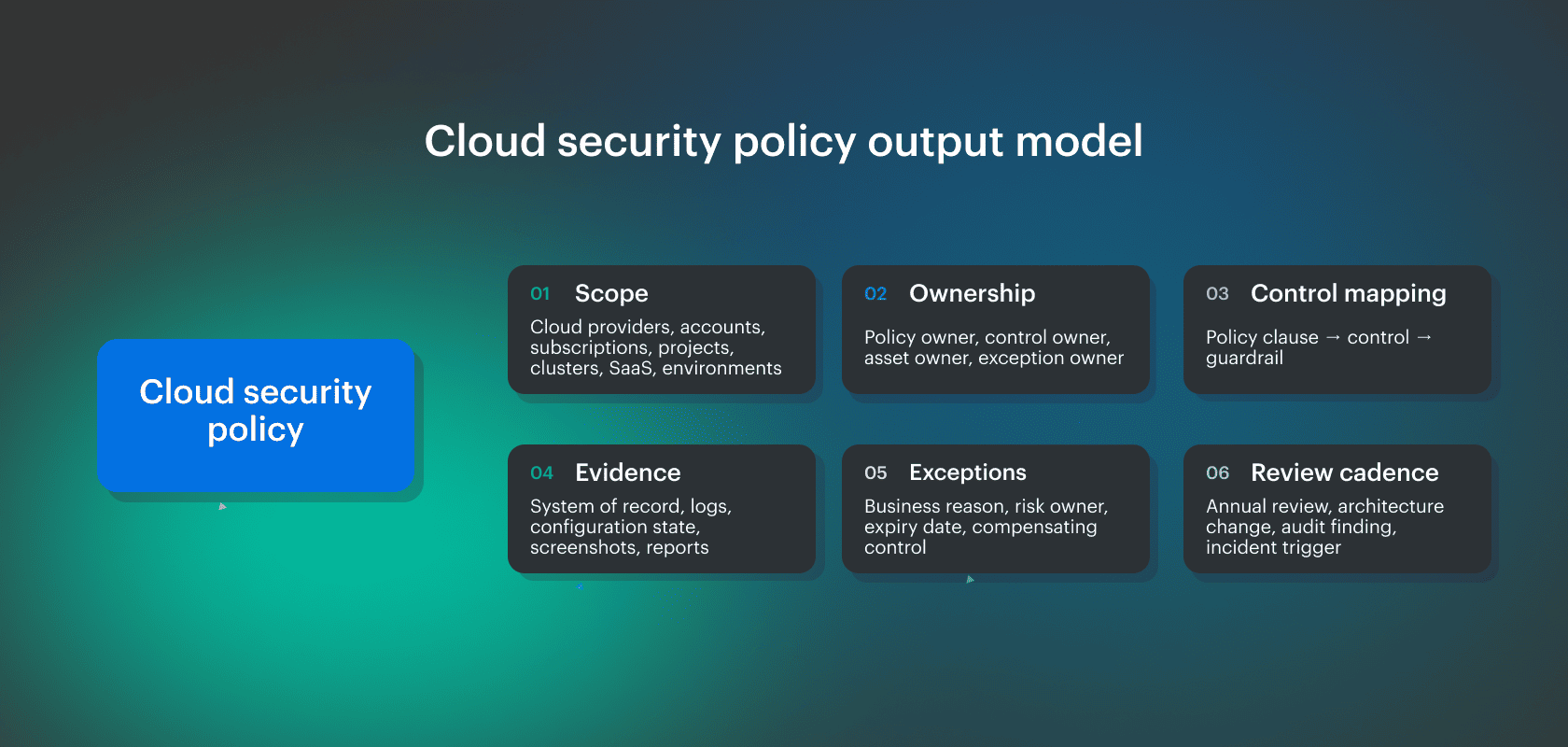 Policy has to produce more than approved language. As a result, you should have:
- A control map that shows which requirements apply to which assets, environments, data classes, identities, and workloads.
- An assigned policy ownership, technical ownership, and exception ownership so approval does not disappear into a shared mailbox, humanity’s most reliable accountability graveyard.
How to create a cloud security policy in 8 steps
Creating the policy is not the same as writing the document. The work starts with scope and ends with enforcement, evidence, and review behavior.
If those outputs are missing, the policy may satisfy a formatting requirement, but it will not help security, compliance, engineering, or audit when something breaks.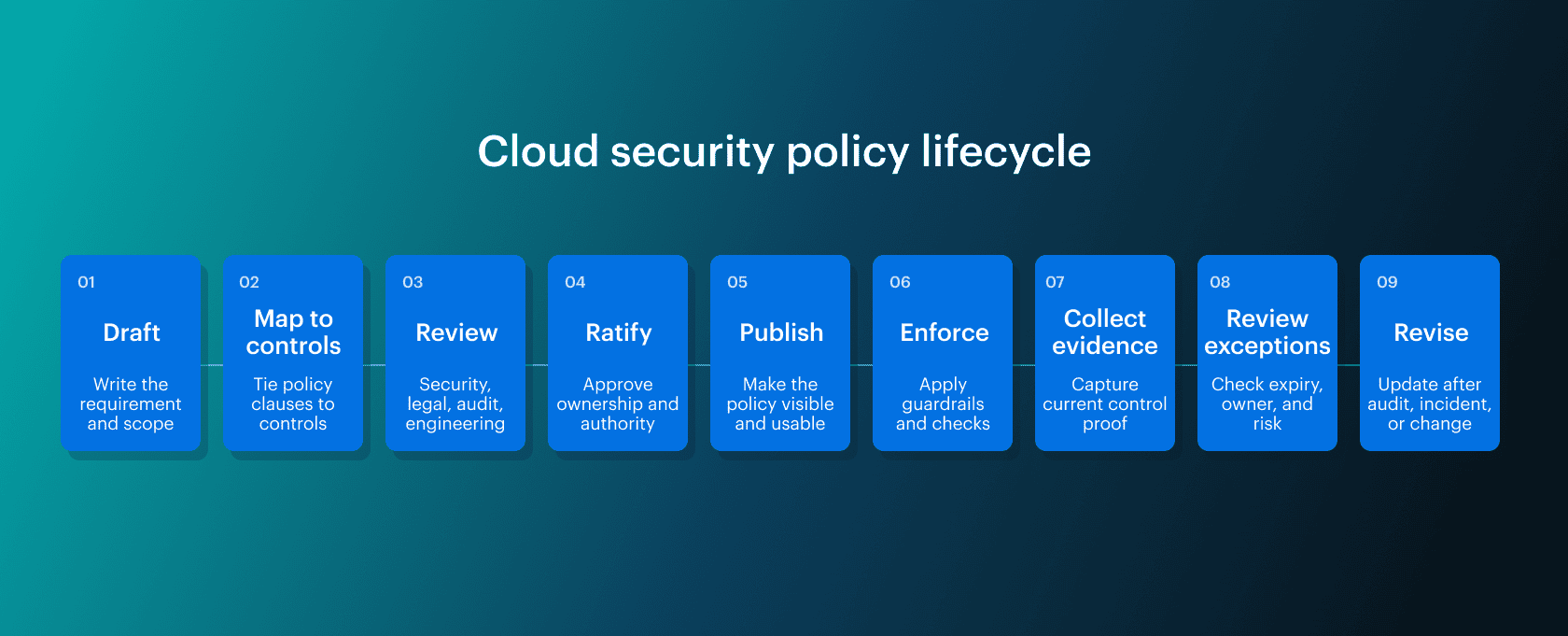 Understand frameworks, translate requirements, build governance playbooks, test in hands-on environments, monitor continuously, align with maturity, and maintain documentation and training.
1. Define scope, cloud environments, and policy owner
Start by defining where the policy applies. In a multi-cloud environment, “cloud” is not a scope. It is a category that hides too much.
Document the environments covered by the policy:
- AWS accounts, Azure subscriptions, and Google Cloud projects
- Kubernetes clusters
- SaaS platforms
- Production, staging, development, and sandbox environments
- Data stores and managed services
- Acquired or third-party managed environments
Separate production from non-production because the same rule rarely has the same risk, evidence requirement, or exception path everywhere. A sandbox used for training, a production payment workload, and an acquired cloud account with unknown ownership should not be treated as one policy surface.
Then assign one accountable policy owner. Not “Security,” not “Cloud team,” and definitely not a shared mailbox where accountability goes to decompose quietly. The owner should make final decisions about scope, stakeholder review, exceptions, and the annual review cycle. Other teams contribute, but one function needs accountability in the RACI.
As Katerina L., Cloud Security Expert at Cloudaware, puts it, “The first policy failure is usually scope. If you cannot say which accounts, clusters, and SaaS environments are covered, you cannot prove whether the policy is working.”
2. Inventory assets, identities, workloads, and data
A policy cannot rely on spreadsheets that are stale before the next procurement cycle. Before drafting requirements, validate the inventory that the policy depends on.
At a minimum, inventory should cover:
- Cloud accounts, subscriptions, and projects
- Compute, storage, databases, and managed services
- Kubernetes clusters and workloads
- Identities, roles, and privileged accounts
- Managed devices
- SaaS systems
- Third-party managed environments
For example, a public storage bucket in a dev account, a production database with regulated data, and a forgotten test VM from an acquisition may all appear as “cloud assets.” They should not follow the same review path.
Igor K., DevOps Engineer at Cloudaware, “A policy should attach to the live cloud inventory and ownership context. And definitely include the tagging strategy in the policy scope because owner, application, environment, and data classification tags are often the only practical way to route findings before shadow IT becomes invisible risk.”
3. Map business, legal, regulatory, and contractual requirements
The policy should reflect what the business must prove to customers, auditors, regulators, board, executive stakeholders, and so on.
Use frameworks as mapping inputs:
- NIST CSF 2.0 can help structure governance, protection, detection, response, and recovery.
- NIST SP 800-53 gives detailed control families for regulated environments.
- ISO/IEC 27001 supports management-system governance.
- ISO/IEC 27017 and ISO/IEC 27018 add cloud-specific and privacy-specific guidance.
- CIS Controls v8 and CIS Benchmarks help turn broad requirements into technical baselines.
- CSA CCM 4.0 is useful for cloud control mapping.
- PCI DSS 4.0, HIPAA Security Rule, GDPR Article 32, SOC 2 TSC, FedRAMP, and DORA apply depending on industry, geography, workload, and customer commitments.
Valentin K., Software Developer at Cloudaware, “Understand standards and frameworks first, then translate compliance into technical policies and configurations. For example, enforcing HTTPS-only for Azure Storage Accounts, requiring encryption at rest across cloud providers, and applying technical policies through Azure Policy, GCP organization policies, or AWS policy mechanisms.”
4. Separate policy from standards, procedures, and guidelines
Most cloud security documents become unusable because they mix four distinct layers into one file. You should keep hierarchy because each audience needs something different. If all four layers are mashed together, nobody gets what they need.
| Layer | What it does | Example |
|---|---|---|
| Policy | States what must be true | Production cloud workloads must use approved identity, encryption, logging, and ownership controls. |
| Standard | Defines the minimum required rule or configuration | Sensitive data must use AES-256 at rest and TLS 1.2 or 1.3 in transit. |
| Procedure | Explains how to execute the requirement | How to request an exception, rotate a key, onboard a cloud account, or review privileged access. |
| Guideline | Gives recommended practice where teams need flexibility | Preferred tagging patterns, naming conventions, or design options for lower-risk workloads. |
5. Draft enforceable policy statements
This is where how to write a policy becomes practical. A good statement is specific enough to test and broad enough to survive platform changes.
Avoid language like: “Cloud systems must follow security best practices.” That sentence creates no owner, no control, no evidence source, and no enforcement path.
A stronger version: “All production cloud workloads must have an assigned business owner, environment tag, data classification, and logging destination before deployment.” This version defines scope, required conditions, and an operational gate.
Use the same approach for identity, data, logging, encryption, vulnerability handling, and acceptable use.
- For least-privilege access, define who can approve privileged roles, how often access is reviewed, and what proves the review happened.
- For encryption, define where it applies, which standard is required, who owns key management, and where evidence is collected.
- For logging, define required sources, retention, alert routing, and review cadence.
As Katerina L., Cloud Security Expert at Cloudaware, says, “A policy statement should be written so an engineer can turn it into a check. If the sentence cannot become a control, it is probably not ready for approval.”
6. Translate each statement into controls, evidence, and exceptions
Every major policy statement needs a control path before the policy is approved. Otherwise, the document is asking engineering and audit to solve the hard part later. Very generous of it.
For each statement, define:
- Technical control
- Enforcement method
- Evidence source
- Responsible owner
- Exception process
- Review cadence
Here are some examples:
| Policy statement | Control path |
|---|---|
| VMs must not be deployed in unapproved regions | Enforce through Terraform, Bicep, Azure Policy, organization policies, or CI/CD checks. |
| Privileged accounts must use MFA | Enforce through identity policy and verify through access review evidence. |
| Administrator access must be monitored | Alert through Microsoft Defender for Cloud, AWS GuardDuty, Google Security Command Center, or a centralized detection workflow. |
| Sensitive data must be encrypted | Validate encryption state and key ownership through configuration evidence. |
Mikhail M., General Manager at Cloudaware, “Compliance requirements need to become technical policies, sandbox testing helps validate those policies, and monitoring should alert responsible teams when privileged access appears expected or unexpected. Policy statements should connect to live asset context, violations, owners, tickets, exceptions, and evidence. If a clause cannot be tied to the assets in scope and the people responsible, it will be hard to enforce and harder to defend in an audit.”
7. Review with Legal, HR, Engineering, Compliance, Risk, and IT
This review should produce decisions, so track required changes, unresolved risks, approved exceptions, and owners. If a team objects to a control, require a technical reason, a business impact statement, and an alternative control or compensating measure.
| Reviewer | What they validate |
|---|---|
| Legal | Enforceability and contractual alignment |
| HR | Employee-facing rules such as acceptable use, BYOD, managed devices, and disciplinary implications |
| Engineering | Whether controls can work across AWS, Azure, Google Cloud, Kubernetes, and SaaS |
| Compliance | Mapping to control objectives and audit expectations |
| Risk | Which exceptions require formal acceptance |
| IT | Operational handoff, support ownership, and documentation |
8. Publish, enforce, audit, and revise
Once ratified, publish the policy in a controlled location where teams can find the current version, owner, effective date, review cadence, exception process, and related standards or procedures.
Communicate it through onboarding, change management, engineering enablement, and compliance workflows. A policy nobody sees is technically published, in the same way a server under someone’s desk is technically infrastructure.
Enforcement should happen through guardrails wherever possible:
- Identity controls
- Deployment checks
- Tagging requirements
- Encryption policies
- Logging baselines
- Policy-as-code rules
- Continuous compliance checks
Katerina L., Cloud Security Expert at Cloudaware, “Define the policy lifecycle before the first annual review arrives. Review the policy at least once a year and earlier after major changes, such as a new provider, acquisition, regulated workload, incident, audit finding, data residency requirement, or identity architecture change.”
Read also: 10 Cloud Data Security Challenges That Slow Down Multi-Cloud Programs
How to use RACI to keep policy creation accountable
Policy ownership gets messy when cloud security decisions cross teams, tools, and workflows. Palo Alto Networks’ 2025 cloud security research, based on input from more than 2,800 security leaders, points to the cost of misalignment across those exact areas.
A policy clause may need Security to define intent, Engineering to validate enforcement, Compliance to map controls, Legal to check obligations, Risk to approve exceptions, and IT Operations to support handoff. That many handoffs create ambiguity unless each decision has one accountable owner.
This is where a RACI helps during policy creation and without that structure, the policy can look approved while implementation remains scattered across Slack threads, tickets, and heroic assumptions.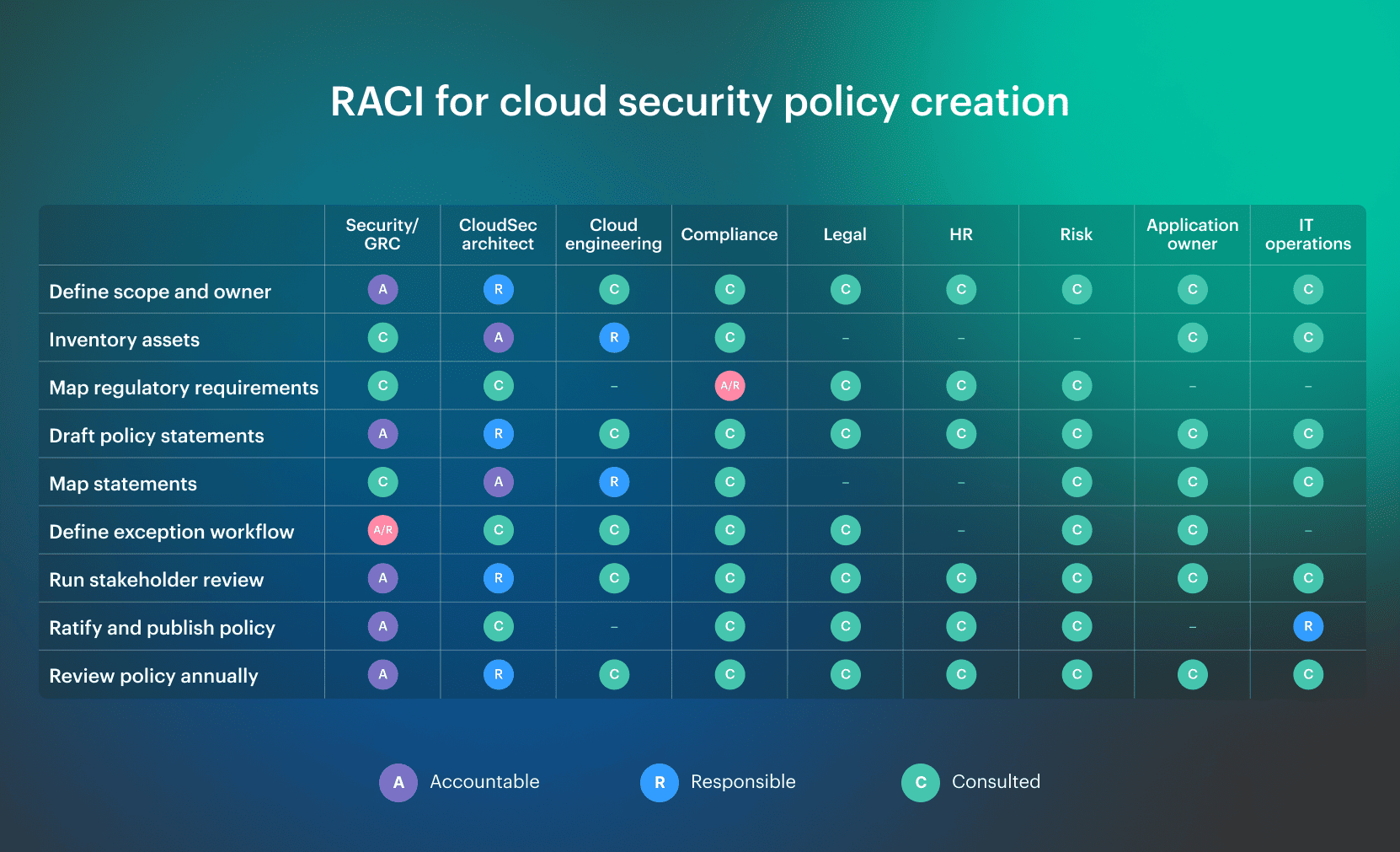 A RACI is not a cloud security standard by itself, and there is no universal role matrix that fits every organization. The table is a starting point for assigning policy ownership, stakeholder review, risk acceptance, and implementation responsibility. Adjust it to your reporting lines, regulatory exposure, and cloud operating model.
Read also: NIST Cloud Security - A Practical Guide to the Framework, Controls, and Audit Readiness
Mapping policy clauses to controls and evidence before approval
Do not approve a policy clause until it can be tested. A statement such as “cloud workloads must be secure” gives Legal something to approve and gives engineering almost nothing to implement.
Before ratification, each major clause should answer 6 questions:
- What system enforces this?
- What data proves it?
- Who receives violations?
- What exception process exists?
- How often is evidence refreshed?
- What happens when drift appears?
Katerina L., Cloud Security Expert at Cloudaware, “Control mapping is where policy language becomes something engineering and audit can both use. Compliance requirements need to be translated into technical policies, tested in real environments, and monitored continuously so responsible teams can act when access, configuration, or compliance state changes.”
The table below is a working example of clause-to-control mapping. It is not a universal standard, but it shows the level of traceability a policy should have before it is approved.
| Policy clause | Mapping details |
|---|---|
| All production storage must be encrypted at rest and in transit | Control: encryption policy or configuration check Evidence: encryption status, key ownership, TLS configuration Owner: cloud platform team Exception path: approved exception with expiry and compensating control |
| All internet-facing assets must have an owner | Control: asset inventory plus exposure check Evidence: owner, application, environment, and exposure metadata Owner: application owner Exception path: risk approval with review date |
| All privileged access must use MFA | Control: IAM policy and access review Evidence: identity control evidence, privileged-role review Owner: IAM team Exception path: emergency access process |
| VMs must not be deployed in unapproved regions | Control: policy as code, CI/CD check, or cloud-native guardrail Evidence: deployment policy result and drift report Owner: cloud engineering Exception path: business exception with region and expiry |
| Logging must be enabled for production workloads | Control: logging baseline and monitoring rule Evidence: log source coverage, retention status, alert route Owner: IT operations or security operations Exception path: temporary exception with remediation plan |
Read also: What Is Cloud Security Posture Management? CSPM Definition, Tools, and Enterprise Use Cases
Building a stakeholder review workflow that catches failure before audit
A policy should not move from draft to approval in one review round. Mikhail M., General Manager at Cloudaware, shared a practical point that matters here: stakeholder review should expose operational failure before the audit does. The goal is to verify that the policy can be enforced, accepted, evidenced, and maintained.
Technical review checks whether the policy can be enforced
Cloud engineering and platform teams should review every major requirement before approval. Their job is to confirm whether the policy can become a working control in real cloud environments.
They should check whether each requirement can be enforced through:
- Guardrails
- Policy as code
- Deployment checks
- Identity rules
- Logging baselines
- Configuration controls
A clause that works for one AWS account may fail across Azure subscriptions, Google Cloud projects, Kubernetes clusters, SaaS tools, or acquired environments. Technical review also checks shared responsibility assumptions: what the provider handles, what the customer owns, and where the organization needs a compensating process.
Legal, HR, and Compliance review enforceability and obligations
Legal, HR, and Compliance should not review the same thing from three different inboxes and call it alignment. Each team has a different job.
| Reviewer | What they check |
|---|---|
| Legal | Contractual language, regulatory exposure, customer commitments |
| HR | Acceptable use, BYOD policy, managed-device rules, employee-facing obligations |
| Compliance | Control objectives, audit criteria, data subject rights, evidence expectations |
This review should remove vague language before policy ratification. “Users must handle data securely” is not enough.
A better clause says: “Employees must store regulated data only in approved cloud services with access logging and retention controls.” That gives teams something they can govern.
Risk review decides what exceptions are tolerable
Risk review should decide which gaps need formal acceptance, which must be fixed, and which cannot be approved. This is where the exception register matters.
Each exception should include:
- Business reason
- Risk owner
- Expiry date
- Compensating control
- Review cadence
Application owners can explain operational impact, but Risk and Security/GRC should decide whether the organization can tolerate the exposure. Without this step, exceptions become private agreements between busy teams, which is a charming way to manufacture audit findings.
Read also: Cloud Security Automation. The Practical Framework for Multi-Cloud Teams
Adding a policy lifecycle that keeps the document alive
The policy should have a lifecycle before it is published. Otherwise, the document becomes stale as soon as the environment changes. A new cloud provider, acquisition, regulated workload, identity model, data residency requirement, incident, or audit finding can make yesterday’s approved language incomplete.
Each stage should have a clear output:
| Lifecycle stage | What should happen |
|---|---|
| Draft | Write policy statements against defined scope, owners, requirements, and asset context. |
| Review | Validate the policy with Engineering, Legal, HR, Compliance, Risk, IT, and application owners. |
| Ratify | Approve the official version, owner, effective date, exception path, and review cadence. |
| Publish | Store the policy in a controlled location and communicate it to affected teams. |
| Enforce | Translate the policy into guardrails, policy-as-code rules, configuration checks, and monitoring. |
| Audit | Collect evidence from systems of record and review exceptions, violations, and drift. |
| Revise | Update the policy after material changes or at the scheduled annual review. |
This is also where continuous compliance matters. A policy lifecycle should not wait for audit season to discover drift.
If a storage service loses encryption, a privileged role bypasses MFA, a workload appears in an unapproved region, or an internet-facing asset has no owner, the policy needs a route from detection to remediation. The document should define who receives the violation, what evidence is collected, when an exception is allowed, and when the policy itself needs revision.
Read also: 10 Azure Cloud Security Best Practices for 2026
Common cloud policy clauses that fail in audit
Most cloud policy failures are not caused by obviously bad clauses. They happen when the clause sounds reasonable but cannot prove scope, ownership, enforcement, or evidence. Mikhail M., General Manager at Cloudaware, shared the same pattern from implementation work: audit pressure usually exposes the gap between what the policy says and what the environment can actually show.
Practitioner discussions show the same failure modes. In one DevOps thread, engineers pointed to misunderstanding cloud platforms, manual provisioning, weak guardrails, and the “not my problem” attitude as common reasons cloud configurations become insecure.
In a cloud security architecture thread, practitioners also pushed back on vague answers and recommended starting from standards such as NIST, ISO, CSA CCM, and CIS, then mapping controls to risk, business requirements, metrics, logging, access, encryption, and incident response.
Use the table below as an audit-failure and testability checklist:
| Policy clause | Why it fails in audit | Better version |
|---|---|---|
| All cloud assets must be inventoried. | The inventory exists, but owner metadata is missing. Accounts are stale. Kubernetes clusters are unmanaged. | Require owner, environment, application, data classification, source system, and review cadence for every in-scope asset. |
| Privileged access must be restricted. | MFA may exist, but there is no evidence of role review. Admin accounts remain active after team changes. Break-glass access is undocumented or untested. | Require MFA, role-based access, quarterly privileged-access review, emergency access logging, and evidence retention. |
| Data must be encrypted. | Encryption is enabled somewhere, but the clause does not define scope, key ownership, rotation process, or where evidence comes from. | Define encryption at rest and in transit, key management owner, KMS process, rotation expectations, and evidence source. |
| Logging must be enabled. | Logs exist, but they are fragmented, retained inconsistently, or not tied to detection workflows. Audit sees activity records, but not operational monitoring. | Define required log sources, retention, monitoring owner, alert route, and review process for production workloads. |
| Exceptions must be approved. | Exceptions are approved in email or tickets with no expiry date, risk owner, or compensating control. They silently become permanent. Lovely little audit traps. | Require business justification, risk owner, expiry date, compensating control, approval status, and scheduled review. |
Mikhail M., General Manager at Cloudaware, “A stronger policy clause does 4 things: it defines the control, names the owner, states the evidence source, and explains how exceptions expire. Without those 4 fields, the clause may still sound audit-ready, but it will collapse during evidence collection.”
Read also: 9 AWS Cloud Security Best Practices That Pay Off
Standards to consider when creating the policy
A framework can tell you what kind of outcome the organization needs, but your policy still has to translate that outcome into business scope. NIST itself describes the Cybersecurity Framework as flexible guidance that organizations should adapt to their own risks, requirements, and business objectives, not as a one-size-fits-all checklist.
Simple workflow to use before creating a policy:
- Identify which standards apply because of industry, geography, customer contracts, or internal risk requirements.
- Extract the requirements that affect cloud systems, identities, data, logging, resilience, and third-party services.
- Map each requirement to the cloud scope: providers, accounts, workloads, data classes, SaaS systems, and environments.
- Assign a control owner and an evidence source.
- Define how often the control is reviewed and what triggers an exception or policy update.
For example, “protect regulated data” is not policy-ready language. It has to become decisions about data classification, encryption, key ownership, logging, access review, data residency, and exception handling.
The table below is not a full compliance map, but it shows when each standard or framework is worth considering while creating the policy.
| Category | Standard / framework | When to consider it |
|---|---|---|
| NIST | NIST CSF 2.0 | Use it when you need a governance structure for identifying, protecting, detecting, responding, recovering, and governing cyber risk. |
| NIST | NIST SP 800-53 | Use it for regulated, federal-adjacent, or control-heavy environments that need detailed security and privacy control families. |
| ISO | ISO/IEC 27001 | Use it when the policy must align with an ISMS, risk treatment process, control ownership, and formal review behavior. |
| ISO | ISO/IEC 27017 | Use it when the policy needs cloud-specific security guidance for cloud service customers and providers. |
| ISO | ISO/IEC 27018 | Use it when public cloud systems process personally identifiable information and privacy controls need explicit treatment. |
| CIS | CIS Controls v8 | Use it when you need practical safeguards that can translate into cloud control areas and operational security priorities. |
| CIS | CIS Benchmarks | Use it when the policy needs technical configuration baselines for cloud services, operating systems, containers, or platforms. |
| CSA | CSA CCM 4.0 | Use it when you need cloud control mapping across domains. CSA describes CCM as a cloud cybersecurity control framework with 197 control objectives across 17 domains. |
| PCI | PCI DSS 4.0 | Use it when cloud workloads store, process, or transmit payment card data. |
| HIPAA | HIPAA Security Rule | Use it when cloud systems handle electronic protected health information. |
| SOC | SOC 2 TSC | Use it when customer trust reporting depends on controls for Security, Availability, Confidentiality, Processing Integrity, or Privacy. |
| FedRAMP | FedRAMP | Use it when cloud services support U.S. federal agencies or federal authorization expectations. |
| DORA | Digital Operational Resilience Act | Use it for EU financial entities and ICT risk requirements. DORA applies as of January 17, 2025. |
The standards to consider always depend on what the organization must prove. For example:
- A healthcare SaaS platform may need HIPAA, SOC 2, ISO 27001, and cloud-specific controls.
- A fintech with payment data may need PCI DSS, SOC 2, DORA, and stronger third-party risk language.
- A federal cloud service may need FedRAMP and NIST SP 800-53.
The policy should not list every framework to look mature. It should show which requirements apply, where they apply, who owns them, and what evidence proves the control is working.
Read also: Cloud Security Frameworks: 7 Top Standards Compared (2026)
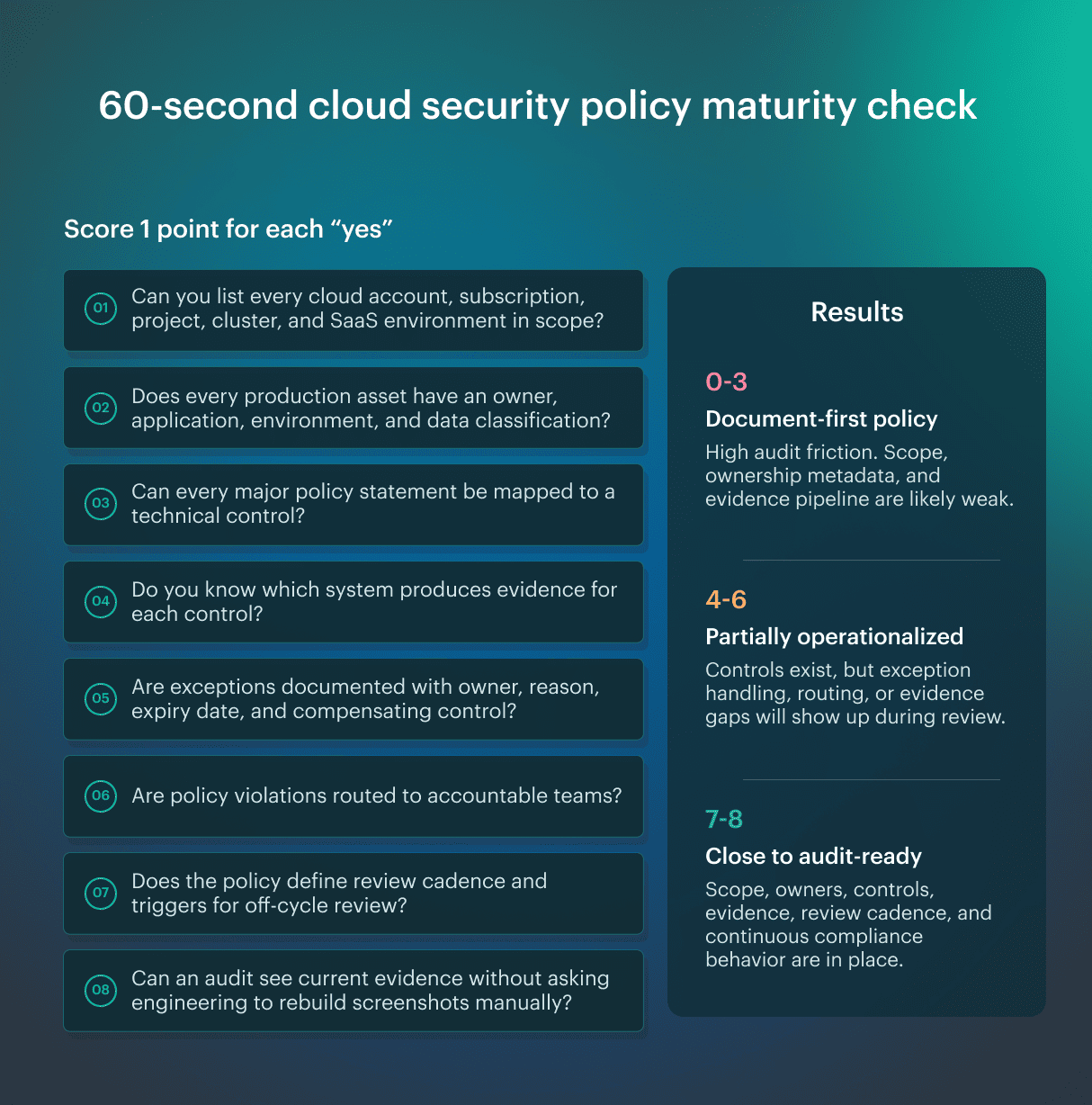
60-second maturity self-check
This check is grounded in a common industry problem: A 2025 Tenable and Cloud Security Alliance survey found in 2025 that 82% of organizations operate hybrid environments and 63% use more than one cloud provider, creating fragmented infrastructure and security blind spots. The same report also found that 59% cite insecure identities and risky permissions as top risks.
Use this quick check before you treat the policy as ready. The point is not to score governance maturity in full, but to see whether the policy can survive basic enforcement and audit pressure.