


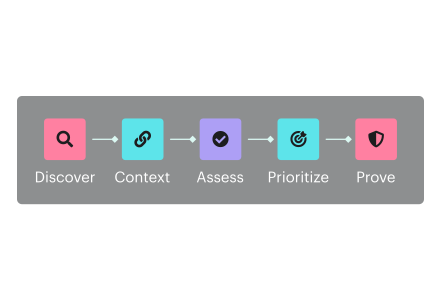
How does cloud security posture management work? A CSPM system watches cloud configuration drift, maps assets into one model, runs cloud configuration assessment through a policy engine, adds owner and risk context, drives cloud risk prioritization, pushes the remediation workflow, validates the fix, and keeps the evidence trail.
That sounds tidy. In real cloud estates, it is not.
A dev bucket goes public. A service account keeps admin reach after a test. Logging breaks in one region. Cloud misconfiguration detection catches the event; context decides whether anyone should panic. Verizon’s 2026 Data Breach Investigations Report found that vulnerability exploitation started 31% of breaches, surpassing stolen credentials as an initial access path.
This article pulls from Cloudaware experts Valentin Kel, Igor K., Katherine Lichkina and client patterns across CISOs, DevSecOps, cloud security, and compliance teams.
We’ll trace:
- What changed?
- Which finding matters?
- Who owns the fix?
- Can you prove posture improvement?
Key insights
CSPM is a cloud posture control loop, not a prettier assessment report. A working CSPM workflow discovers assets, normalizes cloud data, runs policy checks, adds risk context, routes fixes, validates remediation, and keeps proof for dashboards, audits, and posture trend reporting.
- Live cloud beats the quarterly review. New accounts, regions, clusters, and “temporary” resources change posture before the next audit meeting notices.
- No inventory, no posture. Asset discovery pulls configuration data across AWS, Azure, GCP, Kubernetes, VMware, and hybrid environments, then shows what actually exists.
- Normalization decides whether the data is useful. One asset may appear as a resource ID, tag, namespace, service, owner, and CMDB record. CSPM has to connect those pieces before risk scoring is useful.
- Policy checks need context. The same failed encryption control means different work on a dev VM, a production database, and a PCI-scoped payment service.
- Risk prioritization starts after enrichment. Owner mapping, app context, exposure, framework scope, exception state, and remediation history show which failed checks matter now.
- This is how CSPM helps with cloud security: findings move to the team that owns the fix, with the asset story, ticket, SLA, and evidence attached.
- This is how CSPM improves cloud security posture: criticals go down, MTTR shrinks, reopened controls drop, exceptions stop aging out, and remediation evidence proves the fix held.
What is cloud security posture management?
Cloud security posture management is the continuous assessment of cloud environments against security, compliance, and governance expectations. A CSPM system detects risky configurations across cloud infrastructure: public storage, exposed databases, open security groups, disabled logging, missing encryption, over-permissive IAM, missing backups, risky Kubernetes settings, unapproved public endpoints, and failed controls.
That is the short cloud security posture management overview.
The useful version starts when the finding lands.
A failed check that reads “S3 bucket is public” is not enough. Security still needs to know:
| Raw CSPM alert | What practitioners actually need |
|---|---|
| Public storage detected | Is it production? |
| Failed encryption check | What data sits there? |
| Open security group | Is it internet-facing? |
| Weak IAM setting | Which app depends on it? |
| Compliance control failed | Which framework and owner are affected? |
That is where asset context changes the value of cloud misconfiguration detection. The same failed check can be noise in a dev sandbox or a board-level risk in a regulated production app.
Microsoft Defender for Cloud describes CSPM around visibility, recommendations, secure score, and standards-based assessment across cloud environments. NIST SP 800-53 also treats security controls as part of organizational risk management, not isolated technical checks.
A mature CSPM view should not make the analyst rebuild the asset story from tags, tickets, and tribal memory. In Cloudaware, the failed check is tied to the application, owner, environment, business service, compliance scope, ticket, and exception state behind the cloud resource. That is the difference between “public bucket found” and “billing app exposure with a named owner and no approved exception.”
Thus, CSPM is a closed loop: cloud assets feed into an inventory layer, the system evaluates them against policies and frameworks, findings are enriched with risk and ownership context, remediation is routed, and fixes are validated for reporting and audit evidence.
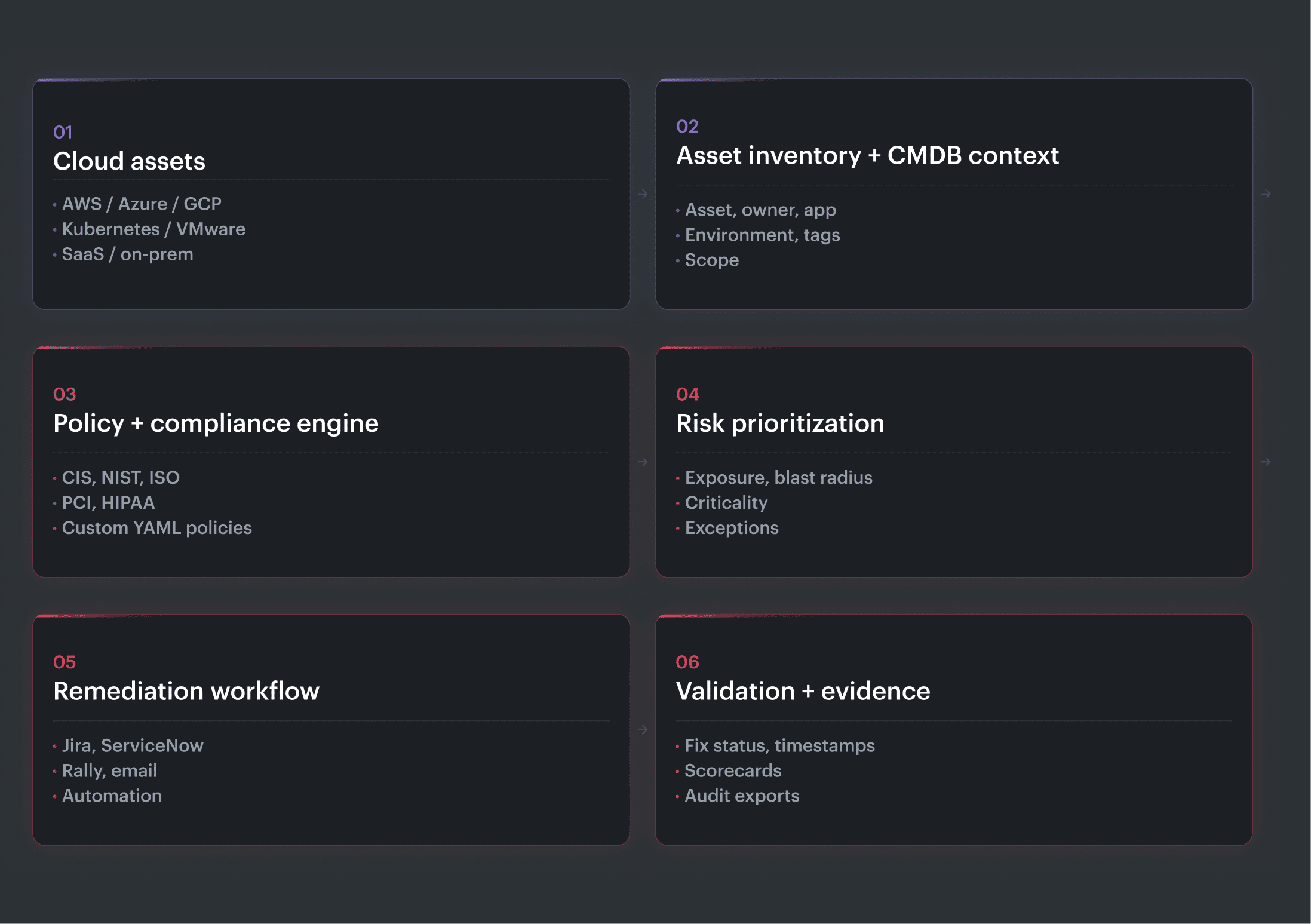
Cloud security posture management diagram
How does cloud security management function within the system?
How does cloud security posture management work once the platform is connected? A CSPM system takes cloud metadata, builds a normalized asset model, runs cloud configuration assessment through a policy engine, adds risk context, routes remediation, validates the fix, and keeps evidence.
That is the clean CSPM workflow.
In real environments, cloud security posture management becomes challenging quickly. Tags are missing. Owners are stale. A test database becomes production-adjacent. One Kubernetes cluster talks to three cloud accounts. The finding is rarely the hard part. The real part is knowing what it belongs to, whether it matters, and who can close it.
1. First, the system builds a live map of cloud assets
A CSPM system starts with cloud asset discovery. It continuously pulls cloud configuration data and cloud metadata from connected environments, then builds an asset inventory that shows what exists, where it runs, and how it is exposed.
That inventory usually covers:
| Layer | What the system maps |
|---|---|
| Cloud scope | Cloud accounts, subscriptions, projects, regions |
| Compute | VMs, serverless functions, load balancers |
| Data | Storage buckets, databases, backups |
| Identity | IAM users, roles, service accounts, permissions |
| Network | VPCs/VNets, firewalls, security groups, public endpoints |
| Kubernetes | Clusters, namespaces, workloads, container registries |
| Hybrid/SaaS | Hybrid assets and SaaS resources, where supported |
A basic cloud security posture management overview would stop at “asset inventory.” Practitioners know better.
Inventory without context becomes another spreadsheet with fresher timestamps.
In Cloudaware, asset data can sit next to CMDB records, so a cloud resource is not just i-082... or prod-bucket-3. It can carry the application, owner, environment, business service, and support team with it. That matters because the next failed check already has a route to remediation instead of becoming another Slack archaeology project.
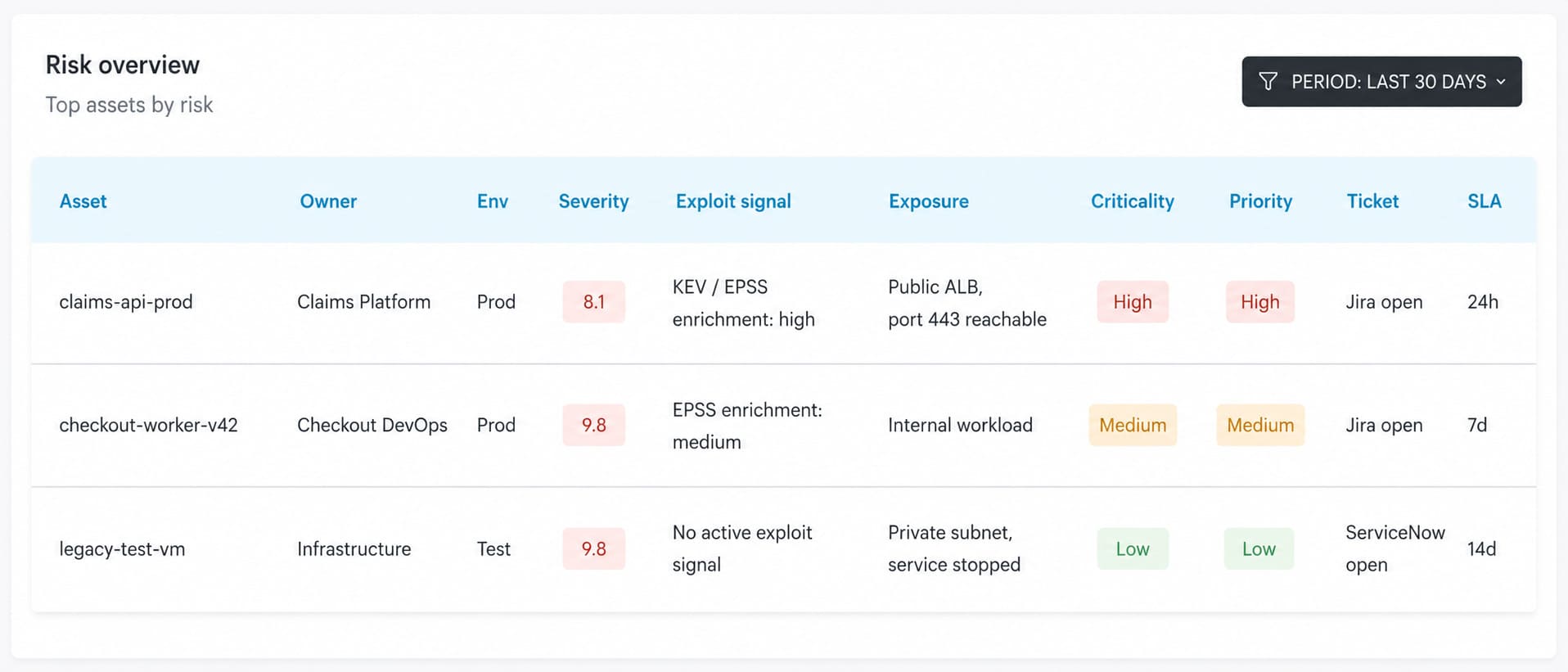
That is how multi-cloud inventory turns into hybrid cloud visibility that security teams can actually use.
2. Then it turns scattered cloud data into one posture model
Asset discovery gives the CSPM system raw inventory. Normalization makes it usable.
AWS, Azure, GCP, Kubernetes, and VMware do not describe infrastructure the same way. A role, subnet, project, namespace, subscription, cluster, and tag can all point to the same business risk, but they arrive as different objects with different logic.
So the CSPM workflow has to turn scattered records into a normalized inventory before policy checks mean anything.
At this layer, the system resolves the following:
- Asset type: bucket, VM, database, role, endpoint, cluster, workload.
- Location: account, subscription, project, region, namespace.
- Environment: dev, test, staging, production.
- Ownership: app owner, service owner, support team, escalation path.
- Exposure: public, private, internal, internet-facing.
- Compliance scope: PCI, HIPAA, SOC 2, ISO, internal controls.
- Exception state: approved, expired, missing, out of scope.
- Risk links: open vulnerability, excessive permission, exposed path.
Here is the pattern security teams recognize fast: the same failed check can mean three different things.
A public endpoint in a sandbox may be cleanup.
A public endpoint tied to a production billing service becomes urgent.
A public endpoint with no owner, no exception, and an exploitable package becomes today’s problem.
That is where cloud security posture stops being a flat list of findings.
In a CMDB-aware CSPM setup, the finding already carries the asset story with it. In Cloudaware, the failed check can be tied to the configuration item, business application, owner, environment, compliance scope, policy context, ticket, and exception state behind the resource.
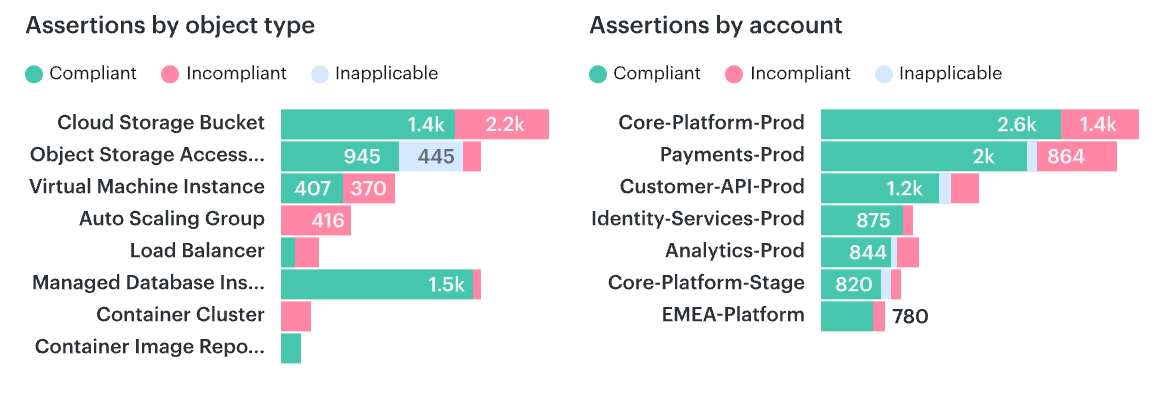
No analyst has to rebuild the chain from tags, Slack threads, and half-stale spreadsheets before deciding what happens next.
Valentin Kel, Cloudaware DevOps Engineer:
3. The policy engine asks: “Is this asset configured the way it should be?”
Once the asset is normalized, the policy engine can judge it properly.
It runs CSPM policy checks against the current configuration: encryption, exposure, identity, logging, backups, network access, Kubernetes posture, monitoring coverage, and workload-specific guardrails.
Context decides the baseline.
A public endpoint in dev may trigger a cleanup. The same exposure on a PCI-scoped payment service should move higher. A missing backup on a test VM is annoying. Missing backups on a production database with customer data is a control failure.
Typical cloud configuration assessments cover the following:
| Control area | What gets checked |
|---|---|
| Storage | Encryption, public access, backup status |
| Databases | Exposure, encryption, logging, retention |
| IAM | Excessive permissions, stale roles, risky service accounts |
| Network | Open ports, security group rules, public endpoints |
| Kubernetes | Privileged containers, namespace exposure, workload permissions |
| Monitoring | Disabled logs, missing agents, broken alert coverage |
| Regulated workloads | PCI DSS, HIPAA, SOC 2, ISO 27001, internal guardrails |
Framework mapping is where the finding becomes useful outside security.
CIS gives benchmark checks. NIST provides a control structure. PCI DSS, HIPAA safeguards, ISO 27001, and SOC 2 turn a cloud setting into audit scope. A mature CSPM system should show not only which cloud security controls failed but also which framework, asset, owner, exception, and remediation record are attached to that failure.
In Cloudaware reports, this is usually represented as more than a pass/fail check. Teams can see the failed policy next to the configuration item, framework mapping, business application, owner, environment, ticket, exception state, and evidence trail.
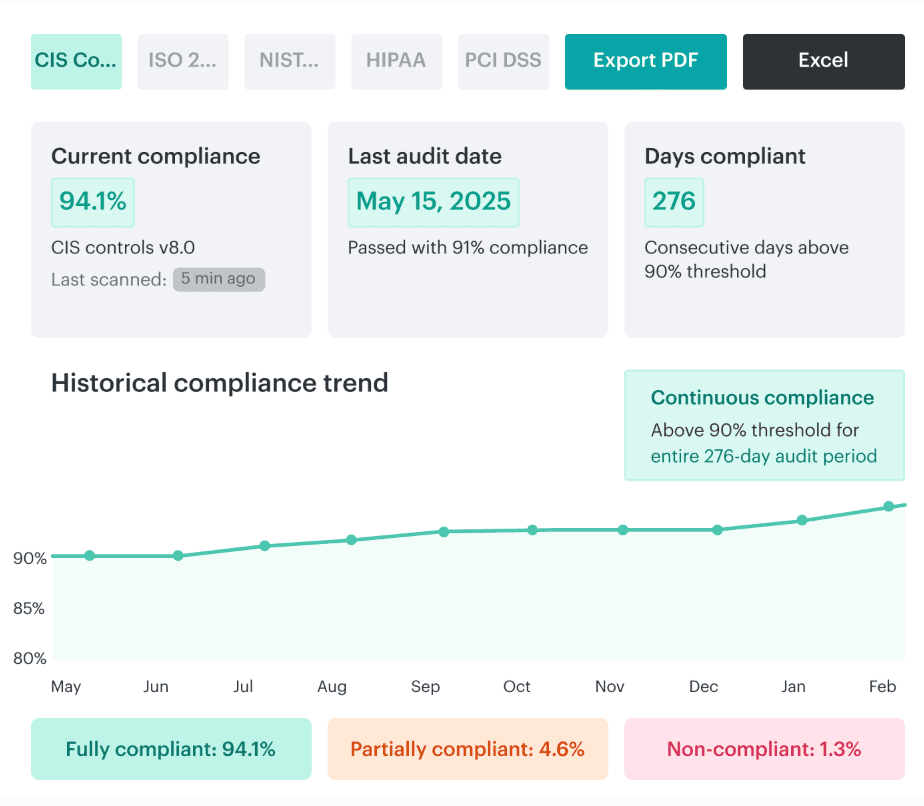
Custom policies can reflect internal guardrails, while UCF-based control mapping helps compliance teams trace one failed cloud setting across multiple frameworks without rebuilding the proof from screenshots.
That is the real cloud security posture management work: not spotting a bad setting, but showing what it breaks, who owns it, and what record proves it was governed.
4. A finding is not useful until the system knows why it matters
A CSPM finding becomes useful only after enrichment. The system has to attach owner context, application, environment, exposure, asset criticality, data sensitivity, IAM permissions, compliance context, ticket status, exception status, and remediation history.
Otherwise, the finding is just noise with a severity label.
Compare the record security actually receives:
| Basic CSPM finding | Enriched CSPM finding |
|---|---|
| Storage bucket is public. | Public storage bucket, production, billing app, Platform Engineering owner, PCI scope, no approved exception, first seen 11 days ago, Jira ticket overdue. |
The first one creates investigation work. The second one creates a decision.
Security sees exposure. DevSecOps identifies the owner and the fix path. Compliance sees framework impact. The CISO sees business exposure. The platform can tell whether this is a one-off mistake or recurring configuration drift.
This is how CSPM improves cloud security posture in practice. Not by showing 4,000 failed checks. By helping the team find the 10 that change the blast radius today.
That is real cloud security posture management work: turn a failed configuration into cloud risk prioritization the team can act on.
Valentin Kel, Cloudaware DevOps Engineer:
5. Not every failed check deserves the same urgency
After enrichment, the queue needs a sort order security can defend.
That is where CSPM improves cloud security posture: not by adding another severity label, but by ranking findings against the conditions that change risk.
A failed control on an isolated dev VM can wait.
A medium finding on an internet-facing production service should not.
Add customer data, cross-account IAM, an open vulnerability, and an expired exception. Now the blast radius is different.
That is cloud risk prioritization.
| What the dashboard shows | Why practitioners care |
|---|---|
| Public exposure | Shorter attack path. Less room for delay. |
| Environment | Production changes the escalation path. |
| Sensitive assets | Data type changes business impact. |
| IAM reach | One weak role can widen access fast. |
| Vulnerability context | Exposure plus exploitability moves up the queue. |
| Compliance scope | PCI, HIPAA, SOC 2, or ISO turns a setting into audit risk. |
| Recurrence | Same failed check again usually means pipeline drift. |
| Remediation SLA | Aging risk shows where ownership is stuck. |
A useful CSPM risk scoring view should not feel like a black box. The analyst should see why a finding moved up: public endpoint, production app, privileged identity, customer data, expired exception, overdue ticket, weak posture score.
In Cloudaware dashboards, this is usually represented as a risk queue, not a raw export: finding, asset, application, environment, owner, exposure, framework, exception state, ticket age, SLA status, and risk score in the same view.
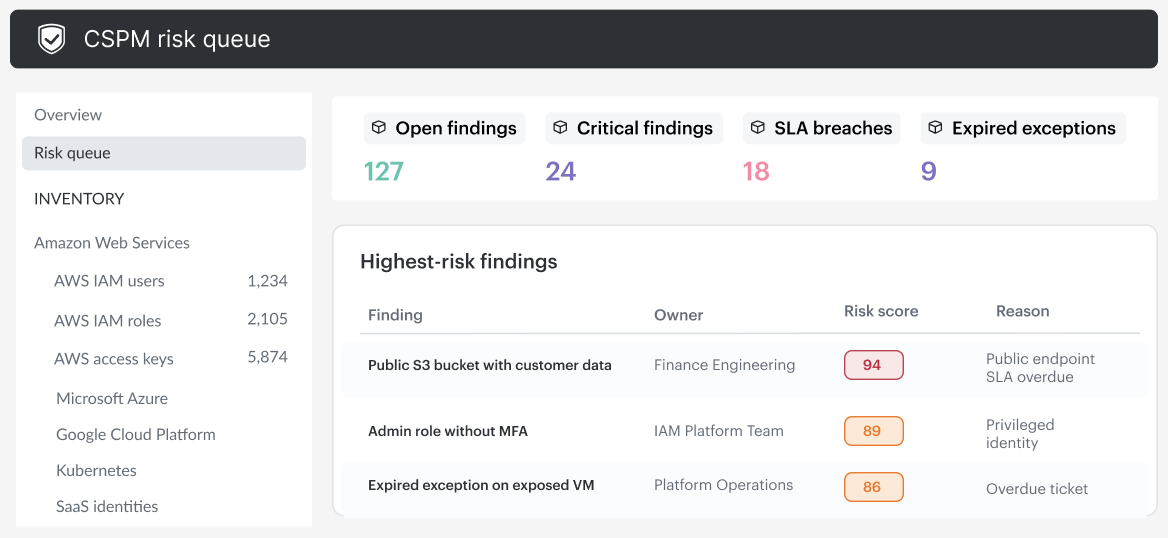
That saves the team from the usual scavenger hunt across CMDB, Jira, scanner output, and compliance spreadsheets.
This is how CSPM helps teams improve cloud security posture in practice: fix the risks most likely to become incidents, audit failures, or customer-impacting exposure before the queue buries them.
6. Container posture gets folded into the same cloud risk picture
Container findings get misread when they stay in a Kubernetes-only queue.
For posture management for cloud container security, the CSPM system pulls Kubernetes and container data into the same risk model as the cloud account, IAM, network, app, and compliance scope.
That changes the read.
| Container finding | What changes priority |
|---|---|
| Privileged container | Is it in prod or a test namespace? |
| Namespace exposure | Can it reach public traffic or sensitive services? |
| Risky service account | Does it map to a powerful cloud IAM role? |
| Open container registry | Are production images or secrets exposed? |
| Weak network policy | Can the workload move laterally? |
Good container security posture is not “Kubernetes configuration looks bad.” It is more specific: This workload runs in production, uses a broad service account, has runtime exposure, and can reach something sensitive.
That belongs in the same risk queue as public storage, weak IAM, and exposed databases.
A practical CSPM container security view should show: cluster, namespace, workload, image, registry, service account, app owner, environment, exposure, policy scope, and workload permissions.
Otherwise, security gets a container report. Useful, maybe. But not a cloud risk picture.
Read also: 7 Pillars of Cloud Security Strategy with Roadmap, Metrics & Examples
7. The system turns findings into work someone can actually close
A public database finding lands at 10:14.
Bad CSPM stops there. The alert exists. Security saw it. Everyone can admire the red badge.
Useful CSPM does the less glamorous work: it finds the owner, opens or updates the ticket, carries the policy context into the work item, watches the SLA, and checks the cloud configuration again after the team claims it is fixed.
That is the CSPM remediation workflow.
In practice, the record needs to carry enough detail for action:
Finding: public database exposure
Asset: production PostgreSQL instance
Owner: payments platform team
Workflow: ServiceNow incident linked to the CSPM record
SLA: 24 hours for internet-facing production exposure
State: open, fixed, reopened, overdue, or exception-approved
Validation: configuration rechecked after the change
Cloud security teams know the trap: a ticket closed does not always mean risk closed. The fix may hit staging, miss the production account, or remove one rule while another public path stays open. That is why remediation validation belongs inside the system, not in a Friday spreadsheet review.
Cloudaware reports can show this chain in one place: asset, app, owner, environment, ticket, SLA, exception, and fix status. CMDB ownership context makes owner assignment less of a guessing game, while ticket routing keeps work in Jira, ServiceNow, Rally, or email where teams already operate.
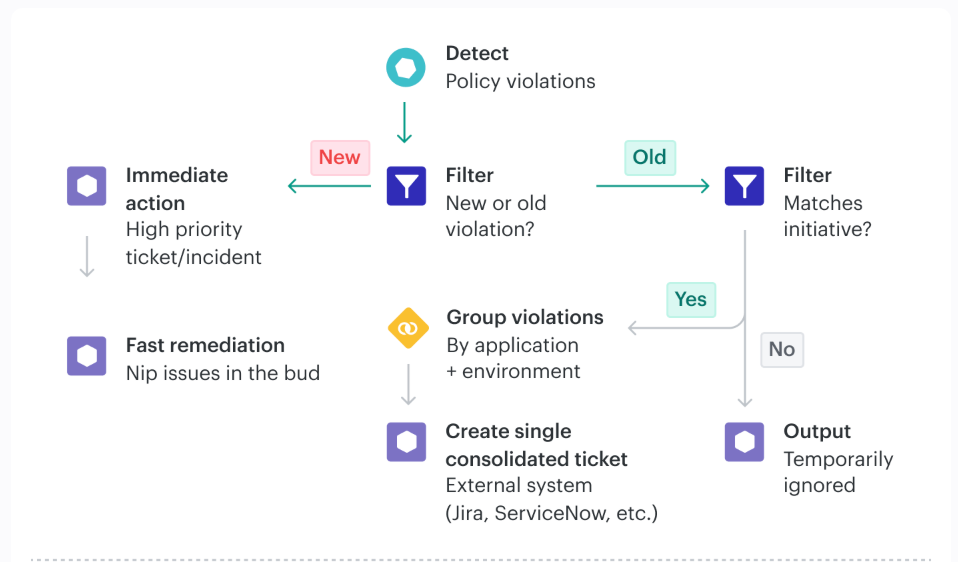
That is how CSPM helps with cloud security after detection: cloud security remediation becomes assigned, tracked, and checked. No heroics. No archaeology. Just closed-loop cloud security posture management work.
Read also: Zero Trust Cloud Security. A Practical Multi-Cloud Architecture and Approach
8. The loop closes only when the system validates the fix
At this point, the ticket is closed. The cloud may not be. A mature CSPM system re-reads the affected asset after remediation and compares the live configuration against policy again. Not the Jira status. Not the owner’s comment. The actual cloud state.
That check needs to answer a few uncomfortable things:
| What changed? | What the system needs to prove |
|---|---|
| Public access removed | The asset no longer exposes the path |
| Encryption enabled | The control now passes |
| Logging restored | Events are actually being captured |
| IAM tightened | Excessive access is gone |
| Exception approved | Scope, owner, reason, and expiry are documented |
| Finding reopened | The same control failed after another deployment |
That is where CSPM reporting stops being a pretty chart and becomes evidence.
Valentin Kel, Cloudaware DevOps Engineer:
In Cloudaware reports, the useful record is boring in the best way: asset ID, owner, failed control, framework mapping, first detected date, remediation date, ticket history, exception approval, current control status, and exportable audit evidence.
That record feeds the cloud security posture dashboard, framework scorecards, remediation history, exception expiry reviews, and compliance reporting. No screenshot folder. No “who has the latest export?” thread.
This is how teams improve cloud security posture for real: the loop closes when the system proves what changed.
How does CSPM help with cloud security when the cloud keeps changing?
Cloud does not drift politely. A storage bucket appears after a sprint hotfix. A service account keeps admin access after testing. A workload lands in a region that compliance never approved. By the time someone opens the quarterly review deck, the cloud security posture has already moved.
That is how CSPM helps with cloud security: it keeps the risk view closer to the live cloud state. Microsoft describes CSPM as continuous visibility and ongoing assessment across Azure, AWS, and GCP, including recommendations, secure score, asset inventory, workflow automation, and risk prioritization.
Timing matters. Verizon’s 2026 DBIR reviewed more than 31,000 incidents and found 31% of breaches started with vulnerability exploitation.
It catches the cloud assets security teams did not know existed
Cloud asset discovery is not glamorous. It is where a lot of real risk first surfaces.
A CSPM system reduces cloud blind spots by continuously finding unmanaged assets, untagged resources, public endpoints, forgotten buckets, accounts outside standard policy scope, and post-deploy configuration drift.
The ugly signals usually look like this:
| Signal | What it can mean in practice |
|---|---|
| Shadow cloud account | No weekly review, no standard guardrails, unclear owner |
| Public endpoint | An attack path exists outside the planned exposure model |
| Missing owner tag | Remediation will stall unless ownership is resolved |
| Unapproved region | Compliance scope may be wrong before anyone notices |
| Temporary bucket | Sprint artifact became permanent infrastructure |
That is where cloud misconfiguration detection becomes useful. Not “bucket found.” More like a public bucket, no owner, production-like naming, tied to a customer-facing service, and outside the expected policy scope.
A pattern Cloudaware teams often surface: security finds a public endpoint in an account no one reviews weekly. In a raw export, it looks like another exposed resource. In the Cloudaware view, the same asset can show up with the business service, environment, owner status, PCI scope, and an aging ServiceNow ticket attached.
Now the read changes.
Security sees exposure. DevSecOps gets the service path. Compliance gets scope. The owner gap is no longer a Slack investigation.
The win is simple: fewer blind spots, less guessing, faster ownership.
It turns a noisy findings queue into a risk-based shortlist
CSPM helps reduce alert fatigue by turning raw findings into a shortlist security can defend. Instead of treating every failed check equally, the system weighs exposure, criticality, environment, compliance scope, owner mapping, exception status, ticket state, and recurrence.
That ranking matters because cloud teams are not short on alerts. They are short on clean priority.
Verizon’s 2026 Data Breach Investigations Report found that 31% of breaches started with vulnerability exploitation, overtaking stolen credentials as the top initial access path in its dataset. Source: Verizon 2026 DBIR. In cloud, that gets uncomfortable fast: an exposed workload with a known vulnerability does not belong three pages deep in a CSPM export.
Check Point’s 2025 Cloud Security Report, cited by ITPro, found that nearly two-thirds of organizations suffered a cloud security incident in the past year, while only 9% detected breaches within the first hour. Source: ITPro coverage of Check Point 2025 Cloud Security Report. That is the cost of fragmented tools, visibility gaps, and buried signals.
A useful CSPM finding carries the sorting logic with it:
| Field in the finding | What it tells the team |
|---|---|
| Owner | Who can fix it |
| Application | What service is affected |
| Environment | Dev cleanup or production risk |
| Exposure | Whether the internet can reach it |
| Asset criticality | How much the business depends on it |
| Framework | Which audit or control set is affected |
| Ticket | Whether remediation is moving |
| Exception | Accepted risk or forgotten risk |
| Recurrence | One-off mistake or pipeline drift |
This is the practical answer to how does CSPM improve cloud security posture: it makes the queue smaller without hiding risk.
In Cloudaware dashboards, the shortlist can be read from the finding row itself: severity, exposure, owner, application, environment, compliance framework, exception status, remediation ticket, and risk context. No separate CMDB lookup. No Jira archaeology. No spreadsheet to decide which “critical” is actually critical.
That is cloud risk prioritization with enough business context to act before the blast radius grows.
It gives security, DevSecOps, and compliance the same version of risk
A CSPM finding usually starts in security.
It rarely stays there.
Take one record: public access on a production storage asset.
Security reads it as exposure. DevSecOps reads it as work. Compliance reads it as control impact. The platform reads it as drift. A CISO reads it as a trend question: Is this getting better, or are we watching the same risk come back every sprint?
That is where the CSPM workflow earns its place. The finding has to carry enough detail to survive every handoff.
A practical record survives every handoff.
A practical record needs the following:
For security operations: failed control, exposure, asset, attack path
For DevSecOps: owner, service, fix path, Jira or ServiceNow ticket
For compliance: framework mapping, exception state, control evidence
For platform: environment, deployment source, recurrence
For leadership: posture trend, overdue risk, business impact
Microsoft’s CSPM documentation reflects this shift from “scanner” to operating layer: asset inventory, recommendations, workflow automation, risk prioritization, regulatory compliance assessments, and ServiceNow integration all sit inside the posture workflow.
The cost of weak handoffs is not theoretical. IBM’s 2025 breach report puts the global average breach cost at $4.4M.
Good compliance reporting starts earlier than the audit. It starts when the finding already knows who owns it, what control it affects, and what changed after remediation.
That is how CSPM helps with cloud security across teams: fewer translation errors, cleaner remediation ownership, and an executive dashboard that reflects the work actually happening in the cloud.
Read also: 9 Reasons Cloud Security Posture Management Matters in 2026
It shows whether cloud security posture is actually improving
Posture improvement is easy to fake.
A team can close 600 findings and still have the same risky pattern coming back every sprint: public exposure, stale identities, missing logs, expired exceptions, and weak ownership.
That is not risk reduction. That is churn.
How does CSPM improve cloud security posture? By proving movement in the few signals that matter:
Criticals down.
MTTR shorter.
Reopened findings fewer.
Expired exceptions cleaned up.
Assets in scope growing.
Public exposure shrinking.
Framework scorecards moving the right way.
That proof matters because cloud breaches still come from boring failures. Wiz research, covered by ITPro, found 80% of cloud breaches were caused by basic security mistakes, including misconfigurations, exposed credentials, and poor exposure management. The same report notes 53% of malicious pre-access activity involved reconnaissance and discovery, which makes external exposure and attack path visibility more than a nice dashboard filter.
A useful CSPM dashboard should prove the estate is getting harder to abuse:
| Proof signal | What good movement looks like |
|---|---|
| Critical findings open | Fewer high-risk issues sitting unresolved |
| MTTR | Faster validated fixes, not faster ticket closure |
| Reopened findings | Fewer controls failing again after deployment |
| Expired exceptions | Less exception debt hiding accepted risk |
| Assets in scope | Better control coverage across accounts, clusters, and regions |
| Public exposure trend | Measurable attack surface reduction |
| Framework scorecards | More controls passing across live environments |
In Cloudaware, teams can prove this through posture reports that connect critical findings by owner, failed checks by framework, remediation state, expired exceptions, reopened controls, assets in scope, and evidence exports.
That changes the review conversation.
Not “we handled a lot of alerts.”
More like billing exposure dropped 38%, expired PCI exceptions went from 14 to 3, reopened S3 controls stopped recurring after the Terraform policy change, and the overdue risk is now concentrated in two owner groups.
That is practitioner-level proof. It shows where cloud security posture metrics improved, where configuration drift still leaks through, and which owner group is slowing the next posture gain.
Read also: Cloud Data Security Best Practices - A Playbook for Multi-Cloud and Migration
How CSPM findings stop being alerts and become fixes
Cloudaware helps operationalize CSPM by connecting posture findings to CMDB context, ownership, applications, environments, policies, tickets, exceptions, and evidence. That gives cloud security, DevSecOps, compliance, and CISO teams a way to move from “we found a misconfiguration” to “the right team fixed it, the system validated it, and the evidence is ready.”
That distinction matters.
Most CSPM pain does not come from detection. Teams already have plenty of findings. The hard part is the chain after detection: who owns the asset, which app depends on it, whether the workload is in scope, whether an exception exists, where the ticket lives, and whether the fix actually landed.
Cloudaware treats that chain as the work.
The platform is built around CMDB-aware CSPM, which means a failed check can carry the asset story with it: cloud resource, configuration item, owner, application, environment, business service, framework, ticket, exception state, and remediation history.
Cloudaware’s CSPM merges CMDB data with multi-cloud and on-prem checks, so teams can apply enforceable guardrails with owner, app, and environment context.
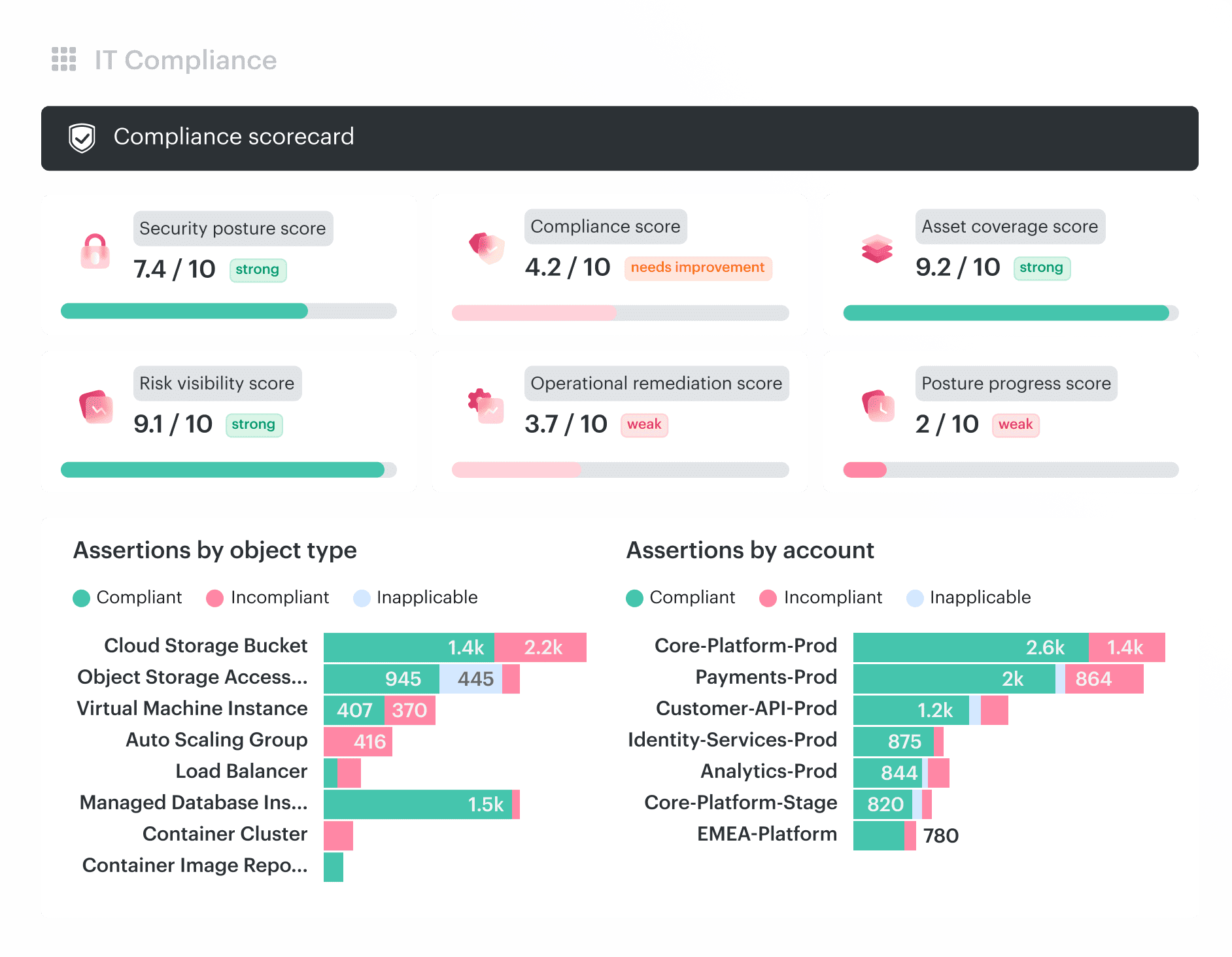
The CSPM loop Cloudaware supports
- Find the asset. Cloudaware pulls cloud and hybrid asset data into a shared inventory, including AWS, Azure, Google Cloud, Oracle, Alibaba Cloud, VMware, Kubernetes, and on-prem resources. Its CMDB coverage includes multi-cloud discovery, on-prem discovery, and support for 3,000+ cloud services and CI types.
- Add the missing context. A finding is not just attached to a resource ID. In Cloudaware, it can sit next to the application, owner, environment, business service, tags, boundary, and CMDB record. That is what keeps a public endpoint from becoming a Slack investigation.
- Check posture against real policies. Cloudaware can run ongoing assessments for CIS, NIST, ISO, PCI, and HIPAA while supporting UCF-enabled dashboards, 900+ UCF authority documents, baseline packs, custom checks, and YAML-based policy language.
- Prioritize the finding. The dashboard can rank misconfigurations by owner, exposure, blast radius, scope, exception state, and remediation context. That helps teams separate “poorly configured setting” from “business-critical exposure.”
- Route the work. Cloudaware can auto-route findings to Jira, ServiceNow, Rally, or email, assign owners from CMDB context, sync ticket status back to CSPM findings, trigger automation playbooks, and escalate by SLA and environment.
- Prove the outcome. For audit and leadership reporting, Cloudaware can preserve coverage, exemptions, owners, timestamps, policy differences, framework scorecards, versioned diffs, remediation trails, and executive posture views.
So, how does cloud security posture management work when it works well?
It finds the asset.
It understands the context.
It checks the policy.
It prioritizes the risk.
It routes the fix.
It proves what changed.
That is the gap Cloudaware is built to close: visibility into cloud risk is useful, but assigned, validated, auditable remediation is what actually changes posture.