


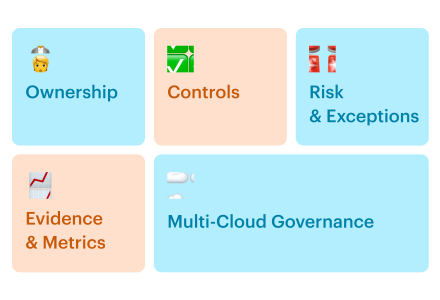
Cloud security governance is where cloud security stops being a slide deck and starts becoming an operating system. A team can have a cloud security strategy, a policy library, CSPM alerts, GRC workflows, and still fail the question that matters during an audit or incident review: who owns this risk, who approved the exception, and what evidence proves the current state?
That is the job of cloud security governance: make cloud security decisions traceable across assets, owners, controls, exceptions, evidence, and escalation.
Red Hat’s 2026 cloud-native security research found that 97% of organizations experienced at least one cloud-native security incident in the past year, 74% slowed or delayed application deployments because of security concerns, and only 39% reported a well-defined cloud-native security strategy.
This article is a working model for building a cloud security governance framework, running a cloud security program, assigning decision rights, measuring risk, and reporting cloud security in a way a CISO, auditor, platform lead, and application owner can all act on.
TL;DR
- Governance starts with ownership. A cloud security governance framework that skips asset scope and owner mapping will fail during the first real escalation.
- Cloud security governance is different from strategy, policy, compliance, and program management. Strategy sets direction. Policy defines rules. Compliance proves requirements. The cloud security program runs the work. Governance decides who has authority, how risk is accepted, and how progress is reviewed.
- A practical framework needs six pillars: inventory and scope, ownership and decision rights, policy and control mapping, risk and exception management, evidence and attestation, and metrics review.
- Hybrid and multi-cloud governance needs one enterprise control model. AWS Control Tower, Azure Policy, Google Cloud Organization Policy, VMware controls, and SaaS controls all matter, but they need to roll up into a shared risk register, exception workflow, evidence model, and executive scorecard.
- Board reporting should show risk movement, not scanner volume. Useful metrics include production asset ownership coverage, exception aging, critical control coverage, evidence freshness, recurring drift, and remediation performance.
- Tools support governance, but they do not replace it. CMDB, CSPM/CNAPP, GRC, ITSM, SIEM, policy-as-code, and FinOps tools only become governance tools when they share asset context, ownership, control mapping, exception status, and evidence.
- See cloud security observability guide for the operational layer that connects governance requirements with current resource state, accountable owners, and remediation evidence.
What is cloud security governance?
Cloud security governance is the operating model for deciding how cloud security risk is owned, controlled, accepted, reviewed, and reported across cloud environments.
It answers the questions that become expensive when nobody owns them:
| Governance question | Cloud example |
|---|---|
| What is in scope? | AWS accounts, Azure subscriptions, GCP projects, SaaS apps, Kubernetes clusters, VMware assets |
| Who owns the asset? | Application owner, platform team, service owner, cost center, or business unit |
| Which control applies? | Encryption, logging, IAM review, vulnerability remediation, backup, segmentation |
| Who can approve an exception? | Risk owner, control owner, GRC lead, CISO delegate, governance committee |
| What proves the state? | Configuration history, scan result, ticket, attestation, approval record, audit evidence |
ISO/IEC 27014 frames governance around evaluating, directing, monitoring, and communicating information-security processes. In cloud terms, that means governance has to define who can make security decisions, how those decisions are reviewed, and what evidence proves the current state.
Cloud security governance vs. strategy, policy, compliance, and program
This is where teams get tangled. They say “governance” when they mean policy. They say “program” when they mean roadmap. They say “strategy” when they mean “we bought three tools and now need the auditors to like the screenshots.”
Cloud security governance sits between direction and execution. It does not replace strategy, policy, compliance, or cloud security program management. It connects them.
Microsoft describes the Cloud Security Benchmark as prescriptive guidance for improving security across workloads, data, and services in Azure and multicloud environments. That kind of benchmark helps with control guidance, but it is not the governance model by itself.
| Layer | What it answers | Example | Governance role |
|---|---|---|---|
| Cloud security strategy | What are we trying to achieve and why? | Multi-year roadmap, investment priorities | Turns direction into decisions, metrics, and escalation paths |
| Cloud security governance | Who decides, approves, measures, and escalates? | Charter, RACI, committee model, scorecard | The operating layer |
| Cloud security policy | What rules must teams follow? | IAM policy, encryption standard, logging standard | Defines how policies are created, enforced, reviewed, and excepted |
| Cloud security compliance | What requirements must be proven? | Control mapping, audit evidence, assessment reports | Assigns evidence owners and review cadence |
| Cloud security program | How is work run quarter by quarter? | Roadmap, OKRs, remediation backlog, POAMs | Executes governance through recurring work |
- Cloud security strategy might say: reduce critical exposure and improve audit readiness across business units.
- Cloud security governance says: production assets must have owners, critical exceptions expire in 90 days, unowned critical findings escalate monthly, and the CISO gets a quarterly risk scorecard.
- Cloud security policy says: production object storage must not be publicly accessible.
- Cloud security compliance says: here is the evidence proving that storage exposure is monitored, exceptions are approved, and failures are remediated.
- Cloud security program management says: here is the backlog, cadence, owner list, escalation path, and progress against the quarter.
That distinction protects the cloud security program from becoming a container for everything: strategy work, policy writing, compliance reporting, tool ownership, and audit response. If every activity is called governance, no one knows where the decision actually happens.
Read also: Cloud Security Monitoring Tools - 7 Platforms for SIEM, Security Analytics & 24/7 Coverage
Cloud security governance framework: the pillars that make controls enforceable
A cloud security governance framework should not start with a giant control library. That is how teams create static control spreadsheets that no one can operate.
NIST CSF 2.0 helps explain why governance belongs before operational controls. The framework includes Govern as a core function alongside Identify, Protect, Detect, Respond, and Recover. NIST says those functions together provide a lifecycle view for managing cybersecurity risk.
CSA Cloud Controls Matrix v4.1 gives the cloud-specific control layer: 207 controls across 17 domains, with CAIQ assessment questions for control evaluation. It helps teams map controls. It does not decide ownership, exception authority, or evidence freshness.
The six pillars of a cloud security governance framework
| Pillar | What governance defines | Example |
|---|---|---|
| Inventory and scope | Which cloud resources, identities, data stores, SaaS apps, Kubernetes clusters, VMware workloads, and network paths are in scope | All production AWS accounts, Azure subscriptions, GCP projects, Kubernetes clusters, and VMware workloads |
| Ownership and decision rights | Who owns assets, risks, controls, exceptions, and escalation | Platform owns guardrails; app owner owns workload remediation; CISO owns risk posture |
| Policy and control mapping | Which internal rules map to NIST, ISO, CSA, CIS, or provider-native controls | Encryption policy maps to AWS Config, Azure Policy, GCP Organization Policy, and CSA CCM controls |
| Risk and exception management | How risk is accepted, deferred, remediated, or escalated | Critical exception requires business owner, expiry date, compensating control, and review |
| Evidence and attestation | What proves the control state and who signs off | Ticket, policy result, configuration history, scan output, approval record |
| Metrics and governance review | How leaders know whether risk is moving | Ownership coverage, exception aging, control drift, MTTR, evidence freshness |
A framework like this should feel predictable enough to operate. The asset is in scope. The control has an owner. The exception has a review date. Evidence exists before the auditor asks for it.
AI workloads now belong inside that same governance scope. Microsoft Cloud Security Benchmark v2 preview adds an AI Security domain with seven recommendations and more than 420 Azure Policy built-in definitions for posture monitoring.
That means model registries, AI platform permissions, agent access, plugins, training data paths, and AI monitoring need owners, controls, approvals, and evidence. Microsoft’s AI security guidance, for example, includes formal model approval before production use.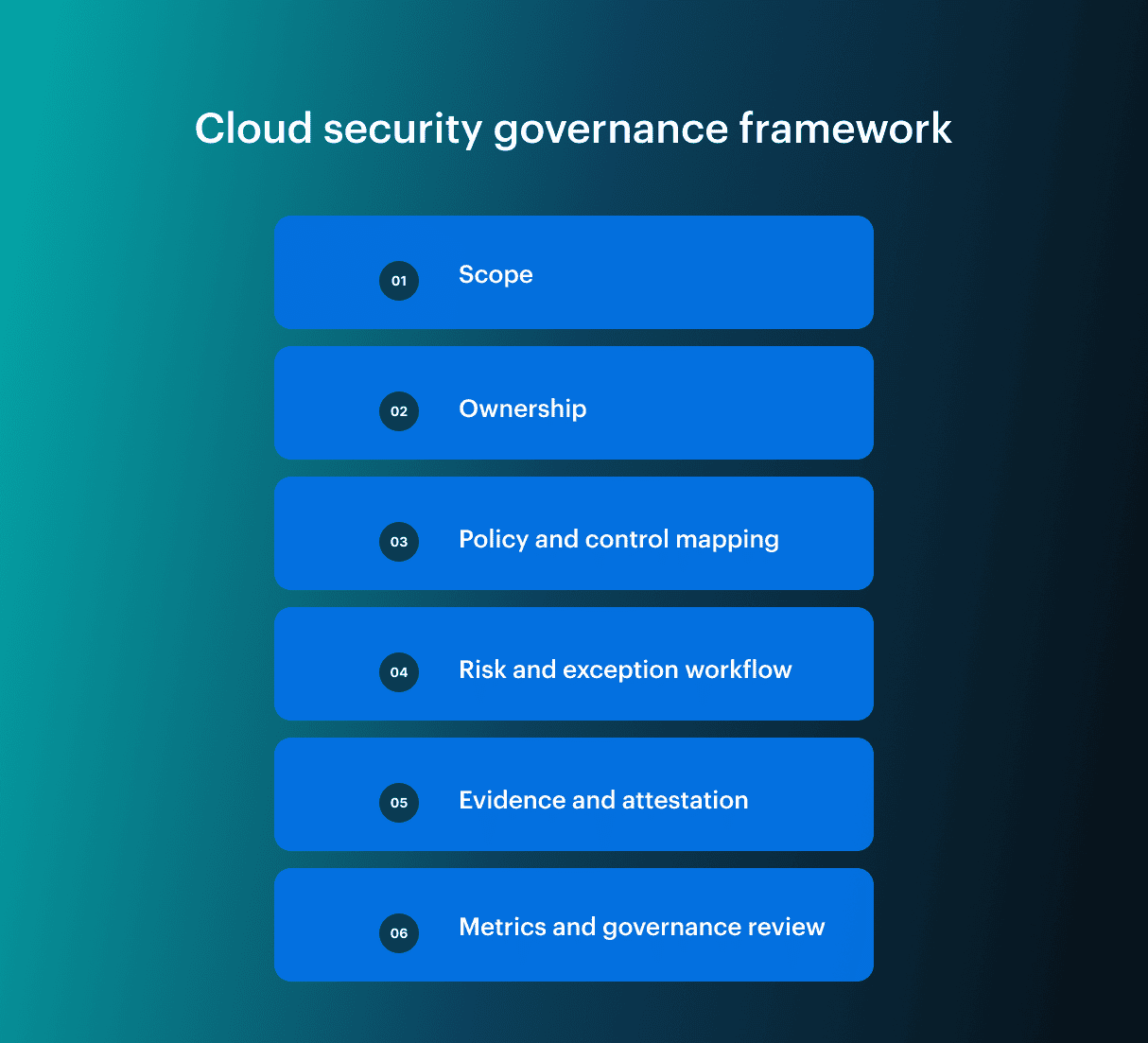 A cloud security governance framework that starts with controls but skips asset ownership will fail in the first escalation.
Read also: Cloud Security Assessment Framework. Checklist, Questionnaire & Templates
Build the cloud security program that runs the governance model
A framework is the map and a cloud security program is the weekly operating rhythm that keeps people from ignoring the map.
Someone has to run intake, review exceptions, check aging risks, track remediation, update controls, prepare the scorecard, and escalate what is stuck. Without that cadence, governance turns into a quarterly meeting where everyone rediscovers the same unresolved issues.
Microsoft’s Cloud Adoption Framework recommends that cloud governance policies define how cloud use will be managed to mitigate risks. Its governance enforcement guidance also says defining policies is not enough: the organization must implement controls, processes, and tools, while platform and workload teams handle day-to-day enforcement in their domains.
Cloud security program management: cadence, roadmap, and exceptions
A basic program cadence can look like this:
| Cadence | Meeting | Decision |
|---|---|---|
| Weekly | Cloud security and platform review | Critical findings, owner gaps, urgent exceptions |
| Monthly | Cloud governance committee | Recurring drift, policy exceptions, unresolved ownership |
| Quarterly | Executive risk review | Risk appetite, funding gaps, exception aging, maturity movement |
| Annually | Framework refresh | Standards mapping, audit findings, policy updates, business changes |
A public storage exposure shows why the program layer matters. A weak process sends an alert to a Slack channel and hopes the right engineer sees it.
A governed process looks different:
- The finding appears in CSPM or provider-native monitoring
- The asset is mapped to application, owner, environment, and data class
- The finding links to a policy ID and control ID
- The owner requests a temporary exception because migration cutover is in progress
- Governance approves a 14-day waiver with business owner, compensating control, and review date
- A ticket tracks remediation
- Evidence includes the original finding, approval, compensating control, remediation proof, and closure timestamp
Assign cloud security roles before assigning controls
Controls fail when every team is “responsible,” and no one is accountable. This is especially visible with identity. CSA and Tenable found that 59% of organizations identified insecure identities and risky permissions as the top security risk to cloud infrastructure.
That is why identity governance cannot sit only with IAM admins. It needs risk ownership, access review, exception approval, and remediation accountability.
- CISO cannot personally remediate every risky role assignment, he’s accountable for risk posture and escalation.
- Cloud security designs controls.
- Platform engineering builds guardrails.
- Application owners fix workload-level issues.
- GRC manages control mapping and evidence.
- FinOps or finance becomes relevant when cost centers and service mapping are the best accountability trail.
A practical RACI for enterprise cloud security and governance can start here: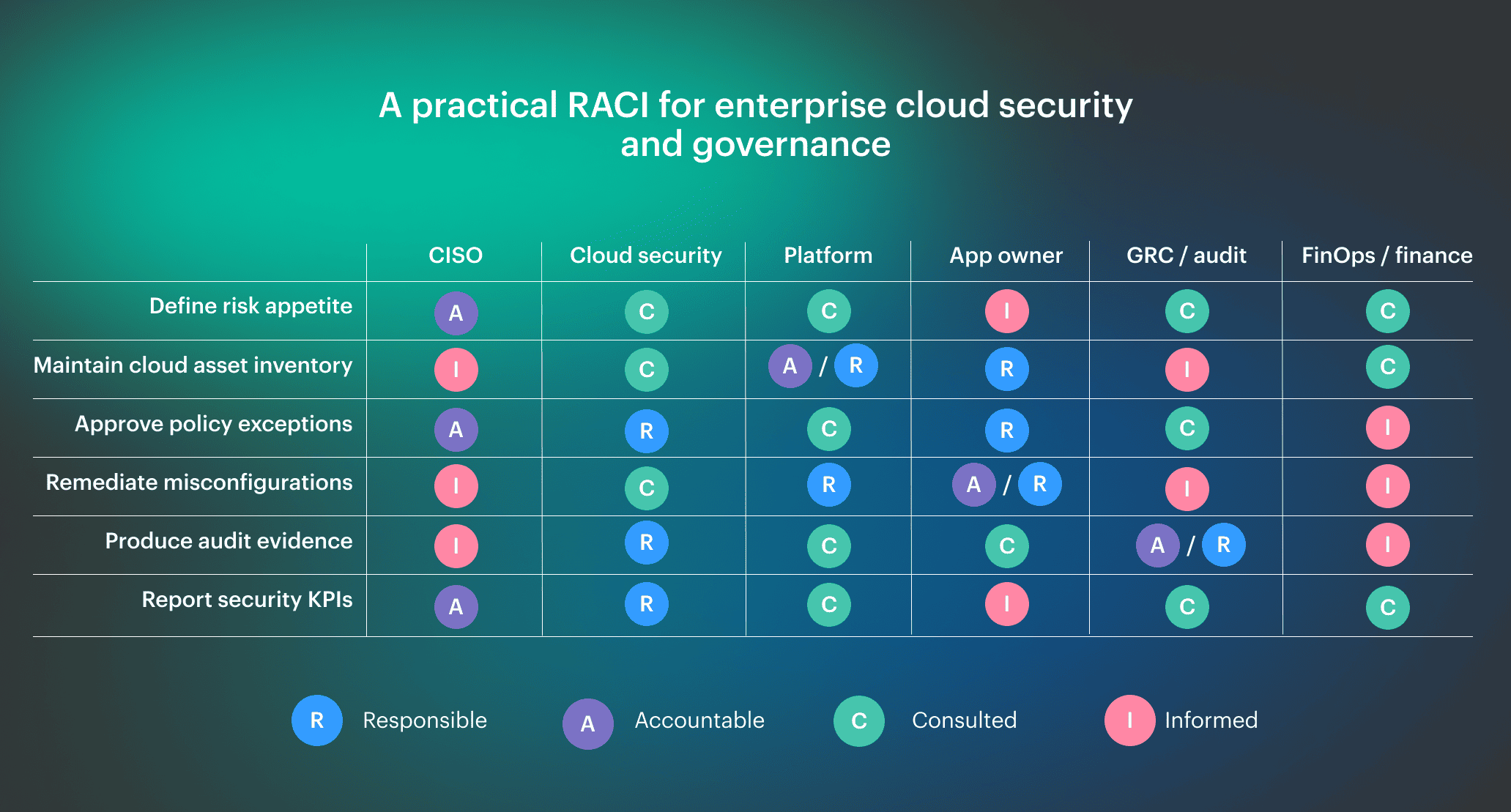 AWS also frames security governance around roles, responsibilities, accountabilities, policies, processes, and procedures. Its Security Perspective notes that RACI can be used to identify and assign responsibility for controls, while a risk register can capture controls without proper ownership.
Read also: NIST Cloud Security - A Practical Guide to the Framework, Controls, and Audit Readiness
Measure cloud security governance maturity before scaling the program
Maturity is whether the same governance behavior works across providers, accounts, teams, and audit cycles.
ISACA describes COBIT 2019 as a framework with 40 governance and management objectives. That structure is useful for maturity conversations because it separates governance and management instead of reducing everything to control checks.
For cloud security maturity, keep the model usable in a leadership review:
| Level | Governance state | What it looks like | Next move |
|---|---|---|---|
| Ad hoc | Decisions happen case by case | Unknown owners, Slack approvals, spreadsheet exceptions | Define scope and minimum ownership fields |
| Documented | Policies exist, enforcement varies | Teams interpret standards differently | Map policies to controls and enforcement paths |
| Repeatable | Workflows exist for controls and exceptions | Monthly governance reporting exists | Add aging thresholds and escalation rules |
| Measured | KPIs and risk trends are tracked | Exceptions have owners, review dates, and status | Tie metrics to risk appetite |
| Adaptive | Governance changes based on incidents, drift, and business change | Automation supports evidence and routing | Use risk signals to adjust controls and investment |
A company can reference NIST CSF, ISO 27001, COBIT, CSA CCM, and CIS at the same time and still sit at Level 2. Framework coverage is not maturity, but repeatable decisions are.
A recurring cloud security risk assessment should feed this maturity review. Governance decides what happens after the assessment: who owns the risk, what enters the roadmap, what becomes an exception, and what escalates.
The maturity test is simple:
- Which production assets still lack owners?
- Which controls failed more than once?
- Which exceptions are older than 90 days?
- Which teams keep creating the same drift?
- Which evidence is stale?
- Which risks exceed tolerance?
Cloud security governance metrics that belong in a CISO board pack
A board pack should show whether cloud risk is understood, owned, moving, and inside tolerance. Thales’ 2025 Cloud Security Study gives a reason to include data context in governance metrics: 54% of cloud data was classified as sensitive, up from 47% the prior year, while only 8% of organizations encrypted 80% or more of their cloud data.
That does not mean every board report needs an encryption chart. Governance metrics should connect control state to asset criticality, data sensitivity, ownership, and evidence. This is where cloud security governance becomes visible to leadership: not as control theory, but as risk movement.
Use metrics that force decisions:
| Metric | What it proves | What good looks like |
|---|---|---|
| Asset ownership coverage | Production resources have accountable owners | >95% for in-scope production assets |
| Sensitive data control coverage | Sensitive cloud data stores have required controls | Coverage tracked by data class and environment |
| Critical control coverage | Required controls are mapped and monitored | Coverage tracked by framework and provider |
| Exception aging | Risk acceptance is not becoming permanent | Fewer exceptions older than 90 days |
| Critical misconfiguration MTTR | High-risk findings are remediated within tolerance | Decrease by severity |
| Evidence freshness | Audit evidence is current | Evidence refreshed within the required review period |
| Policy drift rate | Environments diverge from approved standards | Decrease over time |
| Control failure recurrence | Same failures stop repeating | Decrease by team or control family |
Example: The weak version of this report:
| Board question | Weak metric | Better governance metric |
|---|---|---|
| Are we within risk tolerance? | 18,420 cloud findings | 42 critical findings on production assets, 31 assigned to owners, 11 outside SLA |
| Is ownership working? | 96% tag compliance | 94% of production assets mapped to accountable owner and business service |
| Are exceptions controlled? | 87 open exceptions | 19 exceptions older than 90 days, 7 without business owner renewal |
| Is evidence audit-ready? | Compliance score 82% | 96% of required evidence refreshed inside review period |
| Is drift improving? | 1,200 policy violations | 14 recurring control failures across 3 teams and 2 deployment pipelines |
Hybrid and multi-cloud governance needs one control model, not three provider silos
The best governance models for hybrid cloud security use one enterprise control model, then let provider and platform teams implement it through native controls.
AWS, Azure, and Google Cloud all have strong native governance mechanisms, but they do not create a shared enterprise control model by themselves.
- AWS Control Tower helps set up and govern a secure and compliant multi-account AWS environment, with centralized management, preventive and detective guardrails, and AWS resource provisioning controls.
- Google Cloud Organization Policy gives administrators centralized control over constraints across the Google Cloud resource hierarchy. A policy can be attached to an organization, folder, or project, and descendants inherit it.
- Microsoft’s Azure Arc guidance covers governance, security, and compliance for Arc-enabled servers, which matters when hybrid infrastructure needs to be governed alongside cloud-native resources.
The enterprise governance layer should sit above native controls.
| Governance layer | Centralized | Federated |
|---|---|---|
| Policy intent | Enterprise control requirements | Provider-specific implementation |
| Ownership model | Common owner, service, environment taxonomy | Local team execution |
| Guardrails | Required baseline controls | AWS Control Tower, Azure Policy, Google Organization Policy, VMware controls |
| Risk register | Common risk and exception model | Provider-level remediation |
| Evidence | Common evidence requirements | Provider-native evidence collection |
| Reporting | Executive scorecard | Cloud/team-level detail |
A practical hybrid model says:
- Central governance defines the control requirement
- Cloud and platform teams implement provider-native enforcement
- Application owners remediate workload risk
- GRC defines evidence requirements
- Governance committee reviews exceptions and aging risk
- Executives see risk by service, environment, owner, and business impact
Multi-cloud governance should be centralized in policy and reporting, but federated in execution. AWS, Azure, GCP, VMware, and SaaS controls will not enforce themselves through one universal button.
Read also: 9 Reasons Cloud Security Posture Management Matters in 2026
Cloud governance security tools: what to automate and what not to delegate
Cloud governance security tools help when they connect decisions to live asset context. They are incomplete when leadership treats the tool as the governance model.
CIS Control 1 puts asset inventory at the front of security hygiene. CIS recommends a process to address unauthorized assets weekly and active discovery daily or more frequently.
FinOps Foundation makes a similar accountability point from the cost side. Allocation uses accounts, tags, labels, and other metadata to assign cost and usage to responsible teams and projects. That same ownership context often becomes useful for cloud governance and security because cost centers, services, and business units help identify who should respond.
Flexera’s 2026 State of the Cloud reporting says wasted cloud spend increased to 29% and 81% of respondents use generative AI, up from 72% the previous year and 47% in 2024. AI and cloud cost are now governance topics, not only finance topics.
Tools should help with this, but not decide the model.
| Tool category | Governance role | Limitation |
|---|---|---|
| CMDB / asset inventory | Maps assets to owners, services, environments, and business context | Bad inventory weakens every downstream control |
| CSPM / CNAPP | Detects posture drift and misconfigurations | Findings need owner, severity, exception, and business context |
| GRC platform | Tracks controls, risks, evidence, and audits | Often lacks live cloud asset context |
| Policy-as-code | Enforces standards earlier in delivery | Needs approved policy logic and exception rules |
| ITSM / ticketing | Routes remediation and approvals | Tickets without asset context become noise |
| FinOps tooling | Connects cost, owner, application, and service | Cost allocation alone is not security governance |
| SIEM / logging | Supports detection and audit trail | Logs need retention, control mapping, and ownership rules |
One more detail: policy compliance is not the same thing as governance. Microsoft’s MCSB v2 maps benchmark controls to Azure Policy definitions, which helps measure posture. The governance layer still has to define scope, owners, exceptions, evidence review, and escalation.
Read also: Cloud Security Compliance Standards. The 8 Frameworks Every Cloud Team Should Know in 2026
Common cloud security governance failures and how to fix them
In 2026, the operating gap is becoming easier to measure. The 2026 Cloud Security Report found that 69% see tool sprawl and visibility gaps as the main barrier to effective cloud security. Another 66% lack strong confidence in their ability to detect and respond to cloud threats in real time.
One multi-cloud discussion mentions teams juggling Security Hub and Defender for Cloud with “too many alerts, not enough context.” In another thread, an Azure practitioner described maintaining around 500 CSPM exclusions in a relatively small environment and struggling with the review burden. These are individual experiences, not industry statistics, but the operating pattern is familiar.
The common cloud security governance failures in 2026 are not usually missing frameworks. They are broken handoffs between signal, context, ownership, decision, and closure.
1. Context loss turns security tools into noise generators
A vulnerability scanner knows that a package is vulnerable. CSPM knows that a storage resource is publicly exposed. CIEM sees excessive permissions. None of those findings automatically tell the governance team whether the asset supports payroll, belongs to a test environment, has an approved exception, or can reach sensitive data.
Without that context, severity becomes the routing mechanism. Everything marked critical goes to engineering, including findings that may be unreachable, non-production, or already covered by an active exception.
One Reddit practitioner described a CNAPP deployment that produced 847 critical findings across development containers, unreachable services, and test infrastructure. The number is anecdotal, but the lesson is useful: raw scanner severity is not enough to run a governance program.
Governance needs to add the missing context:
- Production or non-production?
- Externally reachable or isolated?
- Which application depends on it?
- Who owns remediation?
- Does it contain or reach sensitive data?
- Is there an active exception?
- Has the same control failed before?
The goal is to route the right issue to the right owner and preserve the reasoning behind that decision.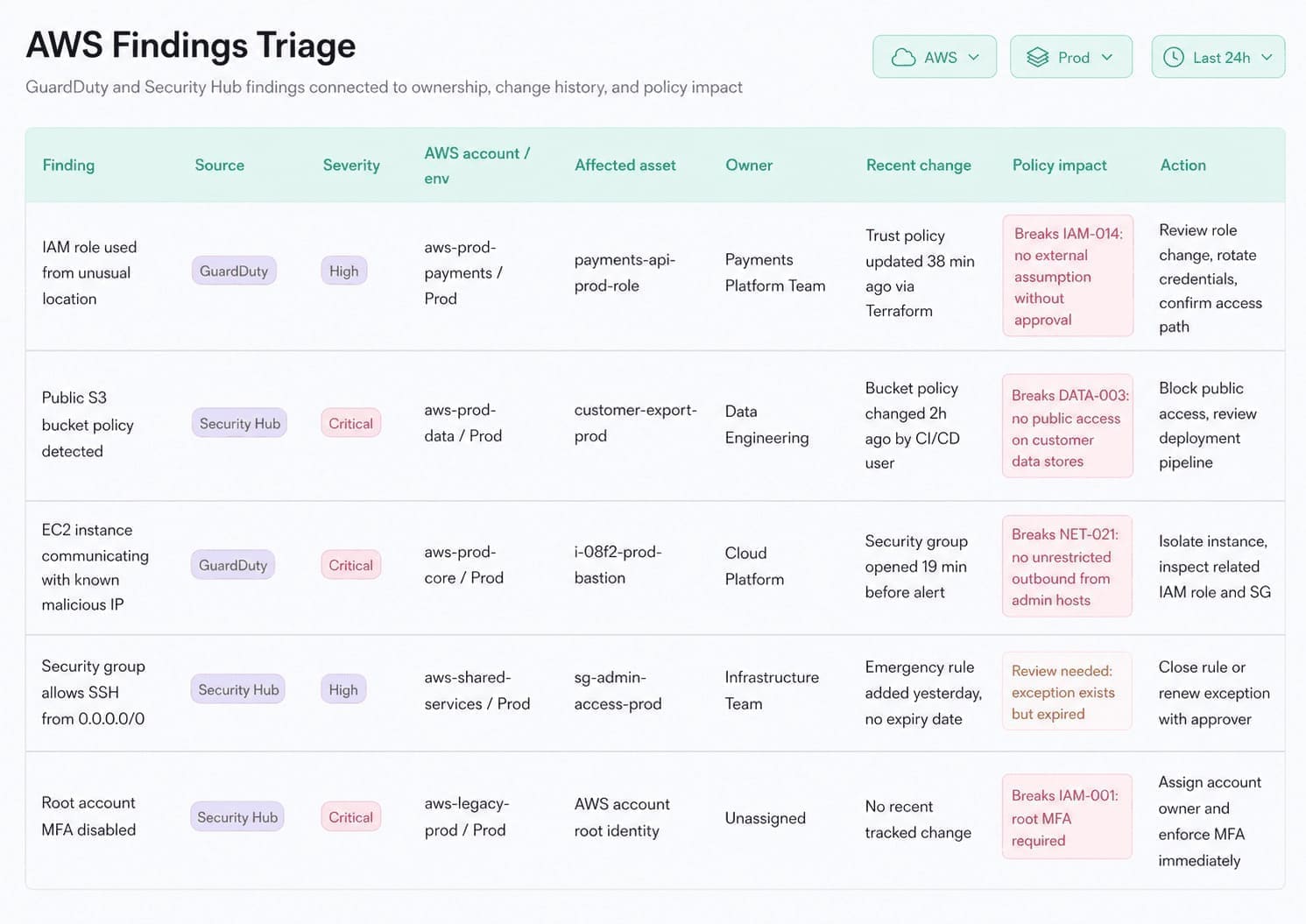 Cloudaware connects security findings with the affected asset, environment, owner, recent changes, and policy context so teams can route issues based on operational impact, not severity alone.
2. The governed estate is often smaller than the real estate
Wiz’s State of AI in the Cloud 2026 reports that 68% of organizations running self-hosted models obtain them through third-party software. That means a team can inherit model and supply-chain risk without launching a deliberate internal AI deployment.
The same research shows AI agents and MCP servers becoming part of production cloud environments, adding new machine identities and access paths.
Governance has not caught up everywhere. Red Hat’s 2026 State of Cloud-Native Security found that 59% of organizations still lack documented internal AI usage policies or governance frameworks.
The lesson is: governance scope has to match the actual technology estate. SaaS integrations, CI/CD systems, service accounts, AI agents, external data flows, and unmanaged cloud resources should not disappear because the original governance charter was written before they existed.
3. Multi-cloud complexity creates gaps between control planes
Hybrid and multi-cloud environments have turned fragmentation into a governance problem.
The 2026 Cloud Security Report found that 88% of organizations operate across hybrid or multi-cloud environments, while 81% depend on at least two cloud providers for critical workloads. The same research identified tool sprawl and visibility gaps as the leading operational barrier to effective cloud security.
AWS, Azure, and GCP understand their own resource models better than any generic policy layer. The failure starts when each provider develops its own risk language, owner taxonomy, exception process, and evidence workflow.
Three providers do not need identical technical controls. They do need a common answer to one governance question: What enterprise requirement does this control support, who owns the risk when it fails, and how is that failure reported?
That is the layer cloud security governance should standardize.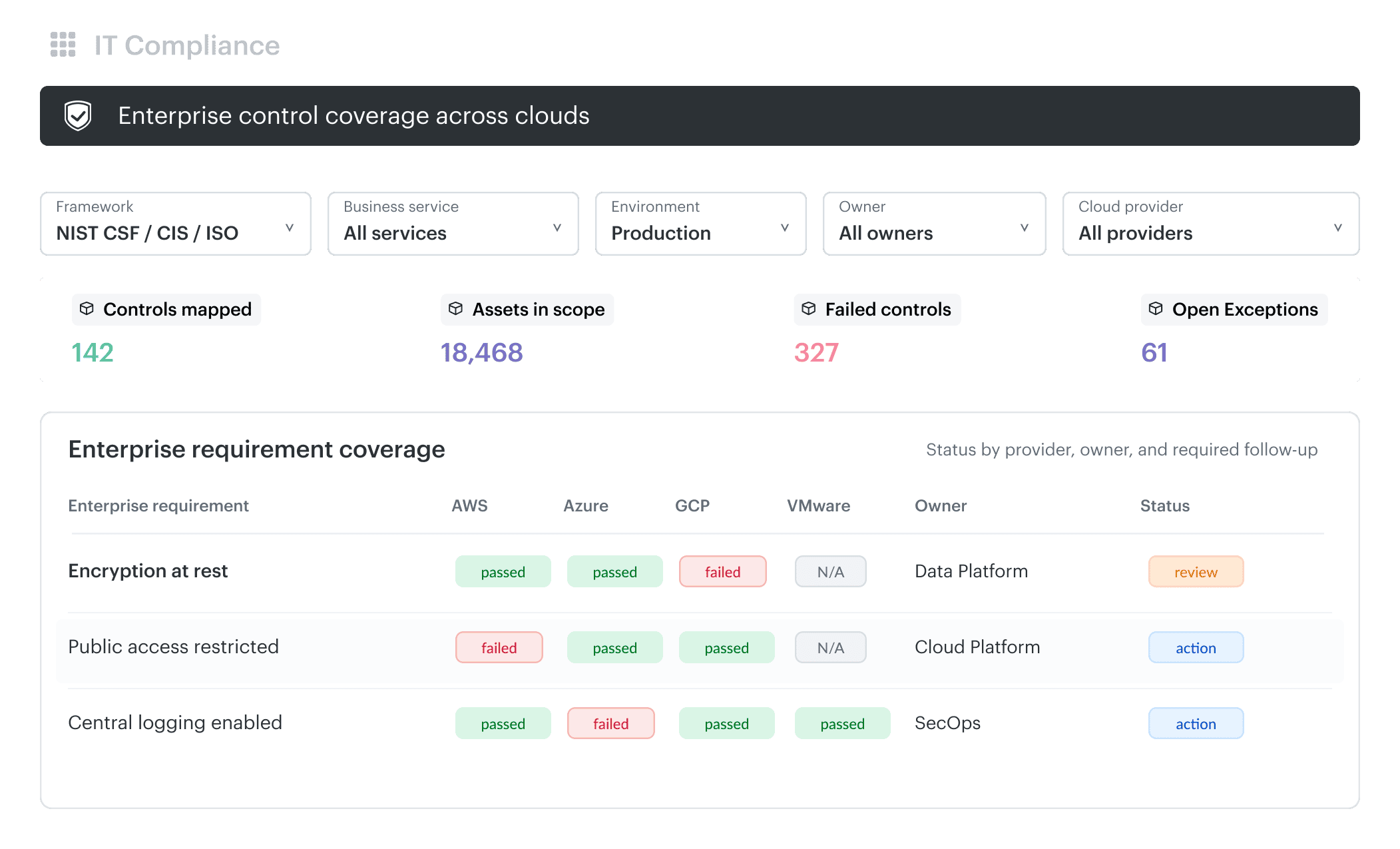 Cloudaware can evaluate CMDB-backed policies across multi-cloud and non-cloud configuration data, scope findings by cloud and organizational context, and report results through shared dashboards and compliance views.
4. Machine identities have outgrown the old access review
Identity governance is no longer mainly about employees and quarterly access certification.
The Cloud Security Alliance’s 2026 analysis identifies insecure identities and machine permissions as a major cloud security risk and notes machine-to-human identity ratios reaching 100:1. Service accounts, workload identities, automation credentials, and AI agents make traditional user access reviews an incomplete model.
A machine identity needs governance context too:
- Which workload uses it?
- Who owns that workload?
- Which resources can it reach?
- Are its permissions still used?
- What happens when the application is retired?
- Who approves additional privileges?
The control is not simply “inventory every service account.” Governance has to keep identity ownership and effective permissions connected to the workload lifecycle.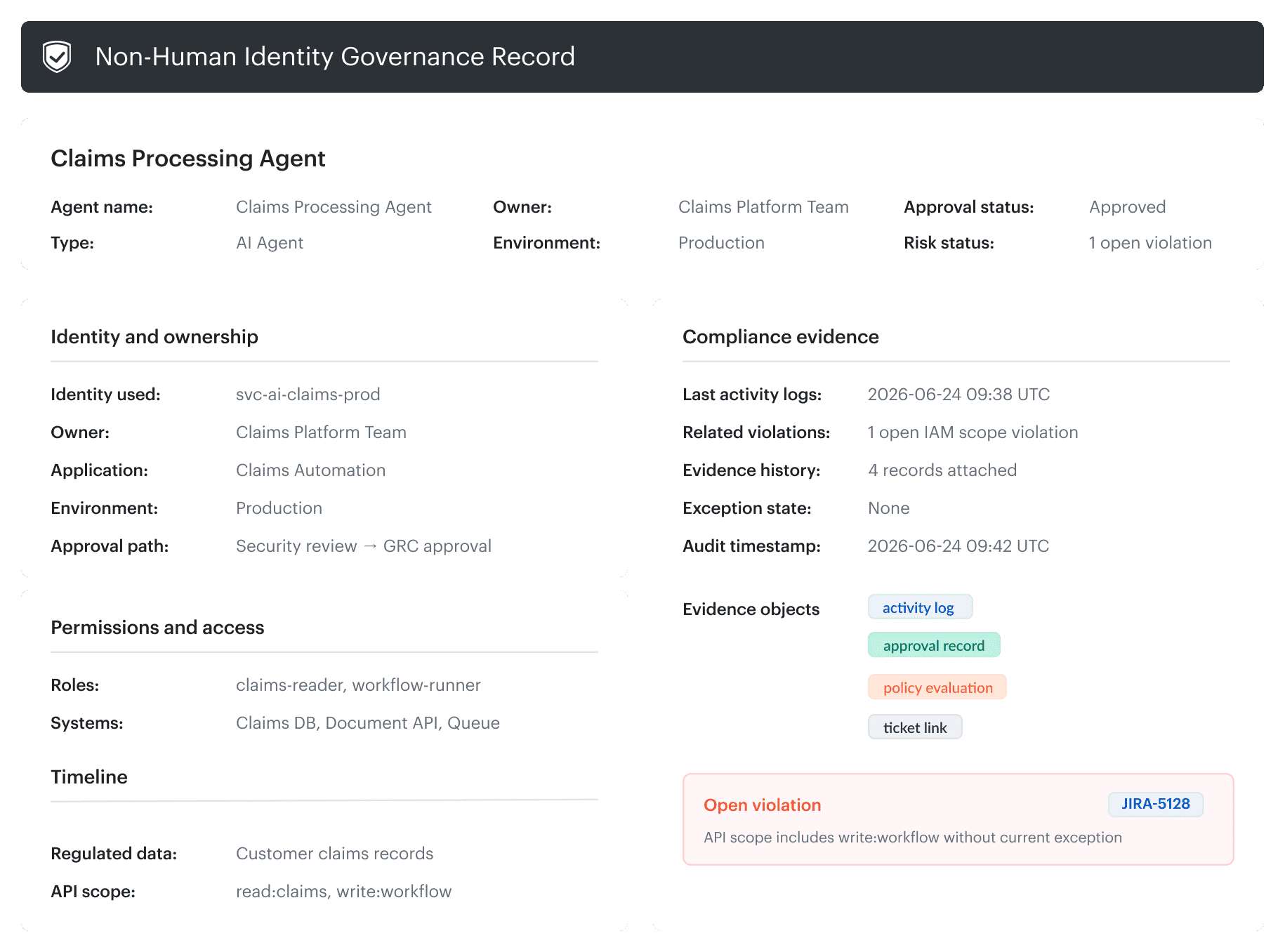 Cloudaware connects machine identity policy findings with workload, owner, environment, permissions, approval status, exceptions, evidence, and remediation context.
5. Exception debt becomes its own security backlog
Exceptions are supposed to be temporary. At scale, they often become a second backlog.
In one r/AZURE discussion, a practitioner described maintaining around 500 CSPM exclusions and expecting the number to grow as new subscriptions were added. In a separate r/cybersecurity thread, a practitioner from a large organization described formal exception management as cumbersome and difficult to track.
Temporary risk acceptance can be legitimate during migrations, legacy retirement, vendor remediation, or phased infrastructure changes. Governance fails when the exception record cannot answer four questions:
- Who accepted the risk?
- Which assets and controls does it cover?
- Which compensating control is active?
- When does the exception return for review?
Total exception count is a weak governance metric. Exception aging, expired waivers, missing business owners, and repeated exceptions against the same control tell leadership much more.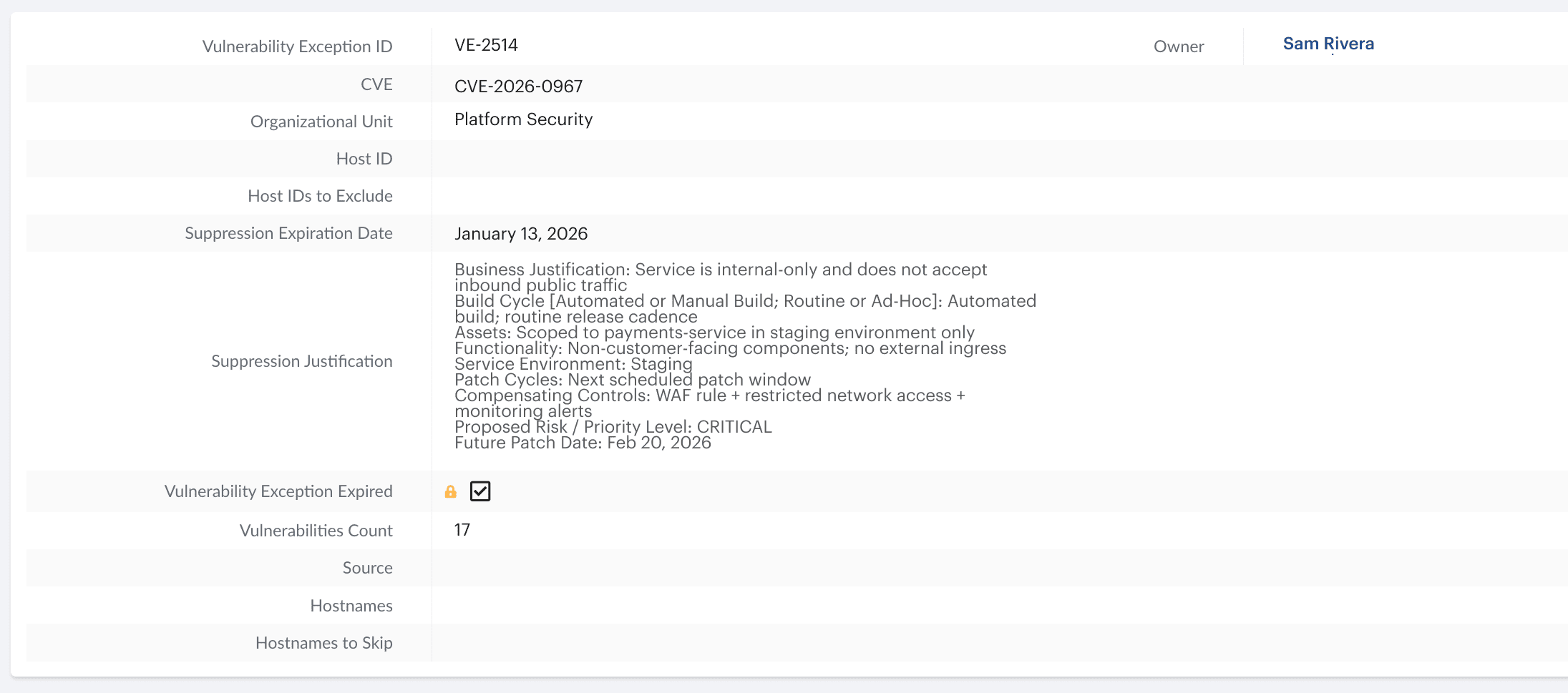 Cloudaware records the exception owner, affected vulnerability context, justification, compensating controls, expiration date, and status so temporary risk acceptance can return to review.
6. Detection is not closure
The 2026 Cloud Security Report found that only 11% of respondents reported autonomous remediation capabilities. When automation stops at notification, security teams still have to investigate context, identify the owner, coordinate remediation, validate the fix, and preserve evidence manually.
A ticket created is not a governance outcome. Neither is a risk accepted without an owner or review date. The program works when a technical signal can move to an accountable decision, remediation can be validated, and the organization can prove what happened afterward.
Cloud security governance across cloud and hybrid infrastructure with Cloudaware
Cloudaware supports cloud security governance by giving teams a shared operational view of cloud and hybrid assets, ownership, application context, control status, and change history. Instead of treating findings, policies, tickets, and evidence as separate records, teams can connect them to the assets and business services they affect.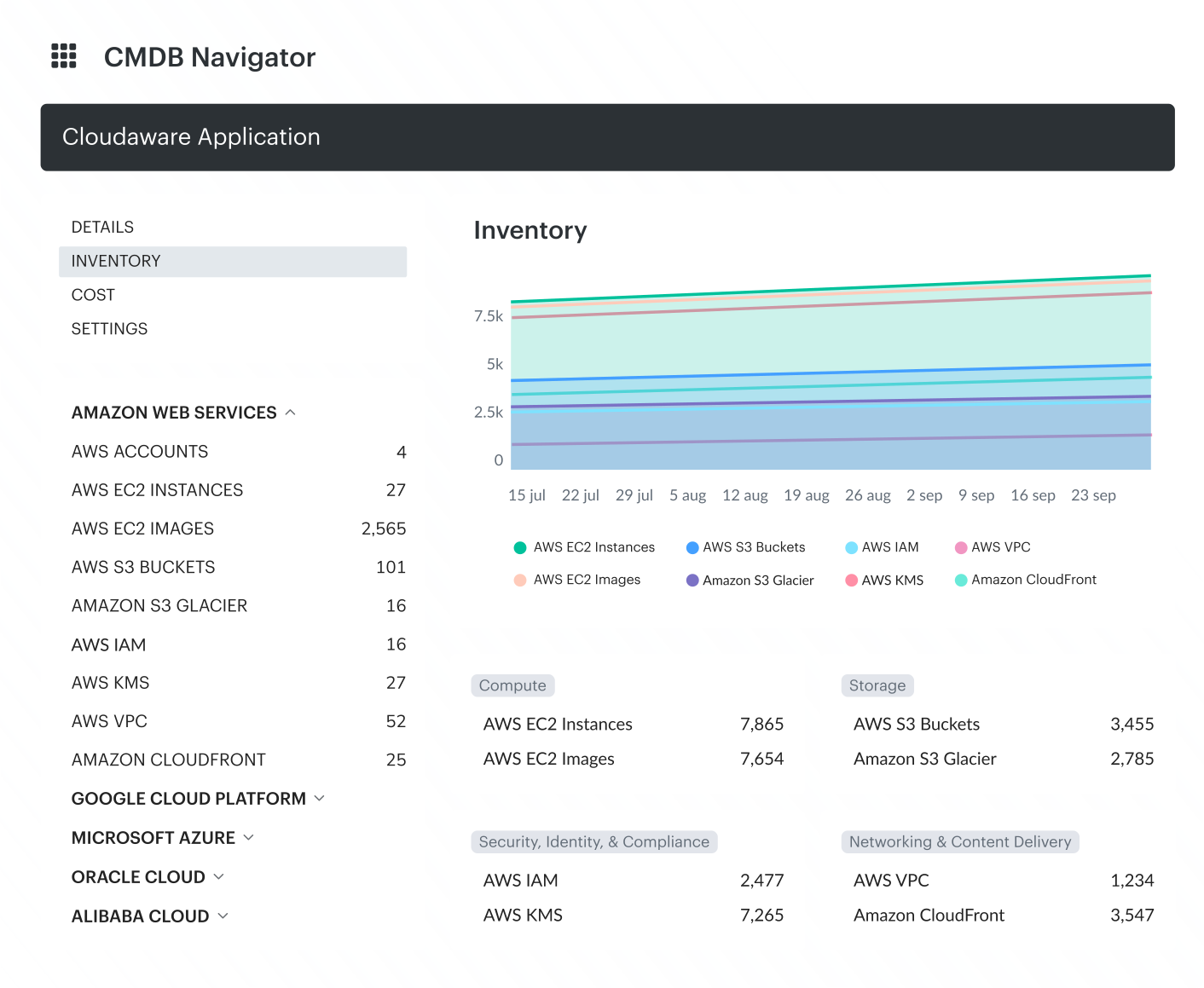 Core capabilities:
- Asset and ownership context: Use CMDB to search and report across cloud providers, accounts, regions, and hybrid infrastructure, then connect resources to owners, applications, environments, and business context.
- Inventory and change context: Collect cloud inventory based on granted provider permissions and review discovered resources, relationships, and changes in CMDB.
- Policy and compliance workflows: Use Compliance Engine policies, policy violations, reports, dashboards, and workflows to turn unsafe configuration into trackable work.
- Application mapping: Group cloud and non-cloud resources by naming convention, tag, or custom logic to reflect teams, projects, departments, customers, or other operating structures.
- Governance reporting: Create dashboards, approval workflows, compliance reports, and change evidence to track ownership gaps, control failures, exceptions, and remediation status.