


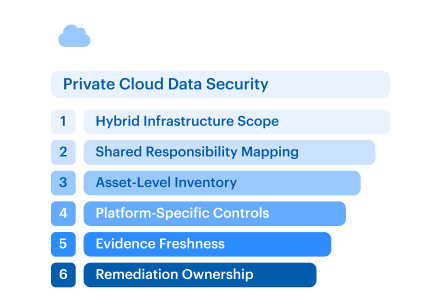
Private cloud data security becomes difficult when one business service spans multiple infrastructure layers. Customer records may reside in a database on VMware-backed storage, while the application runs on Kubernetes. Backups replicate to AWS, selected records enter a Google Cloud analytics pipeline, and identities, monitoring, and remediation workflows cross the entire service.
This architecture is now common rather than exceptional. Fortinet’s 2026 Cloud Security Report found that 88% of organizations operate in hybrid or multicloud environments, while 81% use at least two cloud providers for critical workloads. The result is a growing visibility and accountability gap: teams may monitor individual platforms without proving that the complete data path is protected.
In this article, you will learn:
- What private cloud data security must cover across cloud providers, VMware, and Kubernetes
- How to compare private and public cloud security responsibilities
- How to build an asset-level inventory for data-bearing resources
- How to translate security objectives into platform-specific tests
Key insights
- A private cloud is not inherently more secure than a public cloud. It can reduce certain tenancy and placement risks, but the outcome depends on which controls the organization can operate consistently and prove.
- The security scope extends beyond private infrastructure. Identities, backup targets, telemetry, analytics pipelines, and management integrations frequently cross AWS, Azure, Google Cloud, and SaaS systems.
- Asset inventory needs security context. Each data-bearing asset should include its sensitivity, business service, environment, exposure, owners, control scope, exception state, evidence age, and remediation status.
- A control objective becomes a different test on each platform. Encryption must be validated differently for a vSphere datastore, Kubernetes Secret, persistent volume, database, snapshot, and AWS backup vault.
- Evidence freshness affects control effectiveness. A screenshot from the previous quarter proves what someone observed at one moment. It does not establish the resource’s current state.
- A failed check without an owner, due date, and retest remains an inventory fact. It becomes a managed control failure only after entering a governed remediation process.
- For comparison with provider-managed environments, see our guide to public cloud data security for the controls, ownership model, and evidence layer needed across AWS, Azure, and GCP.
What is private cloud data security
Private cloud data security is the system of controls, ownership, monitoring, and evidence used to protect data within infrastructure dedicated to a single organization. It covers VMware, Kubernetes, storage, identities, backups, management systems, and connected services. Controls reduce risk; current, resource-linked evidence demonstrates whether those controls are operating.
The deployment model determines responsibility, but it does not establish the security outcome. A hosted private environment may divide operational responsibilities between the customer and hosting provider. An on-premises environment can place nearly the entire stack under the customer’s control. In both cases, teams need to know who operates each layer and who can produce evidence when a control is questioned.
For a VMware and Kubernetes estate, the scope may include:
- vCenter and other management-plane components
- ESXi hosts, clusters, virtual machines, networks, and datastores
- Kubernetes control planes, nodes, namespaces, workloads, and service accounts
- Persistent volumes, snapshots, clones, and backup repositories
- Directory, platform, host, workload, and machine identities
- Replication, monitoring, vulnerability management, and public-cloud integrations
Greater administrative control can reduce dependencies on shared provider infrastructure. It also makes the organization responsible for more configuration state, patching, telemetry, lifecycle management, and lower-stack evidence. A poorly governed management plane can expose many workloads via a single privileged path.
An operable private cloud security model should answer three questions for every relevant resource:
- Which business service, data set, and control scope does the resource belong to?
- Which control applies, and when was the resource last evaluated?
- Who owns remediation, exception approval, and retesting?
These questions shift the discussion from whether a control supposedly exists to whether the organization can demonstrate its operation across the complete asset population.
For a broader review of the layers and dependencies involved, use this cloud security architecture review checklist.
What private cloud data security must cover in a hybrid estate
Consider a customer account service with records stored in a database running on VMware. The database uses a vSphere datastore. An application hosted on an on-premises Kubernetes cluster reads and updates the records, with credentials managed through Kubernetes Secrets. Snapshots and backups replicate to AWS, while a governed extract enters a Google Cloud analytics pipeline.
The service crosses at least four control planes. Its security scope includes more than the database and Kubernetes workload:
- The datastore, VM, host, cluster, and management plane can affect the database.
- Secrets, service accounts, RBAC assignments, persistent volumes, and network paths can affect application access.
- The AWS vault, snapshot, KMS key, IAM role, account, region, and retention configuration affect backup protection.
- The Google Cloud dataset, service account, key, project, region, and logging configuration affect analytics processing.
- Directory services, private connectivity, observability tools, and ticketing systems support the complete data path.
An inventory that lists these objects without their relationships cannot show whether the service is covered. An application record saying “encrypted” is also insufficient. The team needs to know which components the statement covers, how the state was observed, which key protects each copy, and when the result was last validated.
A practical asset-level security model includes the following fields:
| Field | Operational purpose | Example |
|---|---|---|
| Platform and resource type | Determines which validation method applies | VMware datastore |
| Data sensitivity | Sets the required control and escalation level | Restricted customer records |
| Business service | Connects infrastructure to operational impact | Customer account service |
| Technical owner | Receives platform configuration failures | VMware platform team |
| Application owner | Owns service impact and remediation priority | Account services lead |
| Data owner | Approves classification, use, and risk decisions | Customer operations |
| Environment | Separates production and non-production scope | Production |
| Exposure and data path | Shows reachable systems and external boundaries | Backup replicated to AWS |
| Control scope | Records the applicable objectives | Encryption, logging, backup |
| Current state and last check | Establishes evidence freshness | Passed 26 minutes ago |
| Exception and expiry | Prevents indefinite suppression | Approved until September 30 |
| Ticket and retest status | Tracks action and verified closure | Jira SEC-482, retest pending |
This model exposes several common private cloud security risks.
Coverage gaps. A policy may evaluate production virtual machines but omit the datastores, snapshots, backup copies, Kubernetes persistent volumes, or test clones that contain the same data. A high compliance score calculated over an incomplete population can hide the missing resources.
Semantic gaps. Teams often normalize a detailed platform state into a generic value such as encrypted: true. That value may omit the key provider, key owner, protected layer, observation source, or validation time. It becomes difficult to determine whether two similarly labeled resources received equivalent protection.
Ownership gaps. A vulnerability or failed control may be attached to a host, cluster, or storage system without a relationship to the affected application and data owner. The platform team can see the infrastructure object but cannot independently determine its business priority or accept the residual risk.
Boundary gaps. The private environment may be assessed thoroughly while its AWS backup destination, Google Cloud analytics service, cross-cloud role, or replication path remains outside the evidence scope. Data residency decisions require coverage of the destination and route, not only the source.
Evidence gaps. A team may know that a setting passed during an audit but lack current state, change history, or a last-observed timestamp. This is especially weak for controls exposed to configuration drift.
Exception gaps. A suppressed finding may lack an approver, business rationale, compensating control, affected-resource scope, or expiry date. The exception then functions as a permanent exclusion rather than a time-bound risk decision.
The objective is not to force VMware, Kubernetes, AWS, and Google Cloud into an identical schema. The platforms represent security state differently. The inventory should normalize the operational questions while preserving the platform-specific fields needed to interpret and retest each control.
See cloud security governance for the broader accountability model and cloud security monitoring tools for the telemetry sources used to observe changing state.
Is private cloud more secure than public cloud
Private cloud is not inherently more secure than public cloud. It can reduce some multi-tenancy and placement risks, but it also transfers more responsibility for infrastructure, the management plane, telemetry, control validation, and evidence to the organization.
The useful comparison is therefore based on responsibility boundaries and the controls each organization can operate reliably.
Private cloud vs public cloud for data security
| Dimension | Private cloud | Public cloud | Security decision |
|---|---|---|---|
| Tenancy and placement | Dedicated to one organization, with greater placement control | Provider-operated infrastructure with logical tenant isolation | Private deployment can reduce specific tenancy concerns |
| Lower-stack responsibility | The organization or hosting partner operates more layers | The provider operates physical facilities and substantial infrastructure layers | More control creates more controls to operate and prove |
| Native telemetry | Depends on VMware, Kubernetes, host, network, and storage sources | Provider supplies native control-plane and service telemetry | Coverage and retention matter more than telemetry volume |
| Provider attestations | Limited or divided between the organization and host | Provider attestations cover defined service layers | Attestations do not replace customer-side evidence |
| Identity boundary | Often combines directory, platform, host, and service identities | Provider-native IAM remains customer-configured | Identity paths must be evaluated across the service |
| Data-boundary proof | The organization proves storage, copies, backups, and hosted boundaries | The provider proves defined lower layers; the customer proves its configuration and use | The evidence burden changes rather than disappears |
| Configuration drift | More heterogeneous control planes may be customer-operated | More underlying infrastructure is standardized by the provider | Drift detection must match the controlled layer |
| Remediation traceability | Findings are commonly split across infrastructure and ITSM systems | Findings often start in native security services before entering ITSM | Both require owners, tickets, exceptions, and retests |
In a private vs public cloud security decision, control ownership should be mapped at the service and resource levels. A provider attestation may cover physical security and certain infrastructure services. It does not prove that the customer configured identity, encryption, logging, retention, or network access correctly.
Private infrastructure can be justified by placement, sovereignty, latency, isolation, legacy integration, or operational requirements. The security case is credible only when the organization can staff and validate the additional responsibility. If a public-cloud service lets the provider operate lower layers without violating data requirements, it can reduce operational work that provides little business differentiation.
For more on how evidence is divided across service layers, see cloud security compliance. For the ISO-specific model behind this responsibility split, see ISO/IEC 27017:2026 guide.
Private cloud security best practices for an operable control system
Private cloud security best practices are frequently reduced to encryption, MFA, segmentation, logging, patching, and tested backups. Each control matters, but the list does not explain how to operate them across a changing asset population.
An operable control system also needs a complete resource scope, accountable ownership, platform-specific tests, and a lifecycle for evidence, exceptions, remediation, and retesting.
1. Model control scope from the data path
Start with the business service and follow its data across infrastructure boundaries. An assessment organized separately around VMware, Kubernetes, AWS, and Google Cloud can validate each platform while missing the identities, storage objects, keys, and replication paths that connect them.
This fragmentation is no longer an edge case. The 2026 Fortinet study found that 29% of organizations use more than three cloud providers. A platform-by-platform inventory is therefore unlikely to represent the complete security scope of a business service.
For the customer account service in our example, scope begins with the VMware-hosted database but must also include:
- VMware Datastores Virtual Machines Hosts And Snapshots
- Kubernetes Secrets Service Accounts Persistent Volumes And Network Policies
- AWS Backup Vaults Snapshots KMS Keys And Replication Roles
- Google Cloud Datasets Service Accounts Keys And Logging Configurations
- Private Endpoints Monitoring Integrations And Administrative Identities
The relationship model should answer which resources store the data, which can access or decrypt it, which can create another copy, and which management objects can change its protection. It should also retain discovery source, last-seen time, environment, business service, sensitivity, and ownership.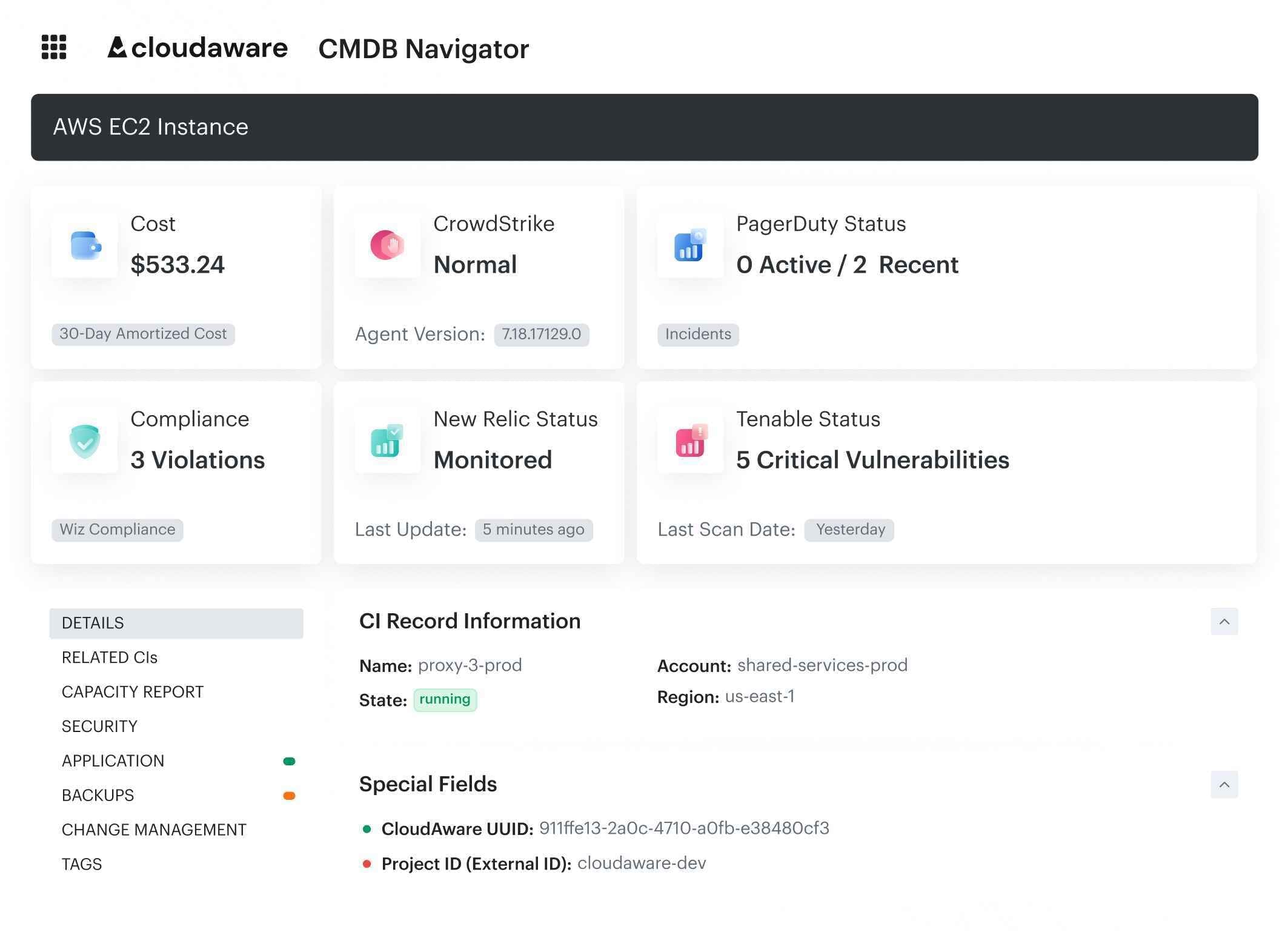 Cloudaware maps the relationships around an individual CI so security teams can scope controls from the complete data path rather than from an isolated asset list
For example, an EC2 instance record can retain its relationships to VPCs, subnets, security groups, IAM roles, storage volumes, load balancers, application records, and operational tools. The same model can be applied to VMware and Kubernetes objects. Security scope can then be derived from the business service and its relationships instead of maintained as a separate spreadsheet for each platform.
For related approaches to posture signals and inventory coverage, see how cloud security posture management works.
2. Resolve ownership before routing a security finding
Ownership should be assigned while the asset record is created or enriched, not after a critical control fails. Without that context, the ticketing workflow can route a finding but cannot determine which team has the authority and platform access to resolve it.
The Google Cloud Threat Horizons H1 2026 report found that trusted third-party application relationships contributed to 21% of observed cloud intrusions during the study period. This is relevant to ownership because the affected resource and the team responsible for the vulnerable integration may belong to different operational domains.
A workable ownership model distinguishes:
| Role | Accountable for |
|---|---|
| Technical owner | Platform And Resource Configuration |
| Application owner | Service Impact And Remediation Priority |
| Data owner | Classification Permitted Use And Risk Acceptance |
| Support group | Execution Through The Operational Queue |
| Control owner | Control Definition Test Quality And Coverage |
| Exception approver | Residual Risk And Compensating Controls |
Shared infrastructure needs explicit treatment. One Kubernetes cluster, datastore, backup service, or identity platform may support several applications. Assigning a single application owner to the shared resource can hide the services affected by a failure. The resource record should preserve the platform owner and its relationships to every dependent service.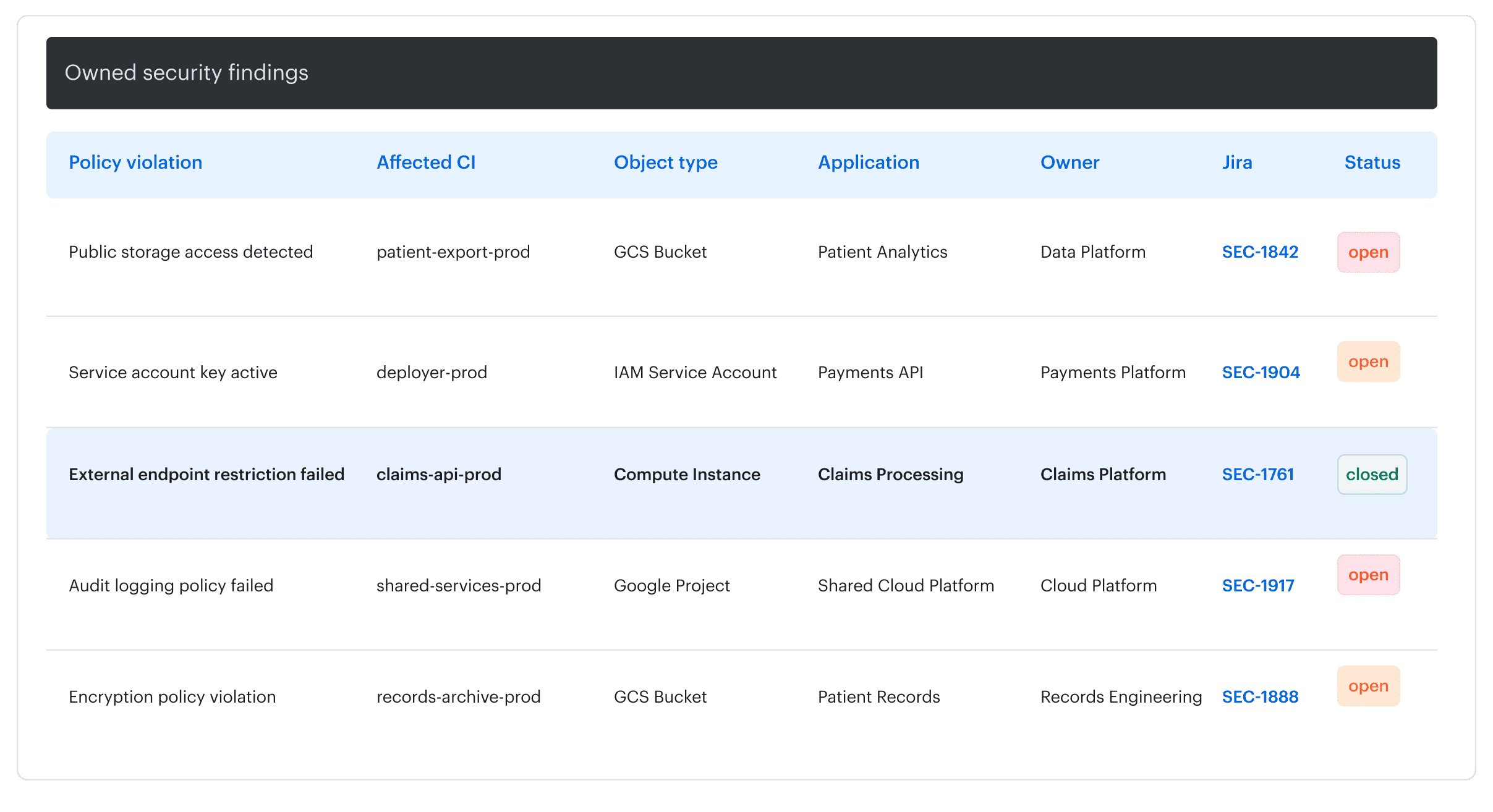 Cloudaware combines policy violations with asset ownership context so findings can be prioritized and routed to the responsible team.
The important control is precedence. An owner obtained from an authoritative application relationship should not be overwritten by an unreliable free-text tag. Conflicting and missing ownership sources should remain reportable rather than being silently normalized into one value.
3. Translate every control objective into platform-specific tests
A control objective defines the required outcome. It does not provide one universal test for every resource type.
The need for resource-specific validation is supported by current threat data. Fortinet’s 2026 study found that identity and access security was the leading cloud-native concern for 77% of respondents, followed by cloud misconfiguration at 70% and data exposure at 66%. Google reported that threat actors targeted data in 73% of the cloud incidents it examined.
A broad control such as “protect sensitive data at rest” must therefore become several technical tests:
| Platform object | Validation question | Required context |
|---|---|---|
| vSphere datastore or VM | Is encryption enabled at the relevant layer, and which key provider supports it? | Workload, cluster, key relationship, last check |
| Kubernetes Secret | Is API data encryption configured, and is access constrained through RBAC? | Cluster, namespace, service account, etcd scope |
| Persistent volume | Does the storage integration encrypt the underlying volume? | PVC, StorageClass, backend, workload |
| AWS backup | Is the backup encrypted with the approved key and retained in the required account and region? | Vault, KMS key, source resource, retention |
| Google Cloud dataset | Do encryption, access, logging, and location settings match its classification? | Project, dataset, key, service account, region |
Kubernetes illustrates why the distinction matters. API data encryption protects Secret data stored in etcd. RBAC controls which identities can retrieve the Secret through the API. Storage encryption for a mounted persistent volume depends on the storage layer. A single Kubernetes encryption result cannot prove all three states.
Each control record should preserve:
- Control Objective
- Platform Implementation
- Test Performed
- Evaluated Resource
- Result
- Evidence Source
- Observation Time
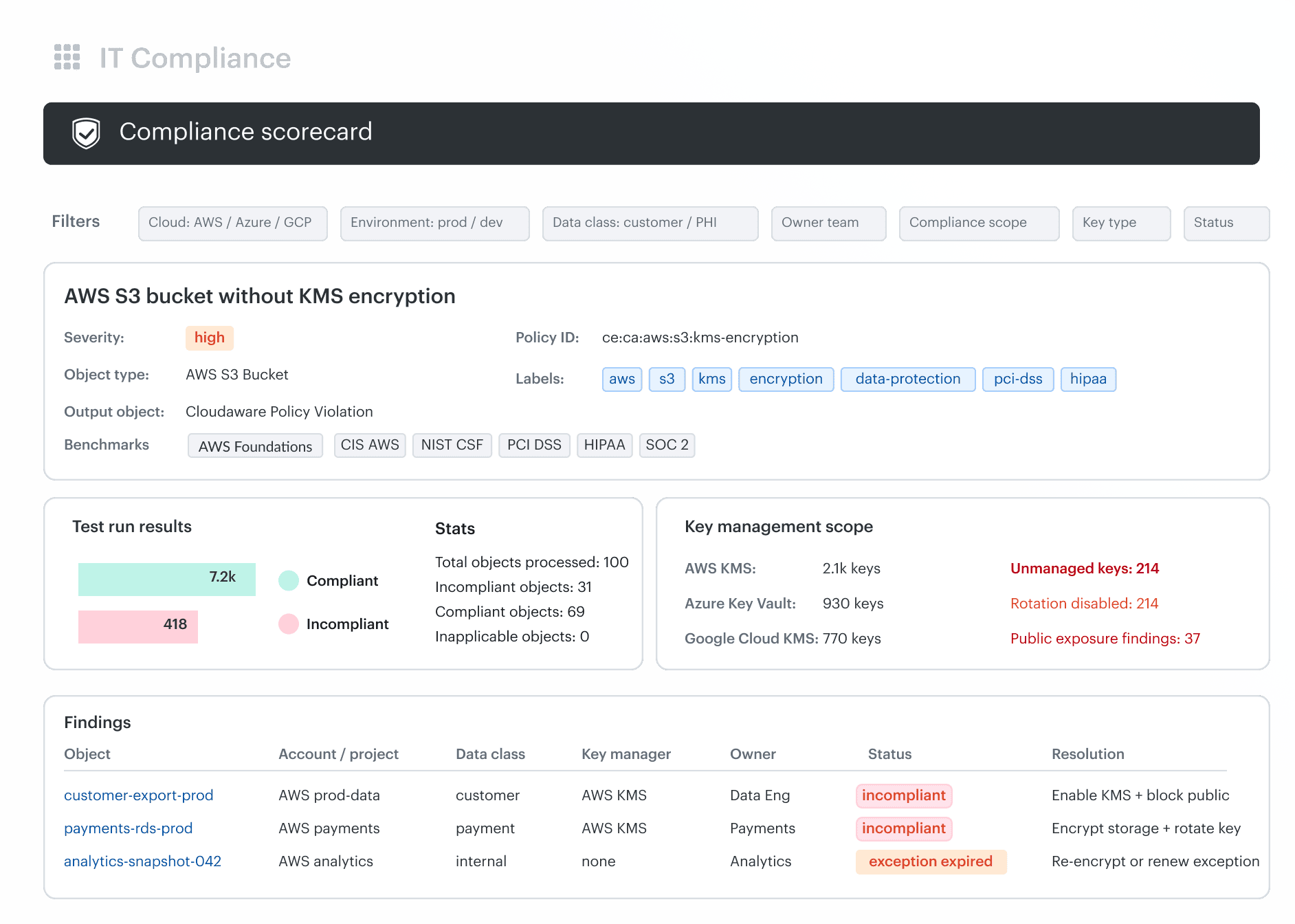 Cloudaware consolidates resource-level encryption and key-management findings so one control objective can be evaluated through platform-specific tests.
It’s important that teams can define separate technical conditions for VMware, Kubernetes, AWS, Azure, and Google Cloud resources while mapping the results to the same higher-level control objective.
To get more insights, see the AWS cloud security assessment for provider-specific assessment scope and the ISO 27001 risk assessment guide for risk-based evaluation.
4. Operate evidence exceptions and remediation as one lifecycle
Security evidence becomes stale as soon as the underlying configuration changes. Evidence collection should therefore run as part of control operations rather than as a separate project before an audit.
The remediation window is also shrinking. Verizon’s 2026 report found that exploitation of vulnerabilities became the leading initial-access vector at 31% of breaches. Only 26% of known exploited vulnerabilities in the assessed population had been fully remediated, down from 38% in the previous reporting period.
A workable lifecycle is:
- Discover the resource and its relationships
- Evaluate the applicable control
- Store the result source population and timestamp
- Route the failure to the correct owner
- Create a Jira or ServiceNow work item
- Review any exception against business and data risk
- Record the approver rationale, scope, and expiry
- Re-evaluate the resource after remediation
- Close the finding after a passing retest or approved disposition
A closed ticket does not prove that the configuration changed. The ticket may have been closed as a duplicate, redirected to another team, or resolved through risk acceptance. The associated control must be evaluated again before the security finding can be treated as technically remediated.
Exceptions require the same discipline. An approved deviation should identify the affected resources, failed condition, approver, rationale, compensating control, and expiry date. A change to the resource’s exposure, application relationship, or data classification should trigger a new risk decision.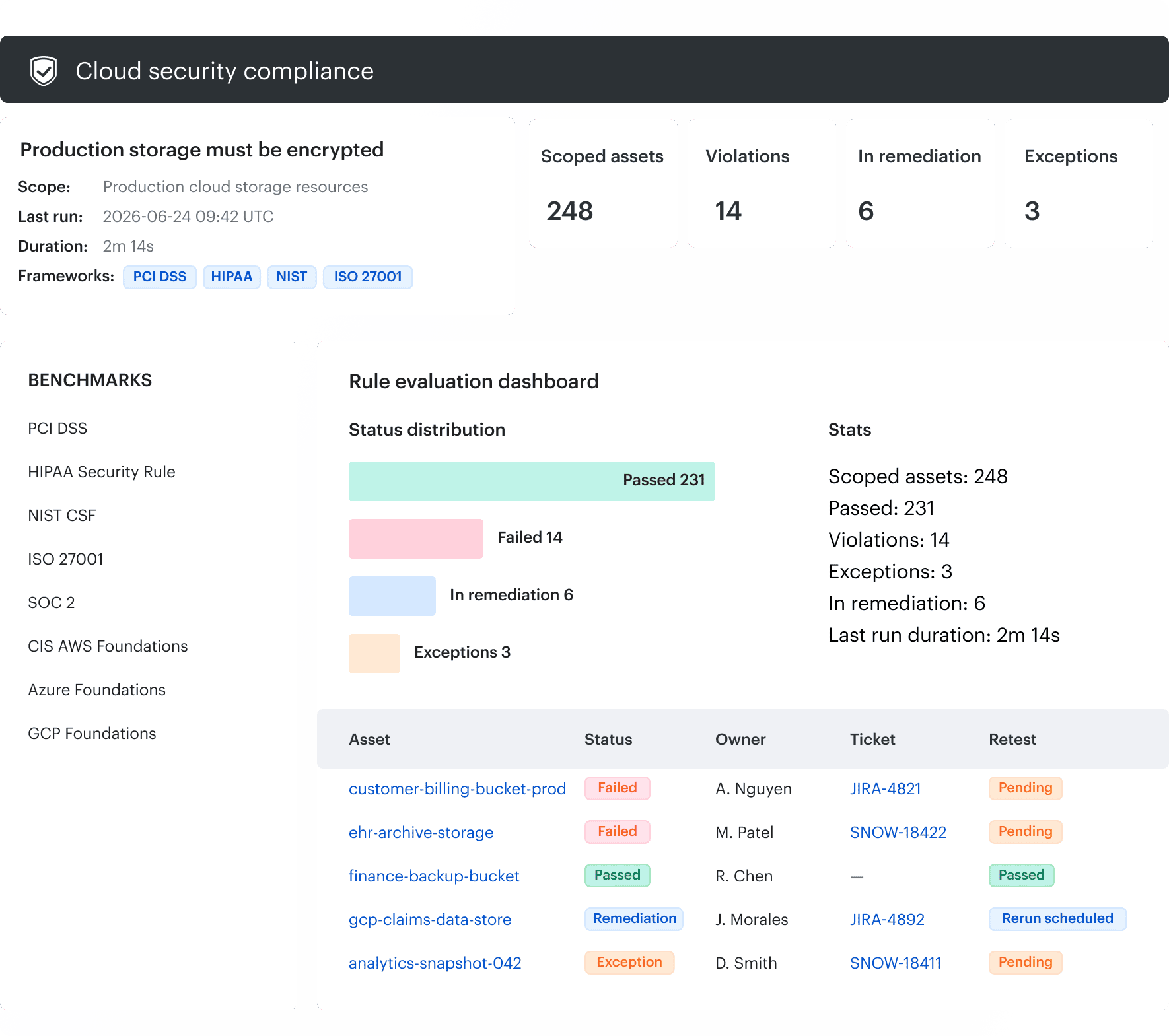 Cloudaware tracks policy results and remediation progress against the current asset population to keep compliance evidence operational and current.
Read also: Enterprise Cloud Security and Governance - CISO Guide
Connect private cloud control evidence with Cloudaware
Cloudaware supports private cloud data security by connecting infrastructure inventory, relationships, control results, ownership context, exceptions, and remediation workflows. It provides the context and validation layer across heterogeneous systems. It does not replace the controls enforced by VMware, Kubernetes, KMS, backup, data-classification, or runtime-security products.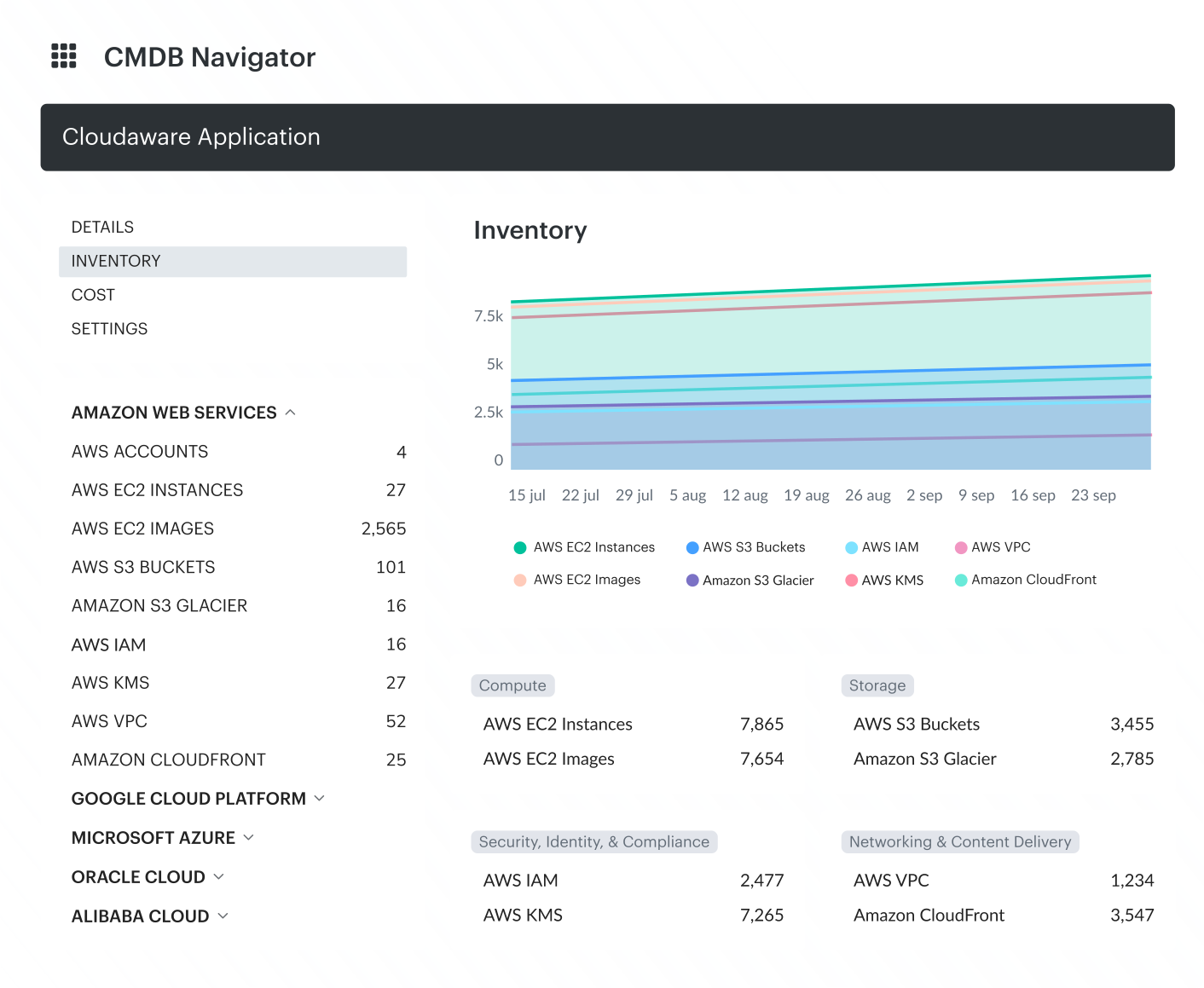 Core capabilities include:
- CMDB: Maintain a live inventory of VMware, Kubernetes, public cloud, and connected infrastructure. Add data sensitivity, business service, environment, technical owner, application owner, control scope, exception reference, evidence timestamp, and remediation ticket to each asset record
- CSPM: Detect configuration conditions that weaken private cloud data protection, including public exposure, missing logging, weak IAM, unencrypted resources, risky network paths, and expired exceptions. Connect each finding to the affected CI and its related applications, storage, identities, and owners
- IT Compliance: Evaluate platform-specific policies for VMware, Kubernetes, AWS, Azure, and Google Cloud resources. Map one technical result to applicable requirements from ISO 27001, NIST, CIS, HIPAA, PCI DSS, SOC 2, and internal policies without rebuilding the same evidence for every framework
- SIEM: Discover cloud and infrastructure log sources and enrich security events with CMDB context. Show which asset, business service, owner, environment, and related resources produced or may be affected by an event
- Integrations: Route failed checks into Jira, ServiceNow, PagerDuty, Slack, or existing operational workflows. Assign findings using asset ownership and business context, track remediation separately from the control result, and retain the relationship between the CI, violation, ticket, and subsequent policy evaluation