



Enterprise cloud security and governance becomes difficult when one CISO is accountable for risk across business units that run different AWS Organizations, Azure tenants, GCP projects, identity models, and security tools. At that scale, enterprise cloud security is less about adding controls and more about keeping material security outcomes consistent across decentralized teams.
In a survey by theCUBE Research, 61.3% of respondents operated between six and 20 cloud accounts or projects across AWS, Azure, and GCP. The sample was Azure-heavy, but the operating issue is broader: as administrative boundaries multiply, locally sound security decisions become harder to compare as one enterprise risk portfolio.
For CISO and CTO leadership, the core questions are which security decisions must stay centralized, what can remain federated, and where shared platforms create systemic exposure across business units.
This article breaks down the enterprise cloud security operating model behind:
- Security invariants
- Centralization boundaries
- Systemic dependencies
- Cross-BU measurement
- Additional pressure created by acquisitions and restructuring
TL;DR
- Centralize outcomes that protect the enterprise from correlated risk, not every provider-specific security decision.
- Define enterprise security invariants that must remain true across business units, cloud providers, and acquired environments.
- Federate implementation only while local variation remains visible and comparable to central security leadership.
- Treat shared identity, CI/CD, network, data, and platform services as shared-platform concentration risk because one control failure can affect otherwise independent teams.
- For implementation priorities, control domains, and execution mechanics, see cloud security strategy guide.
- For RACI, policy exceptions, evidence, review cadence, and decision-right workflows, see cloud security governance.
Why cloud security changes at enterprise scale
The difficult part of enterprise cloud security is not only the number of resources. It is the number of independent operating models applied to them.
Different business units can implement individually reasonable controls yet still produce risk information that is difficult to aggregate. They may classify services differently, report different metrics, maintain separate ownership models, or measure provider-specific controls against different technical baselines.
| Local condition | Enterprise consequence |
|---|---|
| Business units run separate security products | Findings and coverage are difficult to compare |
| Teams use different owner and service taxonomies | Central security cannot aggregate accountability consistently |
| Providers expose different native controls | Control scores may not be directly comparable without a common enterprise outcome |
| Identity and platform services are shared across BUs | A control-plane failure can affect several business units |
| Acquired environments retain existing security models | Material assets can remain outside enterprise reporting |
| Each team reports its own KPIs | Leadership receives metrics that require manual reconciliation |
Tool count does not solve this. The Cloud Security Alliance's 2026 study found that 32% of respondents used 11 or more tools for unstructured-data security, while substantial visibility and protection gaps remained. The scope is narrow, but the distinction matters: deployed capability and measurable coverage are not the same thing.
Which security decisions belong at enterprise level?
Large enterprises need common decisions where inconsistent treatment would create material or correlated risk. Implementation can stay closer to the workload when local variation does not break enterprise comparability.
The Microsoft Cloud Adoption Framework describes a shared-management model in which platform teams provide common capabilities and governance while workload teams retain responsibilities closer to their applications. For cloud security, this creates three practical decision levels: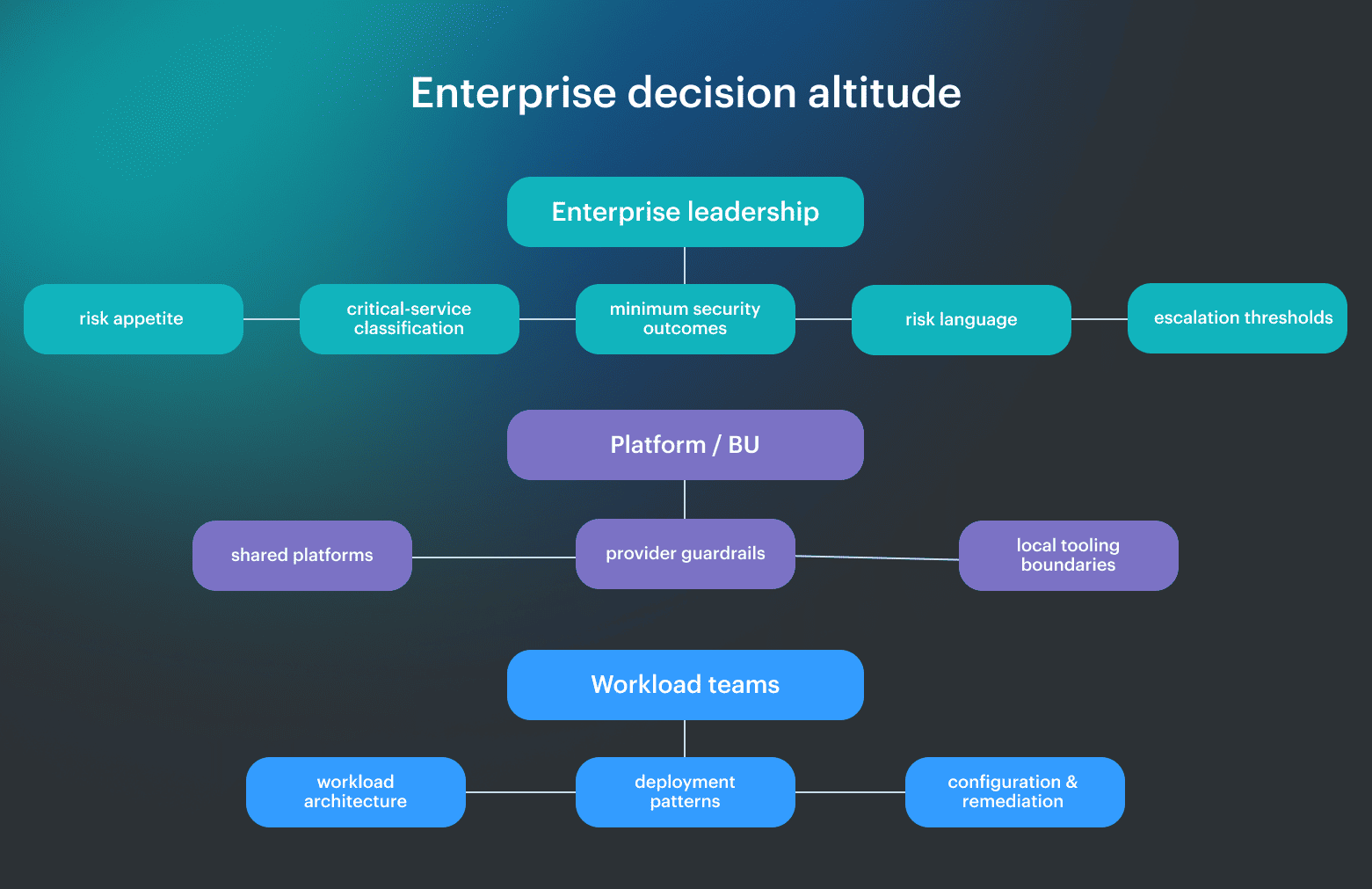 Central security does not need to choose every enforcement mechanism. It needs consistency where local variation would prevent leadership from comparing or accepting risk across the enterprise.
- Enterprise leadership defines the outcomes and risk boundaries that must remain consistent.
- Platform and business-unit teams translate them into shared platforms and provider guardrails.
- Workload teams retain architecture, deployment, configuration, and remediation decisions within those boundaries.
A useful decision rule is: Centralize the outcome when inconsistent treatment creates enterprise risk. Federate implementation when workload or provider context materially affects how that outcome should be achieved.
Define security invariants across clouds and business units
We use enterprise security invariant here as shorthand for a high-level security outcome that should remain consistent even when implementation differs.
That follows the outcome-oriented approach of NIST CSF 2.0, which defines cybersecurity outcomes without prescribing one way to achieve them.
What an enterprise security invariant looks like
An invariant describes the state leadership expects, not the provider feature used to enforce it.
Examples include:
- Every Tier-1 production service sits inside a defined security-monitoring boundary
- Privileged production access is attributable and reviewable
- Internet-facing production resources remain inside enterprise risk visibility
- Critical services have an accountable organizational owner
- Shared-platform security events can be traced to affected applications and business units
- Regulated workloads can demonstrate current control coverage
- Critical services produce the telemetry required for investigation
These requirements remain meaningful if a team changes cloud provider or replaces an enforcement product. For the operating model behind telemetry coverage, resource context, ownership, and response, see cloud security observability.
Allow different implementations without losing comparability
A requirement such as “privileged production access must be attributable” can map to different IAM constructs, logging sources, and enforcement mechanisms across providers. The same enterprise outcome can map to different posture-management mechanics by provider. See AWS cloud security posture management and Azure cloud security posture management for provider-specific operating models.
Requiring identical implementation can create a central bottleneck at scale and is not necessary for achieving the same high-level outcome. For a GCP-specific example of how identity, hierarchy, service boundaries, logging, and posture controls translate into an operating model, see Google Cloud security.
| Enterprise invariant | Local implementation can vary | Enterprise still compares |
|---|---|---|
| Critical resources cannot be unintentionally public | Native controls, IaC checks, admission controls | Coverage and material failures |
| Privileged access is attributable | Provider IAM, PAM, workload identity | Effective privileged paths and ownership |
| Tier-1 services produce required telemetry | Provider-native logs, agents, pipelines | Coverage and missing sources |
| Critical services have known ownership | Tags, CMDB relationships, service catalogs | Business unit, service, and accountable owner |
| Required controls remain evaluated | Native controls, CSPM, policy-as-code | Outcome coverage across the estate |
Decide where federation ends, and enterprise control begins
Federated cloud security works only while local variation remains bounded. Once business units use incompatible definitions of material risk, ownership, required telemetry, or control coverage, central leadership is no longer comparing different implementations of one model. It is reconciling several security models.
Where centralization reduces systemic risk
Centralization is most valuable where inconsistency affects more than one organizational unit.
Typical candidates include:
- Enterprise identity and trust principles
- Minimum requirements for shared cloud platforms
- Common risk and criticality definitions
- Telemetry requirements for Tier-1 services
- Minimum enterprise visibility
- Material-risk escalation thresholds
- Security expectations for shared services
- Reporting dimensions used by executive leadership
The central layer defines the requirement and how it will be measured. It does not need to perform every enforcement or remediation action.
Where federation protects speed and technical autonomy
Federation is appropriate where local context materially changes implementation:
- Workload architecture
- Provider-native configuration
- IaC and deployment tooling
- Service-specific patterns
- Remediation execution
- Platform automation
- Security tooling that fills a legitimate local gap
If business units retain different security platforms, evaluate them against the same enterprise requirements for scope, ownership context, prioritization, remediation, and reporting. Use this CSPM vendor comparison for posture-management requirements, and this CNAPP tools comparison for broader coverage across posture, workloads, vulnerabilities, and runtime security.
| Decision | Enterprise level | Federated level |
|---|---|---|
| Risk appetite | Define tolerance and materiality | Treat local risk within delegated limits |
| Minimum security outcomes | Define required state | Choose provider/workload implementation |
| Critical-service classification | Define criteria | Map applications and services |
| Shared-platform requirements | Define minimum outcomes | Design platform-specific controls |
| Security visibility | Define required scope | Maintain local operational views |
| Remediation | Define materiality and SLA classes | Execute fixes |
| Tooling | Define data and reporting requirements | Retain local tools where justified |
The Microsoft Cloud Adoption Framework warns that a fully centralized model can become a bottleneck as cloud adoption scales. The opposite extreme creates another problem: local security programs may remain internally coherent while their findings, criticality definitions, and risk metrics become difficult to reconcile.
The decision test is: Does local variation preserve the enterprise's ability to understand and compare material risk? If not, the issue belongs at a higher organizational level.
Treat shared platforms and dependencies as a concentration risk
A large enterprise cannot prioritize risk only by counting workload findings. Some technical dependencies carry consequences far beyond the team that operates them.
Here, shared-platform concentration risk means exposure created when one shared platform, identity boundary, or control plane supports many services or business units.
Identify control planes with enterprise-wide blast radius
High-concentration dependencies often include:
- Enterprise identity providers
- Cloud landing-zone automation
- Shared CI/CD infrastructure
- Organization-wide secrets services
- Central Kubernetes platforms
- Enterprise network and transit services
- Logging and security telemetry pipelines
- Shared data platforms
- Common SaaS integrations
- Security platforms trusted by many business units
Consider a shared CI/CD platform used across many applications. A vulnerable dependency inside one workload is primarily a local problem. A compromised shared runner, signing mechanism, deployment identity, or secret store can expose multiple teams through the same trust path.
A business-unit risk register can therefore look healthy while omitting a shared dependency underneath several applications.
Prioritize systemic exposure above isolated findings
NIST SP 800-30 explicitly includes dependencies on common infrastructure and shared services in risk assessment. That dependency context changes how an enterprise should interpret an individual finding.
CISOs need to evaluate two dimensions:
- Local exposure: How serious is the condition for the affected workload?
- Enterprise concentration: How many critical services, trust boundaries, or business units depend on the affected component?
A weakness in a shared identity or deployment platform may therefore deserve more executive attention than several higher-severity findings isolated to non-critical workloads.
The underlying trust and dependency design belongs in a multi-cloud security architecture. Enterprise security leadership needs the aggregate view of where those dependencies create correlated exposure.
Measure enterprise consistency, not security-team activity
Scanner totals, closed tickets, policy counts, and raw MTTR can help an operating team. They do not tell a CISO whether security expectations hold consistently across the organization.
For this operating model, a more useful executive measure is material deviation from the common enterprise outcome.
Compare material exposure across business units and clouds
Useful measures include:
- % of Tier-1 services meeting required security invariants
- Number of business units outside enterprise risk tolerance
- Critical services outside enterprise security visibility
- Invariant coverage by AWS, Azure, GCP, and hybrid estate
- Acquired environments not yet incorporated into enterprise reporting
- Adoption of required shared security capabilities by critical services
- Concentration of critical dependencies in shared platforms
- Duplicated security stacks performing equivalent functions across business units
The objective is to expose distribution, not hide it inside an enterprise average. A strong aggregate coverage rate can still conceal one business unit with materially weaker coverage.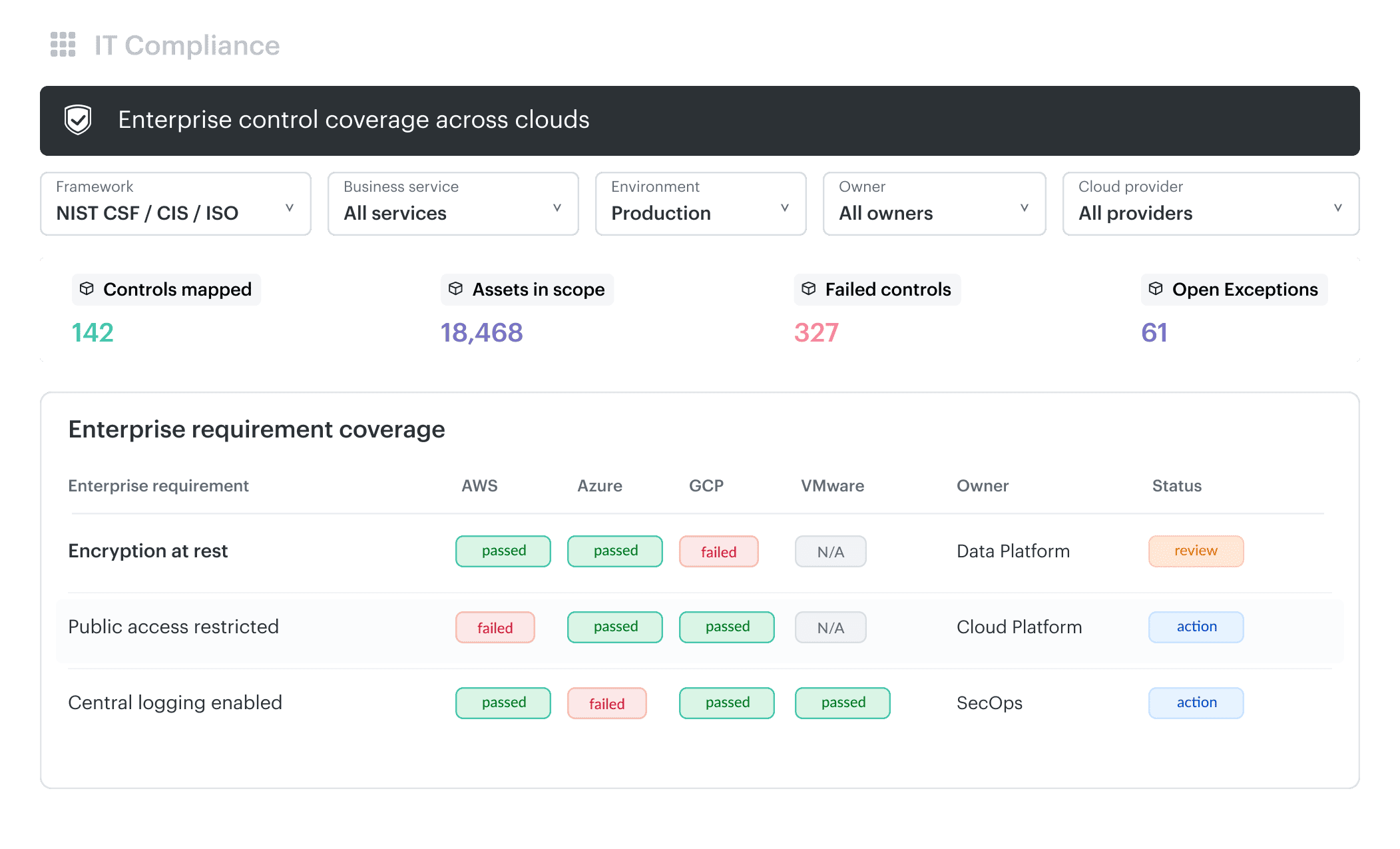 Example enterprise control coverage view in Cloudaware, comparing security outcomes across business units, cloud providers, and critical services.
Track where the enterprise model is not holding
The Cloud Security Alliance's 2026 study illustrates why perceived maturity is a poor substitute for measurable coverage. 75% of respondents described themselves as moderately or highly confident in securing unstructured data, yet 68% reported that less than 80% of their unstructured data was protected.
The study is specific to unstructured data. The reporting lesson is broader: executive assurance needs a defined denominator.
A practical enterprise scorecard can therefore compare:
| Dimension | Executive question |
|---|---|
| Business unit | Which BU is materially outside the enterprise baseline? |
| Tier-1 services | Are critical services covered consistently? |
| Invariant coverage | Which required outcomes are failing? |
| Visibility gaps | Which critical services are outside central security scope? |
| Shared-platform exposure | Where is risk concentrated across dependent services? |
| Required action | Which issue requires an enterprise decision? |
A CISO metric should point to an organizational boundary, critical service, or systemic dependency that requires a decision. Otherwise, it is probably operating telemetry rather than an enterprise security metric.
Enterprise cloud security during acquisitions and restructuring
M&A tests whether the security model is portable. An acquired company often arrives with an existing identity and cloud operating model that differs from the parent organization.
Microsoft's multi-tenant landing-zone guidance describes acquisitions as a common reason organizations operate separate tenants and notes that consolidation can remain complex or incomplete. Enterprise risk assessment, therefore, has to work before every identity, platform, and tooling decision is standardized.
Bring acquired environments into enterprise security visibility first
Central security needs enough context to distinguish material exposure from integration debt.
The first pass should establish:
- Which AWS Organizations, Azure tenants and subscriptions, GCP organizations and projects, SaaS environments, and hybrid systems entered scope
- Which workloads and platforms support critical business services
- Which resources are externally exposed
- Which identity and network trust relationships cross into the parent enterprise
- Which shared dependencies already exist
- Which enterprise security invariants currently fail
- Which risks cannot wait for the longer integration program
That gives leadership a minimum-risk picture before architecture and tooling converge. Once the estate boundary is known, provider-specific reviews can test whether local hierarchy, evidence sources, and control coverage meet the enterprise model. See the Google Cloud security assessment for the GCP-specific approach.
Decide what must converge and what can remain local
Not every acquired security product or platform needs to disappear. Convergence should be prioritized where inconsistent systems prevent the enterprise from:
- Identifying critical assets
- Interpreting risk using the same semantics
- Measuring required security outcomes
- Understanding cross-company trust
- Comparing security posture
- Reporting material exposure
Other implementations can coexist if they preserve those capabilities.
| Acquisition stage | Enterprise security question |
|---|---|
| Initial scope | What cloud and security estate did we acquire? |
| Visibility pass | Which critical services sit outside enterprise visibility? |
| Outcome comparison | Which security invariants do not currently hold? |
| Dependency review | Which trust relationships create exposure across both organizations? |
| Convergence decision | What must be standardized, and what can safely remain local? |
A practical sequencing rule is: Normalize scope and risk interpretation before forcing technology standardization.
That also creates a stronger basis for consolidation. A central tool should replace a local one because the enterprise needs a common capability, data model, or control outcome, not because uniform architecture is an objective by itself.
How to evaluate whether the enterprise operating model is working
A workable enterprise model does not require every business unit to look the same. It requires local differences to remain understandable from the center.
Use these five questions as an executive diagnostic:
- Which business units are outside enterprise security expectations?
- Can Tier-1 services be compared across AWS, Azure, GCP, and hybrid infrastructure using the same risk language?
- Can a failure in a shared platform be traced to the business services that depend on it?
- Can an acquired environment enter enterprise visibility before its entire technology stack is standardized?
- Can local teams choose different technical implementations without breaking enterprise security reporting?
Several “no” answers indicate a structural problem. Individual teams may have adequate controls, while the enterprise lacks the context required to manage them as one risk portfolio.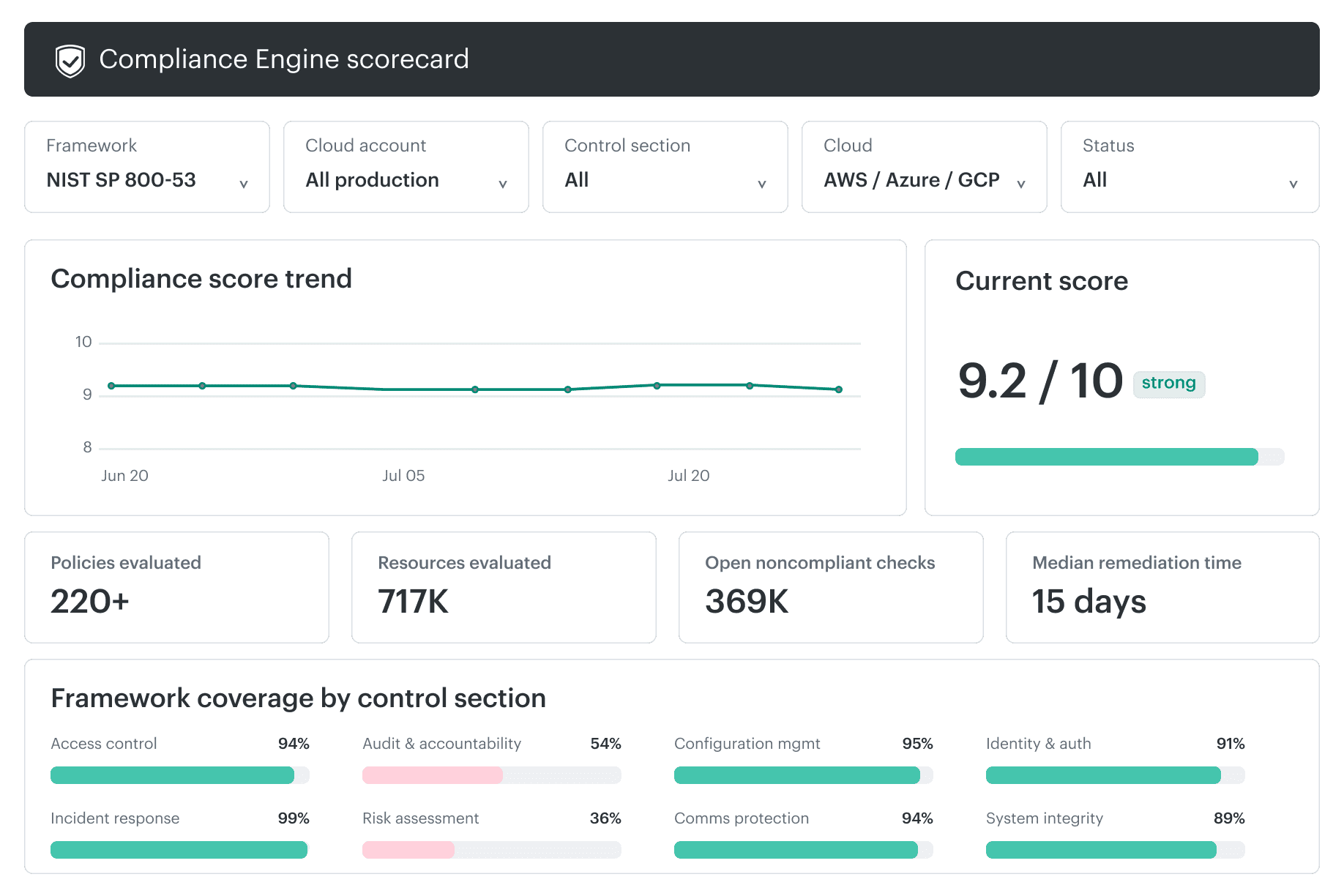 Example of Cloudaware Compliance Engine scorecard evaluated resources, compliance trends, and framework coverage by cloud account and control section.
Get enterprise-wide security context across decentralized cloud estates with Cloudaware
Cloudaware can serve as the shared inventory and reporting layer across AWS, Azure, GCP, VMware, Kubernetes, and hybrid infrastructure. It normalizes provider-specific resources into a common CMDB model while preserving application, owner, environment, account, region, and relationship context. 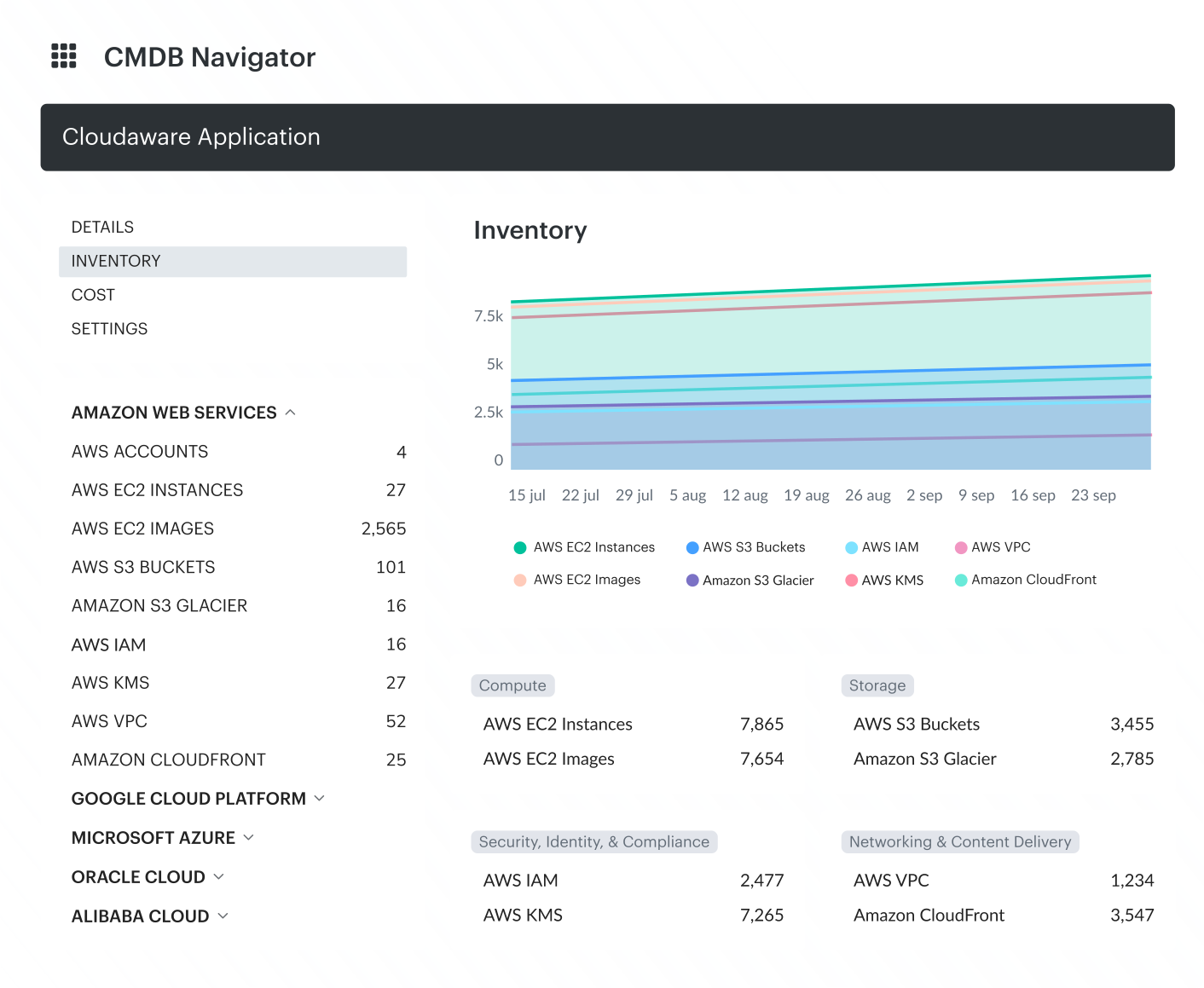 Core capabilities:
- Establish a common enterprise scope. Use the multi-cloud CMDB to discover and query resources across providers, accounts, regions, and environments. Cloudaware models provider-specific resources as CIs and adds organizational context such as applications, owners, tags, and business metadata.
- Group infrastructure around business services. Use Virtual Applications and CMDB relationships to organize resources from different clouds around applications, services, teams, or other logical boundaries.
- Compare security coverage across organizational boundaries. Use CSPM to scope controls by application and environment, map accounts and regions into a common view, and attach owner, application, and environment context to findings.
Cloudaware does not define the enterprise's risk appetite, security invariants, delegation model, or concentration-risk priorities. Those remain management decisions. Its role is to provide the common asset, relationship, and reporting context needed to evaluate whether those decisions still hold across decentralized infrastructure.