


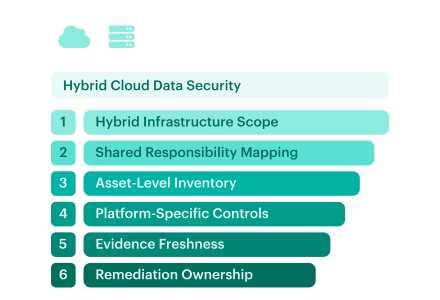
Hybrid cloud data security often breaks at the handoff. An on-premises control pass. The cloud replica clears a different test. Neither result proves that the data path remains owned, traceable, and governed.
That boundary is common, not exceptional. Flexera’s 2026 State of the Cloud report, based on a survey of 753 cloud professionals and executives worldwide, found that 73% operate hybrid cloud environments.
Picture an on-premises database replicated to Azure Storage for analytics. Infrastructure owns the source. Cloud Platform owns the replica. A federated identity reads both copies. Each team can defend its endpoint. Nobody can defend the handoff.
This guide tests three seam failures: split inventory, drifting key governance, and broken lineage. It finishes with one operating answer: reconcile the complete data path before evaluating its controls.
Key insights
These five decisions keep the review anchored to one dataset and one evidence window.
- A local control result proves an endpoint state. It does not prove the transfer, replica, or ownership change.
- Split inventories hide one regulated dataset behind unrelated CIs, owners, keys, and review dates.
- Key governance must produce equivalent outcomes across HSMs, AWS KMS, Azure Key Vault, and Google Cloud KMS.
- Residency evidence must follow backups, exports, logs, restores, and derived datasets beyond the approved primary region.
- Close the seam only when inventory, keys, identities, and lineage resolve within the same evidence window.
What hybrid cloud data security actually means
Hybrid cloud data security is the discipline of protecting data stored across, or moving between, on-premises infrastructure and public clouds. It protects each dataset's source, copies, keys, access paths, owners, and permitted locations. Endpoint controls remain necessary. They cannot prove the handoff without shared evidence.
Take an illustrative nightly export from SQL Server to Amazon S3. Infrastructure owns the source record. A platform team owns the bucket. One federated role can query both copies.
The review starts with five fields:
- dataset_id
- accountable owner
- classification
- key reference
- approved region
One mismatch leaves the transfer unproven. Both storage systems may still pass their local checks.
The network path may use AWS Direct Connect, Azure ExpressRoute, Google Cloud Interconnect, or a VPN. That route proves connectivity. It does not prove consistent ownership, classification, retention, or key custody.
Identity crosses differently. SAML or OIDC federation may start from Active Directory or LDAP. The user never moves with the data. Their effective access still crosses the same control boundary.
Scope boundary: This guide owns the data crossing. Use hybrid cloud security architecture for topology and control placement. Read cloud security threats for attacker behavior. The cloud data security practices guide covers steady-state controls.
Benny Bloch, Global-e's CISO during a 2024 data-security interview, named the visibility requirement:
"DSPM allows us to see where data moves, how it's controlled, and where potential exposures lie."
The quote concerns cloud posture. Its movement test still exposes a failed source-to-replica relationship.
The three data problems that only exist in the seam
Three failures are specific to the handoff: split inventory, drifting key governance, and uncertain lineage. Each begins when evidence stops following the dataset.
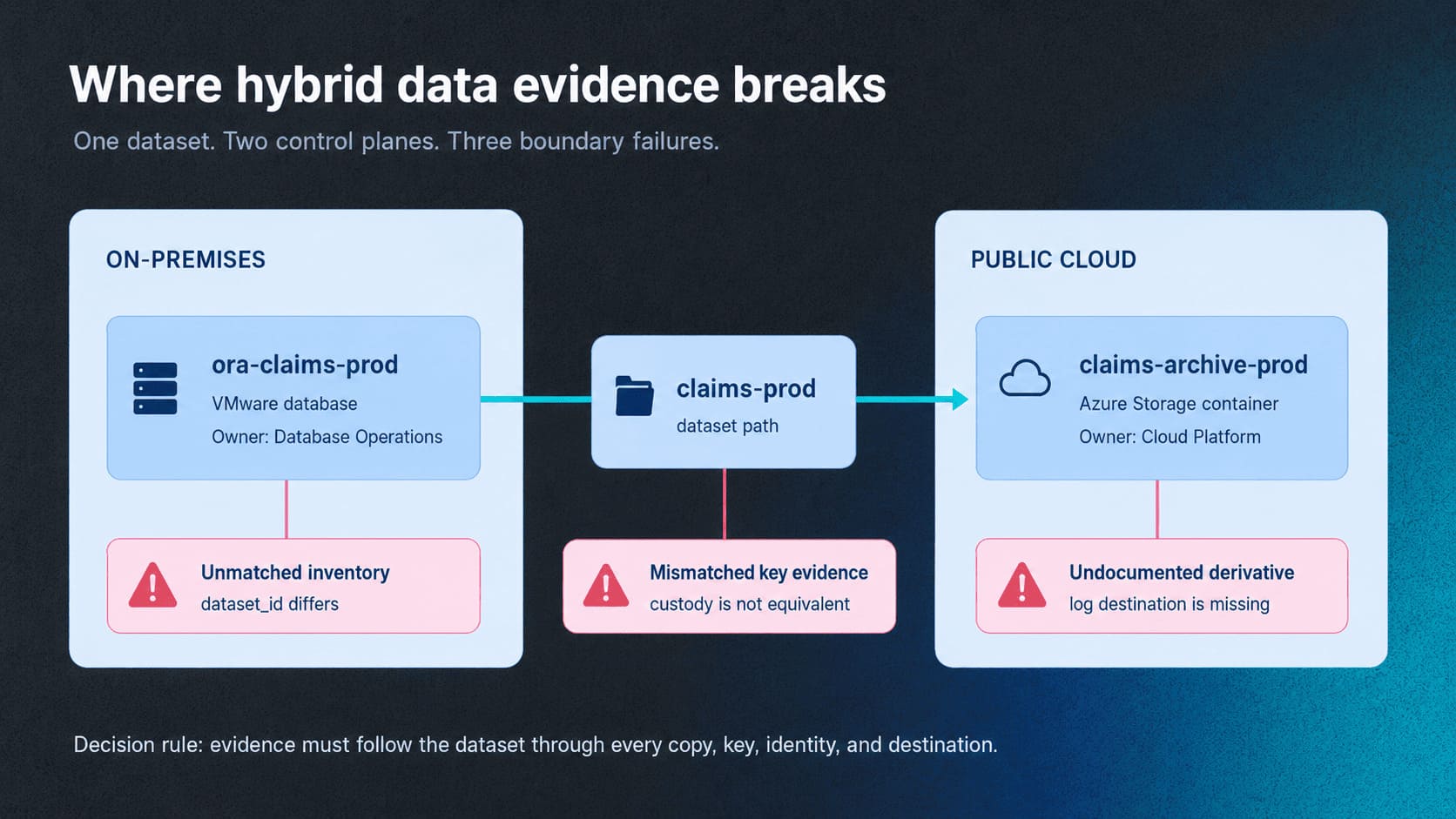
The seam breaks when security evidence stops following the dataset.
Split inventory hides the accountable data owner
An on-premises CMDB may list the database, host, and infrastructure owner. Cloud inventory records the destination, region, and platform team. Neither inventory necessarily records that both resources hold the same regulated dataset.
Consider an illustrative backup path. ora-claims-prod runs on VMware and writes Oracle RMAN backups to nfs-bkp-07. A transfer job copies them into claims-archive-prod in Azure Storage.
Three teams own three resources. None can produce the complete copy chain with one accountable data owner.
Diagnose that gap against these records:
- dataset_id, source CI, and destination CI
- business owner and technical owner
- transfer job, region, retention, and last_seen
A destination without a source relationship signals missing coverage. A relationship without a current owner exposes a governance failure.
Identity can break the same record. Microsoft Entra ID may authorize a group for Azure Storage. Membership may originate in Active Directory through federation.
Follow the source group, synchronization, role assignment, container scope, and last data operation. Never join identities by display name alone. Microsoft documents how Azure roles authorize Blob data access at defined scopes.
NIST's hybrid-cloud reference implementation treats consistent protection and visibility across platforms as an explicit outcome. Two complete inventories fail that outcome when their records cannot reconcile.
Encryption can pass while key governance drifts
An encryption flag answers one narrow question. It does not identify the key custodian, administrator, recovery path, or policy history.
Consider an illustrative finance export encrypted by an on-premises HSM. Its cloud copy receives another encryption layer through AWS KMS. Both resources report encryption enabled.
The HSM requires dual approval. A broad platform role can administer the KMS key. Matching encryption results now hide a weaker approval boundary.
Preserve the evidence before changing either policy:
- dataset_id, key_id, custodian, and administrator principals
- rotation state, policy version, and recovery method
- audit source and verification timestamp
Route a policy mismatch to the cryptography or IAM owner. Missing storage encryption belongs to the workload owner.
Provider details matter. AWS multi-Region key replicas share key material and key IDs. Their policies, grants, aliases, and tags remain independent. AWS documents that boundary directly.
Azure Key Vault and Google Cloud KMS expose different policy objects. Compare the control outcome, not identical field names. The approved standard should cover custody, administration, rotation, recovery, logging, and exceptions.
BYOK and HYOK change custody. They also add recovery, availability, rotation, and compromise decisions. NCSC key-management guidance recommends customer-controlled keys only when the requirement justifies them.
Residency and lineage fail after the first transfer
An approved cloud region proves where one resource operates. It does not locate every backup, export, log, restore, or derivative.
Picture an illustrative claims database approved for processing in Germany. A scheduled job sends masked records to eu-central-1. Later, verbose application logs copy customer identifiers into a global support service.
The primary database may pass its residency check. The log derivative needs another review. Inspect its fields, destination, access, retention, jurisdiction, and legal owner.
Trace one Tier 1 dataset through four branches:
- replicas and backups
- restores and exports
- diagnostic and application logs
- transformed or derived datasets
For each destination, record the source, transformation, region, purpose, retention, owner, and timestamp. The first undocumented destination marks the point of broken lineage.
The NCSC asset-protection guidance includes verbose logs and machine-learning models among data derivatives. Neither object inherits residency approval automatically. Compliance still needs location, access, retention, and ownership evidence.
The seam remains ungoverned when evidence resolves to different datasets, owners, or timestamps.
Closing the seam: What data security in hybrid cloud requires
Closing the seam means assigning one owner, evidence set, and pass condition to each regulated path. Local dashboards can stay green while describing different datasets.
Pass rule: Inventory, keys, identities, and lineage must resolve to the same dataset_id and review window.
| Control | Accountable owner | Minimum evidence | Pass condition |
|---|---|---|---|
| Inventory | CMDB and data governance | Source CI, destination CI, classification, transfer job, owner, last_seen | Every regulated copy relates to one authoritative dataset record |
| Key governance | Cryptography or IAM | key_id, custodian, administrators, rotation, recovery, audit source | Source and replica meet approved governance outcomes |
| Identity monitoring | IAM | Source group, federation mapping, effective role, scope, last use | Each access path matches approved scope and current use evidence |
| Residency and lineage | Data governance | Source, destination, transformation, region, purpose, retention, legal owner | Every copy and derivative remains inside approved rules |
Test one regulated path before scaling the model:
- Reconcile the records. Map ora-claims-prod, nfs-bkp-07, and claims-archive-prod to one dataset_id. Reject stale or ownerless relationships.
- Compare key outcomes. Normalize custody, administration, rotation, recovery, audit source, and exception status across both key systems.
- Trace effective access. Resolve the source identity, federation mapping, cloud role, resource scope, and last operation.
- Finish the lineage record. Walk backups, restores, exports, logs, and derived destinations. Record each purpose, region, retention, and owner.
The operating view needs two measures:
- Seam coverage: Regulated datasets with current evidence for all four controls, divided by regulated datasets in scope.
- Exception age: Days since the path failed, grouped by accountable owner and expiry date.
Use 100% as an internal target for Tier 1 datasets, not an industry benchmark. Retest after destination, key-policy, federation, or region changes.
Exception rule: Missing metadata should not automatically interrupt critical replication. Preserve event evidence and restrict new consumers where feasible. Assign an owner and expiry. Close the exception only after reconciliation and fresh control tests.
One inventory across on-premises and every cloud
Hybrid cloud data security becomes operable when every source and replica can be tested as one path. Separate consoles cannot prove shared ownership, permitted regions, effective access, or review dates.
Required output: dataset_id -> source CI -> transfer job -> destination CI -> owner -> last_seen
That relationship is the gap a cross-environment CMDB must close. Configured Cloudaware collectors ingest public-cloud and on-premises inventory. Mapped attributes and CI relationships make provider-specific records queryable together.
The Cloudaware CMDB does not replace an HSM, KMS, identity provider, or log source. It supplies the shared asset context needed to test the seam.
Reconcile the dataset before counting controls
A combined asset count proves discovery, not reconciliation. The security architect needs the same dataset mapping across VMware, on-premises storage, and Azure.
For the illustrative claims-prod path, inspect three conditions:
- Relationship: ora-claims-prod -> nfs-bkp-07 -> claims-archive-prod
- Accountability: Data owner, technical owner, classification, and approved destination region
- Freshness: last_seen for each CI and the relationship check
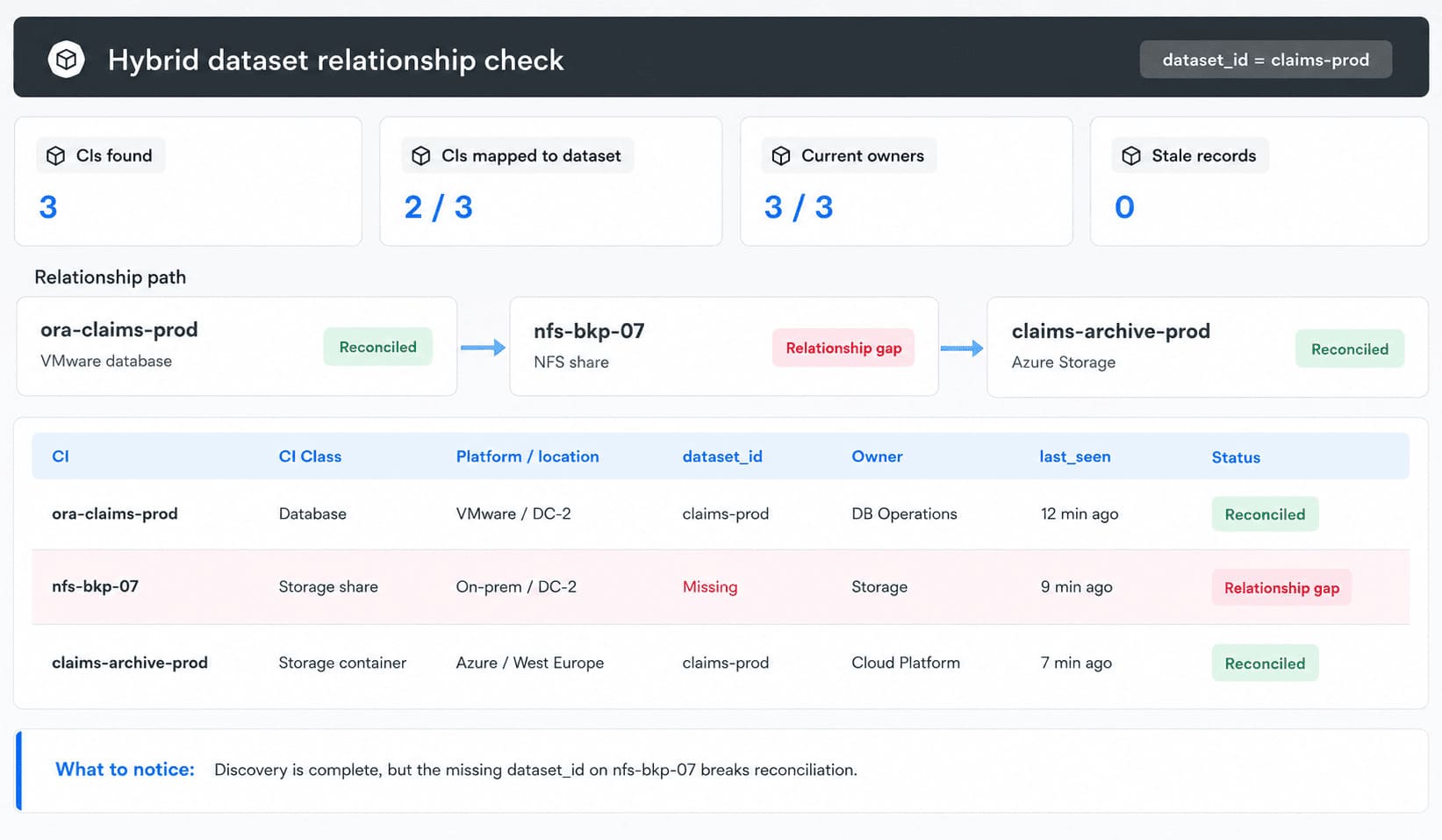
Cloudaware dashboard. All three CIs exist, but nfs-bkp-07 lacks the mapped dataset_id.
The missing field breaks the path. The CMDB owner fixes the authoritative source or enrichment rule. Customer-defined mappings supply dataset_id, ownership, and transfer relationships. Closure requires 3/3 mapped CIs after collection.
Coverage still depends on configured sources and supported CI Classes.
A Coca-Cola case study shows why that shared inventory layer matters. Before Cloudaware, the team had no unified infrastructure asset database across AWS, Azure, and on-premises data centers, which made it harder to answer basic operational questions such as where a machine was hosted and who owned it.
Carry the same scope into CSPM and log review
After the CIs reconcile, posture results and identity events must retain the same dataset, application, environment, and owner. Otherwise, control evidence still splits at the seam.
Run two checks:
- Evaluate the mapped path. A Cloudaware CSPM policy can inspect configured CMDB fields across cloud and on-premises CIs. Comparing HSM and Azure Key Vault outcomes requires mapped fields and a custom policy. A Policy Violation identifies the failed condition. It does not change either source configuration.
- Correlate the identity events. Cloudaware SIEM ingests configured cloud logs and on-premises sources through Syslog or Beats. CMDB tags add owner, application, environment, and asset context during ingestion. Lucene search can filter the mapped dataset and event window.
Azure Activity Logs cover control-plane events. Blob reads require configured Storage resource logs. Microsoft's monitoring guidance explains that distinction. CMDB context cannot reconstruct a missing source log.
Pass condition: The architect can open the policy result and related events with the same dataset, owner, and scope. Remediation still occurs in the source system or a configured workflow.
"Cloudaware CMDB platform has streamlined our operations and provided us with the visibility and control we needed."
Anthony Palmer, Global Cloud Operations, Coca-Cola, quoted on the Cloudaware CMDB page
The statement supports unified operating visibility. It does not prove connector coverage or automatic control closure.