


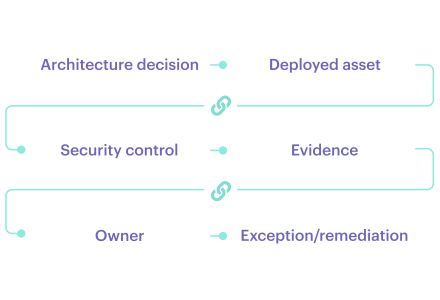
A cloud security architecture review does not ask whether your architecture is well designed. It asks whether your production environment still implements that design.
Architecture documents, ADRs, cloud inventories, policy results, CI/CD records, and CMDB data are rarely updated together. When they describe different versions of the same environment, reviewers cannot determine whether approved architecture, deployed resources, and security controls still align.
In this guide, you’ll learn how to:
- Define review scope and review depth.
- Validate the deployed environment against the approved architecture.
- Build a reproducible evidence package for reviewers.
- Identify and resolve gaps before the formal review.
- Establish a repeatable cloud security architecture review process for multi-cloud and hybrid environments.
A broader cloud security architecture defines how the system should be structured. The review verifies whether that design still exists in production and whether its risk assumptions remain valid.
Key takeaways
- A cloud security architecture review verifies whether the approved architecture still exists in production, not whether the original design was correct.
- Reconcile architecture diagrams, ADRs, cloud inventories, CI/CD records, policy results, and CMDB data before the review. Reviewers should evaluate architecture, not reconstruct it.
- Define review scope by architecture risk, trust boundaries, and business impact rather than project size or team ownership.
- Evidence should prove architecture decisions in the deployed environment, including affected resources, applicable controls, accountable owners, and any approved exceptions.
- A successful review produces repeatable evidence that can be reused for future architecture reviews, audits, and significant infrastructure changes.
What the review should prove
A cloud security architecture review should prove that the system is appropriate for its risk, implemented as approved, and supported by current evidence from the deployed environment.
Security frameworks help reviewers define the outcomes they expect to see, but they do not explain how a particular architecture should achieve them. Teams still need to demonstrate which design decisions, configurations, identity paths, and operational controls satisfy those outcomes.
For example, NIST Cybersecurity Framework 2.0 defines cybersecurity outcomes without prescribing a single implementation method. The framework establishes the expected result, but the review must still show which design decision, configuration, identity path, or operational control produces it.
Connect design intent to deployed architecture
Separate the proposed design, the approved design, the implementation delivered by engineering, and the state currently observed in production. Review preparation begins by identifying material differences between those four states.
A managed service may replace a planned self-hosted component. A temporary public endpoint may remain after testing. A deployment role may gain broader permissions to resolve an operational issue. A SaaS integration may be added without updating the system context diagram.
For each material difference, record:
- Affected resources and relationships
- Reason for the change
- Approving authority
- Effect on existing controls
- Resulting attack surface or blast radius
- Whether the original risk decision still applies
The AWS Well-Architected Security Pillar treats security as part of workload design, delivery, and maintenance. Architecture risk continues after design approval because implementation, dependencies, permissions, and operating conditions change.
Distinguish the review from adjacent security activities
| Activity | Primary question | Typical output |
|---|---|---|
| Security architecture review | Are the design decisions and deployed relationships acceptable? | Decisions, required changes, exceptions, approvals |
| Cloud security assessment | How effective is the broader security posture? | Findings, maturity gaps, remediation priorities |
| Threat modeling | Which attack paths and abuse scenarios are plausible? | Threat scenarios, mitigations, residual risk |
| Penetration testing | Which weaknesses can be exploited? | Validated vulnerabilities and attack chains |
| Compliance review | Can required controls be demonstrated? | Control evidence, gaps, corrective actions |
The architecture review connects assessment and threat-model findings to the system design, current resource relationships, ownership model, and accepted risk.
Set the review workflow with intake, risk triage, and lifecycle gates
A structured review starts by establishing what is changing, which security assumptions are affected, and how much scrutiny the change requires.
Without standardized intake and triage, security teams discover basic context through recurring project meetings. Low-risk changes consume the same attention as new public workloads, while high-risk design decisions may reach security after implementation has started.
Start with a standardized security intake
The intake should capture the minimum context required to route the review.
Minimum intake fields
- Business service
- Business owner
- Technical owner
- Change description
- Target release
- Environments and administrative boundaries
- Data classification
- External exposure
- Identity and privileged-access changes
- Third-party, SaaS, and hybrid dependencies
Escalation fields
- New trust boundary
- New cloud provider or control plane
- Cross-region or regulated data handling
- Expanded production blast radius
- New public endpoint
- New privileged identity path
- Change to encryption-key ownership
- New shared platform or landing zone
The intake is not the review. It allows security to route the change from written scope and risk factors, then join only the sessions where an architecture decision remains unresolved.
Match review depth to architecture risk
Project size is a poor proxy for review depth. A small integration can introduce a privileged identity path or regulated-data transfer, while a large internal refactoring may leave the trust model unchanged.
| Review depth | Decision rule | Minimum exit condition |
|---|---|---|
| Lightweight | No new identity path, data flow, trust boundary, public exposure, or control owner | Affected assets and targeted evidence are recorded |
| Focused | One material security assumption changes | Updated diagram or ADR, control evidence, owner, and validation are complete |
| Full | A new platform, provider, shared control plane, regulated workload, or high-blast-radius dependency is introduced | End-to-end evidence pack, threat-model input, exception review, and named approval authority are complete |
Define two authorities before the review starts:
- Who may approve the architecture decision?
- Who may accept the residual business risk?
The security architect can recommend changes or reject a design under policy, but risk ownership follows the organization’s cloud security governance model. The ISO 27001 risk assessment process provides a fuller model for risk treatment and residual-risk approval.
Use four review gates
Architecture reviews are most effective when they occur at predictable decision points rather than as one-off security meetings. Instead of reviewing every change the same way, organizations can define review gates that match the lifecycle of the system and the level of architecture risk.
| Gate | Trigger | Decision | Required delta evidence |
|---|---|---|---|
| Design | New system or material design | May implementation start? | Diagrams, ADRs, trust boundaries, data flows, and threat assumptions |
| Pre-production | Production release | Does implementation match the approved design? | Deployed IAM, network, encryption, pipeline, logging, and rollback state |
| Material change | A security assumption changes | Does the prior approval remain valid? | Changed assets, relationships, controls, and risk record |
| Recurring review | Scheduled or event-triggered validation | Does production still match the approved architecture? | Current inventory, drift, ownership, exceptions, and open remediation |
This review-gate model is one practical way to operationalize architecture governance. Organizations can adapt the number and timing of gates to fit their engineering process while keeping architecture decisions traceable throughout the system lifecycle.
Use meetings for decisions that require architecture or risk judgment. Use CI/CD controls, policy evaluation, and configuration monitoring to test repeatable conditions and retain evidence. Automated checks can enforce a known requirement; they cannot decide whether the architecture’s trust model is acceptable.
Choose frameworks and benchmarks for the review baseline
Frameworks and benchmarks provide different types of input. A cloud security framework defines outcomes, control domains, and risk-management expectations. A cloud security benchmark provides more specific configuration recommendations. The architecture review determines whether those requirements fit the system’s actual identities, data flows, dependencies, and business risk.
If ISO is part of the review baseline, use ISO 27017 cloud security controls to map cloud-specific responsibilities, requirements, and evidence across controls.
Use each source for the decision it supports
| Input | Use it to define | Do not treat it as |
|---|---|---|
| NIST CSF 2.0 | Governance outcomes and risk communication | A technical configuration baseline |
| NIST SP 800-53 | Applicable security and privacy controls | Proof that controls operate |
| NIST SP 800-53A | Assessment procedures and evidence methods | A cloud architecture design method |
| CSA CCM v4.1 | Cloud-specific controls and shared responsibility | A complete system-specific risk decision |
| CIS Benchmarks | Prescriptive configuration baselines | Architecture approval |
| Provider Well-Architected guidance | Provider-specific design and implementation questions | Cross-cloud governance |
| OWASP and STRIDE | Application and trust-boundary analysis | A complete enterprise control framework |
NIST SP 800-53 provides a detailed control catalog. NIST SP 800-53A helps teams define how implementation should be examined, tested, and evidenced. Neither proves that the control is operating in the reviewed environment.
CSA Cloud Controls Matrix v4.1, released in January 2026, contains 207 controls across 17 security domains. Record the exact version because control scope and mappings change between releases.
This mapping belongs within the organization’s broader cloud security compliance process. The architecture review should use the subset relevant to the system under review.
Record benchmark versions and evaluated scope
CIS Benchmarks are consensus-based prescriptive configuration recommendations. They are useful for evaluating cloud foundations, operating systems, Kubernetes components, VMware infrastructure, and other in-scope technology.
As of July 2026, CIS lists:
- CIS Amazon Web Services Foundations Benchmark 7.0.0
- CIS Microsoft Azure Foundations Benchmark 6.0.0
- CIS Google Cloud Platform Foundation Benchmark 5.0.0
The review record should preserve the version used at assessment time rather than silently adopting the newest release. Add Kubernetes, managed-Kubernetes, operating-system, and VMware benchmarks only when those components fall inside the review boundary. Record their exact versions in the evidence index.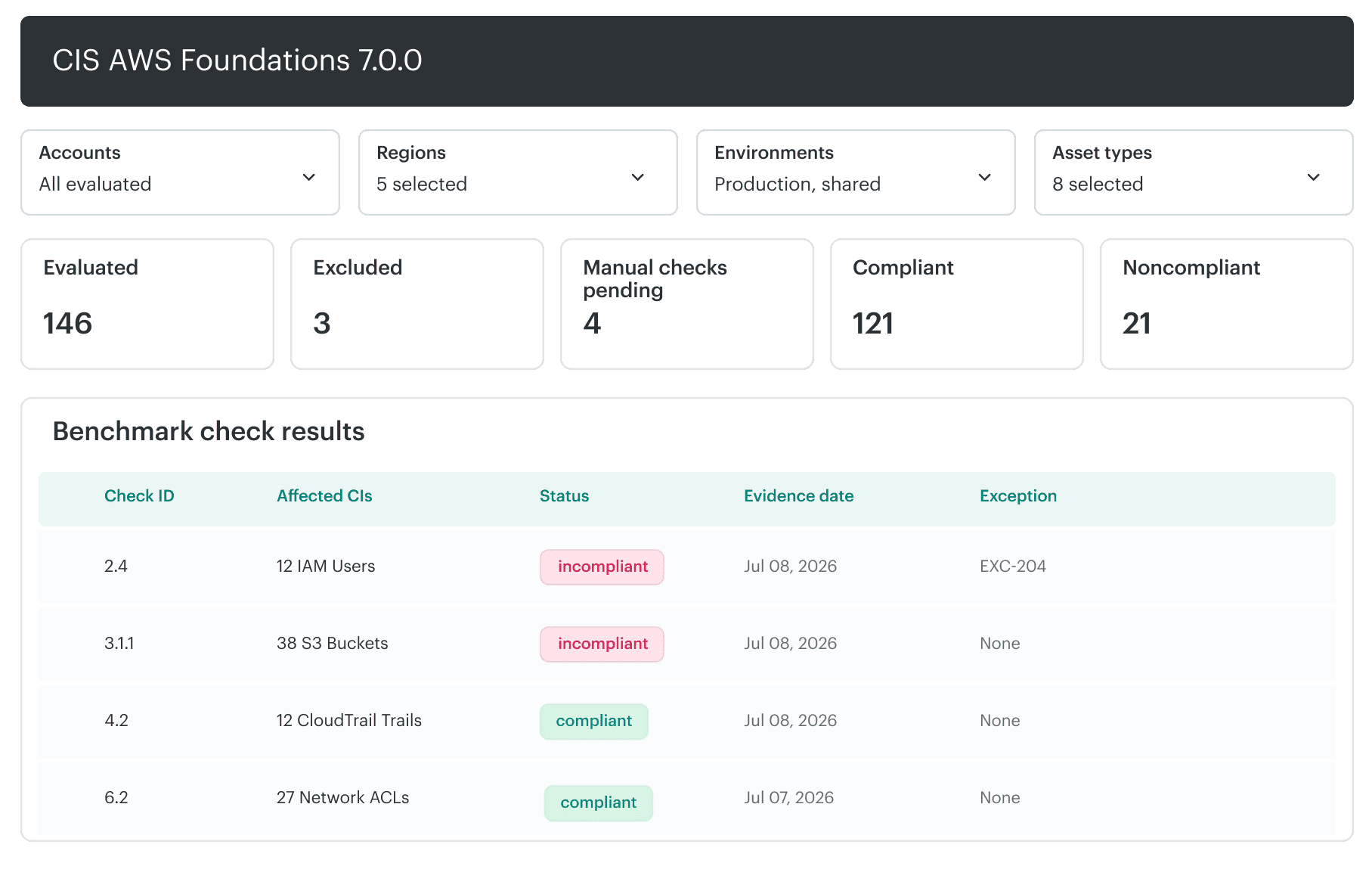 Example of Cloudaware UI. Use benchmark results to validate evaluated scope, identify noncompliant assets, and confirm that each benchmark check has current evidence before the architecture review.
Add provider guidance without creating parallel control programs
Provider guidance can refine implementation questions:
- AWS Well-Architected Security Pillar for AWS workload design and operational trade-offs
- Microsoft cloud security benchmark for Azure and multicloud recommendations
- Google Cloud Well-Architected Framework for GCP design, operation, security, privacy, and compliance
- OWASP Secure Cloud Architecture Cheat Sheet for application, API, isolation, secrets, and trust-boundary guidance
Microsoft currently labels MCSB v2 as preview. Record which recommendations have Azure Policy mappings, which policy effects are configured, and which controls require manual assessment.
Normalize overlapping requirements into one record keyed by:
- Architecture domain
- Affected assets
- Expected state
- Evidence source
- Owner
- Exception
Without normalization, the same requirement appears in several framework sheets with different owners and closure states.
Build a review-ready architecture evidence pack
A review-ready evidence pack lets a practitioner outside the implementation team reconstruct the in-scope architecture and validate the current control state from reproducible records.
Define scope through systems and deployed assets
An AWS account, Azure subscription, or GCP project is an administrative boundary, not necessarily the system boundary.
Scope the business service together with:
- Applications and environments
- Cloud accounts, subscriptions, and projects
- Kubernetes clusters
- VMware and on-premises systems
- Identity providers
- CI/CD platforms
- Secrets and key-management systems
- Logging and observability
- SaaS and external APIs
- Backup and recovery systems
- Hybrid connectivity
For example, a payment platform may include the application, Kubernetes clusters, cloud accounts, identity provider, CI/CD pipeline, managed database, KMS keys, fraud-detection SaaS, logging destination, and an on-premises settlement service.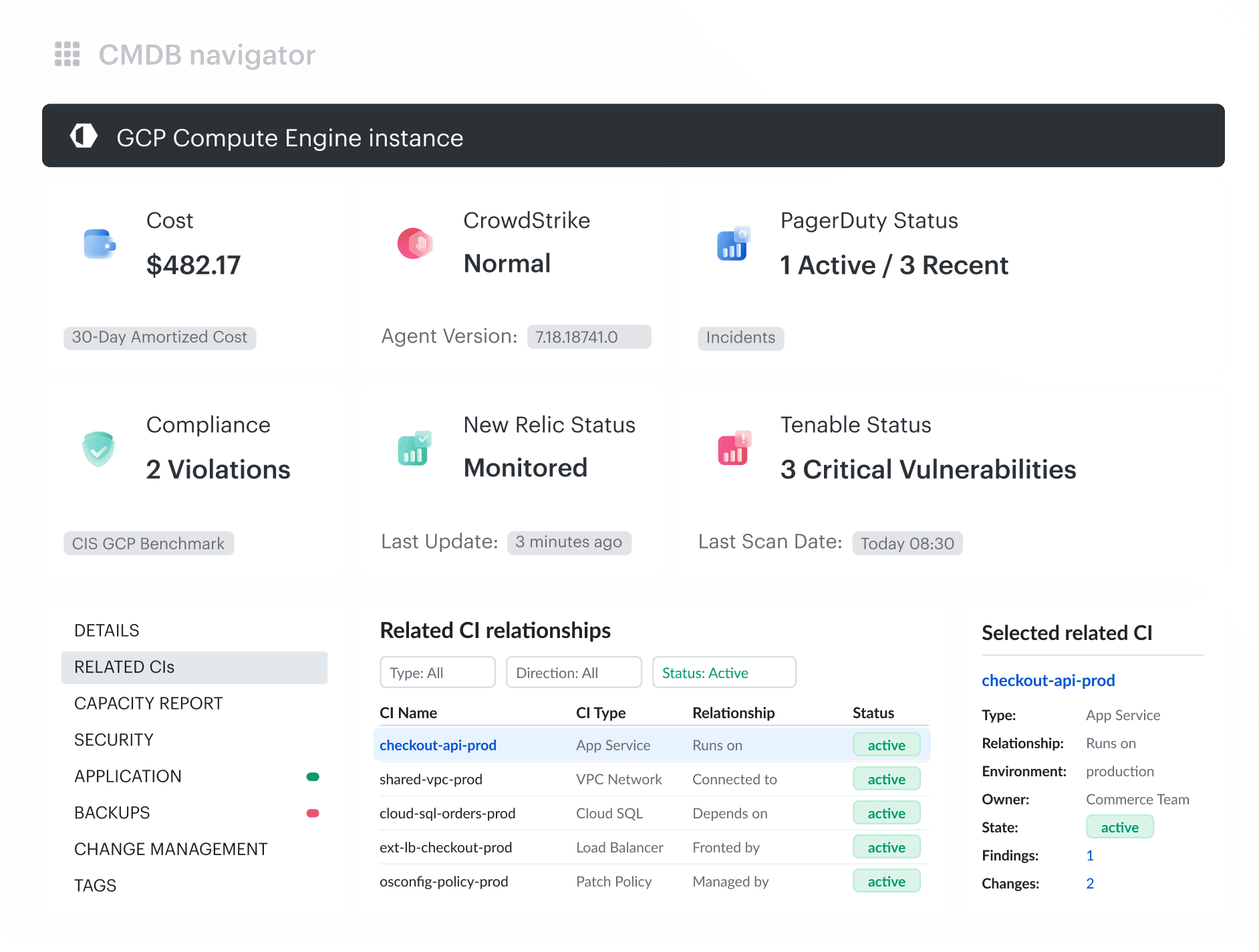 Example of Cloudaware UI. Use Related CIs to identify infrastructure, operational tools, and dependencies that must enter the review scope.
A hybrid cloud security architecture review must preserve those relationships. A resource inventory without dependencies cannot show how risk crosses cloud and on-premises boundaries.
Reconcile diagrams, ADRs, and deployed relationships
Use each architecture artifact for a distinct purpose:
- System context diagram: users, services, external systems, and scope boundary
- Logical architecture: functional components and interactions
- Deployed architecture: current providers, accounts, resources, networks, and regions
- Data-flow diagram: data movement, stores, classifications, and destinations
- Trust-boundary map: identity, administrative, network, and service transitions
Treat a diagram as stale when a material production resource, identity path, data destination, trust boundary, or external dependency cannot be mapped to an object in the diagram. Record unmatched objects as review findings rather than fixing the document silently.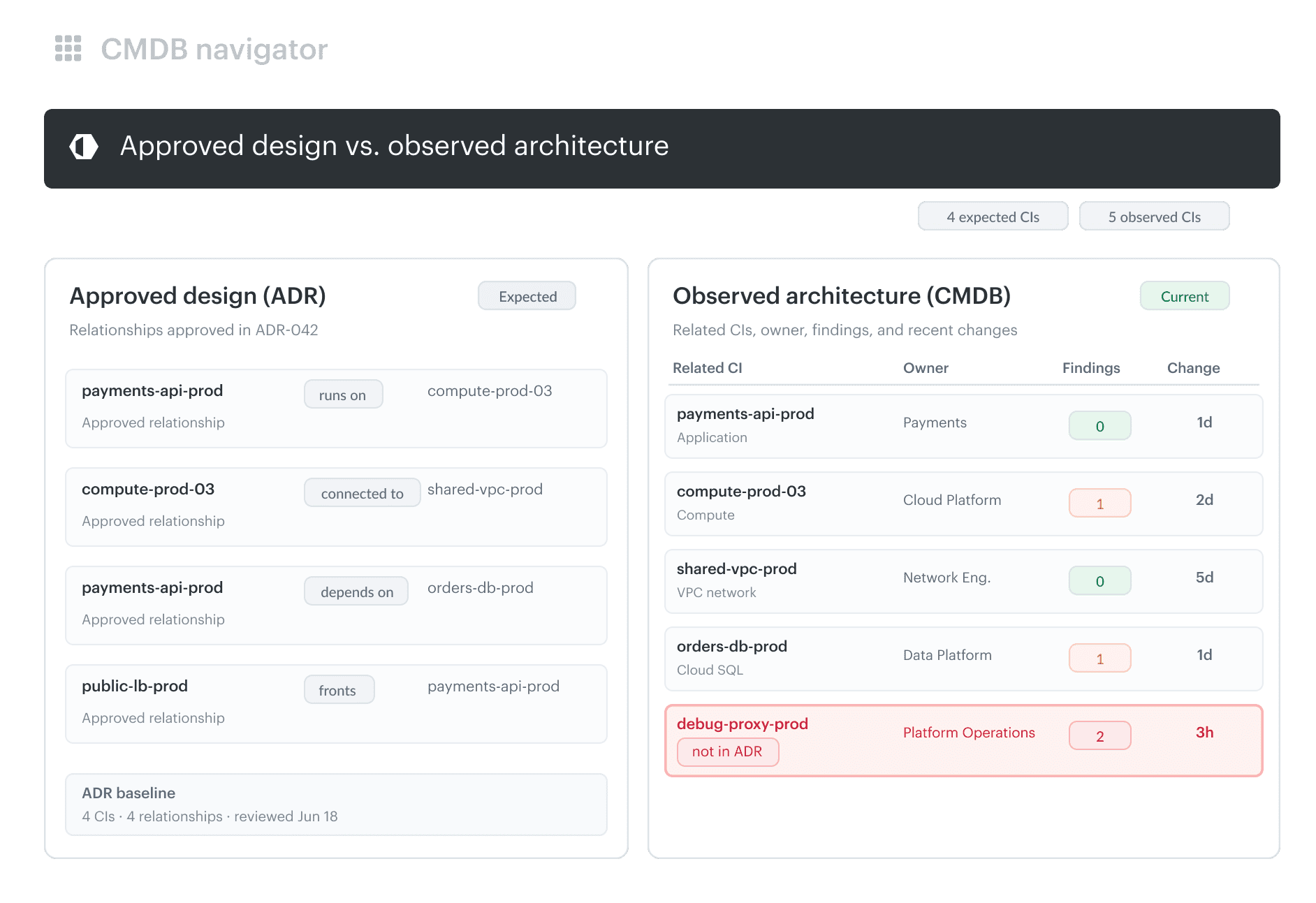 Use Related CIs to compare approved architecture with the current cloud environment.
A security-relevant Architecture Decision Record should include:
- Decision and alternatives considered
- Security assumptions
- Affected trust boundaries
- Identity and data implications
- Required controls
- Residual risk
- Approver
- Re-review trigger
Early security involvement makes the issue a design decision. The same issue found after production deployment becomes redesign, migration, or accepted risk.
Create an evidence index
| Field | Purpose |
|---|---|
| Requirement and baseline | Identifies the expected control and version |
| System and affected assets | Defines operational context and coverage |
| Evidence source and method | Makes collection reproducible |
| Owner | Assigns implementation and evidence responsibility |
| Collection date and validity trigger | Shows when evidence becomes stale |
| Exception or remediation record | Tracks deviation and corrective work |
| Validation result | Supports closure |
Evidence must be recollected when its validity condition changes, such as a deployment, policy update, identity change, new account, changed benchmark version, or material architecture modification.
Verify identity, data flows, and trust boundaries
Identity and data flows define many of the architecture’s real trust decisions. A network diagram alone does not show who can change production, which workload can assume a cloud role, or where sensitive data moves after leaving the primary application.
Map identities that can affect the security architecture
Build one identity-path map across provider boundaries. A developer may authenticate through Microsoft Entra ID, assume an AWS deployment role, deploy to Kubernetes, retrieve a secret from another platform, and send logs to a SaaS service. Reviewing each provider separately hides the complete privilege path.
Separate:
- Workforce users
- Federated cloud roles
- Privileged administrators
- Service accounts
- Azure managed identities
- GCP service accounts
- AWS workload roles
- Kubernetes service accounts
- CI/CD identities
- Break-glass accounts
- Third-party identities
The core diagnostic question is: Which identities can change the architecture?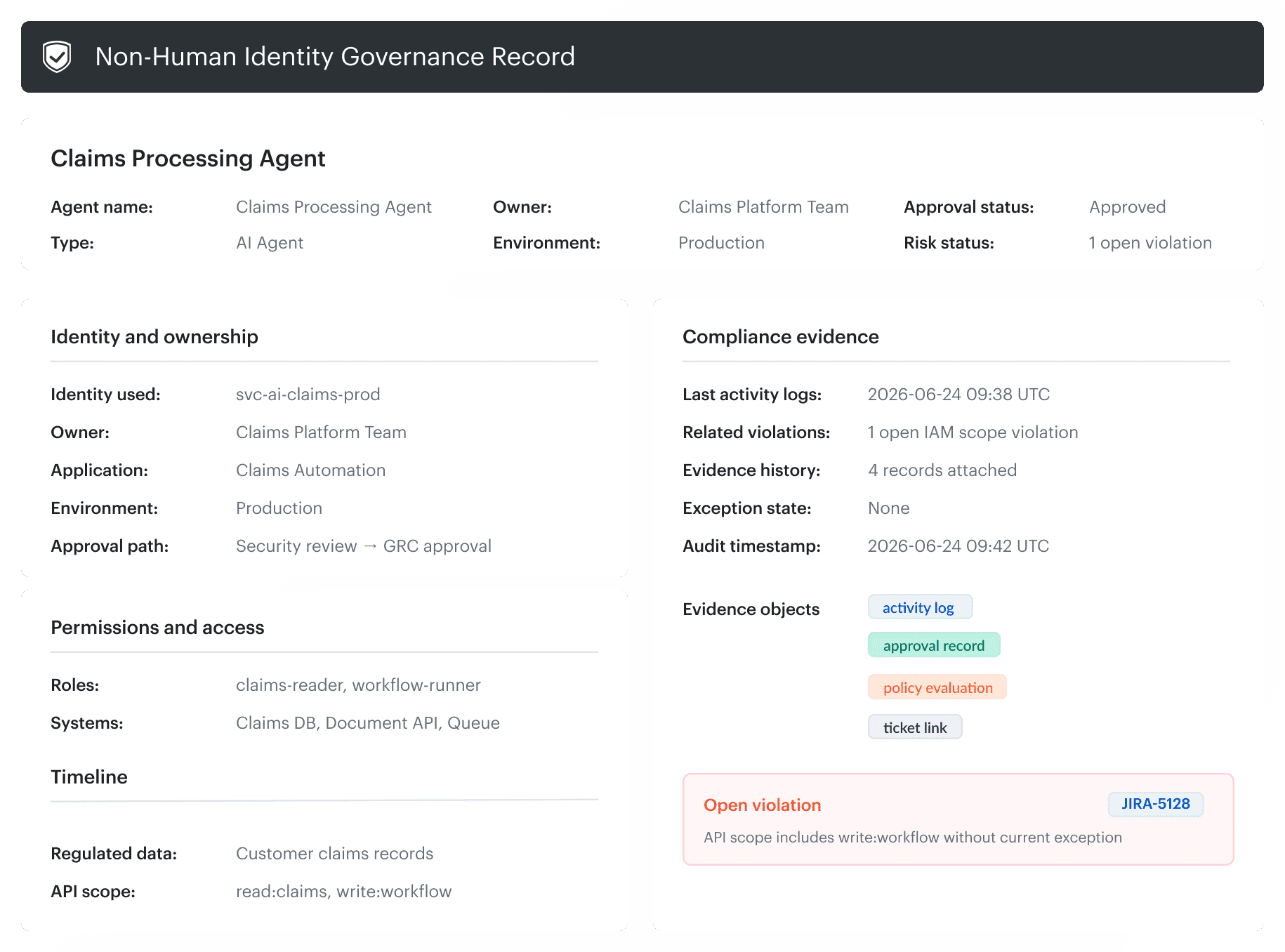 Example of Cloudaware UI. Use a centralized identity record to verify ownership, permissions, related systems, policy violations, and supporting evidence
This identity context helps reviewers understand who can access or administer security-critical resources, how privileges are granted across environments, and whether identity relationships match the approved security architecture.
Trace sensitive data until deletion
Trace regulated or sensitive data until it is deleted, not only until it reaches the primary database.
Include derived or replicated copies in:
- Logs
- Analytics systems
- Backups
- Support exports
- Caches
- SaaS integrations
- Cross-region replication
- Development or troubleshooting environments
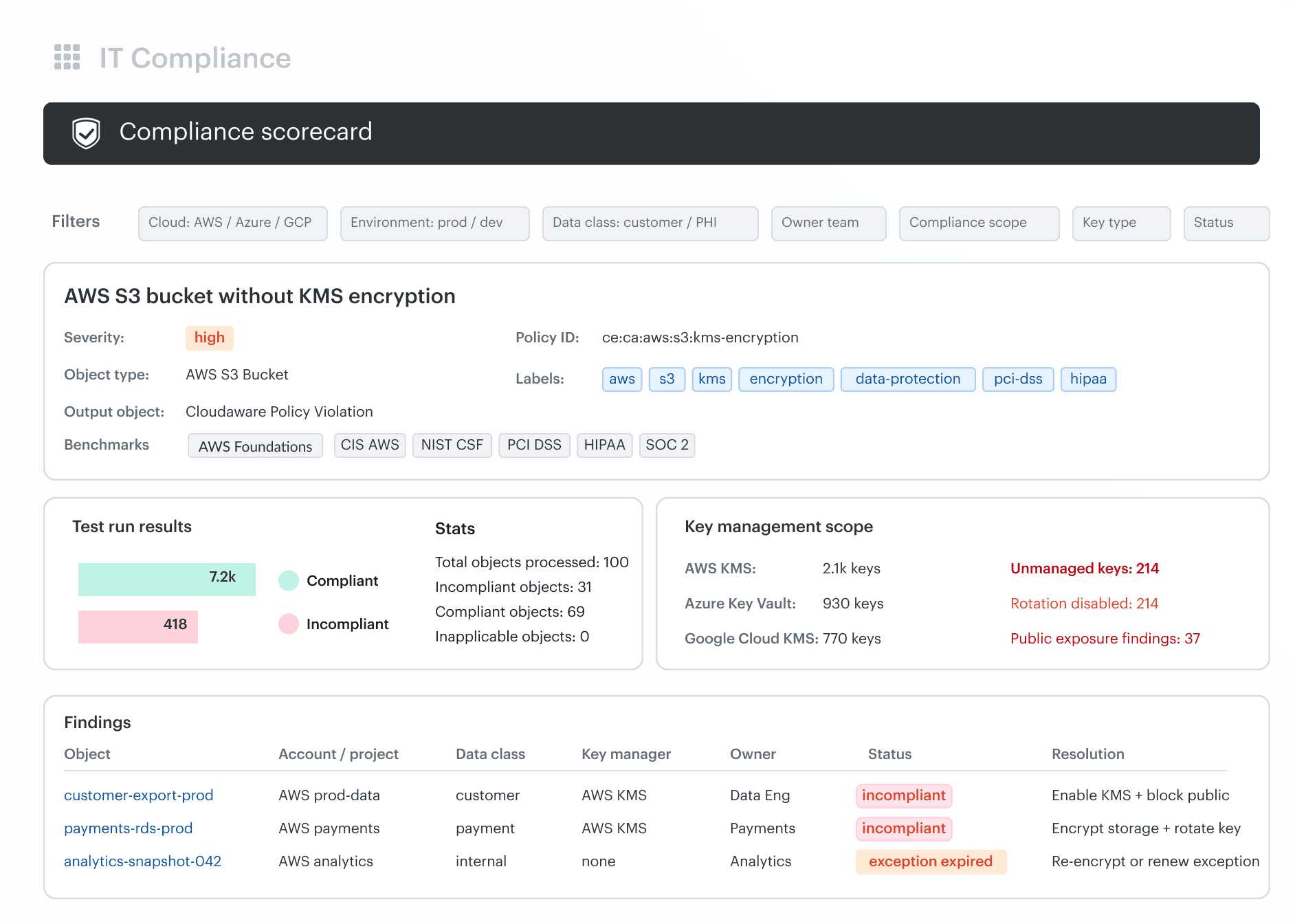 Example of Cloudaware UI. Use compliance findings to identify affected assets, verify encryption controls, prioritize remediation, and track exceptions across cloud environments before the review.
The review should expose cases where “encryption enabled” hides a broader architecture issue. A customer-managed key may still be controlled by a broadly assigned role. A backup may use a different key or region. Logs may retain sensitive fields outside the primary retention model.
For regulated workloads, verify whether PHI, payment data, or personal data is copied into logs, backups, analytics, support exports, or third-party services outside the documented review scope. Healthcare teams can apply the same method to the documented HIPAA cloud security boundary.
Mark trust boundaries and secrets transitions
Trust boundaries include more than subnet edges. Map transitions between:
- External user and edge service
- API gateway and workload
- Workload and data store
- One account, subscription, or project and another
- Cloud and SaaS
- Cloud and on-premises
- CI/CD and production
- Kubernetes workload and cloud API
- Administrator and cloud control plane
- Backup environment and production
A private network path can still form a weak trust boundary when the workload identity is overprivileged or the API token is long-lived and shared.
Reconcile workloads, networks, and delivery controls with production
The review should follow the workload from source to runtime. Application architecture, delivery architecture, network architecture, and cloud permissions interact. Reviewing them separately can hide a privileged deployment path or exposure introduced after the original design.
Trace the source-to-runtime path
Use one end-to-end sequence: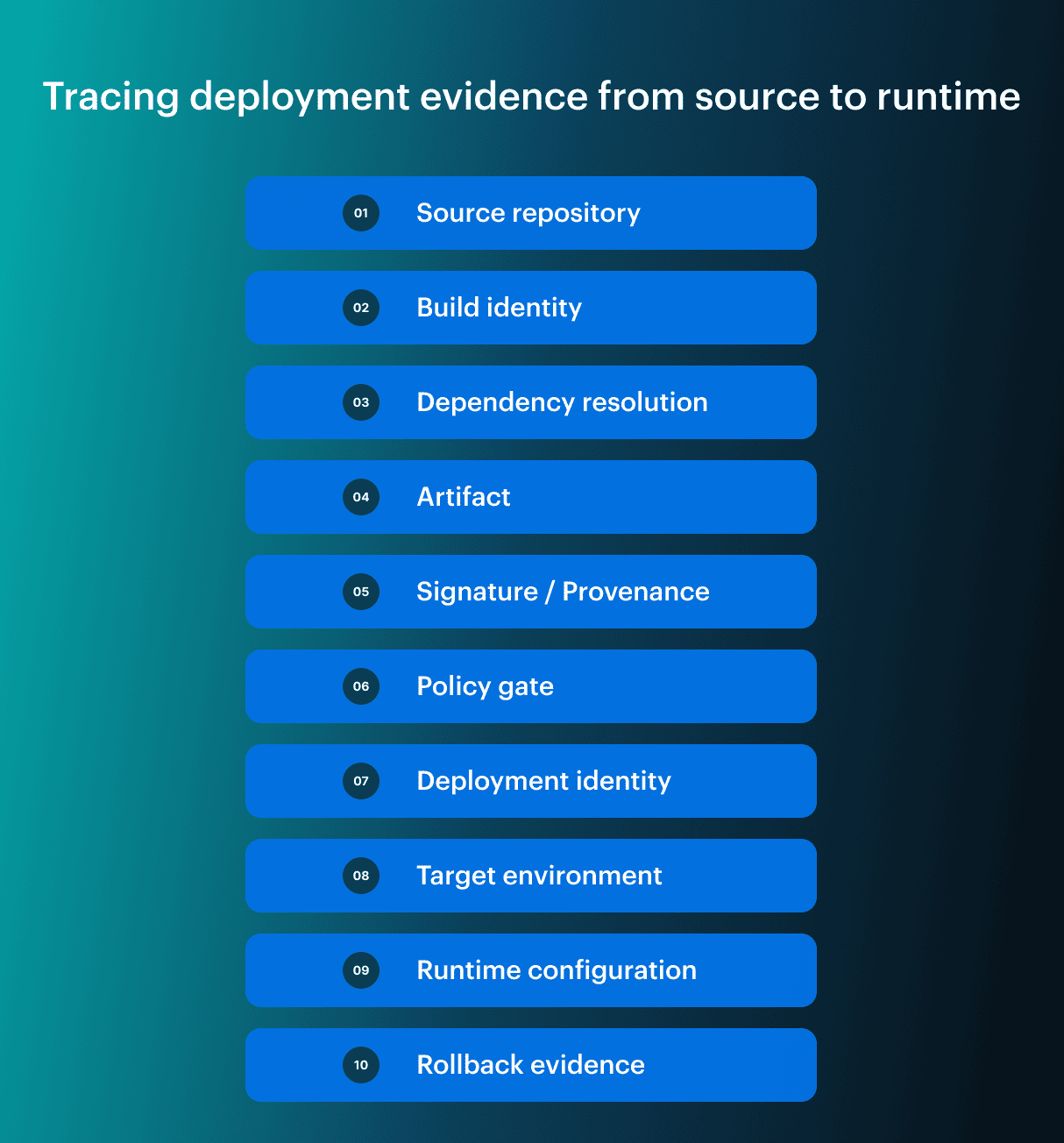 Add SBOM, signature, or provenance evidence where the delivery standard requires it.
The deployment identity deserves explicit review. A pipeline with broad permissions can modify production resources outside the path represented in the application diagram. The application may enforce least privilege at runtime while the delivery system retains organization-wide administrative access.
Verify ingress, egress, and attack surface
Map:
- Public endpoints
- API gateways
- Load balancers
- WAFs
- Ingress controllers
- Service meshes
- Private endpoints
- Outbound internet access
- Cross-cloud connections
- VPNs and private circuits
- Administrative interfaces
- DNS and certificate ownership
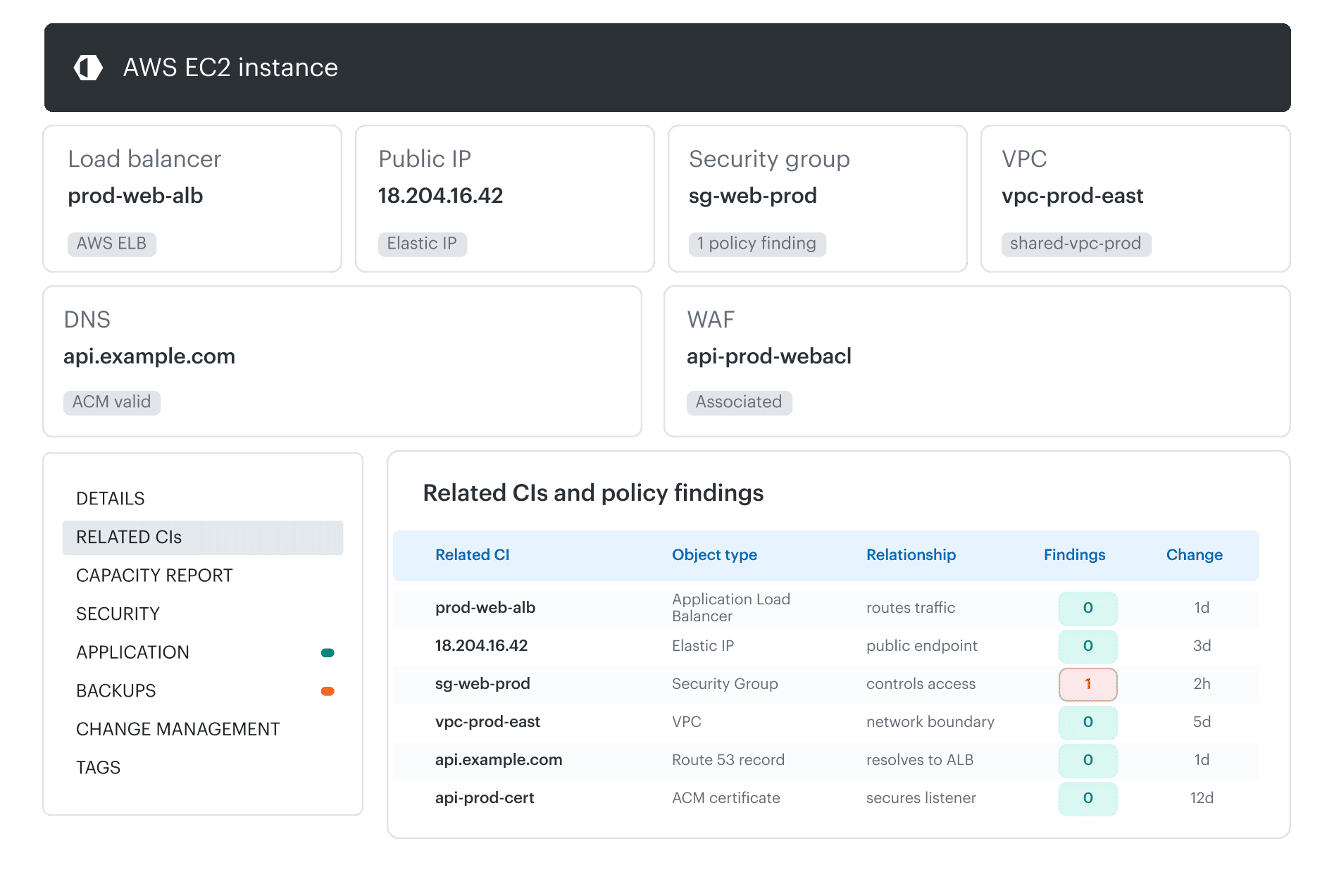 Example of Cloudaware UI. Use Related CIs to trace network exposure, verify security controls, and identify policy findings across interconnected cloud resources before the architecture review.
Verify that:
- Public exposure matches the approved architecture
- Obsolete endpoints have been removed
- Management interfaces are restricted
- Egress destinations are documented
- External APIs have owners
- Certificates and domains have accountable teams
- Cross-cloud and hybrid routes remain inside scope
The hybrid cloud security best practices guide covers segmentation, private connectivity, and control consistency across cloud and on-premises environments.
Verify Kubernetes policies and exceptions
Kubernetes Pod Security Standards define three cumulative policy levels: Privileged, Baseline, and Restricted. The built-in Pod Security Admission controller applies those standards through namespace policy configuration.
Record:
- Selected policy level and version
- Enforce, audit, and warn modes
- Namespace labels
- Exemptions
- Privileged workloads
- Workload identity
- Network policies
- Cluster-to-cloud permissions
Pod Security Standards cover pod-level security posture. They do not validate control-plane configuration, node security, network architecture, workload identity, software provenance, external secrets, or managed-service responsibility.
Connect requirements to controls, owners, exceptions, and remediation
Security requirements become reviewable when they are translated into work with an affected system, accountable owner, acceptance criteria, evidence requirement, and completion state.
A control ID becomes implementable only after it is translated into an expected state for specific assets and environments.
Convert requirements into trackable work
Translate relevant requirements into:
- ADRs
- Jira or project tickets
- Policy evaluations
- CI/CD gates
- Configuration tasks
- Change records
- Remediation items
Separate operating and decision ownership
| Role | Responsibility |
|---|---|
| Asset owner | Business or operational accountability for the asset |
| Application owner | Application lifecycle and service decisions |
| Platform owner | Shared infrastructure, guardrails, and platform operation |
| Control owner | Design and operation of the control |
| Evidence owner | Production and maintenance of evidence |
| Risk owner | Acceptance or rejection of residual risk |
| Security architect | Architecture-risk advice and review conclusion |
| Approval authority | Decides whether the architecture may proceed under policy |
CSA CCM is useful for this mapping because cloud controls may be customer-owned, provider-owned, or shared. The review should identify both the responsible organization and the team or role able to produce the evidence.
Prepare exceptions that expire or become invalid
Every exception should include:
- Affected asset IDs and relationships
- Unmet architecture requirement or control
- Risk scenario
- Business consequence
- Compensating control
- Approving risk owner
- Creation date
- Expiry date
- Scope-change trigger
- Conditions that invalidate the exception
- Required revalidation evidence
- Remediation owner
- Target date
An exception attached only to a document becomes unreliable when the system changes. A new identity path, wider network exposure, additional business service, or larger asset scope can invalidate the decision before its scheduled expiry date.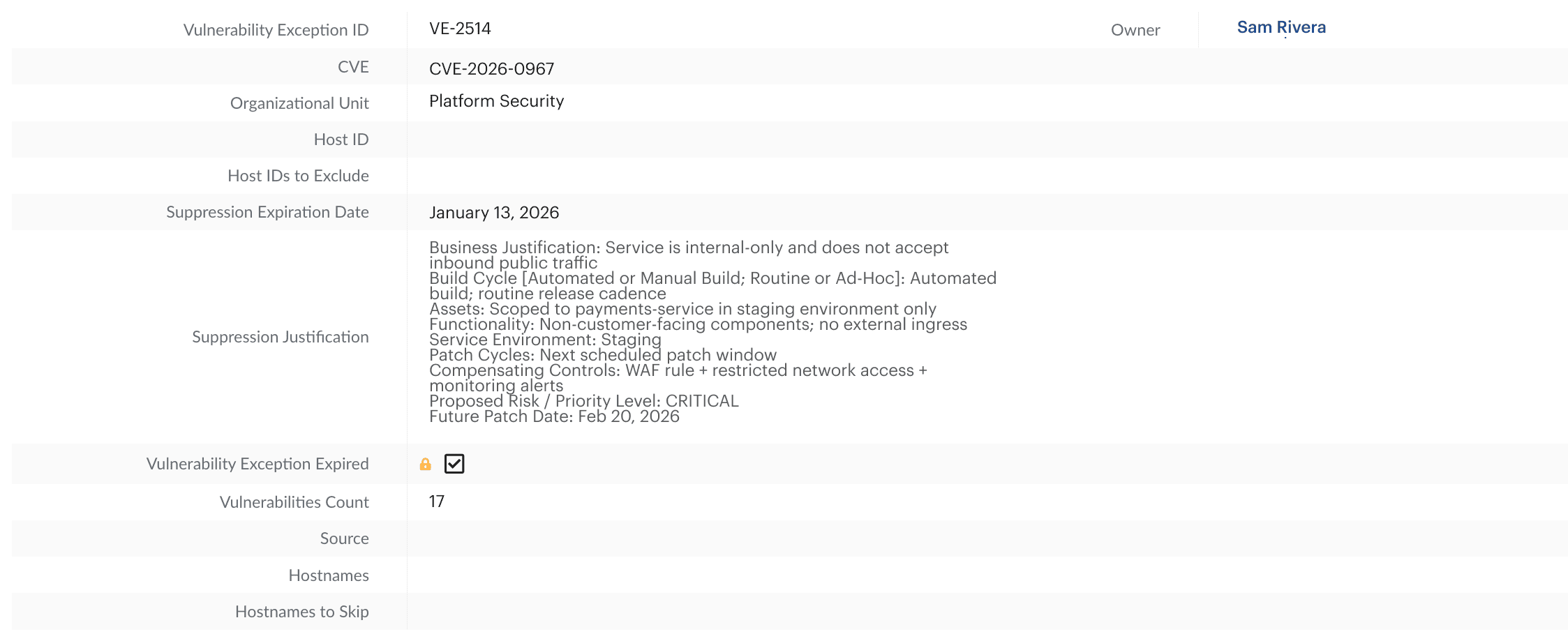 Example of Cloudaware UI. Use vulnerability exception records to review ownership, business justification, expiration dates, and compensating controls before deciding whether an exception should be renewed, remediated, or closed.
Closure requires more than changing the ticket status. The team should provide:
- Implementation record
- Deployment or configuration change
- Current asset state
- Validation result
- Control-owner confirmation
- Risk-owner confirmation where residual risk remains
Cloud security architecture review checklist
Use this cloud security architecture review checklist to confirm that the required preparation work is complete before the formal review.
The checklist is organized around five preparation domains:
- Intake, scope, and review baseline: confirm who owns the system, what environments and dependencies are in scope, which review depth applies, and which framework or benchmark versions are being used.
- Architecture artifacts and deployed state: reconcile system diagrams, ADRs, trust boundaries, data flows, and external dependencies with the resources currently running.
- Identity, data, and encryption: trace workforce and workload identities, privileged access, sensitive-data destinations, encryption controls, key ownership, secrets, and third-party access.
- Workloads, network, and delivery: follow the path from source and build identity to deployment, runtime, public exposure, hybrid connectivity, Kubernetes controls, and rollback.
- Evidence, exceptions, and remediation: verify evidence coverage and freshness, assign findings to owners, review exception expiry and invalidation conditions, and confirm remediation with implementation and validation evidence.
Checklist completion does not equal architecture approval. A checked item confirms that the required artifact or evidence is available; the review still determines whether the decision is acceptable for the system’s risk and operating environment.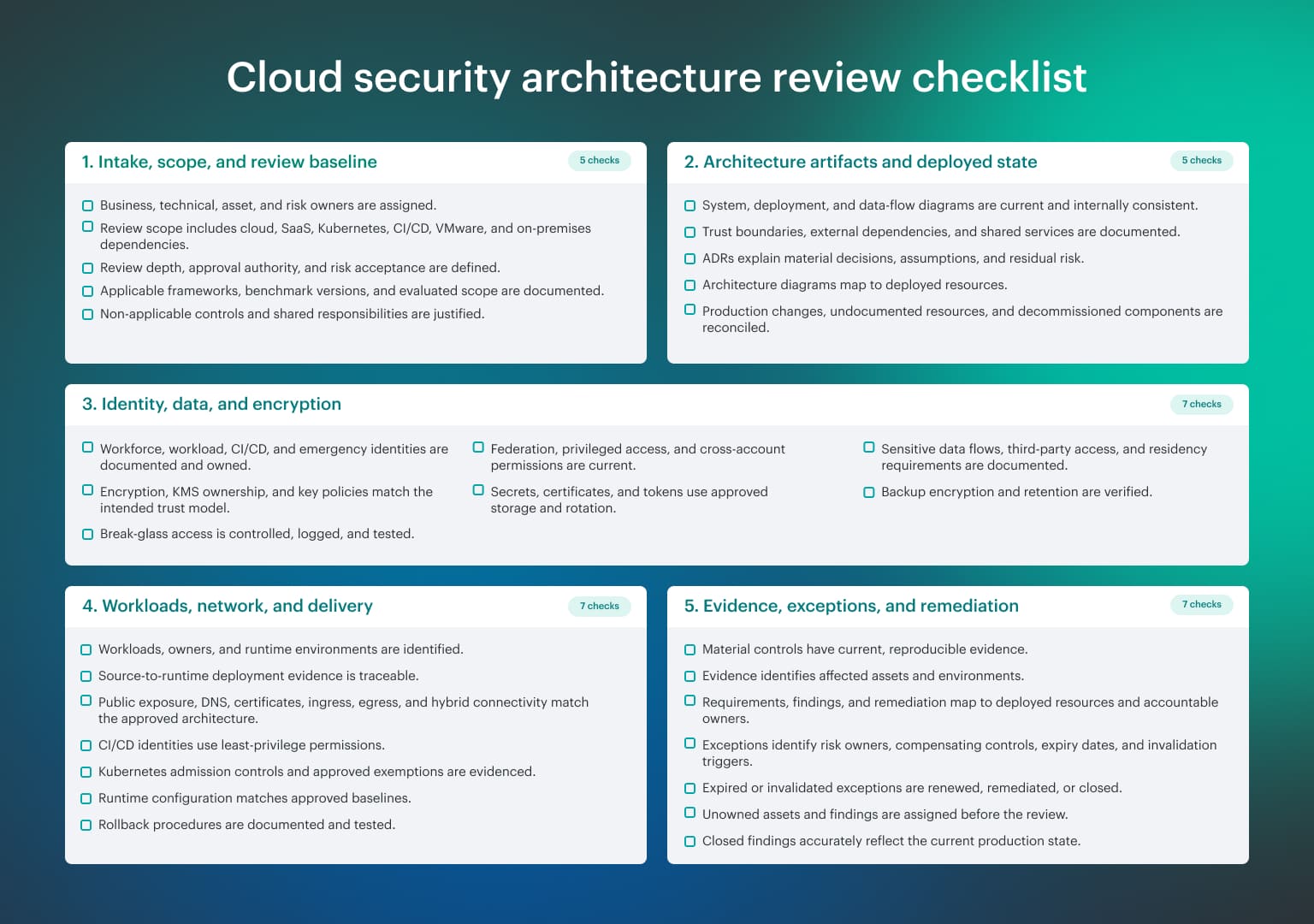
Run an internal dry review and remove avoidable friction
The strongest readiness test is whether someone outside the implementation team can reconstruct a representative high-risk path from current architecture and operational records.
Trace representative high-risk paths
Select three to six paths that reflect the system’s actual attack surface and operating model:
- Internet user to sensitive data
- Developer to production
- Workload to cloud control plane
- CI/CD pipeline to deployment target
- SaaS integration to internal data
- Privileged administrator to organization-level controls
For each path, confirm that deployed resources, identity transitions, trust boundaries, controls, evidence, owners, and active exceptions can be traced without relying on undocumented explanations.
Close preparation gaps before the formal review
Classify each gap by the action required:
| Gap | Required action |
|---|---|
| Diagram-to-production mismatch | Update the architecture record or investigate the deployed resource |
| Missing evidence | Reproduce evidence from the source system |
| Unowned finding | Assign an accountable owner |
| Stale or expired exception | Renew, remediate, or close |
| Obsolete benchmark | Reassess scope against the approved version |
| Unresolved architecture decision | Escalate to the appropriate review gate and decision authority |
Track review readiness with:
- % of in-scope architecture components mapped to deployed assets
- % of material controls with reproducible evidence
- Number of unowned findings and assets
- Number of expired exceptions
- Number of material diagram-to-production mismatches
Meeting count, checklist completion, and total finding volume do not measure architecture review readiness.
Architecture review anti-patterns to eliminate
| Anti-pattern | Correction |
|---|---|
| One review depth for every change | Route by architecture risk |
| Diagrams diverge from production | Reconcile diagrams with live resources |
| Benchmarks substitute for judgment | Use them as supporting evidence |
| Requirements stay in questionnaires | Convert them into asset-linked work |
| Exceptions never expire | Add expiry and invalidation triggers |
| One engineer holds the system model | Make evidence independently reproducible |
Build architecture review readiness with Cloudaware
Cloudaware supports review preparation by maintaining cloud and hybrid resource records, relationships, configuration history, ownership context, and compliance results in the CMDB. Teams can use this operational context to reconstruct review scope and assess the impact of changes or findings.
- CMDB-backed inventory: Track assets across AWS, Azure, Google Cloud, VMware, on-premises infrastructure, and connected SaaS from one relationship-aware inventory.
- Policy evaluation: Evaluate infrastructure resources against 550+ policy checks and identify security, reliability, performance-efficiency, and cost issues at the affected asset level.
- Framework-aligned checks: Map policy results to CIS Benchmarks for AWS, Azure, and Google Cloud and frameworks including NIST, PCI DSS, HIPAA, ISO, and GDPR to support architecture review evidence.
- Relationship-aware impact analysis: Trace dependencies between workloads, identities, networks, storage, and cloud services to understand the operational impact of architecture decisions and policy violations.
- Configuration history: Verify architecture drift by reviewing historical configuration changes and confirming that diagrams, approvals, and evidence still represent the deployed environment.
- Exception and remediation workflows: Manage policy violations, approved exceptions, ownership, and remediation through built-in workflows and integrations with Jira, ServiceNow, and ServiceDesk.