


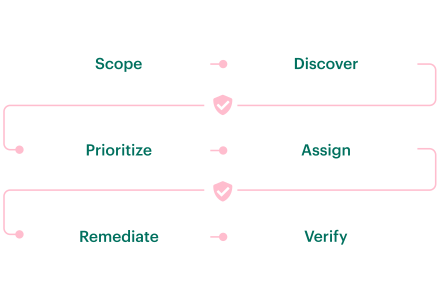
Enterprise vulnerability programs break when findings lose context as they move between scanners, asset inventories, CMDB records, owners, tickets, exceptions, and rescans. The same CVE can appear in multiple sources, the affected workload can lack a reliable owner, an exception can outlive its review date, and a closed ticket can still leave the vulnerability active.
Security teams can see the findings but cannot reliably tell which ones are current, who owns the response, what treatment was approved, or whether remediation worked.
The vulnerability management lifecycle gives each finding a controlled path. This article breaks that path into six operational steps and shows the workflow, decision points, and evidence needed to run it across enterprise cloud and hybrid infrastructure.
TL;DR
- Scanner findings become actionable only when they are connected to the affected asset, owner, business context, SLA, and current treatment state
- Findings from multiple scanners should be normalized into one remediation problem while the source evidence remains available for validation
- Severity alone is not enough for prioritization; exploitability, exposure, environment, and asset criticality change which vulnerabilities should move first
- Risk acceptance needs an approver, rationale, compensating controls where relevant, and an expiry date so deferred remediation stays visible
- A closed Jira or ServiceNow ticket does not prove the vulnerability is gone; closure requires a rescan, retest, or another approved verification method
- Vulnerability testing belongs at both ends of the lifecycle: first to establish the weakness and later to verify that the treated condition is no longer present.
- Useful vulnerability management metrics expose where the lifecycle is failing, such as unscanned assets, unowned findings, overdue remediation, expired exceptions, and failed verification
What is the vulnerability management lifecycle?
The vulnerability management lifecycle is the recurring process for identifying vulnerabilities that affect in-scope assets, deciding what requires action, assigning an accountable treatment, implementing that response, and verifying the result.
The lifecycle and the vulnerability management process describe related but different things. The lifecycle describes the states a vulnerability moves through. The process defines how an organization implements those states through scanners, asset inventory, CMDB relationships, owners, SLAs, tickets, exceptions, change workflows, and evidence.
Five-, six-, and seven-stage models often describe similar decisions but group them differently. This article uses six steps because it keeps three operational controls explicit: coverage before prioritization, accountable treatment before remediation, and verification before closure.
A working lifecycle should let a reviewer take one current finding and answer:
| Lifecycle object | Question it must answer |
|---|---|
| Asset | What resource or workload is affected? |
| Source evidence | Where did the finding come from? |
| Priority | How urgently should the organization act? |
| Owner | Who is accountable for the response? |
| SLA | When is action due? |
| Treatment | What response was selected? |
| Verification | What proves the exposure is gone or controlled? |
For vulnerability types, cloud-specific exposure patterns, and broader context, see cloud security vulnerabilities. See the guide on vulnerability management best practices for coverage, prioritization, ownership, SLA management, exceptions, and verified closure.
How NIST SP 800-40 maps to this lifecycle
NIST SP 800-40 Rev. 4 defines a Software Vulnerability Management Life Cycle that starts with knowing when vulnerabilities affect organizational assets, then planning the risk response, executing it, verifying it, and continuously monitoring the result. Documentation, audit logging, reporting, and change management support those activities throughout the lifecycle.
The six-step model used here separates some of those activities to make ownership and workflow state easier to operate:
| NIST SP 800-40 activity | Six-step operating model |
|---|---|
| Know when vulnerabilities affect assets | 1. Define scope + 2. Discover and normalize |
| Plan the risk response | 3. Prioritize + 4. Assign treatment |
| Prepare and implement the response | 4. Assign + 5. Remediate or mitigate |
| Verify the response | 6. Verify closure |
| Continuously monitor | 6. Verify and improve |
The 6 steps of the vulnerability management lifecycle
Each lifecycle step changes the operational state of a finding. Consider an illustrative OpenSSL CVE reported against production payment workloads by more than one vulnerability source. The technical issue is the CVE. The management problem is determining which records describe the same issue, which workloads matter most, who owns the response, and what evidence is sufficient to close it.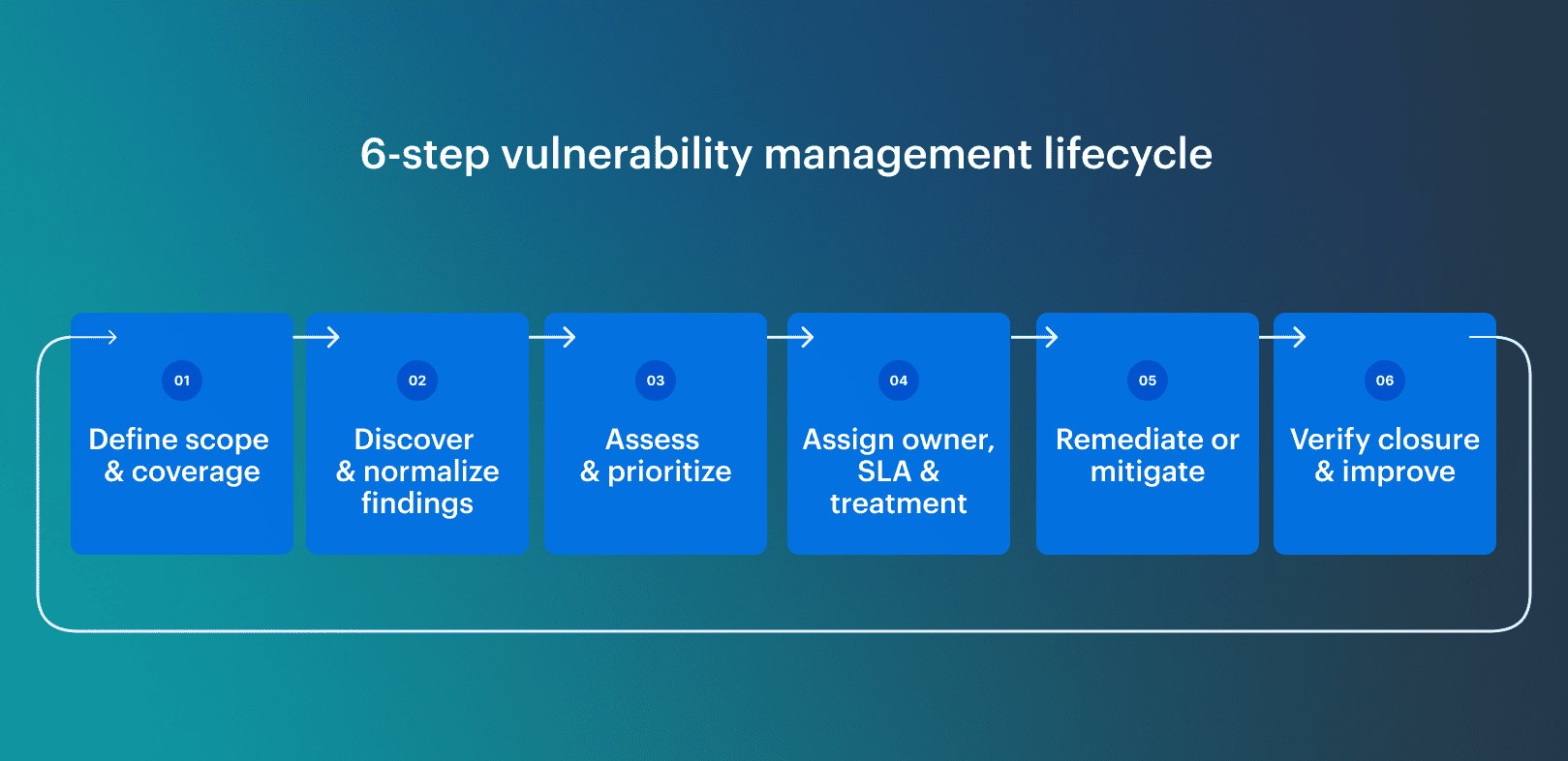
1. Define asset scope and vulnerability coverage
A vulnerability management program cannot manage assets it does not know exist or assets that no current vulnerability source assesses.
Start with the inventory boundary across AWS accounts, Azure subscriptions, GCP projects, Kubernetes workloads, VMware infrastructure, endpoints, and relevant on-premises systems. Then map each asset class to the scanner or security source expected to provide vulnerability evidence.
Coverage should answer more than whether a scanner is deployed. The program needs to know:
- Which assets belong in scope
- Which vulnerability source covers each asset class
- When each asset was last assessed
- Which team owns coverage gaps
- How newly discovered assets enter the process
- How unsupported or temporarily unscanned assets are handled
For the OpenSSL example, the first question is whether every production workload that may run the affected package exists in inventory and is represented by current vulnerability evidence. Five critical findings say little about total exposure if equivalent workloads never entered the assessment scope.
Asset inventory provides the denominator against which scanner coverage can be evaluated. For the role of configuration items and asset relationships in that model, see what a CMDB is. For deeper assessment methodology, see cloud security assessment.
2. Discover and normalize vulnerability findings
Multiple scanners and repeated scans can turn one underlying vulnerability into several records. The remediation process needs a stable logical finding without discarding the evidence that produced it.
Depending on the source and vulnerability type, grouping may use combinations such as:
- CVE + asset
- Rule or check ID + asset
- Package + version + asset
If two sources identify the same OpenSSL CVE on the same payment workload, creating two independent remediation tickets can inflate backlog counts, split evidence, and produce conflicting closure states.
The better model is to treat the records as one remediation problem while retaining source-specific evidence for validation and troubleshooting.
Cloudaware documents this distinction in its vulnerability grouping and deduplication model, where source records can be grouped around asset and CVE, rule/check and asset, or package/version and asset while the original scanner data remains available.
Normalization also changes how program metrics should be interpreted. A report counting raw source records answers a different question from one counting unique actionable findings. Program owners need to know which unit sits behind backlog, aging, and remediation metrics.
3. Assess and prioritize vulnerabilities
Technical severity is one prioritization input. Remediation priority also depends on exploitation signals, exposure, environment, asset criticality, application context, and existing controls.
Exploitation evidence and likelihood can further change the queue:
- EPSS: FIRST's Exploit Prediction Scoring System estimates the probability that a published CVE will be exploited in the wild during the next 30 days
- CISA KEV: The Known Exploited Vulnerabilities Catalog identifies vulnerabilities with evidence of exploitation in the wild
- Local behavior evidence: Cloudaware NeoSec shows whether the affected asset has deviated from its own baseline, which is evidence about this environment rather than the internet at large
None of them replaces asset context.
| Signal | What it contributes |
|---|---|
| CVSS | Technical vulnerability characteristics and severity |
| EPSS | Estimated likelihood of exploitation |
| CISA KEV | Evidence of known exploitation |
| Internet exposure | Whether an attacker can reach the affected system |
| Environment | Production, development, test, or another context |
| Asset criticality | Consequence of disruption or compromise |
| Application/service | Business process supported by the asset |
| Existing controls | Controls that may reduce effective exposure |
The same OpenSSL CVE can justify different treatment windows on an internet-facing production payment service and an isolated development host.
That decision requires a link between vulnerability evidence and the affected infrastructure. For the broader methodology behind business and cloud-risk context, see cloud security risk assessment.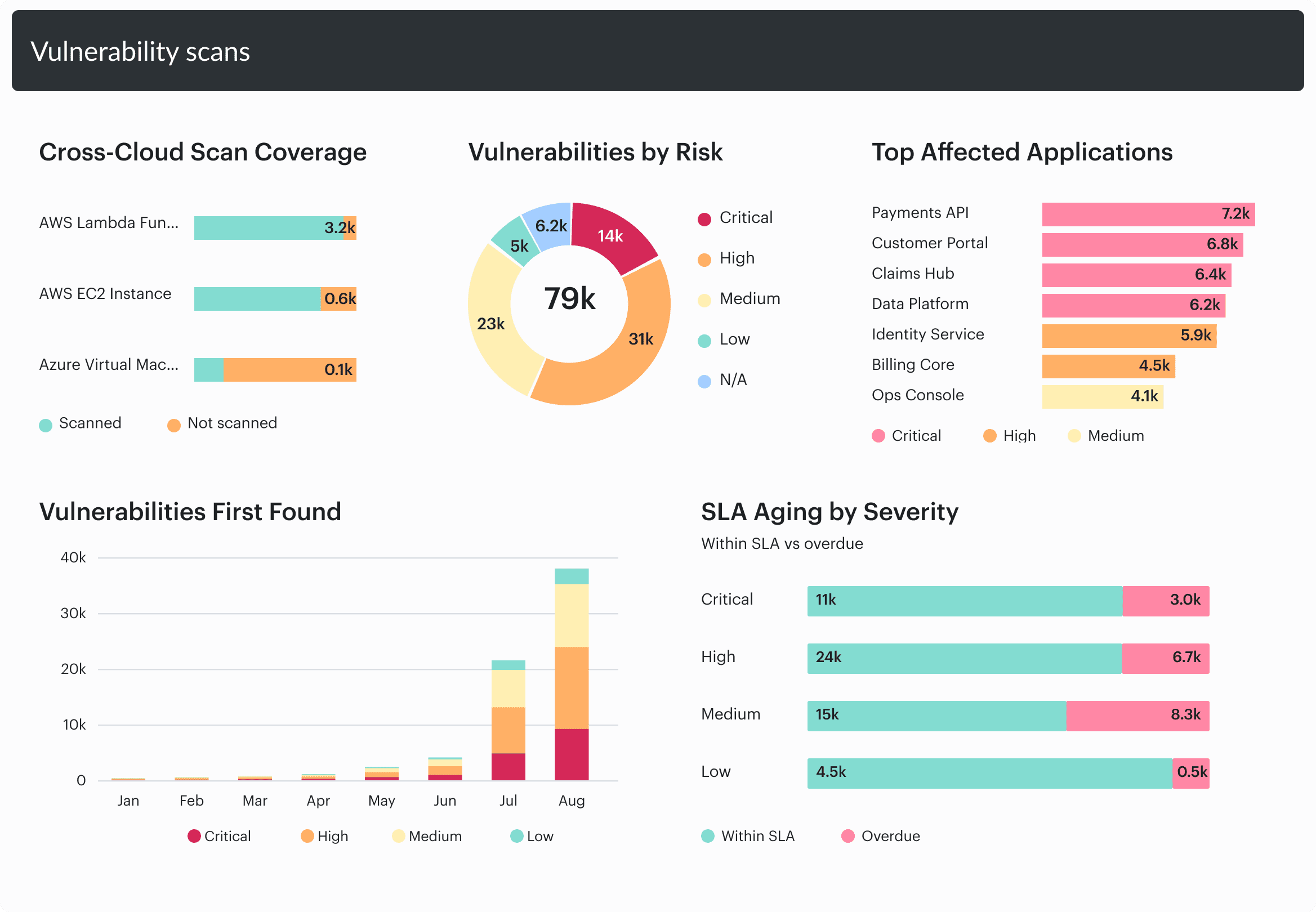 Vulnerability Scans with SLAs in Cloudaware. Scan coverage, asset and application context, vulnerability age, and SLA status help teams distinguish scanner output from the findings that require operational attention.
4. Assign an owner, SLA, and treatment
A prioritized finding becomes actionable when someone is accountable for a defined response within a defined time.
The working record should capture:
- Remediation owner
- Risk or business owner where required
- Due date or SLA
- Selected treatment
- Jira, ServiceNow, or another work item
- Escalation path
- Exception information when remediation is deferred
NIST SP 800-40 describes risk-response options including acceptance, mitigation, transfer, and avoidance. For vulnerability operations, teams still need to make the selected response concrete.
For the workflow below, we use remediation to mean removing the vulnerable condition and mitigation to mean reducing exposure while that condition remains. This is an operational distinction for tracking findings; NIST uses “mitigate” more broadly and includes patching within that risk-response category.
- Remediation removes the vulnerability through an upgrade, patch, rebuild, configuration change, or replacement.
- Mitigation reduces exposure when immediate removal is not feasible. While a mitigation stands in for a patch, behavior monitoring on the asset shows whether the control is holding.
- Risk acceptance authorizes continued operation with the known exposure under defined conditions.
- False-positive closure records evidence that the reported vulnerability does not apply. It should not become a substitute for risk acceptance.
A vulnerability exception should therefore record an approver, rationale, compensating controls where applicable, and an expiry or review date. Without a time boundary, a temporary decision can fall out of normal remediation governance.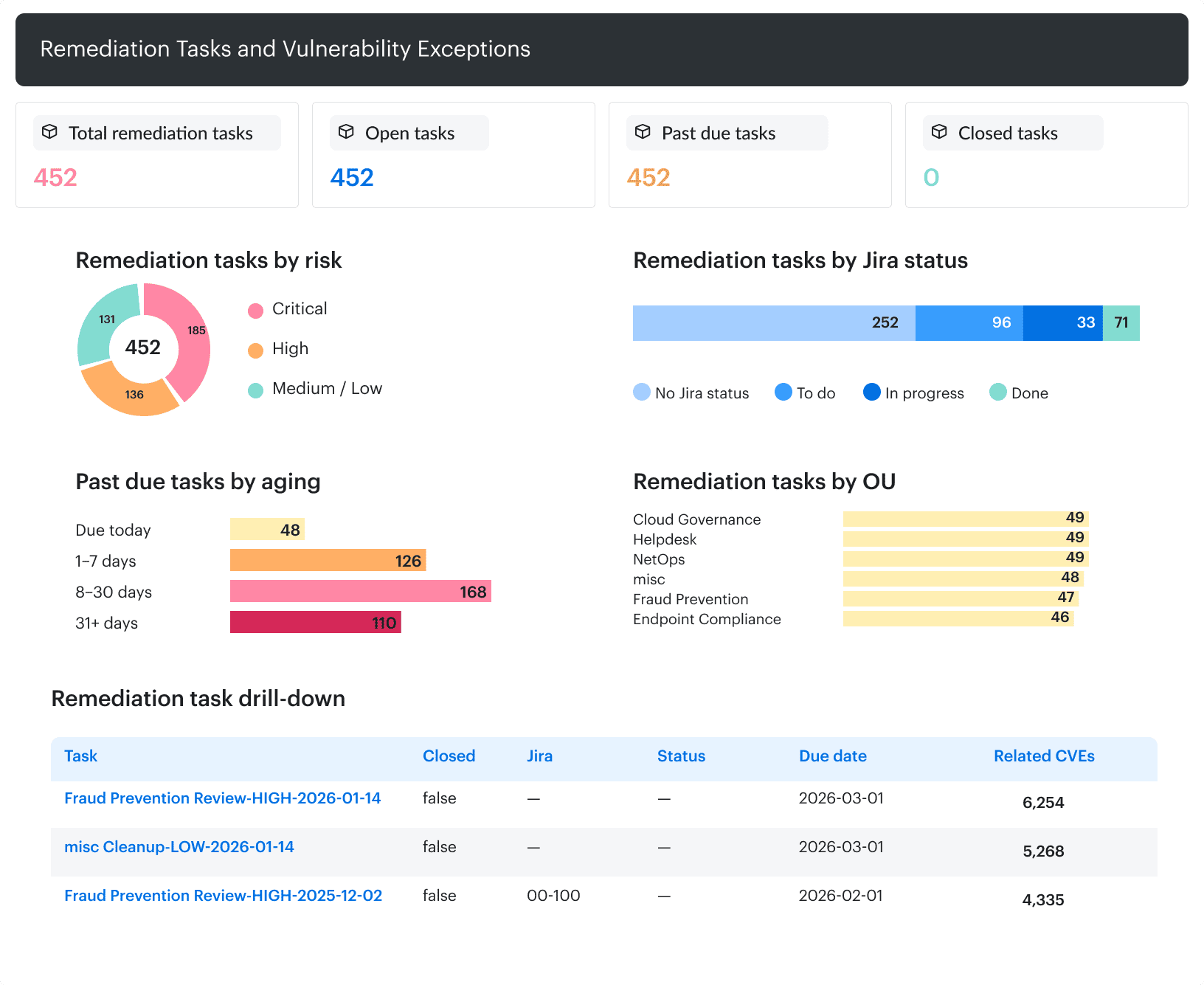 Remediation Tasks & Vulnerability Exceptions in Cloudaware. The dashboard separates vulnerabilities moving through remediation from findings governed through exceptions and surfaces overdue tasks or expired risk acceptance.
5. Remediate or mitigate the vulnerability
The selected treatment now has to become an operational change. For software vulnerabilities, remediation may involve:
- Installing a patch
- Upgrading a package
- Rebuilding an image
- Replacing unsupported software
- Disabling vulnerable functionality
- Changing a security configuration
The implementation path depends on the workload. A mutable VM patched through an operating-system workflow and an immutable container rebuilt through CI/CD should not be forced into the same remediation procedure.
NIST SP 800-40 separates preparation from implementation because software updates may require testing, scheduling, rollback planning, outage coordination, and alignment with enterprise change management.
For the OpenSSL example, the remediation record should remain connected to the deployment, change, or remediation task throughout execution.
For vulnerabilities managed through development pipelines and release workflows, see DevSecOps vulnerability management.
6. Verify closure and improve the process
A vulnerability reaches verified closure when evidence confirms that the selected response worked.
NIST includes verification directly in its software vulnerability management life cycle. For patching, this means confirming that the update was installed and took effect, followed by continued monitoring that the response remains effective. In practice, that includes the patched asset itself: NeoSec compares its behavior with the baseline after the change and flags activity suggesting the response did not hold.
Verification evidence may include:
- A confirming vulnerability rescan
- Package or version evidence
- Configuration validation
- Control testing
- Confirmation that an affected asset was removed or replaced
- Another approved verification method where scanning cannot validate the response directly
If the OpenSSL CVE still appears after the remediation task is complete, the finding returns to treatment.
Program-level improvement starts with the failures exposed here. Recurring vulnerable images, stale owner relationships, failed patches, repeated SLA breaches, scanner coverage gaps, and continuously renewed exceptions all point to lifecycle controls that need attention.
Cloudaware's verification and SLA workflow supports rescan-based updates to vulnerability state and related remediation work after a change.
How to build an operational vulnerability management process
The vulnerability management process turns lifecycle stages into explicit state transitions. Each transition needs an input, accountable owner, decision, output, and evidence requirement.
Vulnerability management process flow chart
A usable vulnerability management process flow chart needs to show the main remediation path and the branches where findings commonly stop moving.
The simplified flow keeps the main treatment and verification decisions visible. Coverage gaps, missing ownership, recurring findings, and other control failures are handled separately in the diagnostic section below.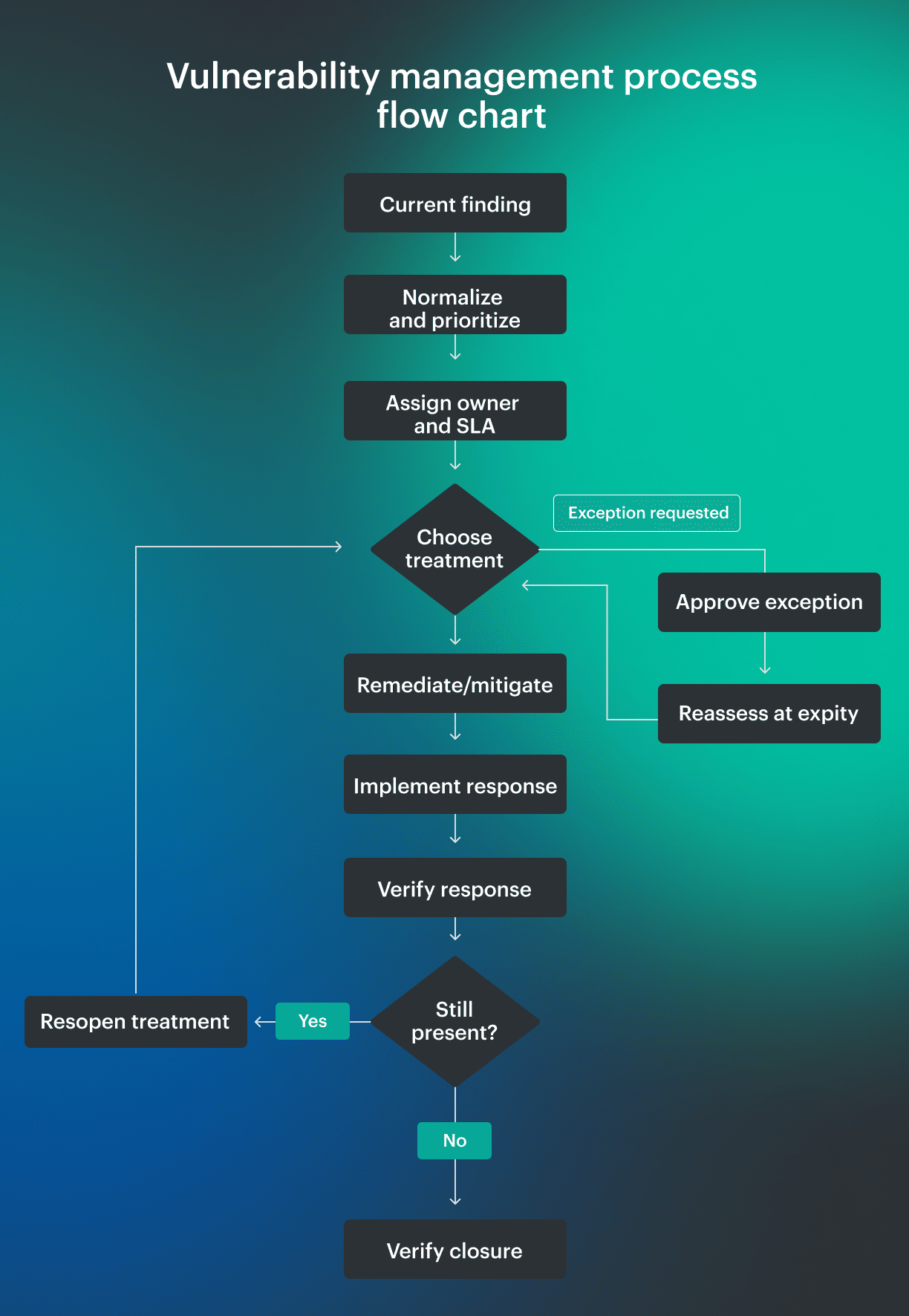 The operating workflow also needs explicit side paths:
- Coverage gap: An in-scope asset has no current vulnerability evidence
- Ownership gap: The affected asset or service has no accountable remediation owner
- Exception path: Deferred remediation requires approval, rationale, compensating controls, and expiry
- Verification failure: The vulnerability remains after implementation work is complete
- Recurring finding: The same exposure returns and triggers review of the underlying deployment or patch process
Vulnerability management process template
A vulnerability management process template should preserve enough state to reconstruct why a finding received its current treatment without relying on scanner exports and ticket comments.
| Field | Required content |
|---|---|
| Scope | Asset classes, environments, and applicable vulnerability sources |
| Finding ID | CVE, scanner ID, rule ID, or another identifier |
| Affected asset | CI, resource, host, image, or workload |
| Source evidence | Scanner/source and current observation |
| First/last observed | Dates used to establish age and current state |
| Priority | Risk/severity level and supporting rationale |
| Owner | Accountable remediation owner |
| SLA | Due date or remediation window |
| Treatment | Remediate, mitigate, accepted exception, or validated false positive |
| Exception | Approver, rationale, compensating controls, expiry |
| Work item | Jira, ServiceNow, change, or another execution record |
| Verification | Rescan, retest, or alternate approved evidence |
| Final state | Open, exception, remediated, verified closed, or reopened |
Define owners and handoffs before automating the workflow
Routing rules are only as reliable as the ownership data behind them. Effective vulnerability management automation starts here: automate assignment, SLA tracking, escalation, task creation, and verification only after the ownership and decision rules behind those actions are explicit.
| Decision | Primary accountability | Evidence |
|---|---|---|
| Asset/scanner coverage | Vulnerability management or cloud security | Coverage report |
| Priority | Security with asset/business context | Priority rationale |
| Remediation execution | Application, platform, or infrastructure owner | Change/task record |
| Risk acceptance | Authorized risk or business owner | Exception record |
| Verification | Security/scanner owner | Rescan or retest |
| Program improvement | Vulnerability management owner | Metrics and recurring-failure review |
Cloudaware's ownership and routing model uses asset, application/service, and organizational relationships in the CMDB to assign and route vulnerability work.
Metrics that show whether the process is working
Vulnerability management metrics should measure whether findings are progressing through required lifecycle states. Coverage, ownership, treatment, SLA, exception, and verification metrics each expose a different point where the process can stall.
| Metric | How to measure it | Operational example |
|---|---|---|
| Vulnerability scan coverage (%) | Assets with a current vulnerability assessment ÷ total in-scope assets × 100 | Coverage drops when newly discovered production assets have no current scan record, even if the scanner reports thousands of findings elsewhere |
| Application-owner routing (%) | Current actionable findings routed to the owner derived from the affected asset or application ÷ all current actionable findings × 100. | A high-risk finding without an owner cannot enter an accountable remediation queue and should appear as an ownership gap |
| Treatment coverage (%) | Prioritized findings with an active remediation task, mitigation, or approved exception ÷ all prioritized findings × 100 | A prioritized finding with no task or exception is visible to security but has no active treatment path |
| Verified closure within SLA (%) | Eligible findings whose closure was verified on or before their original due date ÷ eligible findings with a due date in the reporting cohort × 100. | Show approved exceptions, overdue open findings, and work awaiting verification separately. |
| Expired exception count/exception expiry rate | Exceptions past their review date; optionally expired exceptions ÷ all active and expired exceptions × 100 | An exception that passes its expiry without reassessment should return to review rather than remain an indefinite accepted-risk state |
| Verified closure rate (%) | Remediated findings that pass the required rescan, retest, or approved verification ÷ findings marked remediation-complete × 100 | If a ticket is closed but the next scan still detects the vulnerability, the remediation was implemented but closure was not verified |
| Reopen / recurrence rate (%) | Findings that reappear after verified remediation ÷ verified findings over the measurement period × 100 | Repeated findings on the same image, package, or deployment path can indicate a systemic remediation or release-process problem |
| Median vulnerability age/time to verified closure | Time from first observed finding to verified closure, reported by risk tier rather than only as one global average | Comparing critical production findings with lower-risk development findings prevents one blended average from hiding long-lived high-priority exposure |
Define the denominator before comparing percentages. A 95% SLA compliance rate says little about program health if only 70% of in-scope assets have a current vulnerability assessment. Likewise, owner coverage should be calculated against current actionable findings, not raw scanner records that may contain duplicates.
Measure lifecycle state, not scanner activity
A useful metric should trigger a decision. "10,000 findings detected" describes source output. "43 production findings are past SLA, and twelve reached a fallback queue because their application ownership needs review." identifies work requiring intervention.
Mean time to remediate has the same dependency. Teams need to define when the clock starts, what stops it, how accepted exceptions are handled, and whether "remediated" means an implementation task finished or the vulnerability subsequently passed verification.
Cloudaware's vulnerability management dashboards include views for scan coverage, remediation status, SLA state, vulnerability age, recurring issues, and exception tracking.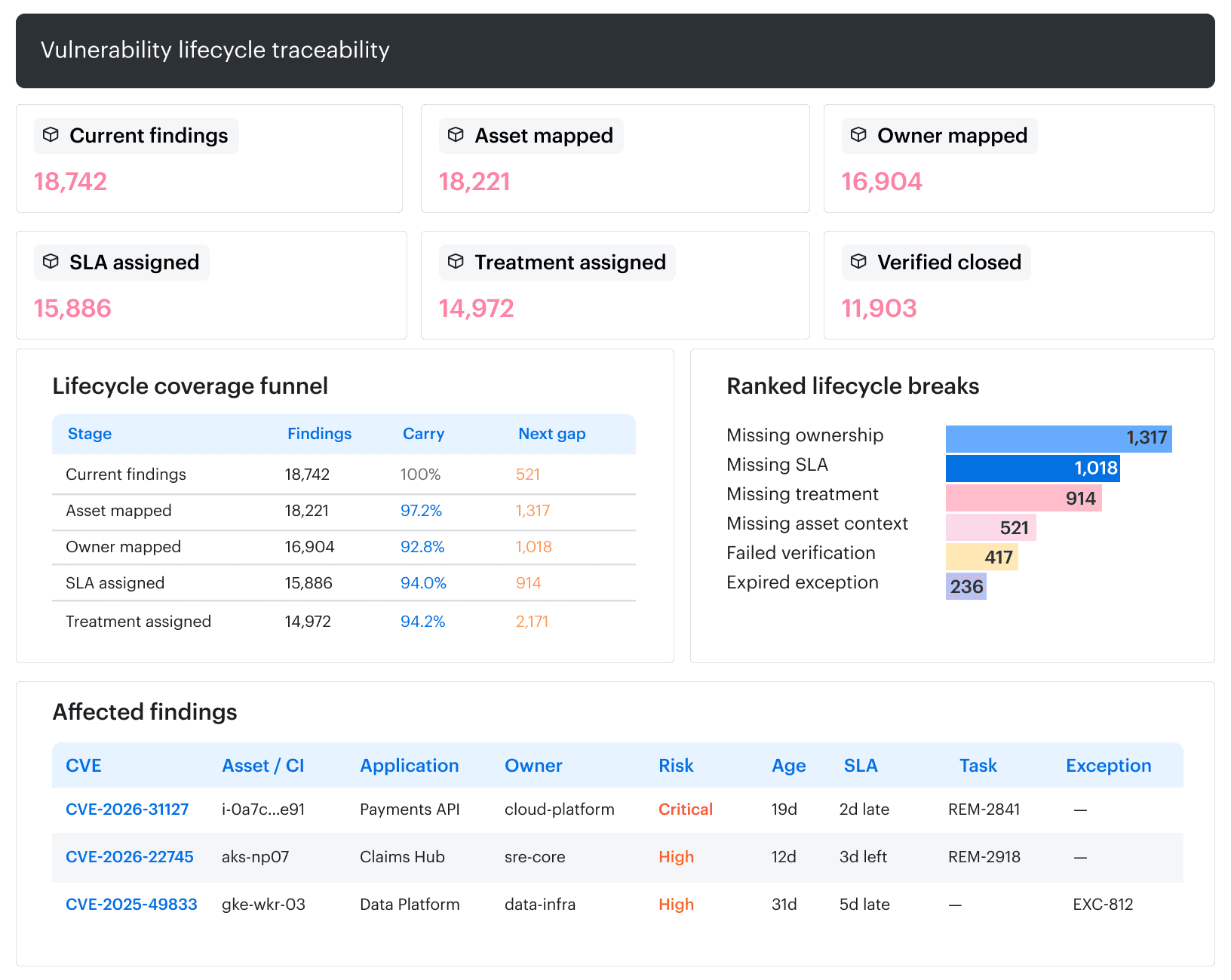 Vulnerability lifecycle traceability in Cloudaware. The dashboard shows where current findings lose the asset, ownership, SLA, treatment, or verification state required to reach verified closure.
Where the vulnerability management process breaks
Lifecycle failures usually occur at the handoff between vulnerability evidence and operational action.
| Failure | What breaks | Control to add |
|---|---|---|
| Unknown or unscanned assets | Vulnerabilities never enter the managed population | Reconcile inventory with scanner coverage |
| Duplicate source records | Teams receive redundant work and backlog counts become distorted | Normalize logical findings while retaining source evidence |
| Severity-only triage | Technical score becomes the entire priority decision | Add exploitation, exposure, asset, and business context |
| SLA without escalation | Overdue findings remain overdue without changing workflow | Define warning, breach, and escalation conditions |
| Silent suppression | Accepted exposure disappears from normal review | Use a formal exception with approver, rationale, controls, and expiry |
| Ticket-only closure | Work is marked complete while exposure may remain | Require rescan, retest, or another approved verification method |
| Repeated finding | The immediate fix does not address the underlying deployment or patch process | Reopen the finding and review the recurring pattern |
These failures can compound. A scanner accurately identifies a vulnerability, but a stale CMDB relationship routes remediation to the wrong team. The delay becomes an SLA breach. If the finding is then removed from normal remediation tracking without a documented exception, the ownership gap becomes a governance gap.
The corrective action should target the missing lifecycle state rather than simply increase scan frequency.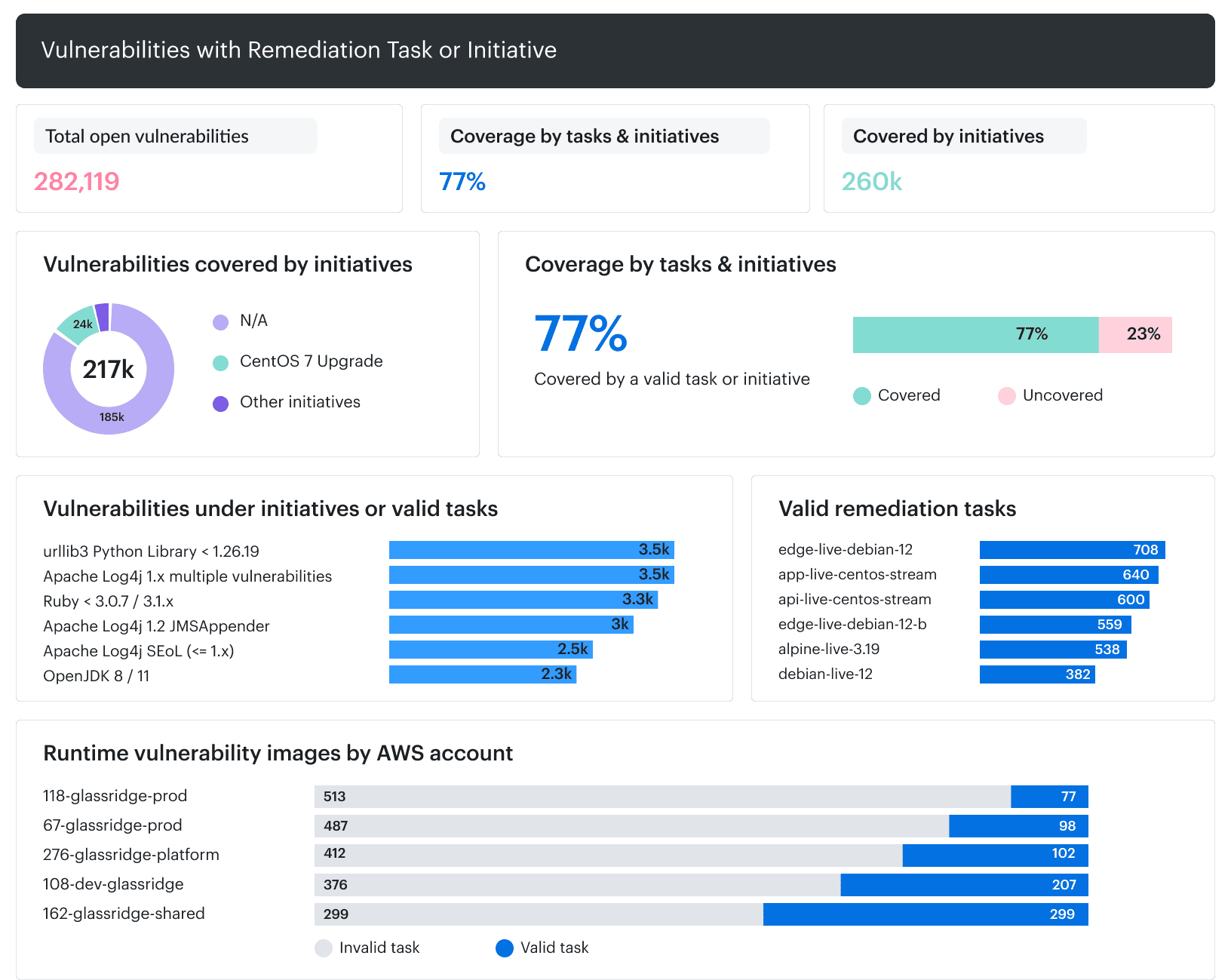 Remediation coverage in Cloudaware. Findings without a valid remediation task or initiative expose the gap between identifying a vulnerability and getting it into an accountable execution workflow.
Add operational context to vulnerability management
Cloudaware sits between vulnerability sources and remediation workflows, connecting findings with CMDB asset, application, environment, ownership, SLA, exception, and verification context. Vulnerability Management capabilities use infrastructure relationships, ownership data, treatment state, remediation work, exceptions, SLAs, and verification as part of the operating model.
Core capabilities:
- Normalize findings: Group source records around logical vulnerability findings while preserving scanner evidence through grouping and deduplication
- Add asset context: Connect vulnerability evidence with CIs, applications, environments, and other infrastructure relationships through Cloudaware CMDB
- Route remediation: Use ownership context to create and track remediation work and connect it with Jira or ServiceNow workflows
- Govern exceptions and SLAs: Track remediation deadlines, overdue work, exceptions, and expiry through the vulnerability management workflow
- Verify closure: Use subsequent scan results to update vulnerability state after remediation through verification workflows
- Monitor patched and mitigated assets: NeoSec, a separate Cloudaware module, flags behavior that deviates from each asset's baseline and investigates it with CMDB context
Cloudaware can ingest vulnerability and security data from supported integrations while keeping the affected infrastructure, ownership relationships, and remediation context in the CMDB. The scanner remains an evidence source. The CMDB-backed workflow supplies the context required to decide what happens next.