


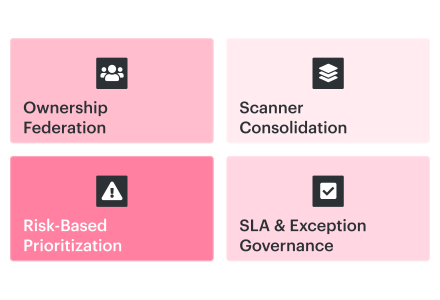
Enterprise vulnerability management becomes difficult when the organization can find vulnerabilities faster than it can determine which ones matter, who can remediate them, and whether remediation actually happened.
The volume problem is increasing. NIST reported that CVE submissions increased 263% between 2020 and 2025. In the first three months of 2026, submissions were nearly one-third higher than during the same period in 2025. Verizon's 2026 Data Breach Investigations Report found that exploitation of vulnerabilities accounted for 31% of breaches with known initial access vectors.
For a large organization, scanning is therefore only the beginning. Central security needs common rules for risk, SLAs, exceptions, and evidence, while remediation remains distributed among the application, cloud, platform, and infrastructure teams that can actually change the affected systems.
This guide was developed with input from Igor Kachurin, DevOps Engineer at Cloudaware, and Valentin Kel, Software Developer at Cloudaware. Their comments focus on the points where enterprise vulnerability programs usually become difficult in practice: scanner reconciliation, prioritization, ownership, remediation, and exception handling.
Key insights
- Enterprise vulnerability management is an execution problem as much as a detection problem: NIST reported a 263% increase in CVE submissions from 2020 to 2025, while Verizon found vulnerability exploitation accounted for 31% of breaches with known initial access vectors in its 2026 dataset.
- A vulnerability finding is not actionable until it has enterprise context: Teams need to resolve findings to an authoritative asset or CI, application, environment, and remediation owner before they can prioritize and route work consistently
- CVSS alone should not determine remediation order: Enterprise risk prioritization should combine technical severity with exploit evidence such as CISA KEV or EPSS, internet exposure, asset criticality, attack paths, and verified compensating controls
- Centralize vulnerability policy, but federate remediation: Security should define the risk model, SLAs, exception rules, escalation, and evidence requirements, while application, platform, and infrastructure teams own the technical changes they are actually able to make
- Measure verified risk reduction, not vulnerability volume: Verizon found only 26% of CISA KEV vulnerabilities were fully remediated in 2025, so enterprise reporting should emphasize scan coverage, owner coverage, exploitable vulnerabilities remediated, MTTR, backlog age, SLA breaches, exceptions, and verified closure
What is enterprise vulnerability management?
Enterprise vulnerability management is the operating model for identifying, contextualizing, prioritizing, assigning, remediating, and verifying vulnerabilities consistently across business units, cloud environments, infrastructure platforms, and technical teams.
A scanner can identify a vulnerability and assign technical severity. It usually cannot answer every operational question that follows. This is why enterprise VM starts with the asset model, not the vulnerability queue.
In practitioner discussions about building security programs at scale, establishing an accurate asset directory and understanding the organizational footprint comes before building a reliable risk model. A vulnerability cannot be prioritized or routed consistently when the affected asset itself is ambiguous.
For the general sequence from discovery through closure, see vulnerability management lifecycle guide. The enterprise problem begins when that lifecycle must operate across organizational boundaries.
Enterprise vulnerability management vs. a standard VM process
The difference is not an extra lifecycle stage. It is the amount of coordination required to make the same lifecycle produce consistent decisions.
| Standard or team-level VM | Enterprise vulnerability management |
|---|---|
| One or a few infrastructure teams | Multiple business units, applications, platform teams, and infrastructure owners |
| Limited scanner set | Cloud-native, host, container, endpoint, network, and third-party vulnerability sources |
| Relatively consistent environment | AWS, Azure, GCP, Kubernetes, VMware, on-premises, and acquired infrastructure |
| Local prioritization decisions | One risk policy applied across organizational units |
| Familiar technical owners | Ownership derived from CIs, applications, support groups, and business structures |
| Ad hoc exceptions | Governed risk acceptance with approval, expiry, and compensating controls |
| Team backlog reporting | Cross-BU coverage, SLA, exposure, backlog, and executive reporting |
A central security team rarely has enough system knowledge or change authority to remediate every finding itself. The more scalable model is for security to define policy and standards while the teams that operate the affected systems supply technical context and execute the change.
Where enterprise vulnerability assessment fits
Enterprise vulnerability assessment determines what weaknesses exist and where they occur. Enterprise vulnerability management determines what the organization does with those findings over time.
A useful operating sequence is: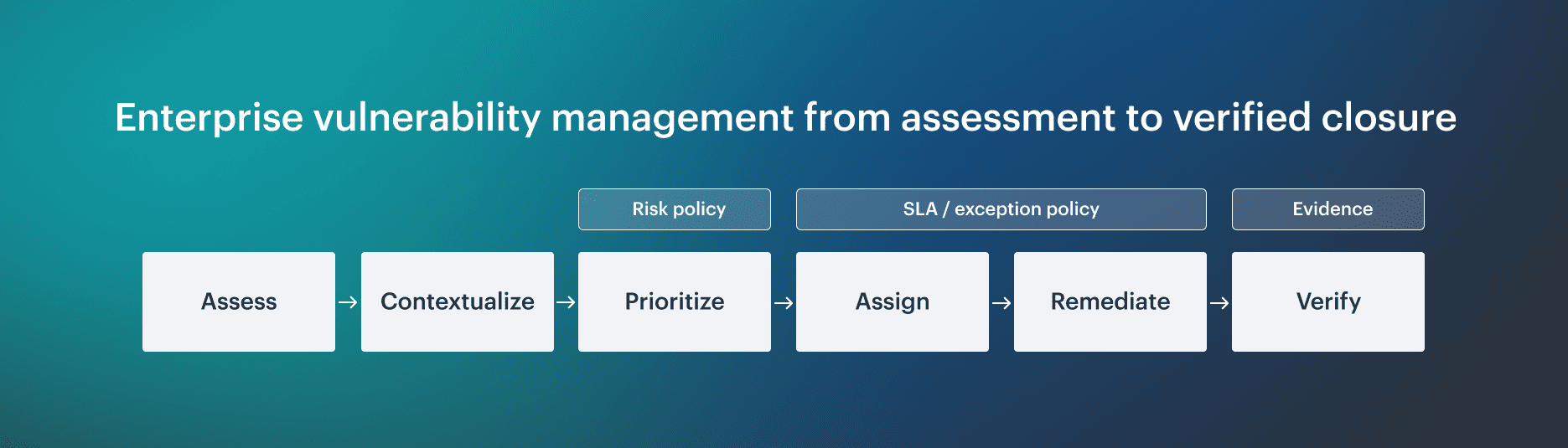 Assessment produces evidence about exposure. Management adds risk policy, ownership, workflow, SLA tracking, exceptions, escalation, and technical verification.
That distinction matters when an organization already owns several scanners but still cannot answer whether every important asset is covered or whether high-priority findings are moving toward closure.
How to build an enterprise vulnerability management program that works across the organization
A scalable enterprise vulnerability management program needs common governance without assuming that one security team can perform every remediation action.
The operating principle is to standardize the rules that determine priority, ownership, deadlines, exceptions, and evidence, then route the technical work to the teams with authority over the affected systems.
1. Federate remediation ownership without fragmenting the program
Enterprise remediation usually has at least two owners: the party accountable for the risk and the team capable of changing the vulnerable component.
A vulnerability may affect the Payments application, for example, while the required fix belongs to the database platform team. Assigning only the application owner creates accountability without execution authority. Assigning only the platform team loses the business context that determines priority.
"The team accountable for the risk is not always the team that can fix the vulnerable component. In enterprise environments, remediation works better when the finding keeps both the business owner and the technical resolver attached to the same workflow." — Valentin Kel, Software Developer at Cloudaware
The routing model should distinguish:
- Asset owner
- Application or service owner
- Platform or infrastructure remediation team
- Risk or exception approver
- Escalation owner
Shared infrastructure makes this distinction especially important. If 20 applications run on the same Kubernetes platform, creating 20 separate node-level remediation assignments generates duplicate work. The platform team may need to own the fix, while application relationships remain attached so security can understand the affected business scope.
This is also where enterprise cloud security governance intersects with vulnerability management: policy can remain centralized even when remediation is distributed.
2. Consolidate scanner findings around assets, not scanner consoles
Owning several scanners does not prove that the intended infrastructure is covered.
A large organization may receive findings from cloud-native scanners, host agents, container scanners, CNAPP platforms, and network or application security tools. The same EC2 instance can appear in several systems under different identifiers.
If those records cannot be reconciled against an authoritative asset, the VM team cannot reliably answer whether it is looking at several exposures, duplicate observations of the same exposure, or a finding associated with an asset that no longer exists.
"The first question I ask is not how many vulnerabilities the scanners found. It is whether those findings map to the assets we actually operate, whether those assets have owners, and whether we know which parts of the environment are not being scanned at all." — Igor Kachurin, DevOps Engineer at Cloudaware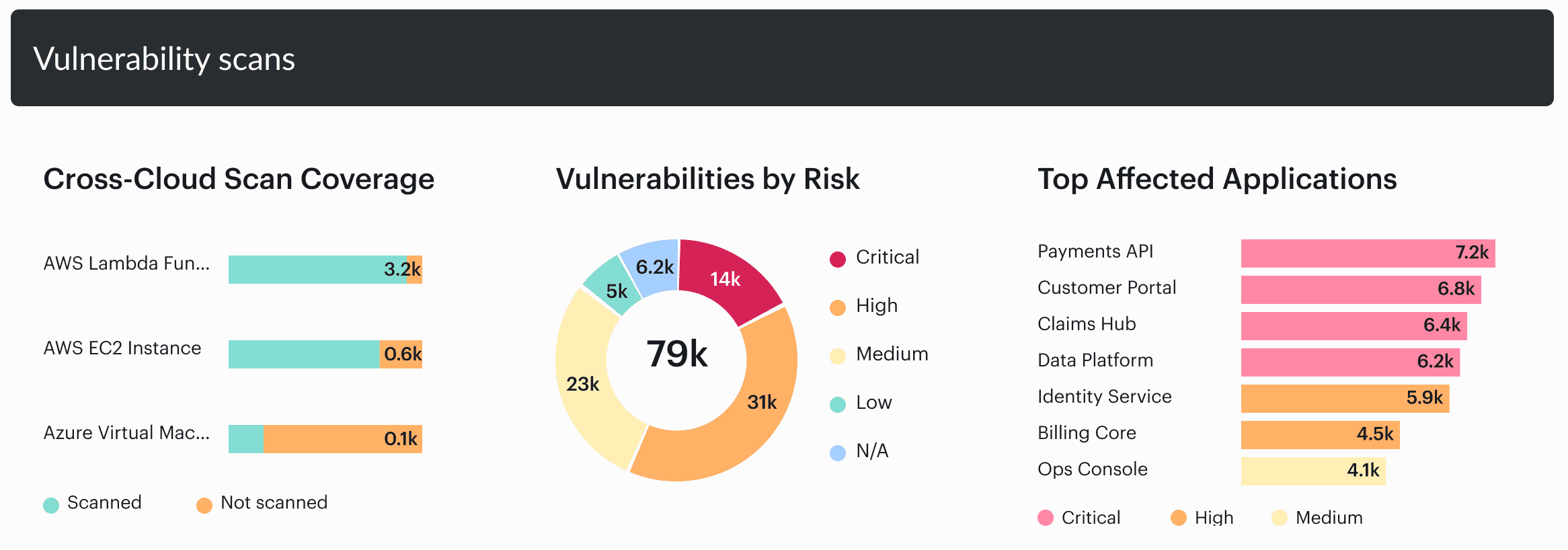 Cloudaware supports vulnerability data from multiple source types and brings findings into Vulnerability Scan records connected to CMDB context. This does not eliminate specialist scanners. It provides a common operational layer for applying ownership, SLA, and reporting logic to their findings.
The operational question therefore changes from "How many scanner integrations do we have?" to "Which in-scope assets are actually covered, and which findings can be mapped to the infrastructure that security expects to manage?"
3. Use one risk model across business units without relying on CVSS alone
Enterprise risk-based vulnerability management requires consistent prioritization, but consistent does not mean severity-only.
A useful decision model combines several signals: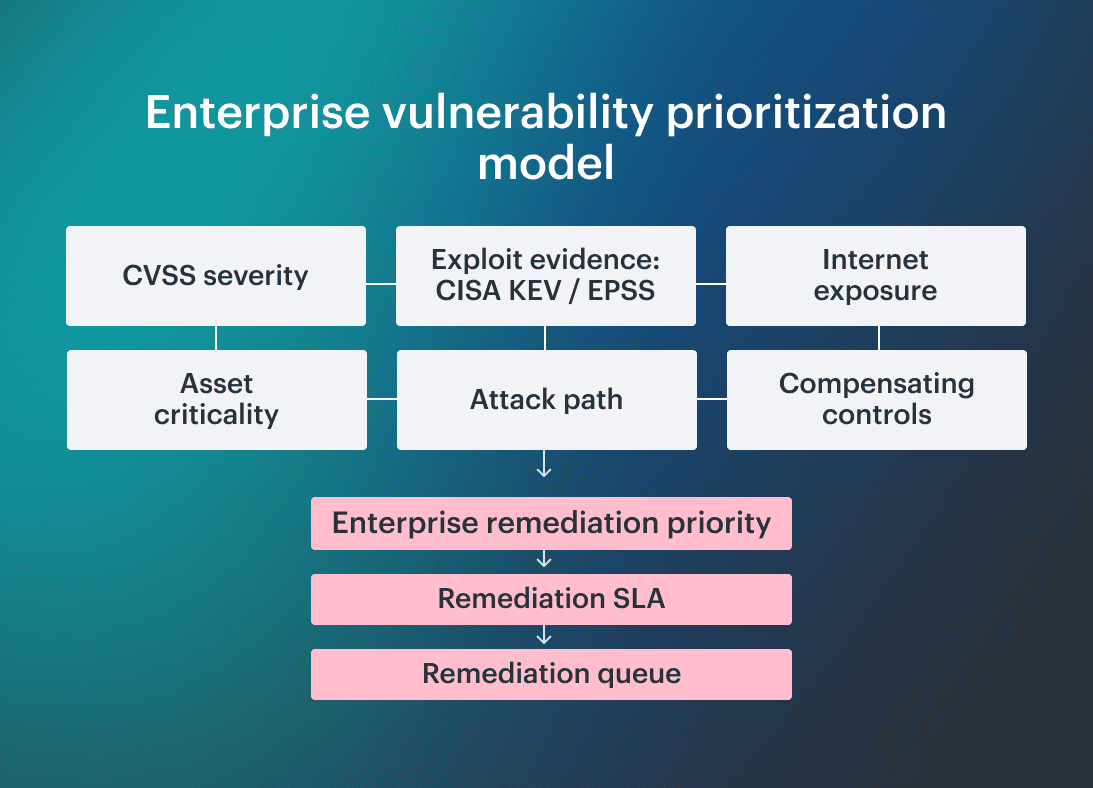 CVSS remains valuable as a technical severity input. It does not describe the complete organizational impact of a vulnerability.
"CVSS helps describe technical severity, but it does not tell you what should be fixed first in your environment. Exposure, exploitability, asset criticality, and the path an attacker can take from that asset often change the remediation order." — Valentin Kel, Software Developer at Cloudaware
Practitioners working with large vulnerability queues make this distinction explicitly. A Critical or CVSS 10 finding does not automatically represent the most urgent organizational risk if it sits on an isolated, low-value system. A lower-scored vulnerability may deserve faster remediation if it affects an internet-facing production service, supports a critical business function, or creates a useful path toward sensitive systems.
Consider two findings:
| Finding | Scanner context | Enterprise context |
|---|---|---|
| Vulnerability A | CVSS 9.8 | Isolated non-production host, segmented network, no known active exploitation |
| Vulnerability B | CVSS 7.5 | Internet-facing production service, high-value application, useful attack path toward sensitive systems |
A severity-only queue puts Vulnerability A first. A contextual model may correctly prioritize Vulnerability B.
Exploitability data can improve the decision. CISA's Known Exploited Vulnerabilities catalog identifies vulnerabilities with evidence of exploitation, while EPSS estimates exploitation probability. Neither replaces asset context. If the organization has confirmed that it does not use the affected technology, the KEV normally falls outside its remediation scope.
The scale pressure behind this model is visible in public vulnerability infrastructure. NIST moved toward selective NVD enrichment in 2026 after CVE submissions had increased 263% since 2020. The enterprise equivalent is similar: spend deeper analysis where additional context can change the remediation decision.
For rapidly changing exposures where exploit and patch information remain incomplete, see the zero-day vulnerability guide.
4. Standardize remediation SLAs and exception governance across teams
A common risk model does not create consistent outcomes if each business unit interprets deadlines, deferrals, and closure differently.
Every prioritized finding needs a defined operating state. At minimum, the program should know who owns remediation, when the SLA started, when the work is due, whether the vulnerability has an approved exception, when that exception expires, and what evidence will count as closure.
"An exception should not remove a vulnerability from the program. It should explain why remediation is deferred, who accepted the risk, what compensating control exists, and when that decision must be reviewed again." — Igor Kachurin, DevOps Engineer at Cloudaware
Suppose a Critical vulnerability affects a legacy production server that cannot be patched until the next maintenance window. A defensible exception would identify the affected finding and CI, document the business reason, name the approver, capture the compensating control, and include an expiry date. When the exception expires, the finding should return to the normal remediation path or go through a new risk decision.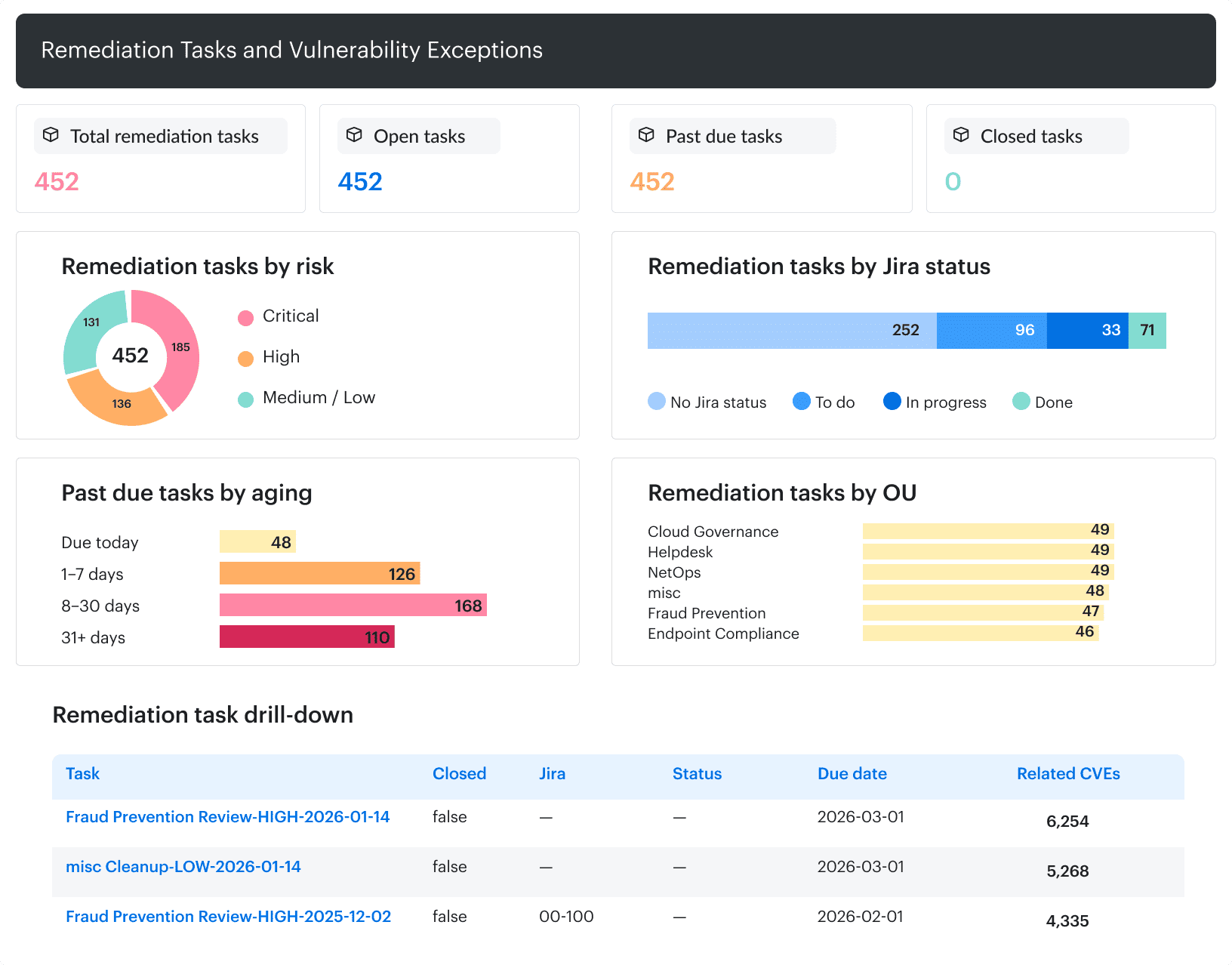 Cloudaware models Vulnerability Exceptions as records linked to vulnerability findings, allowing teams to retain scope, justification, ownership, approval, dates, and compensating-control context alongside the affected vulnerability data. Cloudaware can also track remediation tasks and SLA state across organizational scopes.
5. Treat acquisitions as vulnerability-management onboarding, not just asset discovery
An acquired environment should not enter corporate vulnerability reporting simply because its findings were imported successfully.
Consider an acquisition that brings two AWS Organizations, VMware infrastructure, its own Tenable deployment, local severity rules, and a backlog of accepted exceptions. Merging those findings into the parent company's reporting immediately would create apparent visibility without guaranteeing comparable ownership, prioritization, or exception policy.
Before the acquired environment enters standard SLA reporting, validate that:
- Scanner assets map to authoritative CIs so findings are tied to the infrastructure the organization actually manages
- Remediation ownership is defined for the acquired assets and applications
- Production and business-critical systems are identified so prioritization reflects business impact
- Local severity rules map to the enterprise risk model rather than creating two competing priority systems
- Inherited exceptions are revalidated for current ownership, business justification, compensating controls, and expiry
- Scanner coverage gaps are understood before coverage metrics are rolled into enterprise reporting
The key decision is therefore will be "Can we interpret and govern that data under the same operating model as the rest of the organization?"
For the broader security implications of moving systems and data between environments, see the cloud migration data security guidance.
6. Report exposure and remediation performance by business unit
Leadership reporting should show whether actionable risk is being reduced, not how busy the vulnerability program is.
A raw total such as "80,000 open vulnerabilities" does not tell leadership whether critical systems are covered, whether exploitable findings are aging, or whether one business unit consistently misses remediation deadlines.
Practitioner guidance favors metrics that show risk reduction and coverage over time rather than activity counts such as scans run or findings processed.
Useful enterprise metrics include:
| Metric | Decision it supports |
|---|---|
| Critical-asset scan coverage | Are the systems that matter actually being assessed? |
| Owner coverage | Can actionable findings reach an accountable team? |
| Exploitable vulnerabilities remediated | Are teams removing the exposures most likely to matter? |
| MTTR by risk band | How quickly does material exposure leave the environment? |
| Backlog age | Is unresolved security debt accumulating? |
| SLA compliance by BU or application | Where is remediation systematically missing policy? |
| Expired exceptions | Has temporary risk acceptance become unmanaged exposure? |
| Reopened findings | Did remediation actually eliminate the condition? |
The 2026 Verizon DBIR illustrates the gap between discovery and closure. In the vulnerability-remediation data analyzed for the report, only 26% of critical vulnerabilities, defined there as vulnerabilities in CISA KEV, were fully remediated by organizations in 2025. Median time to full resolution increased from 32 to 43 days.
Those numbers describe observed outcomes, not recommended SLA targets. Their value is showing why enterprise VM metrics need to connect exposure to remediation progress.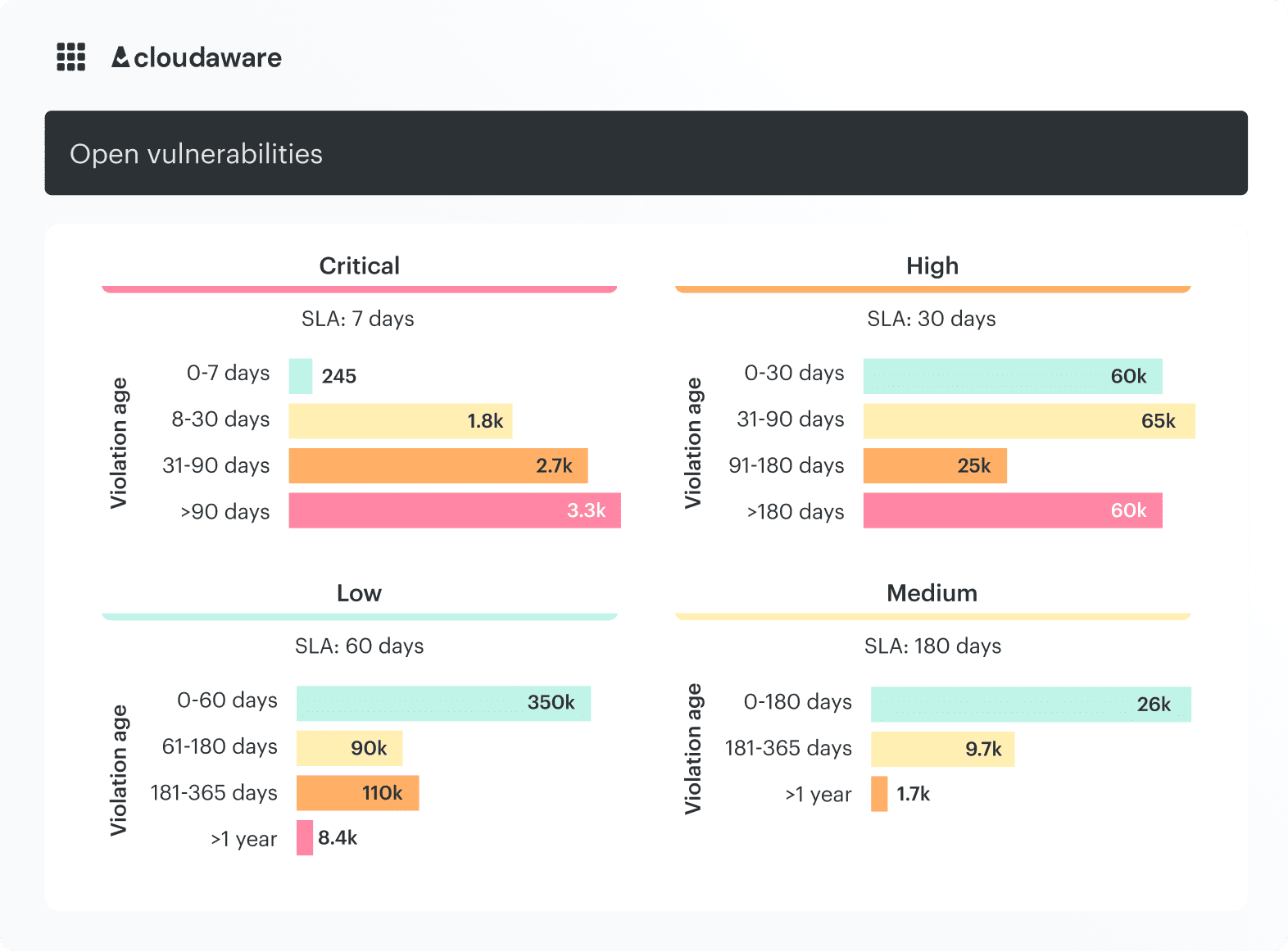 Cloudaware's dashboard groups findings by risk and age against the configured SLA windows. The thresholds shown are example configurations, not universal remediation standards.
What to look for in enterprise vulnerability management tools and software
An enterprise vulnerability management tool should be evaluated by whether it preserves enough context to move a finding from detection to accountable, verifiable remediation.
Large organizations often already own several products capable of identifying vulnerabilities. The harder requirement is maintaining continuity across assets, owners, risk decisions, remediation systems, SLAs, exceptions, and verification.
| Criterion | Enterprise test |
|---|---|
| Coverage | Can the system prove which in-scope assets are scanned and expose coverage gaps? |
| Source normalization | Can findings from multiple scanners resolve to authoritative infrastructure records? |
| Context preservation | Does a finding retain application, environment, owner, exposure, and business context? |
| Risk prioritization | Can prioritization use exploitability and asset context rather than severity alone? |
| Ownership | Can remediation reach the team with authority to make the change? |
| ITSM workflow | Can findings move into Jira, ServiceNow, or existing queues without losing context? |
| SLA governance | Can teams track age, due dates, breaches, and performance by organizational scope? |
| Exception governance | Are accepted risks scoped, approved, time-bound, and reportable? |
| Verification | Can the program distinguish "ticket closed" from "vulnerability no longer detected"? |
| Reporting | Can leadership compare coverage and remediation performance across business units and applications? |
This is also a useful test for enterprise risk-based vulnerability management software. A proprietary risk score is less important than understanding which inputs changed the decision and whether the resulting work can be governed. For a vendor-by-vendor evaluation, see our vulnerability management tools comparison.
What an enterprise vulnerability management operating model looks like
A scalable operating model centralizes policy and evidence requirements while distributing technical remediation.
| Stage | Central security owns | Distributed teams own | Evidence |
|---|---|---|---|
| Scope | Coverage policy and minimum requirements | Accurate system and service context | Asset inventory and scan coverage |
| Prioritization | Enterprise risk model | Application and operational context | Priority decision |
| Assignment | Routing and escalation rules | Acceptance of accountable work | Owner mapping |
| Remediation | SLA policy | Technical change | Task, ticket, or change record |
| Exception | Approval requirements | Business justification and compensating controls | Exception record and expiry |
| Verification | Closure criteria | Support for validation | Rescan or equivalent technical evidence |
| Reporting | Enterprise metrics and trends | BU-level performance | SLA, MTTR, backlog, and coverage data |
A fully centralized model becomes a bottleneck because the central team lacks detailed knowledge and change authority across every system. A fully decentralized model creates the opposite problem: different teams start interpreting severity, SLA, exception, and closure rules differently.
Connect vulnerability findings to enterprise context with Cloudaware
Cloudaware provides an operational layer between vulnerability sources and the teams responsible for managing the affected infrastructure. Its role is to connect vulnerability records with CMDB context and carry that context into remediation, exceptions, SLA tracking, and reporting.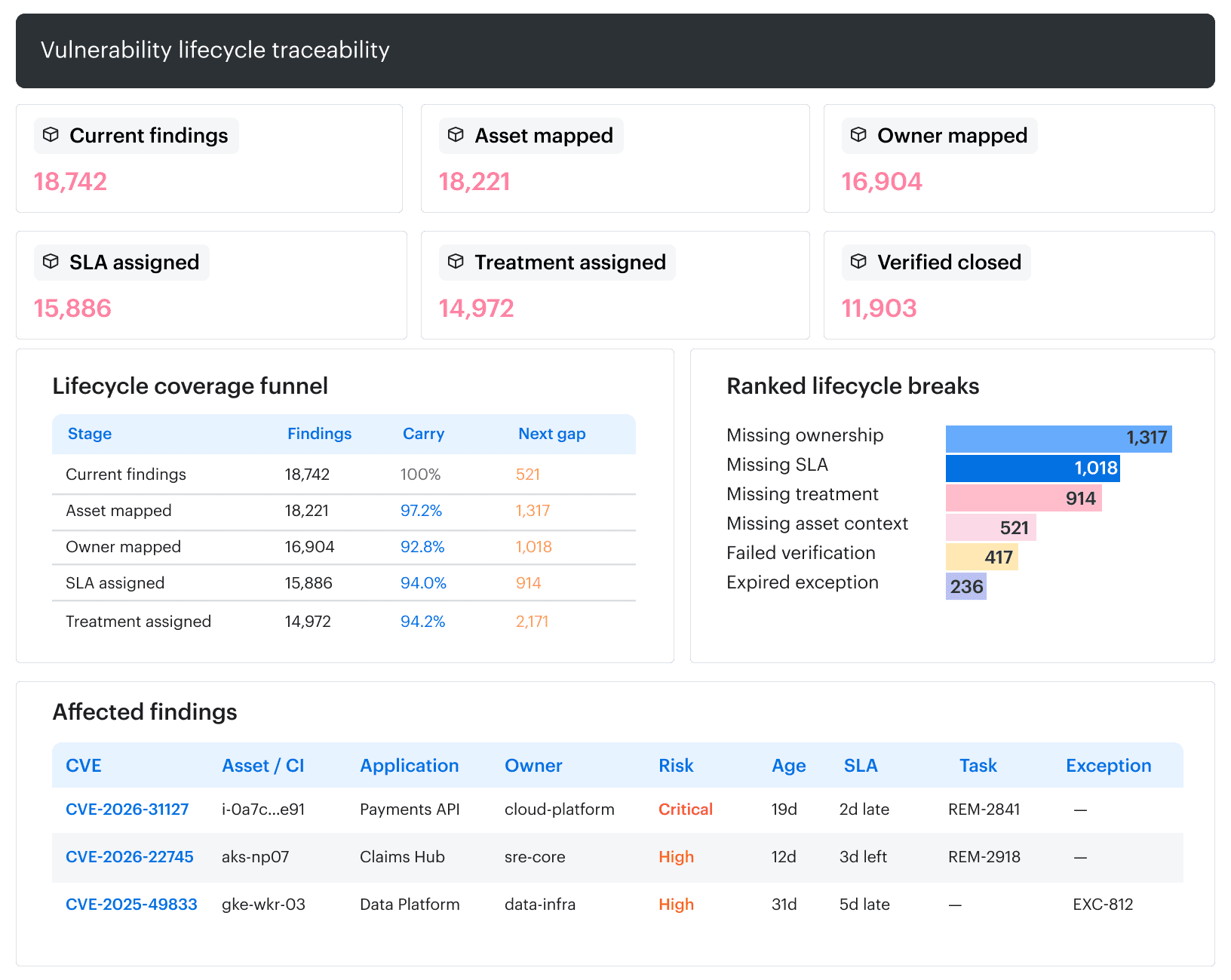 Core capabilities:
- Normalize findings. Group source records around logical vulnerability findings while preserving scanner evidence through grouping and deduplication.
- Add asset context. Connect vulnerability evidence with CIs, applications, environments, owners, and other infrastructure relationships through CMDB.
- Investigate coverage with MCP. Ask questions across the normalized CMDB data to find unscanned assets, stale coverage, scanner overlap, or gaps across AWS, Azure, GCP, vCenter, and other connected infrastructure without checking each environment separately.
- Route remediation. Use ownership and asset context to create and track remediation work and connect it with Jira or ServiceNow workflows.
- Govern exceptions. Keep deferred findings tied to the reason for acceptance, accountable owner, approval, compensating controls, and expiry instead of removing them from the operational record.
- Verify closure. Use subsequent scanner data to confirm that the vulnerability is no longer detected rather than treating a closed task or ticket as proof of remediation.
Enterprise vulnerability management checklist
Use this checklist to evaluate whether your enterprise vulnerability management program can move findings from detection to governed closure.
It brings together the operating practices covered in this guide: authoritative asset coverage, contextual risk prioritization, clear remediation ownership, governed SLAs and exceptions, and verified closure.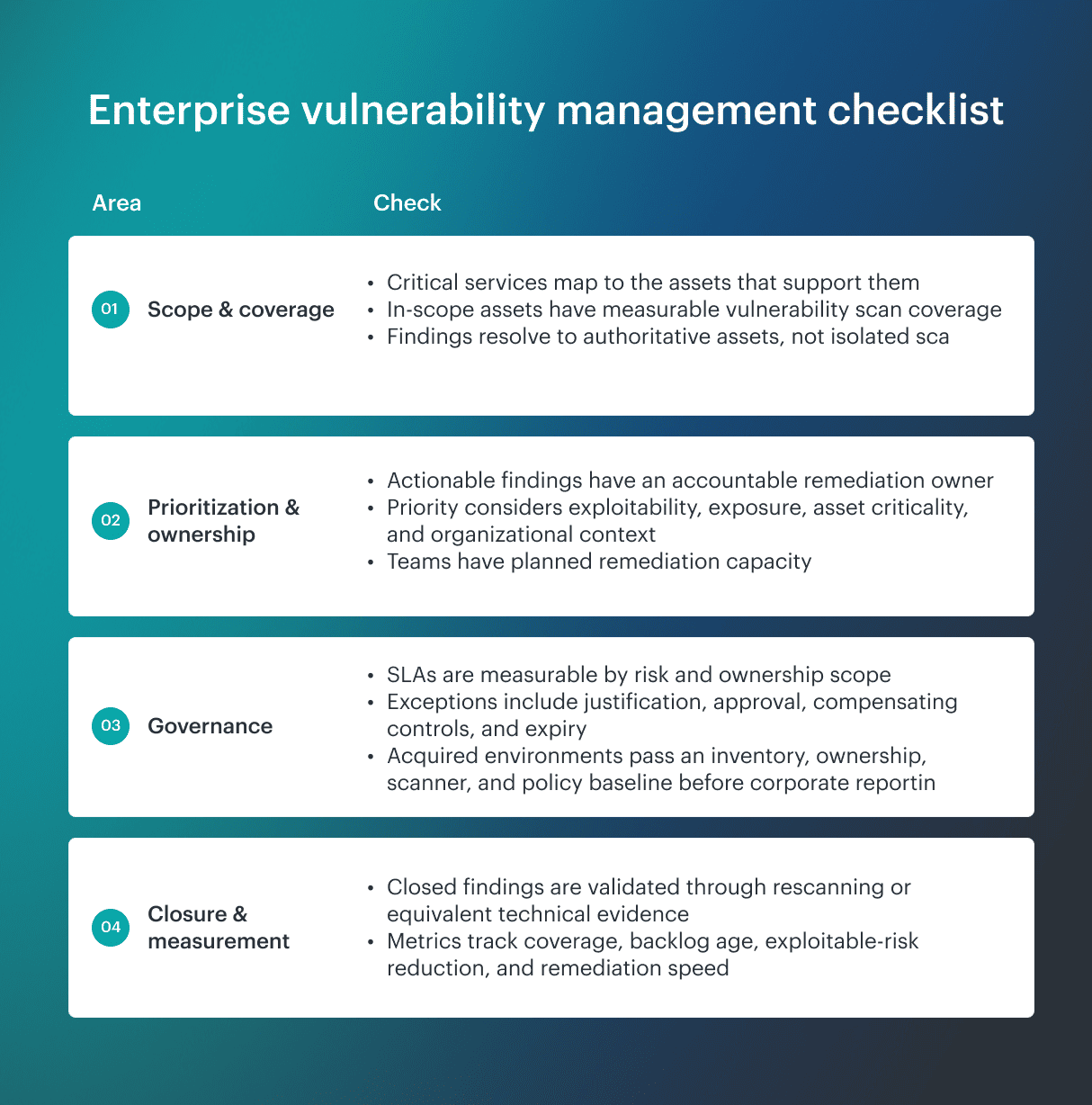 The pressure on these controls is increasing. NIST reported a 263% increase in CVE submissions from 2020 to 2025, while Verizon's 2026 DBIR found that only 26% of CISA KEV vulnerabilities were fully remediated in the organizations it analyzed.
Together, those figures reinforce the operating problem behind enterprise VM: finding vulnerabilities at scale is not enough if teams cannot prioritize, assign, remediate, and verify them consistently.