


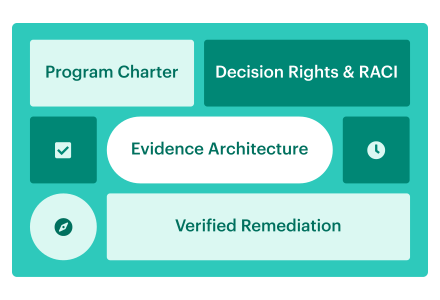
A vulnerability management program usually fails after detection, not before it. Scanners continue producing findings while the organization loses the ability to answer the questions that determine what happens next.
In the 2026 2026 Verizon Data Breach Investigations Report, 31% of breaches began with the exploitation of software vulnerabilities. Rapid7 Labs reported 8,539 high- and critical-severity CVEs disclosed in Q2 2026, compared with 4,268 in Q2 2025. Disclosure volume alone does not show which vulnerabilities affect an organization's assets or deserve the earliest treatment.
A vulnerability management program needs a repeatable way to connect each finding to the affected asset, determine whether the vulnerable condition matters in that environment, assess exploitation evidence and business impact, assign treatment, preserve the decision trail, verify the outcome, and revisit the decision when infrastructure or controls change.
Key insights
- A vulnerability management program should connect every finding to an in-scope asset, application or service, accountable owner, and enough environmental context to support a treatment decision
- Vulnerability priority should be based on the affected asset and its environment, combining applicability, reachability, CVSS, CISA KEV, EPSS, compensating controls, and business impact rather than severity alone
- Patching is one treatment path; configuration changes, compensating controls, isolation, asset retirement, and approved risk exceptions also need defined owners, evidence, validation, and review
- Program governance should define who can set priority, approve exceptions, change SLAs, accept residual risk, and determine when a vulnerability is verified as closed
- Useful vulnerability management metrics show where execution breaks, including scope coverage, source freshness, owner mapping, work linkage, SLA state, exception health, closure validation, and recurrence
- Verified closure is a point-in-time decision, so mature programs reassess risk when configuration, topology, exposure, asset function, or compensating controls change
What is a vulnerability management program?
A vulnerability management program is the governed capability that defines which assets and findings are in scope, how vulnerability risk is evaluated, who can make and execute treatment decisions, what evidence is required, and how those decisions are verified and reassessed over time.
That is broader than scanning and different from the vulnerability lifecycle or patch management.
| Artifact | What it controls | What it should not replace |
|---|---|---|
| Vulnerability management program | Ongoing governance, decisions, evidence, and accountability | Scanner deployment |
| Vulnerability management strategy | Direction, priorities, and target state | Day-to-day operating plan |
| Vulnerability management framework | Reference structure used to design the program | Organization-specific implementation |
| Vulnerability management plan | Approved operating rules and program fields | The program itself |
| Vulnerability management project plan | Work required to launch or change the program | Evergreen operations |
| Vulnerability management lifecycle | How an individual finding moves through states | Program governance |
| Patch management | One way to remove vulnerable software conditions | All vulnerability treatment |
A finding becomes actionable when the program can connect it to the environment in which it exists. Asset function, application relationships, communication paths, network position, data flows, and compensating controls can change the treatment decision even when two systems carry the same CVE. A risk-based operating model therefore starts with inventory and relationships before it attempts to prioritize vulnerability records.
For the cloud-specific discovery, prioritization, and remediation workflow beneath that program layer, see cloud vulnerability management.
Build a vulnerability management program framework around the decisions it must control
A useful vulnerability management framework starts with decisions and evidence requirements. Tools support those decisions, but they should not define the operating model.
At minimum, the program should answer the following questions.
| Program component | Decision the program must support | Required evidence |
|---|---|---|
| Scope | Which assets, services, and environments are governed? | Current asset denominator and scope rules |
| Finding intake | Which sources are authoritative and current? | Source, timestamp, and affected asset |
| Applicability | Does the vulnerable condition actually exist here? | Software, package, version, and configuration context |
| Exposure | Can an attacker reach or trigger the vulnerable condition? | Reachability, relationships, topology, and controls |
| Prioritization | Why should this finding be handled now? | Severity, exploitation evidence, context, and impact |
| Ownership | Who is accountable for treatment? | Valid owner or team mapping |
| Treatment | What action is required and by when? | Remediation task, change, compensating control, or exception |
| Exception | Who accepted the residual risk and for how long? | Owner, rationale, approval, and expiry |
| Validation | Did the treatment change the exposure? | Re-scan or other verification evidence |
| Reassessment | Is the previous decision still valid? | Configuration, topology, exposure, or control changes |
| Reporting | Where is program execution failing? | Coverage, workflow, exception, and closure metrics |
These controls also form the baseline for vulnerability management best practices: maintain complete scope, preserve finding context, assign accountable owners, govern exceptions, and verify treatment before closure.
1. Set scope, decision rights, and governance
A vulnerability management program cannot report meaningful coverage until it has a defensible denominator.
For a multi-cloud or hybrid estate, that means knowing which AWS accounts, Azure subscriptions, GCP projects, VMware assets, applications, services, and other infrastructure objects belong in scope. The inventory also needs to distinguish active assets from stale, duplicate, or decommissioned configuration items.
Ownership belongs in the same baseline. A scanner may identify a vulnerable package on a compute instance, but remediation can still stall if nobody can determine which application depends on that instance or which team is authorized to change it.
That problem appears repeatedly in practitioner discussions. In a recent r/cybersecurity discussion about building a vulnerability management program, one practitioner reduced the starting question to whether the organization has an up-to-date, sufficiently complete asset inventory. Other responses in the thread similarly put inventory, CMDB quality, and repeatable process ahead of adding more tools.
The governance layer then needs explicit authority for the decisions that create delay or ambiguity:
- Scope authority: Who approves inclusions, exclusions, and temporary coverage gaps
- Priority authority: Who may override the default priority or SLA
- Treatment ownership: Which team must act on the affected asset
- Exception authority: Who may accept residual risk and under which conditions
- Closure authority: What evidence is sufficient to consider the exposure treated
- Escalation authority: Who resolves missing ownership, overdue remediation, or conflicting treatment decisions
A charter that says “Security owns vulnerability management” is incomplete. Security may own program governance while infrastructure, platform, application, network, and risk teams own different treatment decisions.
If the broader inventory and ownership baseline is still unreliable, use the multi-cloud governance scorecard to test coverage, CMDB accuracy, dependency mapping, and remediation context before those fields become inputs to vulnerability decisions.
2. Vulnerability management architecture: connect findings to business context and action
The architecture should preserve why a finding received its current treatment priority, not only its severity and ticket status.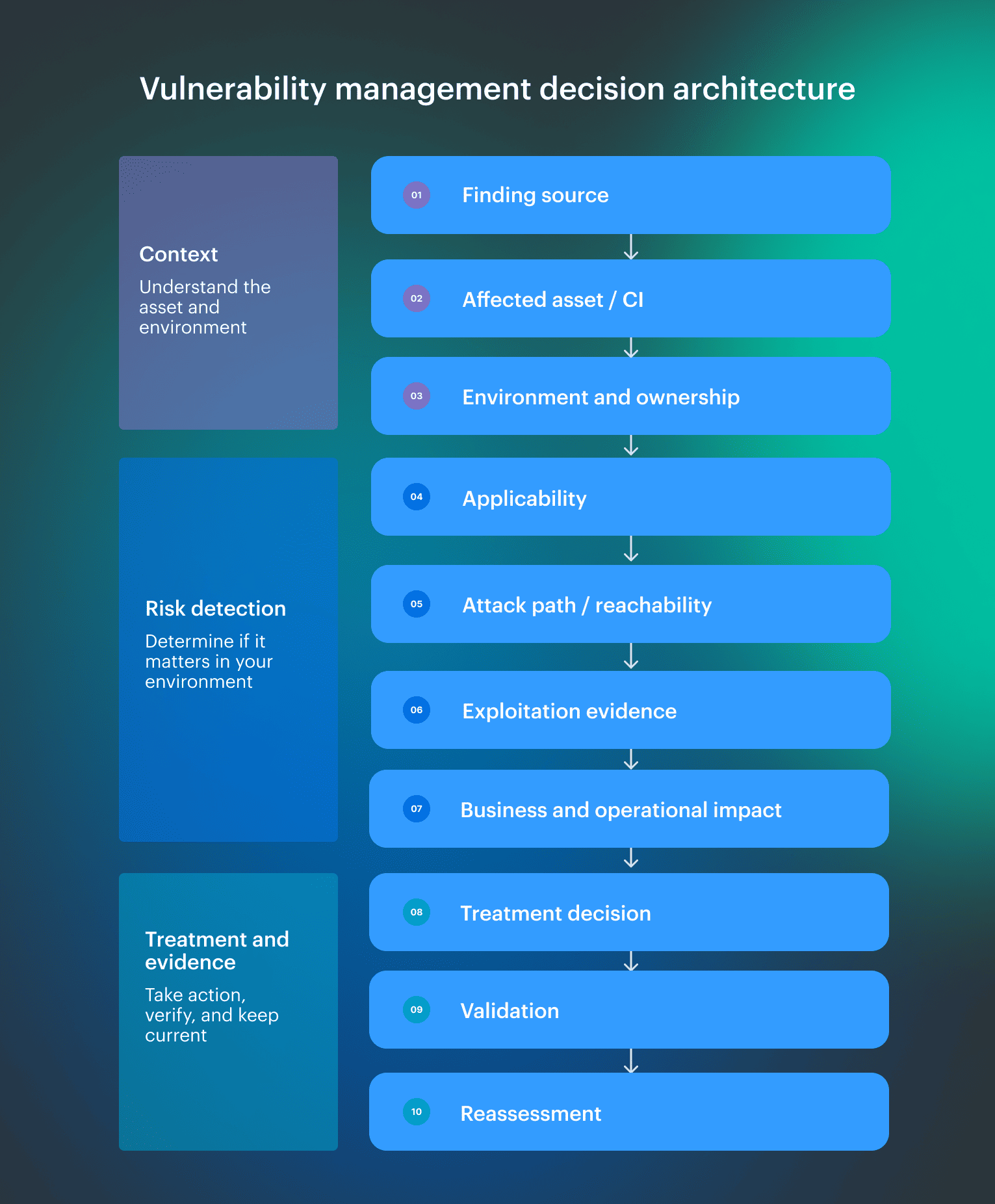 The same vulnerability can justify different treatment on two similar assets. Network placement, communication paths, local configuration, and compensating controls may make the vulnerable condition reachable on one system and materially harder to reach on another.
External exploitation signals refine that environmental analysis rather than replace it.
The CISA Known Exploited Vulnerabilities Catalog provides evidence that specific vulnerabilities have been exploited in the wild. CISA recommends using KEV as an input to vulnerability prioritization.
FIRST's Exploit Prediction Scoring System answers another question: how likely exploitation activity is to be observed for a vulnerability in the next 30 days. FIRST also makes clear that EPSS is not a full organizational risk score because it does not know the affected asset's business context, compensating controls, or impact.
That gives the program several distinct inputs.
| Input | What it contributes |
|---|---|
| CVSS | Technical severity under standardized conditions |
| CISA KEV | Evidence of known exploitation |
| EPSS | Estimated short-term exploitation probability |
| Local behavior evidence | Whether the affected asset is behaving abnormally, as flagged by Cloudaware NeoSec |
| Applicability | Whether the vulnerable condition exists on the asset |
| Reachability | Whether the condition can realistically be reached |
| Compensating controls | Which protections currently reduce exposure |
| Asset context | What service or business function the asset supports |
| Impact | What exploitation could cause in this environment |
The output is an asset-specific treatment priority, not a universal ranking for the CVE.
When threat evidence becomes an explicit prioritization input, threat and vulnerability management goes deeper into how exploitability and asset context change what gets fixed first.
3. Write the charter and operating rules before scaling
The vulnerability management program charter establishes authority. The vulnerability management plan converts that authority into repeatable operating rules.
The charter can remain compact if it answers the right questions.
| Charter field | Decision to document |
|---|---|
| Purpose | What governed outcome the program must produce |
| Scope | Which infrastructure and applications are covered |
| Authority | Who can set or change program rules |
| Ownership | Who owns program decisions and treatment |
| Priority policy | Which inputs influence treatment priority |
| Treatment policy | Which remediation and mitigation paths are allowed |
| Exceptions | Who can approve them and how they expire |
| Validation | What constitutes verified treatment |
| Reporting | Which operating metrics stakeholders review |
| Review cadence | When rules and program performance are reassessed |
Reference frameworks contribute different pieces of this model. NIST guidance can inform governance and risk-management structure. CIS Control 7 provides safeguards around continuous vulnerability management. OWASP guidance is relevant to application-specific vulnerability handling.
For teams mapping vulnerability-management evidence into cloud control requirements, the Cloud Controls Matrix provides a useful model for connecting control scope with ownership, exceptions, current evidence, and re-evaluation.
A vulnerability management maturity model can help assess program capabilities. None of them removes the need to define organization-specific scope, ownership, systems, treatment authority, and evidence.
How to build a vulnerability management program in 90 days
The first 90 days should establish a trustworthy decision system before the organization scales vulnerability management automation or adds more tooling.
That sequence matches the implementation problems practitioners describe when inheriting immature programs. In a SecurityCareerAdvice discussion, practitioners repeatedly recommended understanding the asset estate, network topology, system relationships, business criticality, and prioritization process before expanding the tool stack.
Days 0-30: establish scope, environmental context, and ownership
The first month should answer whether you can trust the denominator and the context behind each finding.
Start with a bounded pilot such as one production application, infrastructure domain, or business service. Declaring the entire enterprise in scope is less useful if the team cannot yet trace findings to active assets and accountable owners. Enterprise vulnerability management adds the operating model needed across multiple business units, scanners, cloud platforms, and infrastructure teams.
Build these artifacts:
- Scope register: In-scope accounts, subscriptions, projects, applications, services, and infrastructure
- Asset denominator: Authoritative source used to determine how many active assets should be covered
- Source inventory: Scanner, cloud-native, application, container, and other vulnerability sources
- Freshness baseline: Last successful scan or source update by scope
- Ownership map: Security owner, infrastructure or platform owner, application owner, and escalation route
- Relationship baseline: Relevant application, service, network, and business relationships
- Workflow map: Where remediation tasks, changes, exceptions, and closure evidence currently live
Then test the model against real findings.
For each sampled finding, determine whether the team can answer:
- Which active asset or CI is affected?
- Which application or service depends on it?
- Who can modify or retire it?
- Is the vulnerable component or configuration actually present?
- Can the team determine enough about reachability to assess exposure?
- Is there already a remediation task, compensating control, or exception?
Cloudaware can make this baseline measurable rather than spreadsheet-driven. The Vulnerability Scans with SLAs dashboard compares scanned and unscanned resources, surfaces stale coverage, and lets teams break findings down by application, service, account or subscription, platform, and risk.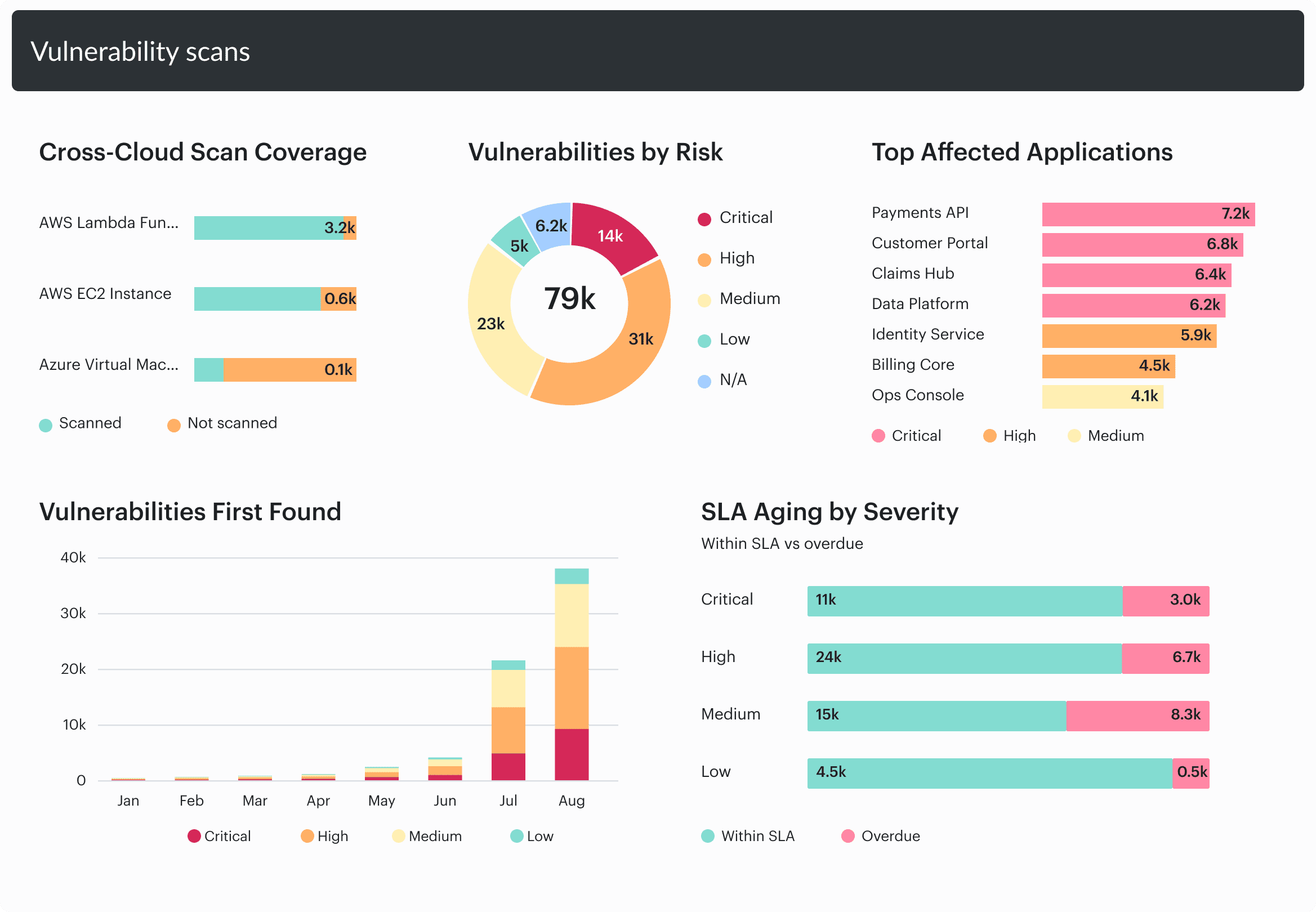 Cloudaware Vulnerability Scans: Scan coverage, stale exposure, affected applications, and vulnerability age show where the program's baseline is incomplete before prioritization begins.
Days 31-60: connect environmental risk to treatment
Once the inventory and relationships are trustworthy enough, define how the program turns findings into priorities.
Rapid7 Labs reported 8,539 new high- and critical-severity CVEs in Q2 2026, compared with 4,268 in Q2 2025. Its Q2 threat analysis identified a much smaller set of vulnerabilities with observed exploitation. That gap illustrates why severity alone cannot determine an enterprise remediation queue.
For each finding, evaluate:
- Applicability: Is the vulnerable component, version, or configuration actually present?
- Reachability: Can an attacker access the vulnerable condition through a relevant path?
- Known exploitation: Does CISA KEV or another validated source show exploitation?
- Exploit probability: What does EPSS or another approved predictive input indicate?
- Existing controls: Which segmentation, firewall, authentication, endpoint, or other controls change exposure?
- Asset function: Which application, service, or business process depends on the asset?
- Impact: Could exploitation cause data exposure, downtime, lateral movement, safety impact, or another material consequence?
Map an accountable owner during intake, using the application or asset owner where the relationship is reliable and a documented fallback owner where it is not. After prioritization, confirm the treatment owner, set the due date, and route the work. Review fallback assignments and disputed mappings rather than treating every assigned owner as correct.
The SLA should set the default response expectation without pretending that severity alone resolves prioritization. The Vulnerability Management Program Pack discussion on r/cybersecurity shows the range of real operating models. Some practitioners describe fixed severity-based SLAs backed by formal exception approval. Others adjust treatment based on exploitability, attack vector, and business-specific risk.
Days 61-90: validate closure, report the program, and expand
The third month should prove that the program can convert a treatment decision into verified risk reduction. Do not make the ticket's Closed state the authoritative signal.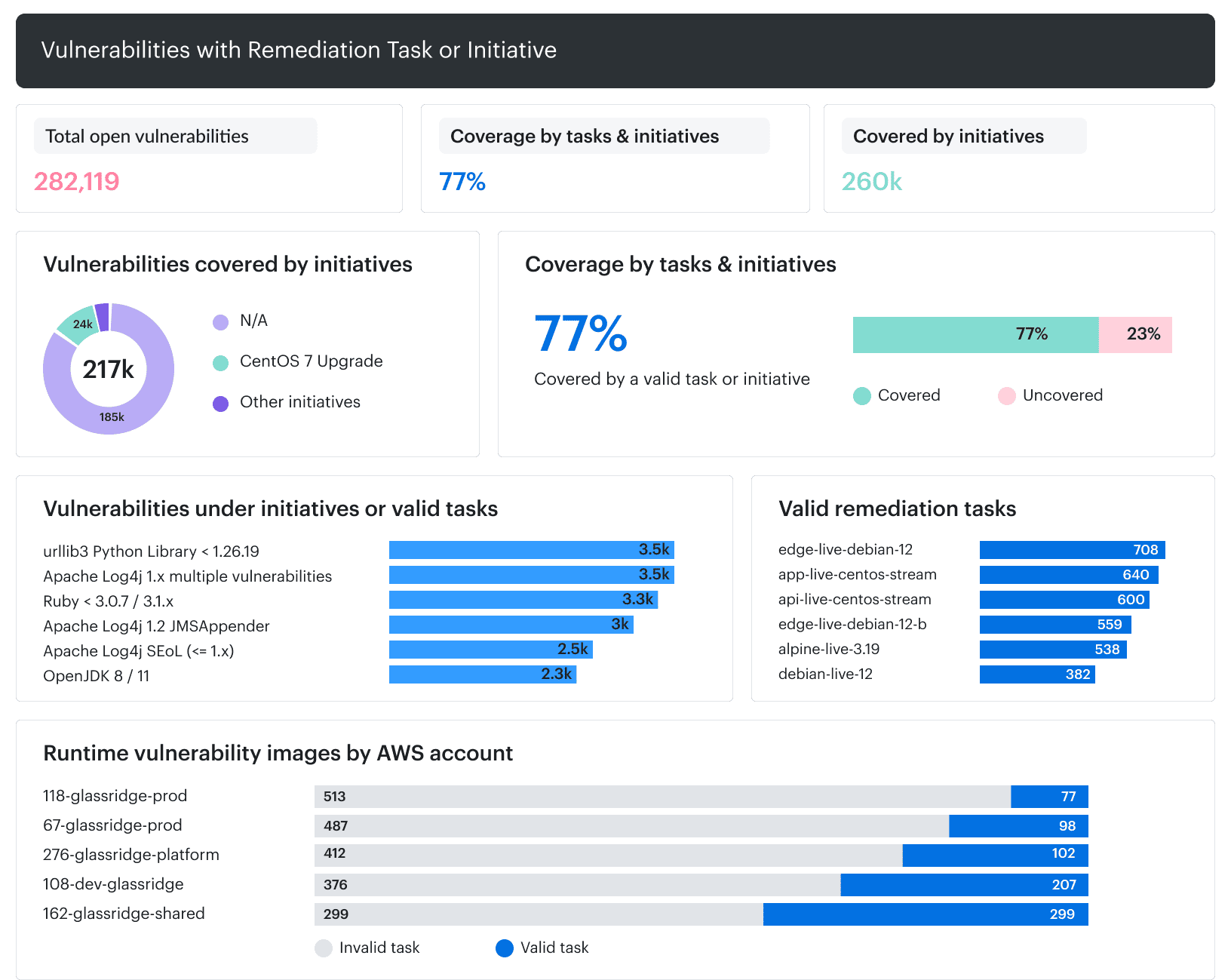 Cloudaware Vulnerability Management: Remediation coverage shows which vulnerabilities are connected to valid Tasks or Initiatives and where exposure still lacks an actionable remediation path.
Cloudaware can close the evidence gap between ticket completion and remediation. After a patch or configuration change, a verification scan can update the underlying Vulnerability Scan record when the issue is no longer detected. Related remediation tasks and ITSM tickets can then reflect the verified state rather than relying only on a user's Done status.
Require evidence appropriate to the treatment:
- Patch or upgrade: Re-scan or version evidence confirms the vulnerable condition is gone
- Configuration change: Current configuration proves the unsafe setting changed
- Compensating control: Control verification demonstrates the relevant path is restricted
- Risk exception: Record the affected findings, residual risk, accountable owner, approver, justification, review date, and expiry. Report the finding as governed accepted risk, not verified remediation.
- Asset retirement: Decommission evidence confirms the asset left service
Distinguish implemented work, verified remediation, validated compensating controls, and accepted risk in reporting. A completed task does not by itself prove that the vulnerability is gone.
Review the pilot cohort for findings that expose structural failures:
- Findings routed to a fallback owner or to an incorrect or disputed application owner
- Overdue remediation without escalation
- Active findings disconnected from work records
- Expired exceptions
- Closed tasks where the finding still exists
- Recurrent vulnerabilities after treatment
- Stale scan or source coverage
- Assets added after the original scope baseline
Expand only after the team understands where the first cohort failed.
Turn the operating model into an executable vulnerability management plan
A vulnerability management plan records how the program will make and prove decisions. A vulnerability management project plan records the work required to launch or modify that capability.
Launch tasks end. Scope rules, prioritization criteria, treatment authority, exceptions, evidence requirements, and review cadence remain.
The vulnerability-management program pack discussed in r/cybersecurity separates SLA guidance, workflow documentation, runbook content, metrics, and supporting artifacts rather than treating one policy document as the complete program.
Vulnerability management plan template
| Plan field | What to document |
|---|---|
| Program objective | Security and operating outcome the program must produce |
| Scope | Included assets, environments, applications, and exclusions |
| Asset denominator | Authoritative source for expected active assets |
| Vulnerability sources | Approved sources and freshness expectations |
| Environmental context | Asset, application, service, network, and business relationships required for decisions |
| Roles | Program owner, treatment owner, exception authority, escalation owner |
| Applicability criteria | How the team confirms that a vulnerable condition affects an asset |
| Attack-path criteria | How reachability or exposure is evaluated |
| Exploitation inputs | CISA KEV, EPSS, threat intelligence, or other approved evidence |
| Impact criteria | Business, operational, regulatory, data, safety, or availability consequences |
| Priority policy | How inputs become a treatment priority |
| Treatment options | Patch, upgrade, configuration change, compensating control, isolation, or retirement |
| SLA | Default treatment target by approved priority |
| Exception workflow | Owner, reason, residual risk, approval, expiry, and review |
| Work tracking | Jira, ServiceNow, change system, or another authoritative work record |
| Validation | Evidence required to prove treatment worked |
| Post-treatment baseline | Expected safe state after remediation or mitigation |
| Reassessment triggers | Changes that invalidate the previous decision |
| Metrics | Coverage, ownership, execution, exception, validation, and outcome measures |
| Review cadence | Operational and leadership review schedule |
| Rollout milestones | Pilot, expansion dependencies, and acceptance criteria |
The value of the template is in the relationship between the fields.
Consider two assets carrying the same CVE. One is an internet-facing production service with a viable attack path and known exploitation evidence. The other sits behind effective segmentation, does not expose the vulnerable function externally, and supports a lower-impact workload. The CVE is the same. The environmental risk and required treatment can be different.
The program should preserve enough evidence to explain that difference later.
Treat compensating controls as governed treatment
Patching is a major treatment path, but not every vulnerable component can be patched immediately without creating operational risk. This becomes especially important with a zero-day vulnerability, when teams may need to scope affected assets and use containment or compensating controls before a vendor patch exists.
A complete treatment model should support several outcomes.
| Treatment path | Appropriate when | Evidence to retain |
|---|---|---|
| Patch or upgrade | Vulnerable software can be changed safely | Work record plus version or re-scan evidence |
| Configuration change | Exposure depends on an unsafe configuration | Change record plus validated configuration |
| Compensating control | The vulnerability remains but exposure can be reduced | Control, scope, owner, and validation |
| Isolation or segmentation | Reachability needs to be restricted | Policy or configuration plus connectivity evidence |
| Asset retirement | The system should leave service | Decommission evidence |
| Risk exception | Treatment cannot currently be completed | Owner, rationale, residual risk, approval, and expiry |
Compensating controls create their own governance problem. A firewall rule, segmentation change, or access restriction can reduce an attack path, but a poorly designed control can disrupt legitimate traffic. Over time, accumulated controls can also create policy sprawl where nobody remembers why a rule exists or which exposure it was intended to mitigate.
If a compensating control carries the residual risk, the program should record:
- Which control is relied upon
- Which findings and assets it covers
- Who owns the control
- How effectiveness was validated
- Which change would invalidate the mitigation
- When the control must be reviewed
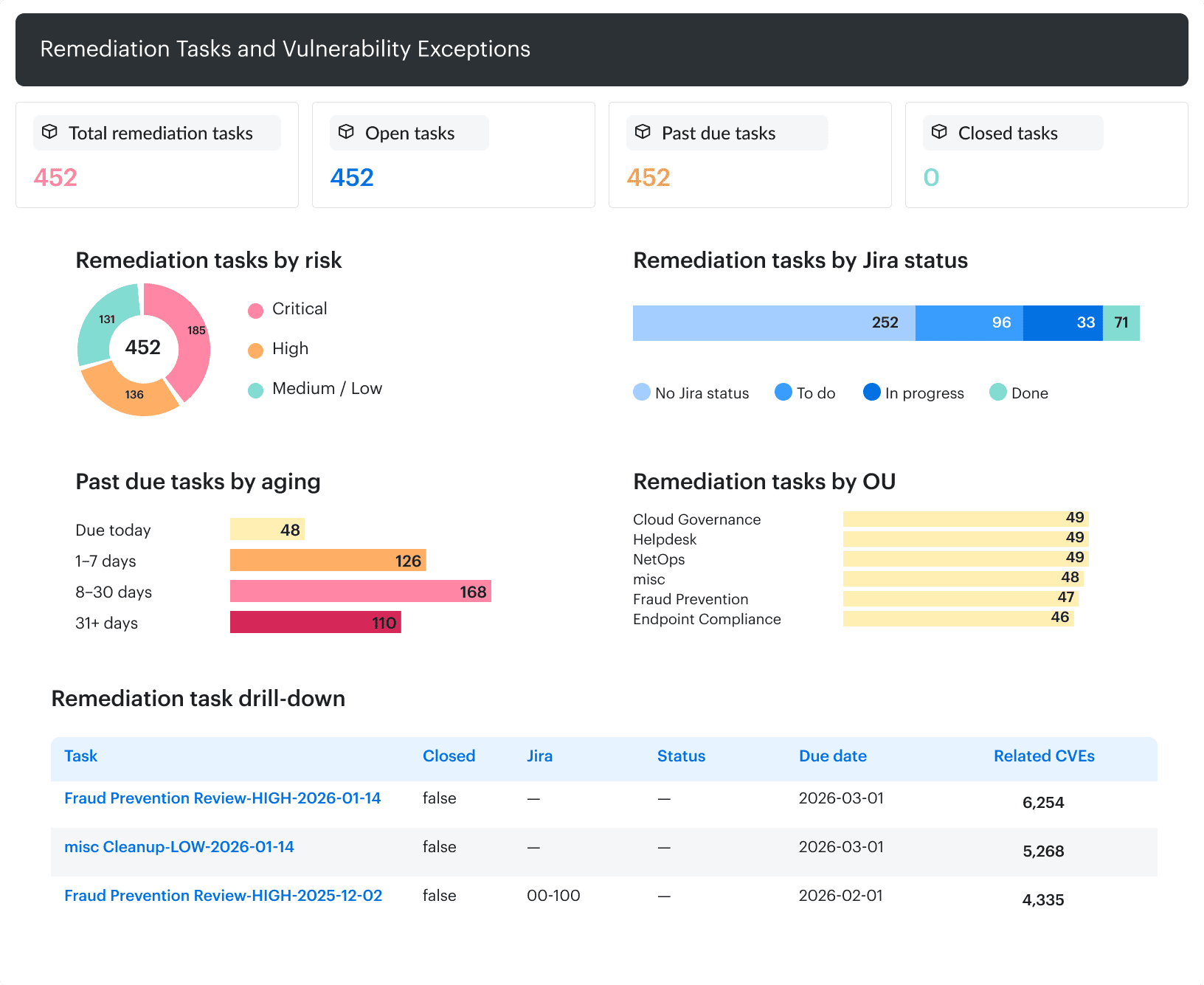 Remediation Tasks and Vulnerability Exceptions: Remediation tasks by status, risk, due-date aging, and organizational unit.
Measure whether the vulnerability management program is operating as designed
Useful vulnerability management metrics show where the operating chain is breaking. Total findings rarely answer that question.
| Metric family | Question it answers | Example evidence |
|---|---|---|
| Scope coverage | Are all governed assets represented? | Covered assets / expected active assets |
| Source freshness | Are findings current enough to support decisions? | Last successful scan or ingestion |
| Asset mapping | Can each finding be tied to a valid active CI or resource? | Finding-to-CI relationship |
| Owner-routing accuracy | Does the finding reach the team that can act on it? | Correct application or platform owner versus fallback routing; disputed and stale mappings reviewed separately |
| Priority evidence | Can the priority rationale be reconstructed? | Severity, KEV/EPSS, reachability, context, and impact |
| Work linkage | Is treatment actually being executed? | Active task or change linked to the finding |
| SLA state | Which findings are due or overdue? | Priority plus due date |
| Exception health | Is accepted risk still governed? | Valid owner, approval, and expiry |
| Closure quality | Was treatment verified? | Re-scan or control validation |
| Recurrence | Does the same exposure return? | Reopened or repeated finding |
| Decision durability | Did a later change invalidate the previous treatment decision? | Material topology, configuration, exposure, or control change |
Define the denominator and reporting period before publishing each metric. For example, measure verified-on-time closure as findings verified closed by their applicable due date divided by findings whose due date falls in the reporting period. Report open work and approved exceptions separately. For ownership, measure correct routing and fallback routing separately; an assigned owner alone does not prove that work reached the right team.
The same logic applies to aggregate backlog metrics. A decline in open findings can indicate successful remediation, narrower coverage, asset retirement, stale source data, or bulk exception handling. The program needs enough denominator and workflow evidence to distinguish those outcomes.
Vulnerability management maturity model: choose the next capability to improve
Vulnerability management maturity should be assessed capability by capability rather than by the number of security products connected to the program.
A team can have broad discovery coverage and poor ownership. It can enforce SLAs while letting exceptions expire. It can automate ticket creation while lacking reliable closure validation.
Use the maturity assessment to expose those differences.
| Capability | Baseline question |
|---|---|
| Scope and inventory | Can we prove which assets should be covered? |
| Finding intake | Are authoritative sources current enough for decisions? |
| Context | Can findings be connected to owners, services, environments, and relationships? |
| Prioritization | Can we explain why one asset-vulnerability instance outranks another? |
| Treatment | Is every actionable finding assigned to an approved treatment path? |
| Exception management | Do exceptions have owners, rationale, approval, expiry, and review? |
| Validation | Can the organization prove treatment worked? |
| Reassessment | Can the program detect when a previous decision becomes stale? |
| Reporting | Do metrics identify where the process breaks? |
The SANS Vulnerability Management Maturity Model (VMMM) is one established option for a formal assessment. The questions above are a practical starting point for this program, not a substitute for the SANS model. For each capability, record the current evidence, the decision it supports, the gap, and the next measurable improvement.
Turn maturity gaps into a vulnerability management roadmap
For each weak capability, document six things:
- The decision that cannot currently be made reliably
- The missing or unreliable evidence
- The operational or security consequence
- The accountable owner
- The dependency that must be fixed first
- The measurable target state
That sequencing prevents automation from amplifying a bad process.
If ownership mapping is weak, automating ticket creation produces more unrouteable work. If the asset denominator is unknown, a scan-coverage percentage provides false confidence. If exceptions have no expiry or review workflow, adding more dashboards does not improve governance.
Reassess findings when exposure or controls change
Verified remediation means the vulnerable condition was no longer detected or was otherwise confirmed removed at the time of validation. Reopen or create a finding if a later scan or configuration check shows that the condition has returned.
Mitigated findings and findings under an approved risk exception require a different review. The vulnerability may still exist, so a disabled control, new network path, changed asset role, expired exception, or behavior deviation on the asset can invalidate the earlier risk decision. Reassess exposure, priority, treatment, and approval when those conditions change.
Keep these states separate in reporting: verified remediated, mitigated with a validated control, and open under an active exception.
Configuration and topology context help distinguish a genuinely new vulnerability from a change that invalidated an earlier risk assumption. This matters because exploitation remains a persistent entry path. Google's M-Trends 2026 reports that exploits remained the most common initial infection vector in Mandiant investigations for the sixth consecutive year, accounting for 32% of investigated intrusions in 2025.
Maturity therefore includes the ability to revisit old decisions as the estate changes, not merely process new findings faster.
Define the interfaces with patching, DevSecOps, ITSM, and GRC
A vulnerability management program defines treatment requirements and evidence expectations. Adjacent teams and systems execute parts of that decision.
| Adjacent discipline | VM program owns | Adjacent discipline owns | Evidence returned |
|---|---|---|---|
| Patch management | Treatment requirement and priority | Patch deployment and maintenance execution | Deployment and verification status |
| Platform/infrastructure | Required remediation or mitigation | Configuration or infrastructure change | Change state and validation |
| DevSecOps/AppSec | Program rules and risk decision | Application, code, image, or dependency fix | Fix and release evidence |
| ITSM/change management | Required work state and SLA | Ticket and change workflow | Assignment, due date, and completion |
| Network/security engineering | Compensating-control requirement | Firewall, SASE, or segmentation implementation | Control state and validation |
| GRC/risk | Vulnerability-specific context and exception request | Enterprise risk acceptance governance | Approval and review status |
This boundary matters most when patching is impossible or delayed.
A production application may require regression testing before an upgrade. An appliance may have no vendor patch available. A maintenance window may make immediate change unsafe. In those cases, the program still owns the requirement to reduce or explicitly accept the risk. The treatment may move to configuration, segmentation, isolation, or another compensating control.
The program should also require evidence back from the executing process. A Jira issue, ServiceNow task, change request, firewall update, or risk record is useful only if the finding can be traced to it and the resulting state can be validated.
For application teams, detailed CI/CD remediation belongs in the DevSecOps vulnerability management workflow rather than being duplicated here.
Support the evidence layer of your vulnerability management program
A vulnerability management program still needs human decisions around scope, risk tolerance, treatment policy, and exception authority.
Cloudaware helps operationalize the repetitive work that follows those decisions by connecting vulnerability findings with CMDB context, ownership, remediation work, SLAs, exceptions, ITSM tickets, and verification results.
Key capabilities:
- Route findings to the right owners: Use CMDB relationships and ownership metadata to connect findings with the responsible application, service, OU, or team and carry that accountability into remediation work
- Create remediation work automatically: Generate Remediation Tasks based on criteria such as vulnerability risk, age, or scheduled remediation cycles while retaining links to affected findings, assets, applications, environments, and owners
- Apply SLA rules to remediation: Use factors such as risk band, environment, and regulatory scope to determine due dates and track overdue work, SLA performance, and remediation time
- Synchronize remediation with Jira and ServiceNow: Route vulnerability work into existing ITSM queues with asset and ownership context, then keep task and ticket status aligned as remediation progresses
- Keep exceptions governed: Track exception scope, justification, owner, approver, expiry, and compensating controls so accepted risk remains measurable and returns to the normal workflow when the exception expires
- Verify remediation with new scan evidence: Use subsequent scan results to confirm that the vulnerable condition is no longer detected before moving the finding to a remediated or closed state
- Report where execution breaks: Use dashboards built from Vulnerability Scan records, Remediation Tasks, and Exceptions to identify gaps in scan coverage, ownership, remediation coverage, SLA performance, overdue work, exception health, and closure
Cloudaware's role here is to help maintain the operational context around vulnerability findings. Scanner coverage, exploitation intelligence, patch execution, and other specialist controls continue to come from the systems responsible for those functions.