


Vulnerability management teams rarely have a shortage of findings. The harder problem is deciding which findings deserve remediation capacity first.
In 2025, NIST enriched nearly 42,000 CVEs (45% more than in any prior year) even as submissions continued to outpace the program’s capacity. That volume says nothing about which vulnerabilities will be exploited in a particular environment.
Risk-based vulnerability management (RBVM) prioritizes remediation according to the risk a vulnerability creates in the organization's actual environment. Technical severity still matters, but remediation priority should also reflect exploitability, reachability, asset criticality, probable business impact, and validated compensating controls.
In this piece you’ll learn how RBVM works in practice, from combining CVSS, EPSS, CISA KEV, reachability, and asset context to setting priorities, assigning owners and SLAs, choosing treatment, and verifying remediation.
Key takeaways
- The biggest RBVM blind spot can appear before scoring starts: teams may be prioritizing findings against incomplete or stale asset coverage
- CVSS, EPSS, and CISA KEV answer different questions, and treating them as interchangeable signals can distort remediation priority
- Internet exposure does not automatically determine what should be fixed first; asset context and attack paths can change the order
- A priority score matters only if it changes ownership, SLA, treatment, and what counts as verified closure
- The article shows where RBVM commonly breaks in practice, from stale scanner records and missing asset context to exceptions that never expire
What is risk-based vulnerability management?
Risk-based vulnerability management is an approach to vulnerability management that prioritizes findings by the likelihood and potential consequence of exploitation in a specific environment. It combines vulnerability data with threat, infrastructure, asset, and business context.
Traditional severity-led triage starts with the vulnerability and often ends with the score. RBVM asks several additional questions: Is exploitation likely? Can an attacker reach the vulnerable component? What does the affected asset support?
RBVM still sits inside the broader vulnerability management lifecycle. Discovery, assessment, treatment, and validation remain necessary. RBVM changes the logic used to decide which findings should move first.
Severity-led triage vs. risk-based prioritization
| Severity-led triage | Risk-based prioritization |
|---|---|
| Uses CVSS or vendor severity as the primary ordering signal | Combines technical severity with exploitation evidence and environmental context |
| Prioritizes the finding largely on technical attributes | Evaluates the finding in the context of the affected asset and service |
| Can produce a broad Critical/High queue | Narrows remediation according to environment-specific urgency |
| Often reports backlog and closure volume | Tracks prioritized exposure, SLA performance, and verified remediation |
Where CVE, CVSS, EPSS, and KEV fit
Each signal answers a different question.
| Signal | Question it answers |
|---|---|
| CVE | Which vulnerability are we talking about? |
| CVSS | How severe are its technical characteristics? |
| EPSS | How likely is the CVE to be exploited in the wild within the next 30 days? |
| CISA KEV | Has exploitation in the wild been confirmed? |
| Reachability and controls | Can an attacker realistically reach the vulnerable component here? |
| Asset and business context | What does the affected resource support, and what would exploitation impact? |
EPSS and the CISA Known Exploited Vulnerabilities Catalog are complementary. KEV records evidence of known exploitation. EPSS estimates future exploitation probability.
FIRST explicitly cautions that EPSS is not a complete risk score. It does not know whether a vulnerable product exists in your environment, which controls surround it, or what successful exploitation would mean to your organization.
Those are the inputs RBVM has to supply.
How risk-based vulnerability prioritization works
A practical vulnerability management prioritization model evaluates four categories of evidence: exploitability, reachability, asset criticality, and business impact. Before those signals can be applied, the finding has to resolve to the correct asset.
Practitioners in a Cloud Security Alliance workshop made a good point: many organizations still struggle to know their complete asset population and detect assets outside expected controls, making attack-surface knowledge foundational to prioritization.
1. Exploitability: is exploitation likely or already happening?
CVSS provides the technical-severity baseline. Exploitability evidence answers a different question: how likely is this vulnerability to be used by an attacker, or has exploitation already been observed?
Useful exploitation signals include:
- EPSS for near-term exploitation probability
- CISA KEV for confirmed exploitation in the wild
- Public exploit availability where relevant
- Threat intelligence relevant to the organization's threat model
These inputs should not be collapsed into an arbitrary formula such as CVSS × EPSS. CVSS Base Score and EPSS represent different concepts and scales. The useful question is how each signal changes the remediation decision.
For example, a CVE listed in KEV deserves different treatment from a similarly severe vulnerability with no evidence of exploitation. Treat KEV as an escalation signal when it applies. Use EPSS primarily to order the much larger non-KEV population; a low EPSS score should not downgrade a KEV-listed vulnerability.
Do not treat EPSS, public exploit availability, and CVSS Threat metrics as independent weights without validating the model, because these signals may reflect overlapping evidence.
2. Exposure and reachability: is there a viable attack path?
A vulnerable package being present does not prove that an attacker can reach the vulnerable component.
Reachability analysis should consider public exposure, network paths, identity prerequisites, segmentation, security controls, and service configuration. An asset does not have to be internet-facing to be reachable, and an internet-facing asset is not automatically the most consequential target.
“Two systems can carry the same CVE and CVSS score and still deserve different remediation priority. If one vulnerable component is reachable through an attack path and the other is isolated behind effective controls, the technical finding is the same but the environmental risk is not.” — Mikhail M., General Manager at Cloudaware
This is a separate question from whether exploit code exists. A vulnerability may be exploitable in the wild but unreachable on a particular asset.
3. Asset criticality: what depends on the affected asset?
Reachability describes whether an attack path exists. Asset criticality tells you how much the affected resource matters. Business impact estimates the consequence if exploitation succeeds.
Useful context includes:
- Application or business service
- Production, staging, or development environment
- Data classification
- Service tier
- Availability and recovery requirements
- Dependencies on the affected asset
- Safety or operational importance
“Internet-facing does not automatically mean highest business risk. An isolated system supporting a critical process can matter more than a public-facing service with limited business impact. Exposure and asset criticality need to be evaluated separately.” — Anna Maeva, Vulnerability Management Expert at Cloudaware
Asset criticality therefore should not be inferred from exposure alone. It should come from the role the affected asset plays in the application, service, data flow, or operational process.
4. Business impact and ownership: what happens if exploitation succeeds?
The final priority should reflect the likely consequence of successful exploitation. Once that priority is set, the finding must be routed to the person or team authorized to act.
Possible consequences include service downtime, data exposure, transaction disruption, safety impact, or regulatory consequences. The assessment also needs an accountable owner. A high-risk finding without a resolver can remain in the queue indefinitely even when its technical priority is obvious.
Context and prioritization
Asset inventory + finding reconciliation → CVSS baseline + exploitation evidence + reachability + asset criticality + business impact → priority tier
Execution
Priority tier → owner → treatment → SLA → verification → reassessment
Keeping these stages separate prevents workflow state, such as ticket ownership or an approved exception, from being mistaken for evidence that the underlying vulnerability is lower risk.
How to implement a risk-based approach to vulnerability management
The implementation model below combines established RBVM signals such as CVSS, EPSS, and CISA KEV with the operating realities Cloudaware engineers see in enterprise environments: incomplete asset coverage, vulnerability findings that are disconnected from CMDB context, unclear ownership, and remediation workflows that stop before verified closure.
1. Establish complete asset and scan coverage
Start with the denominator: the assets that should be in scope.
A common failure in vulnerability programs is treating scanner inventory as asset inventory. If a scanner has a record for a VM, the asset looks covered. But that record may be stale, the scanner may no longer be active for that environment, or another part of the infrastructure may never have been scanned at all.
Before prioritizing findings, answer three questions:
- Which assets currently exist
- Which vulnerability source covers each asset
- How current that coverage is
This gets harder when AWS, Azure, vCenter, and on-prem infrastructure are covered by different scanners. The practical solution is to compare vulnerability-source data against the infrastructure inventory rather than assess coverage from each scanner in isolation.
A practical way to test coverage is to compare current scanner evidence against a separate source of asset truth. In Cloudaware, the CMDB provides that asset population, while vulnerability records provide scanner coverage and freshness.
The MCP example below queries the combined dataset by platform, scanner, recent activity, and last scan date.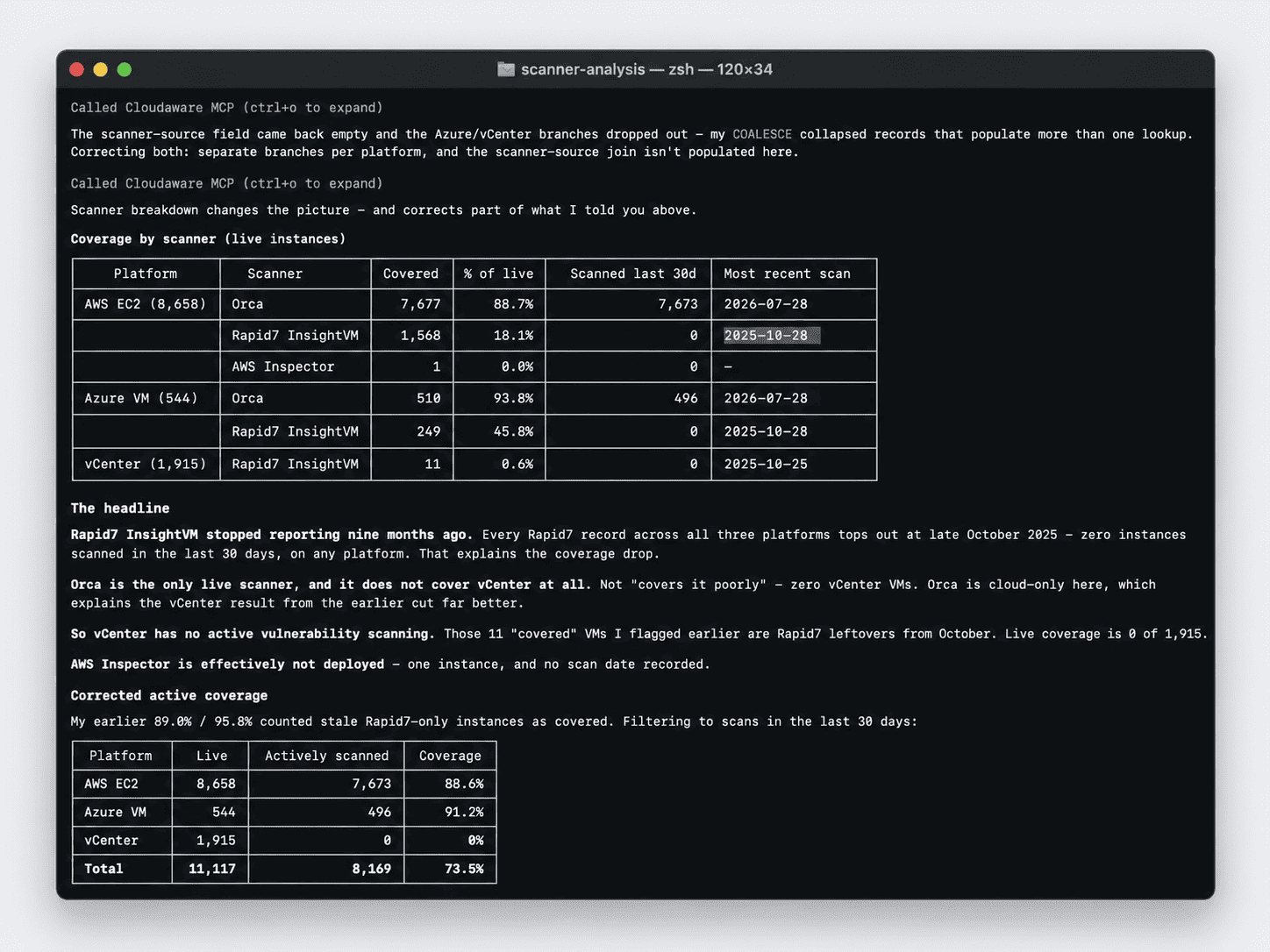 In this demo dataset, Rapid7 records still exist across AWS, Azure, and vCenter, but none were updated in the previous 30 days.
The result shows the kind of coverage error that is easy to miss in a scanner-by-scanner review. Rapid7 records still exist across all three platforms, but none were updated in the previous 30 days. Once those stale records are excluded from active coverage, vCenter falls to 0%, while AWS EC2 and Azure VM resolve to 88.6% and 91.2% active coverage.
That is the baseline RBVM needs before any CVSS, EPSS, KEV, or business-criticality weighting is applied. For cloud-specific implementation details, see cloud vulnerability management.
2. Join vulnerability findings to asset and business context
A finding becomes actionable when it resolves to the infrastructure object and business context needed for a remediation decision.
Start by resolving the finding to the affected asset: Vulnerability finding → affected asset/CI. Then enrich that asset with the context required for triage:
- Application/service
- Environment
- Network context
- Owner/OU
- Business criticality
- Exception state
In Cloudaware, the Vulnerability Scan record stays linked to the affected infrastructure object while CMDB relationships provide application, environment, owner, OU, and business-criticality context for triage.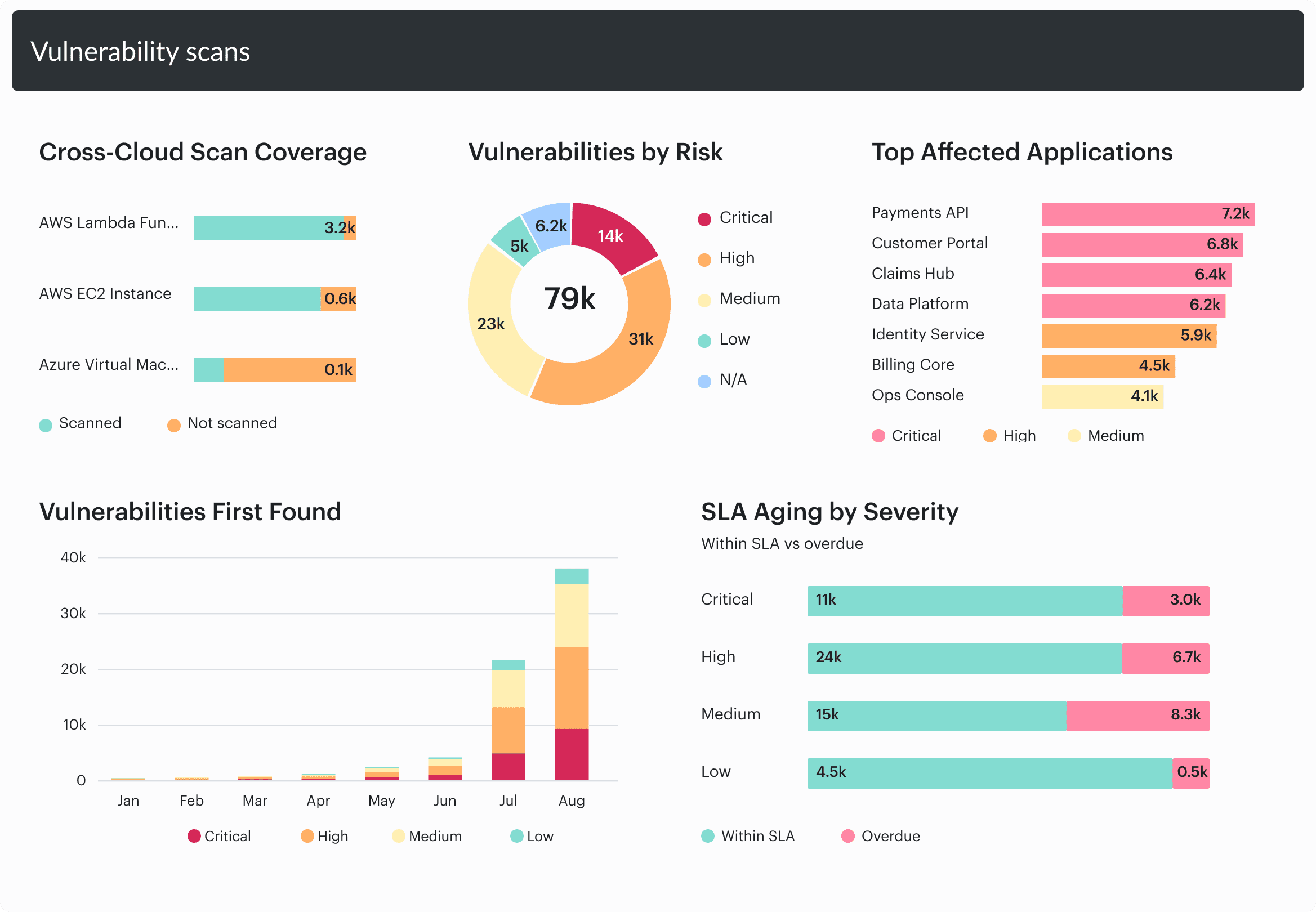 The problem is that vulnerability scanners rarely can tell you that a finding exists, but not necessarily which business service depends on the asset, who owns remediation, or whether an approved exception already exists. Cloudaware uses CMDB relationships to connect vulnerability findings with the affected infrastructure and the context already associated with it.
Example:
| Finding | Context | RBVM outcome |
|---|---|---|
| A | Isolated development VM, disposable workload, no production dependency | Lower remediation priority |
| B | Reachable production payment service, Tier 1 application, confirmed owner | Higher remediation priority |
The CVE, CVSS score, and EPSS score can be identical. The remediation decision changes because the asset context changes.
This is also where vulnerability analysis and RBVM diverge. Analysis establishes what is technically present. RBVM determines what should happen next.
3. Define a prioritization policy, not a universal formula
There is no useful one-size-fits-all weighting model for every organization. Availability, confidentiality, safety, intellectual property, external exposure, and operational impact matter differently depending on what the business is protecting.
“I would be cautious with any universal vulnerability-risk formula. KEV, EPSS, reachability, and asset criticality are useful inputs, but their importance depends on the environment. The policy needs to explain why a signal changes priority for this organization, not just add another number to the score.” — Anna Maeva, Vulnerability Management Expert at Cloudaware
A practical policy should answer:
| Input | Policy question |
|---|---|
| CISA KEV | Is exploitation already confirmed? |
| EPSS | How likely is near-term exploitation? |
| Reachability | Can an attacker reach the vulnerable component? |
| Asset criticality | What application or service depends on it? |
| Business impact | What happens if exploitation succeeds? |
| Compensating controls | Is the attack path already constrained? |
Keep risk and risk acceptance separate. An approved exception does not make the vulnerability less exploitable or the asset less critical. It changes how the organization treats the residual risk, who approved it, and when the decision must be reviewed.
The result can map to a small number of operational priority tiers, for example P1 through P4. The test is whether those tiers create useful separation. If most findings still land in P1 or P2, the organization has recreated its original Critical/High backlog under different labels.
4. Tie priority tiers to owners and realistic SLAs
A priority tier only becomes operational when it changes who must act, how quickly they must respond, and what happens when they do not.
This is also where asset criticality gets tested against reality. Calling a service "critical" is easy until the classification also means a short remediation SLA and an escalation path the owning team must support.
The workflow should connect priority to execution: Priority → owner → acknowledgment → remediation SLA → escalation
Some programs separate acknowledgment from remediation SLAs. If you do, define both explicitly. Security first needs to know that the accountable team has received the finding. The remediation SLA then defines how long the organization is prepared to leave that risk untreated.
“Criticality should have an operational consequence. If an asset is classified as critical, that should translate into a tighter remediation expectation. If the business cannot support that SLA, the classification or the treatment policy needs another look.” — Anna Maeva, Vulnerability Management Expert at Cloudaware
Keep the risk decision and the execution record linked, but separate. In Cloudaware, CMDB relationships provide asset and ownership context, Remediation Tasks carry work status and due dates, and Vulnerability Exception records capture approved risk acceptance. 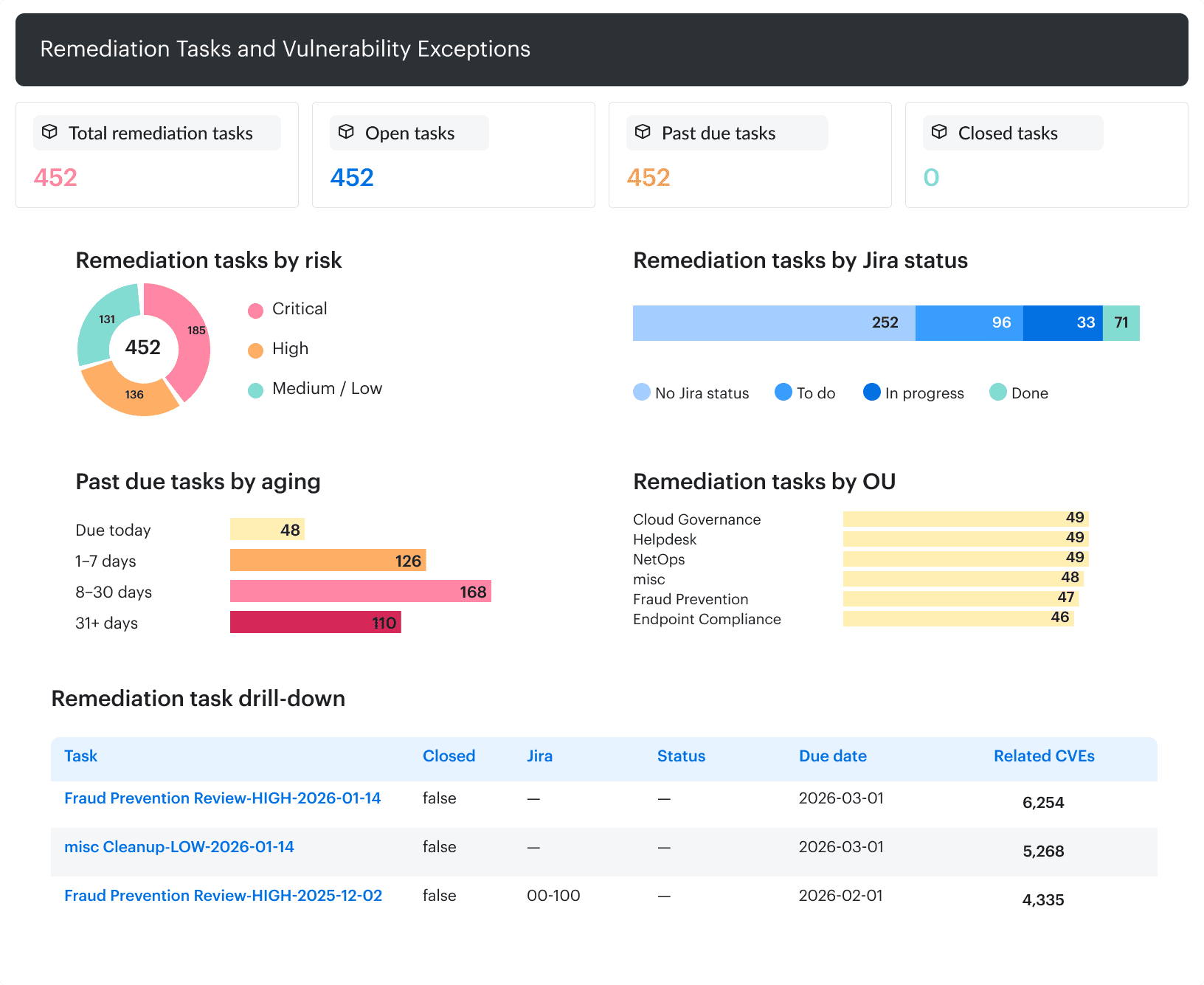 This distinction also matters in vulnerability management automation. Automation should route an agreed prioritization decision to the right owner. Automating a weak priority model only moves the wrong work faster.
5. Choose a response: remediate, mitigate, remove, or accept the residual risk
Prioritized findings do not all require the same treatment.
| Treatment | When it fits |
|---|---|
| Patch or upgrade | A safe permanent fix is available |
| Compensating control | Immediate patching is impractical but exposure can be reduced |
| Isolation or segmentation | A reachable attack path can be restricted |
| Remove or decommission | The vulnerable asset or service is no longer required |
| Temporary risk acceptance | Residual risk is understood, approved, time-bounded, and reviewed |
Patching may require regression testing, maintenance windows, vendor coordination, or planned downtime. Where immediate remediation is not feasible, the team may be able to reduce risk by constraining the attack path until a permanent fix is ready.
“The remediation decision is not always ‘patch now.’ Sometimes the fastest safe action is to remove exposure, isolate the workload, or put a compensating control in front of it. The important part is to be explicit that you reduced the path to exploitation, not that you removed the vulnerability.” — Igor Kachurin, DevOps Engineer at Cloudaware
When the selected treatment is mitigation rather than remediation, preserve both states: the vulnerable condition may still exist even though the current exposure has been reduced.
6. Verify closure and recalculate risk
A closed ticket records workflow state. It does not prove that the vulnerability disappeared or that the original risk assessment is still valid.
Verification can be tied back to scanner evidence rather than ticket status alone. After a verification scan no longer detects the issue, the Vulnerability Scan record can move to Remediated/Closed and record when the finding disappeared from the scanner. If the issue appears again later, the finding can be reopened or recreated according to the workflow.
Closure may require a rescan, retest, configuration check, or confirmation that the affected resource was decommissioned. The priority decision should also be revisited when one of its inputs changes.
Reassessment should be triggered when:
- New exploitation evidence appears, such as a KEV addition or EPSS crosses a threshold defined by the prioritization policy
- Exposure changes, such as a new public interface, route, security-group rule, or identity path
- Asset context changes, such as a development workload moving into production
- Compensating controls are removed or fail
- An exception reaches its review date
- Ownership or application relationships change
Configuration history matters because the vulnerability itself may remain unchanged while the environment around it becomes more or less exploitable. The same rule applies to accepted risk. An exception should have an owner and a review or expiry point. Otherwise, a temporary decision can survive long after the conditions used to approve it have changed.
For the governance layer around these decisions, see enterprise vulnerability management and vulnerability management program.
How to measure whether RBVM is reducing risk
Measure whether prioritized exposure is falling and whether higher-risk findings receive a different operational response. Raw vulnerability counts cannot answer either question.
The 2026 Verizon Data Breach Investigations Report found that vulnerability exploitation had become the leading breach entry point, accounting for 31% of breaches. The figure reinforces the need to identify which vulnerable conditions are both exploitable and relevant to the organization’s environment.
Useful RBVM metrics diagnose where the operating model breaks:
| Metric | What it tells you |
|---|---|
| Current scan coverage % | Whether the prioritization denominator is trustworthy |
| P1/P2 findings per 1,000 in-scope assets | High-priority exposure normalized for estate size |
| % of P1/P2 findings within SLA | Whether priority changes remediation speed |
| Median age of open P1/P2 findings | Whether high-risk debt is accumulating |
| % of P1/P2 findings with an owner | Whether prioritized work can be routed |
| KEV findings past SLA | Known-exploitation exposure left unresolved |
| Exceptions past review/expiry | Accepted-risk debt |
| Reopened findings | Whether closure is durable |
Read backlog metrics together with coverage. A rise in high-priority findings can reflect better discovery rather than worsening security, especially after onboarding a new scanner, cloud account, or asset population.
A team can close thousands of low-impact findings while a much smaller group of reachable, exploitable vulnerabilities remains on critical services. RBVM reporting should make that mismatch obvious.
Risk-based vulnerability management tools: what to evaluate
Risk-based vulnerability management software should be evaluated on the decisions it enables, not simply on whether it displays a proprietary risk score.
When comparing risk-based vulnerability management tools or solutions, test whether the platform can connect technical findings to the context and workflow required for remediation.
| Capability | What to test |
|---|---|
| Asset inventory | Can the platform establish which infrastructure is actually in scope? |
| Multi-scanner ingestion | Can findings from several scanners be analyzed without separate priority silos? |
| Asset identity resolution | Can fragmented findings resolve to the correct CI or resource? |
| KEV and EPSS context | Are confirmed and predicted exploitation represented distinctly? |
| Exposure/reachability context | Can the platform provide or ingest evidence about whether the affected component is exposed or reachable? |
| Application and business context | Can findings inherit environment, service, and criticality information? |
| Ownership mapping | Can prioritized findings reach accountable teams? |
| Treatment workflow | Can remediation, compensating controls, and exceptions be tracked? |
| Reassessment | Can priority change when threat or infrastructure context changes? |
| Evidence | Can an analyst explain why the finding received its priority? |
A single platform does not have to generate every signal itself. In many enterprise environments, scanners provide vulnerability evidence, threat sources provide KEV or exploitation context, CMDB data supplies asset and ownership context, and ITSM systems carry execution. The important test is whether those inputs remain traceable through prioritization and remediation.
For a broader vendor comparison, see best vulnerability management tools.
Common RBVM failure modes
Most weak RBVM implementations fail because context, ownership, or workflow breaks, not because the organization lacks another scoring algorithm.
These failure modes come from the implementation model above, reviewed against Cloudaware SME input and external guidance on exploitation likelihood, asset context, remediation workflow, and risk acceptance.
| Failure | What breaks operationally |
|---|---|
| CVSS is renamed "risk" | The severity-first queue remains unchanged |
| Asset inventory is incomplete | Unmanaged systems never enter prioritization |
| Historical scanner records are counted as current coverage | Assets appear protected even though the vulnerability evidence is stale |
| Duplicate findings from overlapping scanners are treated as separate risk | Backlog size is inflated and remediation work is duplicated |
| Everything is classified critical | The SLA queue becomes impossible to execute |
| Risk priority is static | New attack paths or exploitation evidence do not change urgency |
| Findings lack owners | Security can identify risk but cannot route remediation |
| Ticket closure equals remediation | Findings can return after rescan |
| Accepted risk never expires | Temporary exceptions become permanent exposure |
A simple diagnostic question catches many of these failures: Can the team explain why this vulnerability on this asset should be handled by this owner within this timeframe, and what evidence will prove closure?
If one part of that chain cannot be answered, the RBVM decision is incomplete.