


Asset management software gives an organization a controlled record of the assets it owns, uses, supports, or pays for. In enterprise IT, that record may cover hardware, software, cloud resources, virtual machines, licenses, contracts, and the relationships needed to manage them throughout their lifecycle.
The difficult part is keeping those records trustworthy. Asset data arrives from cloud APIs, discovery tools, procurement systems, endpoint platforms, contracts, spreadsheets, and IT service workflows. The software must reconcile conflicting records, assign ownership, track lifecycle changes, and preserve evidence of what changed and when.
This article explains how asset management software performs that work, how it differs from ITAM, SAM, EAM, CMDB, and ITSM, and how to determine whether the resulting asset records are reliable enough for operational, financial, and compliance decisions.
TL;DR
- Asset management software maintains a traceable record of hardware, software, cloud resources, licenses, contracts, and related lifecycle data.
- A record becomes trustworthy when the system reconciles source data, assigns ownership, preserves lifecycle and change evidence, and exposes unresolved conflicts.
- Asset management software overlaps with ITAM, SAM, EAM, CMDB, and ITSM, but each serves a different decision: asset governance, licensing, maintenance, dependency mapping, or service workflows.
- Evaluate a platform against real decisions: can it show an asset’s current source, owner, lifecycle state, relationships, history, and conflicts before an audit, incident, renewal, or retirement action?
What is asset management software?
Asset management software is a system for recording, maintaining, and using information about assets throughout their lifecycle. It connects each asset to relevant data such as its source, owner, location, status, cost, contract, configuration, and retirement history.
Its scope depends on the operating model:
- An IT asset management platform may track laptops, servers, software, cloud resources, and licenses.
- Enterprise asset management software usually focuses on physical equipment and maintenance.
- Software asset management tools concentrate on licenses, entitlements, installations, and usage.
In IT environments, an asset record may also be connected to a configuration item in the CMDB. The asset record supports lifecycle, financial, contractual, and ownership decisions, while the CI record describes the component’s configuration and relationships to applications, services, and other infrastructure. The two records can overlap, but they serve different management purposes.
The useful output is more than an inventory count. It is an asset record that teams can trace to authoritative sources, reconcile against conflicting data, and use to answer operational questions:
- Does the asset still exist?
- Which source last verified it?
- Who owns it?
- Is it active, unused, unsupported, or scheduled for retirement?
- What costs, risks, contracts, and services are connected to it?
- What changed since the previous observation?
A reliable asset management system should make those answers consistent and verifiable. If it only collects records without maintaining their source, ownership, lifecycle state, and change history, teams still have asset data, but they do not yet have a trustworthy operational record.
How asset management software creates a trustworthy asset record
Asset management software earns its value when it turns observations from different systems into a record that teams can use with confidence. The workflow is not simply “discover, then display.” Each stage must leave the asset more identifiable, attributable, and usable for a decision.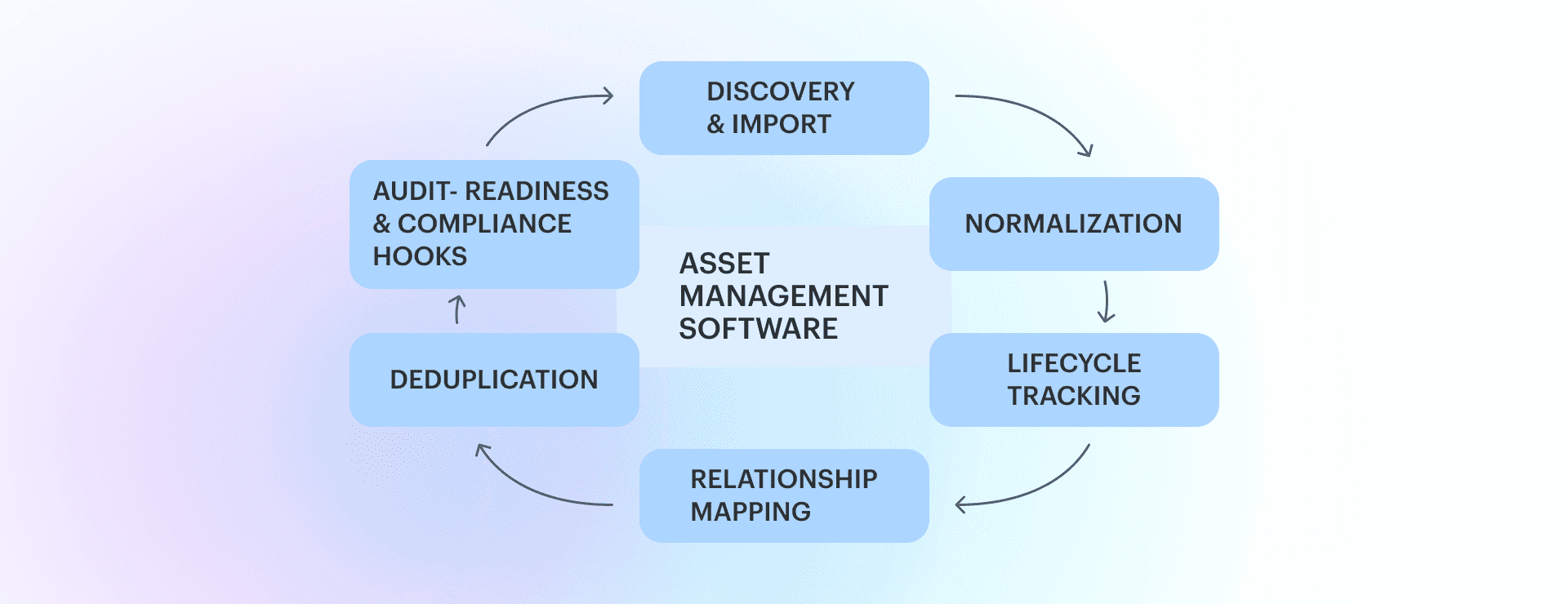
- Discover and identify. The system collects asset data from relevant sources, such as cloud-provider APIs, endpoint platforms, procurement records, license tools, ITSM, and configuration repositories. It identifies whether records refer to the same asset and retains source-specific identifiers instead of treating every observation as a new asset.
- Normalize and reconcile. Sources often disagree on names, lifecycle states, owners, or timestamps. The system standardizes fields, applies matching rules, and records which source is authoritative for each type of data. A cloud API may be authoritative for a resource’s current state, while an ITSM system may own lifecycle approval.
- Enrich with operational context. A usable record connects the asset to its owner, application or service, environment, cost center, contract, license, configuration data, and relevant risk or compliance findings. This context determines whether a resource can be safely changed, retired, investigated, or charged back.
- Maintain lifecycle and change history. The record should show when the asset was first observed, when its state or ownership changed, and whether it has been retired or merely stopped reporting. Historical evidence prevents teams from treating a temporary monitoring gap as a completed decommissioning.
- Validate the record before relying on it. Before using asset data in an audit, incident, renewal, or cost decision, teams should confirm that the record has a current source, accountable owner, valid lifecycle state, and no unresolved conflicts with authoritative systems.
What does asset management software do in practice?
A useful system turns a discovered asset into a managed operational record. Consider an EC2 instance that appears in a cloud account without a clear owner, current service mapping, or approved lifecycle state.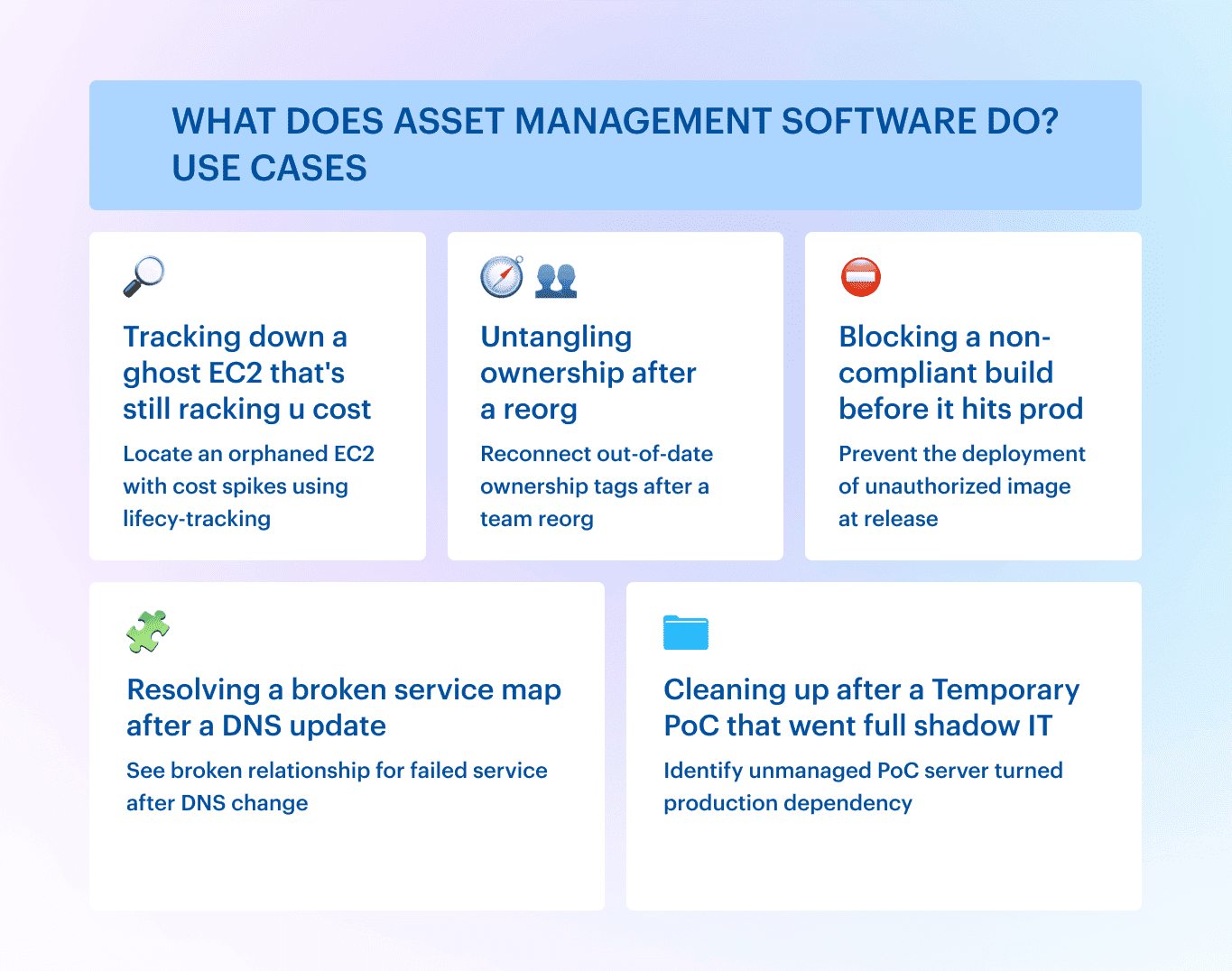
- Identify the record and its sources. The system captures the cloud-provider identifier, account, region, creation time, tags, and current state. It then checks whether the instance already exists in the asset inventory under another name or source record.
- Establish ownership and lifecycle status. It matches available evidence, such as tags, account structure, service relationships, procurement data, ITSM records, or change history. If no accountable owner or approved lifecycle state can be established, the record should remain visibly unresolved rather than silently classified as active.
- Add decision context. Teams can connect the instance to the application or service it supports, its cost data, security and compliance findings, related configuration items, and relevant operational history. This lets FinOps, security, and platform teams investigate the same resource without starting from separate inventories.
- Route the exception to an owner. The appropriate team decides whether the instance should be brought under management, corrected, retained with a documented exception, or retired. The asset management software provides the record and evidence for that decision; the organization defines the approval and remediation workflow.
- Preserve the result. The record should retain its status, owner, source evidence, and change history so that future audits, incident reviews, renewals, and cost investigations do not reopen the same ownership question.
This is where asset management becomes useful beyond inventory. A suspicious or costly resource is not automatically a problem to delete. It may support a legacy dependency, an active service, or an approved exception. The asset record gives the responsible team enough context to make the decision safely.
For a deeper evaluation checklist, see our guide to asset management software features. For governance of the underlying estate, see IT inventory management.
What types of assets can asset management software track?
The asset types a platform tracks depend on its intended operating scope. IT-focused asset management software commonly brings together:
- Hardware: laptops, servers, network devices, mobile devices, and peripherals
- Software and licenses: installed applications, entitlements, usage data, renewals, and contracts
- Cloud resources: accounts, subscriptions, projects, virtual machines, storage, databases, identities, containers, and managed services
- Virtual and hybrid infrastructure: VMware objects, on-premises servers, and the services that depend on them
- Business context: owners, departments, cost centers, applications, environments, support groups, and lifecycle status
The goal is not to force every asset type into one identical schema. A laptop needs custody, warranty, and assignment data. A cloud resource needs provider identifiers, account context, configuration state, tags, relationships, and current discovery evidence. A useful system preserves those differences while giving teams a consistent way to find, validate, and govern the estate.
For cloud and hybrid environments, inventory quality also depends on coverage. Teams need to know which accounts, subscriptions, projects, and data sources are connected, when each was last refreshed, and which asset populations remain outside the managed inventory.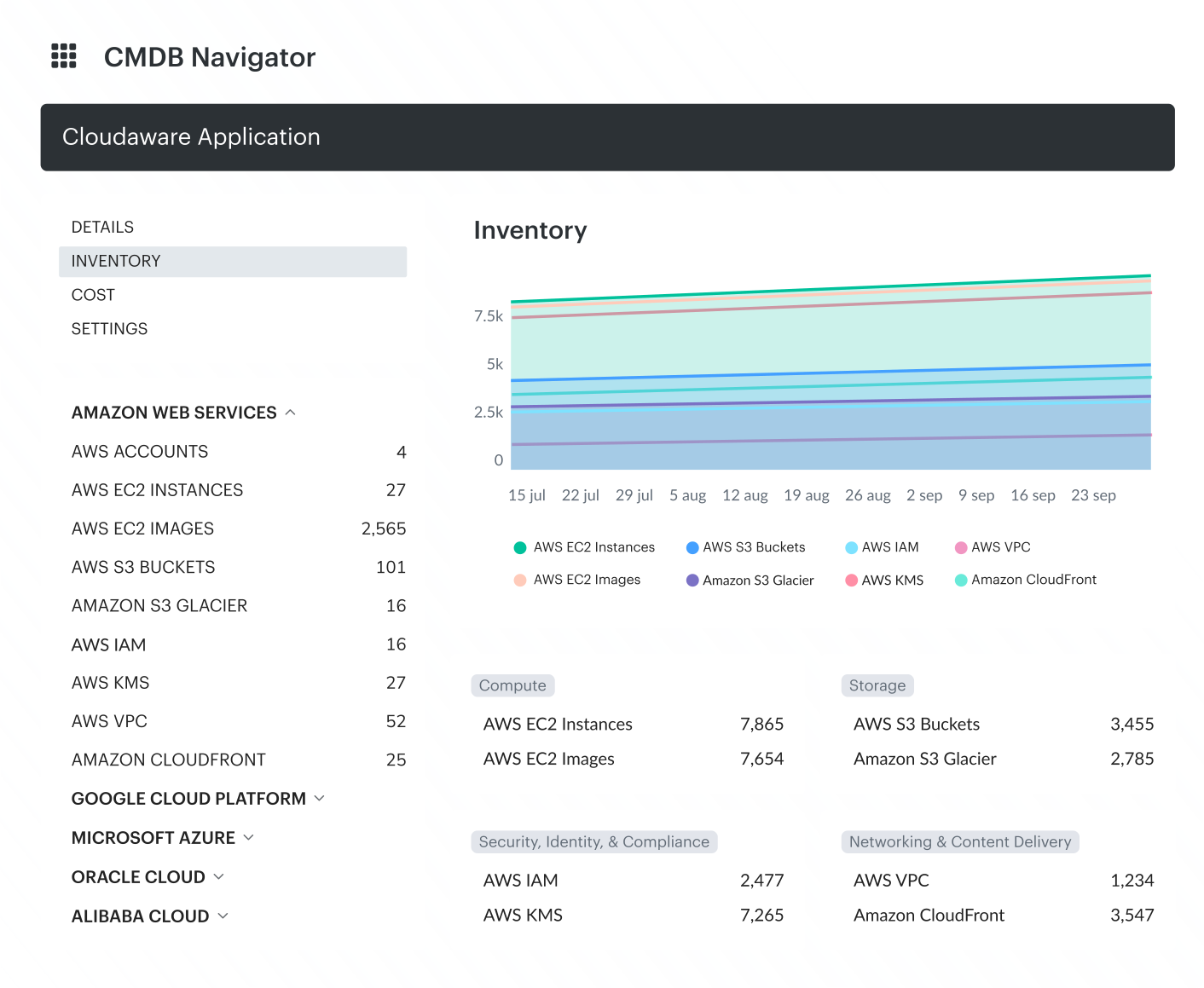 Cloudaware CMDB Navigator shows inventory by cloud provider and resource type, helping teams review the scope and composition of their cloud estate. Request a demo to see how it works.
Asset management software vs. ITAM, SAM, EAM, CMDB, and ITSM
These terms overlap because they often use the same asset data. They answer different operational questions, however, and one system may support several of them.
| Discipline or system | Primary question | Typical scope |
|---|---|---|
| Asset management software | What assets do we have, who owns them, what state are they in, and what evidence supports the record? | Hardware, software, cloud resources, contracts, costs, and lifecycle data |
| IT asset management (ITAM) | How do we govern IT assets from request or purchase through use, reassignment, and retirement? | End-user devices, data-center hardware, cloud assets, contracts, and financial lifecycle |
| Software asset management (SAM) | Are our software installations, usage, and license entitlements compliant and cost-effective? | Licenses, entitlements, installations, usage, renewals, and vendor agreements |
| Enterprise asset management (EAM) | How do we maintain high-value physical assets and plan their maintenance? | Facilities, production equipment, fleets, and field assets |
| CMDB | How are configuration items related, configured, and dependent on one another? | Applications, services, infrastructure, dependencies, and change-impact context |
| IT service management (ITSM) | How are requests, incidents, changes, and service operations managed? | Service workflows, tickets, approvals, SLAs, and knowledge |
The distinction matters when a team needs to make a decision. An ITAM process may determine who owns a laptop and when it should be replaced. A SAM process may determine whether the installed software has a valid entitlement. A CMDB may show which application service depends on a server. An ITSM workflow may record the approved change that altered it.
In cloud environments, the same resource can appear across all four operational layers. An EC2 instance may have an asset record with ownership and cost data, a CI record with application dependencies, compliance findings from a security tool, and a change ticket documenting a configuration update. Connecting those records makes the resource easier to govern without treating every system as the same thing.
For a deeper comparison of the record types and their roles, see CMDB vs. asset management.
Where trustworthy asset records change operational decisions
Asset management software supports decisions that otherwise depend on reconciling several systems under time pressure. Its value comes from making the asset record usable across teams, with a known owner, lifecycle state, source evidence, and relevant relationships.
1. Prioritizing modernization and retirement
Architecture and finance teams can distinguish resources that are expensive from resources that are both expensive and safe to retire. A reliable record connects the asset to its service, owner, current state, dependencies, and cost allocation before a decommissioning or migration decision is made.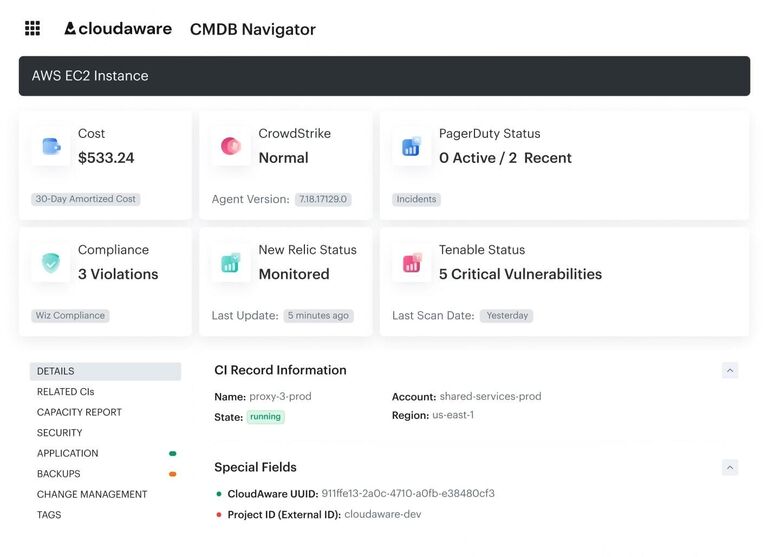 Cloudaware CMDB can bring those asset and relationship views together for cloud and hybrid infrastructure.
2. Making ITSM records actionable
Change, incident, and problem workflows are more useful when tickets resolve to current assets and configuration items. The team handling a change can see what service may be affected; the incident team can identify the owner and related infrastructure; the CMDB owner can investigate records that no longer match the operational estate.
For the lifecycle process behind that data, see IT asset lifecycle management.
3. Investigating cloud spend with operational context
A cost anomaly alone cannot establish whether a resource is waste, production capacity, a shared dependency, or an approved exception. Asset records add the ownership, service mapping, lifecycle state, and deployment context required to assign the investigation and make a defensible decision.
4. Preparing evidence for security and compliance reviews
Security and GRC teams need to connect a finding to the affected asset, its accountable owner, its current configuration, and the record of any exceptions or remediations. Asset management software does not replace security controls, but it makes the asset context and evidence easier to retrieve and review.
For environments that need lifecycle controls across hybrid infrastructure, see asset lifecycle management software.
5. Narrowing incident impact
During an incident, teams need more than a list of resources reporting errors. They need to identify the affected service, its dependencies, the resource owner, recent changes, and whether the record is current enough to trust. Relationship and change context shorten the investigation path, while unresolved records make uncertainty visible instead of creating false confidence.
How to evaluate asset management software
Feature lists do not show whether asset data is reliable enough to support real decisions. Evaluate the system against the records and workflows your team must trust during an audit, incident, renewal, ownership dispute, or retirement decision.
| Acceptance test | What to verify |
|---|---|
| Source traceability | Can users see where each critical field came from, when it was last updated, and which system is authoritative? |
| Identity reconciliation | Can the system distinguish duplicate observations from separate assets without losing source-specific identifiers? |
| Ownership coverage | Can teams identify an accountable owner, application, service, cost center, or support group for assets that require one? |
| Lifecycle evidence | Does a status such as active, retired, disposed, or exception have supporting evidence and change history? |
| Relationship context | Can users connect an asset to the services, configuration items, contracts, licenses, costs, and findings that affect the decision? |
| Conflict visibility | Are conflicting values, stale sources, and unresolved records visible instead of silently overwritten? |
| Workflow handoff | Can the record provide enough context for ITAM, FinOps, security, and service-management teams to investigate and resolve an issue? |
A practical asset record trust test is simple: choose several assets that recently changed state, generated unexpected cost, appeared in a security finding, or were scheduled for retirement. For each one, ask whether the system can show its current source evidence, owner, lifecycle state, related service, relevant history, and any unresolved conflict.
If the answer is incomplete, the gap is usually not “more inventory.” It is a missing operating rule: an unconnected source, unclear field authority, absent ownership mapping, unreliable lifecycle process, or no route for correcting disputed records.
For teams evaluating lifecycle governance in more detail, our guide to IT asset lifecycle management covers the controls that should support each transition.
Ready for real asset control? It starts with Cloudaware CMDB
Cloudaware supports enterprise IT asset management across AWS, Azure, GCP, VMware, Alibaba Cloud, and on-prem infrastructure. It is built for teams that need one current system of record across hybrid environments.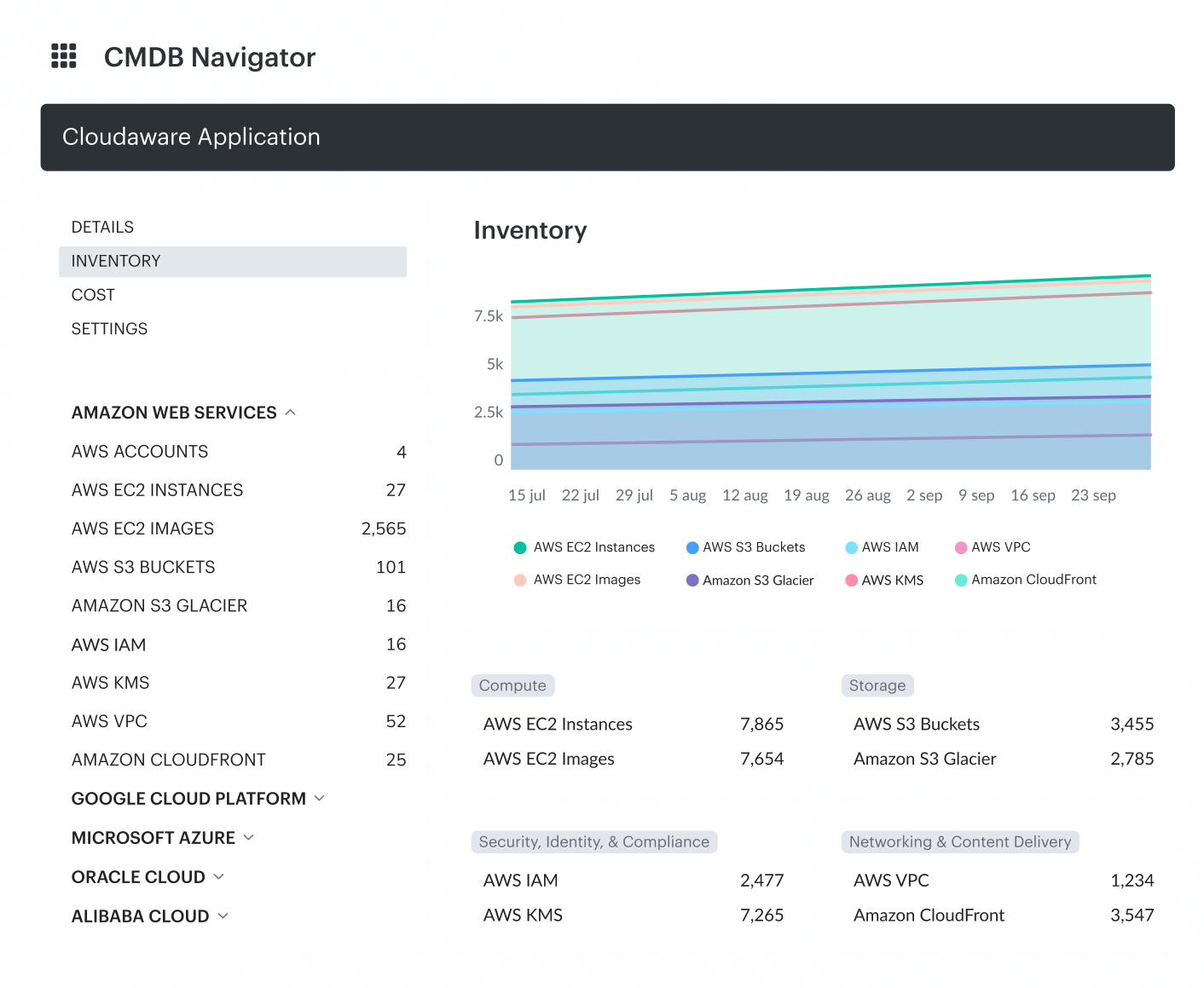 Core capabilities include:
- Agentless discovery: Pulls asset data through APIs without requiring agents on every resource.
- Broad source coverage: Connects cloud, SaaS, and hybrid infrastructure into one current inventory.
- CMDB enrichment: Consolidates duplicates and keeps CI records useful across teams and systems.
- Lifecycle and change support: Helps track asset state, document changes, and support audit workflows.
- Cost and software visibility: Surfaces unused licenses, idle resources, and wasteful spend.
- Dashboards and reporting: Supports analysis, reviews, and audits with built-in reports and analytics.