


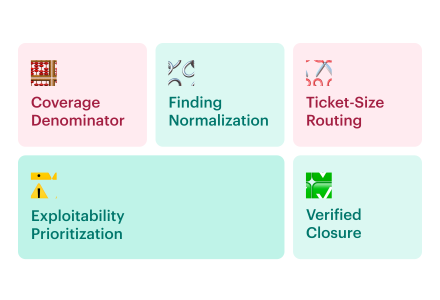
Start with one high-risk application. Follow one finding through the repository or package, immutable artifact, environment, runtime asset, owner, deadline, and validation target. Wherever that chain breaks, you have found the control gap worth fixing before you buy another tool.
This guide turns that check into six operating practices for AppSec, DevSecOps, and platform teams. The method combines current NIST and OWASP guidance with documented Cloudaware workflows and practitioner input from Igor Kachurin and Valentin Kel. A worked example then shows how 147 illustrative observations become three owner-ready tasks without losing source evidence.
Key insights
Application vulnerability testing works when its controls can be inspected separately. Audit one application before adding another scanner.
- Measure per-control coverage as applications with a current successful result divided by applications required to run that control.
- For each release, let the application risk profile and material changes set test depth. Cadence cannot prove the new API entered test scope before release.
- Cross-tool grouping starts with application, component, version, and environment identity. CVE-only matching can collapse separate fixes or send one defect into several queues.
- Technical severity is a baseline; exploitability, reachability, business impact, and compensating controls determine order. Record the factor that changed the order.
- Closure needs a same-scope repeat test or an approved, expiring risk decision. A completed ticket without either remains open exposure, whatever its status shows.
What application vulnerability testing covers in a working AppSec program
In a working program, the discipline coordinates automated and manual checks across proprietary code, third-party dependencies, APIs, configuration, authentication, authorization, business logic, build artifacts, and runtime behavior. The practical question is whether any of those surfaces can be exploited in the version that was actually built and deployed. A useful result stays tied to the artifact, environment, owner, remediation decision, and repeat test.
Keep the work products distinct. A scan records an automated observation; a test returns pass or fail for one condition and artifact; an assessment interprets several results; a penetration test records human-led attack paths. They require different triggers and closure evidence.
No single technique covers that chain. NIST IR 8397 describes complementary verification methods; OWASP SAMM adds the operating split: automate repeatable breadth, and reserve expert testing for high-risk components, business logic, and material change. Each technique still needs a trigger, scope, owner, and retained evidence.
That handoff belongs in the broader DevSecOps architecture. The immediate design task is narrower: match each technique to the failure surface it can observe and the event that makes its evidence stale.
Match each application security test to the failure surface and trigger
Choose the test from the failure you need to surface and the event that makes prior evidence stale. A clean SAST result says nothing about live authorization; a DAST pass cannot prove which dependency version was built.
| Technique | Strongest signal | Suggested trigger | Blind spot | Evidence retained |
|---|---|---|---|---|
| Threat modeling / abuse cases | Trust boundary and business-logic abuse | New auth, payment, data-flow, or privilege path | Implementation and runtime defects | Model version, scenario, reviewer, decision |
| SAST + secret scanning | Source-level defects and exposed secrets | Pull request or commit changing relevant code | Deployed config, dependencies, and runtime behavior | Commit, rule, path, result, suppression |
| SCA + SBOM | Known-vulnerable component in a build | Dependency, manifest, base image, or advisory change | Reachability and business logic | Manifest or SBOM version, package, advisory, digest |
| DAST + API tests | Observable behavior of deployed endpoints | Route, schema, auth, or production-like deployment change | Unexercised paths and root cause | Build, environment, endpoint, request-response proof |
| IAST or fuzzing | Runtime code path and unexpected-input failures | Integration test, parser, protocol, or harness change | Code paths the harness never reaches | Build, harness, input, coverage, crash evidence |
| Manual review / penetration test | Chained abuse and business-logic failure | High-risk release or material trust-boundary change | Repeatable breadth and cadence | Scope, rules, path, proof, retest target |
| Runtime and cloud observation | Deployed artifact, exposure, and drift | Deployment, config, network, or threat change | Source-level intent and hidden code paths | CI or digest, environment, timestamp, finding, relationship |
Use the table as a release-evidence map. Mark a technique Not triggered when its surface did not change; “Mark a technique Not required only when policy confirms that no change, advisory, or evidence-expiry trigger applies.” Mark it Missing when required evidence is absent, failed, or belongs to an earlier artifact.
In the checkout example, a payment SDK update triggers SCA and an SBOM refresh. A new public callback also triggers abuse-case review and API authorization testing. Missing authorization evidence for the new build holds the release.
The AppSec policy owner defines the triggers. The release owner records the commit or digest, environment, endpoint, result, timestamp, and reviewer. When a release policy requires current evidence, a missing or stale result should block promotion or trigger an approved exception.
Six application vulnerability testing practices that turn findings into fixes
The order matters because each practice preserves evidence required by the next.
Here is the operating sequence:
- Define the application and coverage denominator before scanning. Require current evidence for every in-scope repository, API, artifact, environment, and deployment.
- Trigger tests from risk and change, not one calendar. Rerun the control when its evidence becomes stale.
- Normalize findings into one application-level work queue. Preserve source evidence; group only records with one owner and remediation path.
- Prioritize exploitability and application impact before setting the clock. Use reachability, threat evidence, and business consequence to set the deadline.
- Route remediation at a ticket size one team can own. Split work when the fix, owner, deadline, or verification target changes.
- Prove closure against the same scope and keep regression visible. Ticket status starts verification; new technical evidence closes it.
Start with the denominator. If the application scope is wrong, every coverage, priority, and remediation metric that follows inherits the same error.
Define the application and coverage denominator before scanning
Pick one high-risk production application and trace its release from repository to workload. Coverage remains unproven until the build, image digest, service, API, environment, and accountable team connect. In application-level vulnerability testing, that relationship set is the application.
Build the coverage record around three evidence blocks:
| Record block | What must resolve |
|---|---|
| Application and risk | ID, business purpose, risk tier, data sensitivity, owner and routing team |
| Build and interface | Repositories, pipeline, packages, artifacts or image digests, APIs and critical dependencies |
| Runtime and proof | Environments, deployed services, related cloud CIs, required controls and last successful results |
Label each relationship Observed, Declared, or Unresolved. Keep unresolved records in the denominator until an authoritative source confirms them; removing them only improves the percentage, not coverage.
Keep two measurements separate:
- Policy-compliant application coverage: in-scope high-risk production applications with current evidence for every required control in the policy window ÷ all in-scope high-risk production applications.
- Per-control coverage: applications with a current result for that control in the policy window ÷ applications required to run it.
OWASP SAMM’s Application Risk Profile is a practical starting point for inventory and risk classification. AppSec owns the required controls and evidence window. Product or platform owners reconcile mappings after onboarding and material change.
In the checkout example, scope includes three repositories, two APIs, one pipeline, two image digests, and eight EKS nodes. “Eight successful node scans establish node-level assessment coverage for that window. Application and container coverage require separate evidence for that window. They do not prove build-to-image lineage or API-test coverage.
What is missing is the relationship. A Cloudaware cloud CMDB view can show the node’s cluster, network, application, environment, owner, and related security CIs when those sources and mappings are configured.
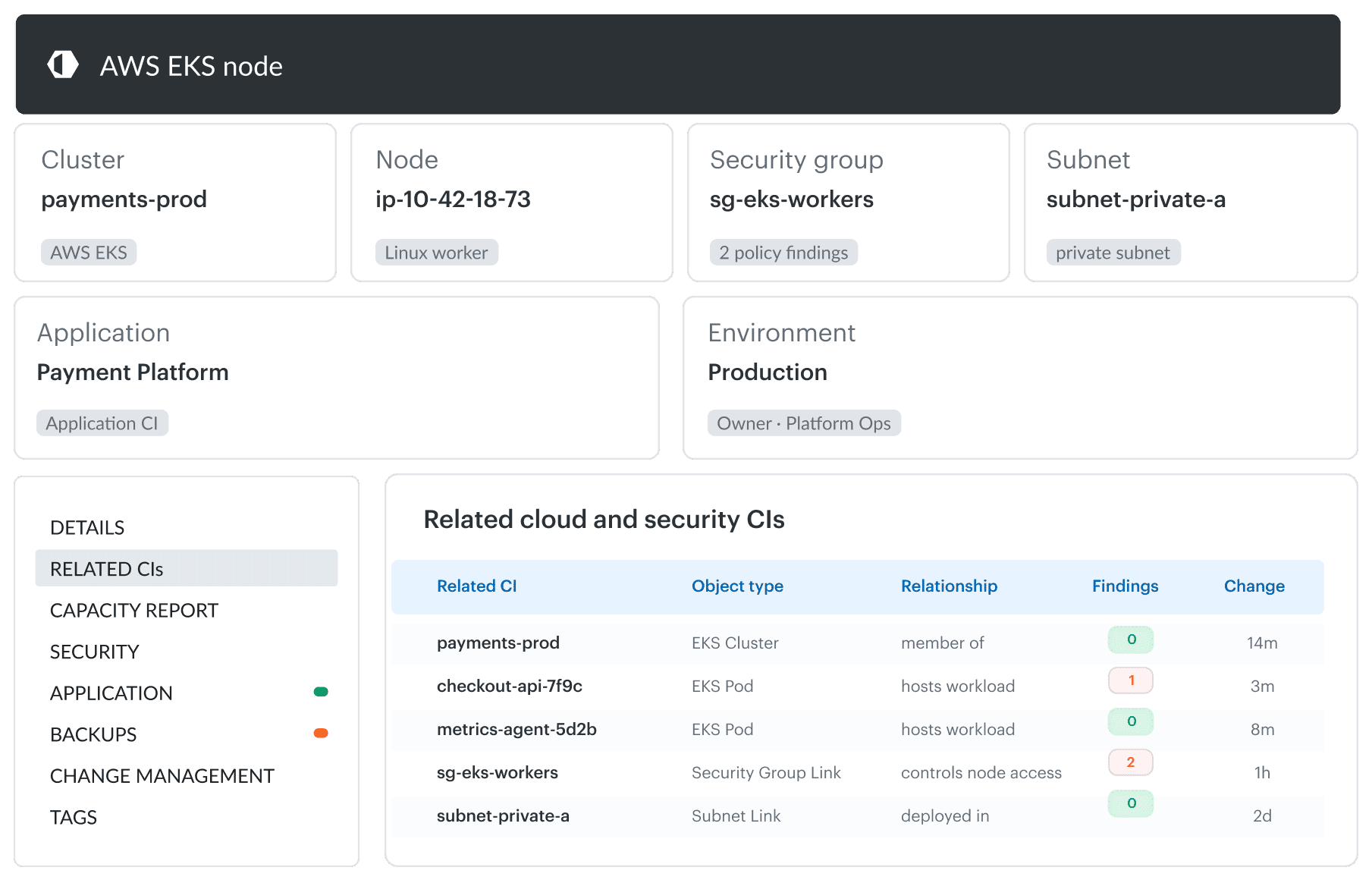
Related CIs: application and runtime context
Read the Related CIs view as a mapping check, not a testing result. Runtime context is visible; source-code, dependency, and API evidence is not. Coverage remains incomplete until the deployed digest resolves to the tested build and every required result is current.
Across a large portfolio, enterprise vulnerability management establishes common ownership, SLA, and exception rules across application and platform teams. Compare portfolios only after the application unit, control set, and evidence window are stable. Then decide which changes should trigger each control.
Trigger tests from risk and change, not one calendar
Trigger tests from application risk and the change event. Risk sets depth; the event identifies stale evidence and determines whether release may continue. For software vulnerability testing, that beats repeating every control on one calendar.
Turn that logic into an executable policy matrix:
| Change event | Control | Scope | Output | Escalation |
|---|---|---|---|---|
| Pull request | Static and secret checks | All | Commit result | Engineering; block or warn |
| Dependency or build | SCA and SBOM refresh | Selected | Version, digest, result | Component owner |
| Production-like deployment | DAST or API tests | Internet-facing or high-risk | Build, environment, endpoint | Release owner; tier gate |
| Authentication or data flow | Abuse cases and manual review | High-risk | Review decision | AppSec or expiring exception |
| Runtime or exposure | Runtime check | Deployed | Asset, change, finding | Service owner; out-of-cycle review |
For each row, set evidence age, outcome, exception owner, executor, and retained record. AppSec owns policy; delivery teams produce evidence. Count a pass only when the result resolves to the artifact or version entering the gate.
NIST SSDF places security practices inside the SDLC. OWASP SAMM adds the practical boundary: deeper manual testing should follow application risk, relevant change, and major releases.
Pre-release controls inspect the change; later deployment or exposure can invalidate their evidence. The workflow becomes operational when each new event reopens the relevant control.
Start with high-risk applications and consequential events. During DevSecOps implementation, track escaped defects, median gate time, override rate, and stale-evidence failures. Change one rule at a time. Configured Cloudaware relationships and ingested scanner findings can supply runtime trigger input; they do not replace application tests.
If a newly exposed API never enters the matrix, a daily scan adds little. Retain the event, artifact, result, policy decision, and exception state; the application-level queue needs that provenance.
Normalize findings into one application-level work queue
Your queue should count decisions, not scanner hits. Normalize the record, resolve it to an application and component, and only then deduplicate. Reverse that order and you get 126 tickets for one fix or one ticket hiding another team's exposure.
The vulnerability operations lead owns this sequence at scanner ingest and after relationship changes:
- Keep the source truth. Retain the source ID, CVE, CWE, or rule, component and version, image digest, evidence, timestamps, status, and false positive decision.
- Resolve the work identity. Add application ID, environment, runtime CIs, component identity, routing team, and validation method. Unresolved relationships go to mapping review, not a guessed application.
- Group matching work. Fingerprint the issue, application, environment, affected version, build lineage, and remediation path. Scanner integration supplies observations; it does not decide that two teams share a fix.
This data contract does not describe every tool's schema. It lets application security testing sources disagree without losing provenance. OWASP SAMM Defect Tracking also separates defect collection from analysis and action.
Valentin Kel, Software Developer at Cloudaware
Test the rule on one noisy case first. In an illustrative sample, a vulnerable library appears in 126 replicas but maps to two image digests. Keep all 126 observations. Create one remediation record only when both digests share the rebuild, owner, and validation path. Otherwise, create two.
For QA, include one expected merge, one split by version or build lineage, another by environment or owner, and an unresolved mapping. Compare observations, application instances, and remediation paths. Reject any merge the fingerprint cannot explain.
Once the sample holds, apply the rule to the working queue. Cloudaware's grouping and deduplication model retains raw scanner evidence behind grouped work. The supplied Analytics Studio recipe shows the aggregation, filtering, and join to application context.
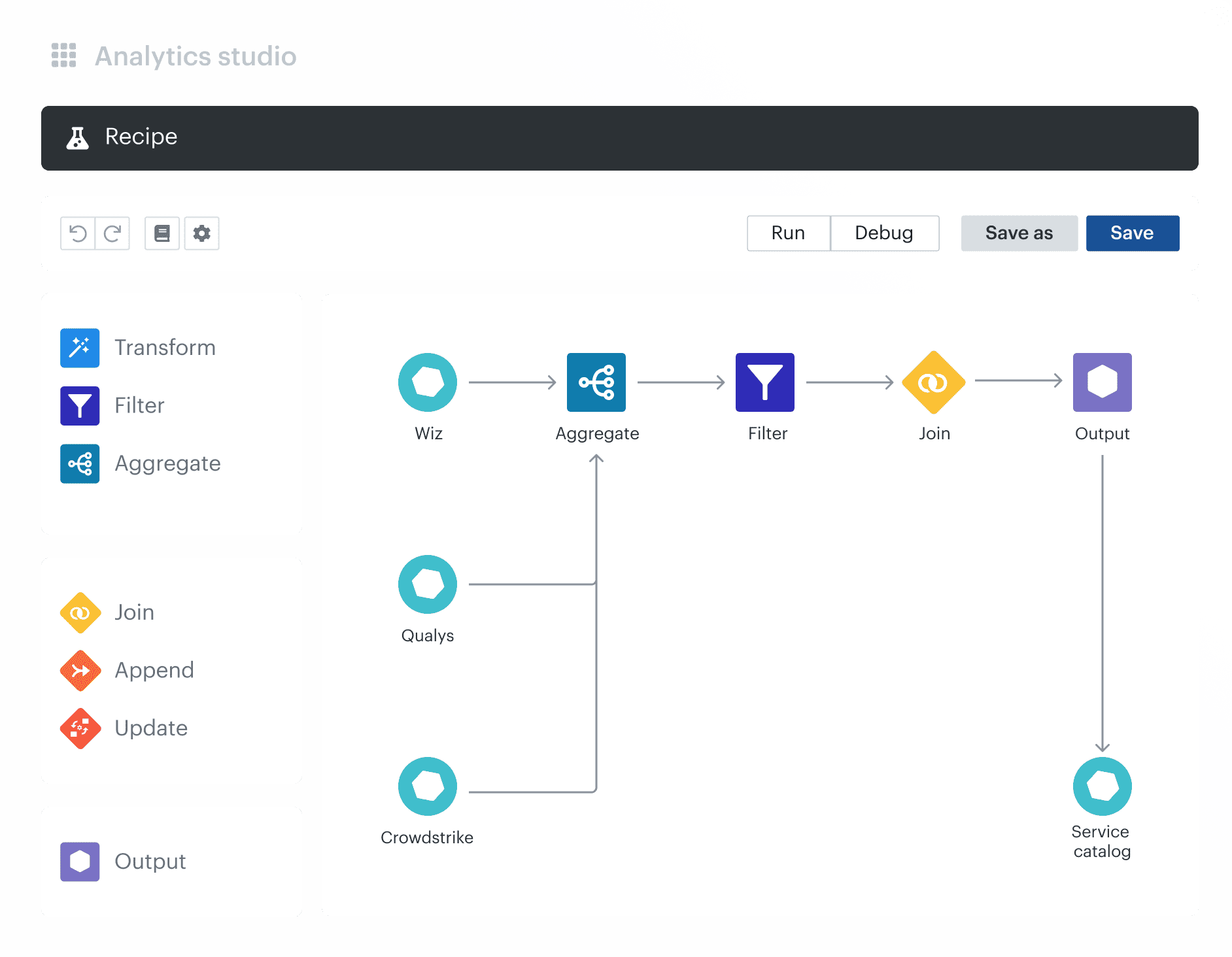
Analytics Studio: scanner inputs and transformation path
The visual proves the transformation path, not the match quality. Re-run the QA sample after a source schema or application relationship changes. Confirm that first-seen and last-seen history survives. Only then are the normalized findings ready for risk-based prioritization.
Prioritize exploitability and application impact before setting the clock
A CVSS-B score of 9.8 does not automatically deserve your shortest SLA. Before starting the clock, check exploitability, deployment reachability, business impact, and safe-response constraints. Keep severity visible; do not let it decide alone.
CVSS v4.0 keeps intrinsic severity separate from Threat and Environmental context. EPSS estimates the probability that a published CVE will be exploited in the wild within the next 30 days; the CISA KEV catalog lists vulnerabilities for which CISA has evidence of active exploitation. Keep the source and timestamp beside the decision.
Use the same four-question order for every finding:
| Ask | Inspect | Decision effect |
|---|---|---|
| Is exploitation observed or strongly signaled? | KEV, internal intelligence, EPSS timestamp | Confirmed exploitation outranks a forecast. Low EPSS does not cancel KEV. |
| Is the vulnerable path reachable? | Loaded component, public exposure, network path | Reachability raises urgency. Unknown means validate, not downgrade. |
| What is at stake? | Business criticality, sensitive data, dependencies, production impact | Consequence sets the deadline and escalation. |
| What changes the response? | Compensating control, fix availability, rollout constraint | Record it before the SLA or exception route. |
Consider two illustrative findings. A scores 9.8, but its component is not loaded and the isolated test deployment is awaiting retirement. B scores 8.1, is KEV-listed, reachable through a public production API, and affects payment authorization. B gets the faster deadline. A stays visible until retirement is verified.
For application security vulnerability testing, record the inputs, timestamps, rationale, deadline class, and escalation path. Reassess after a KEV change, policy-defined EPSS band change, new exposure, production promotion, or control change. Another reviewer should reproduce the decision without reverse-engineering a proprietary score.
At the portfolio scale, review application concentration and vulnerability age together in Cloudaware Vulnerability Management. Those views show where prioritized work is accumulating or already outside a configured SLA; they do not decide priority for the security team.
Route remediation at a ticket size one team can own
Use one rule: if one team cannot estimate, schedule, deploy, and verify the work as one unit, the ticket is the wrong size. One finding per ticket floods the board. One application-wide mega-ticket buries different owners, fixes, and deadlines.
Build the grouping key from application, rollout domain, routing team, remediation path, and deadline class. Split whenever one changes, but keep every source finding and its evidence attached. This follows the same collect-then-analyze discipline used in OWASP SAMM Defect Tracking.
Before creating the ticket, give the receiving team:
- Business reason for the priority, plus application and environment;
- Affected component, version range, and complete finding list;
- Application owner or routing team and the agreed remediation path;
- SLA due date or a scoped exception with an expiry;
- Validation method and links to the supporting evidence.
Before automating, compare three ticket shapes on one application: per finding, per CVE, and per owner-ready task. Track post-handoff splits and reassignments. If they rise, add the field that caused the split, such as repository, release train, or validation target, to the grouping key.
Suppose the same CVE affects staging and production. The platform team rebuilds production on a new base-image digest; staging receives the fix in the application’s next release. The owner, deployment window, and verification target differ, so create two remediation tasks.
Valentin Kel, Software Developer at Cloudaware
Once the grouping rule is stable, keep each task linked to its findings and current owner. Configured Cloudaware remediation workflows can create Remediation Tasks or Initiatives and synchronize work with Jira or ServiceNow; PagerDuty can receive configured escalations. The scanner supplies the evidence, and the receiving team owns the fix.
A routed ticket proves that work exists; the next practice defines what proves closure.
Prove closure with the same scope and keep regression visible
Treat Done as a handoff to verification. A finding leaves the queue after every required target reaches an allowed terminal state. The remediation team records the change; AppSec checks proof of closure.
Make the outcome explicit:
- Verified fixed: a fresh test no longer reproduces the condition on the original target.
- Mitigated with evidence: the flaw remains, but validation proves that an approved control blocks the relevant path.
- Accepted risk: the record has an approver, scope, compensating control, review date, and expiry. It is not fixed.
- Unresolved or reopened: validation fails, misses the target, or finds the condition again.
Mitigated with evidence may be terminal under your policy; never rename it Verified fixed. For grouped work, each underlying finding must qualify. One clean endpoint cannot close three untested ones.
Illustrative failure: the dependency update is merged and Jira shows Done, yet production still runs the previous image digest. A rescan finds the same package version. For a business-logic defect, the required repeat evidence may be an expert abuse test instead.
Igor Kachurin, DevOps / Platform Engineer | Kubernetes, Terraform, GitOps
Verify the same vulnerable condition across the affected deployment scope. For image-based fixes, link the original digest to its patched replacement and confirm that the replacement is deployed and passes verification.
At portfolio scale, preserve that comparison by linking the finding, application, environment, remediation task, change reference, validation target, repeat-test result, and final state. Cloudaware can relate configured scanner observations to CMDB and remediation records and expose their verification state. The scanner remains the finding source. When Cloudaware Vulnerability Scanning is configured for it, an operator can request an on-demand scan.!
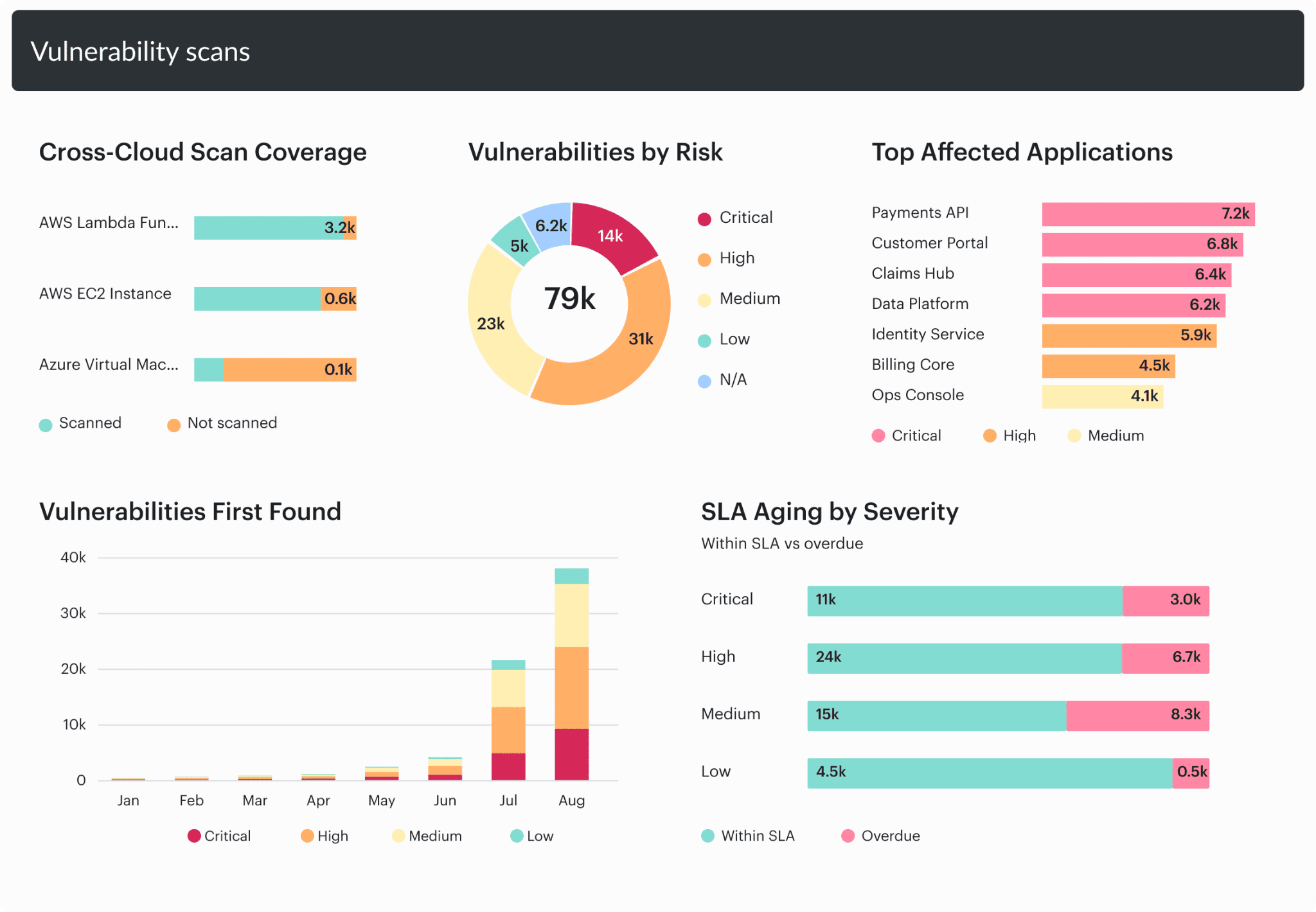
Filter Done or Resolved tasks where successful validation is blank or predates deployment. Return those findings to Verification pending, schedule the correct repeat test, and keep the vulnerability age running. The remediation owner fixes the application; the scanner or expert validates it.
Define verified mean time to remediate (MTTR) as the interval from finding qualification to the first successful repeat test against the required target. Track repeat-test completion, exposure age, accepted-risk expiry, and reopened findings separately. OWASP SAMM Metrics and Feedback treats these as different signals.
The worked example below carries 147 fictional observations to their allowed final states.
Worked example: 147 scanner observations become three owner-ready tasks
All names, counts, vulnerabilities, and workflows are illustrative. The example preserves all 147 observations across the three remediation tasks.
Checkout API is an internet-facing payment application with three repositories, two APIs, and two image digests in staging and production. The example combines 126 package-vulnerability observations reported against running replicas across the two digests, 15 API endpoint observations, and six secret-scanning detections.
Map each signal to its component, branch or endpoint, digest, environment, and owner. Group only when one team can ship one change and prove it with one completion rule. A different remediation object, rollout, deadline, or repeat test requires another task.
| Raw signal | Application context | Risk decision | Owner-ready task | Verification evidence |
|---|---|---|---|---|
| 126 package-vulnerability observations across running replicas and two image digests | Both digests; staging and production | One platform team owns both digests; production supplies the due date, and both rollouts meet it. | Platform: rebuild the dependency, publish clean digests, and replace old workloads. | New digests run in both environments; old digests are absent; the post-rollout scan finds no vulnerable version. |
| 15 endpoint observations from one authorization defect | Two APIs; affected endpoints and shared authorization path | Group only after confirming one failed control and one code change. | Application: correct the authorization control and test every affected endpoint. | Positive and negative tests pass on every affected endpoint in both APIs. |
| 6 secret observations in archived branches | Three repositories; matching fingerprint and credential owner | Group only when every observation refers to the same active credential. | Identity: revoke the credential and coordinate repository cleanup. | Revocation is recorded; the repeat scan finds no matching fingerprint. |
Use that as a triage stop. If one change and one proof path cannot be named, hold the group for review.
Each task needs its own proof: replacement digests plus a clean post-rollout scan; authorization tests across both APIs; or revocation evidence plus a repeat repository scan. Mixed results remain open or split into new work.
One ticket per observation creates 147 queue items; one application-wide ticket mixes three teams and incompatible completion rules. Three tasks preserve the evidence without handing engineers scanner-shaped work.
Each source record should remain linked to an application, an owner-ready task, and the required proof. Cloudaware Vulnerability Management can relate configured scanner records to CMDB relationships and remediation links, then surface later observations. Security sets policy; responsible teams implement and validate fixes.
See which application owns the risk and whether the fix held
Open one high-risk production finding and answer two questions: which application owns the exposure, and which later observation proves the fix held?
Cloudaware Vulnerability Management connects configured scanner records to CMDB relationships, remediation tasks, and later source observations so environment, owner, exposure, age, and verification state stay on one evidence path. The scanners still generate findings; engineers still implement and validate the fix.
Follow the same record through five handoffs. Stop when its identity or evidence disappears:
- Ingest. Confirm the source finding ID, affected target, first- and last-seen times, and current scanner status. An aggregate count is not enough.
- Relate. Follow the affected CI through deployment and environment to the application and current routing team. A broken relationship returns to CMDB mapping review.
- Decide. Filter a recipe or custom dashboard by application, exposure, vulnerability age, scan coverage, SLA state, and remediation state. Security owns the risk, grouping, and exception rules.
- Route. Create a remediation task. Configured integrations can create or update Jira or ServiceNow work and support PagerDuty escalation. Keep every source finding linked.
- Verify. Compare the later observation with the same target. A resolved ticket starts verification; only the required technical evidence proves closure.
Cloudaware workflow: These supplied views illustrate separate stages. They do not trace one finding ID or show its post-change retest.
1. Map the application and related CIs
2. Inspect the scanner recipe
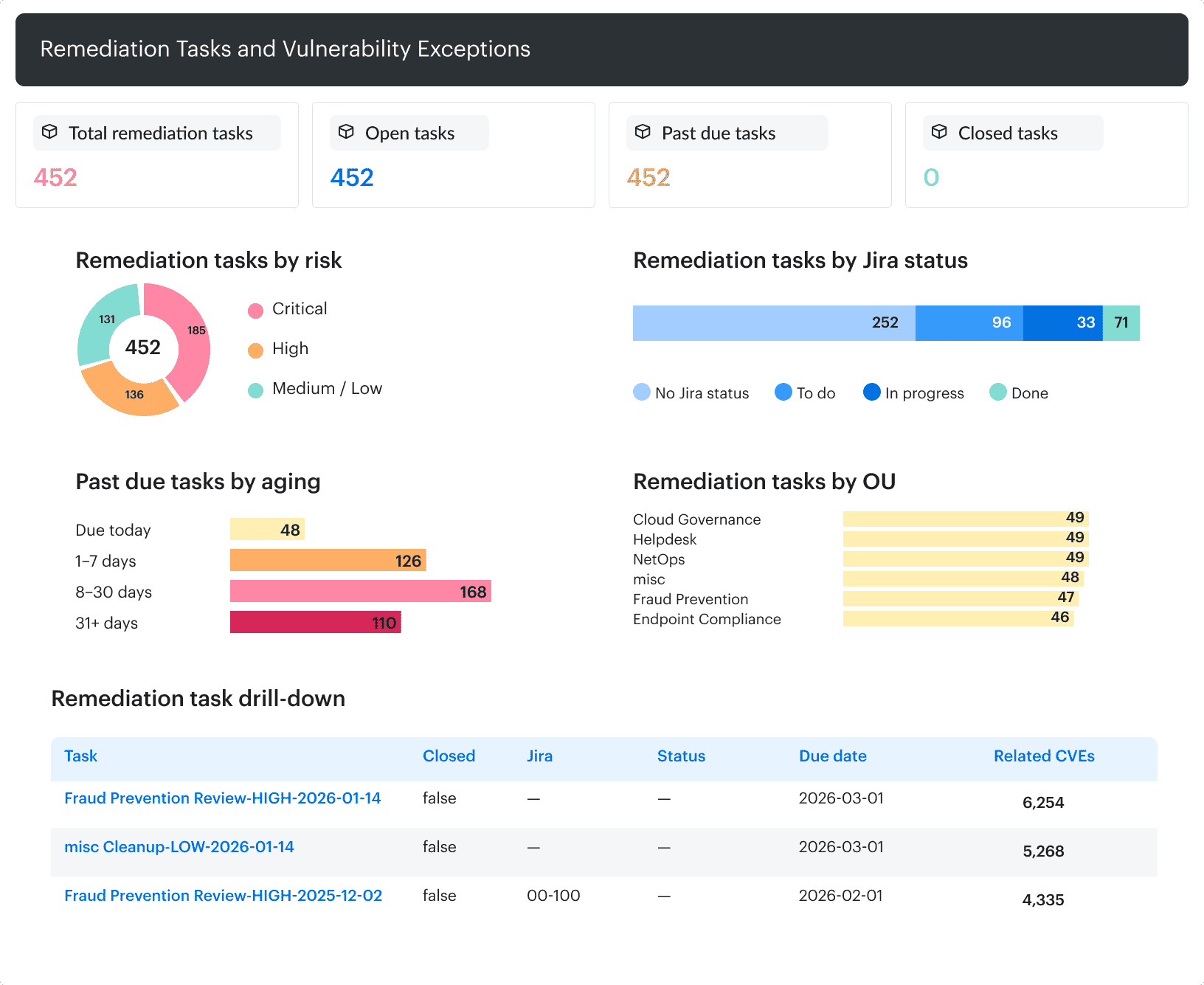
3. Review remediation tasks and Jira status
4. Review lifecycle and verification gaps
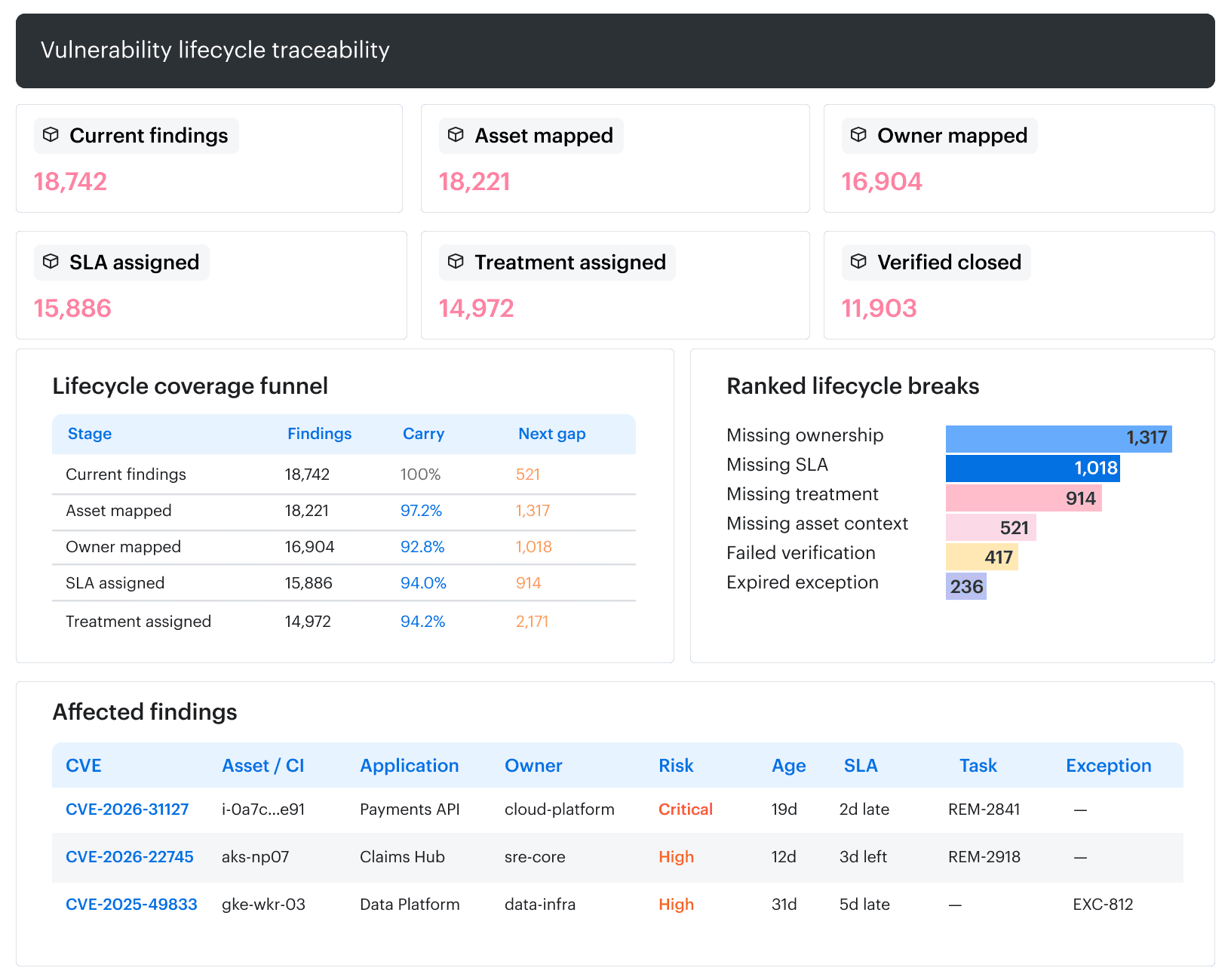
Read the dashboard as an exception queue. A missing application relationship goes to the CMDB owner, an overdue task to the routing team, and resolved work without a later observation back to verification.
The capability boundary should remain explicit:
| Native Cloudaware capability | Integration-dependent capability | Operator action |
|---|---|---|
| CMDB application mapping, related-CI relationships, configurable recipes, dashboards, and remediation records | Scanner fields, scan cadence, and later observations supplied through configured connectors | Define risk and SLA policy; review mapping exceptions and scan coverage gaps |
| Custom views of exposure, vulnerability age, application concentration, and remediation state | Jira or ServiceNow creation and update; PagerDuty escalation through configured integrations | Approve the grouping rule, route the work, perform remediation, and approve exceptions |
| Traceability between findings, application context, remediation work, and available later evidence | Jira ticket update or closure behavior governed by the external workflow and its configuration | Decide whether evidence qualifies as verified fixed; configure any Jira closure automation separately |
Cloudaware does not replace SAST, DAST, SCA, penetration testing, or the ticketing system where engineers execute work. It gives application vulnerability testing a shared context and evidence path across those systems.