


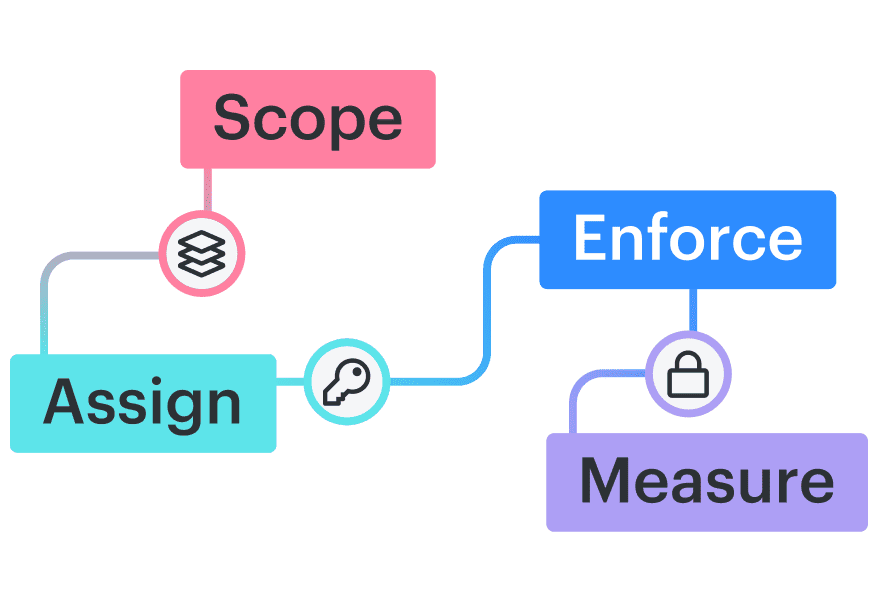
A vulnerability scanner can identify a critical finding, but someone still has to decide who owns it, how quickly it must be addressed, and what happens when remediation is not possible. A vulnerability management policy establishes those requirements, including assessment coverage, remediation deadlines, risk acceptance, and evidence of closure.
Use the free editable template below to document these rules for your organization. The article also explains why the policy's requirements matter, how to adapt them to AWS, Azure, GCP, and hybrid infrastructure, and how to verify that teams are following them. A policy example shows how to populate selected policy fields, while a reference table connects policy requirements with relevant CIS, NIST, and ISO 27001 controls.
TL;DR
- Get the editable policy template here: Use the document to define asset scope, ownership, vulnerability assessment, remediation SLAs, exceptions, verification, and reporting
- Adapt the policy to your infrastructure: Map AWS accounts, Azure subscriptions, GCP projects, and hybrid assets to responsible owners and appropriate assessment methods
- Make requirements enforceable: Define when remediation deadlines begin, who approves exceptions, and what technical evidence is required before a finding can be closed
- Align with security standards: Map policy requirements to CIS Control 7, ISO 27001 Annex A 8.8, and NIST guidance without treating the document itself as proof of compliance
- Verify that the policy is followed: Compare asset inventory with scan coverage, track overdue remediation and verified closure, and review approved exceptions separately
What's included in the vulnerability management policy template?
The template provides a customizable internal policy for managing vulnerabilities across cloud and on-premises infrastructure. It defines the requirements teams need to agree on before they can consistently assess vulnerabilities, assign remediation, approve exceptions, and report results.
| Policy area | What's included |
|---|---|
| Scope and governance | Covered assets, policy ownership, roles, and responsibilities |
| Vulnerability identification | Asset inventory requirements, assessment methods, and coverage |
| Risk and remediation | Prioritization criteria, SLA deadlines, treatment, change control, and verification |
| Exceptions | Risk acceptance, approval authority, compensating controls, and expiration |
| Reporting and review | Performance metrics, evidence retention, third-party obligations, and policy review |
The document includes editable organization fields, a RACI matrix, and a remediation SLA table.
You can review the full policy text below or open this editable template to work directly on your organization's version.
Before adoption, the policy owner should validate its requirements against the asset inventory, risk tolerance, existing security procedures, and applicable compliance obligations. The template itself does not establish compliance with a particular standard.
Policy document information
| Document field | Value |
|---|---|
| Policy title | [Organization] Vulnerability Management Policy |
| Document ID | [Policy ID] |
| Version | [Version number] |
| Policy owner | [Responsible role] |
| Approved by | [Approving authority] |
| Effective date | [Date] |
| Next review date | [Date] |
| Related documents | [Risk Management, Change Management, Incident Response, Vulnerability Management Procedures] |
The following is the complete policy text, grouped by the decisions and responsibilities it governs.
Scope, responsibilities, and asset coverage
1. Purpose
[Organization] shall maintain a vulnerability management program to identify, assess, prioritize, treat, and verify security vulnerabilities affecting its information assets.
The program shall address vulnerabilities according to business risk, technical exploitability, and the organization's approved risk tolerance. This policy establishes the requirements, accountability, and reporting obligations governing that program.
2. Scope
This policy applies to information assets owned, operated, or managed by [Organization], including applicable resources within:
- AWS accounts, Azure subscriptions, and GCP projects
- On-premises servers, VMware infrastructure, and network devices
- Endpoints, operating systems, databases, and business applications
- Container images, containerized workloads, and Kubernetes infrastructure
- Managed cloud services and third-party systems within the organization's responsibility
Security and IT teams shall document which asset classes are in scope, their assessment methods, and any approved exclusions.
For cloud services, vulnerability management responsibilities shall follow the applicable shared responsibility model. Provider-managed components shall be distinguished from customer-controlled configurations and workloads.
3. Policy ownership and governance
[Policy Owner] shall maintain this policy and coordinate its implementation with Security Operations, infrastructure teams, application owners, and risk management.
[Approving Authority] shall approve the policy and material changes. Operational responsibilities shall be documented in the organization's vulnerability management procedures.
4. Roles and responsibilities
[Organization] shall assign accountability for vulnerability assessment, remediation, exception approval, and verification.
The following RACI is an example and must be adapted to the organization's governance structure.
| Activity | Security lead | SecOps | Asset owner | Platform/IT | Risk approver |
|---|---|---|---|---|---|
| Maintain policy and standards | A | R | C | C | I |
| Maintain assessment coverage | A | R | C | R | I |
| Assess and prioritize findings | A | R | C | C | I |
| Execute remediation | C | C | A | R | I |
| Approve risk exceptions | C | C | R | C | A |
| Verify and report closure | A | R | C | C | I |
A = Accountable, R = Responsible, C = Consulted, I = Informed.
Each activity shall have one accountable authority. Every finding shall have a designated remediation owner. Where ownership is disputed, [Designated Escalation Owner] shall retain accountability until the responsible asset or service owner is confirmed. Reassignment shall not restart the remediation deadline.
5. Asset inventory and vulnerability identification
[Organization] shall maintain an authoritative inventory of in-scope assets in [CMDB/Asset Inventory System]. Inventory records shall identify the asset, environment, responsible owner, and relevant business service where available.
Approved vulnerability assessment sources shall be defined for each asset class. These may include authenticated host scanners, cloud-native assessment services, container image scanners, configuration assessments, and vendor security advisories.
Assessments shall occur according to [Approved Assessment Schedule] and following material changes, where applicable.
Security Operations shall monitor assessment coverage and investigate assets with missing, failed, or outdated results. An asset's absence from scanner records shall not be treated as evidence that it is free of vulnerabilities.
Risk prioritization, remediation SLAs, and verification
6. Vulnerability risk assessment
[Organization] shall evaluate identified vulnerabilities using technical severity and the risk they create in the affected environment.
Prioritization shall consider relevant evidence, including CVSS severity, known exploitation documented in the CISA Known Exploited Vulnerabilities Catalog, exploitation likelihood from FIRST EPSS, network exposure, asset criticality, and business impact.
Security Operations shall document the priority assigned to a finding and reassess it when material exploitation evidence or environmental conditions change.
7. Remediation service-level agreements
Vulnerabilities shall be treated within deadlines established by [Organization]'s approved risk-based remediation standard.
| Risk tier | Remediation deadline | Escalation requirement |
|---|---|---|
| Critical / actively exploited | [Approved timeframe] | [Responsible authority and trigger] |
| High | [Approved timeframe] | [Responsible authority and trigger] |
| Medium | [Approved timeframe] | [Responsible authority and trigger] |
| Low | [Approved timeframe or maintenance cycle] | [Responsible authority and trigger] |
The remediation standard shall define the SLA start event, calendar or business-day basis, due-date calculation, escalation triggers, and treatment of approved exceptions. The deadline shall include technical verification of remediation. Reassignment shall not restart the clock. Evidence of active exploitation shall trigger immediate risk reassessment and, where required by the approved standard, an accelerated treatment deadline.
8. Vulnerability treatment
Assigned asset or service owners shall ensure that vulnerabilities receive an approved treatment appropriate to the identified risk.
Treatment may include installing patches, upgrading software, correcting configurations, removing affected components, restricting exposure, or implementing validated compensating controls.
Temporary mitigation shall not automatically be classified as permanent remediation. Any residual vulnerability or risk shall remain subject to tracking, reassessment, and exception requirements.
9. Remediation testing and change control
Remediation activities shall follow [Organization]'s approved change-management process, including testing, authorization, deployment, and rollback planning appropriate to the affected service.
Emergency changes may use an expedited approval process where permitted by organizational policy.
The responsible implementation team shall document the treatment performed, affected assets, deployment status, and relevant change or ticket references.
10. Remediation verification and closure
A vulnerability finding shall be marked as remediated only after appropriate technical evidence confirms that the identified condition has been corrected.
Acceptable verification may include a successful follow-up scan, application retest, configuration assessment, validated patch state, or confirmation that the affected resource has been decommissioned.
Verification evidence shall identify the affected asset and finding, assessment date, method, and result. A failed assessment, a stale record, or loss of scanner reporting shall not establish remediation. Decommissioning shall be confirmed through an authoritative lifecycle record.
Ticket closure alone shall not constitute verification. Findings that remain detectable, recur, or lack sufficient evidence shall remain open or be returned for investigation according to the approved procedure.
Exceptions, reporting, and policy governance
11. Vulnerability exceptions and risk acceptance
Where remediation cannot meet the approved deadline, the responsible owner shall submit an exception request early enough for the designated authority to decide before the remediation due date. A pending request shall not pause the SLA clock or constitute risk acceptance. Findings without an approved exception shall follow the overdue escalation process.
Each exception shall identify:
- Affected assets, vulnerabilities, and business services
- Business or technical justification
- Accountable risk owner and approving authority
- Compensating controls and residual risk
- Approval date, expiry date, and review conditions
Exceptions shall be reassessed before expiry and whenever material risk conditions change. Extensions require renewed authorization before the existing approval expires. If an exception expires without renewed approval, the finding shall return to the remediation and escalation process under the approved SLA rules. The reporting record shall retain the original deadline, exception period, approval history, and current treatment status.
12. Metrics and reporting
Security Operations shall report vulnerability management performance to [Governance Authority] at [Approved Reporting Frequency].
Reporting shall include applicable measures of asset assessment coverage, overdue findings, remediation SLA performance, time to verified closure, outstanding high-priority exposure, and approved exceptions.
Metric definitions shall specify the scope, data sources, measurement dates, and treatment of missing or suppressed records. Corrective actions shall be assigned when performance falls outside approved thresholds.
13. Evidence retention
[Organization] shall retain vulnerability assessment results, remediation records, change approvals, verification evidence, risk exceptions, and policy-review history according to [Evidence Retention Schedule].
Evidence shall remain accessible to authorized personnel responsible for security governance, investigations, and audits.
14. Third-party responsibilities and enforcement
Suppliers and service providers responsible for in-scope systems shall comply with applicable vulnerability management requirements established through contracts, service agreements, or organizational security standards.
Unresolved violations shall follow the organization's documented escalation and enforcement procedures. Security, Legal, Human Resources, or vendor-management authorities shall be involved where appropriate.
15. Policy review and approval
[Policy Owner] shall review this policy at least annually and following significant changes to the organization's infrastructure, threat environment, or applicable requirements.
The operating remediation process shall be reviewed at [Approved Frequency], separately from the formal policy review.
Approved revisions shall include a version number, review date, summary of changes, and approving authority.
Policy references: CIS Controls v8.1, NIST Cybersecurity Framework 2.0, NIST SP 800-40 Rev. 4, and ISO/IEC 27001:2022 Annex A 8.8.
Vulnerability management policy example
A completed vulnerability management policy should make clear which infrastructure is covered, who makes remediation decisions, and what evidence is required before closing a finding. The template's placeholders become enforceable requirements only after the organization has agreed on the values and approved them.
The following fictional example shows how a mid-sized organization might populate selected policy fields.
| Policy field | Completed example: Acme Systems |
|---|---|
| Scope | Production EC2 workloads in AWS, Azure virtual machines, and VMware-hosted servers |
| Policy owner | Head of Information Security |
| Remediation accountability | Application owners, with implementation assigned to the relevant platform team |
| Assessment | Authenticated host assessment at the approved cadence, supplemented by cloud-native security findings |
| Risk evaluation | CVSS, CISA KEV status, EPSS, exposure, and application criticality |
| Critical SLA | 7 calendar days |
| High SLA | 30 calendar days |
| Medium SLA | 90 calendar days |
| Verification | Follow-up assessment or documented technical validation |
| Reporting | Monthly vulnerability review with overdue findings and exceptions |
The SLA values are illustrative organizational decisions, not universal requirements.
Example exception: Acme Systems cannot upgrade a legacy ERP server within the High-risk deadline because the supported application version depends on its current operating system.
The IT Director requests a time-limited exception, with restricted network access as a compensating control. The designated risk authority approves the exception until December 31, 2026, subject to review if exploitation evidence or exposure changes.
The server remains visible in vulnerability and exception reporting. Its accepted risk remains separate from verified remediation.
This example also demonstrates why approval and expiry requirements belong in the policy. An unresolved vulnerability may have an authorized treatment decision, but it still needs a traceable owner, current risk assessment, and review date.
How to customize a vulnerability management policy for multi-cloud environments
To use the policy, validate its requirements against the infrastructure and operating processes it will govern. A statement requiring regular assessment of production systems is meaningful only if the organization knows which systems are in scope, how each can be assessed, and who is responsible for acting on the results.
Start with four decisions:
| Step | Decision | Required output |
|---|---|---|
| 1. Confirm scope | Which cloud accounts, subscriptions, projects, applications, and hybrid assets are covered? | Approved scope and ownership mapping |
| 2. Define control requirements | Which assessment methods, SLAs, and treatment rules apply to each asset class? | Assessment schedule and risk-tier rules |
| 3. Test exception and closure rules | Can a finding move from detection to verified closure or approved risk acceptance? | Worked treatment and evidence records |
| 4. Approve the policy | Who can approve requirements, exceptions, and subsequent revisions? | Signed, versioned policy |
Cloud service responsibility needs particular attention. An Amazon EC2 instance exposes operating-system patching responsibilities that differ from those of a fully managed database service. Similarly, the controls available for Azure virtual machines, GCP Compute Engine instances, Kubernetes workloads, and SaaS applications are not identical.
The policy should identify the assessment and treatment responsibilities that the organization actually controls. Requirements for host vulnerability scanning cannot automatically be applied to every managed service.
Before approval, create an assessment matrix for each in-scope asset class: assessment source, responsible team, required cadence, and evidence of a successful assessment. Record approved exclusions separately with their justification and review date. Resolve missing assessment assignments through the designated accountable owner.
Where a resource lacks an owner or assessment source, assign the gap for investigation. Do not silently exclude it from the policy's coverage calculations.
Next, test the proposed SLA and exception rules with one real operating scenario. For a High-risk vulnerability affecting a production application, confirm:
- Which system records the finding and starts the remediation clock
- Who accepts ownership and who performs the change
- Who can authorize an exception if the deadline cannot be met
- Which technical evidence is required before the finding is closed
- How overdue work and accepted risk appear in reporting
This test often exposes inconsistencies between policy wording, ITSM workflows, scanner data, and change-control procedures.
The detailed deployment and patch-verification steps belong in supporting procedures, where teams can maintain them alongside their vulnerability and patch-management workflow.
How the policy relates to the program, plan, and procedures
Once the organization establishes policy requirements, it needs a separate operating model to execute them. A vulnerability management program template, plan, and procedure serve different functions.
| Document | Primary function | Typical contents |
|---|---|---|
| Policy | Define mandatory requirements and authority | Scope, ownership, SLAs, exceptions, review |
| Program | Govern the vulnerability management capability | Objectives, stakeholders, resources, operating model |
| Plan | Define implementation arrangements | Assessment sources, schedules, milestones, reporting |
| Procedure | Explain how work is performed | Scanner operations, triage, remediation, verification |
For example, a policy may require verification before a finding is closed. The corresponding procedure specifies how SecOps requests a rescan, what constitutes an acceptable configuration check, and how the result is recorded in the remediation ticket.
A vulnerability management program worksheet can then document the approved asset inventory source, scanner integrations, remediation and ticketing systems, responsible teams, assessment cadence, and reporting schedule.
A combined patch and vulnerability management plan template should reference the policy's approved remediation SLAs rather than introduce conflicting deadlines or exception rules.
Vulnerability management controls and standards
A vulnerability management policy can support several security frameworks, but an approved document alone does not demonstrate that the corresponding controls are operating effectively.
When reviewing the policy against CIS Controls, ISO 27001, or NIST guidance, map each applicable requirement to the relevant policy clause and the evidence that demonstrates implementation.
| Policy requirement | Relevant control or guidance | Example evidence |
|---|---|---|
| Maintain asset scope | CIS Control 1; NIST CSF 2.0 ID.AM | Current inventory of in-scope assets |
| Document the vulnerability management process | CIS Safeguard 7.1 | Approved process and revision history |
| Review risk-based remediation | CIS Safeguard 7.2 | Remediation process and review records |
| Assess vulnerabilities | CIS Safeguards 7.5 and 7.6 | Dated internal and external assessment records |
| Manage technical vulnerabilities | ISO/IEC 27001:2022 Annex A 8.8 | Vulnerability assessment and treatment evidence |
| Establish enterprise patch management practices | NIST SP 800-40 Rev. 4 | Patch management plan and deployment records |
CIS Control 7 addresses vulnerability management processes, remediation, and assessment. Safeguard 7.1 calls for reviewing documented processes annually or when significant changes occur. Safeguard 7.2 requires monthly or more frequent reviews of the risk-based remediation process.
NIST SP 800-40 Rev. 4 addresses enterprise patch management planning, including identification, prioritization, deployment, and verification of updates. It does not prescribe one remediation SLA for every vulnerability.
Organizations working toward ISO 27001 should evaluate Annex A 8.8 within the context of their ISMS, risk assessment, and Statement of Applicability. The policy should reflect the controls the organization has determined are applicable, while procedures and operating records demonstrate their implementation.
For a more detailed examination of control expectations and supporting evidence, see ISO 27001 vulnerability management.
How to verify that your vulnerability management policy is being followed
An approved policy is only the starting point. To determine whether its requirements are being followed, security teams need to examine actual assessment coverage, remediation records, and risk exceptions. Three checks help identify where the documented process breaks down.
Check whether all in-scope assets have current vulnerability coverage
Start by comparing the assets covered by your policy with the systems reporting vulnerability assessment results. Check the last successful scan date, required assessment frequency, and whether the assessment method is appropriate for each asset type.
The common problem is incomplete scanner coverage. A new EC2 instance may appear in the cloud inventory but never enter the scanning scope. Another server may stop reporting after an agent failure. Neither necessarily appears in the vulnerability backlog, leaving SecOps with an incomplete view of exposure.
Cloudaware helps close this gap by connecting vulnerability assessment data with the CMDB inventory.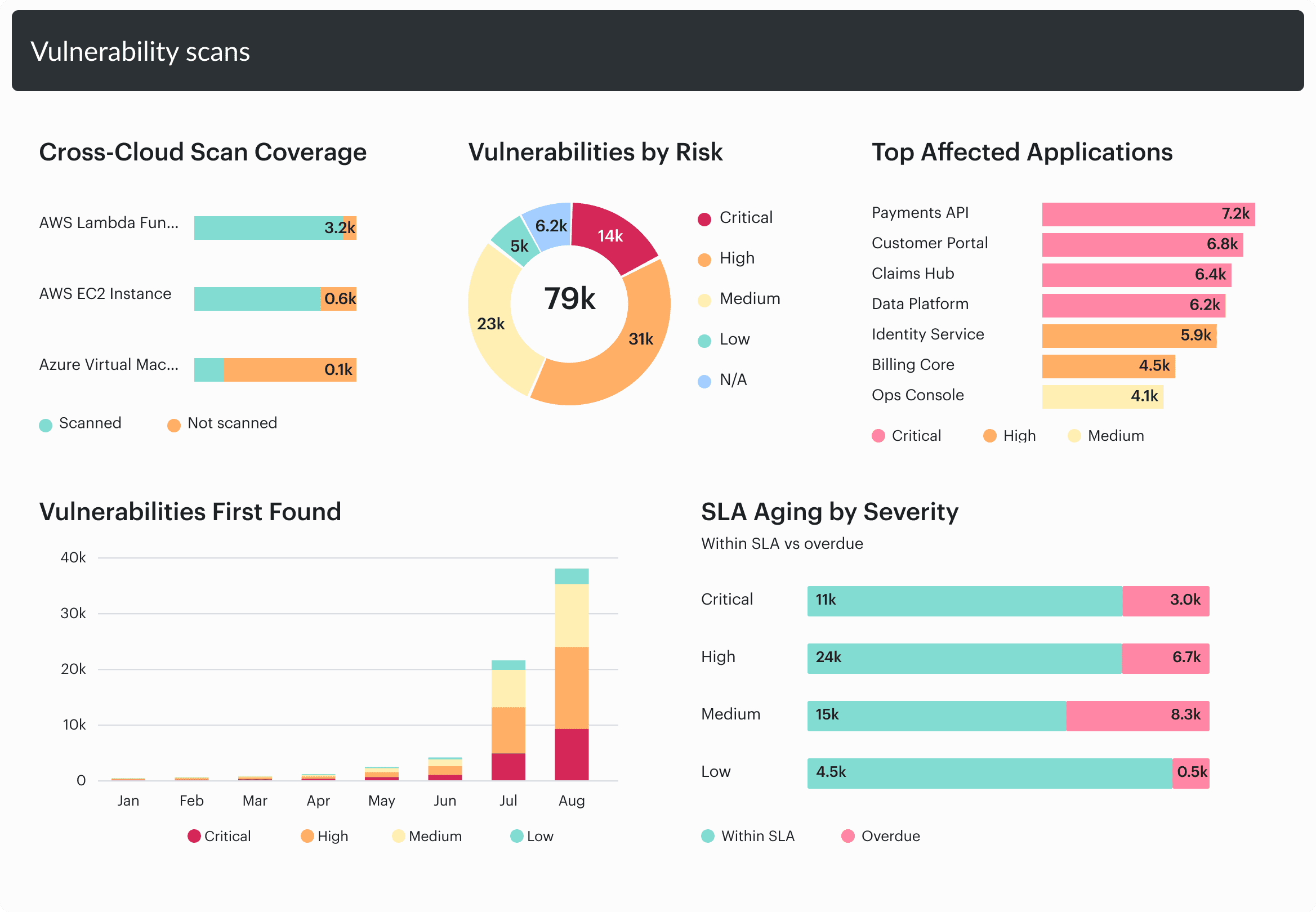 Scanned and unscanned assets across cloud environments. Coverage gaps reveal resources that may not meet the policy’s vulnerability assessment requirements.
Instead of looking only at scanner output, teams can see which in-scope resources are scanned and which are not, then narrow the view by account, platform, or date to investigate missing coverage.
Check remediation coverage, deadlines, and closure evidence
For each open finding, check the remediation owner, linked work, approved due date, and latest verification result. Use Cloudaware’s task and initiative view to inspect whether findings have valid remediation work attached. That view answers the coverage question; it does not establish verified closure.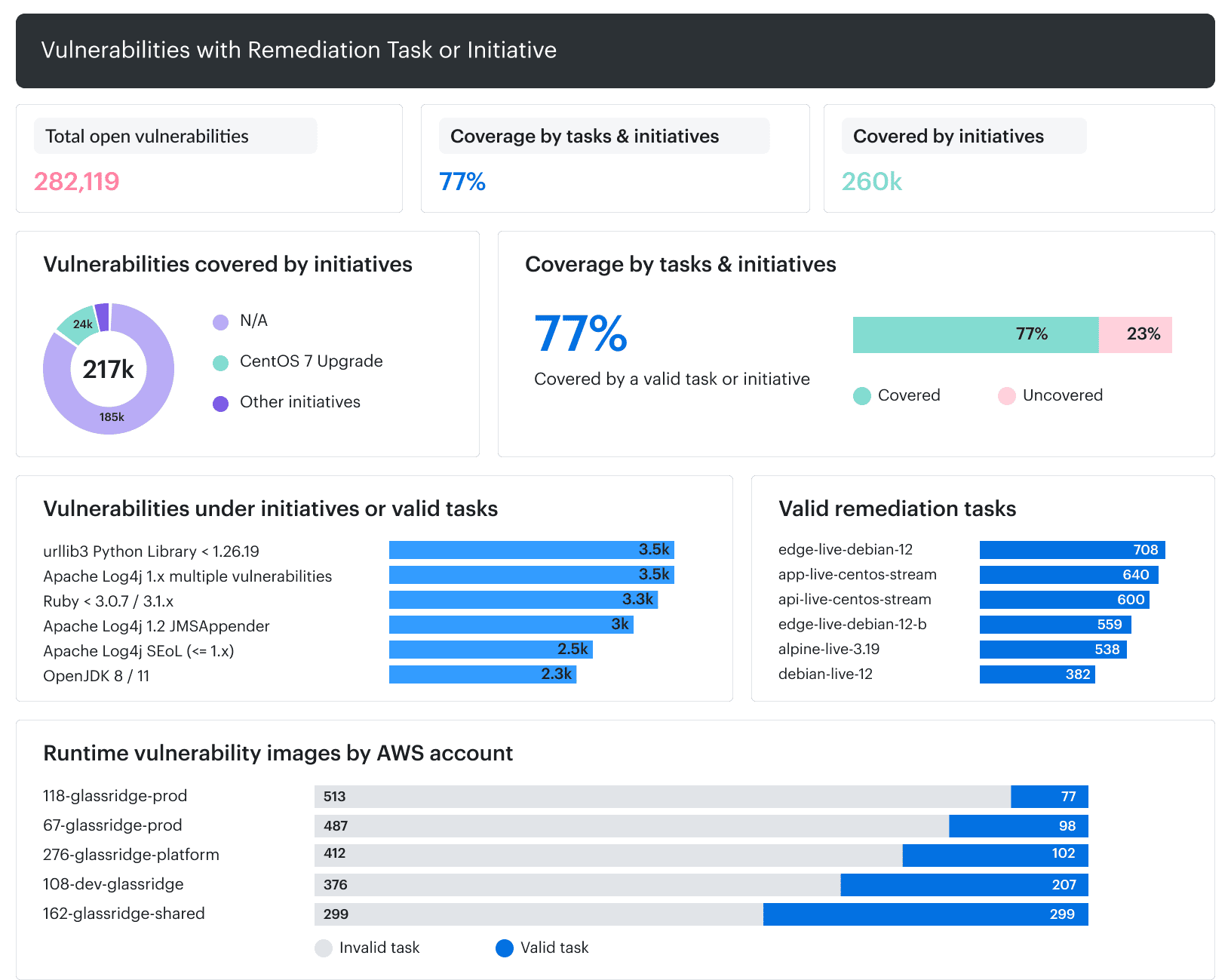 Remediation task and initiative coverage. A linked task establishes tracked work, not proof that the vulnerability has been removed
Review overdue findings in the SLA view and inspect the latest successful assessment before accepting closure. Cloudaware’s verification workflow can update finding status from rescan results, subject to the configured source and workflow. Investigate a completed Jira task if its related finding remains detectable or has no current verification evidence.
Review active and expired vulnerability exceptions
Finally, review the vulnerabilities that are not being remediated under the standard workflow because they are covered by an approved exception. Each exception should have a documented justification, accountable owner, approval record, compensating controls, and expiration date.
This is where many teams lose control. Exceptions are often tracked outside the core vulnerability workflow, which makes it difficult to tell whether accepted risk is still valid, whether approvals have expired, and which findings remain open under an exception.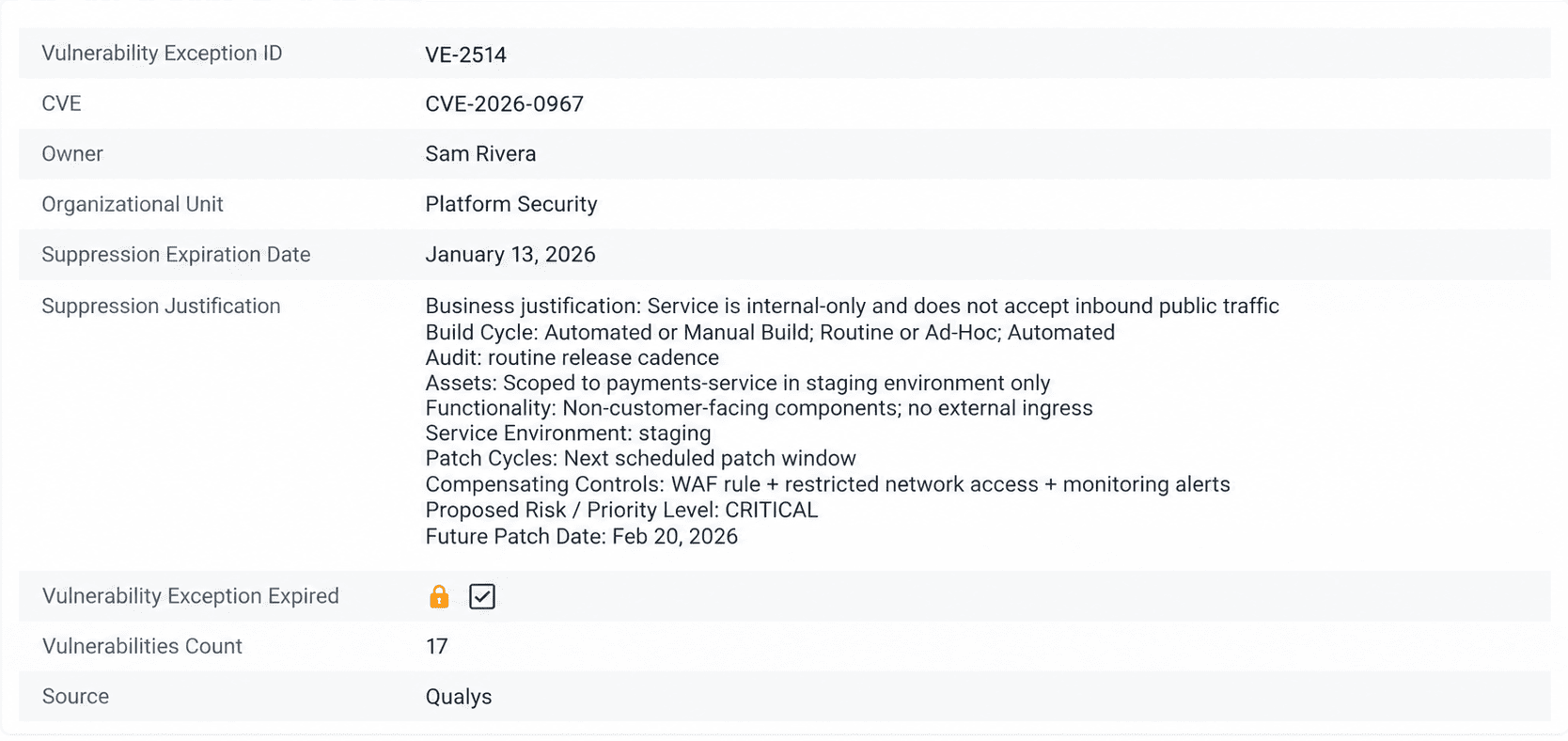 Vulnerability Exception records show which findings are covered by approved exceptions, who owns the decision, and when the approval must be reviewed or renewed.
Cloudaware allows security and risk teams to review accepted exposure separately from the remediation backlog and identify which exceptions are active, which are expiring, and which findings require renewed approval or corrective action.