


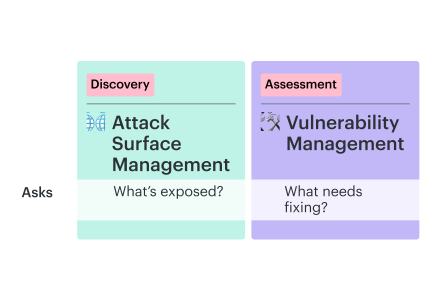
Attack surface management vs vulnerability management covers two connected jobs: ASM finds and shrinks what an attacker can reach, including unknown assets and shadow IT; VM identifies weaknesses, prioritizes remediation, and verifies fixes. ASM asks, "what's exposed?" while VM asks, "what's wrong, and how do we fix it?"
In the cloud, choosing ASM or VM can distract from the more dangerous gap between them: an exposed asset no scanner has ever targeted.
Suppose a development team launches a public test server outside the configured scan range. The scan can complete without ever touching it. A clean scan speaks only for its assessed scope. Assets discovery never added to the target list remain outside that evidence.
Before adding another tool, identify which gap you actually have: assets missing from assessment or assessed weaknesses nobody has resolved.
Key insights
- The scanner’s target list cannot serve as the sole denominator for estate-wide coverage: it excludes exactly the undiscovered assets you need to account for.
- On a public, business-critical service, reachability can raise a finding’s priority above a higher-scoring weakness behind verified access controls. Severity alone misses that distinction.
- When a newly discovered asset has no assessment or remediation path, it is visible but still unmanaged. A larger inventory is not evidence of reduced exposure.
- The convergence toward exposure management and continuous threat exposure management (CTEM) points to one program, not two purchases. Separate tools still need shared scope and remediation ownership.
Attack surface management vs vulnerability management: the core difference
ASM starts with exposure; VM starts with evidence of a weakness. In an ASM investigation, ownership and reachability come first. A VM investigation begins with the affected software or configuration and the treatment it needs. These are differences in emphasis; VM also uses discovery.
What attack surface management does
ASM starts by questioning the inventory: which reachable assets belong to your estate, and which are still unknown? Its scope includes known assets, shadow IT, cloud services, and third-party connections. For the external attack surface, outside-in checks establish exposure and possible attack vectors; cloud asset discovery reconciles findings with internal records.
For a public S3 bucket missing from inventory, the useful evidence is concrete: the owning account, permitted anonymous access, and business reason for that access. Restricting unnecessary public access reduces the attack surface without a software patch.
Modern ASM spans external attack surface management (EASM) and cyber asset attack surface management (CAASM), with both feeding exposure management.
What vulnerability management does
Once an asset enters the assessment scope, VM asks what needs fixing. Scanning identifies CVEs and configuration weaknesses; CVSS describes severity, while EPSS adds an exploitation-probability signal. Risk-based prioritization weighs exploitability and business context alongside CVSS.
On an already tracked EC2 instance, a vulnerable Log4j dependency points to application work: locate the affected package, deploy the fixed version, and reassess. Patching the operating system alone can leave that application dependency untouched.
Verified closure is the payoff of the vulnerability management process. Mean time to remediate (MTTR) tracks elapsed time from detection to verified remediation.
| Dimension | Attack surface management (ASM) | Vulnerability management (VM) |
|---|---|---|
| Core question | Which assets and paths are exposed? | Which weaknesses need fixing? |
| Starting point | Discovery, including unknown assets | Assessment of inventoried assets |
| Scope | Reachable assets, services, and third-party connections | Software and configuration weaknesses on assessed assets |
| Prioritizes by | Reachability, exposure, asset importance | Severity, exploitability, exposure, business context |
| Primary output | Reconciled inventory and exposure-reduction tasks | Prioritized findings and remediation tasks |
| Key metric | Discovery coverage; unresolved exposures | MTTR; remediation SLA attainment |
| Ends at | Verified removal or restriction of exposure | Verified remediation or mitigation |
Attack surface reduction vs vulnerability management
Attack surface reduction vs vulnerability management is a question of prevention versus repair: ASR reduces what an attacker can reach or use; VM fixes weaknesses in what must remain. Both help prevent exploitation, but they change different things.
Before assigning another patch ticket, check whether the service still needs to exist. To reduce attack surface, practical ASR work includes:
- Retiring unnecessary internet-facing services.
- Enforcing least privilege on workload identities.
- Closing ports that have no operational purpose.
- Decommissioning shadow assets after checking dependencies.
The business dependency decides which action makes sense. For example, an old marketing subdomain still points to an outdated cloud server after the campaign has ended. The owner confirms that no forms, redirects, or integrations depend on it. Retire the subdomain and decommission the server. That exposure disappears without patching the obsolete software.
Deleting DNS alone is insufficient: the server may remain reachable through its public IP. Check both the hostname and direct endpoint after retirement. This is where understanding cloud exposure paths changes the closure test.
If the server still collects leads or supports an active integration, removing it would break a business function. VM takes the repair path: scan the retained workload, identify applicable CVEs, patch affected components, verify the result, and monitor for recurring weaknesses. Unnecessary ports and permissions can still be removed while that work proceeds.
Here, ASR means the general security practice; Microsoft Defender ASR rules specifically harden endpoints by restricting risky software behavior.
In this comparison, EVM + ASR simply pairs enterprise vulnerability management (EVM) with surface reduction.
For attack surface reduction vs vulnerability management, the useful distinction is the evidence required to close the work: no reachable retired service, or a verified fix on the retained workload. Keep the owner’s retirement decision with the change record; a new deployment should not resurrect the old endpoint.
Do you need attack surface management, vulnerability management, or both?
If you can't say with confidence how many internet-facing assets you have, start with ASM. If you're drowning in CVEs you can't rank, start with risk-based VM. Mature programs run both as one loop.
VM is probably already running in your estate: scheduled scans and a remediation queue that grew out of compliance. For a team preparing PCI DSS evidence, those scans may already shape the week’s work. Keep that coverage running, even when discovery becomes the immediate priority.
After an acquisition, start with ASM. In this example, the acquired startup hands over an AWS organization, several GCP projects, and a domain list nobody trusts. Before VM can cover that inherited estate meaningfully, establish which accounts, services, and public endpoints now belong to the company. Keep scanning known assets, adding newly confirmed workloads to assessment as discovery progresses. Assessment need not wait for a perfect inventory. The same starting point applies when cloud sprawl or shadow IT makes the boundaries of a multi-cloud estate uncertain.
Reliable inventory, 5,000 findings? Start with risk-based VM. At another company, active workloads have owners and current assessment evidence, yet engineering cannot agree on next week’s fixes. Here, risk-based vulnerability management begins by grouping findings into distinct remediation jobs. Several scanner records may share one affected image or dependency; ranking them separately can obscure the actual fix. Prioritize those jobs by exploitable exposure and service impact. Otherwise, five tickets could compete for attention when one image rebuild would address them all. More discovery would not resolve that scheduling problem.
Continuous threat exposure management (CTEM) unites attack surface and vulnerability management within an exposure management program.
Exposure management vs vulnerability management (where ASM and VM are heading)
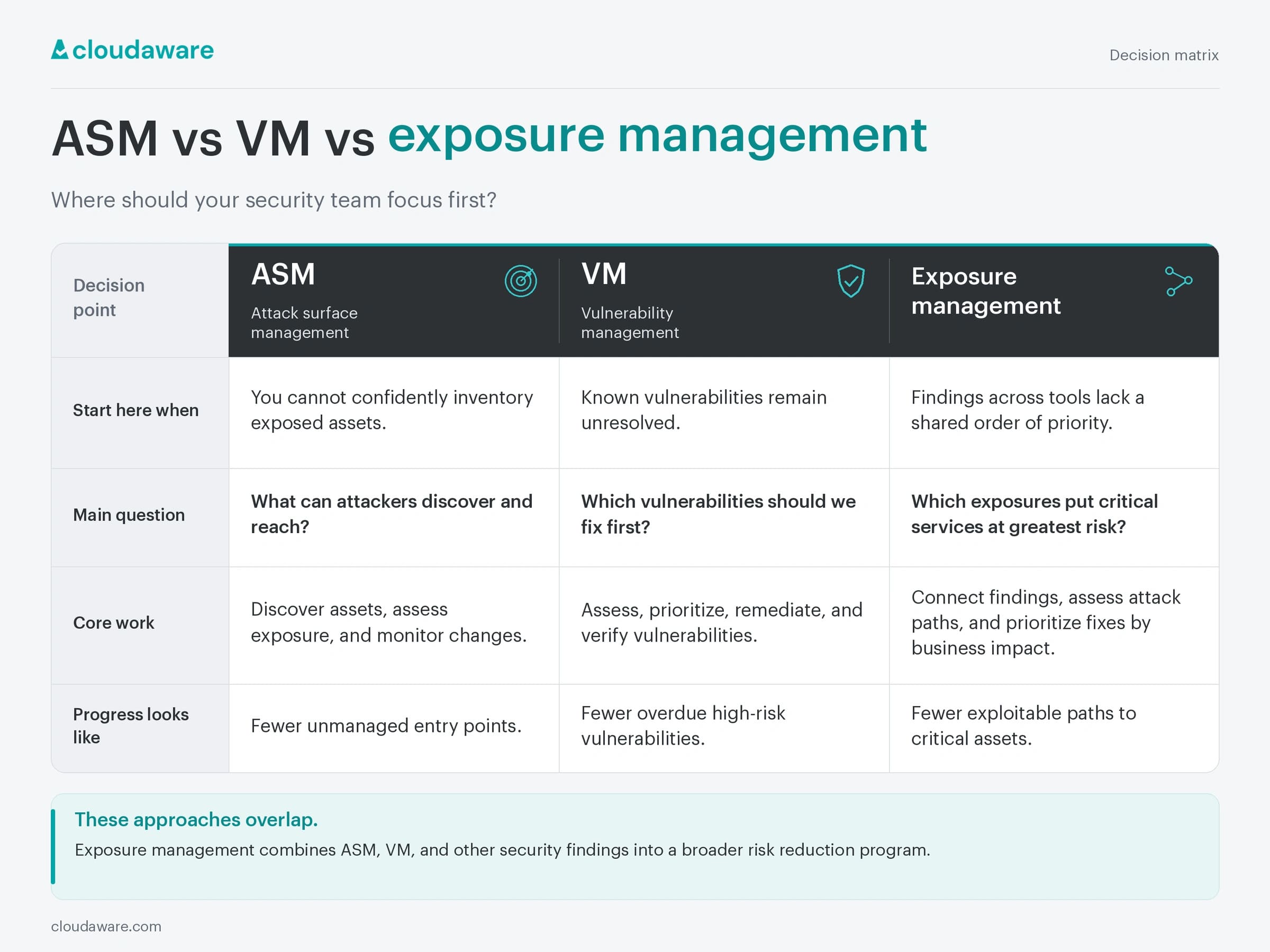
The real difference in exposure management vs vulnerability management is scope: VM manages weaknesses on assessed assets. Exposure management ranks those weaknesses alongside misconfigurations, reachable services, and identity paths by their potential business impact. Validation then checks which attack paths actually work.
You can have a scanner, CSPM, and inventory and still spend the meeting arguing over three queues. Before buying a fourth tool, get those reports into one queue. With CAASM pulling asset records from internal tools, the team can check which reports describe the same workload.
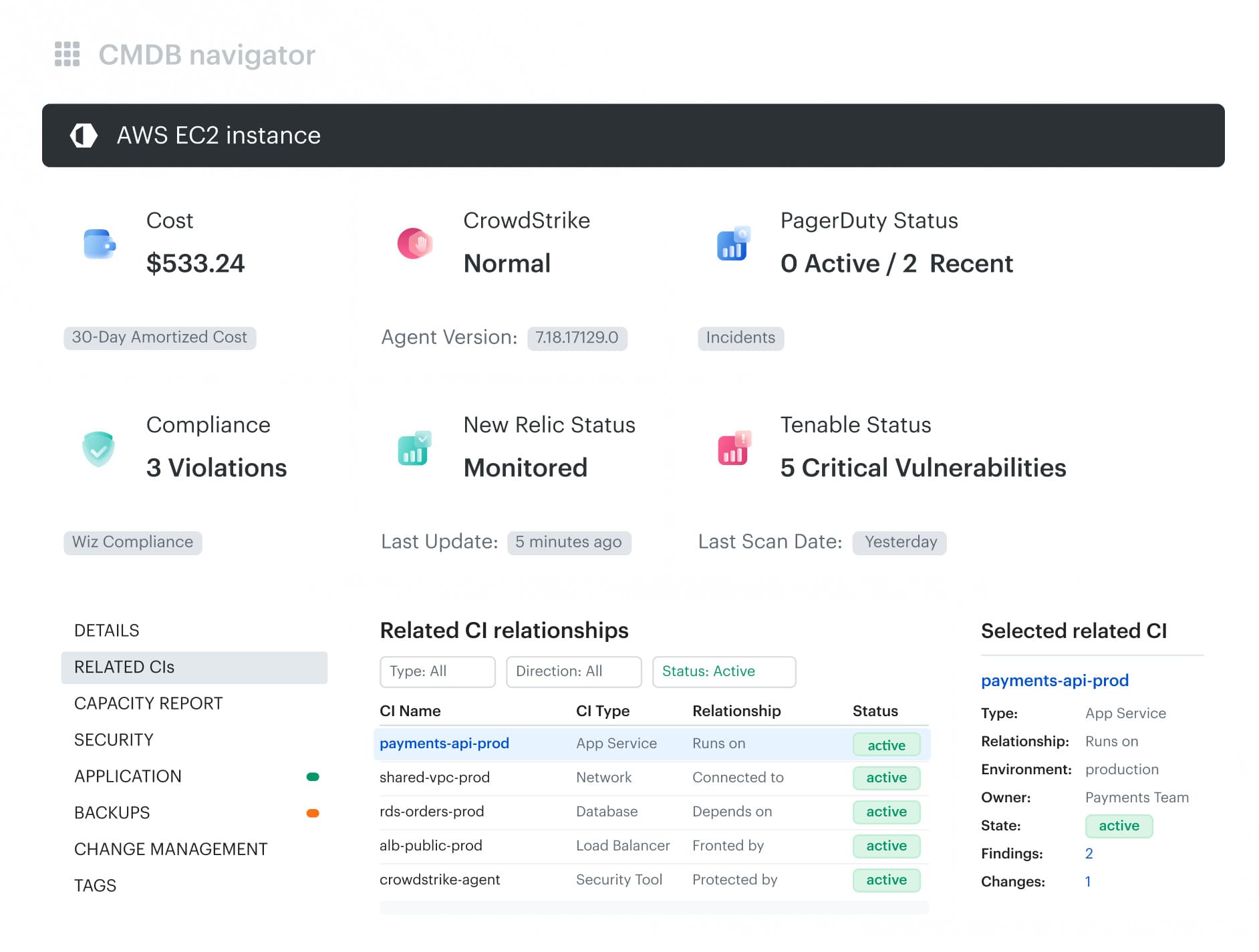
Review vulnerability findings, compliance signals, monitoring status, and related application records in one EC2 view.
In this illustrative queue, a patched EC2 instance has public SSH allowed from 0.0.0.0/0 by its security group. Its IAM role reads a production bucket. Elsewhere, the critical CVE belongs to an isolated internal worker.
How VM ranks it: CVE-only ranking puts the worker first, leaving the patched instance outside the findings queue.
How exposure management ranks it: Once validation confirms an exploitable SSH-to-bucket path, the instance moves to the top. Replace 0.0.0.0/0 with approved VPN/bastion ranges, and limit the role’s reads to required bucket prefixes.
Continuous threat exposure management (CTEM) runs Gartner’s cycle: scoping, discovery, prioritization, validation, and mobilization. Here, validation tests unauthorized SSH entry and effective bucket permissions, including whether existing controls block that route. That goes beyond a patch rescan: can an attacker actually reach the production data?
Valentin Kel, DevOps expert
How to run attack surface and vulnerability management together
When discovery finds a public dev instance, the ticket can lose its owner, account tag, and public-access flag. Two sprints pass while engineering works out whose instance it is and whether the exposure needs urgent action. Found, but still exposed.
In a vulnerability attack surface management workflow, engineers need the owner, account, exposure, and verification deadline in the ticket. Keeping those fields attached lets attack surface and vulnerability management route fixes to engineers and track overdue verification. The four practices draw on Cloudaware’s team experience (Igor Kachurin and Valentin Kel.), pairing approaches with cloud examples.
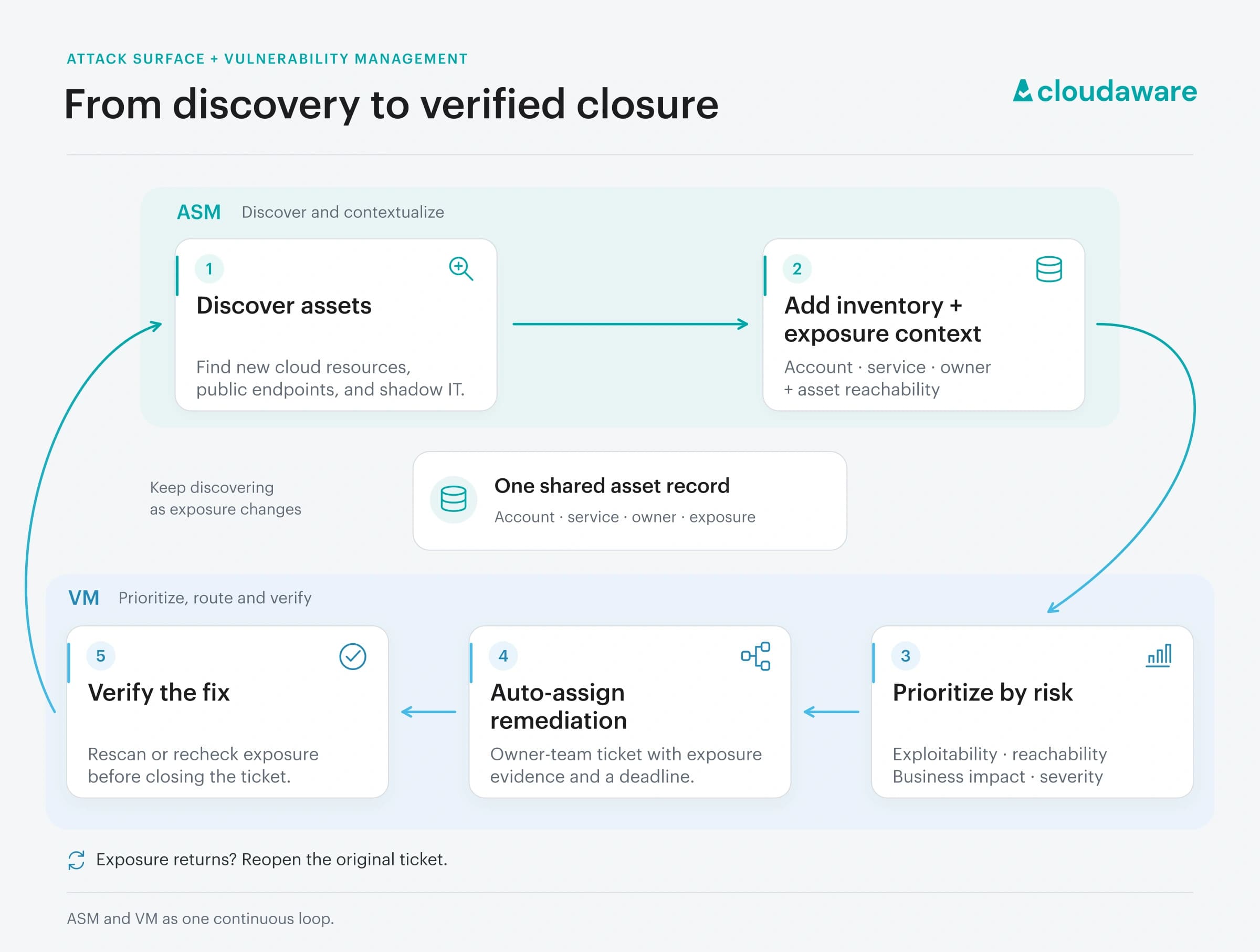
ASM and VM as one continuous loop.
1. Work from one shared asset inventory
On a cluster using public load balancers, a Kubernetes Service with type=LoadBalancer can create an internet-facing endpoint. If its IP falls outside the scanner’s static ranges, the endpoint never enters the VM’s target list. Public, but outside scope.
That gap closes when scan scope follows the CMDB inventory that asset discovery keeps current, including newly discovered shadow IT. Account and tag selections make that inventory the single source of truth for coverage, rather than another manually copied list. Below, the account column puts assets without recent scan evidence back into their cloud context.
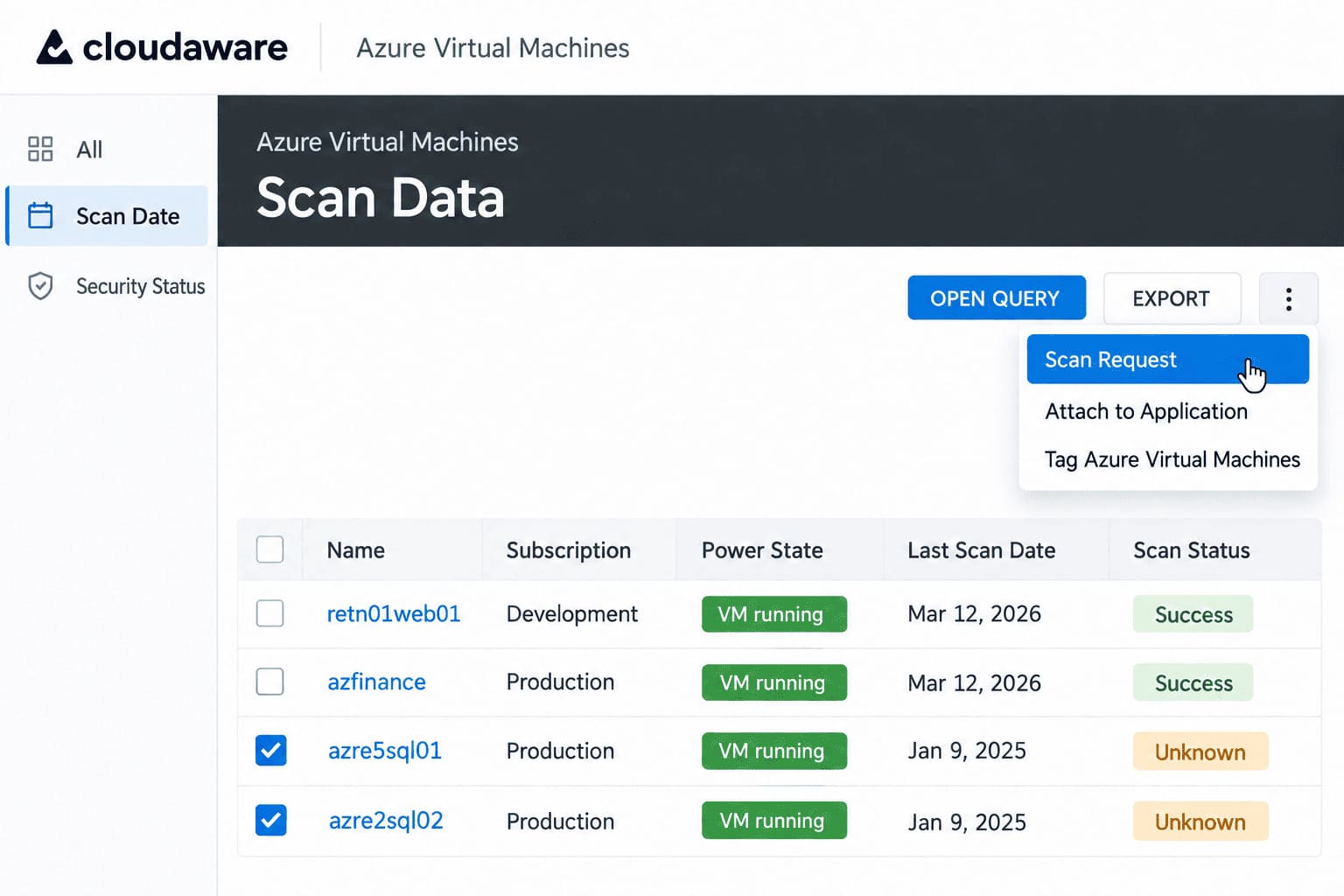
Use asset names, subscriptions, and last scan dates to investigate assessment gaps.
The first decision is whether the scanner needs new targets or its data feed needs repair. Before adding a target, confirm that ingestion is current; a missing timestamp can reflect a delayed import. Each asset class needs an appropriate assessment source; a node scan does not establish coverage of the public endpoint.
Weekly check: Review active inventory assets without a recent assessment, using their required scan intervals to flag gaps.
Igor Kachurin, DevOps expert
2. Prioritize by exposure, not just CVSS
Your maintenance window has room for one fix, so sorting by CVSS can send engineering to the wrong service. The score needs context.
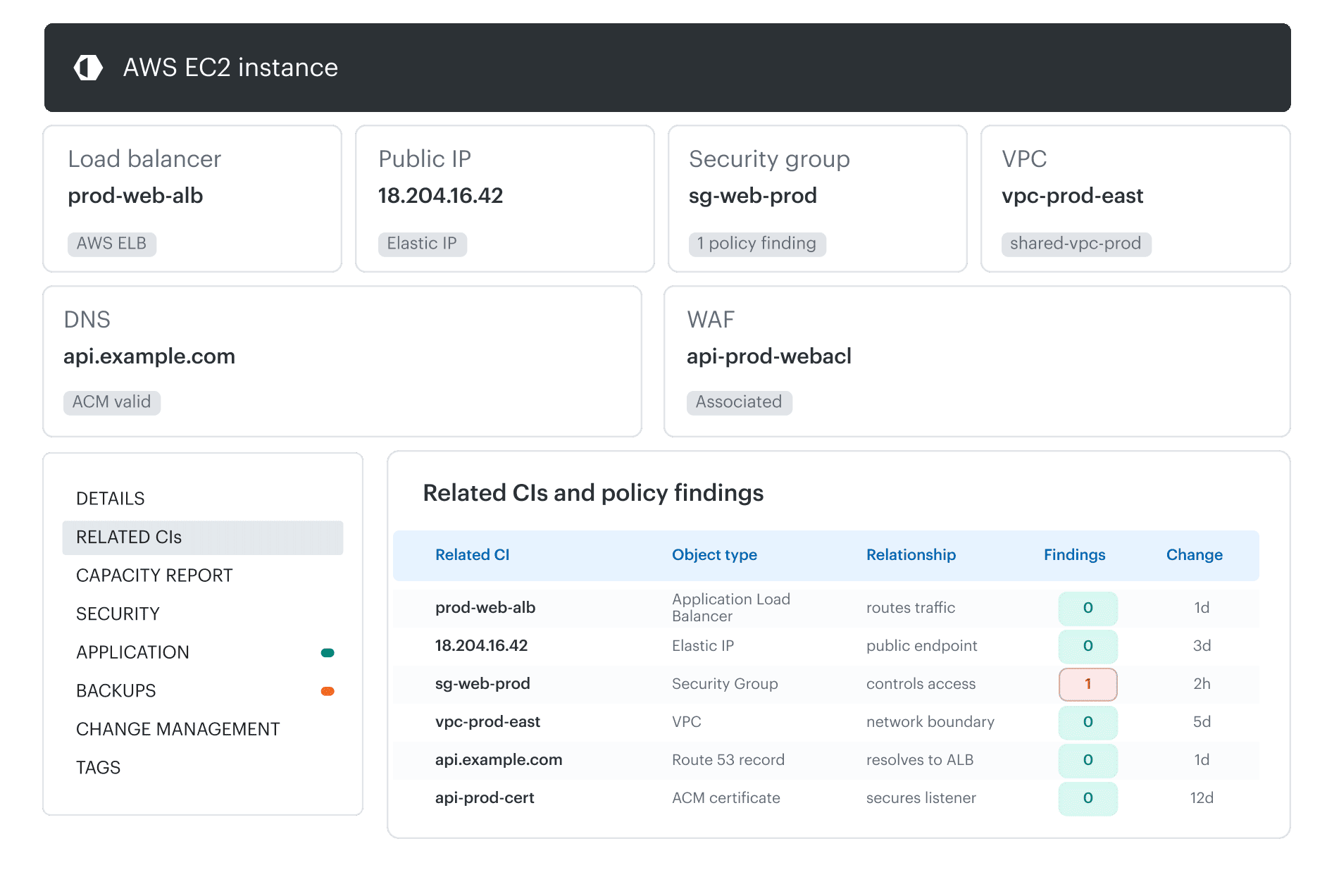
Inspect the public IP, load balancer, security group, and WAF before deciding what is reachable.
In this illustrative review, the batch host’s CVSS 9.8 has already secured the maintenance slot. Then someone opens the payment API’s base-image findings: there’s a 6.5 listed in CISA’s KEV catalog. The API is internet-facing; the batch host has inbound access blocked.
That’s where risk-based prioritization earns its keep: exposure can overturn a schedule built around severity alone.
- Exploitability: If the API’s CVE is in KEV, move it up for review. For unlisted CVEs, FIRST’s EPSS helps compare exploitation likelihood.
- Reachability: Can internet traffic actually get to the vulnerable library? Public DNS doesn’t settle it; a WAF rule can drop that exact path upstream.
- Business context: Then look at what the API touches. A prod tag plus payment data is why it jumps the queue. But ask the image owner about the rebuild; triage rarely controls that image.
- CVSS: If those checks still leave you torn, let CVSS decide which finding goes first.
Keep the batch host’s patch deadline. With that route confirmed, the internet-facing API gets the first rebuild slot, assigned to its owner.
Valentin Kel, DevOps expert
3. Close the discovery-to-remediation loop in one workflow
Who checks the instance after its ticket says “Resolved”? Decide that before the first ticket exists; below, the owner, status, and ticket link should already be visible.
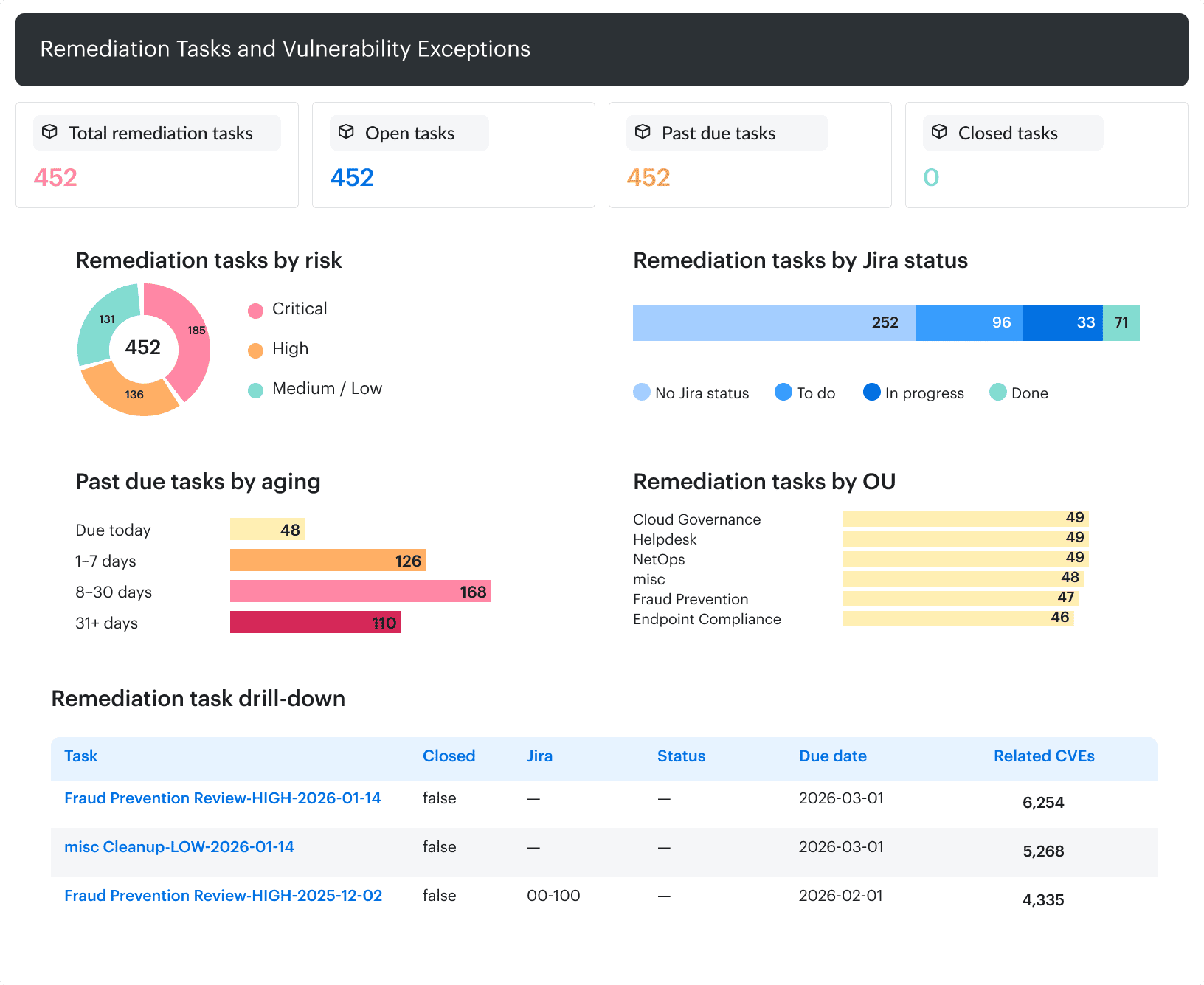
Review remediation tasks by risk, overdue age, organizational unit, and Jira status.
In this illustrative setup, discovery picks up a new production analytics instance with an exposed administrative endpoint. Once exposure meets your risk criteria, automated task assignment uses CMDB cloud-account, tag, and service mappings to resolve ownership. With the integration configured, Cloudaware creates the Jira or ServiceNow ticket in that team’s queue.
One illustrative routing rule, not product syntax:
public exposure + prod tag → Jira P1 → CMDB owner-team queue → SLA 72h
The 72-hour target is your policy choice; a comparable internal instance gets a longer window.
After the fix, a rescan or exposure check must confirm the administrative endpoint is no longer exposed. Only then can the ticket close. If the endpoint becomes exposed again, your workflow should reopen the same ticket for its owner instead of creating another.
For MTTR, use the exposure’s first-seen discovery timestamp, ending at verified closure. Otherwise, a Friday discovery and Monday ticket make three exposed days disappear from the metric.
Igor Kachurin, DevOps expert
4. Measure coverage as your attack-surface metric
After a reorg, overall coverage can hide transferred prod workloads still waiting for assessment. Below, prod gets its own line.
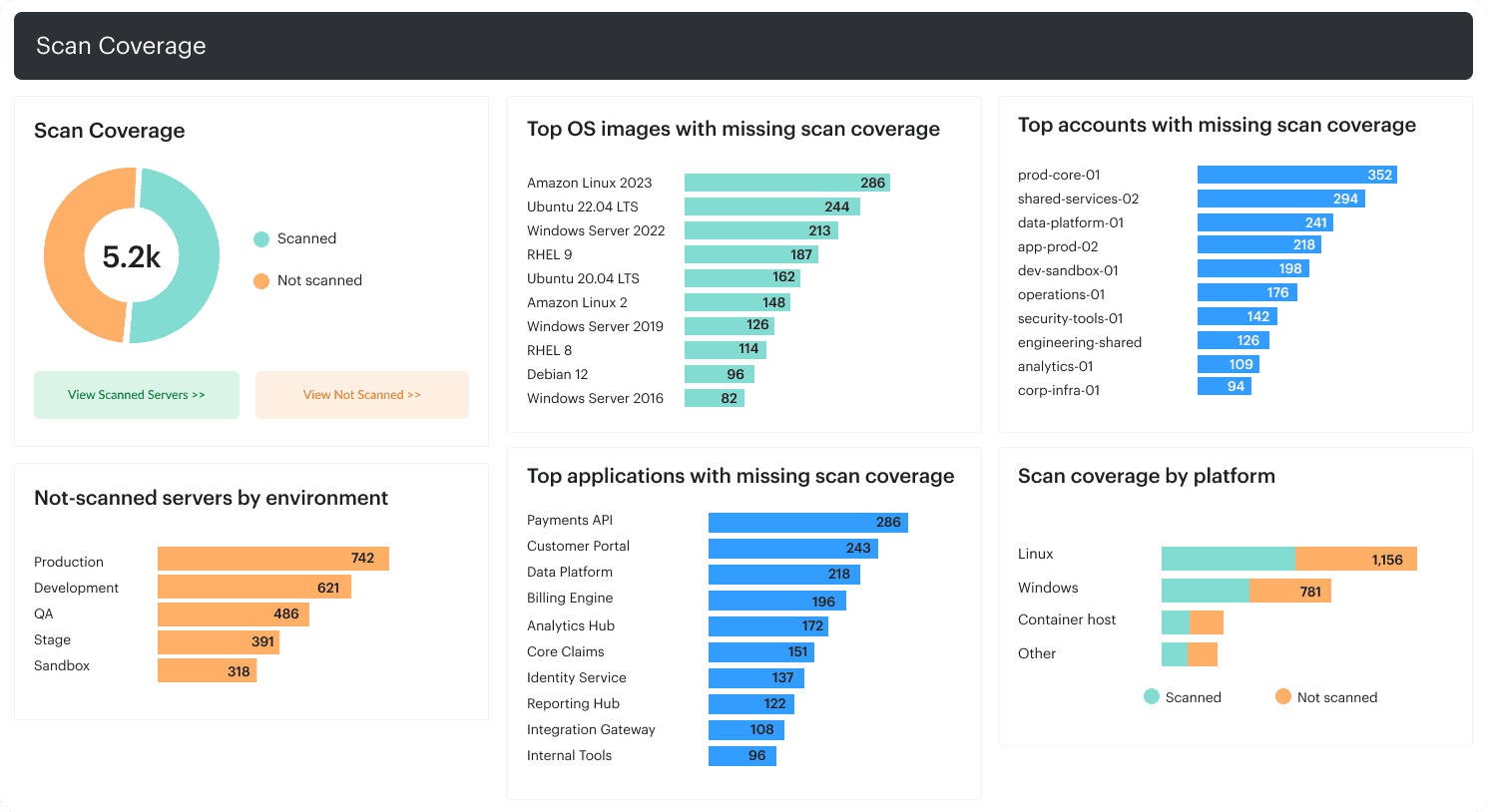
Break down the unscanned backlog by environment, account, application, and platform.
Change asset classes between snapshots and these metrics compare different populations; overdue scans shouldn’t count as current assessments.
| Metric | How to calculate | Healthy signal |
|---|---|---|
| Scan coverage | Currently assessed assets ÷ inventory assets × 100, by cloud account/environment | Unscanned counts fall toward zero within each cohort |
| Time-to-first-assessment | First assessment − discovery timestamp; for waiting assets, measure elapsed time to now | Fewer new assets wait past the assessment deadline |
| Vulnerability age | Now − first seen, for open findings on internet-facing assets | Fewer ageing findings exceed their risk-based SLA |
The example of the reorg report goes upstairs with 94% coverage: 900 established assets assessed, plus 40 in the transferred account. That prod account has 100 assets. Monday starts with that account’s 60 unassessed records and the owner who can fix onboarding.
Unknown assets, discovered but unreconciled, and unscanned backlogs need to shrink across snapshots. Zero alone proves neither complete discovery nor attack surface reduction.
Put the affected assets and remediation status behind each trend, so the team can move from a percentage to work.
Unify attack surface visibility and vulnerability management with Cloudaware
The loop above becomes easier to run when a finding carries its cloud account, service, owner, and remediation status. Cloudaware vulnerability management connects scanner findings with CMDB relationships, so the vulnerability manager can follow that record into assigned work.
Filtering public prod findings by application and checking ticket states separates scheduled fixes from work that has not yet started. The linked records answer three different operational questions:
- Priority: Why is this finding near the top? The row answers it: public exposure, a misconfiguration or malware signal, and how much the service matters.
- Ownership: A ticket that has sat for a week may have gone to the wrong team. Status plus the assigned team tells you who to call.
- Coverage: Watch for accounts where assessment timestamps go stale. It could be a new account nobody onboarded.
The overview below keeps those decisions attached to the findings.
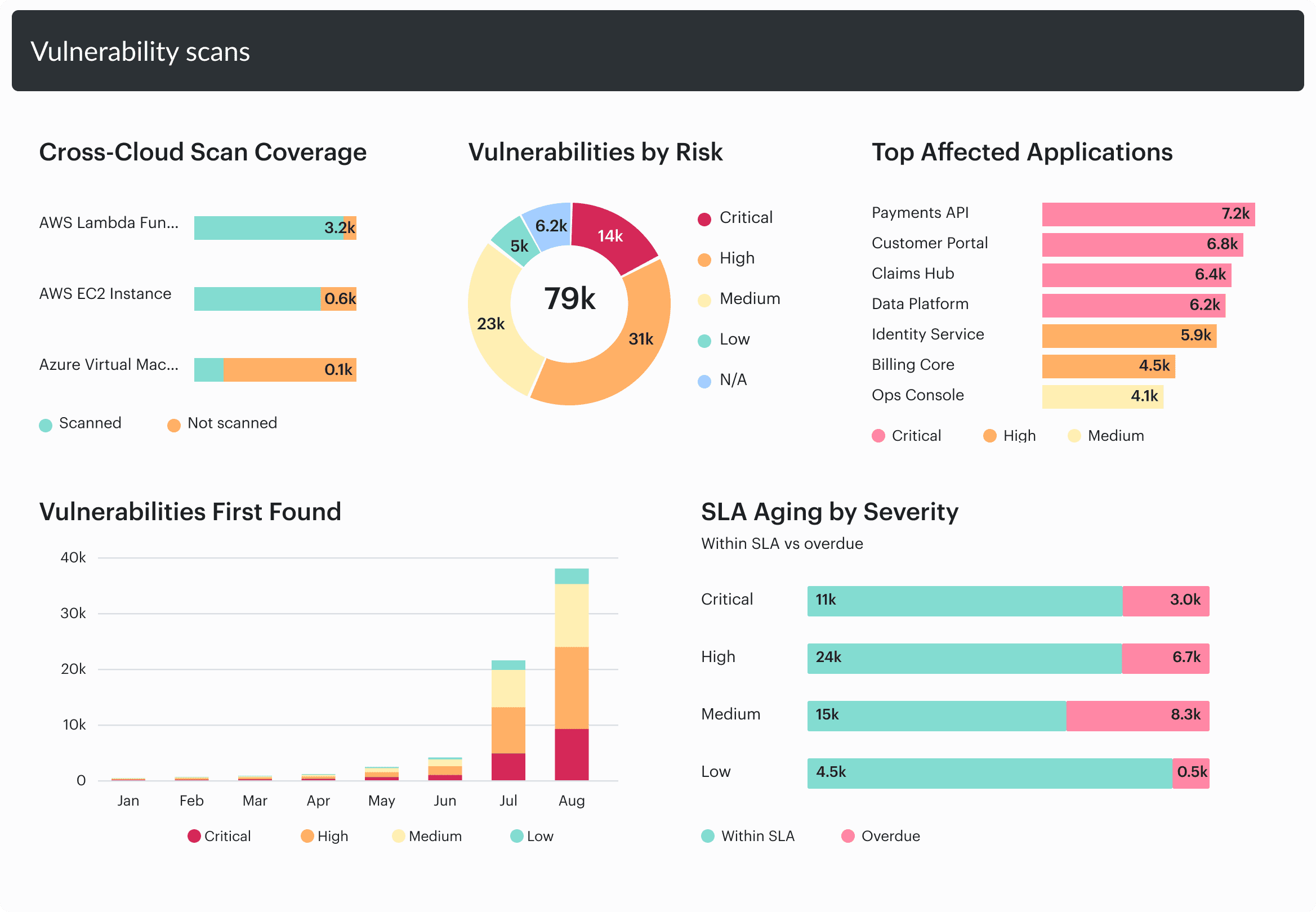
Review scan coverage, affected applications, risk, and SLA aging together.
On a high-priority row, compare exposure context with the assigned owner; the ticket shows whether work has started. Those linked records support the daily work of risk-based vulnerability management through four capabilities:
- Discovery: API-based continuous discovery across connected multi-cloud sources updates known assets and surfaces unknown or shadow-IT resources for reconciliation.
- Configuration evidence: The CSPM module’s misconfiguration checks produce asset-linked violations, giving owners the failed configuration to inspect.
- Routing: Tickets land in the owning team’s ServiceNow, Jira, or PagerDuty queue with the asset and risk context already attached. Once routing rules exist, CMDB ownership decides whose queue that is.
- Assessment: Continuous scans run as often as every 15 minutes, with agent-based and agentless options.
Cloudaware combines cloud-side ASM inputs with VM, complementing a separate outside-in EASM tool for attacker reconnaissance. Your scanner and ticketing system remain in the workflow.