


Here's the number I'd open a budget meeting with: in the 2026 Verizon DBIR, 31% of breaches with a known entry point started with an exploited vulnerability. That alone explains most of the importance of vulnerability assessment. Finding a flaw is only one part of it, though. A known gap can still sit open. Only 26% of known exploited vulnerability cases in Verizon's remediation sample were fully remediated. The median from detection to full remediation was 43 days.
IBM, meanwhile, puts the average global breach cost at $4.99 million.
Picture a customer portal you picked up in an acquisition. It's been taking orders for months, and this week its servers finally land in your scan scope. What does the first scan find? An end-of-life web server, still handling checkout traffic.
What follows is how Cloudaware's Igor Kachurin and Valentin Kel make this case: six reasons why vulnerability assessment matters, each with a stat, a cloud example, and what skipping it costs. Take them straight into your next conversation about risk reduction and budget.
TL;DR
A vulnerability assessment is how you find out which known weaknesses are sitting in your systems and cloud accounts right now. Its purpose is simple: find them, rank them, and get the riskiest ones fixed before attackers use them.
Why bother? In the 2026 Verizon DBIR, exploitation was behind 31% of known breach entry points, and the median time to fully remediate a known exploited vulnerability was 43 days.
IBM's 2026 report puts the average global breach cost at $4.99M.
The benefits of vulnerability assessment:
- Catch exploitable flaws first, instead of hearing about them from incident response.
- Reduce seven-figure breach exposure. One exploited flaw on a revenue service can stop orders for days.
- Focus effort by risk, so scarce change windows go to the fixes that matter.
- Map the full attack surface. An asset nobody scanned is a risk nobody measured.
- Support audits. PCI DSS, ISO 27001, SOC 2, and HIPAA reviewers all ask for evidence.
- Prove risk is falling. Ticket counts won't convince a board; a trend will.
See how to run a vulnerability assessment.
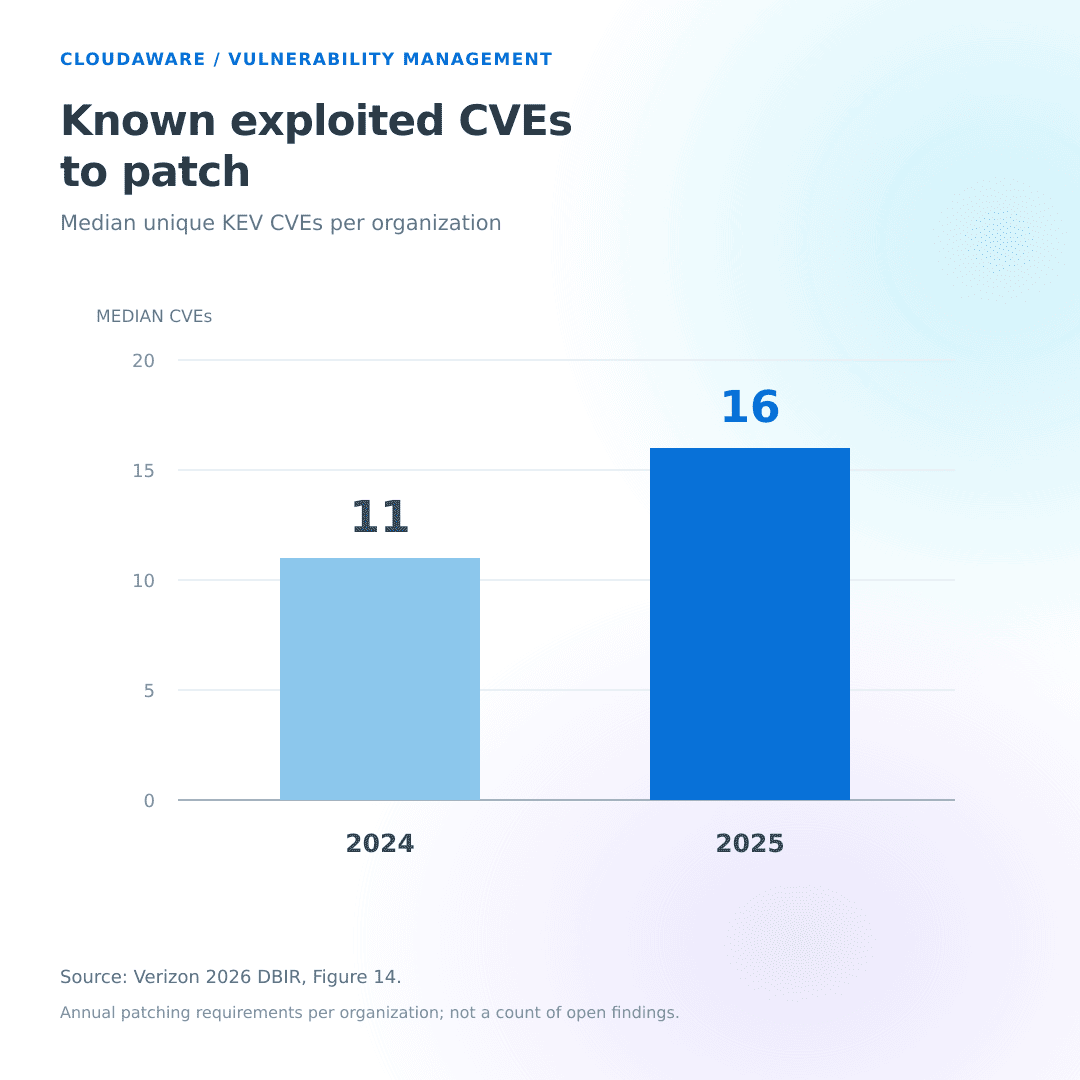
Median unique known exploited CVEs requiring patches per organization: 11 in 2024 and 16 in 2025. Source: Verizon 2026 DBIR, Figure 14.
What a vulnerability assessment is, and its purpose
Short version: a vulnerability assessment checks the systems you've put in scope for known weaknesses and hands back a ranked list, with each finding tied to an asset and an owner. Raw scan output doesn't count. The purpose of vulnerability assessment is to show you where your security posture is weakest while there’s still time to act. You can't defend a gap you haven't found.
Say a scan flags a vulnerable library in the billing API. The CVE names the flaw, and base CVSS rates how bad it is in general. The asset inventory helps you identify who owns that API and which team can patch it. So the objective of vulnerability assessment isn't a longer report. It's a finding the responsible team can carry into this week's change review.
“A ten-thousand-line scan export doesn't help anyone. What gets fixed is the short list where every finding already has an owner, a deadline, and a reason it beats everything else in the queue. That's what I'd call an assessment.”


| Practice | Question | Cadence | Output |
|---|---|---|---|
| Vulnerability assessment | What needs attention first? | Recurring and after relevant changes | Ranked, assigned findings |
| Penetration test | What impact can a tester demonstrate? | Scheduled by risk and scope | Test evidence and demonstrated impact |
| Vulnerability management | What happened to the finding? | Ongoing | Verified fixes and tracked exceptions |
A penetration test is the deeper, narrower cousin. The vulnerability management lifecycle carries the finding through to closure.
For the step-by-step, see how to run a vulnerability assessment.
Why vulnerability assessment matters: the benefits
Each reason below follows the same pattern, because that's how budget conversations actually go. What do you get? What's the number behind it? What does it look like in a real cloud account? And what does skipping it cost? Here are six benefits of vulnerability assessment, in the order I'd present them.
Find and fix exploitable weaknesses before attackers do
The first benefit is the obvious one: assessment can show you which exploitable weaknesses are live in your environment while you still have time to close them. The clock is shorter than most teams assume, though. For 17 edge-device flaws in the 2025 Verizon DBIR, the median time between a CVE going public and landing in CISA's Known Exploited Vulnerabilities (KEV) catalog was zero days. Full remediation of edge flaws took a median of 32 days. A team waiting on its next scheduled scan can already be behind.
The cloud makes this trickier. Picture a managed load balancer with a standard public HTTPS listener, forwarding customer traffic to a reverse proxy running a vulnerable version. The proxy has no public IP, so it looks internal. It isn't. It became part of your attack surface the moment the listener went live.
Illustrative timeline
- Monday — CVE disclosed.
- Monday — Exploit activity reported elsewhere.
- Friday — Scheduled scan confirms the affected proxy.
- Next Tuesday — Patch window closes, fix verified.
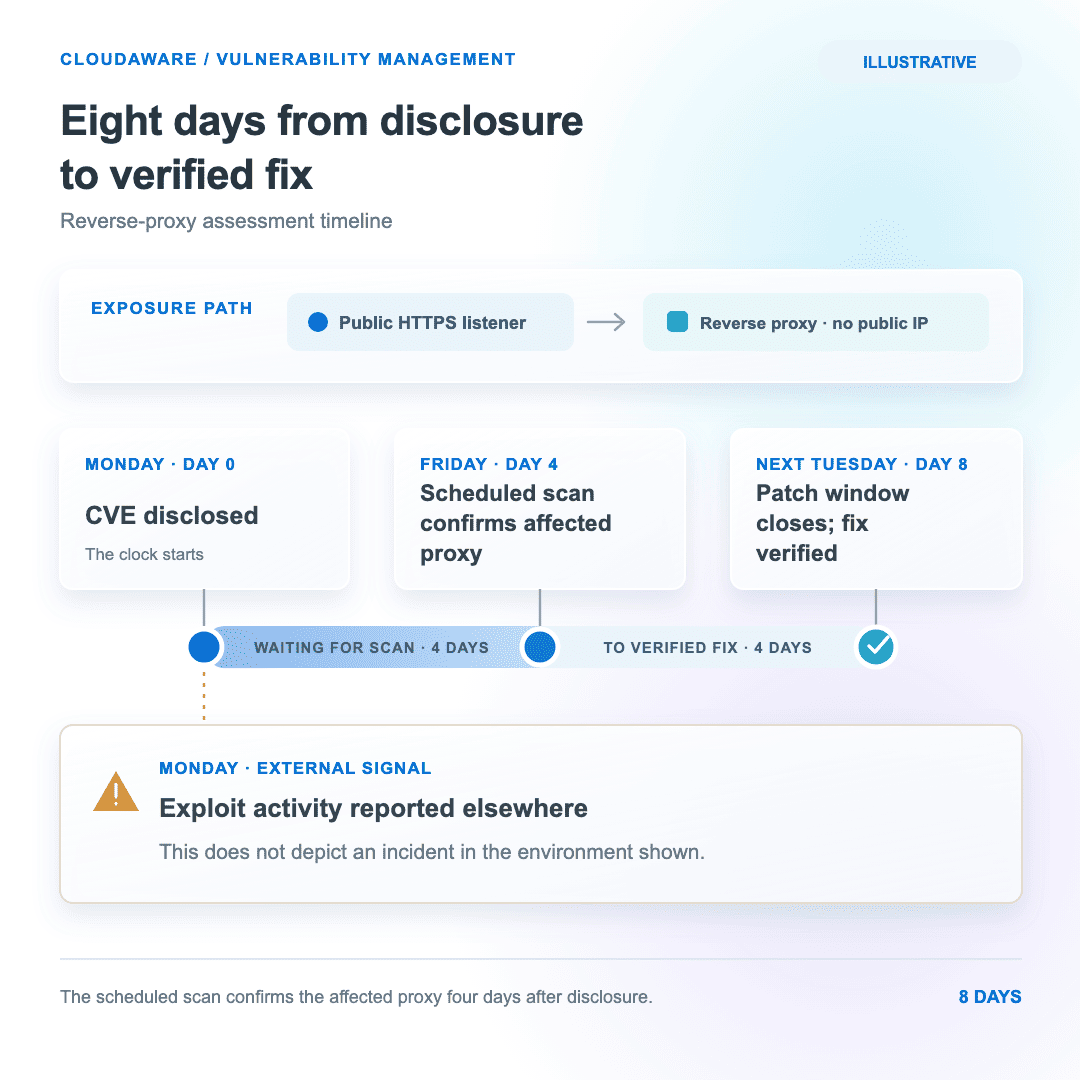
Eight days, four of them spent waiting for a scan. I'd bring in the service owner as soon as the advisory maps to that proxy, before Friday's scan. Wait, and a planned upgrade can turn into an emergency change on a live checkout path.
“People treat the patch as the only fix, and it's rarely the fastest one. If the advisory lands Monday and the patch window is next Tuesday, you can still pull the listener, isolate the workload, or put a WAF rule in front of it that same afternoon. Assessment is what tells you that afternoon matters.”

One practical test when you compare vulnerability assessment tools: ask whether they can see the workload behind the public listener or only the listener itself.
Avoid the seven-figure cost of a breach
In plain money terms, the benefit is simple: closing an exploitable gap before it's used can spare you the cost of an incident. And breaches get expensive. IBM's 2026 study puts the U.S. average breach cost at $11.5 million. Across the study, it took 247 days on average to identify and contain a breach.
In Sophos's 2025 survey, respondents attributed 32% of reported ransomware attacks to exploited vulnerabilities.
Averages don't win budget meetings, though. A believable number for one of your own services does. So here's the version where nobody looked.
A cloud storage bucket behind a paid document-delivery service is publicly readable, and it holds regulated files. Someone finds it before you do. The team confirms unauthorized access and pauses the service for eight hours to contain it.
Illustrative cost for one service
- Lost sales — 8 hours × $6,000/hour = $48,000 (only sales you won't win back).
- Incident response, forensics, containment — $35,000.
- Customer notifications, if required — $12,000.
- Total — About $95,000.
That's five figures, and that's fine. Seven-figure averages start as five-figure services nobody checked. Leadership believes it because it's theirs. I'd have Finance check the hourly number before it goes on a slide, then put the assessment budget right next to it.
“Everyone counts the response vendor's invoice. Almost nobody counts what the platform team dropped to get the service back. The release that slipped a week, the migration that got paused, that cost lands on somebody else's calendar, and it's usually bigger than the invoice.”
Focus scarce security effort where it cuts the most risk
With one patch window, I'd spend it on whichever fix removes the most immediate risk to the business. The highest score is one piece of that decision. In its 2026 Vulnpocalypse Report, Root Evidence found documented exploitation in the wild for 1.48% of the 253,912 CVEs it analyzed, covering disclosures from January 1, 2018, through July 15, 2026. Evidence of exploitation gives you a way to narrow a raw queue.
Finding that slice takes more than one signal. KEV tells you a flaw has been exploited in the wild. FIRST's EPSS estimates the chance that someone will observe exploitation in the wild over the next 30 days. Neither knows your network, though.
Reachability and data sensitivity add that business context, and that's what risk-based prioritization actually means in practice.
Two illustrative findings competing for one patch window
| Finding A | Finding B |
|---|---|
| Medium CVSS on a public support API | Critical CVSS on an isolated build machine |
| KEV-listed | Low EPSS, no observed exploitation |
| Vulnerable component reachable, API reads sensitive customer records | Restricted network access, no release credentials |
| Customer Platform owns the fix | Build Engineering owns the fix |
| Fix first | Keep scheduled while isolation holds |
On paper, B looks scarier. In practice, A is the one an attacker can reach today, and it reads customer records. When you analyze each finding, ask what would flip the order. A new network route to that build machine could change the call. Until then, patching B first just leaves the public API open for another change window. That's the cost of skipping this step: the team stays busy while the real exposure waits.
“A component CVE with no owner is a rumor. Nobody fixes rumors. The test I use is simple: does the team named on the ticket recognize the application, and do they accept the work? If they don't, the finding isn't prioritized yet, no matter what the score says.”
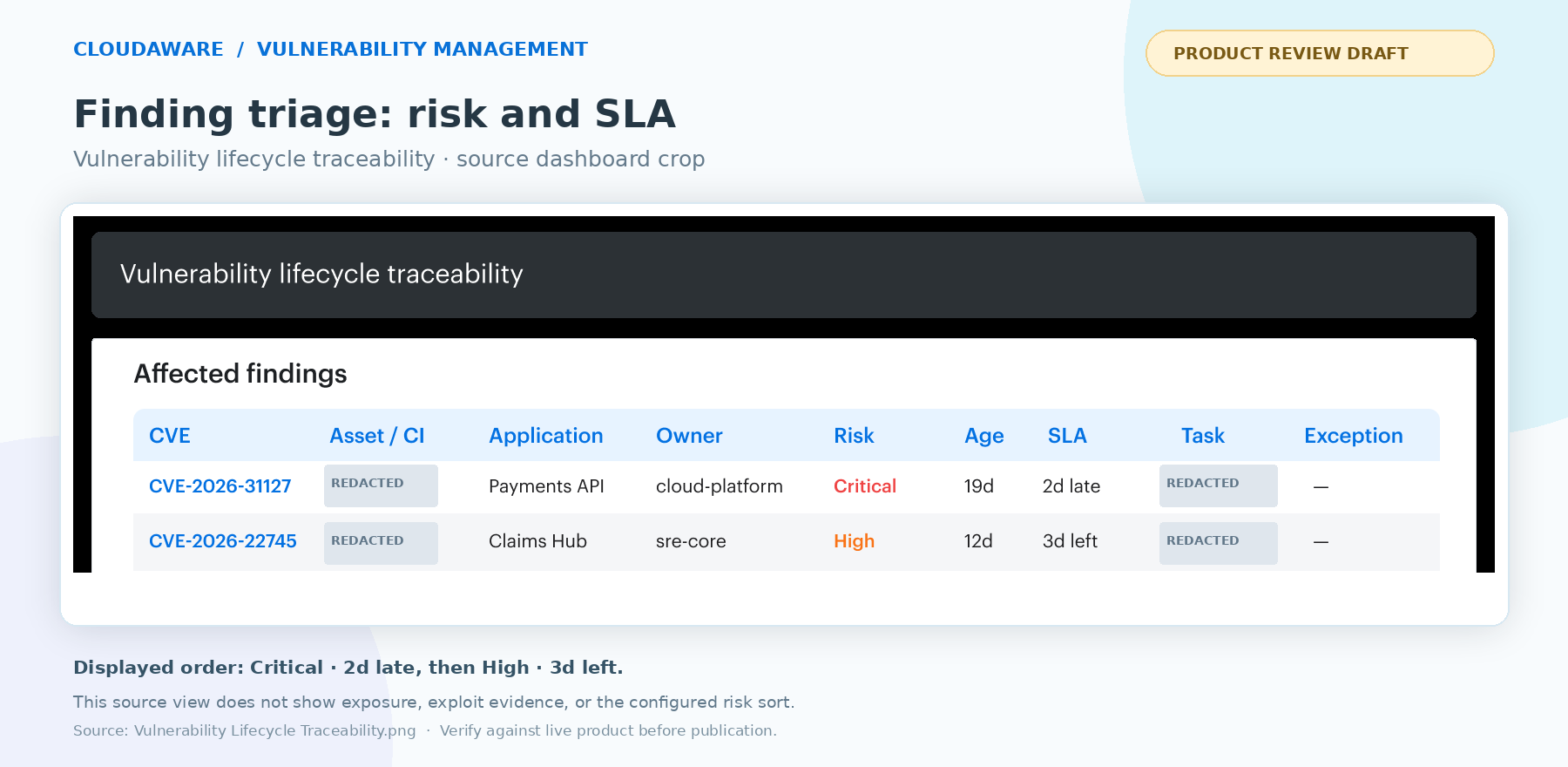
Figure V-2. Cloudaware Vulnerability lifecycle traceability: a Critical finding 2 days past SLA appears above a High finding with 3 days left. Asset and task IDs are redacted.
Download the free PDF of the vulnerability assessment checklist
Get my pdf
See your real attack surface — with no blind spots
Pair vulnerability assessment with current asset discovery and you can see which running workloads have no scan evidence. That matters in a cloud estate that changes between scans. The assets I'd look for first aren't hidden. They're short-lived, freshly acquired, or forgotten.
- Autoscaling fleets. A clean base image proves little if workers pull packages at boot. What ran in production can differ from what got scanned.
- Accounts still being onboarded. An acquired AWS account or a new Azure subscription can host production workloads before it shows up in the central asset inventory.
- Shadow assets. Someone spins up a demo in a project account and moves on. Months later, a stray DNS record may be the first sign it's still live.
Take an illustrative coverage review. A video-processing fleet adds six workers for an afternoon upload spike, and two hours later they're gone. The midnight scan covers every VM still running. AWS scaling history lists six terminated instance IDs, and not one of them has a scan record. For those two hours, the team has no scan evidence of what they ran.
That's the gap I'd raise in any cloud vulnerability management review. Keep terminated workers in the CMDB's coverage history, and check what continuous assessment caught while they were alive. If the answer is nothing, those workers belong in the report as unassessed.
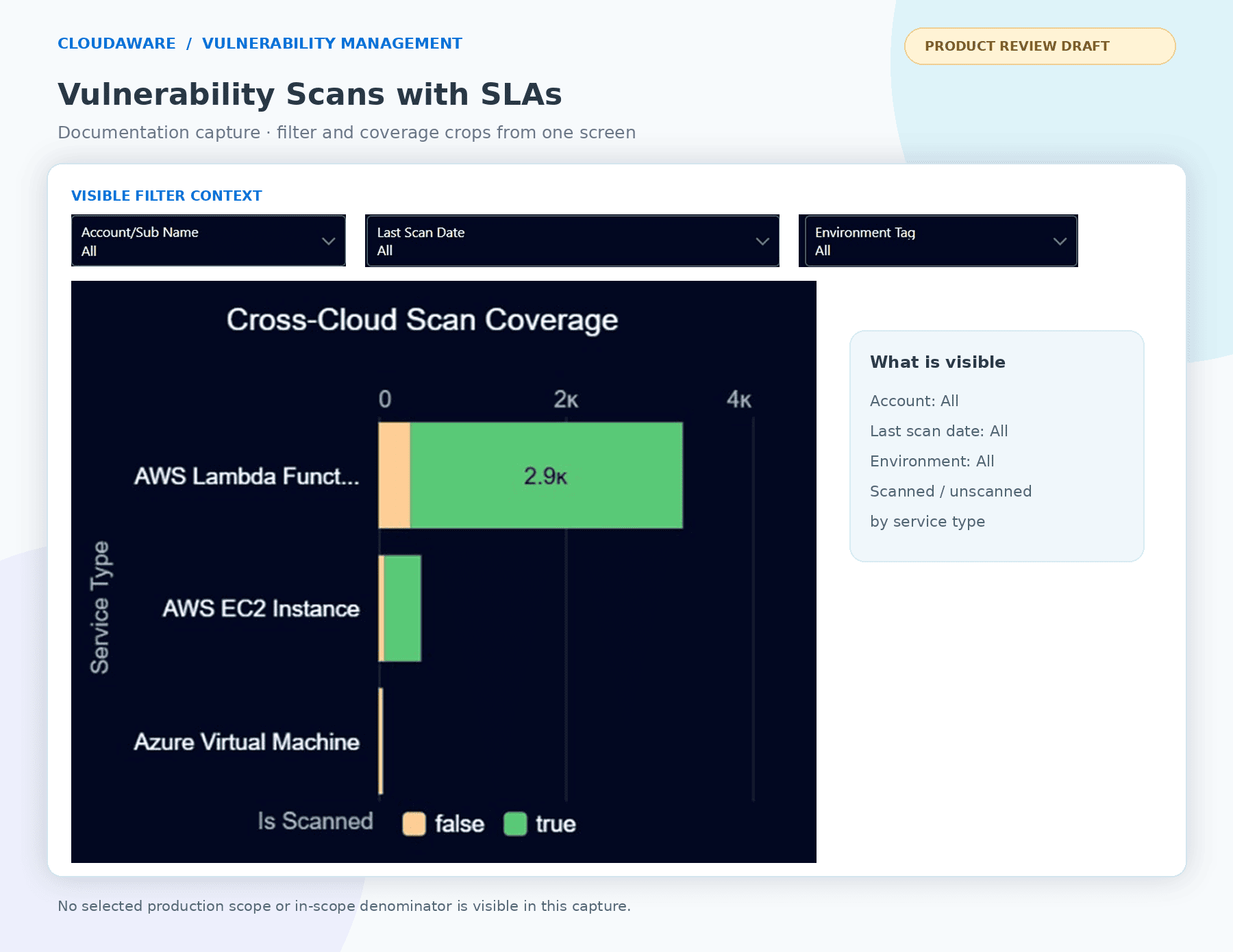
Figure V-1A. Cloudaware Vulnerability Scans with SLAs. Documentation capture; account, date and environment controls show All.
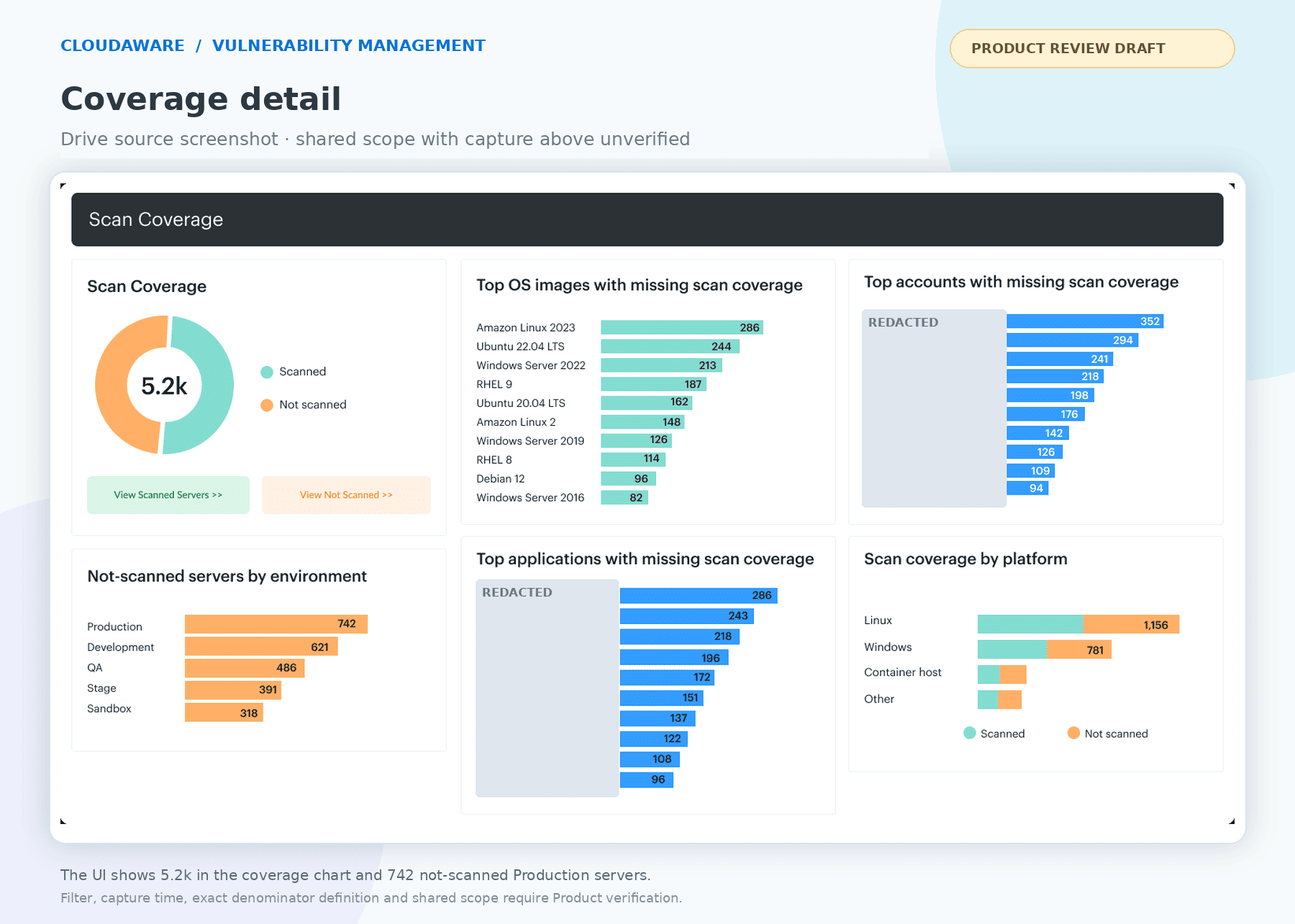
Figure V-1B. Scan Coverage. Separate source view; its coverage chart displays 5.2k and 742 Production servers are marked not scanned.
“Every how-did-we-miss-that I've worked through turned out to be an inventory problem, not a scanner problem. The scanner did exactly what it was told. My first question is when that account showed up in the inventory, and if nobody can give me a date, that's where the fix starts.”
Meet compliance requirements and pass audits
Audits get easier when every finding has a date, an owner, and proof of closure. That first dated record is the part of the assessment that you get almost for free. A reviewer can go straight past the scan schedule. They pick one finding, ask when it was due, then check the retest date to see if the fix landed on time. Which records count depends on the frameworks in scope.
| Framework | What it asks for | Evidence an auditor actually accepts |
|---|---|---|
| PCI DSS v4.0.1, Requirement 11.3 | Internal and external vulnerability scans at least once every three months and after significant changes. A PCI SSC Approved Scanning Vendor (ASV) performs the regular external scans. | Dated internal scan reports, passing external ASV results, and applicable post-change scans and rescans. |
| ISO/IEC 27001:2022, Annex A 8.8 | Where the control applies, obtain timely information on technical vulnerabilities, evaluate exposure, and take appropriate action. | Statement of Applicability and a sampled finding linked to an exposure decision and evidence of treatment. |
| SOC 2, CC7.1 | Monitor configuration changes that introduce vulnerabilities and assess susceptibility to newly discovered ones. | Dated monitoring or scan records and evidence of how findings were addressed during the examination period. |
| HIPAA Security Rule, §164.308(a)(1)(ii)(A) | Assess risks and vulnerabilities to the confidentiality, integrity, and availability of electronic protected health information. | A documented risk analysis that identifies the systems handling that information and the risks assessed. |
Picture a merchant ready to switch on a new payment integration. The acquirer wants a current passing ASV report before launch. Then the quarterly scan fails. The culprit is a public test endpoint on the checkout host that someone forgot to tear down, and it's still in PCI scope. Until the rescan passes, the new integration just waits.
In this example, the launch slips six business days. The labor is small, maybe 16 hours of engineering and retest coordination, or about $2,400. The bigger hit is six days of delayed revenue from an integration that was supposed to be live.
ISO 27001 vulnerability management works the same way. Auditors test you against the deadlines your own risk treatment process set, so those commitments need to sit right next to the closure evidence.
“The question that trips teams up most isn't about the scan. It's who approved this exception, and when. If the sign-off is dated the week of the audit, the reviewer's next question is who accepted that risk for the four months the finding was open, and nobody likes answering that one.”
Build trust with the board, customers, and partners
Buyers will trust your answer more once you show how much of the service you checked and how quickly you fixed any issues. Questionnaires are where your competence gets tested. During a SaaS renewal, an enterprise customer's security team might ask for your mean time to remediate (MTTR) on the cloud service they use. It's a pointed question. A vague answer just buys you another round of email.
| What the security questionnaire usually gets | What the reviewer can actually verify (illustrative) |
|---|---|
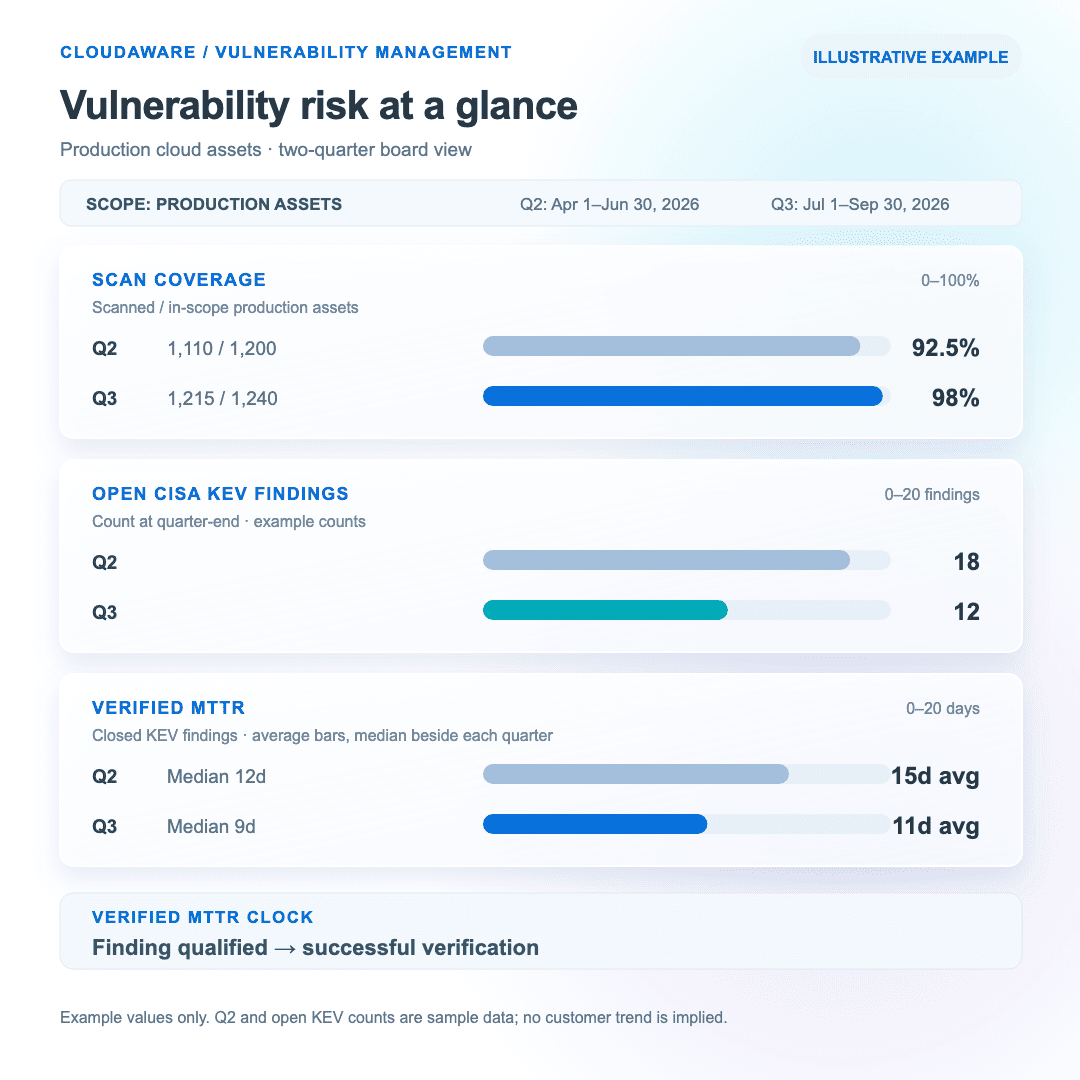
| We scan regularly and remediate critical vulnerabilities promptly. | Q3 scan coverage was about 98%, with 1,215 of 1,240 in-scope production assets checked. KEV findings closed that quarter took 11 days on average from detection to verified fix, 9 at the median. Two criticals were still past SLA at quarter-end, and one approved exception expires December 15. |
In this example, the reviewer matches the MTTR number to the attached closure records and signs off on that question the same afternoon. The account team had blocked out a week for follow-ups.
Boards want the same thing in trend form. I'd put quarterly MTTR next to the open KEV backlog, because one without the other can mislead, as the retired-scanner example earlier showed. Read together, those vulnerability management metrics tell leadership whether fixes are getting faster and open exposure is shrinking.
“My test for any security slide is to hand it to the person who owns the budget and ask them to explain it back. If they can tell me which service got safer and by how many days, the reporting works. If they start reading CVE IDs aloud, it doesn't, and we redo it.”
The cost of skipping vulnerability assessment
What assessment costs: scanner licensing, plus the team hours it takes to keep the asset inventory current, triage findings, and route each one to an owner. Engineering time for the fixes comes on top, and that's the line that hurts when the release calendar is already full. Still, it's an operating cost you can budget for.
What skipping can cost: an unplanned bill nobody budgets for. One exposed service already came to roughly $95,000 in the scenario above, and IBM's 2026 average for a U.S. breach sits in eight figures.
The one-line board argument: “We're not buying scans. We're paying to shorten the days a known hole stays open on the services that bring in revenue.”
That's why vulnerability assessment is important, in one sentence: it's a budgeted cost you can plan for, set against a loss whose size depends on the incident.
Enrich your vulnerability assessment findings with Cloudaware context about each asset
In a backlog review, I want two answers fast: which assets have no scan evidence, and which findings are waiting on somebody to act. Cloudaware pulls results from your connected scanners into the CMDB, right next to the cloud inventory. So SecOps can check coverage and hand off fixes from one place instead of three tabs and a spreadsheet.
Take an Amazon Inspector finding on an EC2 instance. The inspector reports the flaw. Cloudaware ties it to the affected instance and its AWS account. When application and ownership mappings are configured, the record also carries the service and the team that should get the ticket. That puts the context from Finding A on the record before somebody has to chase it down at 6 p.m.
Spot missing scans
Compare scan status and last scan dates against inventory, including short-lived workloads your connected sources captured, like the six workers from earlier.
Set the fix order
Pull exploitability and service criticality into the queue next to scanner severity.
Catch stalled handoffs
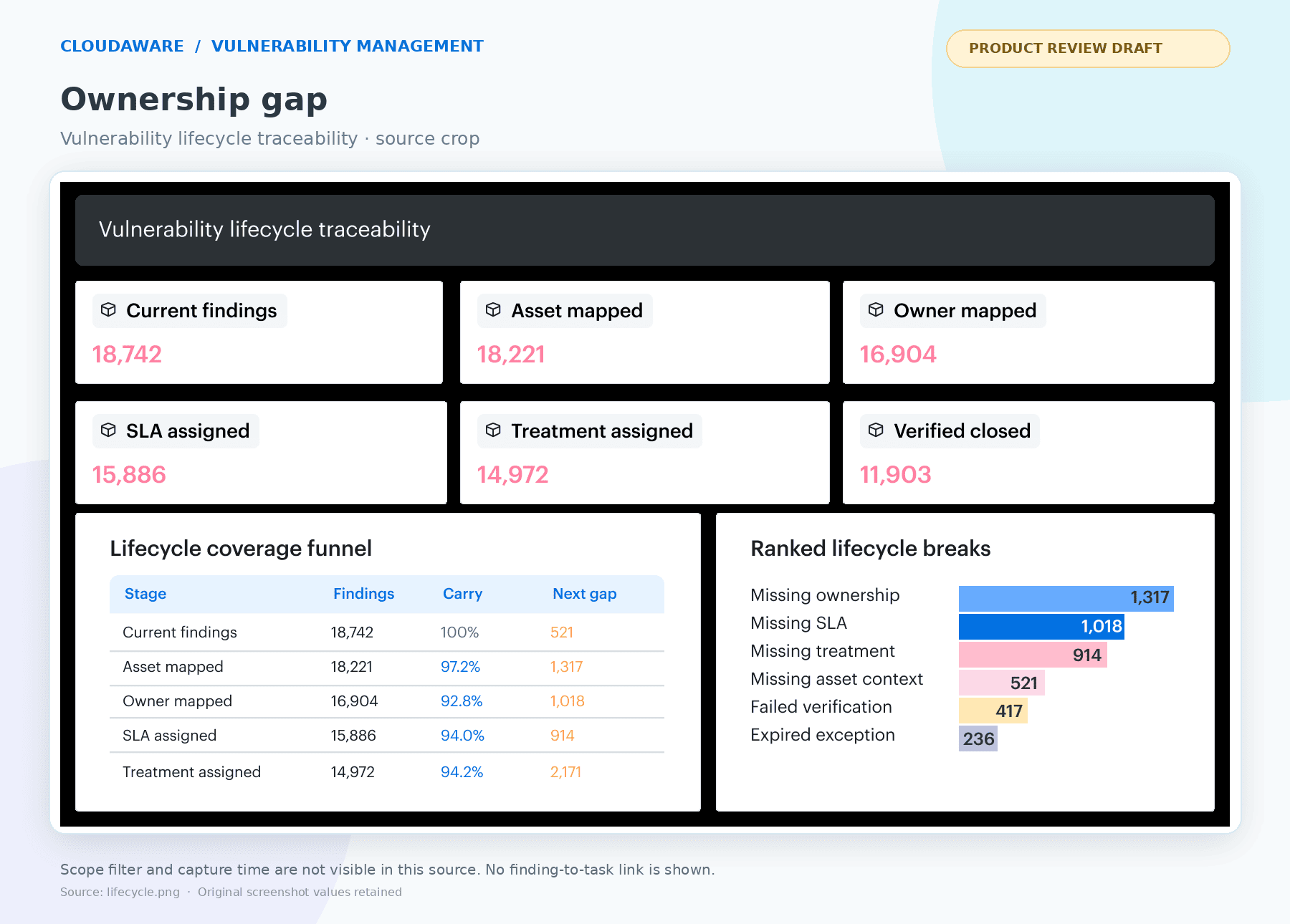
See unassigned findings and ones linked to invalid remediation tasks.
Keep the evidence together
Attach verification results and exceptions to findings, then report MTTR and overdue work for the scope you define.
Integrations and reporting
- Scanner sources. Qualys, Tenable, Rapid7 InsightVM, Amazon Inspector, and Microsoft Defender for Cloud. Cloudaware also offers a managed scanning service.
- SLA and ticketing. Set risk-based due dates and sync remediation tasks with Jira or ServiceNow when configured.
- Compliance reporting. Schedule reports or export records for SLA performance, remediation, and exceptions.