


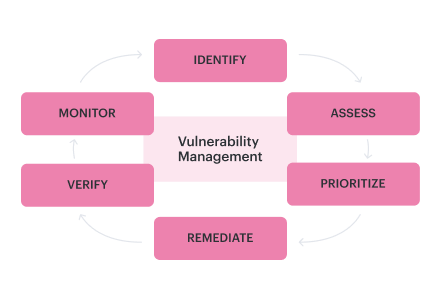
Vulnerability management is the continuous process of finding, assessing, and prioritizing security weaknesses, then fixing and verifying them. A modern, unified program connects findings from every scanner to one asset inventory, so teams fix what matters first.
The hard part begins when findings become somebody's work. Security engineers must identify the affected service and the person authorized to change it. Then they must determine whether the proposed fix will remove the exposure.
Closing the ticket proves only that a workflow ended. Evidence from the affected system shows whether remediation worked.
This guide draws on established standards (OWASP, NIST) and Cloudaware practitioner experience operating unified vulnerability management on a CMDB. It maps the lifecycle, the move beyond isolated scanner queues, and the role each tool plays.
Key insights
These four checks reveal more about program health than the backlog total:
- Scan results are snapshots; new assets, software changes, and disclosures can alter exposure, so reassessment cannot be a one-off.
- FIRST draws a useful line in its Common Vulnerability Scoring System (CVSS) guidance: the Base score measures severity, not risk. In practice, an exposed production asset carrying an actively exploited vulnerability can outrank a higher-scoring internal host.
- Two scanners, two identifiers, one server. Ownership and affected-system counts stay unreliable until both records resolve to the same asset.
- When the backlog drops, check what actually disappeared before celebrating. Sometimes the "improvement" is an asset that stopped reporting, while its risk stayed put.
What is vulnerability management?
Vulnerability management is the operating discipline for finding weaknesses in assets, ranking urgency, coordinating remediation, and confirming whether fixes worked. It covers in-scope assets, accountable owners, treatment choices, deadlines, exceptions, and records that keep decisions reviewable. Scanner output is an input, not the operating record.
In practice, the label often follows the team carrying the queue. Infrastructure groups may call it IT vulnerability management when hosts and network devices anchor the scope. Underneath the label, the queue still needs scope, decisions, and accountability. Security vulnerability management describes that job from the security team’s side. The emphasis shifts again during audit work. There, information security vulnerability management puts documented scope and exceptions closer to the foreground.
Those labels change emphasis, not the operating boundary; cyber vulnerability management may signal coverage beyond conventional IT. Whether that breadth is intended depends on the source. Cybersecurity vulnerability management usually means the same thing.
The fastest boundary check is the output each activity leaves behind. A vulnerability assessment captures conditions at one point in time; the broader program keeps the record moving afterward. Penetration testing goes narrower and deeper, using human-led exploitation to test whether selected weaknesses are usable.
Attack surface and exposure management ask a wider question: what is reachable, connected, and worth reducing? Vulnerability and configuration management meet at the asset record. One finds weaknesses; the other manages settings and approved state. VATP and vulnerability detection and response are tooling frames for much of that same operational work.
Where vulnerability management applies (infrastructure, cloud, applications, containers)
Scope follows the asset, not the org chart. Infrastructure vulnerability management covers servers, operating systems, network devices, virtual machines, and supporting services across data centers and hybrid estates. Cloud vulnerability management extends that scope to provider services, images, identities, and ephemeral resources. Application and container programs examine code, packages, runtime images, and deployed workloads. External, dependency, and open-source work narrow the lens by entry point, component ownership, or reachability.
How vulnerability management works: the lifecycle at a glance
Pick one weakness and follow it through verification. The lifecycle makes more sense that way. A current asset inventory keeps the system, owner, environment, and status together while infrastructure changes.
[VISUAL V0: Show a circular five-stage flow with Asset Inventory at the center. Connect Monitor back to Identify.]
Caption: “The vulnerability management lifecycle.”
Alt: “Cycle diagram: identify, assess, prioritize, remediate, verify, monitor.”
The 5 steps of vulnerability management fit on one line. Their handoffs are where queues come apart:
- Identify. Start with the asset, not the CVE. Match each scanner observation to an in-scope system.
- Assess and prioritize. Does the weakness apply here? Exposure, business role, and asset state determine how quickly it moves.
- Remediate. Ownership changes at this point. The responsible team may patch, rebuild, reconfigure, isolate, or retire the system. Risk acceptance belongs with an approver.
- Verify the result. Fresh evidence answers one blunt question: does the original condition still exist?
- Monitor for change. New disclosures can overturn yesterday’s answer. So can a new network path or asset role.
Take an illustrative case: CVE-2024-6387 appears in OpenSSH on an internet-facing Linux VM. Its owner updates OpenSSH, rescans that host, then watches for the finding to return.
What vulnerability management does, in practical terms, is preserve that thread. A finding should not become five unrelated records as it moves between teams. For execution detail, the full vulnerability management lifecycle keeps six operating steps separate.
Different cases stress different handoffs. Log4j puts continuity under pressure: one weakness must survive ownership, repair, rescanning, and recurrence checks. A critical CVE lands across cloud VMs. During triage, exposed production workloads move first. Old scanner backlogs are messier. Regroup them by exposure before severity alone sets the order.
Read also: AI Spend Tracking for Cloud & Platform Leaders
Traditional vs modern, unified vulnerability management
Unified vulnerability management brings scanner findings into one asset-linked queue. It did not start there. Early teams scanned, exported the list, sorted by CVSS, and tracked patches in spreadsheets. Modern programs ask harder questions. Which exposed asset matters, who owns it, and what proves closure?
The difference shows up in the queue, not the label:
| Operating question | Traditional model | Modern, unified model |
|---|---|---|
| What is affected? | Each scanner carries its own asset identity. Duplicate names and retired hosts can survive. | One asset inventory anchors every source. Matching findings resolve to the current asset. |
| What moves first? | CVSS sorts the list. “Patch everything” follows when context is missing. | Exposure, active threats, controls, and business impact can reorder it. |
| Who acts? | Spreadsheet triage ends in manual owner chasing. | Integrated ownership data can route work automatically to the team controlling the asset. |
| What counts as done? | Ticket status becomes the closure test. | End-to-end tracking waits for fresh scan or test evidence before closure. |
That priority shift is deliberate. Risk-based vulnerability management keeps severity in the model without letting it dictate the queue.
Ten scanners create ten lists and ten owners’ worth of confusion; unified VM produces one prioritized, de-duplicated queue.
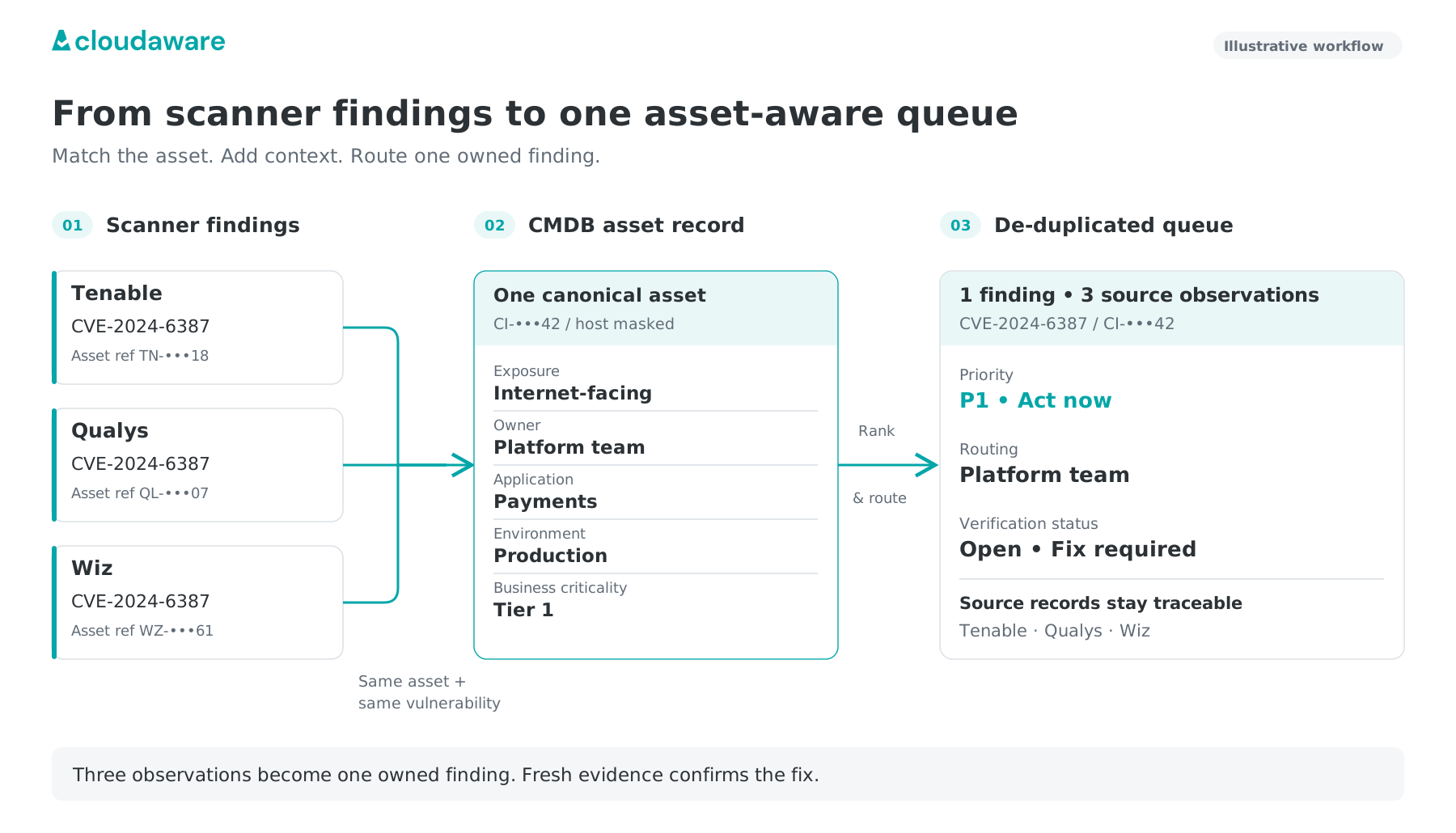
Notice what stays fixed: the asset record. Scanners can change, yet ownership, risk context, and verification remain attached. Centralized is easy to misread. One security team does not patch everything. Policy, evidence, and queue state stay consolidated; system owners make the change.
Is the asset match reliable? If so, vulnerability management automation can route work and update status. Bad match, bad handoff. Automation cannot restore trust, whatever the next-generation or full-stack label says.
Vulnerability management tools, briefly
Vulnerability tooling spans four jobs: detection, cloud context, patch deployment, and coordination. Start with the job, not the logo.
Where does each category stop? Scanners inspect hosts, applications, and dependencies. Need cloud posture, identity, or exposure context? That is CNAPP territory; patch management takes over for deployment. Detection creates findings. A management or unification layer turns them into owned work.
That layer connects outputs to the asset, removes duplicates, keeps ownership, and tracks closure evidence. One CVE may arrive from both a scanner and CNAPP. Without a shared asset identity, two alerts can create two tickets for one problem. A missing owner can hurt more than another severity score because nobody can accept, schedule, or verify the work.
For cloud-native coverage, CNAPP tools combine several security controls. Check their depth against workloads you actually run.
Delivery changes packaging, not the operating job. A SaaS tool may run remotely; an add-on or app can extend an existing vulnerability stack.
Already running several scanners? Detection may not be your gap. Inspect how findings reach owners, survive asset changes, and return with proof after remediation. For product-level trade-offs, compare vulnerability management tools by the job your stack still misses.
Unified vulnerability management with Cloudaware
Severity cannot route the work by itself. Which asset is exposed, who owns it, and what evidence proves the fix? Cloudaware relates scanner results to the CMDB asset record. The output is one prioritized queue. Operators assign remediation from there. Before closure, they check the dashboard for fresh verification evidence. That is unified vulnerability management, not a stand-alone replacement for existing scanners or patch tools. Cloudaware orchestrates the handoff; owners or their automation still make the change.
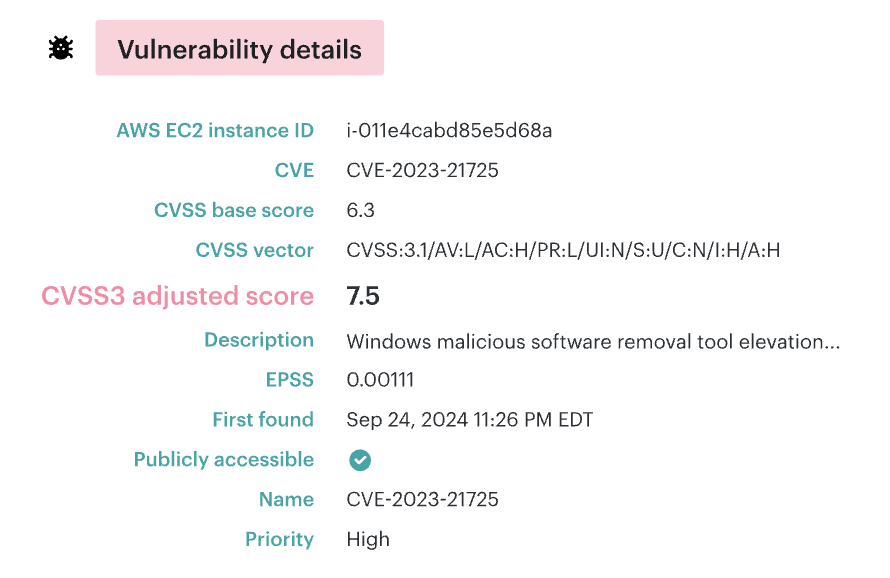
Watch Last Scan Date. A “Done” ticket without a newer scan still lacks verification evidence.
What stays in this workflow:
- One intake layer. Findings from Tenable, Qualys, Wiz, Nessus, CrowdStrike, Orca, Snyk, and Rapid7 land in the CMDB.
- Need managed coverage? VSaaS uses Breeze Agent for host scanning and supported vendor backends. Cadence: every active, in-scope asset at least once every seven days.
- Start with severity, but do not stop there. Risk-based prioritization brings exposure, exploitability, and asset criticality into the decision.
- Next stop: Jira, ServiceNow, or PagerDuty. Status sync brings ticket changes back into the queue.
- Did the fix hold? Last Scan Date and finding status provide the evidence. Mean Time to Remediate (MTTR) measures time to verified closure.