


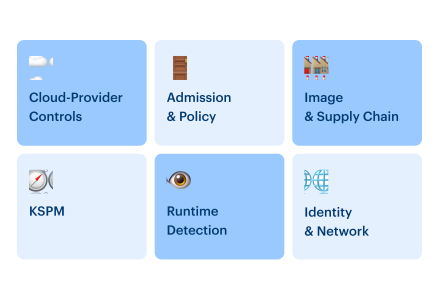
A Kubernetes security stack can include an image scanner, admission policies, posture management, cloud provider controls, and runtime detection. They all protect Kubernetes, but they make different security decisions at different points in the workload lifecycle.
That is the real problem behind Kubernetes security options in cloud environments. A workload can pass image scanning and admission checks, then execute an unexpected process, use an overprivileged cloud identity, or communicate with a destination the application never needed. The control that approved deployment cannot prove what happens afterward.
The useful way to evaluate Kubernetes security is therefore by control point and decision: what the control can prevent, assess, detect, or respond to, and what remains outside its coverage.
Key insights
- Kubernetes security options are not interchangeable. Admission, image scanning, KSPM, runtime detection, and cloud controls act at different points and answer different security questions.
- Runtime security covers the gap after deployment. A workload can pass scanning and admission checks and still execute unexpected processes, change behavior, or abuse its identity once running.
- Managed Kubernetes changes the responsibility boundary, not the security objectives. EKS, AKS, and GKE implement controls differently, but teams still need consistent outcomes for identity, posture, runtime detection, and response.
- Kubernetes compromise can extend beyond the cluster. Cloud permissions, network reachability, and accessible secrets often determine how far an attacker can move after gaining control of a workload.
- The right security option starts with the missing decision. Evaluate what the current stack cannot prevent, assess, detect, or resolve, then check coverage, evidence, ownership, and remediation flow before comparing products.
What are Kubernetes security options in cloud?
Typically, the options are control layers that prevent, assess, detect, or respond to risk across Kubernetes workloads and the cloud infrastructure around them. Kubernetes itself exposes multiple security mechanisms covering API access, Pod security, admission, networking, Secrets, auditing, and workload protection.
The categories become easier to compare when each is tied to one operational question.
| Security option | Control point | Typical output | Cannot establish alone |
|---|---|---|---|
| Managed-cloud security | Cloud control plane | Identity, configuration, and provider findings | Safe application behavior |
| Kubernetes policy and admission | Kubernetes API and admission | Allow, deny, warn, or mutate | What the workload does later |
| Image and supply-chain security | Build, registry, deployment | Vulnerabilities, SBOM, provenance, signature status | Runtime behavior |
| KSPM | Cluster and workload configuration | Misconfiguration or drift finding | Active malicious behavior |
| Runtime security | Container, workload, node, kernel | Behavioral telemetry and alerts | Build provenance or full configuration posture |
| Cloud identity and network controls | IAM, cloud APIs, network | Permission and connectivity decisions | Behavior inside the workload |
This article stays at that decision layer. Implementation details such as RBAC design, Pod Security Standards, network isolation, and image-hardening controls belong in Kubernetes security best practices for cloud environments.
Kubernetes runtime security options detect what preventive controls miss
Kubernetes runtime security evaluates workload behavior after execution begins. Depending on the product and deployment model, telemetry can include processes, system calls, files, network connections, Kubernetes API activity, container state, and node-level events.
That timing creates its own security boundary. AWS describes runtime security for EKS in similar terms: active protection for running containers through detection or prevention of malicious activity, using mechanisms ranging from kernel security controls to runtime monitoring.
Runtime products can expose three distinct capabilities:
| Runtime capability | Job | Example |
|---|---|---|
| Monitoring | Capture workload or node activity | Process, syscall, file, API, or network event |
| Detection | Decide whether observed behavior is suspicious | Unexpected shell, privilege change, unusual outbound connection |
| Protection or response | Act after a defined condition is met | Stop a process, block execution, isolate a workload, or trigger response |
Runtime workload protection overlaps with cloud workload security and CWPP, where the scope expands beyond Kubernetes to VMs, containers, serverless, and hybrid workloads.
A product that provides runtime telemetry does not necessarily provide enforcement. That distinction belongs in the buying criteria, especially when vendors use "runtime protection" for different combinations of sensors, analytics, and response.
MITRE ATT&CK provides a useful attacker-side view of why runtime controls exist. Its Container Administration Command technique covers execution through the Kubernetes API server, kubelet, or commands such as kubectl exec when an adversary has sufficient permissions. Its Escape to Host technique covers paths such as privileged containers and host filesystem access that can extend control beyond the container boundary.
Example: an approved workload gains an unauthorized container
Consider a workload whose original image and manifest passed scanning and admission. An attacker later obtains enough Kubernetes permissions to alter the workload and introduce another container.
The security questions immediately split by control layer:
- Admission: Was the workload modification allowed?
- Posture: Does the resulting specification violate policy?
- Runtime: Which processes and network connections did the added container create?
- Identity: Which Kubernetes and cloud permissions can that workload use?
- Response: Which application owner investigates the event, and what evidence proves that the unauthorized state is gone?
This is where runtime alerts also need infrastructure context. A process name and container ID may be enough to trigger detection, but SecOps still needs to determine what is affected.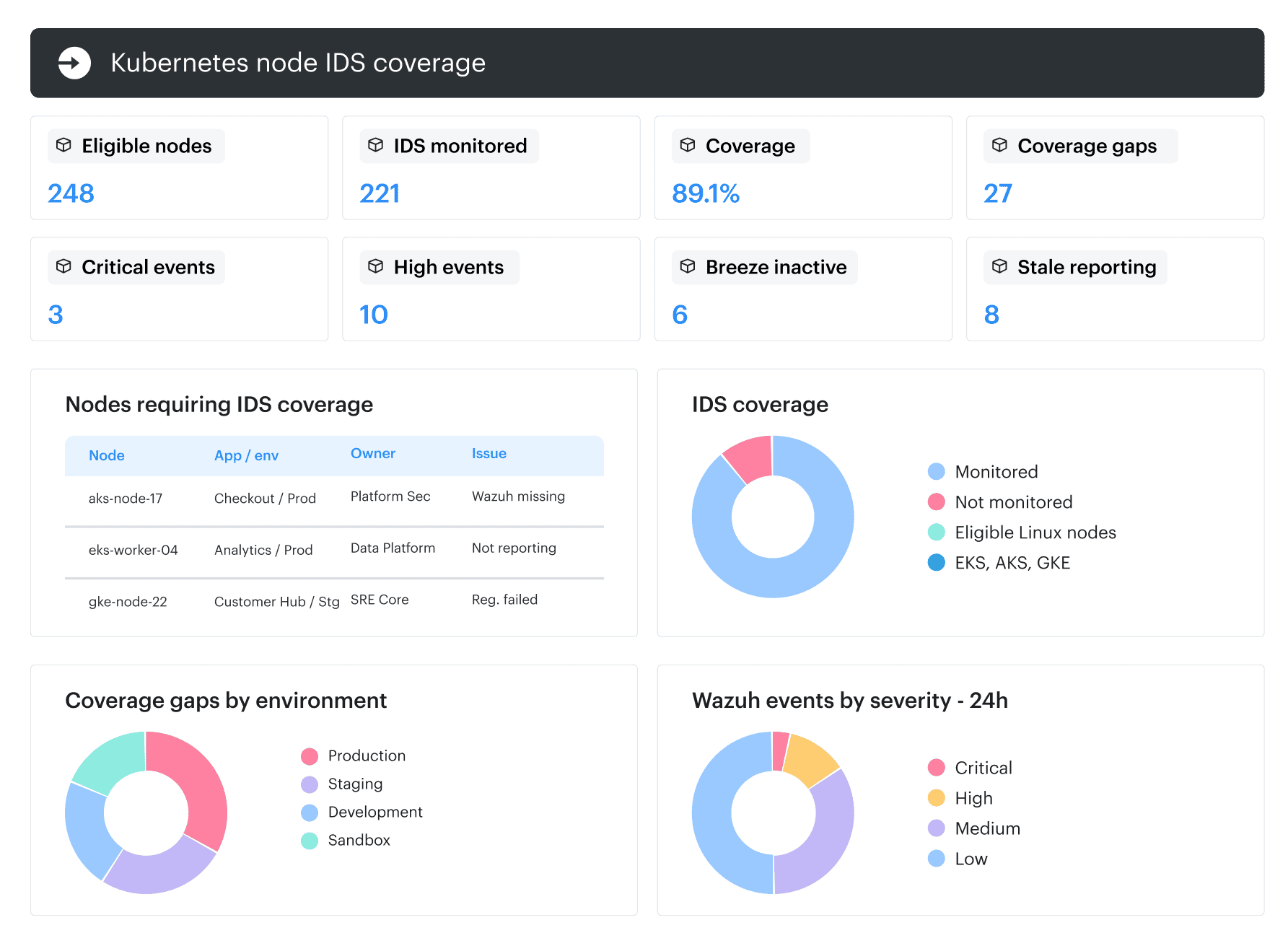 Cloudaware can track host-level IDS coverage across Kubernetes nodes and connect Wazuh security events with application, environment, owner, and infrastructure context for investigation.
Kubernetes auditing provides another evidence layer. Audit records capture security-relevant actions from users, applications using the Kubernetes API, and the control plane, with configurable policies determining which requests and details are retained.
For runtime security evaluation, ask:
- Can the platform observe the behavior represented in your threat model?
- Which telemetry sources remain available if the workload itself changes?
- Can detection distinguish expected application behavior from suspicious activity?
- Which permissions or kernel access does the runtime sensor require?
- Can an alert be mapped to its workload, application, environment, and owner?
- Does the platform detect only, or can it enforce a response?
Other Kubernetes security options cover controls before and around runtime
Runtime detection answers what a workload is doing now. The surrounding layers reduce which workloads can start, which privileges they receive, which artifacts reach production, and how far a compromise can travel.
Managed Kubernetes and cloud-provider security
Managed Kubernetes transfers part of cluster operation to the provider, but it does not transfer the whole security problem.
AWS, for example, manages the EKS control plane, including control-plane nodes and etcd. Customers remain responsible for areas including IAM, Pod security, runtime security, networking, and application workloads. The infrastructure boundary shifts further when teams move from self-managed worker nodes to managed node groups or Fargate.
Provider-managed security therefore answers a narrower question than "Is this cluster secure?"
Use this layer to determine which infrastructure and control-plane responsibilities the provider already owns, then identify the customer controls that remain.
Kubernetes-native policy and admission controls
Admission controls requests before Kubernetes persists the requested state. Pod Security Admission is the built-in controller for enforcing Pod Security Standards and has been stable since Kubernetes 1.25. PodSecurityPolicy was removed in that release.
More complex policy can be implemented through validating or mutating admission mechanisms. Current Kubernetes guidance also distinguishes webhook-based controls from built-in CEL-based admission policies and recommends built-in mechanisms where they can satisfy the requirement, partly because webhooks introduce another dependency and latency path into API processing.
Admission infrastructure needs its own privilege review. Kubernetes RBAC guidance notes that principals able to control mutating or validating webhook configurations can control webhooks capable of reading admitted objects and, for mutating webhooks, changing them.
Use this layer to answer: Should Kubernetes accept this workload or API change?
Image and software supply-chain security
Image and supply-chain controls evaluate what is about to run. They can identify known package vulnerabilities, maintain SBOM data, validate provenance, check signatures, or enforce policy around approved artifacts.
Their evidence remains artifact-centric. A vulnerability scanner can establish that an image contains a vulnerable package. Provenance can establish where an artifact came from. Those controls cannot determine whether an already running process was exploited afterward.
That creates two useful security paths:
- Artifact evidence: source/build → image → registry → admission
- Runtime evidence: running workload → observed behavior → detection → response
For the prioritization and remediation workflow after a vulnerable image or package is identified, see our cloud security vulnerabilities guide.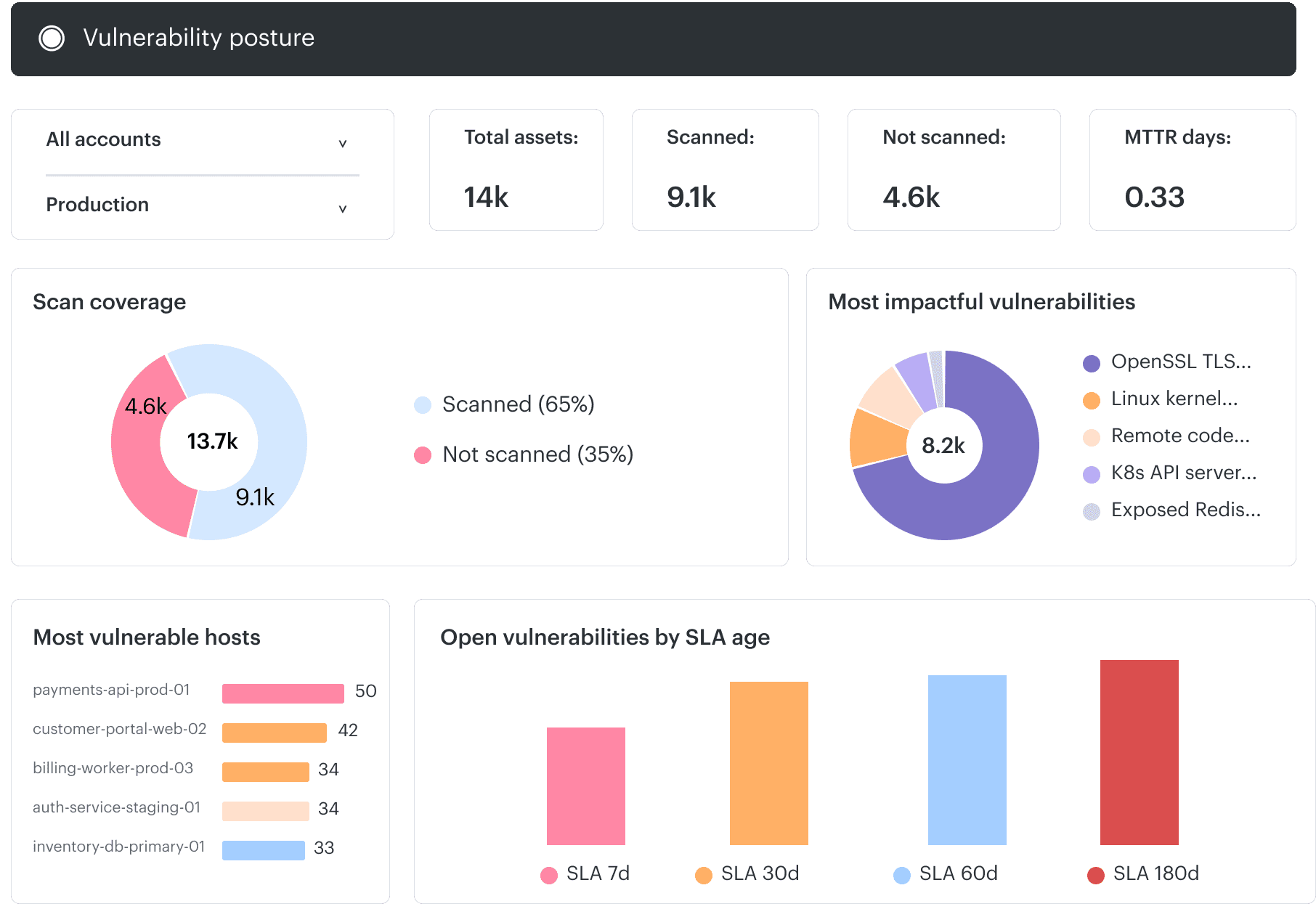 For the vulnerability layer, Cloudaware shows scan coverage alongside open vulnerabilities, affected assets, applications, environments, and remediation metrics.
Use this layer to answer: What artifact are we deploying, and what known or provenance-related risk does it carry?
Kubernetes Security Posture Management evaluates state and drift
KSPM evaluates Kubernetes configuration against expected policies, security rules, or benchmarks. Typical findings concern privileged settings, risky access, exposed resources, weak workload configuration, or deviation from an approved baseline.
- KSPM evaluates configuration state
- Runtime security evaluates observed behavior
A compliant configuration can still host an exploited process. A runtime alert can also occur on a workload that passes every posture rule. The CIS Kubernetes Benchmarks provide configuration guidance for Kubernetes and maintain separate benchmarks for environments including Amazon EKS, AKS, GKE, and GKE Autopilot.
Use this layer to answer: Does the current Kubernetes configuration meet the security state we expect?
Cloud identity, network, and secrets controls protect paths outside Kubernetes
The role of Kubernetes security in cloud infrastructure extends beyond Kubernetes authorization. A workload can have narrow Kubernetes RBAC and still carry a cloud identity capable of reading an S3 bucket, accessing Azure Key Vault, or calling Google Cloud APIs.
A compromised pod can become a path into cloud services, other workloads, or external systems even when Kubernetes RBAC is tightly scoped. Three control areas determine how far that access can extend:
| Control | What to verify after workload compromise |
|---|---|
| Cloud identity | Which AWS, Azure, or Google Cloud permissions the workload can use through EKS Pod Identity, Microsoft Entra Workload ID, Workload Identity Federation for GKE, or another identity mechanism |
| Network | Which services and workloads the pod can reach. Pods remain non-isolated until applicable NetworkPolicies restrict traffic |
| Secrets | Which credentials, tokens, or external-service secrets the workload can read. Kubernetes recommends least-privilege access and encryption at rest for Secrets |
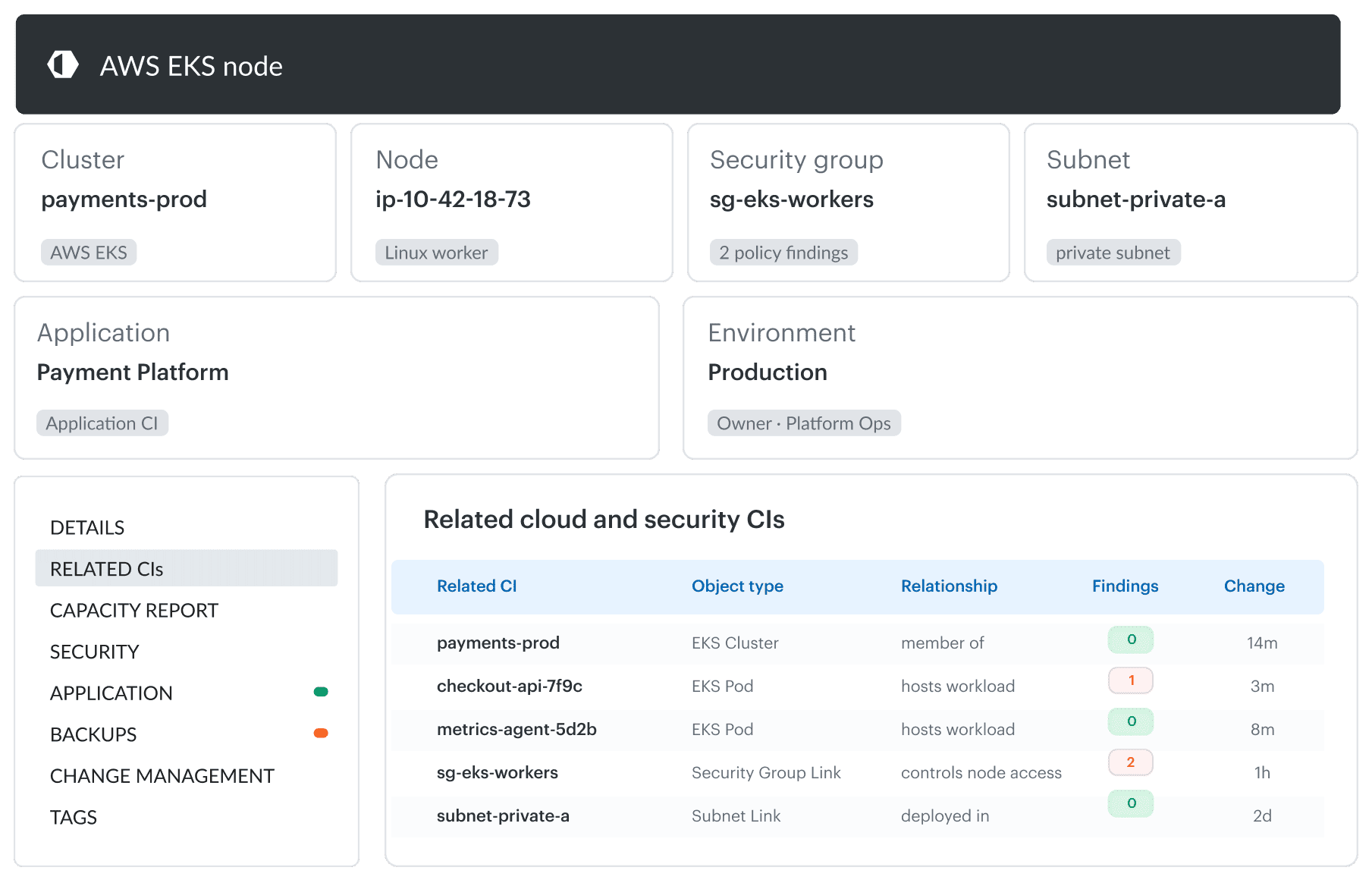 Cloudaware can connect Kubernetes workloads and nodes with their surrounding cluster, network, cloud, and application context, helping security teams trace the infrastructure around an affected asset.
Use these controls to answer: after a workload is compromised, what can it reach, access, or impersonate outside its original execution context?
Kubernetes security features differ across EKS, AKS, and GKE
Kubernetes security features in cloud platforms differ in implementation, while the security decisions remain consistent across EKS, AKS, and GKE. A multi-cloud team therefore needs a common control model before mapping provider-native services to it.
A multi-cloud team therefore needs a common control model before mapping native services to it.
| Evaluation area | Amazon EKS | Azure Kubernetes Service | Google Kubernetes Engine |
|---|---|---|---|
| Workload-to-cloud identity | EKS Pod Identity or IRSA | Microsoft Entra Workload ID | Workload Identity Federation for GKE |
| Deployment and admission | Kubernetes admission and policy controls | Kubernetes controls, Azure Policy, and optional Defender security gating | Kubernetes controls, Binary Authorization, and provider policy options |
| Posture | Kubernetes and AWS security services | Defender for Containers posture capabilities | GKE security posture dashboard |
| Runtime signals | GuardDuty Runtime Monitoring for EKS, or third-party tooling | Defender sensor and audit-based detections when Defender for Containers is configured | Security Command Center Container Threat Detection plus Kubernetes and Cloud Logging telemetry |
| Operational question | Which EKS workloads and nodes remain customer responsibility? | Which AKS controls are covered by the enabled Microsoft security services? | Which GKE or Autopilot defaults already enforce the required outcome? |
How to choose the right Kubernetes security options for cloud use
The recommended Kubernetes security for cloud use depends on the decision your existing stack cannot make reliably. A team with a strong admission policy but no runtime telemetry has a different gap from one that sees runtime events but cannot determine which images, identities, or clusters are affected.
That is why a universal best rated Kubernetes security for cloud product is not a useful evaluation target. Runtime detection, admission, KSPM, image scanning, cloud IAM, and network controls act at different points.
Start with the control gap:
| Evaluation question | Evidence to request |
|---|---|
| Which security decision is currently uncovered? | Current control map by build, admission, posture, runtime, identity, and response |
| Does the option prevent, assess, detect, or respond? | Exact enforcement point and product behavior |
| Does it observe running workloads? | Supported runtime telemetry and example detections |
| What access does the security component require? | RBAC, node, kernel, cloud IAM, and network prerequisites |
| Does it cover the environments you actually run? | EKS, AKS, GKE, self-managed Kubernetes, OS, and runtime support matrix |
| Can a finding be mapped to application and owner? | Alert schema, asset relationship, and ownership fields |
| How are exceptions handled? | Owner, reason, scope, expiry, and review workflow |
| What happens after detection? | Alert routing, containment options, ticket/incident workflow |
| What proves remediation? | Fresh scan, policy evaluation, runtime state, or other production evidence |
| Who owns the control after deployment? | Named operating team and tuning/review responsibilities |
To assess security of cloud-based containers, test the stack against several failure paths instead of relying on a single vendor demo:
- An approved image is exploited after startup and spawns an unexpected process
- A valid workload identity can access a cloud resource outside the application's requirement
- A user with excessive Kubernetes permissions creates a privileged workload
- A newly disclosed vulnerability affects an image already running in production
- A valid security finding has no owner, application context, or verified remediation path
These tests expose different gaps. A runtime product may catch the first but have no answer for artifact provenance. Admission can stop the third while adding no evidence about a post-exploitation process. A scanner may identify the fourth but still leave SecOps unable to determine which production owner should act.
A practical Kubernetes Security Coverage Matrix can be maintained with seven fields:
| Field | Reject privileged workloads | Detect unexpected process execution | Identify vulnerable running images |
|---|---|---|---|
| Existing control | Admission policy | Runtime security | Scanner + inventory |
| Environment | EKS production | AKS production | Multi-cloud |
| Function | Prevent | Detect | Assess |
| Owner | Platform Security | SecOps | AppSec |
| Evidence | Admission result | Runtime event | Scan + workload mapping |
| Remaining gap | None | GKE not covered | Owner missing |
That forces tool selection back to the operating requirement instead of marketing category overlap. Once the missing category is clear, compare named platforms within that category using a broader cloud security tools buyer's guide.
Unify Kubernetes security context with Cloudaware
Cloudaware helps expose gaps in Kubernetes security operations by connecting discovered Kubernetes inventory with CMDB relationships, supported vulnerability findings, host-level IDS coverage, application context, and ownership. Admission policy and specialized Kubernetes-native runtime enforcement remain separate controls.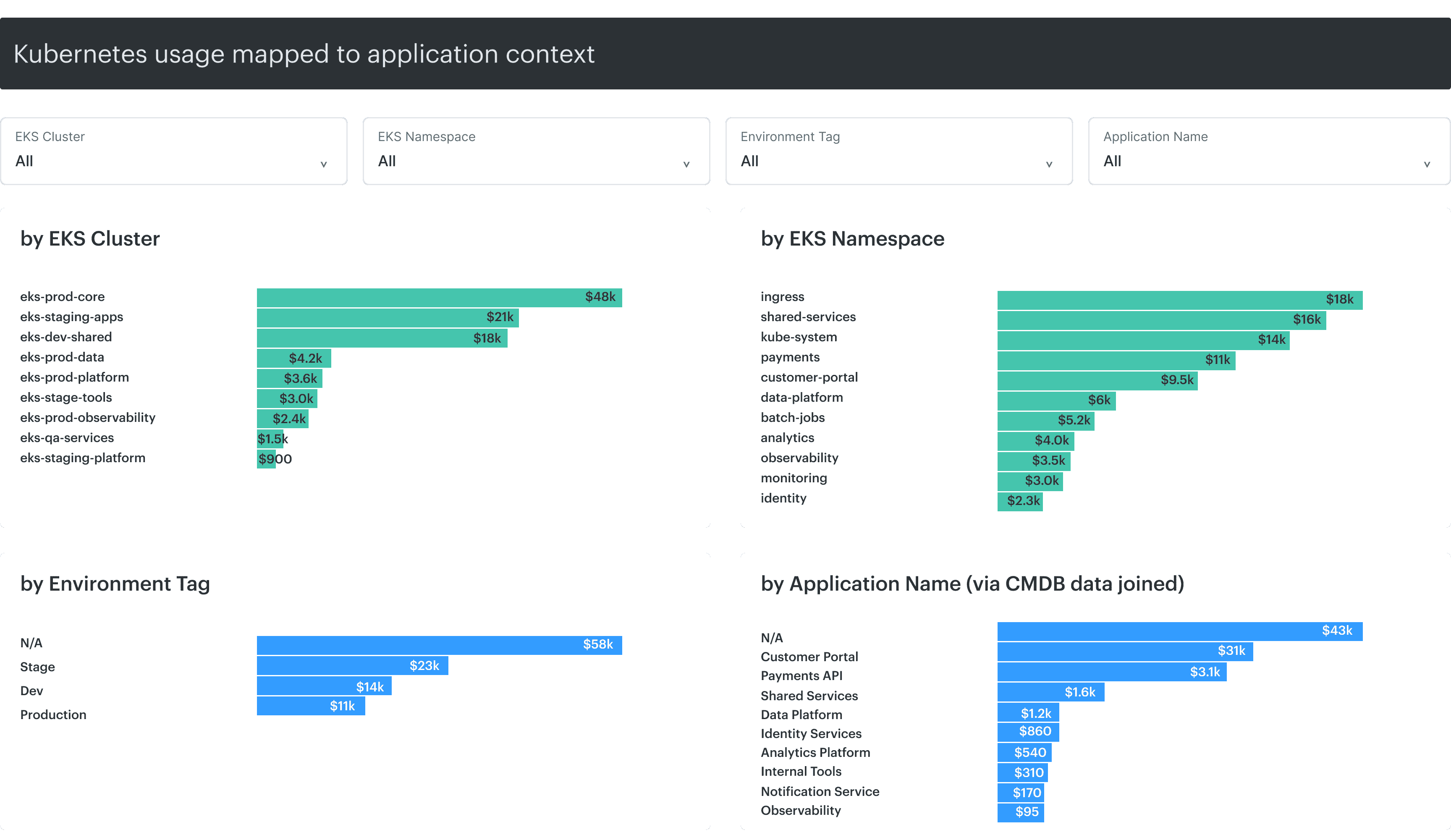 Core capabilities:
- Kubernetes inventory and relationships: Map supported EKS, AKS, and GKE resources to cluster, application, environment, and ownership context in CMDB.
- Vulnerability context: Connect supported findings and scan coverage with the affected infrastructure and CMDB context; use Breeze on Kubernetes worker nodes where agent-based container scanning is required.
- Host and endpoint detection: Connect Wazuh events and IDS status with the affected host, application, environment, owner, account, and related infrastructure.
- Coverage and response: Identify expected IDS or vulnerability coverage gaps and route supported findings into existing ticketing or incident workflows.