


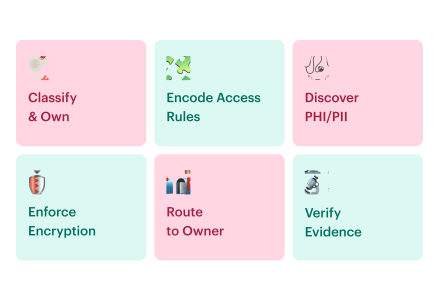
Data security and privacy in cloud computing can look healthy until someone asks which regulated datasets the controls actually covered. A bucket may be encrypted, logged, and approved in the quarterly access review while remaining unclassified, reachable through an overbroad role, replicated into an unapproved region, or assigned to an owner who left months ago. Each control passed. The operating model failed at the joins.
IBM’s 2024 study of breaches at 604 organizations across 17 industries found that 35% involved shadow data. Those incidents cost USD 5.27 million on average. The study shows an association, not proof that classification gaps caused the result.
The practical problem is keeping control scope attached to data as storage, owners, access conditions, and legitimate copies change. Quarterly evidence proves what was true on review day. It cannot explain what changed on Tuesday afternoon.
This guide covers the technology baseline, the access-control and DSPM disciplines that carry most of the operational load, three practices for maintaining control state, and a connected workflow for ownership, remediation, and evidence.
Key insights
- Data security and privacy in cloud computing does not succeed because encryption is enabled. A useful control view also shows data classification, key ownership, access scope, exceptions, and current evidence.
- Attribute-based access control (ABAC) extends role-based access control with identity and resource attributes. It reduces policy duplication only when both sides use a governed tag taxonomy.
- Data Security Posture Management (DSPM) works best as a maintained operating state: discover a data store, classify it, assign an owner, evaluate its posture, and repeat as the estate changes.
- Privacy controls need more than a
**confidential**tag. Processing purpose, residency, retention, and permitted use determine whether access is appropriate. - Inventory, access policy, posture checks, and audit evidence should resolve to the same asset record. Otherwise, every team spends the week translating identifiers before it can make a decision.
What this article covers vs. adjacent reading This guide stays at the operating layer: the technologies, policies, evidence, and recurring workflows used to protect cloud data after deployment.
- Foundation: cloud data security best practices for the end-to-end control sequence.
- Failure modes: cloud data security challenges for the gaps that break otherwise valid controls.
- Architecture: cloud security architecture for trust boundaries and control placement.
- Threat and weakness paths: cloud security threats and cloud security vulnerabilities for exploitable conditions and remediation.
- Framework evidence: cloud security compliance for audit scope and control mapping.
- Tool and program choices: cloud security services for category and operating-model selection.
- CSPM and DSPM handoff: cloud data security posture management for the posture-management boundary.
The boundary here is a current data-store record with a classification, owner, permitted use, access state, integrity evidence, recovery state, retention rule, exception, and proof timestamp.
What data security and privacy in cloud computing actually means
Data security and privacy in cloud computing are the operating disciplines for protecting cloud-hosted data from unauthorized access, alteration, loss, and misuse while proving that its collection, processing, sharing, retention, and deletion remain within approved business, contractual, and regulatory boundaries.
Security and privacy overlap, but they do not address the same issues. NIST FIPS 199 organizes information security around confidentiality, integrity, and availability. The NIST Privacy Framework also considers problems individuals may experience because of data processing. Security asks whether the data was protected. Privacy asks whether its collection, use, sharing, retention, and movement were appropriate.
The four aspects of data security in cloud computing become useful when each one resolves to evidence rather than a policy statement:
- Confidentiality: Who or what can read, decrypt, copy, export, or share the data? Inspect effective permissions, resource policies, key policies, and temporary access paths.
- Integrity: Can the team prove that data was not changed or deleted improperly? Check version history, hashes, audit records, and the identity behind each material change.
- Availability: Can the owner recover the correct data inside the required window? A completed restore test is stronger evidence than a successful backup job.
- Privacy: Was processing appropriate for the data category, purpose, location, retention period, and affected individuals? Check classification, residency, sharing, and deletion records.
Consider an encrypted Amazon S3 bucket holding customer records. Encryption supports confidentiality, but it does not settle the other three questions. An unapproved replica creates privacy risk; unexpected object changes concern integrity; a failed restore test exposes an availability gap. Many data security and privacy protection issues in cloud computing appear at these intersections, even when one technical control reports a pass.
Use a simple decision rule: do not report a data store as protected until its record identifies the data category, owner, permitted use, access paths, integrity evidence, recovery status, retention rule, and current exceptions.
Next, we need the technologies that can maintain those answers as the estate changes.
The technologies for data security in cloud computing: baseline and beyond
For data security and storage in cloud computing, encryption is where the review starts. Transparent data encryption (TDE) and envelope encryption cover data at rest; Transport Layer Security (TLS) covers it in transit. That is the easy part. The harder review asks which key protects each asset, who can use it, and when access was last checked.
| Security layer | Typical technologies | What to verify |
|---|---|---|
| Data at rest | TDE, envelope encryption | Key assignment, custody, rotation, decrypt access |
| Data in transit | TLS | Endpoint coverage, protocol support, certificate management |
| Key management | AWS KMS, Azure Key Vault, Google Cloud KMS, AWS CloudHSM | Service-managed vs customer-managed keys, BYOK/HYOK, HSM requirements |
| Policy validation | CIS Benchmarks, NIST SP 800-53 | Control mapping, exceptions, current evaluation state |
| Data in use | AWS Nitro Enclaves, Intel SGX, AMD SEV-SNP | Attestation, region, machine family, application support |
Google Cloud’s key-management model draws the line clearly: Bring Your Own Key (BYOK) from Hold Your Own Key (HYOK): BYOK imports externally generated key material, while HYOK keeps the key in an external key manager. Similar acronyms, different custody. Verify the exact storage or database service, SKU, and region because support varies.
A green encrypted=true field is not enough evidence for cloud data security standards.
Encryption evidence should include:
- Asset or dataset owner
- Key owner and custody model
- Rotation state
- Principals allowed to decrypt
- Approved exceptions
- Last control evaluation
- Applicable service and region constraints
CIS Benchmarks provide provider-specific recommendations, while NIST SP 800-53 supplies the broader control catalog. Together, they help move the review from “encryption is enabled” to whether the control is configured, governed, and evidenced well enough to defend.
For selected regulated workloads, an enhanced data security model for cloud computing adds confidential computing for data in use. That may mean AWS Nitro Enclaves, or Intel SGX and AMD SEV-SNP. Before calling the control complete, check the provider, region, machine family, and application design. Treat encryption in use as an attested boundary, not a diagram label.
Every program starts with encryption. At scale, operational depth shifts to faster-changing controls: who can reach the data, and whether its posture remains inside policy. Access control comes next.
Access control and IAM for data: where cloud data security gets won or lost
Role-only IAM becomes hard to trust before it looks broken. Reviewers see plausible role names, while effective access also runs through nested groups, inherited permissions, resource policies, and exceptions. A quarterly review may catch drift only after a principal has held unnecessary access for months. AWS treats granting only the required actions, resources, and conditions as a least privilege practice, not a periodic cleanup exercise.
ABAC changes the unit of control from “which role does this person have?” to “do these identity and resource attributes satisfy the rule?” A payments engineer tagged team=payments and clearance=restricted, for example, may read only resources with matching owner and sensitivity tags. In AWS, ABAC policies compare principal and resource tags through condition keys; federated identities can receive attributes as session tags.
Treat tag mutation as a privileged operation. Changing an access-bearing tag can change the decision.
Provider mechanics differ, so the semantic model should stay consistent while implementation is tested natively.
- AWS: identity policies, resource-based policies such as S3 bucket policies, tag-driven conditions, and service control policies
- Azure: ABAC conditions on RBAC assignments, with current support depending on resource type and data action
- Google Cloud: IAM Conditions and tags to constrain role bindings
The syntax and service coverage are different. Do not assume that one provider’s ABAC design can be copied directly into another.
- Start with a governed taxonomy:
data-sensitivity,environment,application-owner,compliance-scope, and the identity attributes that match them. - Assign every field an owner and test the deny path.
- Keep JIT access and break-glass access outside normal entitlements. Each elevation needs an approver, reason, affected assets, session log, and automatic expiry. Without expiry, it is standing access with an urgent label.
- Do not let IAM and CSPM define
confidentialdifferently. Where canonical fields exist in provider tags and the Cloudaware CMDB, use CMDB asset IDs and tags to scope CSPM policies. - Filter active production data resources, then compare provider resource tags with CMDB sensitivity, application, environment, owner, policy scope, exemption status, and evidence timestamp. The mismatch determines who acts next.
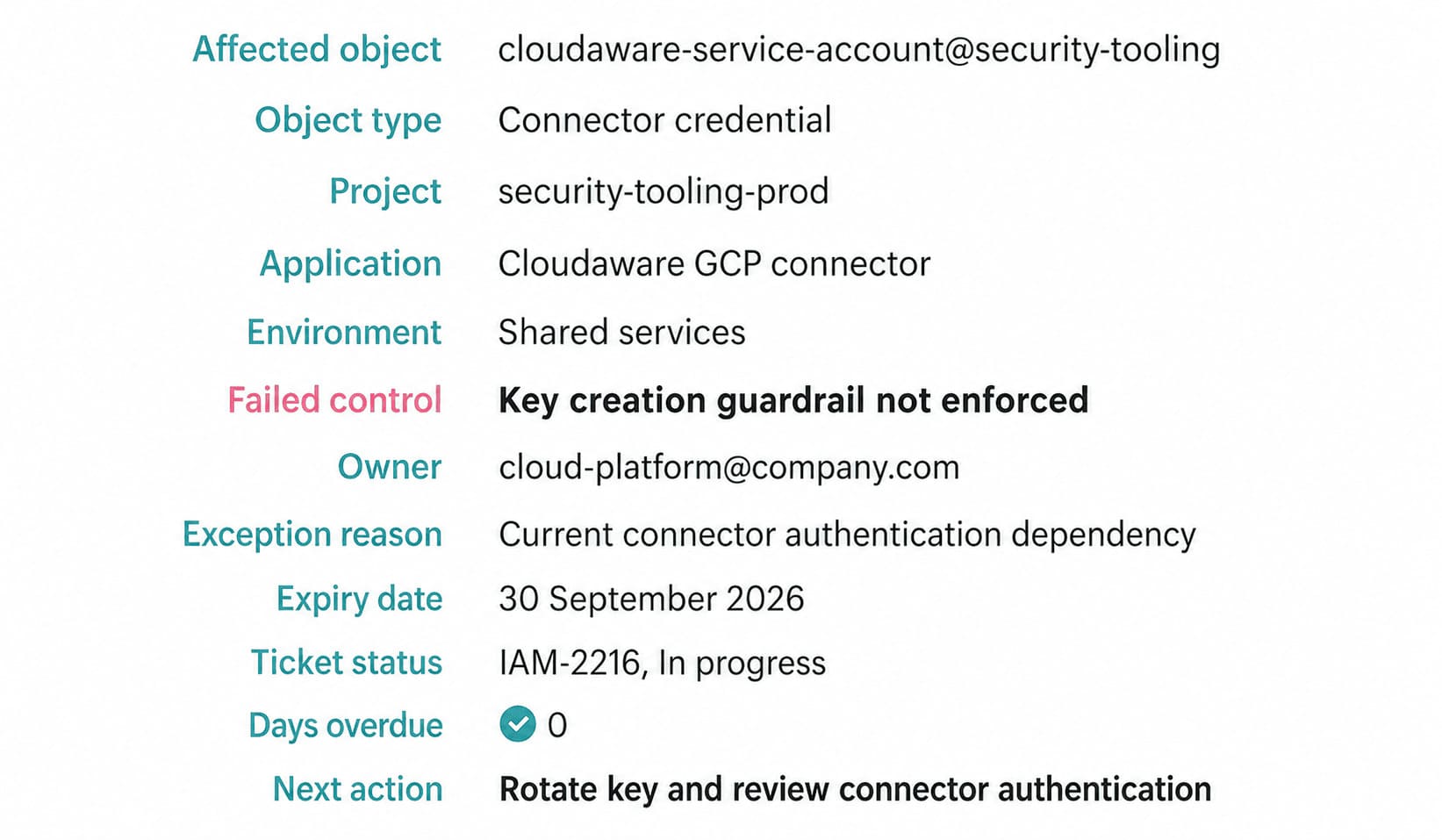
This is the Cloudaware dashboard comparing provider resource tags with CMDB sensitivity and CSPM scope.
- Look first at
Value mismatchandMissing tag + no owner. - Send the former to the taxonomy owner. The latter needs an application owner before the platform team changes the provider tag. An expiring exception returns to its approver. Keep those evidence cohorts separate in the dashboard.
- Confirm in provider-native IAM that the intended tag and condition actually participate in the access decision.
- Verify the access model after identity, policy, or tag changes, not only at quarter-end.
- Query confidential resources, then flag principals without matching clearance, broad bucket policies, active JIT or break-glass grants, and exceptions past review.
- Record the owner, expiry, and evidence that the rule ran.
In operational terms, Zero Trust for data keeps access conditional, observable, and narrow enough to limit blast radius. It still depends on something IAM cannot prove: whether the data was classified correctly. That is where DSPM enters the design.
DSPM and data discovery: You cannot protect what you cannot see
Data security posture management (DSPM) is the operating discipline of continuously discovering data, classifying sensitivity, and testing each store against a known-good baseline. A DSPM product can automate that loop. It cannot define risk appetite, approve exceptions, or compensate for missing ownership.
In long-lived estates, shadow data often sits in restore buckets, data-science sandboxes, snapshots, or CSV exports. Dark data adds retained content that no team actively uses or governs. Names and tags are weak evidence: archive-final-2 does not reveal whether it contains PHI, PII, or PCI cardholder data.
Sensitive data discovery needs content and metadata. Pattern matching finds structured identifiers; checksums, contextual rules, and ML classification filter plausible matches. Google’s detector documentation also warns that built-in detectors do not prove regulatory compliance. AWS Macie continually evaluates S3 bucket inventory but samples representative objects. That is useful coverage, not proof that every object was inspected.
An actionable finding needs:
- Asset: ID, account, region, and environment.
- Finding: Data class, confidence, detector, and scan time.
- Posture: Encryption and access state.
- Context: Application, owner, and data lineage.
- Action: Exception, ticket, status, and verification evidence.
Keep those fields in the data catalog or data map used by security and governance. Microsoft Purview Data Map, for example, maintains metadata, classifications, and lineage. Unknown is a posture state. This posture state is not the same as clean.
IBM’s 2024 breach-cost analysis covered 604 organizations across 17 industries. It found that 35% of the studied breaches involved shadow data. Those incidents cost USD 5.27 million on average and took 291 days to identify and contain. That is correlation, not proof that missing data classification caused the outcome.
Annual discovery is mostly archaeology. Scan at ingest and after copies, restores, schema changes, access-policy changes, or ownership transfers. Periodic full scans catch missed events and lost permissions.
Discovery creates a second problem. A PHI or PII finding still needs an asset, application, environment, exposure state, exception, and ticket before a team can prioritize it. Without those relationships, every match enters the same queue.
When TNS content inspection is configured as the source, Cloudaware Vulnerability Management can bring findings into CMDB and change workflows, connecting them to asset and remediation context. TNS generates the signal, and Cloudaware contextualizes it. Coverage depends on permissions, supported formats, and inspection scope.
Prioritize that queue by data class, environment, exposure, application, exception, and remediation state.
How to ensure data security in cloud computing: three practitioner-level practices
Generic checklists stop after naming the controls. In practice, data security and privacy in cloud computing depends on a loop that detects drift and records closure. Each control needs an owner, an evidence source, and an observable result.
Ensuring data security in cloud computing, therefore, becomes an operating discipline: define the rule, evaluate the resource, route the exception, and verify the changed state.
The failure points are taxonomy drift, stale classification, and controls checked only after deployment.
Practice 1: Encode data-access rules as CSPM policies that share the CMDB tag taxonomy
An ABAC policy and a posture policy can both be valid while using different meanings for confidential, owner, or production. IAM then authorizes against one taxonomy while security reports against another. A quarterly review finds that there is disagreement after the resource and its tags have changed.
Start with four governed fields: data-sensitivity, environment, application-owner, and compliance-scope. Assign an authoritative source and a mutation owner to each field. Then:
- Map provider tag keys and allowed values to the canonical model. Reject unknown or missing values in the infrastructure pipeline where supported.
- Implement access in provider-native IAM. AWS ABAC can compare principal and resource tags; Azure role assignment conditions and Google Cloud tag conditions use different mechanics and coverage. Test an allowed request and a denied request in each enforcement plane before rollout.
- Express the corresponding posture check as code. Cloudaware IT Compliance supports declarative policies stored in Git, pull-request review, unit tests, CMDB-based scope, time-boxed exceptions, and rule findings with owner, severity, SLA, evidence, and lifecycle.
- Route a failed check to the current application or platform owner through configured Jira or ServiceNow workflows. Require the next evaluation to record the corrected state.
Cloudaware is not the authorization plane. The provider makes the access decision. Cloudaware evaluates configuration data from configured connections and CMDB relationships used for policy scope. A missing record cannot prove the underlying policy is correct.
The operations queue should separate a bad policy result from a missing owner or an expiring exception.
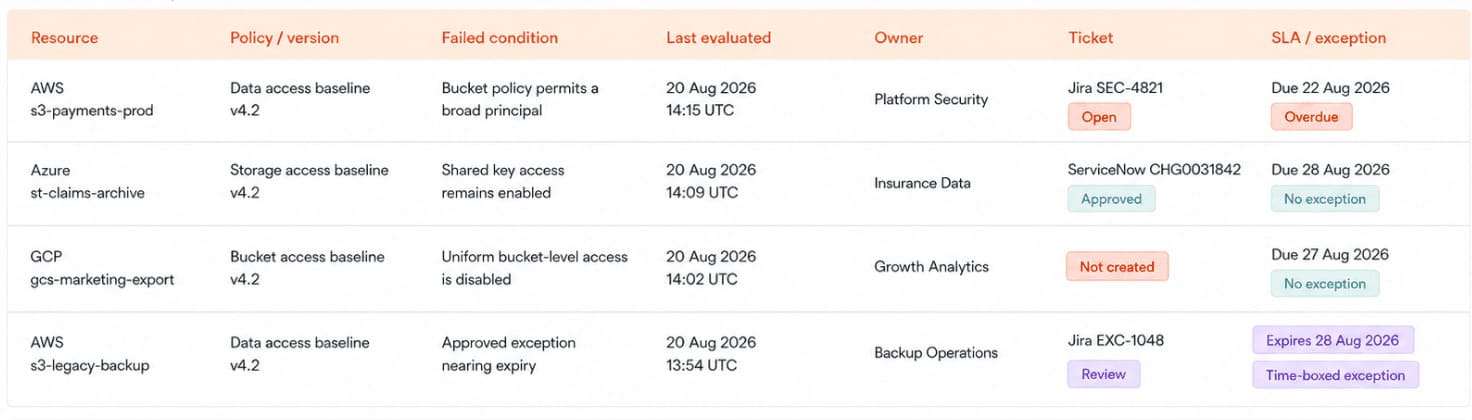
Look first for failed checks with neither an owner nor a ticket. Repair accountability, route the finding, then use the next policy run as closure evidence. Track finding age, owner coverage, reopen rate, and SLA breaches against your baseline.
Practice 2: Run PHI and PII discovery continuously, not annually
An annual classification project records where sensitive data existed during the scan, not what appeared the next day. Build an eligible-resource denominator: every in-scope storage resource, inspection support, last evidence timestamp, owner, and exclusion reason. This follows the logic of continuous monitoring: collect current control information often enough to support a timely risk decision.
Set cadence in the content-inspection source according to sensitivity and change rate. Treat a PHI or PII match as a finding until the data owner confirms intent and classification. Promoting every match into an authoritative tag can turn a false positive into an access change.
When TNS content inspection is the configured source, Cloudaware can relate the finding to its asset, application, owner, exposure, exception, ticket, and remediation state. TNS generates the signal; Cloudaware supplies the CMDB and workflow context. Coverage depends on permissions, supported stores and formats, connector scope, and schedule.
That relationship is best inspected as coverage and exception cohorts, not as a single percentage.
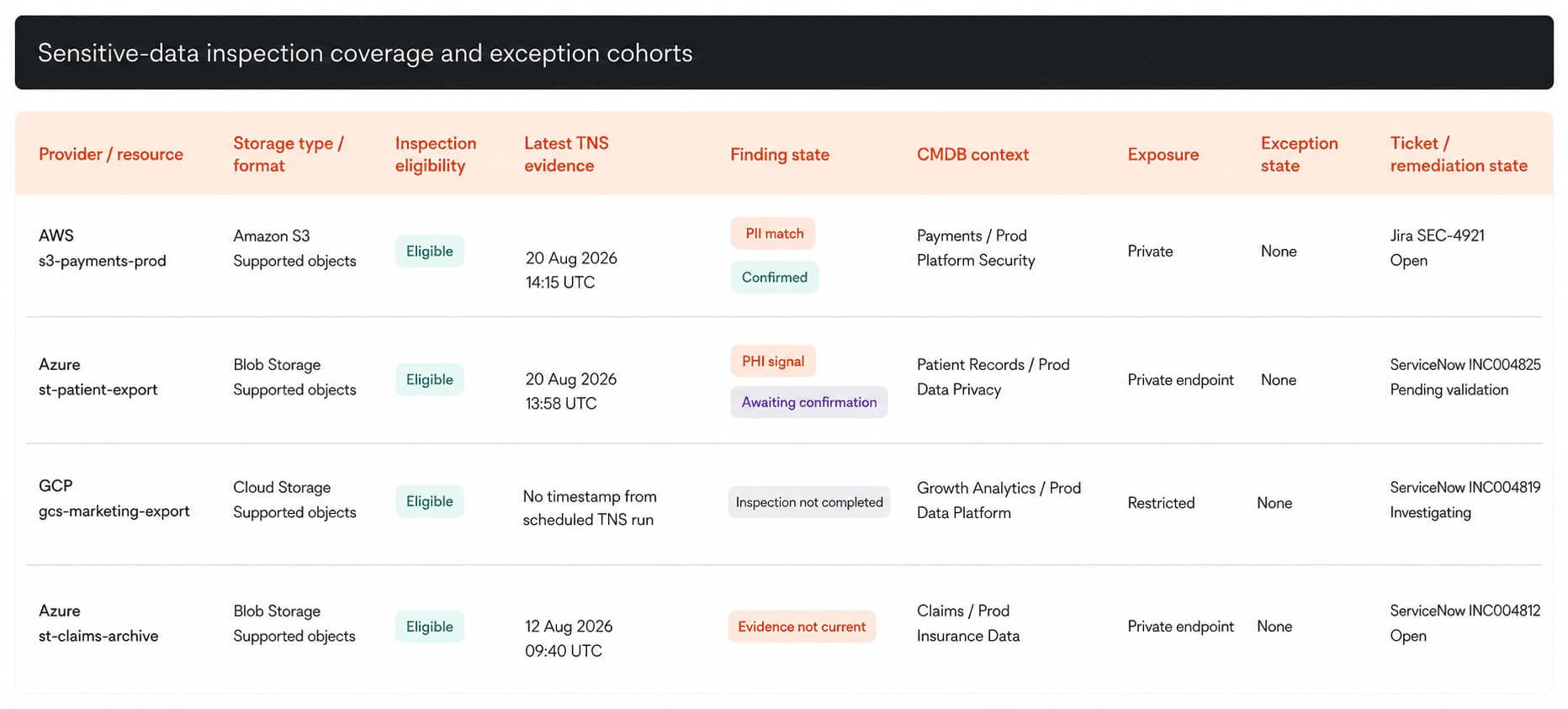
Start with eligible resources lacking current inspection evidence. That cohort tests whether discovery is keeping pace with inventory change. Resolve active findings without owners next. Calculate coverage only across eligible resources, and report unsupported resources separately.
Practice 3: Enforce encryption and recovery policy at resource creation, then verify it continuously
Audit-time detection is too late for a missing customer-managed key, backup rule, or retention setting on a production data store. Use a preventive control in the deployment path: policy-as-code in CI, AWS CloudFormation Hooks, Azure Policy with a deny effect, or Google Cloud custom constraints where the resource and method are supported. Test the reject path, not only a compliant template.
Then add an independent detective check. Scope it by sensitivity and resource type; evaluate key class, backup configuration, retention, and the current exception. Send a failed check to its owner with evidence attached. This preventive-plus-detective pattern supports data security mitigation in cloud computing because one control limits bad changes while the other finds bypasses and drift.
Cloudaware CSPM can evaluate configured controls against CMDB data, create trackable findings, route by CMDB context, and maintain exception review and expiry. It does not deny the provider's create call. Evaluation follows CMDB ingestion and the configured policy schedule. Keep restore-test evidence separate because backup configuration does not prove recoverability.
The final queue should show whether the next action belongs to the pipeline owner, the data owner, or the exception approver.
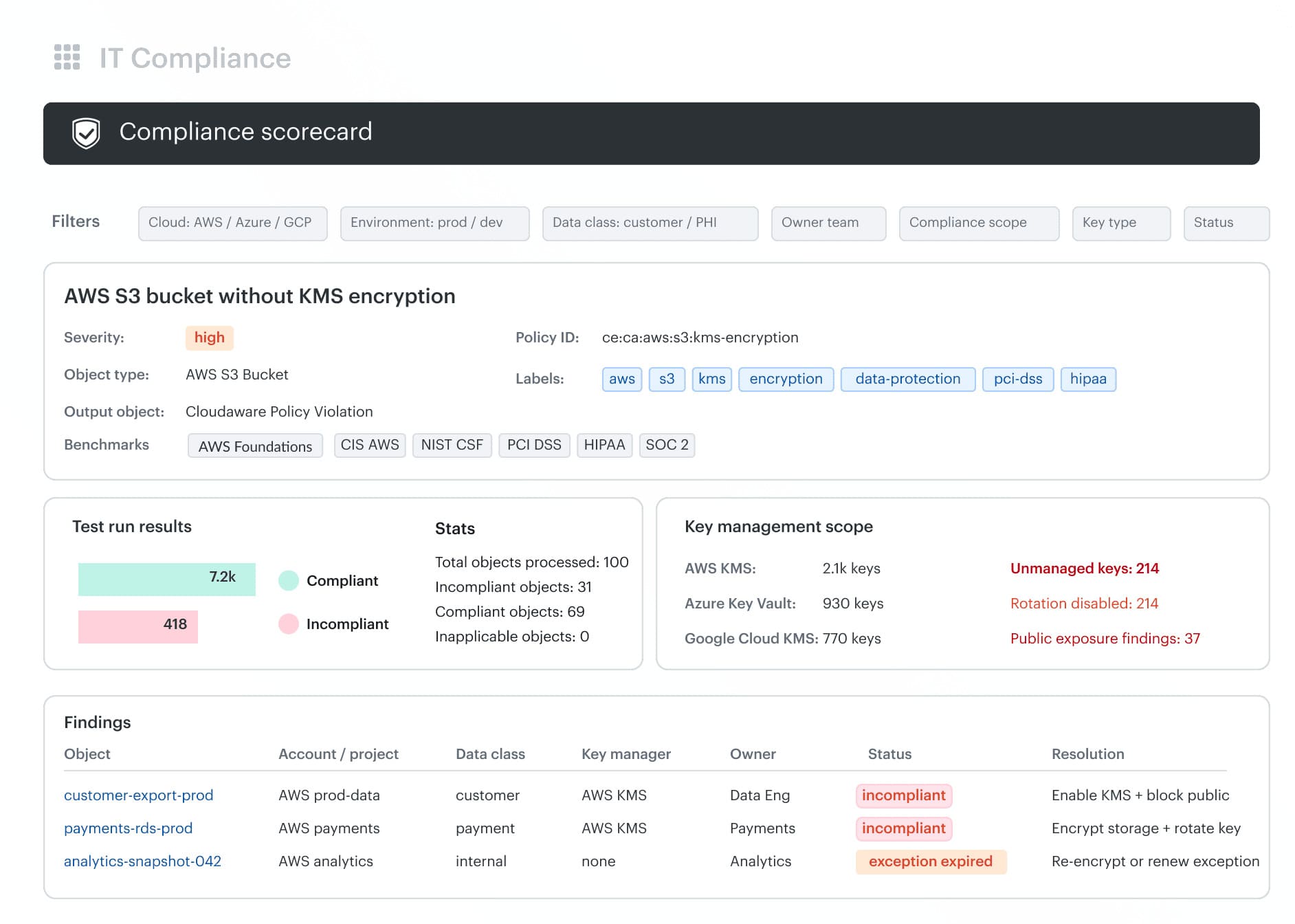
Example of a data protection and key management posture view in Cloudaware, surfacing encryption findings, unmanaged keys, rotation gaps, affected resources, owners, and remediation context across AWS, Azure, and Google Cloud.
Prioritize a failed encryption control on high-sensitivity production data before an expiring approved exception. Report closure only when a new evaluation records corrected configuration or a valid exception. Recovery requires a current restore-test artifact from the testing system. Measure finding age, time to ownership, exception expiry, and restore-evidence coverage.
Once these practices are running, the remaining problem is connection. Asset, finding, owner, exception, ticket, and evidence records must stay related as the estate changes. The next section shows how to operate that shared context.
How to keep cloud data controls connected as your estate changes
Consider one production bucket. Inventory lists it as payments-prod-data. A content check flags PII. CSPM finds a public-access setting, the ticketing system holds the remediation task, and the SIEM has last night’s object-read event.
Each record may be accurate. The trouble starts when one names the Payments application, another points to the platform team, and a third has no owner at all. Now the responder is comparing records before investigating the risk. The auditor inherits the same cleanup job three months later.
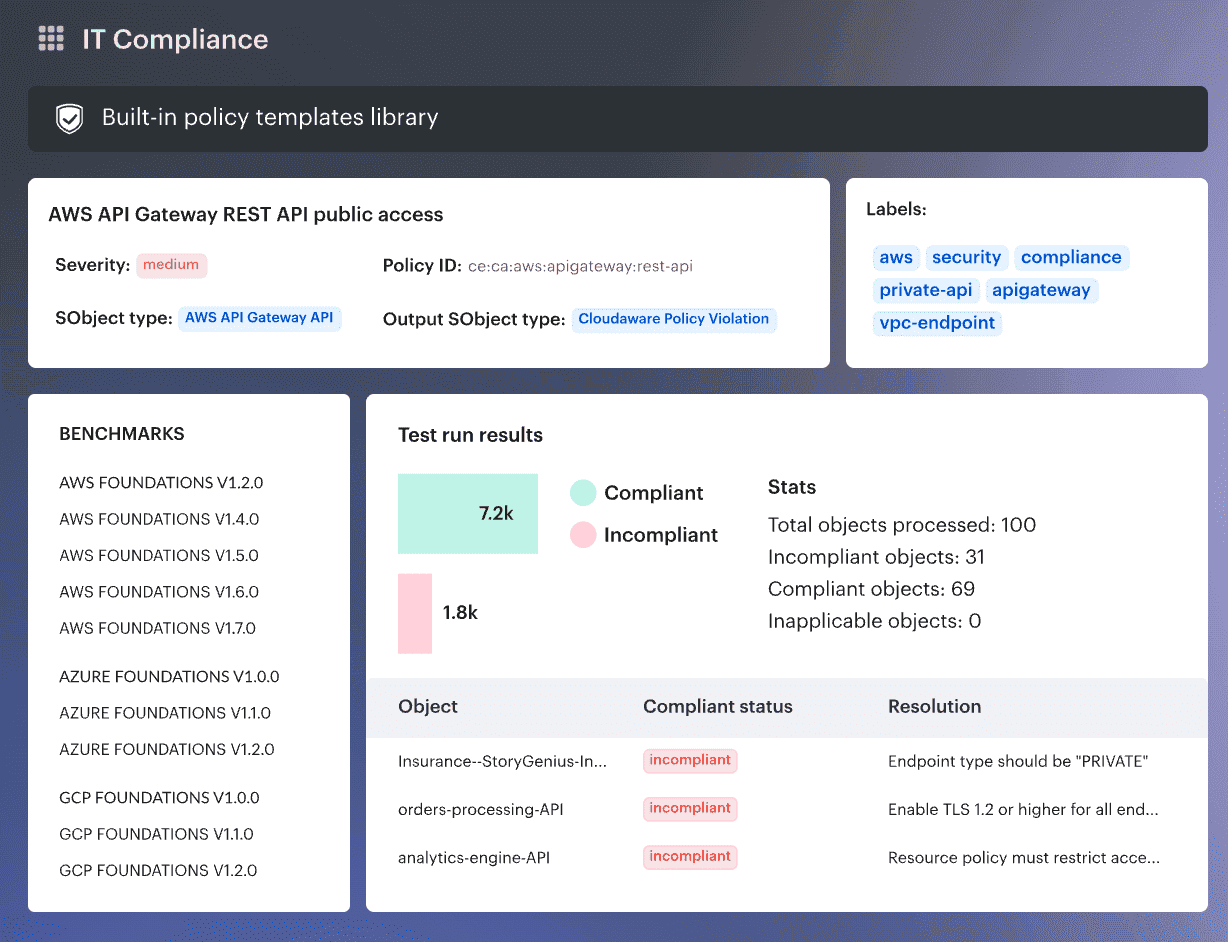
That is the operational problem behind data security and privacy in cloud computing. Controls work better when they share the same resource identity and business context.
A cloud security architect investigating the illustrative payments-prod-data bucket should be able to carry one resource identity through the entire review. The next four steps show that verified workflow.
- Map the resource to its current owner. Open the bucket in Cloudaware CMDB and check its account, region, application, environment, current owner, tags, and related resources. If ownership or sensitivity is missing, repair that record before routing a security finding. The CMDB supplies context from configured sources; it does not classify content by itself.
- Connect the data finding to the affected store. Next, review any configured PHI or PII data-leak finding related to the asset in Cloudaware Vulnerability Management. TNS remains the content-inspection source. Cloudaware relates the finding to the bucket, application, owner, exposure, exception, ticket, and remediation state so the architect can decide whether the next task is classification confirmation, access restriction, or ownership repair.
- Turn failed controls into owned work. Evaluate the bucket against the correct scope in Cloudaware CSPM. Policies can use CMDB application, environment, tags, boundaries, and approved exceptions.
- When a check fails, Cloudaware IT Compliance records the rule finding with evidence, owner, severity, SLA, lifecycle, and exception state. The architect routes the record through the configured Jira or ServiceNow workflow and treats the next policy evaluation as closure evidence.
- Follow the access trail with the same context. Finally, filter the resource’s events in Cloudaware SIEM by application, owner, environment, account, and region. CMDB-enriched events reduce the identifier-matching work during an investigation, while the configured log sources remain the evidence source. The review closes only when the control state, ticket, exception, and relevant event trail agree on the same asset.